

At its core, sales enablement is all about giving your sales team everything they need to close more deals. Think of it as the strategic process of arming them with the right content, training, and technology at the exact moment they need it to have better conversations with buyers. This moves your sales efforts from random shots in the dark to a predictable, repeatable growth engine. For B2B companies in Canada and the United States, a strong sales enablement strategy is no longer optional—it's the key to predictable growth.
What Is Sales Enablement And Why It Matters Now

Imagine your top sellers are elite race car drivers. They’ve got the skill and the drive to win, but they can’t take the checkered flag without a world-class pit crew. This crew delivers the perfect fuel (targeted content), tunes the engine with advanced tools (technology), and provides a winning race-day strategy (training) at just the right lap.
That’s exactly what sales enablement does for your B2B sales force. It’s a formal process designed to bridge the all-too-common gap between your marketing and sales teams.
Marketing teams often create a mountain of content, but a staggering 60–70% of it is never even touched by sales. Why the disconnect? Usually, it’s because reps can't find it, it doesn’t speak to a specific buyer’s problem, or they simply don’t know how to use it effectively in a conversation.
Bridging The Marketing And Sales Divide
Sales enablement fixes this by creating a tight feedback loop. It ensures the content marketing produces is precisely what reps need to answer tough questions, handle objections, and keep deals moving forward.
This alignment isn't just a "nice-to-have." For B2B companies in competitive North American markets—from tech startups in Toronto to established industrial firms across the United States—it's non-negotiable.
Without it, you end up with:
- Inconsistent messaging from one rep to the next.
- Painfully long ramp-up times for new sales hires.
- Wasted marketing budget on content that collects digital dust.
- Lost deals because reps lack the confidence and preparation to win.
A strong sales enablement strategy delivers a real, measurable impact. Organizations with dedicated enablement functions see a 49% win rate on forecasted deals, compared to just 42.5% for those without. It is the single most effective way to improve sales productivity and performance.
A Critical Investment For North American Growth
The adoption of these strategies is accelerating—fast. In the North American market, the sales enablement software space has exploded, with global revenue surging towards $1.18 billion USD by 2025. This incredible growth highlights its critical role in modern B2B growth plans for companies in both Canada and the United States. To see the numbers for yourself, you can read the full research about the sales enablement software market.
Ultimately, understanding what sales enablement is means recognizing it as the operational backbone that empowers every seller to perform like your very best one. It systematizes success, making sure every person on your team has the knowledge, skills, and assets to confidently guide buyers and drive revenue.
This shift from ad-hoc support to a structured framework is what separates high-growth companies from the rest of the pack.
Ready to build a predictable growth engine for your B2B company? Contact us today to see how our Fractional CMO services can design and implement a sales enablement strategy that delivers real results.
The Four Pillars Of A Winning Enablement Strategy

Think of a high-performance engine. It doesn't run on just one system; it relies on a few core components working in perfect harmony. A strong sales enablement strategy is built the same way, resting on four essential pillars.
Moving beyond the theory, these are the components that give your strategy structure and power, turning your sales team into a well-oiled, revenue-generating machine. Let’s pop the hood and look at what makes it all run.
Each pillar solves a specific challenge reps face every single day, from finding the right information at the right time to mastering tough conversations. Build out each one, and you create a comprehensive support system that makes every seller dramatically more effective.
Pillar 1 High-Impact Content
This isn't about churning out more blog posts or generic brochures. High-impact sales content is about arming your reps with precision tools—assets designed to win specific moments in the sales cycle. These are the resources that answer a buyer's toughest questions and build unshakable confidence in your solution.
Great sales enablement content includes:
- Competitive Battle Cards: Clear, concise breakdowns of how you stack up against key competitors, highlighting their weaknesses and your unique strengths.
- ROI Calculators: Interactive tools that help prospects build a solid business case internally by quantifying the financial impact of your solution.
- Industry-Specific Case Studies: Real-world success stories that speak directly to a prospect's vertical, proving you understand their world and can solve their unique problems.
When sellers have instant access to this calibre of content, they stop selling features and start facilitating value-driven conversations. They become trusted advisors, not just vendors. For a deeper look into mapping content to prospect needs, check out our guide on creating effective customer journey mapping examples.
Pillar 2 Continuous Training And Coaching
The days of the one-and-done onboarding week are long gone. Modern sales training is an ongoing process, focused on sharpening the specific skills reps need to navigate complex buying committees and sophisticated customer questions. It moves beyond product features to master both the art and the science of selling.
A robust training program covers:
- Advanced Objection Handling: Role-playing and scripting to turn common pushback into opportunities to build trust and uncover deeper needs.
- Buyer Psychology: Training on how to identify different buyer personas and adapt communication styles to resonate with each stakeholder in the decision-making process.
- Value Proposition Articulation: Coaching reps to confidently communicate your company's unique value in a way that connects directly to the buyer's strategic goals.
This continuous development ensures your team's skills stay sharp and adapt as the market—and your buyers—evolve. Great coaching is the difference between a team that meets quota and one that consistently blows it out of the water.
According to a study by CSO Insights, organizations with formal, ongoing coaching programs see up to 28% higher win rates. This isn't a small improvement; it's a significant lift that directly impacts your bottom line.
Pillar 3 The Right Technology Stack
Technology acts as the nervous system for your sales enablement strategy. It connects every other pillar and provides the critical, data-driven insights you need to improve. The right tech stack doesn't just store information; it actively helps sellers perform better by delivering what they need, exactly when they need it.
Key tools in a modern enablement stack include:
- Content Management Platforms: A central library that makes finding the perfect, up-to-date asset simple and fast.
- Conversation Intelligence Software: Tools that record and analyze sales calls to identify coaching opportunities and replicate what top performers do.
- Customer Relationship Management (CRM) Systems: The core hub for tracking every interaction and providing a 360-degree view of the customer relationship.
For a cutting-edge approach, consider an expert guide to how modern sales enablement can leverage Knowledge Management and Artificial Intelligence.
Pillar 4 Actionable Analytics And Metrics
Finally, you can't improve what you don't measure. The analytics pillar is all about tracking the key performance indicators (KPIs) that prove your enablement efforts are actually working. This means moving past vanity metrics and focusing on data that demonstrates a clear, undeniable impact on revenue.
By tracking the right metrics—like content engagement, sales cycle velocity, and win rates—you create a feedback loop that allows for continuous improvement. This data-driven approach ensures your strategy isn't based on guesswork but on a proven understanding of what truly helps your team win more deals.
When these four pillars are built and integrated, they create a powerful engine for predictable growth. Is your sales engine firing on all cylinders? Contact us to find out how B2Better can build a winning strategy for you.
Real-World Sales Enablement Success Stories
The theory behind sales enablement sounds great, but where does the rubber meet the road? How does a sharp strategy actually translate into measurable wins for B2B companies? The impact is often dramatic, turning struggling sales teams into high-performance engines.
These stories aren’t just about incremental gains; they showcase a fundamental shift in how sales teams operate, compete, and ultimately, win. By looking at some realistic before-and-after scenarios, you can see exactly how the core pillars—content, training, technology, and analytics—drive tangible ROI.
Let’s explore two examples inspired by real North American businesses that completely changed their fortunes by investing in a structured sales enablement program.
Slashing The Sales Cycle For A US-Based SaaS Company
A mid-sized SaaS company in the United States was hitting a classic growth wall. Their sales cycle kept getting longer, stretching to an average of over 120 days. Deals were stalling because reps spent hours hunting for the right content, often grabbing outdated pitch decks or creating their own one-pagers on the fly.
The Before:
- Inconsistent Messaging: Prospects were confused because every salesperson pitched the product differently.
- Wasted Time: Reps were losing nearly a full day each week just looking for or building their own materials.
- Lost Momentum: Deals would go cold while reps scrambled to find the right case study or technical sheet to answer a specific buyer question.
The company decided to tackle this head-on with a sales enablement solution focused on centralizing and activating their content. They built a digital content portal, neatly organized by buyer persona and sales stage. At the same time, they developed persona-specific "sales plays," giving reps a clear script, key talking points, and curated content for every step of the buyer's journey.
The After:
The results came fast. With instant access to approved, on-brand materials, reps became more confident and efficient. They could pull up the perfect asset during a live call, keeping the conversation moving and the deal alive.
Within six months of launching their content portal and sales plays, the company slashed its average sales cycle by 30%, from 120 days to just 84. This acceleration directly added a full quarter of revenue back into their fiscal year.
Boosting Win Rates For A Canadian Professional Services Firm
A growing professional services firm in Canada was finding it tough to stand out in a crowded market. Their proposal win rate was stuck at a disappointing 20%. The sales team was talented, but they didn’t have deep insights into their key competitors or a structured way to articulate their unique value in high-stakes presentations.
The Before:
- Low Win Rates: They were losing competitive deals, even when they knew their service was superior.
- Reactive Selling: Reps were often caught flat-footed by competitor claims and couldn't push back effectively.
- Inconsistent Coaching: Sales managers lacked the data to give their teams targeted, effective coaching.
Their sales enablement initiative zeroed in on training and competitive intelligence. They rolled out a coaching program using conversation intelligence software to analyze sales calls, which gave managers hard data on where reps were stumbling. They also created detailed competitive intelligence dashboards and battle cards, accessible right inside their CRM. This partnership between sales and marketing is key to unlocking what is sales enablement's true potential.
The After:
Armed with sharp insights and targeted coaching, the team’s performance skyrocketed. Sales enablement agencies are delivering massive ROI in Canada's B2B landscape, with some firms reporting returns as high as 383% from these kinds of initiatives. You can discover more insights about these impressive B2B returns. For this particular firm, reps started winning head-to-head battles by proactively highlighting competitor weaknesses and confidently playing to their own strengths.
- Proposal Win Rate: Jumped by 45% in the first year alone.
- Team Confidence: Morale and performance shot up across the board.
- Revenue Growth: The firm locked in several large enterprise clients they had previously lost to the competition.
These success stories show that sales enablement isn't just an internal process—it's a powerful growth strategy. Ready to write your own success story? Contact us to build a sales enablement plan that drives predictable growth for your business.
How To Build Your Sales Enablement Roadmap
Knowing you need a sales enablement program is one thing; actually building it is another beast entirely. For growing B2B companies across Canada and the United States, the process can feel overwhelming. Where do you even start?
The key is to stop thinking of it as a massive, one-time project. Instead, approach it as a structured journey with clear, manageable phases. A well-defined roadmap turns a vague goal into an actionable plan, making sure your efforts are focused, aligned, and designed to deliver measurable results from day one.
Forget trying to boil the ocean. Let's focus on building a strong foundation and then layering on improvements over time. This four-phase process provides a practical framework for launching a sales enablement function that scales right alongside your business, turning chaos into a predictable engine for growth.
The infographic below breaks down this four-step roadmap, showing the path from initial discovery to continuous improvement.
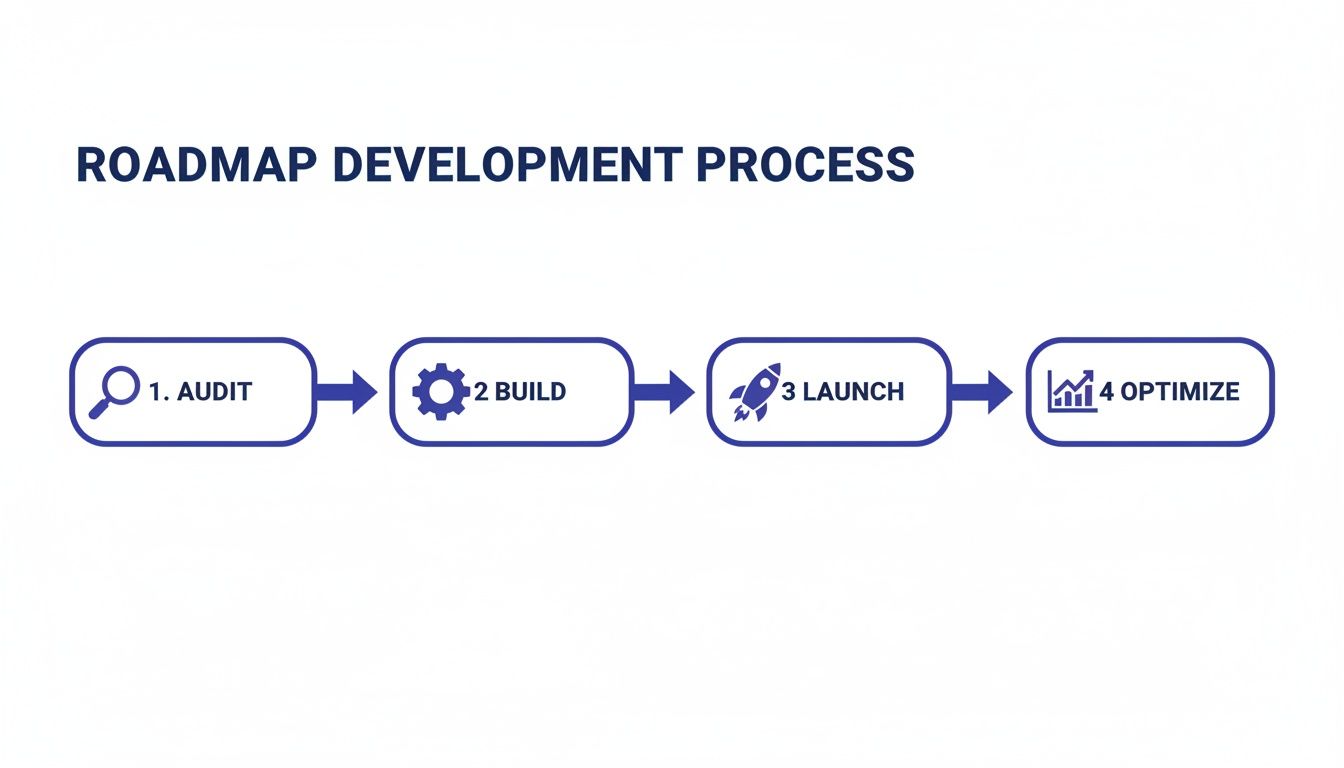
As you can see, this isn't a one-and-done initiative. Real sales enablement is a cycle of strategic action and data-driven refinement.
Phase 1: Audit And Alignment
Before you can build anything, you need a blueprint. This first phase is all about discovery and diagnosis. You have to get a painfully honest look at the current state of your sales and marketing efforts to spot the biggest gaps and opportunities.
Start by interviewing the people on the front lines. Sit down with your sales reps, sales managers, and marketing team. Ask them pointed questions to uncover their biggest daily headaches:
- What are the top three objections you hear from prospects?
- Where do you struggle most to find the right content for a deal?
- What part of the sales process feels the most inconsistent or just plain broken?
Next, it’s time to audit your existing sales content. Gather up every pitch deck, case study, and one-pager you can find. Dig into what’s actually being used, what’s collecting digital dust, and where the critical gaps are. More often than not, this process reveals a major disconnect between what marketing produces and what sales truly needs to close deals.
Finally, this phase is about getting everyone on the same page. Sales and marketing must agree on what success looks like. Define your core key performance indicators (KPIs) together, whether that means shrinking the sales cycle, boosting win rates, or getting new hires up to speed faster.
Phase 2: Foundational Build
With your audit complete and goals aligned, it’s time to start building. This phase is all about creating the core assets and systems that will give your sales team the firepower they need. A Forrester study revealed that a staggering 60-70% of content created by marketing goes unused by sales—a problem this phase tackles head-on.
Your first step is to map out the buyer’s journey. Document every single stage a prospect moves through, from their first inkling of a problem to the final decision. At each stage, identify the key questions they're asking and the information they need. This map becomes the north star for your entire content strategy.
Now, using that journey map as your guide, create your core content assets. Start with the essentials:
- A Master Pitch Deck: A compelling, on-brand presentation that every single rep uses as their foundation.
- Key Case Studies: Powerful stories that prove your value to specific industries or buyer personas.
- Competitive Battle Cards: Concise, hard-hitting one-pagers that arm reps to win against your top competitors.
This is also the time to pilot some basic technology. You don’t need a complex, expensive platform right out of the gate. A simple content management system or even a well-organized shared digital library can make a world of difference, just by making resources easy to find and use.
Phase 3: Launch And Training
Creating great resources is only half the battle. Driving adoption is what actually matters. This phase is all about rolling out your new program and training your team to use the new tools and content effectively.
Whatever you do, don't just send an email with a link to a new folder. A formal launch generates excitement and signals that this initiative is a big deal. When building out your training, consider using tools like interactive step-by-step guides to make sure everyone adopts the new processes and products.
A successful rollout is an event, not a memo. Schedule dedicated training sessions, showcase the new resources, and role-play with the new pitch deck and battle cards. This hands-on approach ensures reps internalize the material and feel confident using it in the field.
Most importantly, establish a clear and continuous feedback loop from day one. Create a dedicated channel—like a Slack channel or a weekly meeting—where reps can ask questions, share what’s working, and suggest improvements. This makes them active participants in the program's evolution, not just passive consumers.
Phase 4: Measure And Optimize
Sales enablement isn't a "set it and forget it" project. This final phase is a continuous cycle of tracking performance, gathering insights, and refining your approach for maximum impact. By systematically measuring what works, you can prove the program's ROI and make smarter, data-driven decisions.
Go back to the KPIs you defined in Phase 1. Are win rates actually improving? Is the sales cycle getting shorter? Use analytics from your content platform to see which assets are getting the most use and which are being ignored.
Combine this quantitative data with qualitative feedback from your sales team. Regular check-ins and quick surveys will tell you the story behind the numbers. This ongoing optimization loop is what ensures your program stays relevant and continues to drive real value for the business.
Building a roadmap takes strategic effort, but the payoff is immense. Ready to design a plan that delivers predictable revenue growth? Contact us to build a custom sales enablement roadmap for your B2B company.
Measuring The Metrics That Actually Matter
If you can't prove your sales enablement strategy is working, you can't justify the investment. It’s that simple. But proving it means cutting through the noise of vanity metrics—the kind that look great on a dashboard but don't actually connect to the bottom line.
To get a real picture of your program's impact, you need to track both leading indicators and lagging indicators.
Think of it like navigating a ship. Your compass bearing and engine speed are your leading indicators; they tell you if you're on the right course right now. The distance you've travelled is the lagging indicator; it shows the result of your journey. You need both to reach your destination.
Leading Indicators: Predicting Future Success
Leading indicators are your early warning system. They measure the health and adoption of your sales enablement program in real time, giving you a chance to course-correct before a problem ever hits your revenue reports.
Think of them as the pulse of your sales team's readiness. Key metrics to watch include:
- Content Adoption and Usage: What percentage of your sales content is actually being used by the team? High adoption is a clear sign that marketing is creating assets that genuinely help reps close deals.
- New Hire Ramp Time: How long does it take a new salesperson to land their first deal or hit full productivity? A shorter ramp time is a direct result of solid onboarding and training, showing a faster return on your hiring investment.
- Training Completion Rates: Are your reps actually finishing the training modules? This metric isn't just about ticking boxes; it gauges their engagement with your coaching and their readiness to execute new sales plays.
Keeping a close eye on these numbers gives you a live look at your team's engagement. For a deeper dive into structuring these reports, check out our guide on building a powerful digital marketing reporting framework.
Lagging Indicators: Proving Bottom-Line Results
Lagging indicators are the results. They're the backward-looking metrics that measure final business outcomes. These are the numbers that get your leadership team's attention because they tie directly to revenue and profitability.
Ultimately, these are the metrics that prove your sales enablement efforts are paying off. Essential ones include:
- Quota Attainment: What percentage of your sales team is hitting or exceeding their number? This is one of the clearest, most direct measures of sales effectiveness.
- Win Rate: Of all the qualified opportunities in the pipeline, how many are you actually winning? A rising win rate shows your team is getting sharper in competitive situations.
- Average Deal Size: Is the value of your average closed deal going up? This indicates reps are getting better at communicating value and successfully upselling or cross-selling.
- Sales Cycle Length: How long does it take to move a deal from a qualified lead to closed-won? Shorter cycles mean your team is moving deals through the pipeline faster, which accelerates revenue.
Here’s how it looks in the real world: A North American tech firm rolled out a sales enablement platform to share competitive intelligence. They tracked a leading indicator—adoption of their new "battle card" content—and saw it hit 90% in the first quarter. By the end of the next quarter, their key lagging indicator—win rate in competitive deals—had jumped by an incredible 22%.
By balancing both types of metrics, you build a powerful story that demonstrates clear ROI. You stop reporting on activity and start proving real, measurable impact.
| KPI Category | Metric | What It Tells You | How to Track It |
|---|---|---|---|
| Content Effectiveness | Content Usage Rate | Which assets are being used most frequently and which are being ignored. | Sales enablement platform analytics, CRM content tracking. |
| Sales Readiness | New Hire Ramp-Up Time | How quickly new reps become productive, reflecting training effectiveness. | CRM data on first deal closed, time to reach 50% quota. |
| Team Performance | Quota Attainment % | The overall effectiveness of the sales team in meeting their targets. | Sales performance reports from your CRM (e.g., Salesforce). |
| Deal Velocity | Average Sales Cycle Length | The efficiency of your sales process from lead to close. | CRM reporting on opportunity stages and close dates. |
| Sales Efficiency | Win Rate % | How effectively your team converts qualified leads into customers. | CRM analytics on closed-won vs. closed-lost opportunities. |
| Value Proposition | Average Deal Size | The team's ability to communicate value and drive larger purchases. | Financial data and sales reports from your CRM. |
How A Fractional CMO Accelerates Your Growth
Plenty of growing companies across Canada and the United States see the writing on the wall. They know they need sales enablement, they understand the concept, but they hit a familiar roadblock: they don’t have the senior strategic leadership to build a program that actually works.
This is where a Fractional CMO becomes your unfair advantage. Instead of committing to a high-cost, full-time executive, you get an experienced, on-demand leader who acts as the architect for your entire sales enablement function.
Strategic Leadership Without The Overhead
A Fractional CMO brings C-level experience to the table from day one. They don’t just manage tasks; they build the strategic scaffolding that connects every marketing activity directly to a sales outcome. It’s the fastest, most cost-effective path to building a high-impact enablement function that drives real revenue.
For companies needing expert guidance without the full-time financial commitment, this model is a perfect fit. Research shows organizations with a dedicated enablement function see a 49% win rate on forecasted deals—a massive jump from the 42.5% for those without one. A Fractional CMO is the catalyst that gets you there.
A Fractional CMO doesn’t just advise—they roll up their sleeves and build. They are the strategic mind and the hands-on leader who bridges the gap between your marketing engine and your sales team, ensuring both are fixated on the shared goal of predictable growth.
An Architect For Your Entire Program
An experienced Fractional CMO doesn’t just consult; they lead every phase of building your sales enablement roadmap, from the initial audit to ongoing optimization. They become the single point of accountability, ensuring every pillar of your strategy is strong and integrated.
This hands-on leadership includes:
- Leading the Audit: Interviewing sales and marketing teams to uncover the most painful gaps and biggest opportunities.
- Selecting the Tech Stack: Choosing the right-fit tools—from CRMs to content platforms—that empower your team without creating needless complexity.
- Overseeing Content Strategy: Making sure marketing creates assets that reps actually need and will use to close deals.
- Implementing Training: Developing and rolling out coaching programs that make every rep more confident and effective.
By owning the entire process, a Fractional CMO ensures nothing falls through the cracks. They align your people, processes, and technology around a single, unified vision for growth. If you’re curious about how this on-demand leadership can work for you, take a look at our Fractional CMO services.
This approach transforms sales enablement from a set of disconnected activities into a cohesive, revenue-driving machine. Are you ready to accelerate your growth and transform your sales results?
Contact us for a consultation, and let's build your custom growth roadmap today.
Still Have Questions? Let's Clear a Few Things Up
Diving into sales enablement can bring up some common questions, especially for businesses in Canada and the United States figuring out their next growth move. Here are the answers to a few we hear all the time.
What's the Difference Between Sales Enablement and Sales Operations?
This is a big one. Think of it like a Formula 1 team.
Sales enablement is the driver's coach. Their job is to make the driver—your salesperson—as effective as possible. They provide the training, the race strategy (your pitch), and the mental prep needed to win. It's all about maximising performance in every single conversation.
Sales operations, on the other hand, is the pit crew and engineering team. They focus on the machine itself. They’re tuning the engine (your CRM), optimising the car's systems (territory planning, compensation plans), and making sure everything runs with ruthless efficiency.
You absolutely need both to win, but they solve for two very different things: effectiveness vs. efficiency.
How Long Until We Actually See Results From This?
You'll see progress faster than you might think, but it happens in waves.
The early signs—what we call leading indicators—pop up within the first few weeks. Are reps actually using the new pitch deck? Are they completing their training modules? Seeing that initial adoption is a great first win.
The bigger, revenue-tied results take a bit longer. Most companies start to see a real lift in metrics like win rates and quota attainment within two to three quarters. For example, we saw a US-based SaaS client boost their competitive win rate by 22% just six months after we helped them roll out a formal enablement program.
Is Sales Enablement Really Worth It for a Small Team?
Absolutely. In fact, it might be more valuable for a small team.
When you only have two or three reps, you can’t afford to have anyone going rogue or wasting time reinventing the wheel. Sales enablement isn't about fancy tech or a massive budget; it's about creating a single, powerful playbook that everyone runs.
Give that small team one killer pitch deck, a set of clear battle cards for top competitors, and a consistent process, and you’ve suddenly levelled the playing field. It aligns everyone, slashes the learning curve for new hires, and makes every seller more confident and effective. It's how David beats Goliath.
Ready to stop asking questions and start building a sales enablement program that delivers real results? The team at B2Better can design and implement a strategy that fits your unique goals. Let's talk about what that could look like for you.