

Let's cut to the chase. Marketing Return on Investment (ROI) is the one metric that tells you if your marketing is actually making money. It’s the ultimate performance gauge for your business's growth engine, showing you which activities are fuelling profits and which are just burning cash.
For B2B leaders in competitive Canadian and US markets, mastering ROI isn’t a nice-to-have; it’s the key to making smart, data-backed decisions that drive the bottom line.

Why Marketing ROI Is Your Most Important Metric
Think of your marketing budget like fuel for a cross-country road trip. Each channel—SEO, paid ads, content, social media—is a different grade of fuel. Some are premium and pricey but get you there faster; others are cheaper but less efficient.
Marketing ROI is your vehicle's dashboard, showing you the exact kilometres per litre for each type of fuel. Without it, you're just pouring money into the tank and hoping for the best. You could be spending a fortune on an inefficient channel while a highly profitable one sits neglected.
Tracking ROI allows you to shift resources to the activities that deliver the best results, ensuring every dollar is working as hard as possible. For B2B companies, especially in the tech and SaaS sectors across North America where long sales cycles and multiple touchpoints can muddy the waters, this clarity is absolutely critical.
For the C-suite, especially CMOs and CFOs, marketing ROI is the language of business. It provides the financial proof needed to justify continued investment. For marketing teams, it’s the tool to prove their value in terms the entire organization understands.
The Real-World Impact of Tracking ROI
When you consistently measure ROI, you transform marketing from a "cost centre" into a proven "revenue driver." That shift is fundamental for any business looking to scale. Companies that rigorously track their ROI are far better equipped to:
- Justify Marketing Budgets: When you can show a 500% return on a specific campaign, asking for more funding becomes a simple business case, not a hopeful plea. A perfect example is Old Spice's "The Man Your Man Could Smell Like" campaign, which famously increased sales by 107% in just a few months, providing undeniable proof of its ROI.
- Optimize Campaign Performance: Seeing that one channel delivers double the return of another lets you make real-time adjustments, reallocating funds to where they'll have the biggest impact on profitability.
- Achieve Sustainable Growth: Data-driven decisions create more predictable revenue streams. In fact, brands using advanced analytics report 5-8% higher marketing ROI than their competitors.
To get a clearer picture of channel-specific performance, it's worth exploring how to boost your social media return on investment with clear metrics, as the principles apply across the board. At the end of the day, mastering ROI is about making smarter, more profitable decisions that directly contribute to your company's success.
The Essential Formulas For Calculating Marketing ROI
Alright, let's move from theory to practice. To really get a grip on marketing ROI, you have to get comfortable with the numbers behind it. The good news? The core formulas are surprisingly straightforward.
At its most basic level, the marketing ROI calculation is a simple ratio of gain versus cost. It answers the one question every executive asks: for every dollar we put in, how many did we get back? This simple perspective is the launchpad for any deeper analysis.

The Foundational ROI Formula
The most common and direct way to calculate marketing ROI is with this simple formula:
Marketing ROI = (Sales Growth – Marketing Investment) / Marketing Investment
This gives you a ratio, which you'll almost always multiply by 100 to turn it into a percentage. Let's walk through a quick example to see it in action.
Imagine a Canadian SaaS company kicks off a new digital marketing campaign.
- Marketing Investment: They spend $10,000 on paid ads, content creation, and promotion.
- Sales Growth Attributed to Campaign: The campaign directly pulls in $50,000 in new sales.
Now, we just plug those numbers into the formula:
ROI = ($50,000 – $10,000) / $10,000 = $40,000 / $10,000 = 4
To express this as a percentage, multiply by 100, giving you a 400% ROI. This means for every single dollar the company invested, it generated $4 in return on top of getting its original dollar back. If you want to get hands-on with this yourself, exploring a practical guide to the ROI Excel formula is a great way to build your own trackers.
A More Advanced B2B Formula Using CLV
For most B2B companies, especially those with long sales cycles or subscription models, the basic formula is just the beginning. A single sale doesn't tell the whole story. This is where Customer Lifetime Value (CLV) becomes absolutely critical.
The CLV-focused formula gives you a much more accurate, long-term picture of your marketing success:
Marketing ROI = (Customer Lifetime Value – Marketing Investment) / Marketing Investment
This approach shifts the focus from a single transaction to the total value a customer brings over their entire relationship with your business. A campaign might look just okay based on initial sales, but if it attracts high-value customers who stick around for years, its true ROI is much, much higher. In fact, one study showed that top-performing B2B marketers are 50% more likely to track CLV than their peers.
Of course, to get an accurate picture of profitability, you also need to understand your expenses. That’s why it’s so important to learn how to calculate customer acquisition cost right alongside CLV.
Which Marketing ROI Formula Should You Use?
Choosing the right formula really comes down to your business model and what you're trying to measure. One isn't inherently better than the other; they just answer different questions.
To help you decide, here’s a quick summary of the key marketing ROI formulas and when they make the most sense.
Key Marketing ROI Formulas at a Glance
| Formula Type | Calculation | Best Used For |
|---|---|---|
| Basic ROI | (Sales Growth – Cost) / Cost | Quick, short-term campaign analysis and businesses with single-transaction sales cycles. |
| CLV-Based ROI | (CLV – Cost) / Cost | SaaS, subscription models, and B2B companies focused on long-term growth and customer retention. |
Ultimately, a solid grasp of these formulas is what elevates marketing conversations from subjective opinions to objective, data-driven strategy. It’s the financial proof you need to justify budgets, optimize your spending, and show marketing’s direct contribution to the bottom line.
If you’re ready to implement a robust measurement framework but aren’t sure where to start, contact us. We help Canadian and US B2B companies build the systems to track, prove, and improve their marketing ROI.
Beyond The Final Click: The Hidden Factors In B2B Marketing ROI
Had that nagging feeling your marketing ROI report is missing something? You run the numbers, but the result feels… hollow. It doesn't quite capture the full story of your team's hard work.
Trust that gut feeling. Most standard ROI calculations are fundamentally incomplete.
They’re obsessed with the final click—the last ad someone saw before they bought. That tunnel vision completely ignores the winding, complex path that B2B buyers in Canada and the United States actually take. It’s a recipe for misleading data and, frankly, bad strategic decisions.
The Short-Term Gain, Long-Term Pain Problem
One of the biggest flaws in how we measure ROI is our addiction to immediate results. We track leads from a single Google Ad, count demo requests from one email blast, and call it a day. The problem? That approach completely misses the immense value of long-term brand building.
Think about it. Activities like publishing thought leadership, hosting webinars, or keeping a steady presence on social media don't always spark a sale tomorrow. What they do is build trust, establish your authority, and keep your brand top-of-mind. So when a buyer is finally ready to pull the trigger, you're their first call.
Ignoring these efforts is like trying to measure the value of a harvest without accounting for the months you spent planting seeds and watering the soil.
For B2B marketers in Canada and the United States aiming for sustainable growth, the data shows a balanced approach is non-negotiable. Experts suggest allocating 50-60% of your budget to brand building, a move that can unlock up to 50% more returns by capturing these long-term effects. While short-term profit ROI looks good at first, it more than doubles when you start measuring the sustained impact of your brand, making every one of your performance tactics work that much harder. You can discover more about unlocking this hidden marketing ROI and see just how well a blended strategy pays off.
The Attribution Puzzle: Which Touchpoint Gets The Credit?
The B2B customer journey is almost never a straight line. A prospect might see your company in a LinkedIn post, read a blog article a week later, notice a targeted ad the next month, and finally click a link in an email to request a demo. So, which of those touchpoints gets the credit for the sale?
This is the classic challenge of marketing attribution. Stick with a simplistic model, and you’ll get a completely warped view of what’s actually working.
Marketing Attribution is the science of assigning credit to the different marketing touchpoints a customer interacts with on their way to becoming a customer. Nail this, and you’ll get a far more accurate picture of your marketing ROI.
Let's break down the common models and their issues:
- First-Touch Attribution: This model gives 100% of the credit to the very first interaction a customer had with you. It’s great for understanding what drives initial awareness, but it ignores every single thing you did afterward to nurture that lead.
- Last-Touch Attribution: The polar opposite. This one gives 100% of the credit to the final interaction before the conversion. It's the easiest to track, which is why it's so common, but it wildly overvalues bottom-of-the-funnel tactics (like branded search ads) while undervaluing the channels that created the demand in the first place.
- Multi-Touch Attribution: Now we're getting somewhere. These more advanced models spread the credit across multiple touchpoints. Models like Linear (equal credit to all), Time-Decay (more credit to recent touches), or U-Shaped (credit split between the first and last touches) give you a much more complete—and honest—picture of performance.
Think of it like a hockey team. A last-touch model only gives credit to the player who scored the goal. A multi-touch model recognizes the assists from the winger and the defenceman who started the play down the ice. To truly understand why you won, you need to see the entire play, not just the final shot.
Getting attribution right is fundamental to understanding what marketing ROI is in a meaningful way. Without a clear picture of the whole journey, you risk cutting the budget for channels that are quietly doing all the heavy lifting.
Need help building an attribution model that reflects your true business impact? Contact us today. Our team specializes in creating measurement frameworks that give B2B leaders in Canada and the United States the clarity they need to grow.
3 Proven Strategies To Boost Your Marketing ROI
Right, you’ve got a handle on what Marketing ROI is and how to calculate it. That’s the hard part done. Now for the fun part: making that number go up. Moving from simply measuring ROI to actively improving it is where savvy B2B companies, especially in competitive Canadian and US markets, really get an edge.
This isn’t about chasing some mythical silver bullet. It's about a disciplined, systematic approach. By applying proven strategies across your most important channels, you can make every single marketing dollar pull more weight, generating more revenue without just throwing more money at the problem.
Sharpen Your SEO With High-Intent Keywords
Let’s be honest: not all traffic is good traffic. One of the most common ways to kill your marketing ROI is by chasing broad, high-volume keywords. Sure, they bring in lots of curious browsers, but very few actual buyers. The real key to unlocking a better return from search is to zero in on high-intent keywords.
These are the phrases people type when they’re getting close to pulling out a credit card. Think "best B2B CRM for Canadian startups" instead of the much broader "what is a CRM." The search volume is lower, yes, but the traffic you get is exponentially more valuable.
- Focus on Problem-Solving: Get inside your customer's head. What keywords are they using when they’re actively trying to solve a problem that your product fixes?
- Target "Bottom of the Funnel" Terms: Weave phrases like "pricing," "demo," "alternative," and "services" into your keyword strategy to attract people ready to make a decision.
- Localize Your Efforts: If you serve specific regions, adding geographic modifiers like "in Toronto" or "for US manufacturers" can be a game-changer for lead quality.
By making this shift in your SEO focus, you stop wasting ad spend and content creation on tire-kickers, which gives your ROI a direct and immediate boost.
Double Down On High-Performing Content
Your content should be more than just a brand-building exercise; it needs to be a lead-generation engine. A fantastic way to squeeze more ROI from your content is to run a simple audit and pinpoint your top-performing assets. These are the blog posts, whitepapers, or case studies that are already bringing in your best, most qualified leads.
Once you know what’s working, the path is clear:
- Repurpose Your Winners: That successful blog post? Turn it into a webinar. Or an infographic. Or a series of LinkedIn updates. This gives your best content a longer life and a wider reach with very little extra work.
- Update and Expand: Go back to those older, high-traffic posts. Refresh them with new data, fresh insights, and better examples to keep them relevant and ranking high in search.
- Create Content Clusters: Take a central "pillar" piece of content and build out a series of related "spoke" articles around it. This helps establish you as an authority on the topic and captures a wider net of related searches.
By amplifying what’s already resonating with your audience, you’re putting your resources where you know they’ll generate a return. We’ve seen a company double its lead quality just by focusing its content efforts on the top 10% of its existing articles.
Unleash The Power Of Email Marketing
If you look across all the digital channels available, one consistently delivers an outsized return: email marketing. It’s a workhorse for B2B marketers for a reason—it’s direct, it feels personal, and it's incredibly cost-effective.
For startups and scale-ups in competitive US and Canadian B2B scenes, email marketing consistently delivers one of the highest ROIs. The latest statistics show an average return of $36–$40 for every $1 invested. That's a mind-boggling 3600%+ ROI. This isn't smoke and mirrors; it’s driven by email’s incredibly low cost per send and its laser-precise targeting. It’s a lead-gen powerhouse that doesn't require a massive in-house team. You can learn more about these Canadian B2B marketing benchmarks to see the full picture.
This incredible return isn't an anomaly; it's the result of smart, targeted execution. Segmentation, personalization, and automation are the keys to turning your email list into a reliable revenue stream.
Want to get that kind of success? Here’s how:
- Segment Your Audience: Stop sending generic email blasts. Group your contacts by industry, job title, purchase history, or how they’ve engaged with you. Then, send them messages that actually matter to them.
- Personalize Your Messaging: Use dynamic content to greet subscribers by name and reference their specific interests or past interactions. It shows you’re paying attention.
- Automate Nurture Sequences: Set up automated email workflows that guide new leads through their buying journey. Give them valuable content at each stage until they’re warmed up and ready for a conversation with sales.
Each of these tactics—from refining your SEO and amplifying your content to mastering email—gives you a clear road to a much healthier marketing ROI. The trick is building a framework that lets you measure your improvements consistently as you go.
If you're ready to put these high-impact strategies into action but could use some expert guidance to get things rolling, contact us. We help B2B companies across Canada and the United States turn their marketing into a predictable engine for growth.
How To Build A B2B Marketing ROI Measurement Framework
Turning abstract ROI theory into a practical, repeatable system is what separates high-growth B2B companies from the rest. Building a measurement framework isn’t about tracking every metric under the sun. It’s about creating a focused, organized engine that gives you a clear view of what’s working, what isn’t, and where to invest your next dollar.
For B2B leaders across Canada and the United States, a solid framework removes the guesswork. It transforms marketing from a series of isolated campaigns into a predictable, revenue-generating function.
Start With Funnel-Specific KPIs
First things first: you need to select the right Key Performance Indicators (KPIs) for each stage of your buyer's journey. A prospect at the top of the funnel has very different needs—and signals different intent—than one at the bottom. Your metrics have to reflect that reality.
A well-structured approach looks like this:
- Top of Funnel (Awareness): The goal here is to attract your ideal audience. Your KPIs should measure reach and initial engagement. Track metrics like website traffic, social media impressions, and new blog subscribers.
- Middle of Funnel (Consideration): Now you're focused on nurturing interest and building trust. Key metrics include Marketing Qualified Leads (MQLs), content downloads (like whitepapers or ebooks), and webinar attendance.
- Bottom of Funnel (Decision): This is where you connect marketing efforts directly to sales. Focus on bottom-line drivers like Sales Qualified Leads (SQLs), demo requests, Cost Per Acquisition (CPA), and of course, new customer sales.
This tiered approach gives you a complete picture of your pipeline's health, from the first touchpoint to the final handshake.
Choose The Right Tools For The Job
You don't need a massive, complicated tech stack to get started. In fact, overcomplicating your tools is a common pitfall. For most B2B companies, a few essential, well-integrated platforms are all you need to track your KPIs effectively.
The best measurement frameworks rely on a "single source of truth." Research reveals that CMOs who use at least 70% of their martech stack’s capabilities achieve 20% better marketing ROI than their peers who don't. The key is integration, not accumulation.
Here are the non-negotiables:
- Web Analytics (e.g., Google Analytics): This is your foundation for understanding website traffic, user behaviour, and conversion paths. It's essential for tracking your top-of-funnel KPIs.
- CRM Platform (e.g., HubSpot, Salesforce): Your Customer Relationship Management system is the heart of your framework. It connects marketing activities to actual sales data, allowing you to track leads as they move from MQL to SQL to closed-won deals.
- Marketing Automation (often part of a CRM): This lets you automate email sequences and track engagement, providing crucial data for your middle-funnel metrics.
The process flow below shows how key activities like SEO, content creation, and email marketing can work together to drive better ROI.
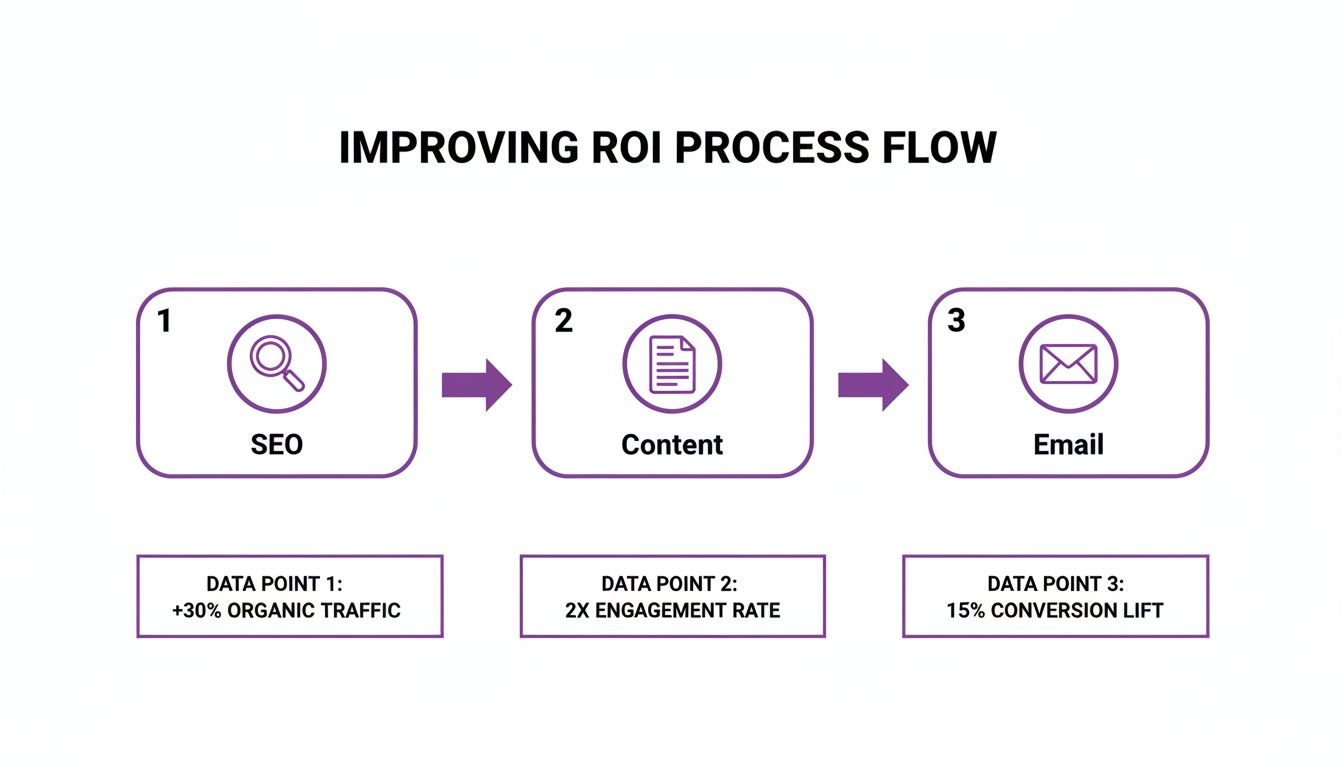
This visualization highlights how a structured process, from initial search discovery to targeted email nurturing, creates a powerful system for improving returns.
Create A Centralized Marketing Dashboard
The final piece of your framework is bringing all this data together. The goal is to create a single, clear marketing dashboard that gives you an at-a-glance view of performance. This isn't just for the marketing team; it’s a powerful communication tool for the entire organization.
Your dashboard should visualize your most important KPIs, making it easy to spot trends, identify high-performing campaigns, and make data-backed decisions. This is the ultimate tool for proving the value of your marketing efforts in a language everyone understands. For more guidance, our complete guide to creating effective digital marketing reports can help you build a dashboard that truly communicates your impact.
Building this framework takes discipline, but the payoff is immense. It provides the clarity and confidence you need to scale your marketing efforts effectively.
If you’re ready to build a measurement engine that drives real growth for your B2B company in Canada or the US, contact us. We can help you implement the framework, tools, and reporting to prove and improve your marketing ROI.
How a Fractional CMO Puts Your ROI Strategy Into Action
Knowing your marketing ROI is one thing. Actually improving it, week in and week out, is a completely different game. This is where the spreadsheets stop and the real work begins. For ambitious B2B companies across Canada and the United States, a Fractional CMO takes all the frameworks and formulas we’ve covered and turns them into an operational reality.
Think of a Fractional CMO as a seasoned, part-time marketing executive who plugs directly into your leadership team. They don’t just offer advice from the sidelines; they roll up their sleeves and build the entire ROI-driven marketing function from the ground up, giving you C-suite expertise without the full-time cost.
From Strategy to Measurable Results
The primary job of a Fractional CMO is to turn your marketing spend into a predictable source of revenue. They’re laser-focused on connecting every campaign and activity directly to business outcomes, shifting your marketing from a cost centre to a proven growth engine. This hands-on leadership is what truly defines what is marketing roi in practice.
Their process isn’t a mystery. It typically looks like this:
- Designing the Measurement Framework: First, they’ll select the right KPIs, set up attribution models that make sense for your sales cycle, and choose the tech stack needed to get a clear, accurate picture of performance.
- Executing High-Impact Campaigns: Next, they oversee the launch of targeted campaigns—from SEO and content to paid media—that are designed from day one to deliver a measurable return. No more "spray and pray."
- Delivering C-Suite Level Reporting: Finally, they translate complex data into concise, actionable reports. These dashboards clearly show how marketing is contributing to the pipeline and revenue, giving you the confidence to reinvest in what’s working.
An Efficient Path to Provable ROI
For founders and CEOs, this approach is the most efficient path to building a high-performance marketing function. It’s not just about getting more leads; it’s about getting the right leads, cost-effectively, and knowing exactly how you got them.
The impact is significant. Brands that successfully integrate AI-powered tools and strategies, a common initiative led by a Fractional CMO, can see a 1.5x boost in click-through rates and accelerate their customer journeys by over 30%.
This is the power of having senior leadership focused squarely on results. For instance, a Fractional CMO might spot that your content strategy is great at attracting top-of-funnel traffic but isn’t generating any actual sales conversations. They would then pivot resources toward creating case studies and product comparisons, directly impacting demo requests—and proving the ROI of that shift with hard data. The value of this expert guidance is clear when exploring the benefits of Fractional CMO services for scaling B2B companies.
If you’re ready to move beyond just calculating your marketing ROI and start actively, consistently improving it, this model offers a clear, effective path forward.
Ready to see a real, measurable return on your marketing investment? Contact us today to learn how our Fractional CMOs can build a growth engine for your business.
Your Top Marketing ROI Questions, Answered
We’ve walked through the formulas, frameworks, and tactics behind a strong marketing ROI. But theory is one thing—putting it into practice is another. To wrap up, let’s tackle some of the most common questions B2B leaders across Canada and the United States ask when they start connecting the dots.
What Is A Good Marketing ROI For A B2B Company?
This is the million-dollar question, isn't it? While it varies by industry and business model, a widely accepted benchmark for a good marketing ROI is a 5:1 ratio, or 500%. That means for every dollar you put into marketing, you get five dollars back in revenue. An exceptional ROI is often considered 10:1 (1000%) or even higher.
But context is everything. For a SaaS company in a competitive US market, a lower initial ROI might be perfectly fine if it’s bringing in customers with a high lifetime value. The real key is to measure ROI against your specific profit margins and long-term growth ambitions.
How Long Does It Take To See ROI From Marketing?
The timeline to see a return on your investment depends entirely on the marketing channels you’re using. It's a mix of sprints and marathons.
- Short-Term Channels: Paid advertising like Google Ads or LinkedIn Ads can show a measurable ROI in days or weeks. They’re built to capture existing demand and drive immediate action, so you see results fast.
- Long-Term Channels: Strategies like SEO and content marketing are investments you make in building an asset over time. It typically takes 6–12 months to see significant momentum, but these channels often deliver a much higher, more sustainable ROI in the long run by building organic traffic and brand authority.
Think about a landmark campaign like Coca-Cola's "Share a Coke." It drove a 2% year-over-year sales lift in the US while also generating over 998 million Twitter impressions. That’s a perfect blend of immediate sales and long-term brand equity.
How Can I Track ROI With A Long Sales Cycle?
This is a critical puzzle for B2B companies in Canada and beyond. When a deal takes months to close, tracking the final sale alone just isn't enough to go on. The solution is to measure the leading indicators and assign value to key milestones along the way.
Instead of only focusing on closed-won deals, your ROI tracking should include metrics that show progress, like:
- The number of Marketing Qualified Leads (MQLs) a campaign generates.
- How many of those MQLs progress to become Sales Qualified Leads (SQLs).
- The volume of demo requests and consultation bookings.
- The total pipeline value influenced by your marketing activities.
By tracking these interim conversions, you can measure the effectiveness of your marketing long before the final contract is signed, giving you the confidence to know what's working and what isn't.
Ready to stop guessing and start measuring? The team at B2Better specializes in building ROI-driven marketing programs for B2B companies across North America. Contact us to build a marketing function that proves its value.