
Website optimization services are a collection of expert practices designed to make your website faster, more visible on Google, and much better at turning visitors into paying customers. This is about more than just a design refresh; it involves deep technical improvements, smarter content strategy, and user experience tweaks that drive real business growth. A prime example is how one SaaS company, through targeted optimization, increased its organic search traffic by 327% in just a few months, turning its website into its primary lead generation channel.
Your Website Is Your 24/7 Salesperson. Is It Performing?
Think of your website as your top salesperson, constantly engaging prospects across Canada and the United States. Now, what if that salesperson was slow, confusing, and couldn't close a deal to save their life? An unoptimized website does just that—it actively leaks revenue by frustrating potential customers and sending them away.
This is especially true for B2B companies. Here, a website isn't just a digital brochure; it's the primary engine for lead generation. Website optimization services are what transform this static asset into a dynamic machine that attracts, engages, and converts your ideal clients from key North American markets.
The Real Cost of a Poorly Optimized Website
A slow-loading page or confusing navigation isn't just an annoyance; it has a direct impact on your bottom line. Research from Google consistently shows that a mere one-second delay in mobile page load time can impact conversion rates by up to 20%. For B2B firms, this means fewer demo requests, webinar sign-ups, and qualified sales leads vanishing into thin air.
The whole point of optimization is to create a seamless, friction-free path from a prospect's first click to a signed contract. This involves a few key things:
- Analyzing user behaviour to figure out what your visitors actually want and where they're getting stuck.
- Refining technical performance to ensure your site is lightning-fast and easy for search engines to find.
- Aligning your content with the real-world problems your customers in Canada and the United States are trying to solve.
Thriving in the Canadian and US Markets
Here in Canada, where a staggering 46.2% of all digital marketing revenue comes from SEO, a powerful optimization strategy is non-negotiable. With over half of all searches now happening on mobile devices, making sure your site is fast and responsive is absolutely critical for keeping users happy and climbing the search rankings. To see how different providers package their offerings, you can look at examples like Mustang WPO's comprehensive optimization services. By focusing on the right performance indicators, you can turn your website into a reliable, predictable source of growth.
A well-optimized website doesn't just attract more visitors—it attracts the right visitors. It acts as a filter, guiding high-intent prospects from the US and Canada directly into your sales pipeline while building your brand's credibility and authority along the way.
Ready to transform your website from a cost centre into a revenue driver? Contact us today to build a tailored plan that delivers measurable results.
The Four Pillars of Website Optimization
Think of your website like a high-performance vehicle. It’s not just one flashy component that makes it win the race for leads; it’s how every part works together in perfect harmony. Effective website optimization services are built on this same principle, focusing on four critical pillars that combine to drive visibility, engagement, and ultimately, revenue.
When you understand these pillars, you get a clear roadmap of what a complete optimization strategy really involves. It’s a journey that goes way beyond simple design tweaks to address the core elements that both search engines and your future customers truly care about.
This diagram shows how a properly optimized website builds value layer by layer—improving visibility and speed to drive the conversions that grow your business.
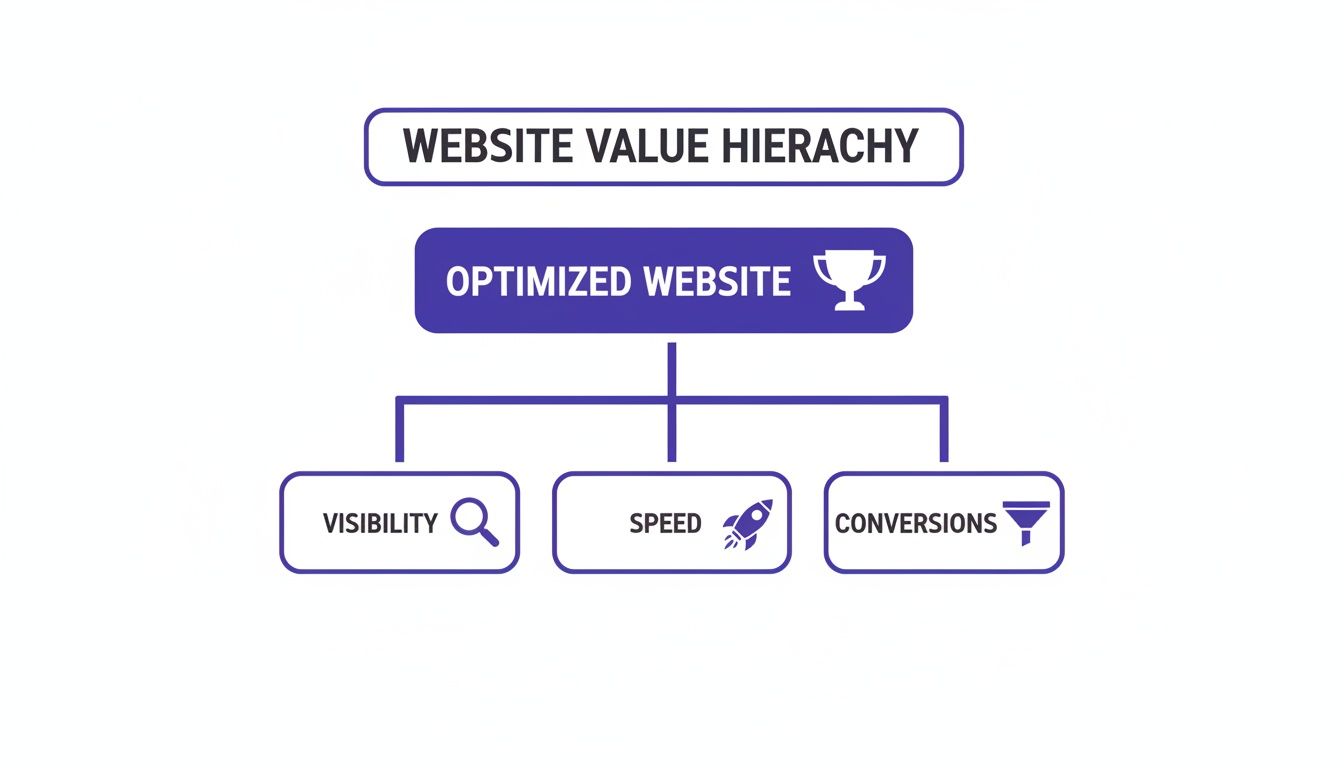
Each element, from your search engine presence to how a user interacts with your site, builds on the others. The end result is a powerful, lead-generating asset for your B2B company.
Technical SEO: The Engine
Technical SEO is the engine under the hood. It’s all the behind-the-scenes work that ensures search engines like Google can find, crawl, and index your site without hitting any roadblocks. If your engine isn’t running smoothly, nothing else matters—your site will be practically invisible to potential customers in competitive Canadian and US markets.
Key activities here include:
- Improving Site Speed: Making sure pages load in a snap. A site that loads in 1 second has a conversion rate 3x higher than a site that loads in 5 seconds.
- Ensuring Mobile-Friendliness: With most B2B research now happening on mobile devices, a responsive design is non-negotiable.
- Fixing Crawl Errors: Resolving issues like broken links or incorrect server responses that stop Google from accessing your valuable content.
- Optimizing Site Structure: Creating a logical site hierarchy that helps both users and search engines navigate with ease.
A strong technical foundation is the absolute first step toward ranking for the keywords that matter. For a deeper dive, check out our guide on how to improve your SEO and build that solid base.
On-Page and Content Strategy: The Fuel
If technical SEO is the engine, then your content is the high-octane fuel that powers it. On-page optimization is all about creating and refining content that directly answers the questions your ideal customers in Canada and the US are asking. It’s about aligning your website's messaging with the buyer's journey to attract qualified leads, not just random traffic.
This strategic approach is incredibly effective. Organic search not only drives higher-quality traffic than paid campaigns but also contributes 46.2% to Canada's digital marketing revenue. Prioritizing content and SEO builds brand authority, with 91% of marketers reporting improved website performance in recent years.
A key part of this pillar is ensuring content quality and relevance. Using advanced AI content optimizer tools can significantly sharpen your messaging and boost engagement. This pillar focuses on smart keyword research, writing compelling copy, and creating a logical page structure that attracts and converts visitors.
Conversion Rate Optimization: The Aerodynamics
Conversion Rate Optimization (CRO) is your website’s aerodynamics. It’s about reducing friction and making the journey from curious visitor to qualified lead as smooth as possible. You can have thousands of visitors, but if none of them take action—like requesting a demo or downloading a whitepaper—your website isn’t adding any real business value.
CRO involves a data-driven process of testing and tweaking elements on your site to encourage more visitors to convert. A famous success story is how Dell, by testing different landing page variations, saw a 300% increase in conversion rates from one of its key lead-generation pages. It turns your existing traffic into tangible results.
User Experience: The Cockpit
Finally, User Experience (UX) is the cockpit where the driver sits. It’s all about how a visitor feels when they interact with your website. Is the navigation intuitive? Is information easy to find? A clean, user-friendly design builds trust and makes visitors want to stick around.
Great UX makes every interaction feel effortless and enjoyable. This pillar is what ties everything together. After all, even a technically perfect, content-rich, and conversion-focused site will fail if it's confusing or frustrating to use.
By addressing these four pillars, website optimization services transform your site from a simple online brochure into a powerful engine for business growth. Let us show you how; contact us today to get started.
Real Success Stories from Canadian B2B Companies
Theory is one thing, but seeing results is what really matters. While it’s helpful to talk about the pillars of optimization, watching them come to life shows you the incredible impact these services can have. For B2B companies across Canada and the United States, strategic website optimization isn't just another line item in the marketing budget—it's a direct investment in revenue growth.
The proof is in the performance. Let’s move past the concepts and look at real-world examples of how businesses have used website optimization services to solve tough challenges and achieve remarkable outcomes.
These stories drive home the direct link between a high-performing website and a healthier bottom line, showing how targeted improvements translate into more leads, better clients, and sustainable growth.
Case Study: The Kitchener-Waterloo SaaS Startup
Picture a promising SaaS startup in the Kitchener-Waterloo tech corridor. They had a fantastic product, but their website was leaking potential customers. Their main goal was to get more demo requests from the United States, but the user journey was a maze, and the site’s content didn’t connect with their ideal customer's pain points.
The challenge was clear: they had to bridge the gap between website traffic and actual sales conversations.
The Strategy Deployed:
A comprehensive optimization plan was put into motion, zeroing in on two critical pillars: User Experience (UX) and Conversion Rate Optimization (CRO).
- UX Overhaul: The navigation was completely simplified, making it effortless for visitors to find pricing details and product features. The entire user flow, from the homepage right through to the demo request form, was redesigned to be intuitive and friction-free.
- Targeted Content Campaign: New landing pages were built with messaging that resonated directly with their target audience in the United States. They shifted from generic feature lists to benefit-driven copy that solved specific business problems.
- CRO Implementation: A/B testing was rolled out on call-to-action buttons, headlines, and form fields. Even tiny tweaks, like changing button text from a flat "Submit" to an inviting "Get Your Free Demo," were tested to see what drove the most action.
The Measurable Outcome:
The results were staggering. In just six months, the startup doubled their qualified demo requests. Their conversion rate from visitor to lead skyrocketed by 120%, feeding their sales team a consistent, high-quality pipeline from their key US market and dramatically accelerating their growth.
Case Study: The Ontario Manufacturing Firm
Now, let's look at a specialized manufacturing firm based in Ontario. They produced high-value industrial components but were struggling to attract qualified leads from their key market in the United States. Their website was technically solid, but it was practically invisible on Google for the specific, high-intent keywords their potential American buyers were using.
Their challenge was to cut through the digital noise and establish themselves as an authority in a crowded niche.
A well-executed SEO strategy does more than just increase traffic; it builds a moat of authority around your brand. It ensures that when a high-value prospect in the US searches for a solution you provide, your business is the first one they find.
The Strategy Deployed:
The focus here was on a powerful one-two punch of Technical SEO and an authoritative content strategy.
- Advanced Keyword Research: The team dug deep to identify long-tail, buyer-intent keywords that competitors were completely ignoring, like "custom CNC machining for aerospace parts in North America."
- Content Development: They created in-depth technical articles, case studies, and resource guides that showcased their expertise. This content was meticulously optimized to rank for those high-value target keywords.
- Technical & Local SEO: The site's architecture was refined to improve crawlability for search engines, and local SEO tactics were deployed to signal their expertise in serving the cross-border market.
The Measurable Outcome:
Within a year, the firm locked in top-three Google rankings for several of their most valuable industrial keywords. This drove a 75% increase in qualified leads from their target American market, directly fuelling their sales pipeline and cementing their digital presence.
These successes show what's possible when you partner with experts. Ready to write your own success story? Contact us today to discuss how our website optimization services can drive your growth.
How to Choose the Right Optimization Partner
Finding the right expert to deliver website optimization services is every bit as important as the strategy itself. The wrong partnership can lead to wasted budgets and missed opportunities, while the right one can feel like hitting the accelerator on growth. A critical first step is picking an engagement model that actually fits your business goals, internal team, and budget, especially when targeting growth in the Canadian and US markets.
Understanding the different ways you can work with an optimization partner gives you the clarity to make a confident investment. Let’s compare three powerful approaches to help you decide which is the best fit for your company’s unique situation.

The Fractional CMO Model
A Fractional Chief Marketing Officer (CMO) brings high-level strategic leadership to your team on a part-time basis. This model is perfect for B2B companies in Canada and the United States that need senior expertise to guide their entire marketing direction but aren't quite ready for a full-time executive hire.
- Best For: Companies that need an integrated strategy, not just someone to execute tactics. The Fractional CMO ensures website optimization is tied directly to broader business objectives like market penetration and revenue growth.
- Pros: You get C-suite-level experience and strategic oversight for a fraction of what a full-time salary would cost. This approach guarantees your optimization efforts are in lockstep with sales, product, and overall company goals.
- Cons: This model is less about the day-to-day, hands-on execution. A Fractional CMO directs the strategy, which is then typically carried out by your internal team or other specialized vendors.
Choosing a Fractional CMO is like hiring a seasoned architect to design the blueprint for your dream home. They make sure the foundation is solid and every room serves a purpose, leaving the specialized construction to the experts under their direction.
The Project-Based Engagement
A project-based engagement is designed for a specific, time-bound goal with a crystal-clear deliverable. Think of it as the perfect model for tackling a distinct challenge, like a comprehensive technical SEO audit, a website redesign, or a CRO campaign for a single key landing page. For businesses new to website optimization services, this is often the ideal starting point.
- Best For: Businesses with a well-defined problem that needs solving. For instance, if your website traffic from the United States is high but your lead conversions are frustratingly low, a targeted CRO project is a perfect fit.
- Pros: The scope, timeline, and cost are all locked in upfront, which makes budgeting a breeze. It’s a fantastic way to score a specific win and see a direct return on your investment.
- Cons: Once the project is done, the engagement ends. This model doesn’t offer the ongoing support needed for continuous improvement, which is absolutely essential for long-term SEO success.
A successful partnership often involves a blend of strategic leadership and technical skill. Understanding the role of a digital marketing technologist can help clarify how high-level strategy connects with the hands-on work required for optimization.
The Monthly Retainer Model
The monthly retainer is the most common model for ongoing website optimization, and for good reason. You pay a fixed fee each month for a continuous suite of services, like technical SEO monitoring, content creation, link building, and performance reporting. This approach treats optimization as a sustained business process—not a one-and-done fix.
- Best For: Companies committed to long-term growth in the Canadian and US markets. SEO and user experience are never truly "done," and a retainer ensures you have consistent effort building and maintaining momentum.
- Pros: This model fosters a deep partnership, allowing the agency to become a genuine expert on your business, your industry, and your customers. It provides the steady effort needed to achieve and protect top rankings while adapting to algorithm changes.
- Cons: It requires a longer-term budget commitment. The results are cumulative and can take several months to become truly significant, which demands a bit of patience and trust in the process.
Choosing the right partner and model is a critical decision. Contact us today, and we can help you assess your internal resources, define your goals, and select the engagement that will best drive your business forward.
Measuring the ROI of Your Optimization Efforts
Pouring money into website optimization without tracking the return is like flying a plane without instruments. You're definitely moving, but you have no idea if you're heading in the right direction. Data-driven optimization takes the guesswork out of the equation, letting you prove your investment is paying off with cold, hard numbers.
This means cutting through the noise of "vanity metrics"—like social media likes or total website visits—and zeroing in on the Key Performance Indicators (KPIs) that actually signal business growth for your target markets in Canada and the United States. These are the numbers that connect directly to your bottom line.

Key Performance Indicators That Matter
For B2B companies targeting clients in Canada and the United States, a handful of core metrics tell the most important part of the story. These KPIs show whether your website isn't just attracting traffic, but attracting the right audience and turning them into real leads.
Here are the essential metrics we track:
- Organic Traffic Growth: An increase in non-paid traffic from your target regions—think specific provinces in Canada or states in the US—is the first sign of improved visibility.
- Keyword Ranking Improvements: Are you climbing the ranks for the specific, high-intent terms your ideal customers are searching for? A successful campaign shows clear upward movement for these revenue-driving keywords.
- Lead Conversion Rate: This is your money metric—the percentage of visitors who take a desired action, like requesting a demo, filling out a contact form, or downloading a whitepaper. An optimized site should see this rate climb steadily.
- Customer Acquisition Cost (CAC): This one calculates the total cost to land a new customer. Effective optimization will drive your CAC down over time by generating more qualified, low-cost organic leads.
The real magic happens when you connect these dots. By tracking these KPIs, you can build a clear narrative that shows stakeholders exactly how technical fixes and better content are fuelling the sales pipeline.
From Metrics to ROI: A Simple Framework
Calculating a clear Return on Investment (ROI) is the ultimate goal. While the formulas can get complex, a straightforward approach gives you a powerful snapshot of your success. It helps you demonstrate how your investment in website optimization services is creating tangible business value.
A study by Backlinko revealed that the #1 result in Google's organic search results has an average Click-Through Rate (CTR) of 27.6%. Reaching that top spot for a high-value keyword doesn't just bring traffic; it brings the most valuable traffic, directly impacting lead generation and sales.
To calculate your ROI, you need to connect your optimization efforts directly to revenue. Here’s a simplified way to think about it:
- Track Qualified Leads from Organic Search: Use your analytics to pinpoint how many high-quality leads came from non-paid search traffic from Canada and the US.
- Calculate Lead-to-Customer Rate: Figure out the percentage of those organic leads your sales team successfully converted into paying customers.
- Determine Average Customer Lifetime Value (CLV): What’s the average revenue a new customer generates over their entire relationship with your company?
- Calculate the ROI: Use this simple formula:
(Revenue from SEO - Cost of SEO) / Cost of SEO.
For example, if you gained 10 new customers from organic search with an average CLV of $15,000 each, that’s $150,000 in new revenue. If your total investment in optimization services was $50,000, your ROI is a healthy 200%. This framework transforms abstract metrics into a rock-solid business case. For more on creating reports that stakeholders actually love, explore our insights on digital marketing reporting.
Ready to stop guessing and start measuring the real impact of your website? Contact us today to build an optimization strategy that delivers a clear, provable return on your investment.
Ready to Start Your Growth Journey?
You've seen what website optimization services can do, why they're so critical for B2B companies in North America, and how to measure what truly matters. The next step is turning that knowledge into action. For businesses across Canada and the United States looking to build a revenue pipeline that scales, it all starts with a clear, strategic plan.
The stakes are high. Companies that get lead nurturing right—a direct result of a slick, optimized user journey—generate 50% more sales-ready leads at a 33% lower cost. This isn't just about getting more traffic; it's about attracting the right traffic and guiding those prospects smoothly toward a conversation.
At B2Better, we don't just advise from the sidelines. We become an extension of your team, bringing the senior marketing expertise you need without the full-time overhead.
Your Path to Predictable Growth
Our proven process makes sure every move we make is tied directly to your business goals, whether you're a SaaS firm in Kitchener-Waterloo or a manufacturing company chasing clients across the US. We're here to turn your digital presence from a passive brochure into an active, high-performance asset.
Investing in a strong user experience (UX) is a cornerstone of optimization, and it pays off handsomely. For every dollar put into UX, businesses can expect a return of up to $100. It’s a stark reminder of the immense value in creating a seamless and intuitive journey for your prospects.
This data-driven approach takes the guesswork out of growth and builds a predictable system for winning new business. Our methodology is straightforward and effective:
- Discover and Define: We kick things off by digging deep into your business, your buyers in the US and Canada, and your goals. This is where we pinpoint the biggest opportunities for immediate impact.
- Strategize and Structure: Next, we build a tailored plan that weaves together technical SEO, content strategy, and conversion rate optimization into a single, cohesive roadmap.
- Execute and Evaluate: Finally, we roll up our sleeves and put the plan into action, constantly measuring performance against the KPIs that actually matter to your bottom line.
If you’re ready to stop leaking revenue and start building a high-performance website that drives measurable growth, the time to act is now. We specialize in helping B2B companies across Canada and the United States hit their most ambitious targets.
Don't let another qualified lead slip through the cracks. Contact us today to build a tailored plan that delivers results.
Common Questions About Website Optimization
Here are some straight answers to the questions we hear most often from B2B leaders in Canada and the US. We've cut through the jargon to give you the practical information you need to make smart decisions about growing your business.
How Long Does It Take to See Results?
While you can see positive signals from foundational technical fixes (like a faster page speed) in just a few weeks, meaningful business results take a bit more time. You should expect to see tangible outcomes—like a noticeable increase in organic traffic from your target markets and a steady stream of qualified leads—within four to six months.
Think of SEO as a long-term investment in a valuable business asset, not a short-term expense. A great success story is that of an American B2B tech firm that saw a 400% increase in organic leads within the first year of a sustained optimization campaign. It requires consistent, methodical effort to build authority and secure rankings that last, especially in competitive B2B industries.
What Is a Typical Budget for B2B Companies?
There’s no one-size-fits-all price tag here. Budgets for website optimization services are tailored to the scope of work and how aggressively you want to grow in the US and Canadian markets.
Here’s a general guide to help you plan:
- One-Time Projects: A focused project, like a deep-dive technical SEO audit or a landing page conversion overhaul, usually starts in the low thousands of dollars. These are perfect for tackling specific, urgent problems.
- Comprehensive Monthly Retainers: For an ongoing program that covers all the bases—technical SEO, content strategy, conversion optimization, and analytics—retainers typically fall in the $5,000 to $15,000+ per month range. The final number really depends on your goals and how crowded your market is.
Remember, a well-executed optimization strategy isn’t an expense; it’s an investment. The entire point is to lower your overall Customer Acquisition Cost (CAC) by building a reliable, predictable pipeline of high-intent organic leads.
This sustained approach ensures your website is always adapting and improving, protecting your digital market share and driving consistent growth month after month.
How Do Optimization Services and Paid Ads Work Together?
They aren't competing channels—they're two sides of the same coin. Website optimization and paid advertising campaigns (like Google Ads) work together to make your entire marketing budget more effective. Each one amplifies the other.
Here’s an easy way to think about it: paid ads are like renting an audience. You pay to bring immediate traffic from Canada and the US to your doorstep. Website optimization is like owning the land your business is built on. It creates a long-term asset that attracts high-quality traffic for free.
A well-optimized website dramatically improves the performance of your paid campaigns by:
- Improving Your Ad Quality Score: Google rewards ads that send users to fast, relevant, and user-friendly landing pages. A higher Quality Score means you can pay less for each click.
- Increasing Conversion Rates: A professionally optimized site provides a smoother user experience and clearer calls-to-action, turning more of that expensive ad traffic into actual leads.
- Lowering Your Cost-Per-Acquisition (CPA): When your landing pages convert better, your total cost to acquire a new customer through paid channels drops—often significantly.
In short, optimization makes sure you aren't pouring your ad spend into a leaky bucket by sending valuable prospects to a slow or confusing website. Ready to get more from every marketing dollar? Contact us to learn how we can help.
Your website is your most powerful sales tool. B2Better specializes in transforming it into a predictable engine for B2B growth. Ready to see what a strategic approach can do for your business? Contact us today for a personalized consultation.