

A vertical market is just a fancy term for a niche industry—a specific group of customers with a shared set of very particular needs. Think healthcare, finance, or construction.
When you focus on a vertical market, you're not trying to be everything to everyone. Instead, you're building products or services designed to solve the unique problems of that single sector. A great success story is Toast, Inc., which developed a point-of-sale and management system specifically for restaurants. By focusing on this single vertical, they captured a massive market share and reached a valuation of over $20 billion, proving the immense potential of specialization.
What Are Vertical Market Industries
Ever thought about the difference between your family doctor and a heart surgeon? The family doctor is a generalist, handling a huge range of common health issues for a broad audience. The heart surgeon, on the other hand, has incredibly deep, specialized knowledge of one single, complex system.
That's the core idea behind vertical markets. Instead of selling a generic product to the entire world (a horizontal strategy), a vertical strategy means diving deep to serve the intricate needs of one specific industry.
This focused approach lets you transform from a simple vendor into an essential partner. When you concentrate on one vertical, you learn its language, its pain points, its regulatory headaches, and its day-to-day workflows inside and out. That kind of expertise is a massive competitive advantage.

Vertical vs Horizontal Markets Explained
To really get it, let's put them side-by-side. Horizontal markets are all about breadth; vertical markets are all about depth. A company playing in a horizontal market might sell accounting software that works for any business. A vertical market company would sell accounting software built specifically for dental practices, complete with features for handling insurance billing codes and integrating with patient management systems.
Here’s a quick comparison to make the distinction crystal clear:
Vertical Markets vs Horizontal Markets At a Glance
| Characteristic | Vertical Market | Horizontal Market |
|---|---|---|
| Target Audience | A single, specific industry (e.g., legal firms) | A broad range of industries |
| Product Focus | Niche, specialized features for one industry | General, widely applicable features |
| Go-to-Market | Deeply tailored messaging and channels | Broad messaging and mass-market channels |
| Competition | Fewer, but highly specialized competitors | Many generalist competitors |
| Expertise Level | Deep industry-specific knowledge required | Broad business knowledge is sufficient |
| Sales Cycle | Often shorter due to clear value proposition | Can be longer as value needs to be proven |
| Example | CRM for pharmaceutical companies | General-purpose CRM like HubSpot |
This table shows how a vertical approach sharpens every aspect of your business, from product development to the sales pitch. It’s a shift from being a jack-of-all-trades to a master of one.
By tapping into the specialized needs of a single industry, companies can unlock unprecedented growth. Research shows that purpose-built vertical software solutions can command higher prices and foster greater customer loyalty compared to their generic, horizontal counterparts.
This specialization also builds a pretty strong wall against competitors. A generalist provider just can't compete with the nuanced features and insider knowledge of a vertical specialist.
Take Veeva Systems, for example. They built a CRM exclusively for the life sciences industry. By solving complex regulatory challenges that generic CRMs couldn't touch, Veeva completely dominated their niche. This laser focus led to a great success: Veeva now generates over $2 billion in annual revenue, a powerful lesson in what can happen when you commit to becoming an expert in one field.
Going deep into one industry changes your relationship with your customers. You’re no longer just selling a tool; you're delivering a solution that feels like it was custom-made just for them. That builds an incredible amount of trust and makes you the obvious choice.
Are you ready to stop being a generalist and become an industry-specific expert? Contact us today to discuss how a vertical market strategy can create a powerful growth engine for your business.
The Strategic Advantages of Vertical Specialization
Choosing to focus on a single vertical market is a powerful strategic move that fundamentally changes how you operate and compete. Instead of casting a wide, generic net, specialization lets you become a big fish in a well-defined pond. This focus creates a series of cascading advantages that broad-based competitors simply cannot replicate.
The core benefit is profound market resonance. When you dedicate your business to one industry, you learn its unique language, regulations, and operational headaches. This deep understanding lets you craft hyper-targeted messaging that speaks directly to your audience’s most pressing problems, making them feel truly understood.
Becoming an Indispensable Partner
When your messaging hits the mark, you stop being just another vendor and start becoming a trusted industry expert. Potential customers don't see you as a company selling a generic tool; they see you as a specialist who built a solution just for their world. This perception is crucial for building credibility and commanding authority in your chosen niche.
This expertise pays off directly with a more efficient sales process and a better marketing return on investment.
- Lower Customer Acquisition Costs (CAC): Your marketing efforts are concentrated on a smaller, more receptive audience, which means less wasted ad spend and shorter sales cycles.
- Higher Profit Margins: Specialized solutions solve complex, high-value problems, allowing you to command premium pricing.
- Increased Customer Loyalty: When a product fits a customer's workflow perfectly, the cost and hassle of switching become incredibly high. This fosters long-term relationships and drives down churn.
A study of B2B buyers revealed that 67% are more willing to purchase from a company that provides industry-specific content and demonstrates a deep understanding of their unique business needs.
This statistic gets to the heart of what makes vertical market industries tick—expertise is currency. By becoming fluent in your customers' world, you build a competitive moat that is tough for generalists to cross. This focus doesn't just improve financial metrics; it cements your market position for the long haul.
Case Study: Veeva Systems
To see the power of vertical specialization in action, look no further than Veeva Systems. While Salesforce was busy building a powerful, horizontal CRM for everyone, Veeva spotted a massive opportunity in one of the most complex vertical market industries out there: the life sciences.
The pharmaceutical and biotech industries are buried in unique challenges, from strict FDA compliance and clinical trial data management to complex physician engagement protocols. A generic CRM couldn't even begin to address these nuanced requirements. So, Veeva built its platform from the ground up to solve these specific problems.
Their CRM wasn't just Salesforce with a few custom fields; it was a purpose-built system designed for the precise workflows of pharmaceutical sales reps and clinical researchers. By focusing exclusively on this vertical, Veeva became the undisputed industry standard. Their success offers a clear lesson—by solving the unique problems of one industry better than anyone else, they dominated it. Veeva now boasts a market capitalization in the tens of billions, a testament to the immense financial rewards of a dedicated vertical focus.
Their journey proves that specialization isn't about limiting your potential; it's about concentrating your power to achieve market leadership. If you're ready to explore how this focused strategy can unlock similar growth for your business, contact us to schedule a consultation and begin your path to vertical market domination.
How to Identify Your Target Vertical Market
Choosing where to point your efforts is the single most important decision you'll make when adopting a vertical market strategy. This isn’t about chasing trends or making a lucky guess; it's a calculated choice, grounded in data and a deep, honest look at your company's own strengths. A methodical approach ensures you pick an industry where you can not only compete but genuinely dominate.
The process starts with a look in the mirror. You need a crystal-clear picture of what your business does exceptionally well. What are your core competencies? Do you have unique technology that could solve a massive problem for a very specific group? This initial self-assessment is the foundation for everything that follows, stopping you from chasing markets where you're just not built to win.
Begin with Thorough Market Research
Once you have a shortlist of potential vertical market industries based on your internal strengths, the real detective work begins. Your goal is to move from a hunch to a data-backed conclusion. This means getting your hands dirty with some multi-faceted intelligence gathering.
Real research goes way beyond a few Google searches. To find a true advantage, you need to dig into the nitty-gritty of each potential vertical. A great place to start is exploring the different types of market research available to B2B companies to give your analysis some structure.
Your research should zero in on answering a few critical questions:
- What’s the Total Addressable Market (TAM)? Is the industry big enough to support your growth plans?
- What’s the growth trajectory? You want to jump into a market that’s expanding, not one that's shrinking.
- Who are the existing players? Get to know the competitive landscape to spot gaps and opportunities.
- What are the regulatory hurdles? Some industries, like finance or healthcare, come with serious compliance barriers that have to be factored in.
This decision tree infographic helps visualize the core pillars of picking a vertical where you can build authority, see a strong return on your investment, and drive long-term profit.
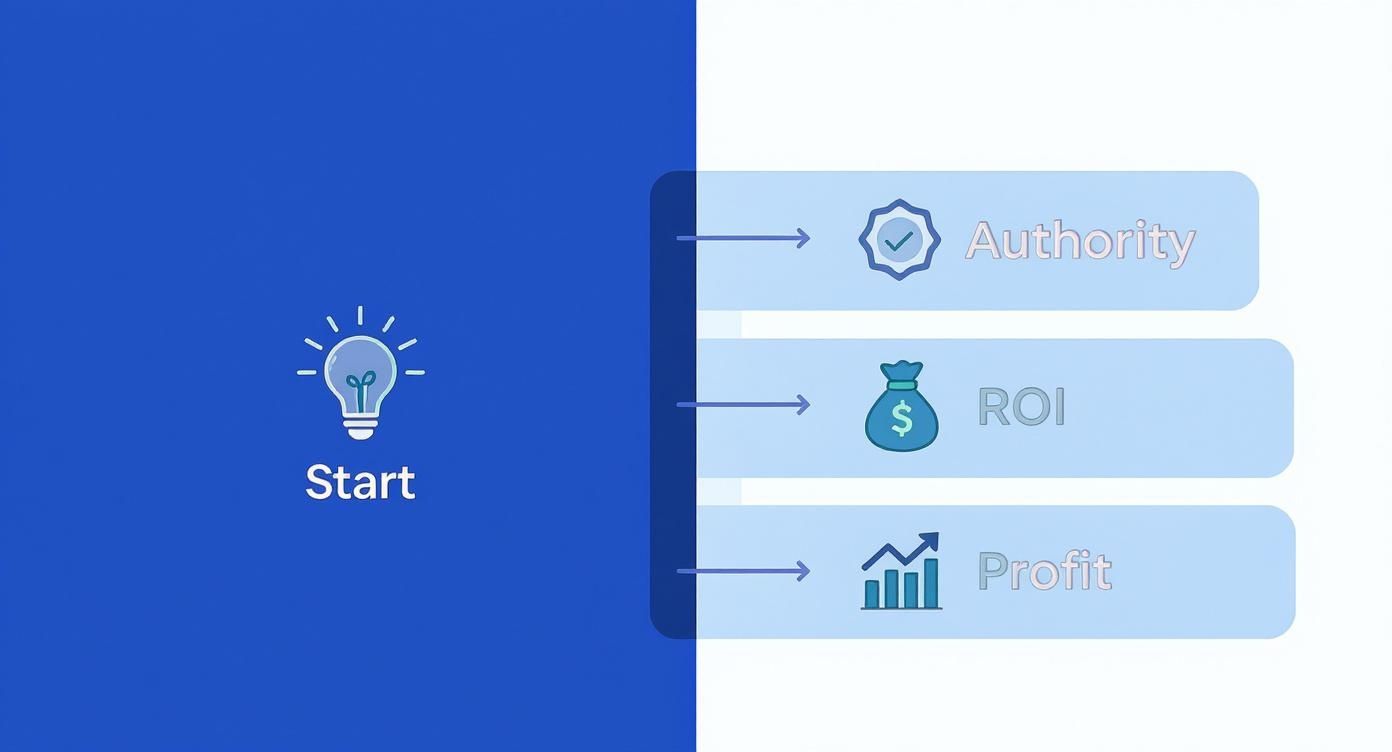
Ultimately, the right vertical is one where your core strengths perfectly line up with a clear, profitable market opportunity.
Analyze a Real-World Example
Let's look at a practical example: California's vertical farming sector. This industry is a textbook case of a vertical born from specific regional needs and technological innovation. Faced with relentless water shortages, traditional agriculture has become more and more difficult.
This created a massive opening for B2B service providers. A great success is Plenty, a vertical farming company that secured over $500 million in funding by developing highly efficient, scalable indoor farms. These farms supply over 13% of California's leafy green products—a huge number that shows just how much of the market it has captured. More importantly, these farms use 90-95% less water per tonne of produce compared to old-school methods, directly tackling the state's most urgent environmental crisis. This created a ripe opportunity for companies specializing in hydroponics, automated climate control systems, and specialized logistics.
Create a Scorable Vertical Checklist
To make your decision as objective as possible, build a weighted scorecard. This simple tool helps you get past gut feelings and compare potential verticals using consistent, data-driven criteria. It forces you to rate each potential industry against the factors that matter most to your business's success.
Here’s a simple template to get you started:
| Criteria | Weight (1-5) | Vertical A Score (1-10) | Vertical B Score (1-10) |
|---|---|---|---|
| Market Size & Growth | 5 | 8 | 6 |
| Profit Margin Potential | 5 | 7 | 9 |
| Alignment with Our Expertise | 4 | 9 | 5 |
| Competitive Intensity | 3 | 6 | 8 |
| Sales Cycle Length | 2 | 7 | 7 |
| Regulatory Complexity | 2 | 8 | 4 |
| Total Weighted Score | N/A | 155 | 145 |
In this scenario, while Vertical B offers better margins, Vertical A is the smarter overall bet because of its size, growth, and how well it matches the company's core skills. By using a framework like this, you can systematically weigh your options and pick the vertical that gives you the highest chance of success. Need help building your scorecard? Contact us for expert guidance.
Crafting Your Go-To-Market Strategy
Once you’ve pinpointed your ideal vertical, the real work begins: building a specialized plan to break in. A generic approach just won’t cut it here. You need a detailed go-to-market (GTM) strategy that speaks the unique language of your chosen industry, solves its specific operational headaches, and fits neatly into its established workflows.
This isn’t about slightly tweaking your sales pitch. It’s a full-scale reorientation of your entire commercial approach, built around the customer’s world. A well-defined plan is your roadmap, and you can dive deeper into the fundamentals by exploring our complete guide on what constitutes a powerful go-to-market strategy for B2B businesses.
That foundational knowledge is crucial before you start tailoring it to the nuances of vertical market industries. The goal is to shift from being an outsider selling a product to becoming an insider offering an indispensable solution.
Customize Your Product and Pricing
First things first: your offering needs to be more than just useful—it must be essential. This almost always means some level of product customization. Does your software need to integrate with industry-specific platforms? Does your service have to meet the stringent compliance standards found in healthcare or finance?
Aligning your product means taking a deep dive into the day-to-day realities of your target professionals. For example, logistics software for general retail is a world away from a system designed for cold chain management in the food and beverage industry. The latter needs features for temperature monitoring, spoilage prevention, and regulatory reporting that a generic solution would never include.
Your pricing has to reflect the vertical’s perception of value, too. Instead of a one-size-fits-all, per-user fee, you might find more traction with models like:
- Usage-based pricing: A perfect fit for industries with fluctuating demand, like manufacturing.
- Tiered pricing based on compliance features: This is highly attractive to clients in regulated fields like law or finance who need very specific capabilities.
- Project-based pricing: Works beautifully for service providers in verticals like construction or engineering.
By tailoring your solution to the precise needs of a vertical, you create a product that feels custom-built. This level of specialization allows companies to command premium prices, as businesses are willing to pay more for a tool that perfectly fits their unique and often complex workflows.
This focused approach transforms your product from a simple commodity into a high-value, strategic asset for your customers.
Align Marketing and Sales for Maximum Impact
A vertical GTM strategy lives or dies by the alignment between marketing and sales. Both teams have to be completely fluent in the industry's jargon, its biggest challenges, and the metrics that define success. Generic messaging will fall on deaf ears; your communication must hit on the specific pain points of industry decision-makers.
Marketing’s job is to build credibility and generate a stream of highly qualified leads. You do this by creating high-value, industry-specific content that proves you’re an expert.
- Detailed Whitepapers: Go deep on complex industry challenges and position your solution.
- In-depth Case Studies: Show exactly how you've helped similar companies get measurable results.
- Targeted Webinars: Bring in industry experts to discuss relevant trends and best practices.
Sales teams then use this content to kick off meaningful conversations. Instead of a cold call with a generic pitch, they can share a relevant case study or invite a prospect to a webinar designed for their exact role. A 2022 study by Forrester found that companies with tightly aligned sales and marketing teams see 27% faster three-year profit growth. That’s the power of a coordinated effort.

Case Study: Central Valley Logistics
Let's ground this with a real B2B example targeting California's Central Valley logistics hub. This region is an absolute powerhouse, especially in one dominant vertical market.
The Central Valley's demographic advantage is huge: the region is home to over 5.3 million people within a 50-mile radius. Within this bustling economic zone, the food and beverage industry has become the clear leader, making up 58% of all leasing activity and cementing its role in California's supply chain. You can learn more about the Central Valley's industrial market outlook on vidtech.com.
Now, imagine a B2B company selling warehouse automation technology. They would craft a GTM strategy laser-focused on this niche.
- Product Customization: Their solution would be loaded with features for refrigerated storage management, batch tracking for food safety compliance, and seamless integration with specialized transport systems.
- Vertical Messaging: All marketing content would revolve around themes like "Solving Cold Chain Challenges" or "Optimizing Produce Distribution," using language that resonates directly with food and beverage logistics managers.
- Sales Alignment: The sales team would be regulars at food industry trade shows, build relationships with agricultural co-ops, and lean heavily on case studies from other food distributors to prove their value.
By concentrating all its efforts on this single, high-value sub-vertical, the company establishes itself as the go-to expert and builds a powerful competitive moat.
Ready to craft a go-to-market strategy that penetrates your target vertical and drives real growth? Contact us today to build a specialized plan for your business.
Navigating the Risks of Vertical Focus
While going all-in on vertical market industries is a proven way to carve out a leadership position and boost profit margins, it’s a strategy that, by its very nature, concentrates your risk. Think of a master carpenter who builds exquisite furniture from a single, rare type of wood. If a blight suddenly wipes out that specific tree, their entire livelihood is on the line.
That’s the core risk of a vertical focus: you’ve put all your eggs in one basket. If your chosen industry gets hit by a recession, a regulatory shake-up, or a disruptive new technology, the shockwaves will travel straight to your business. A downturn isn’t just a distant headline; it's a direct threat to your sales pipeline.
The other major challenge is the built-in market cap. By design, you’re playing in a smaller sandbox. This sharpens your focus, but it also creates a ceiling on growth. Once you’ve captured a hefty share of your vertical, finding new avenues to scale can get tricky, potentially putting the brakes on your long-term expansion plans.
Proactive Strategies to Mitigate Risk
Facing these risks doesn’t mean you should abandon a vertical strategy. It just means you need a smart plan to insulate your business. The key is to be proactive, not reactive. You can build resilience by diversifying within your vertical and mapping out your next move into adjacent markets.
Three core strategies will help you build this resilience:
- Diversify Your Client Base: Even within a single industry, don't let one or two big fish dominate your revenue. Actively pursue a broader mix of customers—from massive enterprises to smaller, innovative firms—to spread your risk across different segments.
- Plan for Adjacent Expansion: Start identifying related verticals that suffer from similar pain points or use similar workflows. If you build a long-term roadmap to enter these neighbouring markets, you can leverage your existing expertise for future growth instead of starting from square one.
- Innovate Relentlessly: Complacency is the enemy. Continuously invest in R&D to keep your product sharp and maintain your competitive edge. This ensures you remain an indispensable partner, even when your clients are tightening their belts.
A Cautionary Tale from High-Tech Manufacturing
To see just how fast an industry-specific downturn can ripple through its suppliers, look at a recent example from California's high-tech manufacturing sector. The state’s entire manufacturing industry recently hit some serious headwinds, with the composite manufacturing index dropping from 61.6 in the first quarter to 54.9 in the second.
But the high-tech segment got hit particularly hard. Its index plummeted from 64.6 down to 50.4, signalling a steep drop in growth expectations for this critical sector. You can dig into the numbers in these economic indicators for California on chapman.edu.
For a B2B supplier serving only these high-tech manufacturers, that kind of dramatic drop would be catastrophic. A generalist supplier serving multiple industries could ride out the storm, but the vertical specialist would face an immediate and severe revenue crisis. This real-world scenario highlights why a clear risk management plan is absolutely essential when you commit to vertical market industries.
By anticipating potential downturns and building a strategy for resilience, you can reap the powerful benefits of specialization while protecting your business from the inevitable bumps in the road.
Ready to build a vertical market strategy that balances powerful focus with smart risk management? Contact us today to schedule a consultation.
Your Path to Vertical Market Leadership
Leading a vertical market doesn’t happen by accident; it’s the direct result of a strategic, almost obsessive, commitment. As we've covered, success boils down to deep industry knowledge, genuinely tailored solutions, and an unwavering focus on specific vertical market industries.
Embrace this approach, and your business can build a formidable competitive moat, command higher margins, and earn exceptional customer loyalty. The principles we've discussed are the bedrock for truly dominating your niche.
Translate Concepts into Growth
If you're ready to turn these ideas into a real growth engine for your business, the next step is to build a customized strategy. True market leadership takes more than just a great product; it demands a clear roadmap and flawless execution, from your first market analysis to the final sales pitch.
Success in a vertical market comes from becoming an indispensable partner, not just another vendor. You get there by solving specific, high-value problems that generalist competitors completely overlook, creating a bond of trust and reliance.
You can see brilliant examples of this all across the B2B world. Veeva Systems did it in life sciences, creating a CRM that handled complex regulatory needs far better than any horizontal platform could. A great success in the construction vertical is Procore, which became the undisputed leader by designing project management software specifically for the tangled workflows of contractors, owners, and subcontractors. Today, Procore is a multi-billion dollar company that manages over $1 trillion in construction volume. These companies didn't just sell to a market; they redefined it by becoming the experts.
Understanding the subtle art of the branding of services within your chosen vertical is a critical piece of this puzzle. It’s what solidifies your position as the only logical choice.
The journey to leadership is a deliberate one. It's the process of becoming the most knowledgeable, most valuable solution provider in your chosen field.
Are you ready to build the roadmap that establishes your company as a market leader? Contact our team of experts today. Let's schedule a consultation to identify your ideal vertical and craft a winning strategy.
Vertical Markets: Your Questions Answered
Pivoting to a vertical market strategy is a big move, and it naturally brings up some important questions. Getting the core concepts straight is the first step toward deciding if this powerful model is right for your business.
Here are some clear, no-nonsense answers to the questions we hear most often from B2B leaders weighing up a move into specific vertical market industries.
Vertical Versus Horizontal: What’s the Difference?
The easiest way to think about it is depth versus breadth.
A vertical market strategy means you serve one specific industry with a solution that's deeply specialized for its unique needs. A perfect example is software built just for dental offices, packed with features for insurance coding, patient charting, and appointment management that a generic CRM just wouldn't have. A great success here is Dentrix, which has captured a dominant share of the dental practice management software market.
On the other hand, a horizontal market strategy solves a common problem that exists across many different industries. Think of accounting software like QuickBooks; it’s used by everyone from retail shops and construction firms to marketing agencies. The focus is on a broad, universal function, not the specific headaches of a single niche.
Is a Vertical Strategy Right for My Business?
Going deep instead of wide is a major strategic choice. A vertical approach is probably a great fit if your business ticks a few key boxes.
First, ask yourself if your product or service can be genuinely adapted to solve the unique, high-stakes problems of a single industry. Second, be honest about whether you can commit to building the deep domain expertise needed to become a credible, trusted authority in that space.
The most successful vertical players don’t just sell a product; they become indispensable partners. A 2023 analysis showed companies with deep vertical specialization can achieve 27% faster profit growth over three years compared to their generalist counterparts, thanks to higher customer loyalty and lower acquisition costs.
Finally, you need to find a niche with significant unmet needs, where your specialized solution can deliver undeniable value that horizontal competitors simply can't match. Unsure if it's the right fit? Contact us for a strategic evaluation.
Can a Company Target Multiple Verticals?
Yes, absolutely. Targeting more than one vertical is a very common—and effective—path to growth. But the secret to getting it right is mastering them one at a time, not trying to enter several at once.
The smartest approach is to master one vertical completely. Dominate the market, perfect your product, and turn your go-to-market plan into a repeatable playbook. Once you've established undisputed leadership and a proven model, you can use that expertise to expand into a closely related, adjacent vertical. This method minimizes risk and dramatically increases your odds of replicating that initial success.
Ready to stop being a generalist and start dominating a niche? The team at B2Better has over 45 years of combined experience helping B2B companies build and execute winning strategies for vertical market industries. Contact us today for a consultation.