

Investing in the right SEO partner is no longer a "nice-to-have" for B2B success in Canada—it's a direct line to sustainable growth. This guide goes beyond the basics to show you how a dedicated seo service in canada can build long-term brand equity and generate high-quality leads from both Canada and the United States.
Why Canadian B2B Companies Need Strategic SEO

For many B2B leaders in tech, SaaS, and industrial sectors, SEO often gets filed under "marketing expense." But that perspective misses its true power as a primary driver of revenue and market authority. Strategic SEO solves a core pain point for founders and marketing leaders: it builds a predictable pipeline of high-intent prospects.
Instead of chasing cold leads, you attract buyers from Canada and the United States who are actively searching for the exact solutions you offer. This fundamental shift from outbound interruption to inbound attraction is what separates high-growth companies from the rest of the pack.
The Growing Demand for Visibility
The demand for effective SEO is exploding across the country. The Canadian Search Engine Optimization Advertising Software Market was valued at USD 5.44 billion in 2024 and is projected to skyrocket to USD 11.49 billion by 2033. This surge shows just how seriously businesses are taking this, especially B2B scale-ups in tech hubs like Kitchener-Waterloo. They're pouring resources into SEO to capture valuable leads from North American markets without the overhead of full-time hires. You can dig into the numbers in this detailed SEO market report.
This investment is paying off for companies that get it right. One of our clients, a Canadian manufacturing firm, was struggling to reach procurement managers in the US. By developing a content strategy targeting highly specific technical queries, they saw a 150% increase in qualified organic leads from their target American states within 12 months, directly leading to two major contracts. This success story showcases how targeted SEO can break into lucrative international markets.
SEO isn't about gaming the system. It's about creating a valuable, user-focused digital experience that Google—and your future customers—reward. It builds brand equity that pays dividends long after a paid ad campaign runs out of budget.
Your Roadmap to Choosing a Partner
This guide provides a clear, actionable roadmap for selecting a partner who genuinely understands the nuances of both the Canadian and US markets. We'll cover everything you need to know to make a confident decision.
- Define Clear Goals: Learn to translate your business objectives into measurable SEO KPIs.
- Evaluate Your Options: Understand the critical differences between an agency and a Fractional CMO.
- Ask the Right Questions: Use our checklist to vet potential partners and spot red flags.
- Measure What Matters: Calculate the true ROI of SEO, moving beyond simple traffic numbers.
Ready to build a powerful engine for organic growth across Canada and the US? Contact us to discover how a strategic SEO partner can transform your B2B lead generation.
Translating Business Goals into SEO Metrics
Before you even think about hiring an SEO service in Canada, you need to get brutally honest about what success actually looks like for your company. It’s easy to say you want "more traffic," but that's a vanity metric. A real win is connecting search performance directly to what your CFO cares about: lead generation and revenue from your target markets in Canada and the United States.
Without that clarity, you’re just throwing money at a wall. You might get glowing reports full of impressive traffic spikes, but the sales needle won't move an inch. The goal isn't just to be found; it's to be found by the right people—the ones actively looking for the exact solution you provide. This all starts by translating those broad business objectives into sharp, measurable SEO key performance indicators (KPIs).
From Business Aims to Search Objectives
Think about your big-picture goals. Are you trying to speed up your sales pipeline? Break into a new market in the US? Maybe you just need to bring down your customer acquisition cost. Each of these goals demands a completely different SEO objective. A partner worth their salt gets this; they build a strategy around your business, not just around Google's latest algorithm update.
Let's look at a real-world example. We worked with a B2B SaaS company in Ontario whose main goal was to increase demo requests by 30% within a year from both Canadian and US prospects. Their SEO objective wasn't just "rank for SaaS keywords." It was surgical: "Increase qualified organic traffic to our demo booking page by 50% and hit a 5% conversion rate on that page." That level of specificity makes success tangible and keeps your SEO partner accountable.
Here’s another success story. An industrial firm in Alberta wanted to expand into the United States, targeting procurement managers in specific industrial hubs. Their SEO objective became: "Achieve top-five rankings for a curated list of 20 high-commercial-intent keywords in key US regions, leading to a 40% increase in MQLs from organic search." This clear, measurable goal drove their strategy and delivered exceptional results.
Your SEO brief shouldn’t be a keyword list; it should be a business problem. A great partner uses SEO to solve that problem, drawing a straight line from search rankings to revenue.
Key Performance Indicators That Actually Matter
Once you have your objectives locked down, you need the right KPIs to track progress. Getting distracted by overall traffic numbers is a classic rookie mistake. Instead, you need to zero in on the data that signals real business impact.
Focus on these:
- Organic Conversion Rate: This is the big one. It's the percentage of visitors from search who actually do something valuable, like fill out a contact form or download a white paper. If this number is going up, you know you're attracting better-quality traffic from your target regions.
- Commercial-Intent Keyword Rankings: Don't just track any keyword. Monitor your position for terms that scream "I'm ready to buy," like "B2B accounting software providers in Canada" instead of "what is accounting." Ranking for these terms has a direct impact on the quality of your leads.
- Lead Quality from Organic Search: This requires working with your sales team to score the leads coming from organic search. A well-executed SEO campaign can deliver a 14.6% close rate, which blows traditional outbound marketing out of the water and is crucial for attracting high-value clients from the US and Canada.
By defining these metrics before you start your search for a partner, you're building a precise roadmap for success. You’re not just hiring an SEO service; you're investing in a measurable engine for growth.
Ready to define your SEO metrics and find a partner who delivers real results in Canada and the US? Contact us today to build a strategy that aligns with your business goals.
Choosing Your SEO Partner: Agency vs. Fractional CMO
Deciding on the right SEO partner is one of the most important calls a growing B2B company in Canada will make, especially when targeting growth in the United States. Your choice usually boils down to two main paths: bringing on a traditional SEO agency or integrating a Fractional Chief Marketing Officer (CMO) into your leadership team.
Each model has its place, and the best fit really depends on your company’s current stage, internal resources, and long-term strategic goals for North American expansion.
Think of a traditional agency as the go-to for executing a well-defined project. If you already have a clear strategy and just need a team to handle the heavy lifting of keyword research, link building, and content creation, an agency can be incredibly efficient. They come with specialized skills and established processes ready to deploy.
But what if you need more than just execution? This is where a Fractional CMO shines. This model is perfect when you're looking for senior-level strategy, deep integration with your sales and product teams, and holistic marketing leadership that ties SEO directly to bigger business objectives across both Canadian and US markets.
When An Agency Makes Sense
An SEO agency is often the right move when your internal team has already done the strategic heavy lifting and mapped out a clear direction. They’re brilliant at plugging into an existing plan and managing the day-to-day tactical work needed to hit specific, predetermined goals.
You might lean toward an agency if you need:
- Task Execution: You have a plan to build out a specific content pillar or run a technical audit and just need the hands to get it done.
- Specialized Manpower: You don't have the in-house resources for labour-intensive tasks like acquiring high-quality backlinks or performing ongoing site maintenance.
- Project-Based Support: Your need is for a defined period, like a one-time website migration or a six-month push to rank for a new product category.
The Strategic Edge Of A Fractional CMO
A Fractional CMO, on the other hand, operates as a genuine extension of your leadership team. They don’t just take orders; they help set the entire marketing direction. They are accountable for the why behind the SEO strategy, not just the what. This model is a game-changer for companies that lack senior marketing leadership but aren't quite ready for a full-time executive hire.
For example, one of our B2B SaaS clients saw a 200% increase in qualified leads from the United States after moving from a task-focused agency to our strategic Fractional CMO model. The agency was hitting all its keyword targets, but the leads just weren't converting. By integrating deeply with their sales team, we pinpointed higher-value keywords and completely reshaped the content to solve core customer pain points. That's what turns traffic into a tangible sales pipeline.
This decision tree helps visualize how your core business goals—whether it’s generating leads, driving revenue, or building authority—should guide your choice of SEO partner.
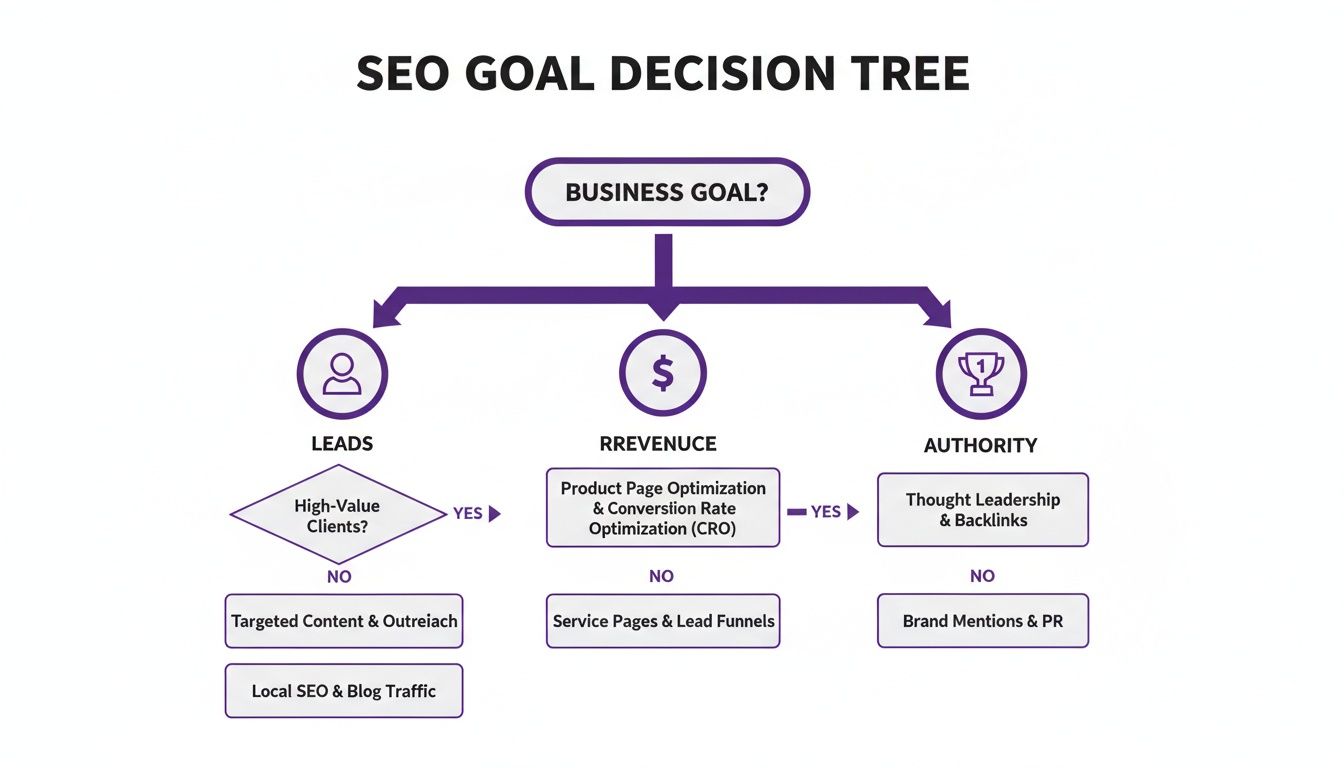
The key takeaway here is that the right partnership model is directly tied to the business outcome you're chasing. When you're assessing potential partners, it's vital to review their core offerings, like their approach to Search Engine Optimization services, to make sure they align with your business goals. You can also get a feel for the different types of support offered by a B2B marketing agency in Canada.
To make the decision clearer, let's break down the key differences side-by-side.
Comparing SEO Agency vs Fractional CMO for B2B Growth
This table provides a side-by-side comparison to help you decide which SEO partnership model best suits your strategic needs, budget, and long-term goals.
| Factor | Traditional SEO Agency | Fractional CMO Partner |
|---|---|---|
| Primary Role | Tactical execution and task management | Strategic leadership and business integration |
| Focus | Delivers specific SEO outputs (e.g., content, links) | Drives business outcomes (e.g., pipeline, revenue) |
| Best For | Companies with a defined strategy needing manpower | Companies needing to build or lead a strategy |
| Integration | Operates as an external vendor | Functions as part of the leadership team |
| Accountability | Responsible for hitting activity-based KPIs | Accountable for achieving business-level goals |
| Cost Model | Typically a fixed-scope monthly retainer | Flexible retainer based on strategic involvement |
Ultimately, the choice comes down to a simple question: do you need a doer or a driver? If you’re looking for a partner to build, lead, and own your entire growth strategy, a Fractional CMO is the clear winner. Contact us to discuss which model is right for your goals in Canada and the US.
Your Vetting Checklist for Canadian SEO Providers
Alright, you've outlined your goals and have a good idea of the kind of partnership you need. Now comes the critical part: actually vetting potential partners. This is where a sharp, insightful process separates a genuine strategic ally from just another vendor cashing a cheque.
Simply asking, "Can you get us to number one?" is a rookie move. You need to dig much deeper to find a true expert who understands the nuances of the Canadian B2B market and how to attract valuable traffic from the United States.
Finding the right SEO service in Canada is about asking questions that reveal their strategic depth, their real-world experience, and their grasp of the unique dynamics between Canadian and US markets. This checklist will help you cut through the sales pitch and see what they’re really made of.
Questions That Reveal Strategic Depth
Generic, fluffy answers are a massive red flag. You're looking for a partner who can speak to your specific business challenges with clarity and confidence. Their responses should prove they get B2B marketing, not just technical SEO jargon.
Kick things off with these essential questions:
- "Can you walk me through a detailed case study from a Canadian B2B client that successfully attracted US customers?" This isn't optional. It’s the ultimate proof that they have relevant experience and can deliver results for a company like yours. A great example is a Toronto-based software firm that saw a 300% increase in organic demo requests from the US after their partner built a content strategy around specific industry pain points.
- "How do you adapt your strategy for regional nuances between, say, Ontario and California?" This question tests their actual understanding of cross-border markets. A smart answer will touch on local search intent, different regional terms, and how they build authority with location-specific industry publications in both countries.
- "How will you integrate your SEO efforts with our sales team's objectives to improve lead quality from Canada and the US?" The best SEO partners get that their work is meant to fuel sales, period. They should be able to explain how they'll track lead quality and use feedback from your sales reps to refine keyword targeting and content.
The whole point of these questions isn't to test their SEO knowledge—it's to test their business acumen. A top-tier partner connects every SEO action back to a tangible business outcome, like better leads or more revenue.
Critical Red Flags to Watch For
Just as important as asking the right questions is knowing how to spot the warning signs. Some providers will promise you the world but deliver very little. You need to be wary of anyone who makes grand guarantees or lacks transparency.
Here are the biggest red flags to look out for:
- Guaranteed Rankings: No one can guarantee a #1 ranking on Google. Ever. This is an immediate sign of a provider who either doesn't understand how search engines work or is perfectly willing to mislead you.
- A Secret "Proprietary" Process: A trustworthy partner will be able to explain their methodology clearly. Hiding behind vague terms like "secret sauce" is often a cover for using outdated or risky black-hat techniques that could get your site penalised.
- Lack of Transparent Reporting: If they can't show you exactly what they're doing and how it's impacting your bottom line, walk away. Reporting should focus on the KPIs you defined earlier, like organic conversion rates and the quality of leads being passed to sales.
Canadian businesses are catching on to the power of SEO. In fact, 46.2% of all digital marketing revenue now comes from search engine optimization, making it a true cornerstone for B2B growth. This is no surprise, considering Google processes 90.66% of all searches in Canada. You can dig into more Canadian SEO and content marketing statistics in this 2024 report.
With so much at stake, choosing the right partner is absolutely critical.
Ready to find a strategic partner who can answer these questions with confidence? Contact us to see how our proven B2B expertise can drive measurable growth for your business.
Understanding SEO Pricing and Measuring True ROI
Let's cut through the noise: figuring out the cost of a professional SEO service in Canada is the first step, but it's not the most important one. The prices you see aren't just pulled out of a hat; they're a direct reflection of the work it takes to get you noticed in a crowded North American B2B marketplace. Knowing the different ways agencies charge helps you set the right expectations from the get-go.
Most SEO providers in Canada work with one of three common models. Monthly retainers are the standard for any serious, long-term strategy, covering everything from content creation and link building to technical site health. Project-based pricing is your go-to for specific, one-off jobs like a website migration or a deep-dive audit. Finally, hourly rates are usually reserved for consulting or quick, targeted tasks.
For a deeper look at what goes into these numbers, our detailed guide on pricing for SEO services breaks it all down.
From Cost to Value
The single most important mindset shift is moving from "How much does this cost?" to "What value will this create?" Let's be blunt: a cheap SEO provider is almost always a bad investment. A true partner is obsessed with delivering a return on your investment (ROI) that makes their monthly fee look like a rounding error.
This is where the magic happens. You stop seeing SEO as an expense on a spreadsheet and start treating it for what it is: a powerful, revenue-generating engine for your business. To get there, you need to track the metrics that actually matter.
Calculating Your Real SEO Return
Measuring the true ROI of your SEO efforts means drawing a straight line from their activities to your bank account. Forget vanity metrics like keyword rankings and raw traffic numbers. Instead, let's talk about the figures that signal real business growth across Canada and the US. A key part of vetting any SEO partner is understanding how they measure and report on their work; top-tier agencies are experts at creating transparent SEO reports that prove their worth.
Here are the only two metrics you really need to care about:
- Customer Acquisition Cost (CPA) from Organic: This is simple: how much did you spend on SEO to land one new customer? For one of our clients in the industrial sector targeting the US market, we drove their CPA from organic search down by 75% compared to their PPC campaigns. We did it in just nine months.
- Customer Lifetime Value (CLV) by Channel: This tells you the total revenue a customer will generate throughout their entire relationship with you. You'll almost always find that customers who come from organic search have a higher CLV. Why? Because they weren't interrupted with an ad; they were actively searching for a solution and found you as the perfect answer.
An effective SEO strategy doesn't just bring you leads; it brings you better, more profitable customers. When your CPA from organic is significantly lower than paid channels, you've built a sustainable growth machine.
By zeroing in on these business-critical numbers, you can confidently gauge the performance of your SEO investment. This data-first approach transforms SEO from a marketing budget line item into a proven driver of profitability.
Ready for a transparent, results-focused proposal that outlines your expected ROI for the Canadian and US markets? Contact us to discuss your goals.
Why a US-Centric SEO Strategy Just Won't Cut It in Canada
Let's be blunt: a generic, one-size-fits-all SEO strategy is doomed to fail in Canada. The Canadian market has its own search behaviours, linguistic nuances, and competitive pressures that demand a specialized approach. Simply copy-pasting a US-centric strategy is a surefire way to waste your budget and miss massive opportunities to attract traffic from both Canada and the US.
Success here requires a deep, hands-on understanding of these differences. It means recognizing that simply targeting google.ca is just the first step. The real work involves tailoring your entire strategy—from content and keywords to technical signals—to resonate with a Canadian audience and outperform savvy local competitors. This is where a partner with firsthand market knowledge becomes your most valuable asset.
Take a real-world example: a Montreal-based B2B software company saw a 45% increase in lead quality from its Canadian audience after their SEO partner implemented hreflang tags to properly differentiate their English and French-Canadian content. This seemingly small technical fix ensured the right users landed on the right pages, dramatically improving their user experience and conversion rates.
Mastering Local and Bilingual Search
Canada is not a monolith. An effective SEO strategy must account for both national scope and regional specificity, especially for B2B companies targeting specific hubs like Kitchener-Waterloo or entire provinces like Ontario. Local SEO isn’t just for brick-and-mortar stores; it’s critical for B2B service providers looking to build a strong regional presence.
This means mastering your Google Business Profile, building citations in reputable Canadian directories, and creating content that speaks to local pain points. A B2B logistics company in Alberta, for instance, might target keywords related to the oil and gas industry, while a tech firm in Toronto would focus on the financial services sector.
On top of that, Canada's bilingualism presents both a unique challenge and a massive opportunity. Properly managing English and French content is non-negotiable for any business aiming for national reach. This goes far beyond simple translation; it requires cultural adaptation to ensure your messaging connects authentically in both languages.
A partner providing a top-tier seo service in canada doesn't just translate keywords; they understand the cultural context behind them. This ensures your brand speaks fluently to customers in both English and French Canada, building trust and authority across the board.
The Competitive Edge of Local Expertise
The fight for local visibility is fierce. The local SEO software market in Canada is projected to grow at a CAGR of 11.3% from 2025 to 2031, a clear sign of how intensely small and medium businesses are battling giants for a spot in local search. With Google dominating 91.47% of the search market and 46% of all queries having local intent, ranking for "near me" searches drives real business. For a deep dive into these trends, you can read the full research on Canada's local SEO market.
Understanding the Canadian market is also essential for attracting US customers. Many American B2B buyers actively search for Canadian partners, and a properly optimized site signals that you are a credible, accessible option. To learn more about this, explore our insights on search engine marketing in Canada.
Ultimately, navigating the Canadian SEO landscape requires a partner who lives and breathes this market.
Ready to build an SEO strategy that truly understands Canadian and US buyers? Contact us to connect with experts who can put your B2B business on the map.
Your Top SEO Questions Answered
When B2B leaders start exploring SEO services in Canada to expand their reach in North America, a few key questions always come up. Here are the straight answers to the most common ones we hear, designed to help you set clear expectations and make a smarter decision.
How Long Does It Take to See SEO Results in Canada?
Let's be direct: while some technical fixes can give you a small boost within a few weeks, real, meaningful B2B SEO results take time. You should expect to see a steady flow of organic leads and strong rankings for valuable keywords in about 6 to 12 months.
Why so long? Because good SEO isn't about quick tricks. It’s a methodical process of developing a deep strategy, creating genuinely useful content for a niche audience, and earning real authority in your industry across Canada and the US.
Success stories are almost always the result of sustained, consistent effort. For example, one of our Canadian B2B tech clients saw a 78% year-over-year increase in organic demo requests from the United States, but the truly significant growth kicked in between months nine and twelve.
SEO is a long-term investment in building a valuable asset for your business. It's more like planting an orchard than flipping a switch; the initial work is foundational, and the real rewards compound over time.
Do I Need Separate SEO Strategies for Canadian and US Markets?
Yes, absolutely. While there’s some overlap, treating Canada and the US as a single market is a common mistake. Canadian and American search behaviour, terminology (think ‘organisation’ vs. 'organization'), and local search signals are all distinct. A one-size-fits-all strategy usually ends up feeling generic and fails to connect deeply in either country.
An effective cross-border approach involves:
- Using
hreflangtags to signal to search engines which regional content to show, ensuring visitors from both countries get the right experience. - Building authority with relevant, high-quality publications and industry groups in both Canada and the United States to maximize visibility where it counts.
- Adapting your content to reflect regional language and interests, which is crucial for boosting engagement and turning visitors into leads.
This targeted approach is the only way to attract high-quality traffic from both sides of the border.
What Makes B2B SEO Different from B2C SEO?
The difference is fundamental. B2B SEO targets a much smaller, highly specialized audience caught up in a long, considered sales cycle. Instead of chasing broad consumer keywords, the focus is on niche, high-intent phrases tied to complex business problems and professional solutions.
The primary goal isn't just traffic; it’s about generating qualified leads that your sales team can actually close. This changes the content you create. In-depth case studies, technical white papers, comparison guides, and webinars become your most powerful assets—far more important than the typical content you see in the B2C world.
Ultimately, B2B SEO success isn't measured by website visitor counts. It’s measured by lead quality and its direct impact on your revenue pipeline.
Ready to partner with a B2B marketing consultancy that builds SEO strategies designed for measurable growth in Canada and the United States? B2Better acts as your Fractional CMO partner, delivering clear strategy and expert execution. Contact us today to get started.