

Trying to pin down the true cost of SEO services in Canada can feel a bit like asking, "How much does it cost to build a house?" The answer is always: it depends.
For a comprehensive monthly retainer, most Canadian businesses should expect to invest between $1,500 and $5,000 per month. That said, simpler projects or hourly consulting can start at a few hundred dollars, while ambitious national campaigns can easily top $10,000 a month.
Demystifying Your SEO Investment
Investing in search engine optimization isn't like buying a piece of software off the shelf. It's much more like commissioning a custom build, where the final price tag directly reflects your business goals, how fierce your competition is, and the current state of your website. A one-size-fits-all price just doesn't exist because every company's starting point and destination are different.
Think of it this way: a local dental clinic in Kitchener that wants to attract patients within a 10-kilometre radius has a completely different set of needs—and a different budget—than a national B2B software company targeting enterprise clients across Canada. The first requires a sharp, focused local strategy. The second needs a complex, authority-building content engine.
Understanding the Financial Landscape
To get a clearer picture, it helps to look at what most businesses actually spend. The chart below gives you a good sense of the common pricing tiers you'll come across, from smaller packages for local businesses to more significant project-based investments.
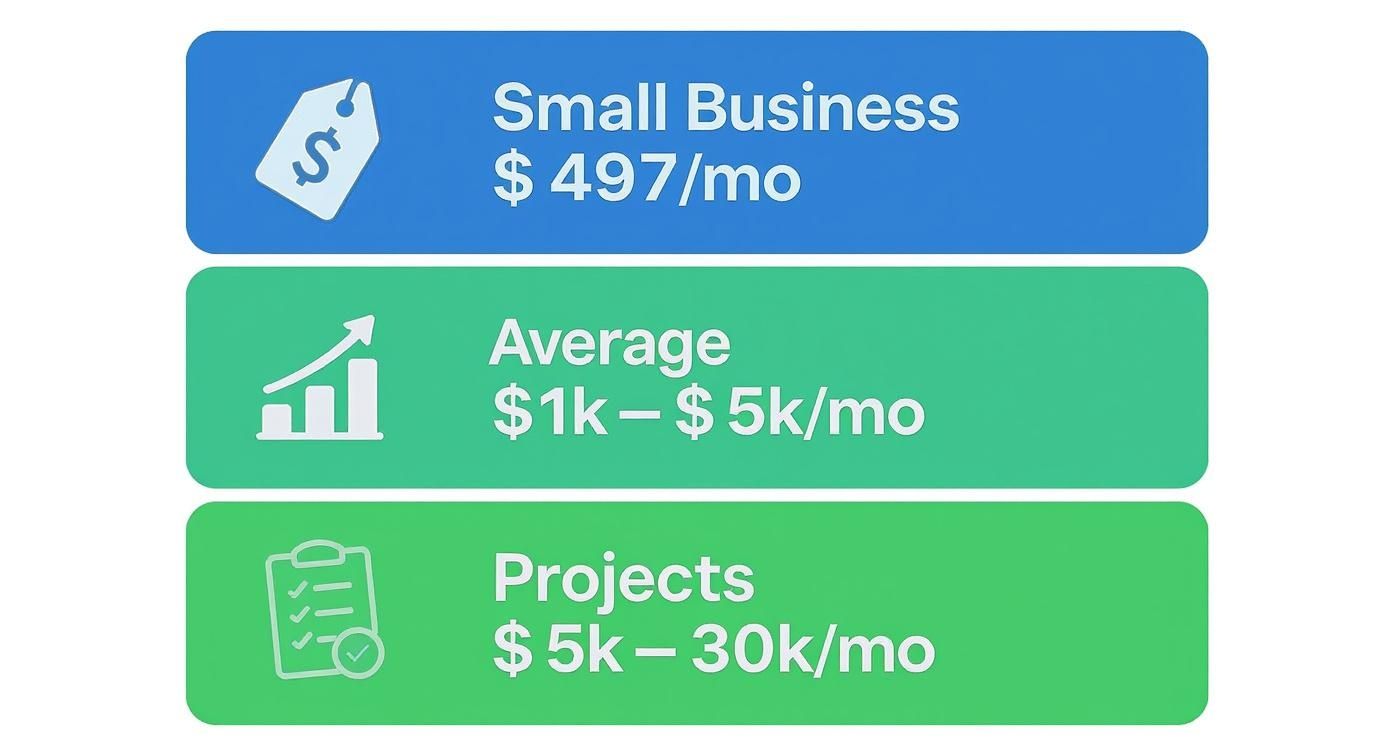
As you can see, while basic services are out there, most businesses land in the $1,000 to $5,000 per month range to see meaningful, sustained growth.
This is the sweet spot for getting real results. Industry data consistently shows a strong link between budget and satisfaction. In fact, businesses investing only $500 per month are 75% more likely to be unhappy with their outcomes than those with bigger budgets.
Why the gap? It comes down to the depth of work involved. A proper strategy includes technical audits, consistent content creation, and strategic link building—where a single high-quality guest post can cost anywhere from $220 to $609. You can read the full analysis on 2025 SEO pricing trends to see how these investment levels directly impact success.
SEO isn't just another expense; it's an investment in a long-term business asset. A well-run campaign builds a predictable pipeline of qualified leads that pays you back for years. That's a world away from paid ads, which disappear the second you stop paying.
We saw this firsthand with one of our clients, a B2B tech firm. They saw a 320% increase in organic demo requests within nine months after we aligned their SEO investment with their aggressive growth goals. That didn't happen by accident. It was the direct result of a properly funded strategy that covered technical optimization, high-value content, and authoritative backlinks. Their story proves a key point: the cost of SEO should always be weighed against the potential return.
How Different SEO Pricing Models Work

The next step in making sense of SEO costs is to get familiar with how agencies and consultants actually structure their fees. Just like different business goals demand different strategies, they also fit better with certain payment models. Picking the right one means your investment is predictable, efficient, and tied directly to what you’re trying to achieve.
Let’s unpack the four main models you’ll come across. Each one offers a different spin on partnership, budgeting, and the scope of work.
The Monthly Retainer Model
The most common arrangement in the SEO world is the monthly retainer. This is a straightforward model where you pay a fixed fee each month for an ongoing, agreed-upon set of services. Think of it as having an expert extension of your marketing team on call, constantly working to improve your online presence.
This consistency is exactly why it's so popular. SEO isn’t a one-and-done task; it’s a long-term game. A monthly retainer provides the sustained effort required for creating content, performing technical upkeep, and building authority over time. For example, a national e-commerce brand would use a retainer to steadily build organic traffic, ensuring they dominate search results during peak shopping seasons like Black Friday. This steady investment compounds, building a powerful business asset. One recent survey found that organic search drives 53% of all website traffic—way more than paid search. This really highlights the immense value of a consistent, long-term strategy, which the retainer model is perfectly built to support.
The Project-Based Pricing Model
If you have a specific, one-off goal with a clear beginning and end, project-based pricing is an excellent fit. This model involves a single, upfront cost for a well-defined scope of work. It’s perfect for initiatives like a website migration, a deep-dive technical audit, or a targeted content marketing campaign.
For instance, a B2B SaaS company preparing to launch a new product feature could hire an agency for a three-month content blitz. The project would focus on creating a cluster of articles, guides, and case studies to build topical authority and capture search interest right out of the gate. Once the project is done, the engagement ends, giving you cost certainty and a clear deliverable.
A well-defined project can deliver a significant, targeted impact. It’s a strategic injection of expertise designed to achieve a specific outcome, like fixing critical technical issues or establishing a foundational content library before moving to a retainer.
This approach offers total budget clarity and is great for businesses that aren’t ready for a long-term commitment but need to tackle a pressing SEO challenge or opportunity. For example, a targeted technical audit project helped an enterprise client identify and fix critical crawlability issues, leading to a 25% increase in indexed pages and a subsequent boost in organic traffic within two months.
The Hourly Consulting Model
Hourly consulting gives you direct access to high-level expertise for specific tasks or strategic guidance. You pay an SEO expert for their time, usually for things like strategy workshops, training your in-house team, or troubleshooting a complex technical problem that has everyone else stumped.
This model is less about hands-on execution and more about tapping into senior-level insight on an as-needed basis. A startup founder might hire a consultant for a few hours to validate their keyword strategy or to get a second opinion on an agency’s proposal. It's a flexible way to get top-tier advice without a major financial commitment.
The Performance-Based SEO Model
Performance-based SEO, sometimes called pay-for-performance, links payment directly to results. This could mean paying a percentage of revenue generated from organic search or a bonus for hitting certain ranking milestones. On the surface, it sounds like a no-risk deal.
However, this model is less common and often comes with some serious strings attached. The focus can narrow to short-term metrics that are easy to manipulate, rather than sustainable, long-term growth. Real SEO success is built on a foundation of technical health, quality content, and brand authority—things that are tough to tie to a simple performance fee.
While it can sound appealing, it’s critical to ensure the agreement promotes healthy, ethical SEO practices that build real business value, not just vanity metrics. For most businesses, a retainer or project-based model provides a more balanced and strategic partnership.
Feeling unsure which model is right for you? Contact us today for a complimentary strategy session, and we’ll help you map your business goals to the perfect SEO investment structure.
Key Factors That Determine Your SEO Cost
Ever get two SEO quotes for what looks like the same service, but one is $1,500 a month and the other is $7,000? That gap isn’t random. It’s a direct reflection of your business’s unique situation—your goals, your industry, and where you’re starting from.
Understanding what drives these costs is crucial. It changes the conversation from a simple price comparison to a strategic discussion about real value and tangible outcomes. Think of it like getting a car serviced: a new vehicle might just need a quick tune-up, but a vintage classic could require a full engine rebuild. Your website's current health and future ambitions dictate the level of work required.
Your Business Goals and Scope
The single biggest factor shaping your SEO cost is the scale of your ambition. Are you a local plumber in Calgary trying to own the map pack, or are you a national SaaS company aiming to unseat industry giants across Canada? These two scenarios demand wildly different levels of effort.
A local campaign zeroes in on geographic keywords and optimizing your Google Business Profile. A national or international campaign, on the other hand, needs a much bigger playbook. We’re talking about competing for fiercely difficult keywords, producing huge volumes of authoritative content, and building a backlink profile that screams credibility to search engines.
- Local SEO: Tightly focused on a city or region, usually with a smaller, highly targeted keyword set.
- National SEO: A much broader scope, targeting high-volume keywords against a sea of well-funded competitors.
- E-commerce SEO: Involves optimizing thousands of product pages, wrestling with complex site structures, and solving unique technical puzzles.
One of our local service clients, for example, saw a 400% jump in qualified leads from a laser-focused local SEO strategy. That success came from putting resources exactly where they mattered for their market, proving that aligning scope with goals is everything.
The Competitiveness of Your Industry
The industry you operate in plays a massive role in what you’ll pay. If you’re in a cutthroat sector like finance, law, or B2B software, you’re not just up against a few local shops. You’re fighting industry titans with deep pockets and years of established domain authority.
Breaking into a crowded market takes a more aggressive, sustained push. With 53% of all website traffic coming from organic search, it’s a battleground you can’t afford to lose. To carve out a meaningful slice of that traffic, your SEO partner will need to pour more time and resources into:
- Deep-dive competitor analysis to find cracks in their armour.
- Creating genuinely superior content that cuts through the noise.
- Building high-authority backlinks to signal trust and expertise.
On the flip side, a business in a niche market with little competition can often see huge results with a more modest investment because the barrier to entry is just so much lower.
Your Website's Current Health
Where your website is today is a critical cost driver. A brand-new site is a blank slate—which can be great—but it also means building authority from ground zero. An older site might have some authority baked in, but it could also be dragging around years of technical debt, thin content, or even a past penalty from Google.
A comprehensive technical audit is the first step in any legitimate SEO engagement. It uncovers underlying issues like slow page speed, broken links, or crawlability problems that can sabotage even the best content strategy. Fixing these foundational problems is essential for long-term success.
If your site needs a major technical overhaul or a big content cleanup before any new strategies can even get off the ground, that work will naturally be reflected in the initial search engine optimization services cost. For a deeper look at the foundational elements we check, take a look at our guide on how to improve your SEO.
A website in good shape can hit the ground running, letting the budget focus immediately on growth activities like creating content and building links. But if your site needs a full restoration first, the initial investment will be higher.
Ready to understand what factors are shaping your SEO potential? Contact us for a free, no-obligation assessment of your website's health and a clear roadmap for growth.
Choosing Your SEO Partner: Agency vs. Freelancer vs. In-House
Figuring out your budget is only half the battle. The next big question is who will actually do the work. This decision is critical.
The partner you pick—whether it's an agency, a freelancer, or an in-house hire—will shape your results, your costs, and how quickly you can scale. Each route brings its own distinct pros and cons to the table.

Think of an SEO agency like hiring a full-service construction crew. You get a project manager, architects, electricians, and plumbers all under one roof, ready to tackle anything. It’s a way to access a diverse, specialized team without the headache and overhead of hiring each person individually.
A freelancer, on the other hand, is like hiring a master craftsperson. They offer deep, focused expertise in one specific area, like technical SEO or link building.
And an in-house team? They are the dedicated stewards of your brand's growth, offering unmatched alignment with your company's mission.
Let's break down when each one makes the most sense.
The Case for an SEO Agency
For businesses that need a comprehensive strategy and the ability to scale, partnering with an SEO agency is often the smartest move. Agencies bring a whole team of specialists to your project—from technical analysts and content writers to link-building pros—making sure no part of your SEO is left behind.
This breadth of knowledge is a huge advantage. A recent report found that 91% of marketers confirmed SEO had a positive impact on their website's performance, a result that usually comes from tapping into a wide range of skills. We saw this firsthand with one of our B2B SaaS clients. They achieved a 175% increase in organic trial sign-ups in just six months because our multi-disciplinary team could overhaul their technical foundation, launch a content strategy, and build authoritative backlinks all at the same time.
Agencies also give you scalability. As your needs grow, they can simply assign more resources to your campaign without the long, painful process of hiring new staff.
The Appeal of a Freelance SEO Expert
Hiring a freelance SEO expert is a fantastic option for businesses with very specific needs or those who want a more personal, hands-on approach. Freelancers often bring deep, niche expertise, making them perfect for targeted projects or for acting as a specialized extension of your current team.
Because they have lower overhead, a freelancer’s search engine optimization services cost is typically more accessible. They’re perfect for plugging a specific knowledge gap. For instance, you might hire a technical SEO freelancer for a complex site migration or a link-building specialist for a focused outreach campaign. This lets you access senior-level talent without the long-term commitment of an agency retainer or a full-time hire.
If you're considering this route, our guide on 12 ways to hire an SEO expert is a great resource to walk you through what to look for.
Building an In-House SEO Team
Bringing your SEO in-house offers the ultimate level of integration and brand alignment. An internal team lives and breathes your company culture, products, and customers every single day. This deep immersion can lead to a highly focused and agile SEO strategy that’s perfectly in sync with your other marketing efforts.
But this path also comes with the highest cost and management overhead. Building a capable team requires a serious investment in salaries, benefits, training, and expensive SEO tools.
An effective in-house SEO team isn't just one person. It often requires a strategist, a content creator, and a technical specialist to cover all the bases, which can quickly become a six-figure annual investment.
This option is best suited for larger, more established companies that have the resources and long-term vision to support a dedicated internal function. For most B2B startups and scale-ups, partnering with an agency or a freelancer provides a more cost-effective and immediate path to expertise.
Comparing SEO Providers: Agency vs. Freelancer vs. In-House
Choosing the right partner depends entirely on your company's specific goals, resources, and culture. There's no single "best" answer, only the best fit for you. This table breaks down the key differences to help you decide.
| Consideration | SEO Agency | Freelance SEO | In-House Team |
|---|---|---|---|
| Expertise | Broad team of specialists (tech, content, link building) | Deep expertise in a specific niche (e.g., technical SEO) | Deep brand and product knowledge |
| Cost | Mid-to-high (retainer-based) | Low-to-mid (project or hourly rates) | Highest (salaries, benefits, tools) |
| Scalability | High; can easily add resources as needed | Limited; dependent on one person's capacity | Moderate; requires new hires to scale |
| Integration | Good; dedicated account manager syncs with your team | Varies; depends on freelancer's process | Excellent; fully embedded in the company |
| Best For | Companies needing a comprehensive, scalable strategy | Businesses with specific needs or project-based work | Large companies with the budget for a dedicated team |
Ultimately, the right choice balances your need for specialized skills with your budget and long-term growth plans. An agency offers a powerful, all-in-one solution, a freelancer provides surgical precision, and an in-house team delivers unparalleled focus.
Unsure which path is right for your business? Contact us for a free consultation to discuss your goals and find the perfect partnership model.
Measuring the True Return on Your SEO Investment
It's a common mistake to see the search engine optimization services cost as just another line item expense. But the most successful businesses don't see it that way. They reframe it as a strategic investment in a revenue-generating asset. When you invest in SEO, you're not just buying clicks; you're building a sustainable pipeline of qualified traffic that pays dividends for years to come.
Shifting this perspective is crucial. Unlike paid advertising, which vanishes the moment you stop paying, a well-executed SEO strategy builds compounding value. Every piece of content, every backlink, and every technical fix strengthens your digital foundation, making it easier to attract future customers without a direct cost per click.
Connecting SEO Efforts to Bottom-Line Results
To truly grasp the value, you have to connect SEO activities directly to the business metrics that matter. This means moving beyond simple traffic numbers and focusing on lead quality, conversion rates, and, most importantly, Customer Lifetime Value (CLV).
For instance, one of our clients, a local service business, initially hesitated at the proposed investment. After we rolled out a targeted local SEO strategy, they saw a remarkable 400% increase in qualified leads in just ten months. This wasn't just about more website visitors; it was about attracting the right visitors who were ready to become customers.
Measuring the ROI of SEO requires looking at the entire customer journey. A single keyword ranking on page one can generate hundreds of qualified leads over its lifetime, each with the potential to become a long-term, high-value client.
This approach transforms the conversation from "How much does SEO cost?" to "How much revenue can SEO generate?" It gives you the clear data needed to make a compelling business case, proving how a calculated investment builds a powerful, long-term growth engine.
A Simple Framework for Calculating SEO ROI
You don't need a complicated formula to calculate your potential return. A straightforward approach involves understanding a few key metrics and how they all connect. By mapping these out, you can project the financial impact of improved organic performance.
Here’s a basic framework to get you started:
- Estimate Traffic Growth: Project a conservative increase in monthly organic traffic based on your SEO strategy.
- Calculate New Leads: Apply your website’s current lead conversion rate to that projected traffic increase.
- Determine New Customers: Use your historical lead-to-close rate to estimate how many new leads will become paying customers.
- Project Revenue: Multiply the number of new customers by your average customer lifetime value (CLV).
Of course, understanding the cost side is just as important. To get a complete picture, it is crucial to learn how to calculate customer acquisition cost and compare it against the lifetime value your new customers bring in. When your SEO-driven CLV significantly outweighs your acquisition cost, you've found a profitable and scalable growth channel.
This simple calculation reveals the powerful financial leverage of SEO. A relatively modest monthly investment can unlock a disproportionately large stream of long-term revenue.
Ready to see what your potential return could be? Contact us for a personalized ROI projection and discover how a strategic SEO investment can fuel your business growth.
Example SEO Packages for Canadian Businesses
To make the idea of search engine optimization services cost a bit more concrete, let's walk through three common scenarios. Think of these as blueprints for typical Canadian businesses, showing how an investment translates into specific actions and outcomes.
Each package illustrates how strategy, scope, and budget come together to fuel real growth.
Package 1: The Local Service Provider
This is for a business like a plumbing company in Calgary or a dental clinic in Halifax. The game here is all about owning the local search results to drive phone calls and appointment bookings from people right in their neighbourhood.
- Primary Goal: Generate qualified local leads and boost foot traffic.
- Key Activities:
- Google Business Profile (GBP) Optimization: Making sure the profile is complete, accurate, and kept fresh with posts, photos, and new reviews.
- Local Keyword Targeting: Zeroing in on phrases like "emergency plumber Calgary" or "best dentist near me."
- Citation Building: Creating consistent business listings across reputable local directories.
- Estimated Monthly Investment: $1,500 – $3,000
This exact approach helped one of our home services clients achieve a 200% increase in calls from their GBP listing in just six months.
Package 2: The B2B Tech Startup
This is built for a growing B2B SaaS company trying to carve out a space in a competitive niche. The aim is to build authority and generate a steady stream of marketing-qualified leads (MQLs).
The whole point here is to become a trusted voice in the industry. You do that by creating high-value, problem-solving content that attracts and educates potential buyers during their long decision-making process.
- Primary Goal: Increase organic demo requests and build a pipeline of MQLs.
- Key Activities:
- In-Depth Content Creation: Pumping out long-form blog posts, white papers, and case studies that hit specific customer pain points.
- Technical SEO: Ensuring the website is fast, secure, and easy for Google to crawl, which gives all that great content a fighting chance to be seen.
- Strategic Link Building: Earning high-authority backlinks from industry publications to build up credibility and trust.
- Estimated Monthly Investment: $4,000 – $8,000
Package 3: The National E-commerce Brand
This package is designed for an online retailer shipping products across Canada. The main objective is to drive organic traffic directly to product and category pages and turn those clicks into sales.
- Primary Goal: Increase organic revenue and improve rankings for transactional keywords.
- Key Activities:
- Category and Product Page SEO: Methodically optimizing potentially thousands of pages with unique descriptions, titles, and structured data.
- E-commerce Technical SEO: Tackling complex issues like faceted navigation, site speed, and internal linking at a massive scale.
- Content Marketing: Creating blog content and gift guides that pull in top-of-funnel traffic and link back to product pages.
- Estimated Monthly Investment: $5,000 – $12,000+
As you can see, the right SEO investment is always tied directly to your unique business goals.
Ready to see what a customized package for your business would look like? Contact us for a detailed proposal.
Common Questions About SEO Services Cost

As you start exploring the right search engine optimization services cost for your business, a few questions tend to pop up again and again. To help you move forward with confidence, we’ve put together direct answers to the queries we hear most often from business owners.
Our goal is to give you the clarity you need to make a smart, informed investment in your company's growth.
How Long Does It Take to See SEO Results?
While you might spot small, foundational improvements within 3 to 4 months, significant SEO results typically take 6 to 12 months to really show. This is when you'll see meaningful gains in organic traffic, keyword rankings, and most importantly, qualified leads.
Think of SEO as a long-term strategy that builds compounding value over time. Your specific timeline will hinge on factors like how competitive your industry is, your website's history, and the intensity of the strategy. Early wins usually come from fixing technical glitches, but lasting success is driven by consistent, high-quality content and building authority.
Are There Any Guarantees in SEO?
Be extremely wary of any agency or consultant that guarantees a #1 ranking on Google. Search engine algorithms are complex, constantly changing, and completely outside of anyone's control. A promise like that is a major red flag.
Instead, a reputable SEO partner will guarantee their work and deliverables. This includes things like:
- Publishing an agreed-upon number of articles per month.
- Acquiring a specific number of high-quality backlinks.
- Resolving a list of technical website errors.
Their focus should always be on transparently reporting progress toward mutually agreed-upon key performance indicators (KPIs) that connect directly to your business goals.
Can I Do SEO Myself to Save Money?
Absolutely. For new or small businesses, handling basic SEO tasks yourself can be a fantastic way to start without a big upfront investment. You can learn keyword research, optimize your Google Business Profile, and manage on-page elements to build a solid foundation.
But as your business grows or as you face stiffer competition, the complexity and time commitment ramp up dramatically. The strategic insight, specialized tools, and dedicated resources of a professional will almost always yield a far greater ROI than the hours you’d sink into managing it all yourself.
One B2B tech firm saw a 320% increase in organic demo requests within nine months of partnering with an agency. This level of success is difficult to achieve with a DIY approach, showcasing the immense value of expert execution.
What Should a Good SEO Report Include?
A truly valuable SEO report does more than just throw data at you; it tells a story that connects SEO activities directly to your business goals. It should give you a clear picture of what was done, what the results were, and what the plan is for the next step.
Key components should always include:
- A clear summary of the work completed during the reporting period.
- Performance tracking for your most important target keywords.
- Metrics on organic traffic growth, conversion rates, and lead generation.
- Actionable insights into what the data means and the strategic priorities for the next period.
You should always walk away from a report understanding the "what," the "why," and the "what's next" of your SEO campaign.
At B2Better, we build SEO strategies that connect directly to your revenue goals. If you're ready to transform your SEO from a cost into a predictable growth engine, we're here to help.
Contact us today for a free, no-obligation consultation to discuss your business objectives.