

For B2B leaders in Ontario's cutthroat tech and industrial sectors, search engine optimization in Ontario isn't just another marketing line item—it's a critical growth engine. Done right, it's the most powerful way to build a predictable sales pipeline, land high-value clients, and cement your authority in a market where visibility is everything. A targeted SEO strategy can increase lead generation by as much as 14.6%, a figure that far outpaces traditional outbound marketing.
Why SEO Is Your Greatest Untapped Growth Lever In Ontario
I see it all the time with B2B founders across Ontario, from the tech hubs in Kitchener-Waterloo to the industrial centres around the GTA. They overlook search engine optimization, and in doing so, leave a massive revenue stream completely untapped. This isn't just about getting more website traffic; it's about attracting the right traffic—decision-makers from Canada and the United States who are actively looking for the exact solutions you provide.
To really get a handle on what this can do for your business, it's worth understanding the fundamentals of what is search engine optimization.
Beyond Tactics to Strategic Growth
Think of SEO less as a marketing task and more as a core business strategy. When it's executed properly, it directly fuels your bottom line by generating a steady flow of inbound, high-intent leads. Unlike paid ads, where the traffic dries up the second you stop paying, a strong SEO foundation is an asset that compounds in value over time.
A great example comes from an Ontario-based manufacturing software company. By zeroing in on long-tail keywords like "supply chain automation solutions for US manufacturers," they saw a 400% increase in qualified organic leads from their target markets in Canada and the US within 18 months. This surge in quality traffic slashed their customer acquisition cost by over 60%, proving the immense ROI of a dedicated SEO program.
The Undeniable Power of Google in Ontario
The market realities in Ontario only amplify the need for a robust SEO strategy. In Canada's bustling digital marketplace, Google commands a staggering 91.56% market share of all search engine traffic. It is the undisputed king for any business aiming to capture B2B leads from tech startups and scale-ups across North America. This dominance isn't just a statistic; it's proof that SEO isn't just a nice-to-have—it’s your primary gateway to being seen.
For any Ontario B2B company, the math is simple: if you aren't visible on the first page of Google for the problems you solve, you are invisible to the majority of your potential customers.
This guide will cut through the generic advice and give you an actionable roadmap for building an SEO program that delivers real, measurable results. We’ll cover everything from dominating local search to creating content that actually closes deals with clients in Canada and the United States.
Ready to turn your website into a predictable lead generation machine? Contact us today for a strategic consultation.
Dominating Local Search From Windsor To Ottawa
For many Ontario B2B companies, your biggest and best clients could be right around the corner, searching for exactly what you offer on their phones. Local search engine optimization isn't just for restaurants or retailers; it's an incredibly powerful tool for tech firms, industrial suppliers, and professional services to become the obvious choice for high-value prospects in their own backyard and across North America.
This is your roadmap to owning the "map pack" and turning proximity into profitability.
The absolute cornerstone of any local SEO effort is your Google Business Profile (GBP). Don't think of it as just another listing—it's your dynamic digital storefront on Google Search and Maps. For many potential clients, both in Canada and across the border, it’s the very first interaction they'll have with your brand. A neglected profile is a huge missed opportunity. A fully optimized one is a lead-generation machine.
Your goal here is simple: give Google so much clear, consistent, and helpful information that it has no choice but to show your business to relevant local searchers.
Turning Your Google Business Profile Into A Client Magnet
A complete and active GBP sends strong signals to Google that you're a legitimate, active business worthy of a top spot. This means digging in and going far beyond just listing your name and address.
Here’s where to focus your energy for maximum impact:
- Complete Every Single Section: Fill out your business description, upload your logo, add high-quality photos of your office or team, and list your hours. An incomplete profile just looks unprofessional and is far less likely to rank.
- Select The Right Categories: Be specific. Choose "Software Company" as your primary category instead of just "Business." Then, layer in secondary categories for all the other relevant services you offer, like "IT Consultant" or "Marketing Agency."
- Use The Q&A Feature: This is a pro move. Proactively ask and answer common questions that potential clients have. It allows you to control the narrative, handle sales objections upfront, and naturally weave in important keywords about your services.
A common mistake I see is treating the Google Business Profile as a "set it and forget it" task. Google rewards activity. Regularly publishing Posts, adding new photos, and responding to every single review shows both customers and the algorithm that you are engaged and active in your local Ontario market.
The data backs this up. With 'near me' searches growing over 500% in recent years, the competition for those top Map Pack spots is fierce. A great success story is a Toronto-based IT firm that saw a 30% increase in calls from US-based companies seeking a Canadian partner after fully optimizing their GBP and consistently adding posts. Getting this right is no longer optional.
The Critical Role Of NAP Consistency
Beyond your GBP, Google constantly cross-references your business information across the web to verify its accuracy. Your Name, Address, and Phone number (NAP) must be perfectly identical everywhere it appears online. Inconsistencies create confusion for search engines and erode the trust that is so crucial for your rankings.
This means ensuring your NAP is uniform across high-authority Canadian and US directories like Yellow Pages Canada, Yelp, and other industry-specific citation sites. Think of each consistent listing as another vote of confidence.
For businesses with a footprint across the province, knowing how to manage local SEO for multiple locations is essential for dominating the market from Windsor to Ottawa.
This checklist can help you get started on the right foot.
Local SEO Priority Checklist for Ontario Businesses
Getting your local presence established correctly from the start saves a lot of headaches down the road. This table outlines the foundational steps every Ontario B2B company should take.
| Action Item | Key Objective | B2B Example |
|---|---|---|
| Claim & Verify GBP | Establish official presence | A Waterloo tech firm claims its profile to appear in local searches for "software development." |
| Complete All Profile Sections | Provide comprehensive info | A Mississauga logistics company adds service areas, hours, and photos of its fleet. |
| Ensure NAP Consistency | Build trust with search engines | An engineering firm audits its listings on Yelp and Yellow Pages to match its website footer. |
| Select Specific Categories | Attract relevant searches | A financial consultancy chooses "Financial Planner" and "Investment Service" as categories. |
| Generate & Respond to Reviews | Build social proof & engagement | An IT services provider in Barrie actively requests reviews from satisfied clients. |
Following these initial steps builds a solid, trustworthy foundation that Google and potential customers will reward.
Hyperlocal Keywords For High-Intent Leads
Imagine your SaaS firm in Waterloo appearing first when an enterprise client in Mississauga searches for "enterprise resource planning software GTA." That’s the power of hyperlocal keywords. Instead of just targeting broad terms like "SaaS solutions," you need to focus on phrases that specify your service areas to attract clients from both Canada and the United States.
Start incorporating these location-specific keywords into your:
- Website's service pages
- Google Business Profile description and Posts
- Blog content and case studies
By creating content that speaks directly to clients in specific regions—whether it's Ottawa's government sector or Hamilton's industrial base—you attract highly qualified leads who are ready to engage. Our team has deep experience in this area; you can see our specific approach in our guide to Ottawa SEO services.
Dominating local search in Ontario isn't about tricks; it's about a detailed, consistent, and active approach. Contact us to start building your local authority today.
Creating Content That Closes B2B Deals
Let's be honest. B2B buyers in Canada and the United States are sharp. They aren’t looking for fluffy blog posts; they're searching for definitive answers to complex, expensive problems. Your content needs to stop acting like a passive digital brochure and start working as your most effective salesperson—on the clock 24/7, attracting, educating, and converting high-value clients.
This is where a smart approach to search engine optimization in Ontario evolves from basic blogging into a genuine revenue-generating machine.

The old model of "write it and they will come" is dead. Today, winning in search means establishing undeniable topical authority. The most effective way to do this is with a topic cluster model.
You start with a comprehensive "pillar" page on a core business topic—think of it as your ultimate guide. Then, you support it with in-depth "cluster" articles that dive deep into related subtopics. This structure signals to Google that you're a true subject matter expert, making it much easier to rank for the valuable, high-intent keywords your ideal clients are searching for.
Building Your Content Engine
The goal is to create content that answers every single question a potential buyer might have, no matter where they are in their journey. This means moving past generic articles and focusing on high-value formats that prove your expertise and build trust from the first click.
Think about the real-world problems your Ontario-based clients are trying to solve. A Waterloo SaaS company targeting manufacturers in the US Midwest isn't just looking for "ERP software." They're searching for specific, actionable solutions to their biggest operational headaches.
Your content must address these precise needs:
- Detailed Case Studies: Don't just say your solution works—prove it. A case study showing how you helped an Ontario-based logistics firm reduce cross-border shipping costs by 15% is infinitely more powerful than a generic features list.
- Insightful Whitepapers: Tackle a major industry challenge with data-backed analysis. A whitepaper on "Navigating Cross-Border Supply Chain Regulations in North America" positions you as a strategic partner, not just another vendor.
- Technical "How-To" Guides: These are pure gold for attracting engineers, IT managers, and other technical buyers. A step-by-step guide on integrating your API with a popular enterprise platform can attract highly qualified leads who are ready to talk specifics.
Great B2B content doesn't just attract traffic; it pre-qualifies it. When a prospect reads your in-depth guide, they arrive at the sales conversation already educated and confident in your expertise, dramatically shortening the sales cycle.
We saw this firsthand with one of our clients, a B2B tech firm in Toronto. They saw a 73% increase in marketing-qualified leads within nine months of shifting from generic blogs to a topic cluster model centred on technical guides and case studies. This established them as the go-to resource in their niche for both Canadian and American buyers.
Finding Keywords That Drive Pipeline
The right keywords are the bedrock of content that actually converts. For B2B, this means zeroing in on long-tail keywords—those longer, more specific phrases that reveal a user's true intent. They might have lower search volume, but they almost always have a much higher conversion rate.
Instead of targeting a broad, hyper-competitive term like "automation software," you need to drill down to find the queries your ideal buyers are actually typing into Google.
Examples of High-Intent Long-Tail Keywords
-
Instead of: "supply chain software"
-
Try: "supply chain automation solutions Ontario"
-
Instead of: "IT services"
-
Try: "managed cybersecurity services for Toronto financial firms"
-
Instead of: "manufacturing ERP"
-
Try: "ERP software for medical device manufacturers in Canada"
These specific phrases capture users who are much further along in the buying process. They've already defined their problem and are actively hunting for a solution, making them incredibly valuable leads for your sales team. Finding these gems requires deep customer knowledge and the right research tools.
Turning Content Into a Conversion Asset
Every piece of content you create needs a clear purpose and a path to conversion. It's not enough to publish an article and hope for the best; you need to guide the reader to the next logical step.
Here’s how to structure your content for action:
- Map Content to the Buyer's Journey: Create assets for every stage. This includes top-of-funnel awareness content (blog posts, guides), middle-of-funnel consideration content (case studies, webinars), and bottom-of-funnel decision content (demo pages, pricing guides).
- Use Clear Calls-to-Action (CTAs): Don't make visitors guess what to do next. End each piece of content with a relevant CTA, like "Download the Full Case Study," "Schedule a No-Obligation Demo," or "Talk to a Solutions Expert."
- Gate High-Value Assets: For your most valuable content, like in-depth whitepapers or proprietary research, it's perfectly fine to ask for an email address. This is a primary way you turn anonymous traffic into identifiable leads.
By building a strategic content engine fueled by topic clusters and high-intent keywords, you create a sustainable pipeline of qualified leads. You stop chasing prospects and start attracting buyers who already see you as the expert they need.
Ready to build a content strategy that closes deals and drives measurable growth for your Ontario business? Contact us today for a strategic consultation.
Winning With A Flawless Technical SEO Foundation
While compelling content and local listings get you into the game, a flawless technical foundation is what lets you dominate. Think of technical SEO as the engine of your website. Without a powerful, well-maintained engine, even the most beautifully designed car won't go anywhere fast.
For B2B companies in Ontario, this is your secret weapon for leapfrogging competitors who often neglect what happens "under the hood."
Many founders mistakenly believe technical SEO is some overwhelmingly complex dark art. In reality, focusing on a few key pillars can deliver an enormous competitive advantage, especially when you're targeting discerning buyers in Canada and the US who just won't tolerate a poor user experience.
The Non-Negotiables Of Technical Excellence
Your website's performance directly impacts how both search engines and potential clients perceive your brand. A slow, insecure, or clunky site sends a clear message: you don't care about the details. This is absolute poison for a B2B sale.
Here are the essentials for a strong technical foundation:
- Lightning-Fast Site Speed: Google's Core Web Vitals are direct ranking factors. But more importantly, a slow site kills conversions. Studies show that a mere one-second delay in page load time can reduce conversions by up to 7%. For an Ontario SaaS company, that could mean thousands in lost monthly recurring revenue.
- A Seamless Mobile Experience: Over 60% of B2B buyers report that mobile is a significant part of their purchasing process. If your site isn't perfectly responsive and easy to navigate on a smartphone, you're alienating a huge portion of your potential market. It's that simple.
- Iron-Clad Security (HTTPS): Using HTTPS (the "S" stands for secure) is no longer optional. It's a baseline requirement for trust and a confirmed, albeit small, ranking signal from Google. Without it, browsers will warn visitors that your site is "Not Secure"—the fastest way to lose a high-value lead.
We worked with an industrial supplier near Hamilton whose site took nearly seven seconds to load. By optimizing images and code, we cut their load time to under two seconds. Within three months, their organic lead form submissions from across North America jumped by 40%. Speed sells.
Using Structured Data To Steal Clicks
One of the most underutilized tools in search engine optimization for Ontario businesses is structured data, also known as schema markup. Think of it as a simple piece of code you add to your website that helps Google better understand your content.
Instead of just seeing a block of text, schema tells Google, "This is our company's address," "This is a review for our product," or "This is the price of our service."
In return, Google may reward you with "rich snippets"—those eye-catching search results with star ratings, FAQs, or event details right in the search results. These snippets can dramatically increase your click-through rate by up to 30%, even if you aren't in the number one position.
Building An Intelligent Site Architecture
How your website is organised matters immensely. A logical, intuitive site architecture and internal linking strategy do two critical things:
- It helps search engine crawlers discover and index all of your important pages, distributing authority (or "link equity") throughout your site.
- It guides high-value prospects effortlessly from a blog post to a service page to your contact form, creating a frictionless user journey.
A great way to do this is by creating a "hub and spoke" model. Your main service pages are the hubs, and you internally link them to and from related, in-depth blog posts (the spokes). You can learn more about this and other foundational strategies in our guide on how to improve your SEO. This structure establishes your topical authority and keeps users engaged on your site longer, sending powerful positive signals to Google.
Mastering these technical elements ensures your incredible content is built on a rock-solid foundation, ready to be discovered by the right clients.
Are you worried your website's technical health is holding back your growth? Contact us for a complimentary technical SEO audit.
Measuring SEO ROI And Choosing Your Growth Partner
So, how do you actually know if your investment in search engine optimization in Ontario is paying off? It's easy to get distracted by vanity metrics like traffic spikes and climbing rankings. But for B2B leaders in Canada and the US, what really matters is the bottom line—a clear, undeniable link between your SEO efforts and actual revenue.
If you can't track what truly moves the needle, you can't justify the budget or scale your growth. It's time to look past basic analytics and focus on the B2B key performance indicators (KPIs) that connect directly to your sales pipeline.
The B2B KPIs That Actually Matter
For any serious B2B company, success isn't measured in clicks. It's measured in closed deals and a healthy, growing pipeline. To get a real grip on your SEO return on investment (ROI), these are the metrics you need to be tracking.
Here's what you should be laser-focused on:
- Organic Marketing Qualified Leads (MQLs): Forget raw traffic numbers. How many high-intent leads are coming from your non-paid search efforts? This is the clearest sign that your content is attracting the right kind of attention.
- Conversion Rate from Search: What percentage of your organic visitors take a meaningful action? This could be requesting a demo, downloading a technical whitepaper, or contacting your sales team. A strong conversion rate means your website isn't just a brochure; it's a lead-generation machine.
- Pipeline Generated from Non-Branded Keywords: This one is huge. It tells you how many potential deals originated from people who found you by searching for a problem you solve, not by typing in your company name. This is pure market share capture.
- Cost Per Acquisition (CPA) from Organic Search: SEO isn't "free," but you can calculate its CPA by dividing your total investment (time, content, tools) by the number of new customers it brings in. More often than not, you'll find that SEO delivers a far lower CPA than paid ads over the long haul.
A B2B software client of ours in the GTA shifted their focus to tracking pipeline from non-branded keywords. They were stunned to discover that while paid ads brought in volume, their SEO-driven leads had a 35% higher close rate and a 50% larger average deal size. It completely changed how they allocated their marketing budget.
In-House Team Or Strategic Partner?
Once you're committed to doing SEO right, the next big question is how. For most Ontario-based founders, it boils down to two paths: build an in-house team or bring on a strategic partner, like a Fractional CMO or a specialized agency.
This decision tree helps visualize some of the foundational technical SEO pillars that a partner would immediately evaluate to ensure your website is built to win.
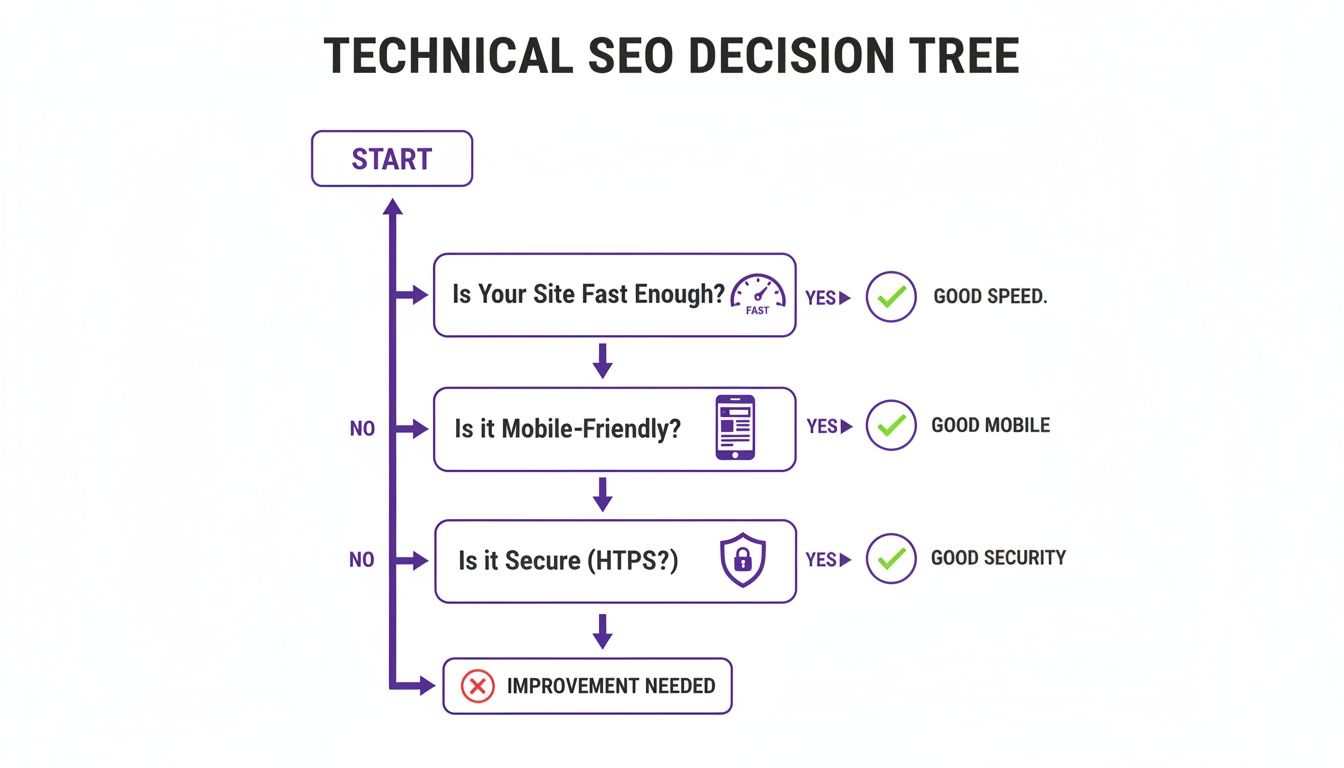
As the visual shows, a rock-solid technical base—covering site speed, mobile experience, and security—is a non-negotiable starting point. Get this wrong, and nothing else matters.
Choosing the right execution model really depends on your company's stage, available resources, and how fast you want to grow.
To help you decide, here’s a quick comparison of the two main approaches.
In-House SEO vs. Fractional CMO Partner
| Factor | In-House Team | Fractional CMO / Agency Partner |
|---|---|---|
| Cost | High fixed costs (salaries, benefits, tools) | Flexible, predictable monthly retainer |
| Expertise | Limited to the skills of your hires | Access to a team of diverse specialists |
| Speed to Impact | Slower ramp-up (hiring, training) | Immediate impact and execution |
| Strategy | Can become siloed and tactical | C-level strategic oversight and integration |
| Scalability | Difficult to scale up or down quickly | Easily scalable based on changing needs |
For many B2B startups and scale-ups, the Fractional CMO model strikes the perfect balance. It provides senior strategic leadership and expert execution without the hefty overhead of a full-time, C-suite hire. If you're considering this route, our overview of SEO services in Canada might be a helpful resource.
The right choice ultimately comes down to your unique situation, but partnering up often gets you to your goals faster and more efficiently.
Questions To Ask Any Potential SEO Partner
Vetting a potential agency or consultant is absolutely critical. A lot of people can talk a good game, but you need a partner with proven B2B experience in the competitive Canadian and US markets.
Before you sign on the dotted line, make sure you ask these pointed questions:
- Can you show me case studies of B2B companies in our industry you've actually helped?
- How do you measure and report on ROI beyond traffic and rankings?
- What's your process for getting inside the heads of our specific buyers and understanding their pain points?
- How do you approach content strategy for a highly technical or complex B2B sale?
- What's your experience with local SEO for generating leads in specific Ontario hubs like the GTA or Waterloo Region?
A real strategic partner will have confident, detailed answers rooted in experience. The conversation should be about your business goals—pipeline and revenue—not just a bunch of SEO jargon. Your website should be your hardest-working salesperson, bringing in qualified leads 24/7. With the right strategy, measurement, and partner, it can become your most powerful and predictable engine for growth. Contact us to start that conversation.
Your Top Ontario B2B SEO Questions Answered
We get a lot of the same questions from B2B founders and marketing leaders across Ontario. Here are some straight answers to help you clarify your next steps and build an SEO strategy that actually delivers results.
How Long Does SEO Really Take To Work In Ontario?
For competitive B2B niches in markets like Toronto or Waterloo, you should expect to see meaningful traction in 6-9 months. You'll likely spot early signs of life—like a jump in impressions or rankings for a few long-tail keywords—in just 3-4 months.
But generating a steady, predictable pipeline of high-quality leads takes a sustained effort. A great real-world example is a B2B tech client of ours in Waterloo that saw a 40% increase in qualified organic leads from US and Canadian markets within seven months, but only after committing to a consistent content and technical SEO program. Patience and persistence are non-negotiable.
We Sell Across Canada and the US. Is Local SEO Even Worth It?
Absolutely. A strong local foundation in Ontario is what builds the initial authority and trust that Google uses as a signal to rank you more broadly. It’s proof that you’re a legitimate, established business.
Think of it this way: dominating your home turf is a powerful signal that helps you expand your reach nationally and internationally. Owning the search results in the GTA demonstrates a level of credibility that helps you win over a client in Chicago.
It also captures those high-intent local clients who might be specifically looking for a partner in the same time zone or region. Don't neglect your own backyard.
What's a Realistic SEO Budget For a Small B2B Company Here?
A realistic starting point for a comprehensive B2B SEO program from a reputable agency or consultant in Ontario is typically in the range of $3,000 to $7,000+ per month. This level of investment covers the essential pillars you need to compete effectively for valuable traffic from Canada and the US:
- Technical SEO: Making sure your site is fast, secure, and easy for search engines to crawl.
- In-depth Content Strategy: Creating expert-level content that actually speaks to your ideal buyers.
- Link Building: Building authority and trust with other reputable sites in your industry.
- Analytics & Reporting: Tracking what really matters—leads, pipeline, and revenue.
Can We Just Do SEO Ourselves, or Do We Need to Hire Someone?
While you can certainly handle the basics in-house, like updating your Google Business Profile, effective B2B SEO requires deep, specialized expertise that's hard to build overnight. Most founders find that partnering with a specialized agency or a Fractional CMO delivers a far greater ROI in the long run.
A great success story is an Ottawa-based cybersecurity firm that attempted in-house SEO for a year with minimal results. After partnering with an agency, they saw a 150% increase in demo requests from their target American enterprise market within six months. An expert partner helps you sidestep costly mistakes and accelerates your growth by implementing proven strategies from day one.
Ready to stop guessing and start building a predictable growth engine with search engine optimization in Ontario? The team at B2Better has decades of experience helping B2B companies just like yours achieve measurable results.