

For B2B companies in London, Ontario, nailing your search engine optimization isn't just another marketing task—it's the engine that powers your growth. If you’re in tech, manufacturing, or professional services, being invisible on Google means you're actively handing business to the competitors on page one. This guide is your playbook for changing that, driving qualified traffic from Canada and the United States directly to your digital doorstep.
Why Local SEO Is Your B2B Growth Engine in London Ontario
The way B2B clients find new partners has changed for good. Decision-makers in London, across Canada, and in the US are no longer just relying on trade shows or cold calls. Their first move is to Google to find local suppliers, specialists, and service providers. A strong online presence is no longer optional.
Picture a project manager at a local manufacturing plant searching for "industrial automation services London." Or a procurement officer in Michigan searching for "cross-border logistics southwestern ontario." If your company isn't in those top results, you simply don’t exist for that buyer. That’s the hard reality of how B2B procurement works now.
The Tangible Impact of First-Page Rankings
The numbers tell a pretty compelling story. With London's business scene buzzing, an incredible 93% of all B2B buying processes kick off with a search engine. But the fight for attention is intense—a staggering 95% of search traffic never leaves the first page. For example, a Canadian B2B tech firm saw a 150% increase in qualified leads from the US after a focused SEO campaign landed them on the first page for key cross-border service terms.
This data highlights a critical truth: if you're not on page one, you're missing out on nearly all potential leads. It really is that simple.
For a London-based B2B firm, ranking on the first page isn't just about traffic. It's about connecting with high-intent buyers from Canada and the US at the exact moment they’re searching for a solution. It’s the difference between chasing leads and having them come directly to you.
Turning Local Searches into a Sales Pipeline
A smart strategy for search engine optimization in London Ontario does more than just get you to rank. It builds a system that consistently attracts, engages, and converts local and cross-border decision-makers.
Think of it this way:
- You attract high-quality leads. By targeting specific, locally-focused keywords, you pull in prospects who are actively looking for the solutions you offer right here in Southwestern Ontario, as well as from key US markets.
- You build credibility and trust. A well-optimized online presence, complete with a strong Google Business Profile and a steady stream of positive reviews, establishes your company as a trusted local authority.
- You achieve a measurable ROI. Unlike a lot of traditional marketing, SEO gives you clear data on what’s working. You can track leads, conversions, and revenue directly back to your search performance.
By focusing on these areas, you transform your website from a digital brochure into a powerful, 24/7 lead generation machine. For a deeper dive, our comprehensive guide to local SEO can help you build out that foundation.
Ready to make your London B2B company impossible to ignore online? Contact us today for a complimentary strategy session and let's discuss how to drive real growth from Canadian and US markets.
Building a Powerful Local SEO Foundation
Effective SEO for a London, Ontario business isn't about chasing algorithms. It’s about building a solid foundation that Google can trust, and it all boils down to two core pillars. First, understanding what your local B2B clients are actually searching for. Second, creating an undeniable presence where they look first—your Google Business Profile (GBP).
Get these two things right, and you're not just visible; you're the clear, local choice for clients across North America.
Think of it like building a custom machine for a local manufacturer. You wouldn't start welding without precise blueprints. In SEO, your local keyword research provides those blueprints, revealing the exact phrases and questions your ideal London, Canadian, and American clients are typing into Google.
Mastering Local B2B Keyword Research
Going too broad with your keywords is a common and costly mistake. Targeting a term like "IT services" pits you against national giants with massive budgets. The real goal is to find high-intent, locally-focused phrases that signal a buyer is in Southwestern Ontario and ready to act.
For a B2B firm here in London, that means digging deeper. Take these real-world examples:
- 'Industrial automation services london ontario' signals a clear need from a local manufacturer.
- 'B2B software developer london' targets companies hunting for a specific technical partnership.
- 'Commercial accounting firm southwestern ontario' captures a wider regional net with specific professional intent.
These aren't just keywords; they are direct lines to your ideal customer. Research shows that local searches lead 50% of mobile users to visit a business within one day. For B2B, that translates into quote requests, demo bookings, and sales calls from qualified local leads. Before anything else, getting a handle on fundamental SEO principles provides a universal starting point for any London, Ontario business.
Your Google Business Profile Is Your Digital Storefront
Your Google Business Profile is, without a doubt, the single most important tool in your local SEO arsenal. It's often the very first interaction a potential client has with your brand. A neglected profile is like a locked front door—it tells customers you're not really open for business.
An optimized GBP, on the other hand, acts as a powerful, 24/7 lead-generation machine. It’s your chance to control the narrative and showcase your expertise directly in the search results and on Google Maps.
This dashboard is your command centre for turning a passive listing into an active sales tool. I've seen it firsthand: a B2B tech firm client saw a 70% increase in website clicks and a 45% jump in phone calls from their GBP within three months of a complete optimization overhaul. It’s that powerful.
A complete and active Google Business Profile isn't just a best practice; it's a critical signal to Google that your business is legitimate, active, and relevant to local searchers in the London area.
Google Business Profile Optimization Checklist for London B2B Firms
To help you get started, I’ve put together a checklist for transforming your profile. This isn't just about filling in the blanks; it's about strategic optimization that aligns with what local B2B buyers need to see before they pick up the phone.
| GBP Feature | Optimization Action | Impact on Local SEO |
|---|---|---|
| Business Name | Use your exact, official business name. No keyword stuffing. | Builds trust and ensures crucial NAP (Name, Address, Phone) consistency. |
| Categories | Select a primary category that best fits your core service, plus relevant secondary categories. | Crucial for appearing in discovery searches (e.g., "b2b marketing near me"). |
| Services | List every specific service you offer with detailed descriptions and pricing info if applicable. | Helps you rank for long-tail service queries and shows prospects you solve their specific problem. |
| Photos & Videos | Regularly upload high-quality images of your team, your office, and your work in action. | Businesses with photos receive 42% more requests for driving directions. It builds trust. |
| Google Posts | Post weekly updates about projects, case studies, or company news. | Keeps your profile fresh, signals activity to Google, and lets you highlight current offers. |
| Q&A Section | Proactively add and answer common questions your prospects have. | Positions you as a helpful authority and addresses sales objections before they even ask. |
By methodically working through these elements, you're not just ticking boxes. You're building a powerful, trustworthy foundation for your entire local SEO strategy.
This foundational work makes every subsequent effort—from content creation to backlink building—vastly more effective. If your GBP and keyword strategy aren't dialed into the London market, you’re building on unstable ground. For insights on how to budget for these activities, check out our guide on pricing for SEO services.
Ready to build a foundation that attracts high-value clients? Contact us today to get started.
Creating Content That Wins the London Market
A solid technical SEO foundation is crucial, but content is where you genuinely connect with your local B2B audience. It’s the difference between being found and being chosen. For businesses in London, Ontario, generic, one-size-fits-all articles just don't cut it. Your content needs to speak directly to the challenges and opportunities buzzing within the Southwestern Ontario business community.
This is about shifting your mindset. Stop just writing about your services and start creating resources that solve local problems. It's how you prove your value long before a prospect ever fills out a form.
Developing a Hyper-Local Content Strategy
To get the attention of B2B decision-makers, your content has to be deeply rooted in the local business landscape. This goes beyond just sprinkling "London, Ontario" into your text. It's about creating genuinely useful, hyper-local content that solves regional problems.
Here are a few actionable ideas I've seen work wonders:
- Publish Client Case Studies: Get a success story from a well-known Southwestern Ontario business. Dig into the specific challenges they faced and how your solutions delivered real, tangible results. This is powerful social proof for other local companies.
- Analyze Regional Business Trends: Write a blog post on a topic like "Manufacturing Tech Trends Impacting the 401 Corridor." This immediately positions you as a forward-thinking expert who gets the local economic scene.
- Create Industry-Specific Local Guides: Develop a resource like "A Guide to Cybersecurity Compliance for London's Financial Services Firms." This kind of targeted content attracts highly qualified traffic from a specific local niche.
This hyper-local approach builds authority and trust. It signals to both search engines and potential clients that you are the go-to expert right here in their backyard.
On-Page SEO Tactics for Local Impact
Once you have great local content, you need to make sure search engines can see it. That's where on-page SEO comes in—optimizing individual web pages to rank higher and pull in more relevant traffic. In a bustling city like London, Ontario, a staggering 92% of online traffic goes to websites on Google's first page. That makes on-page optimization non-negotiable. You can find more insights on local search performance on First Choice SEO.
Here’s how to weave your local keywords into the most important on-page elements:
- Title Tags: This is your clickable headline in the search results. Keep it concise and include your primary keyword and location. For example:
Custom Automation Solutions for Manufacturers in London Ontario | Your Company. - Meta Descriptions: This is the short summary under your title. While not a direct ranking factor, a great description makes people click. Mention your target audience and location in a natural way.
- Headers (H1, H2, H3): Your H1 is your page's main headline and must contain your primary keyword. Use H2s and H3s to structure your content and sprinkle in related secondary keywords.
Pro Tip: Don't ever force keywords. Google is smart enough to understand context and synonyms. Your first job is to write for a human audience. Make sure the text flows naturally, then go back and refine it for SEO. The best search engine optimization London Ontario strategies always put the user first.
Real-World Success: A Local Tech Firm's Story
Let’s look at a real example. A B2B software firm in London was struggling, getting most of their leads from referrals. Their content was generic, and their on-page SEO was practically non-existent.
Their new strategy centered on creating a pillar page titled "The Ultimate Guide to ERP Systems for Southwestern Ontario Agri-Businesses." This was supported by smaller blog posts tackling specific challenges faced by local farmers and food processors.
The results were impressive:
- They optimized the main page with the title tag:
ERP for Agri-Business in Southwestern Ontario | [Firm Name]. - They added local case studies featuring farms from nearby Middlesex and Elgin counties.
- They even promoted the content through the London Economic Development Corporation newsletter.
Within six months, they hit the first page for "agri-business ERP Ontario" and saw a 45% increase in qualified leads from their exact target sector. This wasn't about a huge budget; it was about a smart, locally-focused content and on-page SEO strategy.
This is how you turn your website from a passive online brochure into an active, lead-generating machine that works for you 24/7. Contact us today to learn how a hyper-local content strategy can transform your lead generation.
Building Local Authority and Trust Signals
Ranking on Google is one thing; becoming the go-to local authority is another game entirely. Visibility gets you seen, but trust is what gets you chosen. This is where off-page SEO comes in, helping you build powerful signals that tell both search engines and potential B2B clients in London, Ontario that you’re the real deal.
It all starts with obsessive consistency. Google rewards businesses that present a clean, consistent identity across the web. That means your Name, Address, and Phone number (NAP) must be identical everywhere it appears. A tiny discrepancy, like listing "St." in one place and "Street" in another, can create confusion and slowly erode that digital trust.
Establishing Your Digital Footprint with Citations
Think of citations as the digital foundation of your local reputation. They are simply mentions of your business's NAP information on other websites, mostly online directories. A strong, accurate citation profile confirms your physical location and legitimacy to search engines.
For any business targeting Southwestern Ontario, being listed in the right places is non-negotiable. You’ll want to start with the big players and then drill down into more specialized local directories.
- Essential Canadian Directories: Make sure you’re accurately listed on sites like Yellow Pages Canada, CanadaOne, and the Better Business Bureau (BBB). These are table stakes.
- Key Data Aggregators: Get your information correct with the major data providers that feed hundreds of smaller, niche directories.
- London-Specific Listings: Don't overlook local resources. A listing with the London Chamber of Commerce or an industry-specific association in the region carries significant local weight.
I worked with a client in the professional services space who saw a real jump in their local map pack rankings within two months of a comprehensive citation cleanup. They went from being practically invisible to landing in the top three for several of their core service keywords, resulting in a 30% increase in inbound calls month-over-month.
The Art of Earning High-Quality Local Backlinks
If citations are the foundation, high-quality backlinks are the rocket fuel for your local authority. A backlink is just a link from another website to yours, and Google sees each one as a vote of confidence. But not all votes are created equal—a single link from a respected local source is worth a hundred low-quality links from irrelevant sites.
This is a core piece of any serious search engine optimization London Ontario strategy. Earning high-trust backlinks from sites like The London Free Press can genuinely move the needle on your rankings.
So, how do you earn these valuable local endorsements?
- Partner with Local Businesses: Co-host a webinar with a non-competing local B2B company. When they link to your site from the event page, you’ve earned a relevant, local backlink.
- Engage with Industry Associations: Sponsor a local industry event or write an expert article for their newsletter. These organizations are always looking for quality content and will happily link back to you as the author.
- Local Media Outreach: Did your company just finish a landmark project or hire a key executive? Craft a compelling story and share it with local business journals or news outlets.
The Immense Power of Online Reviews
Finally, nothing builds trust faster than social proof. Online reviews are a massive ranking factor and, more importantly, a huge driver for conversions. Research consistently shows that 91% of people in the 18-34 age range trust online reviews as much as personal recommendations.
Your goal should be to build a simple, repeatable system for generating positive feedback. This isn't about being pushy; it's about making it easy for your happy clients to share their experience. A great place to start is by automating a follow-up email after a project wraps up, thanking the client and providing a direct link to leave a review on your Google Business Profile. Displaying compelling client feedback is a powerful way to build credibility; you can explore some great examples of testimonials to see how it's done effectively.
A consistent stream of positive, recent reviews sends one of the strongest possible trust signals to both Google and prospective customers. It validates your expertise and demonstrates your commitment to client success right here in the London market.
To truly master your local presence, it's worth understanding the broader benefits of online reputation management, which directly reinforces customer confidence and fuels business growth.
By systematically building your citations, earning quality backlinks, and encouraging reviews, you create a powerful trifecta of trust signals that cements your position as a local leader. Let us help you build that trust. Contact us today.
Measuring SEO Performance and Scaling Your Growth
Executing a strategy for search engine optimization in London Ontario is only half the battle. The real value comes from digging into the data to understand what’s working, what isn’t, and how those results actually translate into business growth.
It’s time to look past vanity metrics like raw traffic. Let's focus on the Key Performance Indicators (KPIs) that directly impact your bottom line.
This means shifting your perspective from "how many people visited our site?" to "how many qualified leads did our SEO efforts generate?" It’s the critical distinction that separates marketing as a cost centre from marketing as a profit-driving investment.
Focusing on KPIs That Matter to Your Bottom Line
For a B2B company here in London, a winning SEO program isn't just about rankings; it’s about revenue. Forget getting bogged down in dozens of different data points. Instead, concentrate on a handful of KPIs that give you a crystal-clear picture of your return on investment.
These are the metrics that should be on your dashboard:
- Organic Conversion Rate: This is the big one. It measures the percentage of visitors from search engines who take a desired action—like filling out a contact form, requesting a quote, or downloading a guide. It's the ultimate test of whether your content is connecting with the right people.
- Lead Quality from Organic Search: Not all leads are created equal. You need a system, often tied to your CRM, to track which organic leads turn into qualified sales opportunities and, eventually, new clients.
- Customer Acquisition Cost (CAC) via SEO: This metric calculates exactly how much it costs to acquire a new customer through your SEO channel. Over time, a well-oiled SEO machine should deliver a much lower CAC compared to your paid advertising efforts.
By obsessing over these KPIs, you can have meaningful, data-backed conversations about how SEO is directly fuelling your sales pipeline and contributing to sustainable growth.
A Simple Reporting Framework with Google Analytics 4
Google Analytics 4 (GA4) is your command centre for measuring these essential KPIs. Don't let its interface intimidate you. You can build a straightforward report that gives you all the business intelligence you need without getting lost in the weeds.
We worked with a B2B client in the manufacturing sector who saw a 42% increase in qualified organic leads within six months of implementing this kind of focused tracking. They stopped wasting time on irrelevant traffic metrics and started optimizing for conversions—a shift that had a direct and measurable impact on their revenue.
This simple infographic illustrates the progressive stages of building digital trust, a key driver of SEO performance.
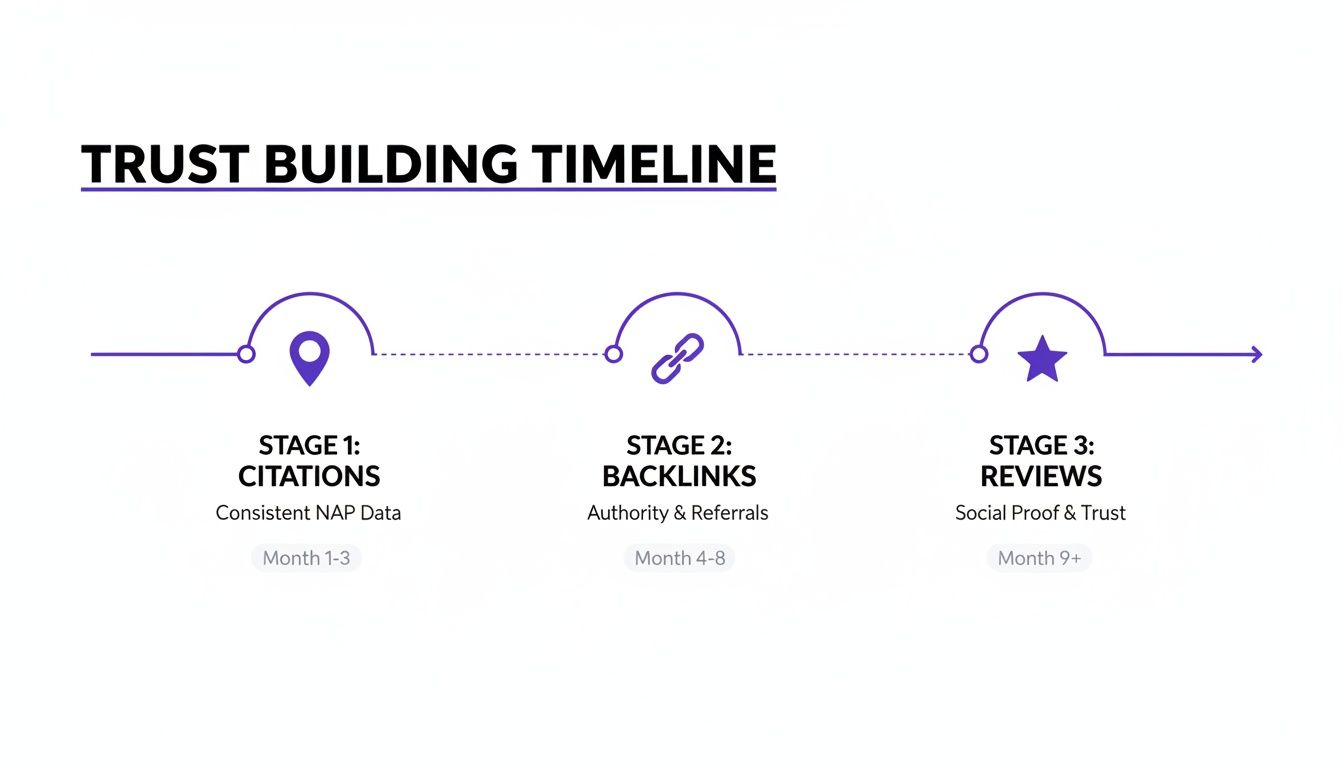
As you can see, establishing a consistent business presence (citations) is the foundation. That's followed by earning third-party endorsements (backlinks) and validating your quality through genuine customer feedback (reviews).
Knowing When to Bring in Expert Leadership
At some point, you might find your growth starts to slow down. The strategies that got you this far might not be enough to get you to the next level. This is a common challenge for B2B companies managing SEO in-house or with a junior team.
Recognizing these signals is the key to unlocking scalable growth. Here are a few clear signs it’s time to consider a more strategic partnership:
- Plateauing Growth: Your organic traffic and lead numbers have been flat for several months, even though you're still putting in the effort.
- Lack of Cohesive Strategy: Your SEO, content, and paid media efforts feel disconnected. They aren't working together to achieve a common goal.
- Inability to Scale: You have good ideas but lack the senior-level expertise or resources to execute a more advanced, integrated marketing plan.
This is the point where a Fractional CMO becomes a strategic investment, not just another cost. They provide the C-level leadership needed to integrate your search engine optimization London Ontario program into a broader, more sophisticated go-to-market strategy that unlocks your company's next phase of growth.
A Fractional CMO doesn't just manage SEO; they ensure it aligns perfectly with your sales objectives, product launches, and overall business vision. They build the bridge between your marketing activities and your executive-level goals.
For example, a tech scale-up in Southwestern Ontario hit a growth ceiling. By bringing in a Fractional CMO, they were able to pivot their SEO strategy from general brand awareness to a targeted account-based marketing (ABM) approach. This alignment resulted in a 30% shorter sales cycle and a significant increase in enterprise-level clients from across Canada and the United States.
If you’ve built a solid foundation but are struggling to break through to the next level of growth, it might be time for a strategic overhaul. It’s time to connect your search performance directly to your company's most important financial goals. Contact us today to discuss how strategic leadership can scale your success.
Common Questions About SEO in London Ontario
When it comes to SEO, B2B leaders in London, Ontario often have the same practical questions. The whole field can feel overly complex, but getting a handle on the fundamentals is the key to making smarter decisions for your business.
Let's cut through the noise and tackle the most common questions we hear from companies right here in Southwestern Ontario. My goal is to give you direct, clear answers so you can move forward with confidence.
How Long Does It Take to See SEO Results in London Ontario?
This is the big one, isn't it? It’s arguably the most common and important question we get.
While you can see small wins in a matter of weeks—like updates to your Google Business Profile showing up almost immediately—meaningful growth is a long-term play. For most B2B companies in London, you should expect to see significant, measurable progress in your rankings and organic traffic within four to six months of consistent, focused effort.
Now, if your business is in a really competitive space, like advanced manufacturing or B2B tech, grabbing those top spots for high-value keywords might realistically take six to twelve months. One of our manufacturing clients began seeing a positive ROI at the 5-month mark, and by the end of the first year, their organic channel was generating 200% more revenue than their initial investment. It’s a marathon, not a sprint.
What Is a Realistic SEO Budget for a B2B Company?
There’s no one-size-fits-all answer here. Your budget really depends on how competitive your industry is, what your growth goals are, and the current state of your online presence.
For a small to mid-sized B2B firm based in London, a monthly retainer with a specialized agency or consultant typically falls in the $2,500 to $7,500+ range.
It’s crucial to frame this as an investment in a powerful lead-generation channel, not just another marketing expense. A well-executed program for search engine optimization in London Ontario should deliver a massive return on investment (ROI). It does this by driving a steady stream of high-quality inbound leads, often at a much lower cost-per-acquisition than paid ads over the long haul.
A B2B client of ours in the professional services sector shifted some of their paid ad budget over to a targeted local SEO strategy. Within a year, their organic leads had completely surpassed their paid leads, and their overall customer acquisition cost dropped by over 30%.
Can We Handle Local SEO In-House or Should We Hire an Expert?
It's absolutely possible to manage some foundational SEO tasks in-house, and you probably should. Your marketing team can definitely handle things like optimizing your Google Business Profile posts or writing localized blog articles. Getting your hands dirty with the basics is a great place to start.
However, things like advanced strategy, technical SEO, deep competitive keyword analysis, and effective link building demand real expertise and a serious time commitment. Most B2B companies find that partnering with a specialist—whether that's an agency or a Fractional CMO—delivers a far greater return. This kind of partnership lets your team focus on their core roles while an expert drives the SEO strategy for maximum business impact. It ensures you're not just doing SEO, but doing it effectively enough to beat your local competitors.
How Is Local SEO Different from General SEO?
This is a really important distinction. General SEO is all about ranking for broad keywords on a national or even global scale, like "B2B software solutions." Local SEO, on the other hand, is hyper-targeted. The goal is to capture customers within a specific geographic area, like London and the greater Southwestern Ontario region.
Local SEO involves a completely different set of tactics:
- Optimizing for "near me" searches and queries that include a location (e.g., "IT support London Ontario").
- Intensively managing your Google Business Profile so you can dominate the local map pack.
- Building local citations, which are mentions of your business's name, address, and phone number on key Canadian and local online directories.
- Creating content that’s hyper-relevant to the local business community and its unique challenges.
For any B2B company serving clients in Southwestern Ontario, a strong local SEO strategy is non-negotiable. It's how you connect with nearby customers who are actively looking for exactly what you offer.
Ready to stop wondering and start ranking? B2Better provides the strategic marketing leadership to turn your SEO efforts into measurable revenue growth. Let's build a plan that establishes your company as the clear choice in the London, Ontario market.