

In Hamilton's cut-throat B2B market, you can't afford to be invisible. A sharp local SEO strategy is what separates the companies that get found from the ones that get buried. It’s how you show up when potential clients in Hamilton, across Canada, and even in the US are searching for exactly what you do. This isn't about chasing vanity traffic; it's about making a direct connection with decision-makers right when they're ready to buy. In fact, SEO drives over 1000% more traffic to websites than organic social media, making it a critical channel for B2B growth.
Why Hamilton B2B Companies Need Local SEO to Compete
A website alone isn't going to cut it anymore. For B2B firms in Hamilton—from precision manufacturers to specialized professional services—being lost online means you're handing business to your competitors on a silver platter. High-value clients aren't thumbing through the Yellow Pages; they're online, searching for local partners they can trust. A rock-solid local SEO presence isn't just another item on the marketing checklist; it's a fundamental growth engine.
The competition is fierce. With over 15,000 businesses in Hamilton, the battle for a spot on the first page of Google is relentless. The reality is, the top three search results snag the vast majority of all clicks. If you're not there, you might as well not exist. This stark truth makes a deliberate, well-executed SEO strategy absolutely essential.
A Quick Comparison
To see the difference, let's stack local SEO against more traditional outbound tactics. The contrast in ROI and lead quality is pretty stark.
Comparing Local SEO vs Traditional Marketing for Hamilton B2B Firms
| Attribute | Local SEO | Traditional Marketing (e.g., Cold Calls, Print Ads) |
|---|---|---|
| Lead Quality | High-intent leads actively seeking your solutions. | Low-intent leads often caught off-guard and unqualified. |
| Cost-Effectiveness | Lower long-term cost per acquisition (CPA) as rankings build authority. | High, recurring costs with no lasting asset value. |
| ROI | High and sustainable ROI; an asset that grows over time. | Low and diminishing ROI as audiences tune out interruptions. |
| Reach | Targets local and North American buyers precisely when they're searching. | Broad, untargeted reach with significant waste. |
| Trust Factor | Builds credibility through organic rankings and reviews. | Often perceived as intrusive and untrustworthy. |
Simply put, investing in local SEO builds a sustainable pipeline of high-quality leads, something that cold calling or print ads just can't match in today's digital-first world.
A Real-World Hamilton Success Story
Let me tell you about a specialized manufacturing firm right here in Hamilton. For years, they were up against bigger, more established names, getting by on word-of-mouth and old-school sales tactics. They had a website, but it was just sitting there, collecting digital dust and generating zero leads. They were an industry leader in quality but a ghost online.
Then, they decided to get serious about a search engine optimization Hamilton strategy. Here’s what we did:
- Dug deep into niche B2B keywords that their ideal buyers—purchasing managers and engineers—were actually using.
- Completely overhauled their Google Business Profile so they’d pop up in local map searches.
- Built out content that answered the specific, technical questions their prospects were asking.
The results? Within six months, they started landing on the first page for several high-value search terms. This wasn't just website traffic; these were qualified inquiries from companies in Canada and the US. Within one year, they saw a 200% increase in qualified leads from organic search, building a real, sustainable sales pipeline that wasn't dependent on a huge ad spend. It’s a perfect example of how a smart SEO plan can level the playing field, even in a crowded market.
Their success story drives home a core truth for any B2B company today: your next big client isn't waiting by the phone for your cold call. They're online, right now, searching for a solution. Local SEO is what makes you the answer they find.
To get your own strategy rolling, this ultimate local SEO checklist is a fantastic starting point for a comprehensive approach. And for a broader look at the Canadian landscape, our guide on SEO services in Canada offers more strategic direction.
Uncovering Keywords That Drive B2B Sales
Proper search engine optimization in Hamilton starts with a deep dive into the language your ideal client actually uses. Forget casting a wide net with generic terms. The goal here is to find the specific, high-intent phrases that signal a B2B buyer is actively looking for a solution just like yours. This is where the real work—and the real opportunity—is.
So many businesses make the mistake of targeting broad, single-word keywords like "automation." Sure, it seems logical, but it attracts a messy audience of students, hobbyists, and job seekers. A qualified B2B lead? They use much more specific language. They're searching for things like "industrial automation solutions Hamilton" or "custom CNC machining for aerospace parts."
These are called long-tail keywords, and they are the absolute cornerstone of a successful B2B SEO strategy. They have lower search volume, but the user intent behind them is exponentially higher. Research consistently shows that long-tail keywords have a click-through rate 3% to 5% higher than generic searches, which is a massive advantage in a competitive market.
Mapping Keywords to the B2B Buyer Journey
Let's walk through a real-world scenario. Imagine a B2B tech scale-up specializing in logistics software wants to break into the Hamilton market. Their ideal clients are warehouse managers and operations directors in the region. Their keyword strategy can't just be a simple list; it has to align with the distinct stages of a B2B buyer’s journey.
- Awareness Stage: The client knows they have a problem (e.g., inefficient inventory tracking) but isn't sure of the solution yet. They might be searching for "how to improve warehouse inventory accuracy" or "common logistics bottlenecks."
- Consideration Stage: Now, the client is actively evaluating different types of solutions. Their searches get more specific, like "inventory management software for small business" or "Hamilton warehouse automation systems."
- Decision Stage: This is the final stage, where the client is ready to pick a partner. Their searches are often branded or include high-intent modifiers, such as "B2Better fractional CMO reviews" or "get a quote for logistics software Ontario."
By creating content that targets keywords at each of these stages, you build a complete funnel that captures prospects early on and nurtures them all the way to a sale.
This process flow shows exactly how this strategic approach moves from analyzing competitors to increasing visibility and, ultimately, generating qualified leads.
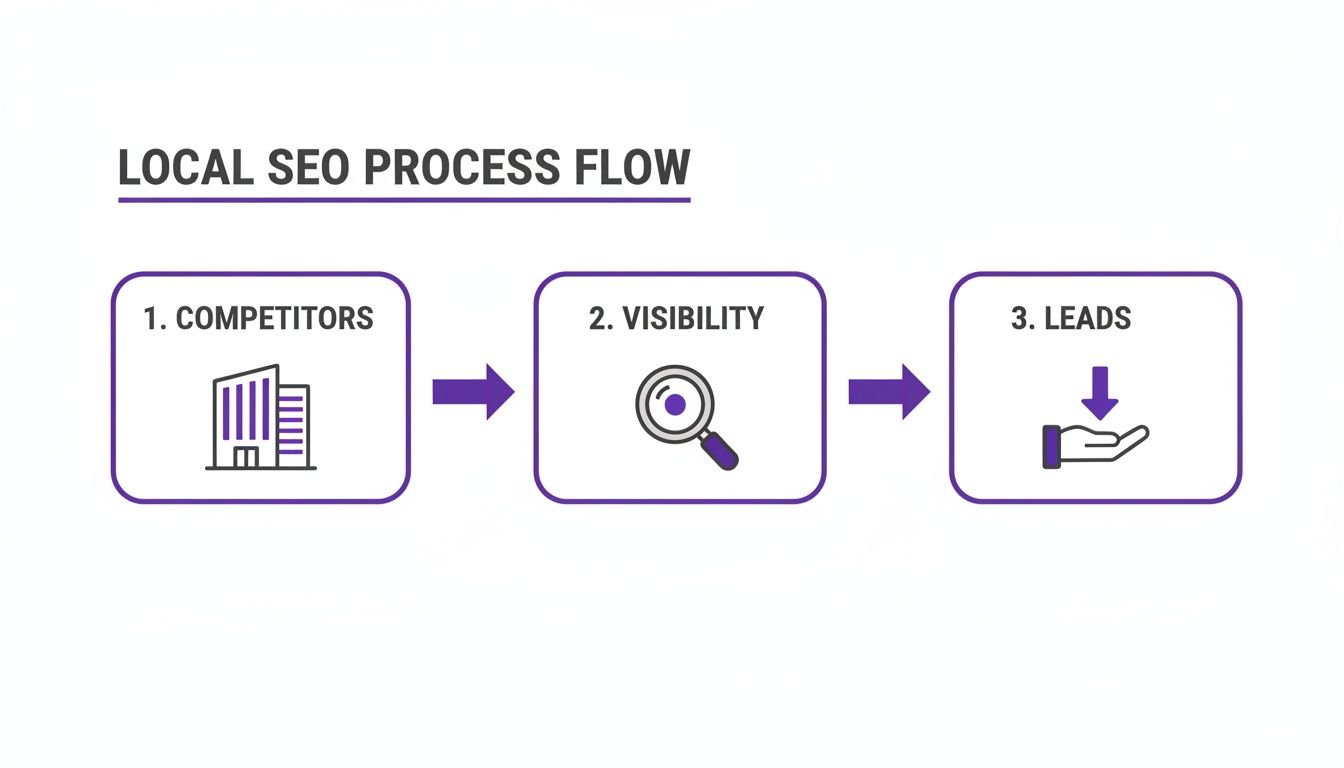
This visual really drives home the point that effective SEO is a structured process, not just a series of random tactics. Every step builds on the last to create a reliable system for generating leads.
Finding and Filtering for North American Leads
So, where do you find these golden keywords? Tools like Semrush, Ahrefs, and even Google's own Keyword Planner are indispensable. The key, however, isn't just finding keywords but filtering them for the right audience. You have to set your search parameters specifically to Canada and the United States to make sure your efforts attract those valuable cross-border leads.
Focus on identifying phrases that carry commercial intent. You're looking for modifiers that signal a user is getting close to making a purchase.
Pro Tip: Prioritize keywords that include terms like "services," "solutions," "provider," "for B2B," "Hamilton," or "near me." These are strong signals that the searcher isn't just kicking tires—they're actively looking to hire or buy.
Beyond just identifying profitable keywords, the ultimate goal is applying them to your content effectively. This is how you go about building an organic search engine presence that truly connects with your target B2B audience in Hamilton. Your research becomes the blueprint for your entire content strategy, from blog posts and service pages to case studies and whitepapers.
This data-driven approach ensures you aren’t just creating content for the sake of it. You’re building a strategic asset that consistently attracts, engages, and converts your ideal clients in Hamilton and across North America. If you need help uncovering the high-intent keywords that drive sales in the Canadian and US markets, contact us for a strategic consultation.
Transforming Your Google Business Profile into a Lead Magnet

Too many B2B companies in Hamilton treat their Google Business Profile (GBP) like a digital business card—fill it out once and forget it exists. This is a massive missed opportunity. Your GBP is arguably one of the most powerful local SEO assets you have. It can drive high-value leads directly from the search results page, often before a prospect even thinks about clicking through to your website.
Think of it this way: a fully optimized profile is a mini-website right on Google. It’s often the very first interaction a potential client from Canada or the US has with your brand. The numbers don't lie—businesses with a complete GBP listing get 7 times more clicks than those with an incomplete one. That alone should tell you how critical this tool is for standing out.
Turning this simple listing into a consistent source of B2B leads isn't about a one-time setup. It requires a deliberate, ongoing strategy. We're moving beyond just your address and phone number and into actively using every feature to build trust and prove your expertise.
Beyond the Basics: Advanced GBP Tactics
To really get results, you need to go past the initial setup and into active, hands-on management. This is where you can carve out a real competitive advantage in the Hamilton B2B market.
Let's start with your service categories and attributes. Don't just list "Consulting Firm." Get specific. Use precise categories like "Business Management Consultant" or "Marketing Consultant." Then, layer on attributes that resonate with B2B clients, such as "Online appointments" or even "Woman-owned." These small details help Google match you with highly specific, qualified searches.
Another powerful, yet criminally underused, feature is Google Posts. Use them weekly to share:
- Service Updates: Announce a new B2B service or a specialized solution for a key local industry.
- Case Studies: Briefly showcase a recent client success story, linking back to the full version on your website.
- Company News: Highlight a key new hire or a community sponsorship to put a human face on your brand.
These posts keep your profile fresh and signal to Google that you're an active, engaged business, which can absolutely influence your local rankings.
Proactively Answering Questions and Building Trust
The Q&A feature on your GBP is a goldmine. It's your chance to address prospect pain points before they even have to ask. Don't just wait for customers to post questions—proactively populate this section yourself by asking and answering the common questions your sales team fields every day.
For example, a Hamilton-based software company could ask, "Do you offer integration services with existing ERP systems?" and then provide a clear, detailed answer. This not only gives immediate value to searchers but also lets you control the narrative and showcase your deep expertise.
Finally, use your photos and videos strategically. Move beyond a single shot of your office building. Upload high-quality photos of your team in action, short video testimonials from clients, and professional headshots. These visuals build immediate trust and give a face to your company, making a tangible difference in a B2B world where relationships are everything.
Real-World Success: A professional services firm in Hamilton was struggling to stand out. By meticulously optimizing their GBP—drilling down into niche service categories, launching a consistent Google Posts strategy, and adding team photos—they achieved a 150% increase in qualified inbound inquiries coming directly from their profile in just one quarter.
This shows the power of a well-managed profile. A focus on core services is a winning strategy. After all, top local firms derive 70% of their revenue from core search engine optimization services, a figure that highlights SEO's central role in the Canadian market. You can explore more about the Hamilton SEO market dynamics to see how local agencies are structuring their offerings.
Turning your Google Business Profile from a passive listing into an active lead magnet is a crucial part of any serious search engine optimization Hamilton strategy. It’s a direct line to your most qualified local and North American prospects.
If you’re ready to stop leaving money on the table and transform your Google Business Profile into a powerful client acquisition tool, contact us today. Let’s build a strategy that gets you seen by the right B2B decision-makers.
Winning with On-Page Local SEO Signals

Okay, you've done the keyword research. Now it's time to put that strategy to work on your actual website. This is where the rubber meets the road. Your site's structure and content send powerful signals to Google about who you are, what you do, and—most importantly for local—where you do it.
Getting this right is fundamental. It’s not about stuffing keywords or trying to trick the algorithm. It's about building a website that clearly communicates your value to both people and search engines. The goal is to create a seamless experience that answers a user's question while ticking all the technical boxes Google looks for.
Crafting Powerful Location-Specific Service Pages
One of the most effective tactics in our local SEO playbook is creating dedicated pages for your key services in your main geographic markets. A generic "Our Services" page just doesn't cut it anymore. Think bigger. Think more specific.
A page titled 'Custom SaaS Development for Hamilton Scale-Ups' immediately tells Google you’re a relevant local player for that exact need. It’s far more powerful than a vague, catch-all page.
These pages become digital hubs for your local presence, allowing you to:
- Integrate Local Keywords Naturally: Weave in terms like "B2B software solutions in Hamilton" and other variants you found during your research.
- Showcase Local Expertise: This is the perfect place to drop in case studies or testimonials from clients right here in the Hamilton area. Nothing builds trust like local social proof.
- Speak Directly to the Market: You can address the unique challenges and opportunities facing businesses in the Golden Horseshoe region.
Imagine a Hamilton-based logistics company. They could create a page for "Third-Party Logistics (3PL) Services in Burlington." This targeted approach captures high-intent traffic from a neighbouring city, expanding their reach without needing another office. This strategy is a core part of any successful search engine optimization Hamilton plan.
Embedding Critical Trust and Location Signals
To really cement your local authority, your website needs to have clear and consistent location signals baked right in. These are non-negotiable elements that search engines use to validate your physical connection to a specific area.
Start with the easy win: embed a Google Map of your business location on your contact page and in your website's footer. It's a simple but powerful visual cue. Next, make sure your Name, Address, and Phone number (what we call NAP) are displayed consistently across your entire site and match your Google Business Profile exactly. No variations.
Websites that are mobile-friendly are 61% more likely to be recommended by searchers. In the B2B world, where decision-makers often research on the go, a poor mobile experience is a direct path to a lost lead.
Beyond the basics, site speed is huge. A slow-loading website is a lead killer. For B2B companies, where a single lead can be worth thousands, ensuring your site is fast and fully responsive on all devices is essential for both user experience and your search rankings.
Implementing Local Business Schema Markup
Let's get a bit more technical. Schema markup is a type of code you add to your website to help search engines understand your content better. Think of it as a translator that speaks Google's language, giving it explicit context about your business.
For local SEO, LocalBusiness schema is your best friend. It’s a specific type of markup that lets you spell out details like:
- Your exact business type (e.g., "ProfessionalService")
- Your address and geographic coordinates
- Your hours of operation
- Customer reviews and ratings
Adding this code helps you show up in rich results, like map packs and knowledge panels, which dramatically increases your visibility. It's a technical advantage that a surprising number of competitors overlook. If you want to dive deeper, our comprehensive guide to local SEO breaks down schema and other on-page essentials in much greater detail.
By combining powerful, location-specific content with the right technical signals, you build a website foundation that is primed for local search success. Contact us to audit your website and identify the on-page opportunities you're missing.
Building Local Authority and Trust Signals

While sorting out your website is a massive step forward, what happens off your site is just as critical for dominating local search. This is where you prove to Google that your company isn't just another business listing—it's a legitimate, authoritative, and trusted part of the Hamilton community.
Off-page SEO can feel a bit abstract, so let's ground it in two practical pillars that drive B2B success: local citations and high-quality backlinks.
Think of these signals as digital word-of-mouth. When other reputable online sources mention your business, Google takes notice. This isn't about chasing quantity; it’s about building a digital footprint that reflects genuine community authority, a cornerstone of any effective search engine optimization Hamilton strategy.
The Non-Negotiable Power of Consistent Citations
A local citation is simply any online mention of your business's Name, Address, and Phone number (what we call NAP). You’ll find them in online business directories, on industry-specific websites, and in local publications.
For Google, NAP consistency is a non-negotiable trust signal.
If your business is listed with three different phone numbers and two versions of its address scattered across the web, it creates confusion. That inconsistency erodes Google's confidence that you are who you say you are. In fact, businesses with accurate and consistent citations are 3.5 times more likely to show up in the coveted local map pack—prime real estate for attracting high-intent B2B clients.
To get started, make sure your NAP is identical everywhere, right down to the "St." versus "Street." Then, build out your presence on these essential Canadian and North American directories:
- Yellow Pages Canada: Still a highly trusted directory that search engines crawl frequently.
- CanadaOne: A long-standing directory focused on Canadian small and medium-sized businesses.
- Industry Canada: Listing your business here adds a valuable layer of governmental authority.
- Better Business Bureau (BBB): A powerful trust signal for clients in both Canada and the US.
- Local Chambers of Commerce: A listing with the Hamilton Chamber of Commerce is an undeniable local signal.
Building these citations is foundational. It's the digital equivalent of pouring the concrete for your building—get it right, and everything you build on top will be much stronger.
Earning High-Quality B2B Backlinks
While citations build trust, backlinks build authority. A backlink is a link from another website to yours. In Google’s eyes, a link from a respected site is like a vote of confidence. For a Hamilton B2B company, the game is all about pursuing relevant, high-quality links, not just any link you can get.
A Real-World Example: A Hamilton-based engineering firm sponsored a major tech conference at McMaster University. As a sponsor, they got a backlink from the university's event page—a highly authoritative
.cadomain. This single link gave their domain authority a significant boost and drove relevant referral traffic from conference attendees.
This is the kind of strategic thinking that wins. Forget about outdated tactics like buying links. Instead, focus on building real-world relationships that translate into digital authority.
Here are a few proactive strategies that work exceptionally well for B2B companies:
- Contribute Expert Insights: Write a guest article for a regional industry publication like the Hamilton Spectator's business section or a trade journal relevant to your field. Sharing your expertise earns you a valuable backlink and positions you as a thought leader.
- Form Strategic Partnerships: Team up with a non-competing local business that serves a similar client base. You could co-host a webinar, produce a joint whitepaper, and link to each other’s websites as trusted resources.
- Sponsor Local Events: Just like in the McMaster example, sponsoring local tech meetups, industry seminars, or charity events is a fantastic way to earn high-quality links from trusted community organizations.
By focusing on these two pillars—clean citations and authoritative backlinks—you create a powerful off-page presence that reinforces all your on-site work. This holistic approach signals to Google that you are a top-tier B2B player in the Hamilton area.
Ready to build the local authority that drives real business growth? Contact us to develop a backlink and citation strategy that puts you ahead of the competition.
How a Fractional CMO Can Accelerate Your SEO Results
Let's be honest. Executing a world-class SEO strategy takes time, expertise, and focus—three things most founders and in-house marketing teams are short on. This is exactly where promising search engine optimization Hamilton initiatives tend to go off the rails. You can have the best playbook in the world, but without dedicated, senior-level oversight, execution sputters and the results just never show up.
This is precisely the gap a Fractional Chief Marketing Officer (CMO) is designed to fill. Instead of getting tangled up in the day-to-day tactical weeds, a Fractional CMO provides the high-level strategic direction to ensure your SEO efforts are not only happening but are also directly fueling your biggest business goals.
Integrating SEO into a Wider Growth Strategy
One of the most common mistakes we see is treating SEO as an isolated marketing channel. A Fractional CMO is your safeguard against this. They weave your local SEO efforts into a cohesive growth strategy, making sure your content marketing, paid media, and sales enablement are all working in harmony. It's about ensuring every dollar you spend on marketing is pulling in the same direction: driving revenue.
For instance, those valuable keyword insights from your SEO research shouldn't just be collecting dust in a spreadsheet. A Fractional CMO will put that data to work:
- To inform your content calendar: Creating the exact blog posts, whitepapers, and case studies that answer the questions your ideal B2B clients in Hamilton are asking.
- To refine paid media campaigns: Using high-intent keywords to build more efficient and targeted Google Ads campaigns that capture leads ready to make a decision.
- To arm your sales team: Giving them content that directly addresses prospect pain points, which helps shorten the sales cycle.
This integrated approach stops you from making costly mistakes and ensures your marketing feels connected and purposeful to your buyers.
From Strategy to Measurable Business Impact
Senior strategic oversight is what turns SEO from a marketing expense into a predictable revenue driver. A Fractional CMO establishes the right Key Performance Indicators (KPIs) and builds the systems to track them. The focus shifts away from simple traffic metrics and onto what actually matters: leads, sales pipeline, and customer acquisition cost.
We saw this firsthand with one of our B2B tech clients in Southern Ontario. They brought on a Fractional CMO and saw a 40% increase in marketing-qualified leads within nine months. The secret wasn't just better SEO tactics; it was having a leader who connected those tactics to a clear, revenue-focused strategy.
Instead of wrestling with execution or wondering if your efforts are even paying off, a strategic partner builds and manages a tailored SEO plan that delivers measurable results. They bring the structure, accountability, and expertise needed to truly accelerate your growth.
If you’re ready to bridge the gap between your strategy and your execution, learning more about Fractional CMO services can show you how strategic leadership drives real-world business outcomes.
Don’t let a lack of time or senior expertise hold your business back. Contact us today to schedule a conversation and discover how a strategic partnership can build a powerful SEO engine for your company.
Common Questions About Hamilton B2B SEO
When we talk with B2B leaders about putting real investment into search marketing, a few questions almost always come up. Here are the straight answers to the most common queries we hear from companies in Hamilton and across North America.
How Long Until We Actually See SEO Results?
You'll likely see some initial movement in rankings within a few months, but for the kind of significant, lead-generating results that impact your pipeline, you should plan for 6 to 12 months. SEO is a long-game investment, not a quick fix.
We worked with a Hamilton-based manufacturer who saw a 50% jump in qualified leads in their first year, but that came from a patient, consistent strategy. The exact timeline always depends on factors like how competitive your industry is, the current state of your website, and how aggressively you pursue the campaign.
Is Local SEO Worth It if We Serve Clients Across North America?
Absolutely. For B2B companies, a strong local footprint in a place like Hamilton builds a foundation of trust and authority that helps you compete nationally.
Think about it from your prospect's perspective. When someone in the U.S. is vetting you and sees a legitimate, well-rated local business, it adds a powerful layer of credibility. Google often uses those local signals as a primary trust factor before it will even consider ranking a site for broader, non-local searches.
A lot of our clients find that their initial local SEO success acts as a springboard. It helps them start ranking for more competitive national keywords as their overall domain authority grows. You have to build a strong home base before you can expand your territory.
Can’t We Just Do SEO Ourselves?
While you can certainly handle basic on-page updates and manage your Google Business Profile in-house, a comprehensive SEO strategy is a complex beast. To compete effectively today, it demands deep technical expertise, specialized tools, and a serious time commitment.
A DIY approach often leads to missed opportunities or, worse, costly technical mistakes that can set you back months. Partnering with an expert ensures you have a strategic, revenue-focused approach from the very beginning.
Ready to get clear, measurable results from your marketing investment? The expert team at B2Better acts as your strategic partner, building SEO programs that drive real growth for B2B companies in Hamilton and across North America. Let's connect and build your strategy.