
A search engine marketing service is a professional team that uses both paid ads and organic strategy to get your website seen on search engines like Google. Think of them as your expert guide in a massive digital marketplace, making sure your business is the flagship store at the main entrance, not some hidden stall tucked away in a quiet corner.
The whole point is to connect your business with customers who are right now searching for what you offer, driving real leads and measurable revenue. A well-executed SEM strategy can be transformative; for instance, businesses using Google Ads see an average return of $2 for every $1 spent.
What Is a Search Engine Marketing Service
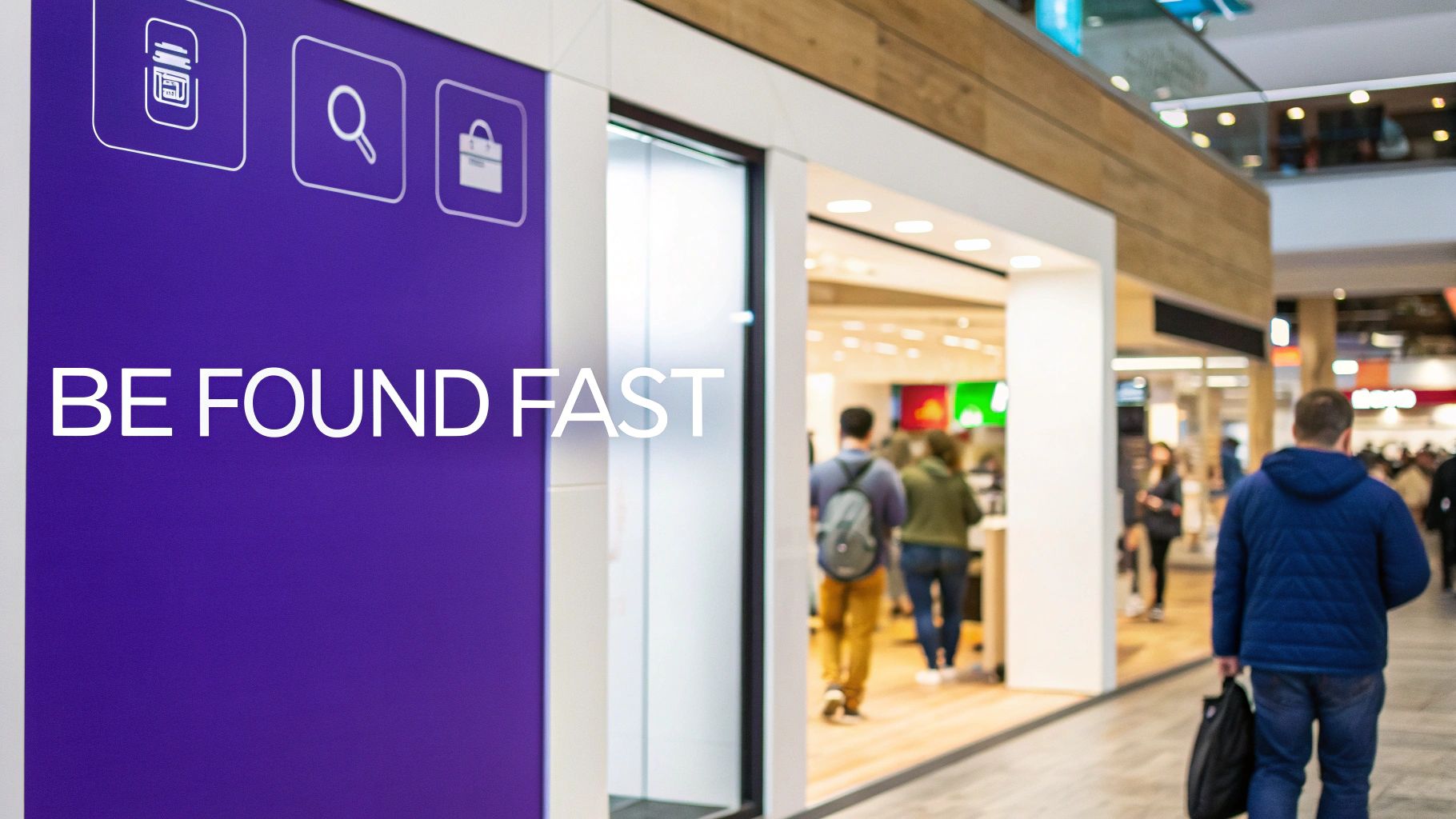
Imagine a huge, bustling shopping centre absolutely packed with potential customers. In this world, search engines are the directories that guide shoppers to the exact stores they’re looking for. A search engine marketing service is your expert team, working to get your store listed prominently where high-intent buyers can’t miss it.
It’s not just about showing up; it’s about showing up at the exact moment a customer realizes they need you. The service uses two powerful pillars to make that happen.
The Two Pillars of SEM Success
A complete search engine marketing service isn't just one thing. It blends two distinct but complementary approaches to cover all the bases.
SEM at a Glance: Key Components and Objectives
This table breaks down the core components of a comprehensive Search Engine Marketing service, highlighting the role and primary business goal of each element.
| Component | Description | Primary Business Goal |
|---|---|---|
| Pay-Per-Click (PPC) Advertising | Paid ads placed at the top of search results for specific keywords. | Generate immediate, high-intent traffic and capture leads ready to buy. |
| Search Engine Optimization (SEO) | Optimizing website content and structure to rank high in unpaid results. | Build long-term brand authority, trust, and a sustainable source of organic leads. |
| Integrated Strategy | The strategic combination of PPC and SEO efforts. | Maximize market visibility, using PPC data to inform SEO and SEO to support PPC. |
By weaving these components together, a professional service creates a system where the whole is far greater than the sum of its parts, driving consistent and predictable growth.
Pay-Per-Click (PPC) Advertising
This is your high-visibility billboard. PPC campaigns place paid ads right at the top of the search results, delivering immediate traffic from people searching for specific keywords.
For example, a B2B software company might run a PPC ad for "project management tool for remote teams" to instantly get in front of leads who are ready to make a decision. One of our clients in the manufacturing sector saw a 300% increase in qualified leads in their first quarter just by targeting precise, long-tail keywords with a focused PPC campaign.
Search Engine Optimization (SEO)
This is the foundation for long-term brand reputation and sustainable growth. SEO is all about optimizing your website—its content, its structure, its authority—to earn high rankings in the organic (unpaid) search results.
It's a long game that builds incredible trust and authority, attracting customers who are still in the research phase and looking for an expert to guide them. As a success story, an enterprise tech client of ours achieved a 45% year-over-year growth in organic demo requests after a targeted SEO content strategy.
An effective search engine marketing service doesn’t see PPC and SEO as separate channels. It strategically combines the immediate impact of PPC with the lasting authority of SEO, creating a powerful system for market dominance.
Why an Integrated Approach Is Crucial
If you only focus on one of these pillars, you're leaving money on the table. Without PPC, you miss out on immediate traffic and incredibly valuable keyword data. Without SEO, you lack a sustainable, cost-effective source of leads and you fail to build that foundational brand credibility that closes deals.
The demand for this integrated expertise has skyrocketed. The search engine marketing industry in California alone is projected to hit an estimated $185.9 billion in 2025. This explosive growth shows just how essential SEM has become for any business that wants to compete. You can learn more about the growth of the search engine industry on ibisworld.com.
Ultimately, a professional search engine marketing service is no longer a "nice-to-have"—it's a core driver of business growth. It provides the strategy, execution, and continuous optimization you need to turn search engine visibility into a predictable revenue stream.
Ready to put your brand in front of high-intent buyers? Contact us today for a complimentary SEM audit and strategy session.
The Core Components of a Powerful SEM Strategy
A successful search engine marketing service is built on two powerful engines working together to dominate the search results. Think of it like a championship racing team: you need a lightning-fast car for immediate speed and a world-class engineering crew for long-term, reliable performance. In SEM, those two components are Pay-Per-Click (PPC) advertising and Search Engine Optimization (SEO).
When they’re in sync, they create a powerful synergy that puts your brand in front of customers at every single stage of their buying journey. One delivers instant visibility, while the other builds a foundation of trust and authority that pays off for years to come.
Pay-Per-Click: The Accelerator for Immediate Leads
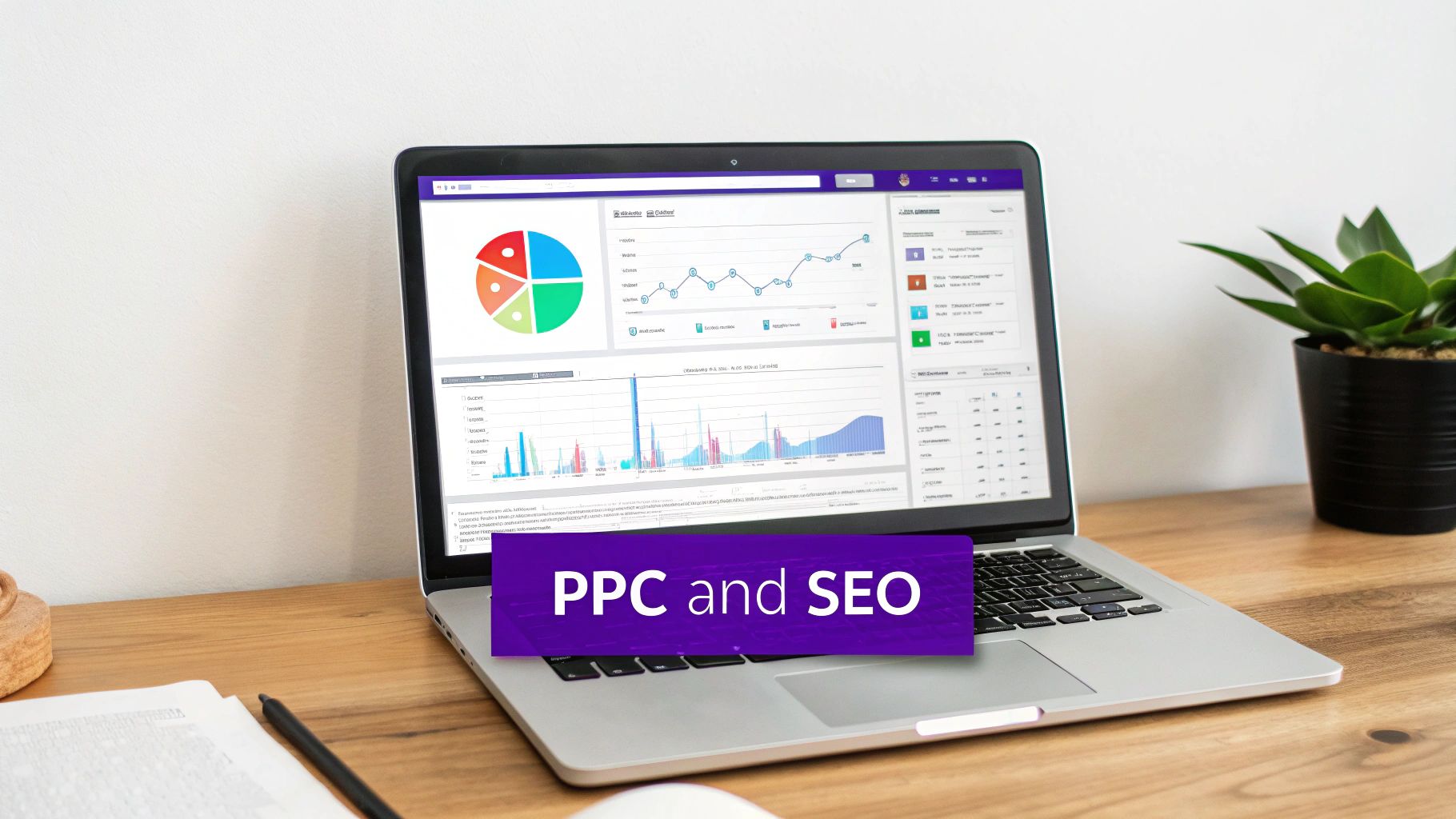
Pay-Per-Click (PPC) advertising is your fast track to visibility. This is the paid side of SEM, where you bid on specific keywords to get your ads placed right at the top of the search results page. It's the quickest way to get in front of high-intent buyers who are actively searching for a solution right now.
But it’s more than just bidding. A winning PPC campaign involves crafting compelling ad copy that demands a click and designing targeted landing pages that seamlessly convert visitors into leads. When companies get this right, the returns are incredible. In fact, for every $1.60 spent on Google Ads, businesses typically earn an average of $3.00 in revenue.
A B2B software company, for instance, could target the keyword "best accounting software for small business." Their ad would appear instantly to prospects ready to make a decision, capturing high-quality leads in the moment. To get the most from your budget, it's crucial to learn how to optimize your Google Ads campaign to ensure every dollar is working as hard as it can.
Search Engine Optimization: The Foundation for Sustainable Growth
While PPC provides the immediate burst of speed, Search Engine Optimization (SEO) builds the powerful, reliable engine for long-term, sustainable growth. SEO is the practice of optimizing your website and content to rank organically—that is, without payment—in search results. This is where you build genuine trust and establish your brand as an industry authority.
A strong SEO strategy is a multi-faceted game, covering several critical areas:
- On-Page SEO: This is all about optimizing individual web pages to rank higher. It includes smart keyword integration, high-quality content creation, compelling meta descriptions, and ensuring your site has a logical, user-friendly structure.
- Off-Page SEO: This focuses on building your website's authority and reputation across the web. The primary tactic here is earning high-quality backlinks from other reputable websites, which act as "votes of confidence" in the eyes of search engines.
- Local SEO: For any business with a physical footprint, this is non-negotiable. It involves optimizing your online presence to attract more customers from relevant local searches, often through platforms like Google Business Profile.
A well-executed search engine marketing service understands that SEO isn't just a technical checklist. It's about creating valuable, relevant content that genuinely helps your target audience, thereby earning their trust and their business over the long haul.
The Synergy of PPC and SEO in Action
The true magic of a search engine marketing service happens when PPC and SEO work in harmony. Let’s go back to our B2B software company. While their PPC ads are busy capturing immediate "bottom-of-funnel" leads, their SEO strategy is targeting prospects much earlier in their research journey.
They might create an in-depth blog post titled, "A Complete Guide to Automating Your Invoicing Process." This article ranks organically for informational keywords, attracting business owners who are just starting to explore solutions. This content positions the company as a helpful expert, building brand affinity long before a purchase is even on the table.
This integrated approach creates a complete search presence that covers the entire customer lifecycle. The data from PPC campaigns can even inform the SEO strategy by identifying high-converting keywords that should be targeted with long-form content. By combining these two pillars, your business doesn't just show up—it dominates. Ready to create this synergy for your brand? Contact us to build your integrated strategy.
Measuring Success and Evaluating SEM Performance
Running an SEM campaign without a clear way to measure its impact is like flying a plane without instruments. You might be moving, but you have no idea if you’re heading toward your destination or flying straight into a mountain. Real success isn’t measured in fuzzy metrics like clicks and impressions; it's about delivering tangible business outcomes that a CFO can get behind.
To evaluate performance like a seasoned executive, you need to tie your marketing spend directly to revenue. This means looking past vanity metrics and demanding accountability for every dollar invested in both paid and organic search.
The KPIs That Matter for PPC
For Pay-Per-Click campaigns, it’s all a numbers game. Every ad, keyword, and landing page has to justify its existence through a measurable return. When you're vetting a search engine marketing service, take a hard look at how they track and improve these critical financial metrics.
Here are the core PPC KPIs you must master:
- Return On Ad Spend (ROAS): This is the ultimate measure of profitability. It tells you exactly how much revenue you’re generating for every dollar you put into ads. A 4:1 ROAS means you’re earning $4 for every $1 you spend.
- Cost Per Acquisition (CPA): This metric tells you exactly how much it costs to bring in one new customer through your campaigns. A primary goal for any sharp SEM strategy is to continuously drive this number down.
- Conversion Rate: This is the percentage of visitors who take the action you want them to, like filling out a form or buying a product. A high conversion rate is a clear sign that your ad copy and landing pages are hitting the mark.
Evaluating SEO Performance for Long-Term Growth
Measuring SEO is less about instant financial returns and more about tracking the growth of a long-term, high-value asset. The ROI isn't as immediate as PPC, but its impact on lead quality and brand authority is undeniable.
An effective search engine marketing service demonstrates the value of SEO by focusing on metrics that signal growing market authority and a stronger lead pipeline, not just temporary traffic spikes.
To get a true read on your SEO success, keep an eye on these three areas:
- Organic Traffic Growth: Are you seeing a steady, month-over-month increase in visitors from non-paid search results? This is the clearest sign that your content and technical SEO work are paying off.
- Keyword Ranking Improvements: Your provider should be tracking your position for high-value, commercial-intent keywords. Moving from page two to the top three spots for a critical term can dramatically boost your qualified leads.
- Quality of Inbound Leads: Are the leads coming from organic search actually a good fit for your business? Tracking lead quality, often through a CRM, confirms your SEO strategy is attracting the right audience.
To really get a handle on these concepts, a deep dive into analytics is essential. For a complete overview, check out our guide on understanding digital marketing analytics.
This data-first approach is gaining traction everywhere. For example, SEM agencies in California are investing heavily in data-driven marketing, with leading firms reporting remarkable client outcomes, including up to a 300% rise in conversions and a 927% increase in clicks for some campaigns. You can discover more insights about these search engine statistics on seo.com.
By holding your search engine marketing service accountable to these specific KPIs, you transform your marketing from a cost centre into a predictable engine for business growth.
Ready to see what a data-driven SEM strategy can do for your bottom line? Contact us today to discuss how we can help you achieve measurable results.
The SEM Process from Strategy to Optimization
Working with a professional search engine marketing service isn't a leap of faith; it’s a structured journey. We follow a methodical process designed to deliver predictable results, moving from deep analysis all the way through to continuous improvement. Knowing this roadmap helps set clear expectations and shows you the expertise that makes a partnership successful.
The whole process is built on a dynamic cycle of learning and refining. It’s the polar opposite of a ‘set it and forget it’ tactic. Instead, it demands constant attention to data, quick responses to market shifts, and a deep commitment to driving ever-improving returns on your investment.
This visual flow shows the four essential stages we follow to take a campaign from a simple idea to a high-performance growth engine.
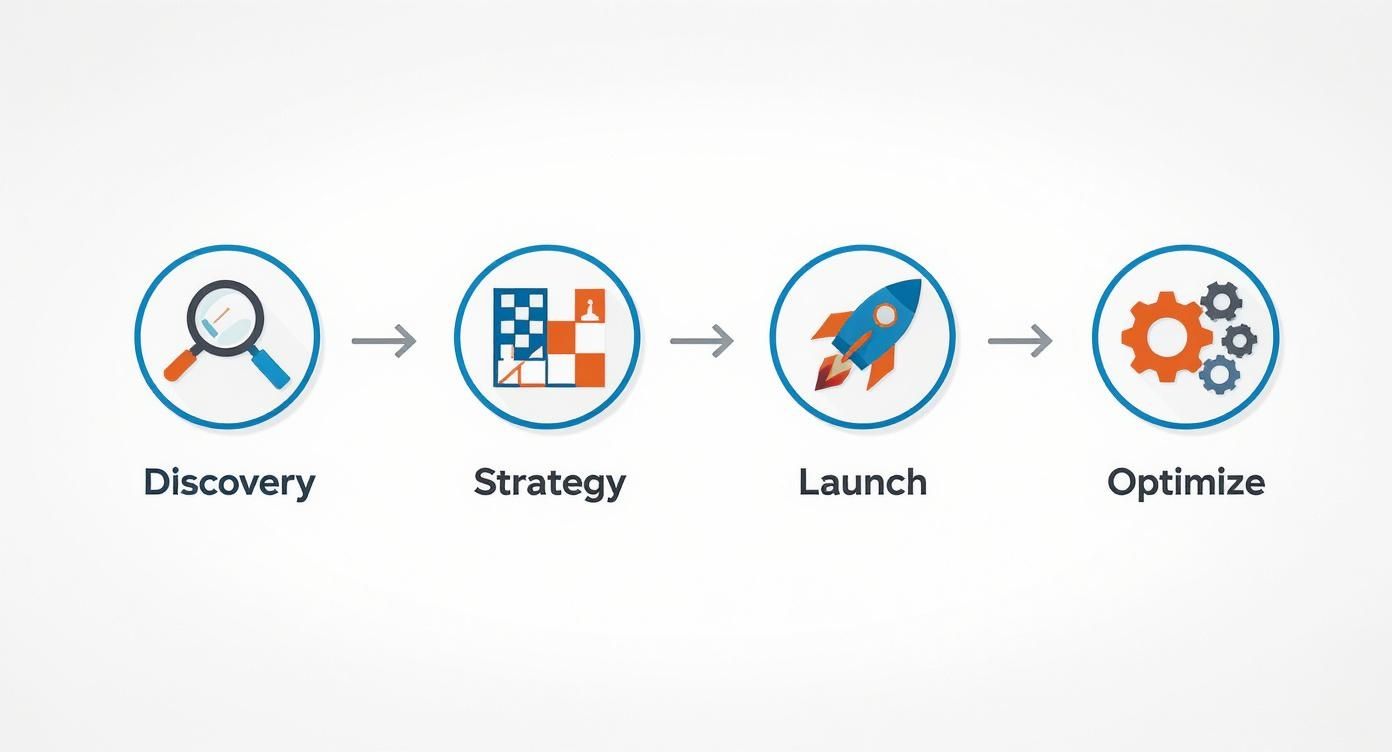
This workflow isn't just a pretty picture. It shows how each step logically builds on the last, ensuring no action is ever taken without a clear, data-backed purpose.
Discovery and Audit
The journey always begins with a deep-dive discovery and audit. Before a single dollar of your ad budget is touched, we analyze your current digital assets, competitive landscape, and market opportunities. This isn’t a quick glance; it's a forensic examination of your website's technical health, existing keyword rankings, and any past campaign performance.
We also conduct a thorough competitor analysis to figure out what’s working for them and where the strategic gaps are. This phase is all about asking the right questions to build a rock-solid foundation for everything that comes next.
Tailored Strategy Development
With the insights from our audit, we build a tailored strategy. Think of this as the architectural blueprint for your entire campaign. It’s where we define target keywords, allocate budgets, and structure campaigns for maximum impact. A great strategy is both ambitious and realistic.
Key elements of this phase include:
- Keyword Selection: We pinpoint the high-intent keywords your ideal customers are typing into search engines to find solutions just like yours.
- Budget Allocation: Your ad spend is strategically distributed across different campaigns and platforms to maximize your return on ad spend (ROAS).
- Campaign Structuring: Ad groups and campaigns are organized logically to make sure your messaging is highly relevant to specific search queries.
This strategic planning is what separates a successful campaign from a costly experiment. For example, one of our B2B clients, a logistics software provider, saw a 65% reduction in their Cost Per Acquisition within three months. How? We simply restructured their campaigns based on a refined keyword strategy developed during this exact phase.
Implementation and Launch
This is where the strategy comes to life. Our team handles all the technical heavy lifting of setting up your campaigns, from writing compelling ad copy and designing high-converting landing pages to configuring conversion tracking. A flawless launch is critical for gathering clean, accurate data from day one.
A well-managed launch isn't just about flipping a switch. It's about ensuring every component—from the ad creative to the final conversion point—is perfectly aligned and meticulously tested to capture every possible lead.
Continuous Optimization and Reporting
The final stage is also the most crucial: continuous optimization and reporting. Once a campaign is live, the real work of a premier search engine marketing service truly begins. We analyze performance data daily, test new ad variations, adjust bids, and refine targeting to consistently improve your results.
This dynamic cycle is what drives long-term success. It involves A/B testing ad copy, experimenting with different landing page layouts, and reallocating budget to the highest-performing areas. Transparent reporting keeps you fully in the loop, turning complex data into clear, actionable insights that demonstrate real business growth.
This rigorous, four-step process ensures your investment is managed with precision and focused on what matters most—delivering measurable results.
Ready to see how our proven process can transform your business? Contact us today for a complimentary SEM audit and strategy session.
Choosing the Right SEM Partner for Your Business
Picking the right partner is probably the biggest decision you'll make when you dive into SEM. This choice directly shapes how fast you grow, how efficiently you spend your budget, and the quality of leads that come through the door. A great partner is a true extension of your team, bringing specialized know-how that gets you results faster. The wrong one? That’s a fast track to wasted ad spend and missed opportunities.
You need to look past the flashy sales pitch and have a real checklist to vet potential providers. This is the only way to find a partner who not only gets the technical side of search engine marketing but also understands your specific business goals and industry.
Your Vetting Checklist
Before you sign on the dotted line, make sure any potential partner can tick these boxes. A bit of due diligence now protects your investment and sets you up for a great long-term relationship.
- Verifiable Case Studies and Success Stories: Ask for proof they’ve done this before, especially with businesses like yours. A confident partner will be excited to show off their wins, like the B2B SaaS client for whom they cut Cost Per Acquisition by 40% while doubling qualified leads in just six months.
- B2B Industry Expertise: The B2B sales cycle isn’t like B2C—it's longer and way more complex. Your partner has to know how to target decision-makers, nurture them through a long consideration phase, and build campaigns that speak to real professional pain points.
- Transparent Reporting: You should never be in the dark. Demand clear, regular reports that focus on what actually matters to the business—like ROAS and CPA—not just vanity metrics. For a closer look at what to track, explore our guide to essential digital marketing services.
A true SEM partner doesn’t just execute tasks; they provide strategic counsel. They should challenge your assumptions, bring new ideas to the table, and operate with a level of ownership that makes them feel like a part of your in-house leadership team.
Smart investing is also a huge piece of the puzzle. California businesses are putting more and more into search marketing. Small businesses there invest an average of $497.16 per month on SEO. What's telling is that companies allocating at least $500 per month are 75% more likely to be happy with their results. It just proves that a proper budget is non-negotiable for effective SEM. You can discover more insights about California SEO spend on digitalsilk.com.
SEM Agency vs. Fractional CMO
Once you have your checklist, the next step is deciding on the right kind of partnership. Two powerful options are the traditional agency and the more integrated fractional CMO.
A standard SEM agency brings a dedicated team of specialists to the table for hands-on execution. A fractional CMO, on the other hand, offers high-level strategic leadership, embedding themselves in your business to guide the entire marketing direction, with SEM being a critical part of that.
To help you decide, here’s a quick comparison of the two models. It's designed to help you figure out whether a traditional agency or a more integrated fractional CMO partnership is the right fit for your SEM needs.
Choosing Your Partner: SEM Agency vs. Fractional CMO
| Factor | SEM Agency | Fractional CMO |
|---|---|---|
| Primary Focus | Task execution and campaign management. | High-level strategy and business alignment. |
| Integration | External vendor, works on specific tasks. | Part of your leadership team, deeply integrated. |
| Scope of Work | Primarily SEM execution (PPC, SEO). | Broader marketing strategy, including SEM. |
| Best For | Companies with an existing strategy needing expert execution. | Companies needing senior marketing leadership to build and guide strategy. |
So, which is the right fit? It really depends on where your company is at and what resources you have internally. If you’ve already got a solid strategy and just need the horsepower to execute it, an agency is a fantastic choice. But if you need that C-level guidance to build the strategy from the ground up, a fractional CMO is the way to go.
Ready to find the perfect fit for your business? Contact us today to discuss which model will best accelerate your growth.
You're at the finish line of this guide, and the takeaway should be clear: a strategic search engine marketing service isn’t just another line item on your budget. It's a high-performance engine meticulously built for B2B growth.
By meshing the instant impact of PPC with the long-term authority of SEO, you're not just participating in your market—you're aiming to dominate it. It’s time to trade guesswork for a data-driven strategy that delivers tangible, predictable results.
The potential here is huge. We've worked side-by-side with B2B technology firms and seen how a well-oiled SEM strategy can slash Cost Per Acquisition by 40% while doubling qualified leads in just six months. That's not a fluke; it's what happens when you apply a methodical, expert-led process.
Turn Visibility Into Revenue
The next step demands a commitment to a unified strategy. A professional search engine marketing service ensures your paid ads and organic content aren't fighting each other but are working in concert, creating a powerful system where each part amplifies the other. This synergy is what separates the market leaders from everyone else.
The goal is simple: make your brand the most visible, trusted, and obvious choice for customers at the exact moment they’re ready to buy. A cohesive SEM strategy is the most direct path to getting there.
If you're ready to convert your search engine visibility into a predictable revenue stream, our team is here to build that strategy with you. We partner with B2B companies to carve out a true competitive advantage in a crowded digital marketplace.
Unlock Your Business Potential
Stop leaving money on the table with disconnected marketing efforts. A comprehensive SEM approach provides the structure and expertise you need to capture high-intent leads and nurture them into loyal customers. Let us show you what’s possible when every single marketing dollar is put to its most effective use.
Contact us today for a complimentary SEM audit and strategy session to unlock your business's full potential.
Your SEM Service Questions, Answered
Jumping into search engine marketing can feel like learning a new language. Before you partner with anyone, you want to be sure you’re making a smart decision. To help, we’ve put together answers to the most common questions we hear from B2B leaders.
Think of this as your cheat sheet for moving forward with confidence.
How Long Until We See Results?
This is always the first question, and for good reason. The answer depends on which part of the search engine marketing service we’re talking about, because its two core pieces—PPC and SEO—work on very different clocks.
Pay-Per-Click (PPC) advertising is all about immediate impact. The moment your campaigns are live, you can expect to see a fresh wave of traffic and potential leads. But that’s just the starting line. Getting your campaigns truly dialled in—refining ad copy, sharpening your targeting, and optimizing bids to boost your Return on Ad Spend (ROAS)—usually takes about 1-3 months to really hit its stride.
Search Engine Optimization (SEO), on the other hand, is a long-term play. You're building a valuable digital asset that pays dividends over time. You should start to see meaningful movement in your keyword rankings and a noticeable lift in organic traffic within 4-6 months. The kind of results that really drive the business often take 6-12 months of consistent, quality work to fully materialize.
What Is the Difference Between SEM, SEO, and PPC?
It’s easy to get these terms tangled, but the relationship is actually pretty straightforward. Think of Search Engine Marketing (SEM) as the entire toolbox you use to get found on Google.
Inside that toolbox, you have two primary tools:
- Search Engine Optimization (SEO): This is the craft of earning your visibility. It’s all about creating fantastic content, building your site's authority, and ensuring its technical health is rock-solid so you rank organically, without paying for clicks.
- Pay-Per-Click (PPC): This is where you buy your visibility. You pay for ad placements at the top of the search results, giving you a direct line to targeted traffic from people actively looking for what you offer.
A complete search engine marketing service doesn’t force a choice between SEO and PPC; it blends them. PPC gets you immediate, targeted traffic and leads right now, while SEO builds the long-term authority and sustainable, cost-effective lead pipeline for tomorrow.
How Much Should a B2B Company Budget?
There’s no magic number here. Budgeting for a professional search engine marketing service really depends on how competitive your industry is, what your growth goals are, and how fast you want to get there.
A good rule of thumb is to allocate between 10-30% of your total marketing budget to SEM. For PPC, that budget splits into two parts: the ad spend (which you pay directly to platforms like Google) and the management fee. For SEO, the investment is almost entirely the service fee for the expertise and execution.
As a practical guideline, B2B companies serious about growth typically invest anywhere from $2,500 to $10,000+ per month for a comprehensive service that delivers real, measurable ROI. One of our enterprise software clients, for example, started with a modest budget. After seeing a 450% ROAS within six months, they confidently scaled their investment to grab more market share.
Ready to stop guessing and start growing with a data-driven strategy? The team at B2Better is here to build a custom SEM program that aligns with your unique business goals. Contact us today for a complimentary SEM audit and strategy session.