

For Canadian B2B founders and marketers, getting noticed feels like a constant battle. Search Engine Marketing (SEM) isn't just another line item on your budget; it's your single most powerful tool for grabbing high-intent leads across North America the very moment they start looking for a solution you offer. It's about turning ad spend into a predictable, scalable revenue engine to capture traffic from Canada and the United States.
Why SEM Is Non-Negotiable for Canadian B2B Growth
Imagine tapping into a direct stream of decision-makers in both Canada and the United States who are actively searching for your B2B services. That's the core power of a well-run search engine marketing strategy. Instead of casting a wide, expensive net with old-school advertising, SEM lets you show up right in front of potential clients who have already raised their hands and declared their need. That precision is why companies that get SEM right often see explosive growth.

This isn’t just a hunch; the numbers back it up. A staggering 93% of B2B buying processes start with an online search. For B2B companies, that signals a massive opportunity to grab market share before your competitors wise up. A targeted campaign lets you connect with prospects in both Canada and the United States, expanding your reach without needing a physical presence.
The Strategic Advantage of SEM
SEM works because of one simple principle: intent. You aren’t interrupting someone’s social feed; you're answering their direct question. This is a fundamental difference, and it’s especially crucial in B2B, where sales cycles are longer and more considered. To really get a handle on how SEM fuels B2B growth, it helps to understand the basics of what is paid search marketing.
A smart SEM program can deliver incredible results. Take one Canadian SaaS startup, for example. By focusing its ad spend on specific, high-intent keywords targeting decision-makers in Canada and the U.S., the company cut its customer acquisition cost by 40% and boosted qualified leads by 60%—all within six months. That’s the kind of game-changing impact a strategic approach can have.
SEM is about more than just buying traffic; it's about buying the right traffic at the right time. It's your direct line to motivated buyers in a crowded digital marketplace.
This guide is your starting point for building that revenue engine. We’ll lay out a clear, actionable roadmap for using search engine marketing in Canada to drive measurable growth. Our expert-led pay-per-click services can also provide the strategic leadership to build and run a high-performance program, all without the overhead of a full-time hire.
Ready to turn your ad spend into a predictable source of B2B leads from Canada and the United States? Contact us today to discover how we can align your marketing efforts with your most critical revenue goals.
Navigating the Canadian SEM Landscape
To get anywhere with search engine marketing in Canada, you need a reliable map of the territory. This means looking beyond broad North American assumptions and digging into the specific data, behaviours, and rules that define the Canadian market. It’s a distinct environment, and treating it as such is the first step toward building a campaign that actually performs.
The biggest landmark on this map? The overwhelming dominance of one search engine.
The Undisputed Giant: Google’s Grip on Canada
In the Canadian digital space, Google is king. It’s not even a close race. This isn't just a hunch; the numbers tell a stark story and provide immediate clarity on where your budget and efforts should be focused.
Canadian Search Engine Market Share: A Snapshot
This table illustrates the current distribution of search engine usage in Canada, highlighting where B2B marketing efforts should be focused for maximum reach.
| Search Engine | Market Share (%) | Primary B2B Audience/Opportunity |
|---|---|---|
| 87.18% | The primary battleground for nearly all B2B campaigns. Decision-makers, from founders to procurement teams, start their research here. | |
| Microsoft Bing | 8.46% | A secondary channel that can capture an older, more established professional demographic, often integrated with Windows and Microsoft products. |
| Yahoo | 2.27% | A minor player with a legacy user base. Worth minimal investment unless targeting a very specific, older demographic. |
| DuckDuckGo | 1.35% | Caters to a privacy-conscious audience. A niche opportunity for B2B tech or security firms whose value proposition aligns with data protection. |
Source: Statcounter, May 2024
This data isn't just a statistic; it’s a strategic directive. For B2B startups and scale-ups trying to connect with founders, CEOs, and technical leads, it confirms that Google Ads must be your primary focus. While other platforms like Microsoft Ads (for Bing) have their place, ignoring Google’s market share is like setting up a fishing net in a pond when there's an ocean right next door.
Understanding Canadian & U.S. B2B Search Behaviour
Beyond picking the right platform, you need to get inside the head of a North American business leader. How do they search? Their behaviour is shaped by regional economies, industry clusters, and cultural nuances that directly impact which keywords you should target and how your ads should sound.
For instance, a search for “logistics software solutions” carries different intent in the manufacturing hubs of Southern Ontario than it does in the resource-rich provinces of Alberta or British Columbia. One might be focused on supply chain efficiency for automotive parts, the other on tracking heavy equipment. Similarly, targeting the U.S. requires understanding major tech hubs in Silicon Valley versus financial centers in New York.
Successful SEM campaigns live and die by these differences. A one-size-fits-all approach airlifted from one market will almost always miss the mark. B2B buyers frequently use location-specific keywords (e.g., “SaaS accounting firm Toronto” or “cleantech consultants Vancouver”) and respond better to ads that show a genuine understanding of their local business context.
A winning search engine marketing Canada strategy is built on localization. It’s about more than just targeting a country; it’s about speaking the language of its distinct regional markets.
The Legal Framework: PIPEDA and Your Ads
Another critical feature of the Canadian landscape is its legal environment. You can’t run digital ads here without a firm grasp of the Personal Information Protection and Electronic Documents Act (PIPEDA). This federal privacy law dictates how private-sector organizations collect, use, and disclose personal information during commercial activities.
For your SEM campaigns, PIPEDA has direct and non-negotiable implications:
- Consent for Data Collection: You must be transparent about how you collect user data through tracking pixels for remarketing or conversion tracking. No surprises.
- Privacy Policies: Your website’s privacy policy needs to be clear, comprehensive, and easy to find. It has to detail what data you gather and why.
- Data Handling: Any personal information collected from leads—say, through a form submission on a landing page—must be handled securely.
Failing to comply with PIPEDA doesn't just risk financial penalties; it demolishes trust with potential clients who are increasingly privacy-conscious. A compliant campaign is a credible one. It shows prospective customers you respect their data and operate professionally within Canadian law—an absolute must in B2B, where long-term partnerships are the goal.
Ready to build a Canada-first SEM strategy that drives real results? Contact us today for a consultation and let's map out your path to B2B growth.
Building Your Canada-Focused B2B SEM Strategy
Now that we've mapped out the Canadian market, it's time to build your growth engine. A powerful search engine marketing strategy doesn't just happen; it's built with purpose, starting with a crystal-clear picture of your business goals and a deep understanding of who you're trying to reach.
Think of your strategy as the blueprint for a high-performance machine. Every single component—from your objectives to your keywords to the platforms you choose—has to work together perfectly. The alternative is wasted ad spend and missed opportunities, a luxury no B2B startup or SMB can afford.
Defining Your Core Business Objectives
Before you spend a single dollar, you have to answer the most important question: what does success actually look like? Vague goals like "getting more traffic" are a recipe for disappointment. In the B2B world, your objectives must be specific, measurable, and tied directly to revenue.
Most B2B goals fall into two main buckets:
- Lead Generation: This is the big one for most companies. Success here is measured by the number of qualified leads you get, like demo requests, consultation bookings, or downloads of a high-value whitepaper.
- Brand Awareness: If you're new to the scene or breaking into a new Canadian market, your first goal might be to just get your name out there. You'd measure this with things like ad impressions, reach, and how many people search for your brand name over time.
For example, a Calgary-based logistics software company might set a primary goal of generating 20 qualified demo requests per month from supply chain managers in Western Canada and the U.S. Pacific Northwest. On the other hand, a new fintech startup in Toronto might focus on hitting 500,000 ad impressions among financial executives in the GTA to build that crucial initial brand recognition.
The clearer your objective, the easier it is to build a campaign that delivers. Aligning every ad, keyword, and landing page with a concrete business goal is the foundation of a profitable search engine marketing Canada program.
Identifying Your Ideal North American Buyer
Once you know what you want to achieve, you need to know who you're selling to. A generic "B2B decision-maker" profile is far too broad. You need to get specific and develop detailed buyer personas for the Canadian and U.S. markets.
Think about factors like:
- Industry: Are you targeting manufacturing in Ontario or the energy sector in Alberta?
- Company Size: Is your ideal client a 10-person startup or a 500-employee enterprise?
- Job Title: Are you trying to reach a CTO, a Director of Operations, or a procurement specialist?
- Pain Points: What specific business challenges does your solution solve for them, right now?
Developing these personas lets you write ad copy and design landing pages that speak directly to their needs. This targeted approach is absolutely essential for cutting through the noise and grabbing their attention.
Mastering Canadian Keyword Research
Keyword research is where your strategy gets real. It’s all about figuring out the exact phrases your Canadian and American buyers are typing into Google. This process has to account for local nuances and the reality of bilingual searches.
A generic keyword like "CRM software," for instance, is brutally competitive and expensive. A much smarter, localized keyword like "CRM for manufacturing companies in Quebec" or "supply chain logistics software Calgary" will attract a far more qualified—and convertible—audience.
When you're targeting markets like Quebec, don't forget that many professionals search in both English and French. Your research has to include French-language keywords and local terms to make sure you're not ignoring a huge chunk of your potential customers. As you build your strategy, it's crucial to explore different ways to bring in high-quality leads. For a deeper look at turning your search traffic into real business, check out these SEO lead generation strategies for B2B. This layered approach to keywords ensures you capture intent, no matter the language. A solid keyword strategy is also a pillar of our comprehensive SEO services for Canadian businesses.
Choosing the Right Platform: Google Ads vs. Microsoft Ads
While Google is the undisputed heavyweight champion of search, Microsoft Ads (which powers the Bing network) is a valuable, and often overlooked, channel for B2B marketers in Canada and the U.S.
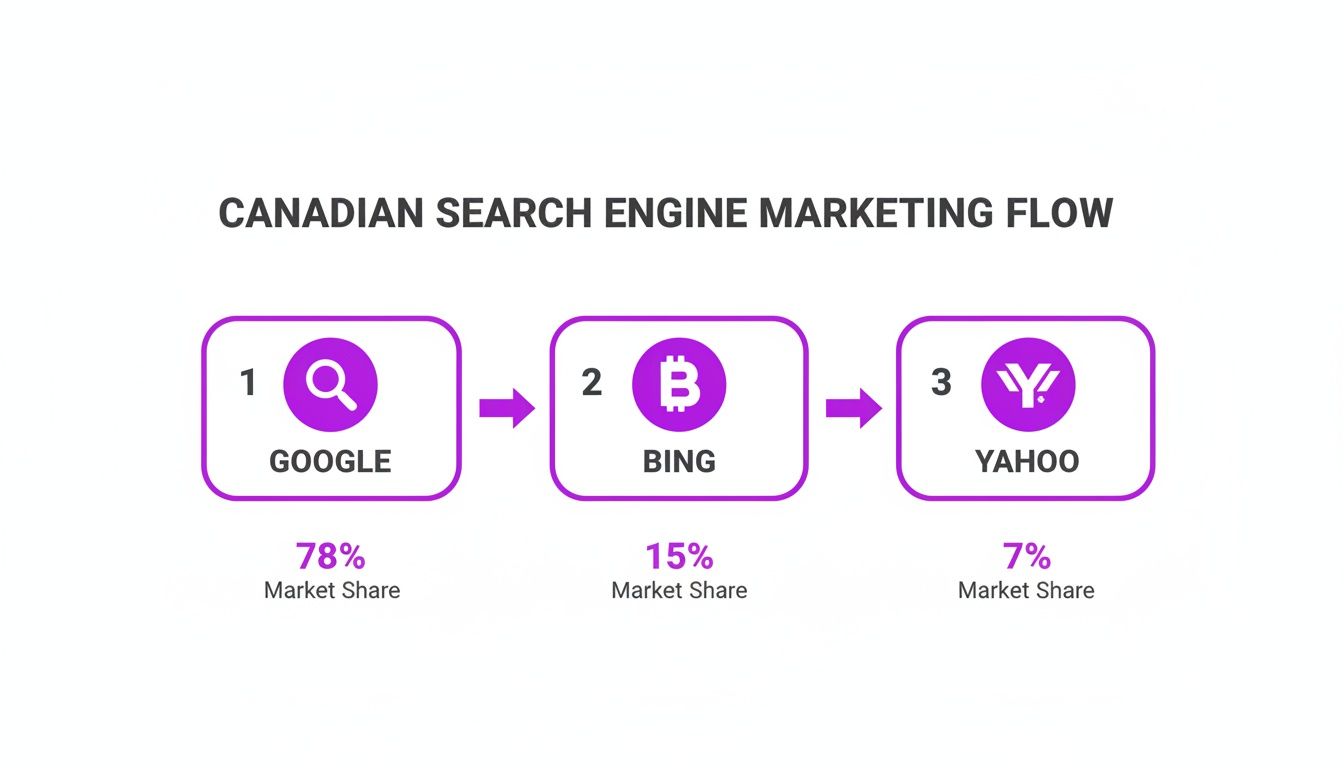
Here’s a quick rundown of how they stack up:
- Google Ads: This is where the volume is. It offers the biggest reach and is an essential starting point for pretty much every B2B advertiser.
- Microsoft Ads: Bing’s user base tends to be a bit older and more established professionally. The competition is lower, which often means you'll see a lower cost-per-click (CPC). Plus, its deep integration with Windows and LinkedIn opens up some unique targeting opportunities.
We saw this play out with a B2B financial services client targeting executives in Canada and the U.S. After adding Microsoft Ads to their mix, they found their cost-per-lead was 30% lower on Bing than on Google for the exact same keywords. That allowed them to bring in high-value clients much more efficiently.
The opportunity here is massive. The search engine marketing Canada sector is a key driver in a digital marketing industry projected to grow from USD 14.01 billion to USD 43.62 billion by 2034. For SMBs, that growth highlights just how important it is to get your paid media right.
Advanced SEM Tactics for a Competitive Edge
A basic Search Engine Marketing (SEM) campaign will get you clicks. A great one builds a predictable revenue engine that gives you a serious leg up in the Canadian and American markets. To make that leap, you need to move beyond standard keyword bidding and embrace the advanced tactics market leaders use to own the search results.
This is all about shifting your focus from just being present to being surgically relevant. It’s the difference between running a generic ad and showing the right message to the right B2B buyer in the right Canadian city, at the exact moment they need a solution. That kind of precision doesn’t happen by accident; it’s engineered.
The Art of Hyper-Localization in Ad Copy
Running the same ad across Canada is a huge missed opportunity. Real localization isn’t just targeting a country; it’s about speaking the language of its distinct regional economies. This builds immediate trust and signals that you actually understand the local business landscape.
Think about these practical applications:
- Canadian Spelling and Phrasing: Use Canadian English like "centre," "colour," and "organise." It’s a small detail, but it shows you’re not just an American company treating Canada as an afterthought.
- Regional Terminology: An ad targeting Alberta’s energy sector should use language that resonates there. That’s going to be very different from the terms used in Ontario's manufacturing hubs.
- Bilingual Campaigns for Quebec: Don't just translate your English ads. Craft distinct campaigns with culturally adapted copy that speaks directly to the business culture in Quebec.
One Canadian B2B tech firm saw a 22% jump in its click-through rate (CTR) just by creating separate ad groups for Western Canada, Ontario, and Quebec with regionally-specific ad copy. That’s the power of making your brand feel local.
Advanced Bidding and Audience Targeting
Setting a simple cost-per-click (CPC) bid is just scratching the surface. To really stretch your budget, you need to let data drive your bidding and then layer on precise audience targeting. This is central to any serious search engine marketing Canada strategy.
Automated bidding strategies like Target CPA (Cost Per Acquisition) tell Google's algorithm to hunt for conversions at a specific cost. Instead of just paying for clicks, you’re optimizing for what actually matters—demo requests, form fills, and real leads. Your ad spend gets tied directly to business results.
By leveraging smart bidding and audience layers, you transform your SEM campaign from a billboard into a guided missile, targeting only the most valuable prospects who are actively showing buying signals.
Layering on audience targeting is where the real magic happens. You can target users based on:
- In-Market Audiences: Reach people actively researching products or services like yours. For example, you can target B2B buyers who are in the market for "Enterprise Software" or "Cloud Services."
- Custom Intent Audiences: Build your own audience by feeding Google keywords and URLs related to your competitors or key industry publications. This lets you reach highly relevant users as they browse online.
- Remarketing Lists for Search Ads (RLSA): Target people who have already visited your website. You can bid more aggressively for this group because they’re already familiar with your brand and much closer to converting.
A Toronto-based SaaS company used RLSA to target previous website visitors searching for competitor brand names in Canada and the U.S. The result? A 40% higher conversion rate compared to their general search campaigns. It’s proof that reaching a warm audience pays off, big time.
Mastering Quality Score to Lower Costs
Quality Score is Google’s rating of how relevant your keywords and ads are. It’s a critical metric because a higher Quality Score leads directly to lower ad costs and better ad positions. Improving it is one of the most effective ways to make your SEM budget go further.
Google calculates your score based on three main components:
- Expected Click-Through Rate (CTR): How likely is your ad to get clicked when it’s shown?
- Ad Relevance: Does your ad copy actually match what the user was searching for?
- Landing Page Experience: Is your landing page relevant, useful, and easy to navigate once they click?
By continuously improving these three areas—writing compelling ad copy, tightly organizing ad groups, and optimizing landing pages—you can significantly boost your Quality Score. A high score is your reward for giving users a great experience, and Google thanks you with cheaper clicks.
These advanced tactics are what separate stagnant campaigns from high-growth revenue drivers. If you're ready to implement an expert-level SEM strategy but lack the senior bandwidth, we can help.
Contact us for a consultation to discover how we can build and execute a high-performance SEM program for your B2B company.
Proving SEM ROI to Your Leadership Team
Every dollar you put into marketing has to answer one simple question from leadership: "Is this working?"
To answer that with a confident "yes," you need to speak their language. That means shifting the conversation away from vanity metrics like clicks and impressions and focusing squarely on what drives the business forward: revenue. This is how you prove your search engine marketing in Canada isn't just a cost centre but a predictable engine for growth.
It’s all about translating campaign data into a clear, compelling story about how your ad spend is generating tangible business results.

The B2B Metrics That Actually Matter
For a moment, forget about click-through rates. To prove ROI, you have to track the entire journey, from a curious prospect to a paying customer.
These are the numbers that tell that story:
- Cost Per Lead (CPL): This is your starting point. It tells you exactly how much you’re spending to get one person to raise their hand, whether that’s by filling out a form or downloading a whitepaper.
- Customer Acquisition Cost (CAC): Taking it a step further, CAC calculates the total cost to bring on a new paying customer. It includes not just your SEM spend but all the sales and marketing touchpoints involved in closing the deal.
- Customer Lifetime Value (CLV): This is the ultimate prize. CLV is the total revenue you can reasonably expect from a single customer over the entire time they do business with you.
- Return on Ad Spend (ROAS): This is a straight-up ratio measuring the gross revenue you generate for every dollar spent on ads. A ROAS of 5:1 means you’re making $5 for every $1 you spend. Not sure where you stand? Figure out your baseline with our break-even ROAS calculator.
By focusing on the relationship between CAC and CLV, you can demonstrate the long-term profitability of your SEM campaigns. A successful strategy ensures that the value of a customer far outweighs the cost to acquire them.
Overcoming the B2B Attribution Challenge
In B2B, the path from seeing an ad to signing a contract is rarely a straight line. It's winding. A prospect might see your ad, visit your site, come back a week later to read a blog post, and finally convert after a follow-up email.
Last-click attribution, which gives all the credit to that final email, just doesn't cut it. It completely misses how your search ads planted the seed in the first place.
To show SEM’s true impact, you need a multi-touch attribution model. This approach spreads the credit across the various touchpoints that influenced the buyer, painting a far more accurate picture of how your ads contribute to the bottom line. It's why 70% of B2B marketers state that SEM generates more leads than any other marketing initiative. They know its influence runs deep. This is mirrored in the B2B space, where 41% of companies now dedicate over half their marketing budget to digital channels, acknowledging SEM's power.
This is where precise conversion tracking becomes non-negotiable. By setting up goals in Google Analytics and tracking events with Google Tag Manager, you connect ad clicks to valuable actions on your website. This data is the raw material you need to build clear reports that turn clicks into business insights your leadership team can get behind.
When you can present a clear narrative backed by these hard numbers, you won’t just be justifying your budget—you’ll be making a case to increase it. Contact us to learn how we can help you build this reporting framework.
Taking the Next Step in Canadian SEM
Mastering search engine marketing in Canada is about more than just following a generic playbook. It takes localized expertise, strategic leadership, and a deep understanding of what makes B2B buyers here tick. We’ve walked through the entire framework in this guide, from grasping unique market dynamics and proving ROI to putting advanced tactics to work that drive real, measurable growth.
If there’s one central takeaway, it’s this: a one-size-fits-all approach simply doesn’t cut it in the North American market. A localized, data-driven SEM strategy is the only reliable path to sustainable success and a genuine competitive edge. We’ve seen it firsthand—like the B2B tech firm that slashed its customer acquisition cost by 40% by tailoring its campaigns for Canada. That’s the power of a focused strategy.
A high-performance SEM program isn't just about spending money on ads; it's about investing in a predictable system for revenue growth. It turns your marketing function from a cost centre into a profit driver.
If you’re ready to implement these powerful strategies but don't have the senior-level bandwidth to lead the charge, it’s time for a different approach. This is where a Fractional CMO can be a game-changer. You get the high-level strategic guidance needed to build and execute a world-class search engine marketing Canada program, all without the overhead of a full-time executive. It's a model built for ambitious B2B companies looking to scale efficiently.
We partner with businesses just like yours, providing the expertise to align every marketing dollar with your most critical revenue goals. It’s time to stop guessing and start seeing measurable returns from your digital advertising investment.
Ready to transform your SEM performance and drive predictable growth in the Canadian and US markets? Contact us for a no-obligation consultation today.
Burning Questions About B2B SEM in Canada? We’ve Got Answers.
When it comes to search engine marketing, Canadian B2B leaders often have the same key questions. Let’s cut through the noise and get you the straight answers you need to build a winning strategy.
What’s a Realistic SEM Budget for a Canadian B2B Company?
There’s no magic number, but if you're serious about getting results in a competitive Canadian market, a realistic starting point is between $3,500 and $7,500 per month.
That budget gives you enough firepower to gather meaningful data, run tests, and optimize your way to qualified leads. Think of it this way: a B2B software company targeting Toronto’s financial sector will face higher costs-per-click (CPCs) than a niche manufacturer in Calgary. Your budget should always be reverse-engineered from your goals, like hitting a target Cost Per Lead (CPL).
How Long Until We Actually See Results?
You’ll see traffic almost immediately, but a real return on your investment takes a bit of patience. Clicks and impressions will start rolling in within the first few weeks, which is great for initial data.
However, generating a steady stream of qualified B2B leads typically takes three to six months. That's the time needed to gather enough performance data to really dial in your keywords, ad copy, and landing pages. As one success story shows, an industrial equipment supplier in Ontario landed its first major sale in month four, but only after we used the early data to sharpen their audience targeting and messaging.
Is Google Ads Enough, or Do We Need Microsoft Ads (Bing) Too?
Google dominates the Canadian market, no question. But ignoring Microsoft Ads is like leaving money on the table. A surprising number of B2B professionals in Canada and the U.S., especially in corporate environments that run on Microsoft products, use Bing as their default search engine.
We consistently see clients achieve a 20-30% lower Cost Per Lead (CPL) on Microsoft Ads compared to Google Ads for the same keywords. This efficiency makes it a crucial secondary channel for maximizing your budget and reaching a valuable professional audience across North America.
Start with Google Ads to get the volume, but layering in Microsoft Ads is the smart move for any comprehensive search engine marketing Canada strategy. It just makes your budget work harder.
Ready to stop guessing and start building a high-performance SEM program that drives predictable growth in the Canadian and US markets? As a Fractional CMO partner, B2Better provides the strategic leadership needed to turn your ad spend into a powerful revenue engine.