

When we talk about real estate SEO, we’re not just talking about getting your website to show up on Google. We’re talking about a highly localized, strategic system designed to connect you with serious buyers and sellers in your specific neighbourhoods across the United States and Canada. It’s the process of turning casual search traffic into signed contracts.
Why Generic SEO Fails in Real Estate
Standard, cookie-cutter SEO advice almost always misses the mark in the hyper-local, high-stakes world of real estate. A generic approach might drive some traffic to your site, sure, but it won’t get you qualified leads from buyers hunting in North Vancouver, Canada, or sellers vetting agents in Austin, Texas.
The goal isn't just to be found online. It's to become the undeniable digital authority in your local market.

Here's the reality: a staggering 97% of homebuyers in North America now use the internet in their property search. Your digital presence isn't just a part of your business—it's your primary storefront. A one-size-fits-all strategy simply can't compete when every single street and school district matters.
The Problem with a Broad Approach
A generalist SEO firm might focus on broad keywords that attract clicks but not clients. Think of it this way: ranking for a term like "houses for sale" is completely useless if the person searching is on the other side of the country.
What you really need is a system built on three core pillars:
- Pinpoint Local Optimization: This means zeroing in on the specific neighbourhoods, cities, and even postal/ZIP codes you serve in the US and Canada.
- Flawless Technical Setup: Your website has to be fast, mobile-friendly, and easy for search engines to crawl—especially when wrestling with complex IDX feeds.
- Community-Focused Content: Creating resources that answer the unique questions of buyers and sellers in your market builds immense trust and authority.
A fantastic success story is the Toronto-based brokerage, The BREL team. They became a local powerhouse by creating incredibly detailed neighbourhood guides and brutally honest blog posts. This strategy didn't just get them to rank on Google; it built a brand that buyers and sellers genuinely trusted. The result? A massive spike in organic leads and a dominant market share in a highly competitive Canadian city.
Building a Predictable Lead System
To achieve sustainable growth in competitive Canadian and US markets, you have to move beyond just chasing random rankings. A specialized approach to real estate SEO transforms your website from a simple digital brochure into a predictable, lead-generating engine.
This is no different from how other specialized fields, like law, require a tailored strategy. You can see a similar breakdown in our guide on law firm SEO, which dives into the nuances of another complex industry.
To truly pull ahead, agents and brokerages need to explore more advanced strategies, including things like AI SEO for real estate agents, to get an edge in attracting clients and boosting listings.
If you're ready to build a professional digital presence that connects with serious clients, contact us. We can show you how to build your authority and own your local market online.
Building Your Local Keyword Blueprint
Success in real estate SEO isn’t about chasing generic terms like ‘Toronto homes for sale.’ It’s about getting inside your client's head and understanding precisely what they’re typing into Google at every stage of their journey, whether they're in Canada or the United States.
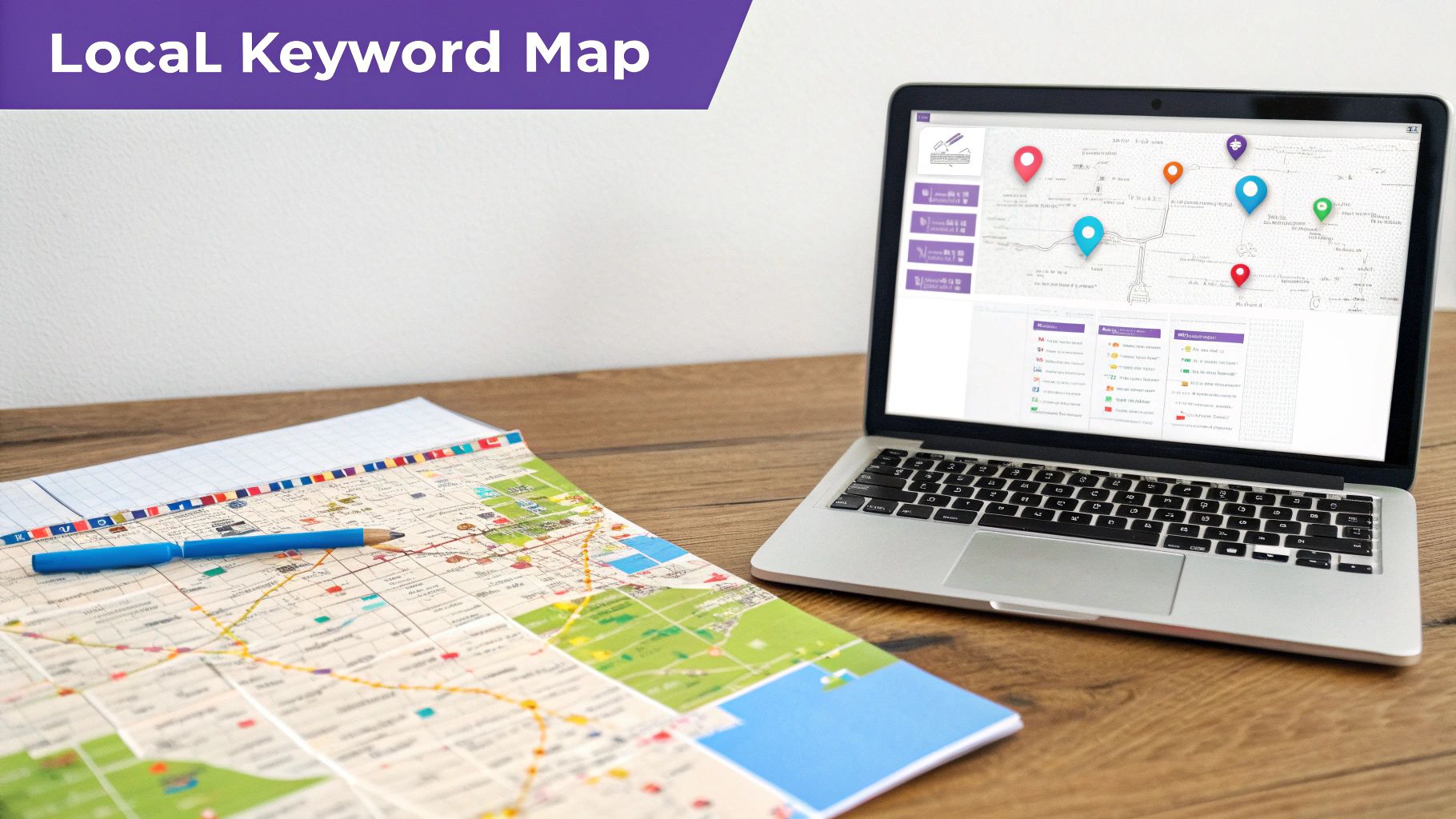
This is more than just a list of keywords; it's about mapping your entire digital territory. When you get this right, every piece of content—from a blog post about school districts to a specific property listing—serves a clear purpose and answers a direct need.
Uncovering High-Intent Keywords
A layered keyword strategy is essential for capturing prospects, from those just starting to browse to those ready to make a decision. People don't just search for houses; they search for solutions. That means your blueprint needs to target three distinct types of queries.
- Long-Tail Keywords: These are longer, more descriptive phrases that signal serious intent. Instead of "Calgary homes," think "three-bedroom homes for sale in Altadore Calgary." The search volume is lower, but these are the queries that convert.
- Buyer-Intent Queries: These keywords show someone is actively planning a move. Searches like "first-time home buyer programs in Austin TX" or "best mortgage lenders in Miami Florida" are prime opportunities. Creating content for these terms positions you as a trusted advisor early on.
- Seller-Focused Searches: Homeowners ask a different set of questions. Targeting keywords like "what is my home worth in suburban Chicago" or "how to sell a condo in Vancouver" attracts high-value listing opportunities.
Mapping Keywords to the Client Journey
A truly effective keyword blueprint connects each search term to a specific stage in the client's journey. This alignment ensures you're delivering the right information at exactly the right time, building trust and guiding them toward becoming a client.
For example, a Vancouver brokerage might target "laneway house potential in Kitsilano," tapping into a specific local Canadian housing trend. A Miami agent, on the other hand, would be smart to focus on "condos with hurricane impact windows," addressing a critical regional concern in the US.
A brokerage in Kelowna, BC, shifted its focus from broad terms to hyper-local keywords. By creating content around "waterfront homes for sale near Okanagan Lake" and "winery-adjacent properties," they saw a 45% increase in qualified organic leads within six months. They didn't just attract traffic; they attracted the right traffic from their target Canadian market.
Tools and Local Knowledge Combined
Modern tools like Ahrefs and SEMrush are fantastic for uncovering keyword opportunities and seeing what your competitors are up to. They provide the data foundation—search volumes, difficulty scores, and related terms—that any good strategy needs. But data alone won't get you across the finish line.
Your greatest advantage is your local knowledge. You know the unofficial neighbourhood names, the sought-after school catchments, and the local slang that SEO tools will never find. Combining this on-the-ground expertise with hard data is what creates an unbeatable strategy. If you want to dig deeper into this, our comprehensive guide to local SEO offers even more practical steps.
To truly master this, it helps to understand broader marketing tactics, including advanced hyper-local SEO strategies. This wider view helps integrate your keyword plan into a more holistic growth framework.
By meticulously building this blueprint, you stop guessing and start strategically targeting the clients you want. Every keyword becomes a signpost, leading potential buyers and sellers directly to your digital doorstep.
Are you ready to map out a keyword strategy that drives real business results in your Canadian or US market? Contact us today to build your blueprint for success.
Fine-Tuning Your Digital Listings and On-Page SEO
Alright, you've mapped out your keywords. Now comes the fun part: putting them to work where it really counts—on your website and in your property listings. This is the nuts and bolts of real estate SEO, where seemingly small adjustments can lead to huge jumps in visibility and, more importantly, client calls.
Getting these on-page details right is what earns you points with both search engines and the people actually looking to buy or sell. It’s the critical step that turns a casual search into a click, and a click into a qualified lead.

Crafting Listings That Actually Rank
Every property listing on your site is a powerful, standalone landing page just waiting to attract buyers. But here’s the problem: most agents just let their default IDX feed do the heavy lifting. The result? Thin, duplicated content that Google has seen a thousand times before and promptly ignores.
To break through the noise, you need to treat each listing like a unique piece of content.
- Write Compelling Title Tags: Go beyond just the street address. A killer title tag looks something like this: "Luxury Waterfront Condo in Yorkville, Toronto | 2 Bed, 2 Bath | For Sale". It's descriptive, packed with high-intent keywords, and tells a user exactly what they're getting.
- Create Location-Rich Meta Descriptions: This is your 160-character elevator pitch in the search results. Instead of a generic blurb, try something like: "Explore this stunning family home in Austin's coveted Zilker neighbourhood. Steps from Barton Springs Pool with a renovated kitchen. View photos and book a showing today!" It sells the lifestyle, not just the house.
- Use Descriptive Image Alt-Text: Every single image needs good alt text. Ditch "IMG_4567.jpg" for something search engines can understand, like "modern-kitchen-with-quartz-countertops-at-123-maple-st-calgary.jpg." This is a huge boost for image search visibility and improves accessibility.
To keep your listings sharp and consistent, a checklist is your best friend. Here are the non-negotiables we implement for every single property page.
Essential On-Page SEO Checklist for Property Listings
| SEO Element | Implementation Best Practice | Why It Matters |
|---|---|---|
| Title Tag | [Property Type] in [Neighbourhood], [City] | [Key Feature] | For Sale |
Your primary signal to Google about the page's content. A descriptive title improves click-through rates. |
| Meta Description | Write a unique, compelling summary under 160 characters. Include a call to action. | This is your ad copy in the search results. A great description convinces users to click your link over others. |
| URL Slug | /listings/123-main-st-toronto-condo-for-sale |
A clean, keyword-rich URL is easy for both users and search engines to understand. |
| H1 Heading | The property's full address and type. Make it unique and clear. | The main headline on the page, confirming to visitors and Google that they've landed in the right place. |
| Image Alt-Text | [Feature]-[Room]-[Address] (e.g., granite-island-kitchen-123-main-st.jpg) |
Helps your images rank in Google Images and makes your site accessible to visually impaired users. |
| Unique Content | Add 200+ words of original description, not just the MLS feed data. | Fights duplicate content issues and provides real value to buyers, giving Google a reason to rank your listing. |
Sticking to this checklist ensures you’re not just uploading listings—you’re creating valuable, optimized assets that work for you around the clock.
Using Schema Markup to Win Rich Snippets
Think of Schema markup as a secret language you speak directly to search engines. It’s a bit of code you add to your site that tells Google, "Hey, this isn't just a webpage—it's a real estate listing with a price, address, and specific features."
The payoff is huge. By implementing schema, you can earn rich snippets—those eye-catching, detailed results that stand out on the search page. They can show price, bed/bath count, and square footage before anyone even clicks.
In fact, some studies show that websites using schema can rank up to four positions higher than sites without it.
For any real estate site, two types of schema are non-negotiable:
- RealEstateListing: This one is tailor-made for your property pages. It spoon-feeds Google all the critical details about a home for sale or rent.
- LocalBusiness: Apply this to your main brokerage or agent profile pages. It reinforces your location, contact details, and service areas, which is a massive signal for ranking in the local map pack.
As a great success story, a mid-sized brokerage in Scottsdale, Arizona, implemented 'RealEstateListing' schema across all their property pages. Within just three months, they saw a 35% increase in click-through rates from organic search. Why? Because their listings immediately stood out with pricing and availability right there in the search results.
Tackling the IDX and MLS Duplicate Content Problem
Internet Data Exchange (IDX) and Multiple Listing Service (MLS) feeds are the backbone of the industry, but they create a monster SEO headache: duplicate content.
When hundreds of agents are all displaying the exact same property description pulled from the MLS, how does Google decide which one to rank? Usually, it just picks one, and the rest become invisible.
The solution is to add unique value. Don't just regurgitate the standard feed. You need to layer your own expertise on top of it.
- Write a personalized, handcrafted property description that highlights features you know buyers care about.
- Shoot a quick video walkthrough on your phone and embed it.
- Add a section about the local neighbourhood—mentioning the best coffee shops, parks, and schools.
- Embed a custom Google Map with nearby points of interest pinned.
By adding your own content, you’re creating a resource that’s genuinely more helpful than your competitors' cookie-cutter pages. You give search engines a clear reason to choose your listing. It's that simple.
Becoming the Local Authority in Your Market
Having your on-page SEO dialled in is a huge step forward, but it's really just the price of admission. To truly become the go-to agent in your Canadian or US service areas, you need to build a digital reputation that goes far beyond your own website. This is how you shift from being just another name online to becoming a genuine local authority.
It all boils down to trust signals. Search engines like Google are always looking for evidence that you’re a legitimate, active, and respected business in the community. Building that trust isn’t magic; it’s about a deliberate process of managing your digital footprint and creating content that actually serves your local audience.
Building a Rock-Solid Citation Profile
The absolute foundation of local authority is consistency. Your business's Name, Address, and Phone Number (NAP) needs to be identical everywhere it shows up online. I mean identical. A tiny variation like "St." instead of "Street" or "Inc." instead of "Incorporated" can confuse search engines and weaken your local standing.
This means building out local citations—mentions of your business on other websites, usually in directories. Don't just stop at the big ones; getting listed in industry- and city-specific directories sends powerful local signals to Google.
- Key Canadian Directories: Make sure you're listed on Yellow Pages Canada, CanadaOne, and your local Chamber of Commerce site. These are non-negotiable for agents north of the border.
- Critical US Directories: In American markets, Yelp, Angi, and your local Better Business Bureau (BBB) page carry a lot of weight.
- Real Estate Specific Sites: Your profile on Zillow, Realtor.com, and other major property portals must be complete and 100% accurate.
A clean, consistent citation profile is the bedrock of any serious real estate search engine optimization effort. It leaves no room for doubt about who you are and where you operate.
Mastering Your Google Business Profile
If there's one asset to obsess over in local SEO, it's your Google Business Profile (GBP). Think of it as your digital storefront—it’s often the very first interaction a potential client has with your brand. A neglected profile is a massive missed opportunity, but a fully optimized one can be an absolute lead-generation engine.
The real power here is getting into the Google Local Pack, that box of three map-based results that dominates the top of local searches. Google's own data shows that a whopping 46% of all searches have local intent. For a California agent, a complete GBP with 50+ reviews can generate 15-25 monthly calls. In one case, an agent jumped from position 7 to 2 in the Local Pack, which boosted their calls from 6 to 18 per month and led to 26 closings worth $172K from a modest investment. You can read more about these impressive local SEO results and how they were achieved.
A fantastic example of great success comes from a brokerage in a competitive Toronto suburb that just couldn't crack the Local Pack. For 60 days, we went all-in on their GBP. We systemized asking for new reviews weekly, published two Google Posts a week with photos of recent sales, and seeded the Q&A section with common client questions. The result? They shot to the #1 spot for "realtors in [suburb name]" and saw a 200% jump in inbound calls coming directly from their GBP listing.
Want to see similar results? Focus on these three areas:
- Gather Five-Star Reviews: Actively and systematically ask every happy client for a review. Just as importantly, respond to every single one—good or bad—to show you're engaged.
- Use Google Posts: Treat this like a mini-blog. Share new listings, quick market updates, open house schedules, and community news. Keep it fresh.
- Leverage the Q&A Feature: Don't wait for people to ask questions. Proactively add and answer the common questions you get from clients all the time. This lets you control the narrative and naturally include important keywords.
Creating Hyper-Local Content That Actually Converts
Your website content is where you prove you know your stuff. Generic blog posts on "tips for buying a home" are just noise. To become an authority, you need to create resources that answer the specific questions people in your local community are asking.
Put yourself in the shoes of a client moving to your area. What would they really want to know?
- In-Depth Neighbourhood Guides: Go deeper than a simple overview. Talk about the local parks, the transit options, the different property styles, and the overall vibe of each neighbourhood you serve.
- School District Breakdowns: For families, schools are everything. Create detailed guides on the local schools, catchment areas, and their reputations.
- Insightful Market Reports: Pull data from your MLS to create monthly or quarterly video and blog reports on what's actually happening in your specific market, not the national headlines.
This kind of content does more than just attract website traffic; it builds unshakable trust. It shows you’re not just trying to make a sale, but that you're a genuine local expert who is invested in the community.
Practical Local Link Building
Finally, you need other respected local businesses to vouch for you online. This happens through local link building—the process of getting other local websites to link back to yours.
Don't overthink this. Start with the professional network you already have.
- Partner with mortgage brokers, home inspectors, and real estate lawyers. Offer to write a guest post for their blog, and in return, you get a link back to your site.
- Sponsor a local youth sports team or a community event. This often comes with a link from their website, which is a fantastic local signal for Google.
- Join your local Chamber of Commerce or Board of Trade. These memberships almost always include a link from a high-authority local domain.
By methodically building your citations, optimizing your GBP, creating hyper-local content, and earning local links, you create a digital presence that’s impossible to ignore. You become the obvious choice for anyone searching for real estate expertise in your area.
Ready to become the definitive digital resource in your community? Contact us to build a strategy that puts you at the top.
Measuring SEO Success and ROI
Any sharp real estate SEO strategy is useless if you can't prove it's actually working. Effective measurement means moving beyond vanity metrics like raw traffic and focusing squarely on the Key Performance Indicators (KPIs) that directly impact your bottom line. We're talking about tracking what actually drives revenue and gets contracts signed.
To get a clear picture of your return on investment, you need to monitor the metrics that matter most in the hyper-local world of real estate. This isn't about chasing every keyword under the sun; it's about owning the ones that lead to phone calls and form fills from serious clients in your target markets, whether that's across Canada or the United States.
Defining Your Core KPIs
Your measurement dashboard should be simple and focused. The whole point is to see, at a glance, how your SEO efforts are translating into tangible business opportunities. Ditch the ridiculously complex reports and zero in on what truly counts.
Here are the essential KPIs for any real estate business:
- Local Keyword Rankings: Specifically, track your position in the Google Local Pack for high-intent terms like "[neighbourhood] homes for sale" or "realtor in [city]." This is your most valuable digital real estate, period.
- Organic Lead Conversions: This is the ultimate metric. Measure how many people fill out a contact form, schedule a showing, or request a home valuation after finding you through a non-paid search.
- Google Business Profile Actions: Track calls, direction requests, and website clicks originating directly from your GBP listing. These are often the hottest leads you'll get.
- User Engagement on Key Pages: Monitor metrics like time on page and bounce rate for your most important content—think neighbourhood guides and school district breakdowns. High engagement signals to Google that you're a valuable local resource.
By setting up a simple dashboard in Google Analytics 4 and Google Search Console, you can monitor these KPIs without getting lost in a sea of data. This focus helps you make smarter decisions and double down on what’s working.
Your 90-Day SEO Implementation Roadmap
Understanding the timeline for results is crucial for managing expectations and budgeting your resources effectively. A focused real estate SEO campaign delivers results in phases, building momentum over time. Don't expect to dominate the search results overnight; it's a marathon, not a sprint.
Months 1-3: The Focus is Building Local Authority
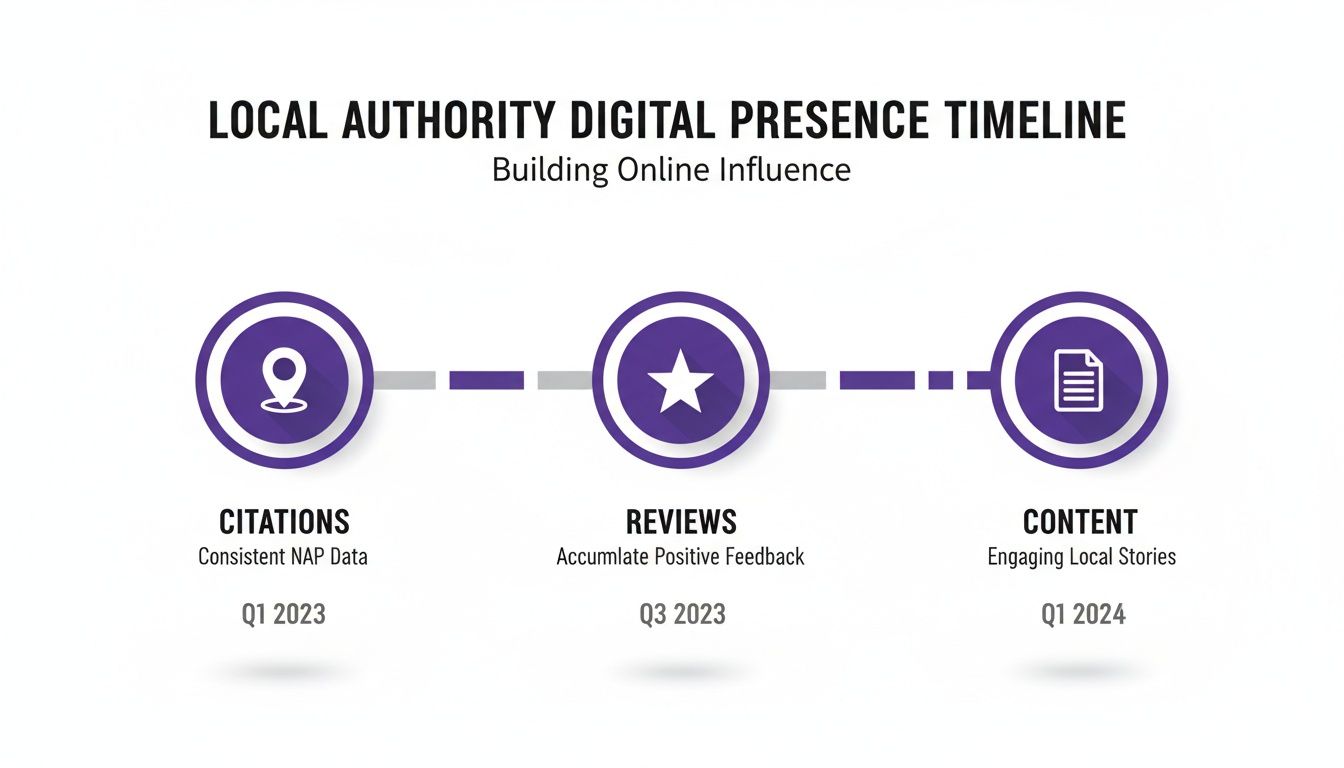
This graphic breaks down the typical progression for establishing local authority. It all starts with foundational citations before you can really build trust through reviews and valuable content.
As you can see, a solid foundation of consistent business information (citations) must be in place before review generation and content marketing can have their maximum impact.
Here’s a realistic breakdown of what to expect:
- First 30 Days: Foundational Setup: The initial month is all about technical fixes, on-page optimization, and building out your local citation profile. You'll see improvements in site health, but don't expect a major shift in lead flow just yet.
- Days 31-60: Gaining Traction: With the foundation in place, you'll start to see keyword rankings improve, especially for longer, more specific search terms. You should notice a modest uptick in organic traffic and possibly your first few leads from the campaign.
- Days 61-90: Building Momentum: By the end of the first quarter, you should see measurable increases in Local Pack visibility, organic leads, and GBP actions. This is when the ROI starts to become really clear.
A powerful case study from Irvine, CA, showed an agent who generated 17 new reviews, leading to 26 closings and an incredible 88:1 ROI on their SEO spend. Similarly, for B2B companies in Kitchener-Waterloo, Ontario, our targeted SEO strategies deliver exceptional wins by optimizing for local Canadian searches in the tech and manufacturing sectors.
"The biggest mistake I see is a lack of patience. Real estate SEO is an investment that compounds. The work you do in month one pays dividends in month six and beyond. Stick with the plan, and the results will follow."
Budgeting for this kind of consistent effort is, of course, a common concern. To get a better sense of what a professional engagement looks like, check out our guide on the cost of search engine optimization services.
A successful real estate SEO program is built on a clear strategy, consistent execution, and transparent measurement. To build a predictable engine for growth in your US or Canadian market, contact us.
Your Real Estate SEO Questions Answered
Diving into the world of real estate SEO always sparks a few important questions. It’s only natural. You’re making an investment, and you need clear, direct answers to feel confident about where your marketing dollars are going.
Here are a few of the most common queries we get from agents and brokers across Canada and the US, along with some straight-shooting answers.
How Long Does It Take to See SEO Results?
This is the big one, and the honest answer is: it depends, but you should see real, meaningful progress within 3-6 months. SEO is a long game, not a quick flip.
In the first month, we’re laying the foundation—tackling technical audits and cleaning up local citations. By month three, you’ll start to see some positive movement in the rankings for longer, less competitive keywords. That's the first sign things are working.
A realistic timeline shows that by the six-month mark, a consistent strategy should be generating a noticeable uptick in organic leads. You should also see much better visibility in the Google Local Pack for your most important local keywords.
One of our clients, a boutique brokerage in a competitive Ontario tech hub, saw a 30% increase in qualified organic leads within five months. We just overhauled their local SEO and focused on creating neighbourhood-specific content. This is a great example of success from consistent execution.
How Much Should I Budget for SEO?
SEO budgets can swing pretty wildly, mostly depending on how competitive your market is and what your growth goals are. Instead of thinking about a fixed cost, it’s better to see it as an investment relative to your potential return.
In smaller Canadian or US markets, even a modest monthly budget can deliver some impressive results. But if you're trying to rank in a cutthroat area like downtown Toronto or Los Angeles, you'll need a bigger war chest to make a dent.
A great success metric is ROI. A solid SEO campaign will often deliver a return many times the initial investment, often within the first year, making it one of the most cost-effective marketing channels available.
Can I Do Real Estate SEO Myself?
It’s definitely possible to handle some of the basics. You can manage your Google Business Profile and do some light on-page optimization yourself. But a comprehensive real estate search engine optimization strategy is a different beast entirely. It's complex and incredibly time-consuming.
The SEO field is also in constant motion, with algorithm updates and new technologies changing the rules of the game all the time.
Successfully juggling technical SEO, link building, citation management, and creating high-quality, hyper-local content really demands specialized expertise. Partnering with an expert lets you focus on what you do best: serving your clients and closing deals.
What Is More Important: Content or Technical SEO?
This is like asking what’s more important for a house: the foundation or the interior design? You need both. They're two sides of the same coin.
- Technical SEO is the foundation. If your site isn't fast, mobile-friendly, and easy for Google to crawl, nobody will ever find it. It doesn't matter how great your content is if the front door is locked.
- Content is what makes people want to come inside and stay awhile. Your neighbourhood guides, market reports, and helpful blog posts are what attract and engage potential clients. This is how you build trust and establish yourself as the local authority.
A successful strategy requires a perfect balance. You need a technically sound website so that search engines can find and understand all the valuable content you're creating for your audience.
Your questions deserve more than a generic FAQ. We build tailored SEO strategies that align with your specific business goals in the Canadian and US real estate markets. Ready for a personalized strategy session? Contact us to get started.