

When you're trying to land B2B clients in Toronto, running a generic, nationwide PPC campaign is like shouting into the wind. The Toronto market is dense, competitive, and incredibly specific. To get results, you need a partner who gets the local landscape—someone who can turn your ad spend into a healthy sales pipeline. For businesses across Canada and the United States, targeting this key economic hub requires a precise, data-driven approach.
Why a Local PPC Strategy Matters in Toronto
Simply bidding on keywords isn't enough in a market like this. A one-size-fits-all approach completely misses the distinct economic ecosystems and buyer behaviours that define the Greater Toronto Area (GTA). Let's be clear: the GTA isn't one big market. It's a collection of unique commercial zones, each with its own needs and opportunities.
Think about it. If you're targeting tech startups, your focus should be laser-sharp on the Kitchener-Waterloo corridor. But for financial services? You'd be pouring ad dollars down the drain if you weren't hyper-targeting Toronto's Financial District. This is exactly where broad strategies fail and where specialized PPC services in Toronto give you a real edge.
The Power of Hyper-Local Targeting
Getting the nuances between different business hubs right is everything. A B2B company with logistics software could see huge returns by targeting industrial parks in Peel Region (Brampton, Mississauga) during peak shipping seasons. That's a world away from a SaaS provider whose ideal customer is likely concentrated in the downtown core.
An effective local PPC strategy isn't just about location; it's about context. It involves:
- Geographic Focus: Zeroing in on the specific postal codes or business districts in Canada and the United States where your ideal clients actually work.
- Temporal Alignment: Scheduling ads to match local business hours and even industry-specific seasonal trends.
- Audience Nuance: Writing ad copy that speaks the language of Toronto's diverse professional cultures, from finance to manufacturing.
Unlocking a Measurable Return on Investment
That deep local knowledge translates directly into better campaign performance and a much stronger return on your ad spend. Before diving in, it helps to have a solid grasp of the basics of paid search advertising. When you apply those principles to a specific market, the results speak for themselves.
In Toronto's competitive environment, businesses that run targeted Google Ads campaigns in the GTA see an average $2 revenue return for every $1 spent. That figure consistently beats national averages, and the secret sauce is often hyper-local targeting of the 416 and 905 area codes.
We saw this firsthand with a B2B manufacturing client targeting customers in both Canada and the United States. They shifted from a broad national campaign to one that specifically targeted industrial zones in Vaughan and Scarborough. The result? A 40% increase in qualified leads in just three months, and their cost per acquisition dropped by 25% because they stopped wasting money on irrelevant searches.
Success like that isn't a fluke. It comes from a deep, practical understanding of the local market—something a dedicated partner brings to the table. For B2B leaders across Canada and the United States looking to make inroads here, a smart local strategy is the key to growth. For more on building a winning strategy in the Canadian market, check out our guide on Search Engine Marketing in Canada.
Ready to unlock your ROI with a targeted local strategy? Contact us today to discuss how we can help you capture the Toronto market.
Defining Your B2B Goals for PPC Success
Jumping into a partnership with a PPC agency without clear, measurable goals is a recipe for wasted ad spend. Before you even start looking for PPC services in Toronto, the most critical first step is defining what success actually means for your business.
It’s time to look past surface-level metrics like clicks and impressions and get serious about tangible outcomes that directly impact your bottom line.
For B2B companies, especially in SaaS or industrial sectors, the sales cycle is longer and more complex. A click doesn’t equal a sale. That’s why your PPC goals have to be tied to specific, meaningful actions within your sales funnel—the kind of metrics that signal real buyer intent for audiences in both Canada and the United States.
Moving From Vanity Metrics to Business Outcomes
To set yourself up for success, you need to translate your high-level business objectives into concrete PPC key performance indicators (KPIs). Instead of just aiming for "more traffic," think about what that traffic needs to accomplish. This alignment is what separates a cost centre from a revenue-driving machine.
Here are a few examples of strong, B2B-focused PPC goals:
- Generate 50 Marketing Qualified Leads (MQLs) per month: This targets leads who have shown significant interest and are ready for your marketing team to nurture.
- Achieve a target Cost Per Acquisition (CPA) of $250: This sets a clear efficiency target, ensuring that the cost to acquire a new customer remains profitable.
- Increase demo requests by 30% quarter-over-quarter: A goal like this focuses on a high-intent conversion that puts your sales team directly in front of potential buyers.
A common mistake is obsessing over Cost-Per-Click (CPC). While it's a useful diagnostic metric, a low CPC is worthless if the traffic doesn't convert. A higher CPC that generates qualified demo requests is always a better investment.
By establishing these specific, business-centric goals upfront, you provide a clear brief for any prospective agency. It allows them to build a strategy designed to hit your numbers, not just drive clicks. This clarity ensures everyone is working toward the same definition of success from day one.
Calculating a Realistic Starting Budget
Once you have your goals, the next logical question is, "How much should we spend?" You can't just pick a number out of thin air. A data-backed budget is essential for having productive conversations with agencies and setting realistic expectations.
A great starting point is to work backward from your goals.
Let's say your goal is to generate 20 new customers per month and your sales team closes leads at a 10% rate. You know you need 200 qualified leads. If your target CPA is $300, your total monthly budget (ad spend + management fees) should be around $6,000. This kind of calculation gives you a solid foundation for your planning.
The ROI from PPC services in Toronto stands out starkly for B2B audiences, with agencies reporting client ROIs ranging from 300% to 1600%, especially for scale-ups and startups with smaller budgets. These impressive returns highlight the importance of starting with a smart, goal-oriented financial plan. If you want to learn more about what top agencies deliver, you can discover more insights about PPC agency performance.
Arming yourself with clear goals and a realistic budget empowers you to lead conversations with confidence. You'll be able to quickly identify which agencies understand your B2B needs and can deliver the outcomes you're looking for.
Ready to define your PPC goals and build a strategy that drives real revenue? Contact us today to discuss how we can help you achieve measurable growth.
How to Vet an Agency's B2B and Technical Skills
Finding an agency that talks a good game is easy. Finding one that truly understands the long, winding path of a B2B buyer's journey? That’s another matter entirely.
Generic PPC strategies that work wonders for e-commerce or local services often fall flat when you’re dealing with SaaS, manufacturing, or complex professional services. This is where your vetting process becomes absolutely critical. You need to look past the polished sales pitch and dig into an agency’s real-world experience with businesses like yours. Their ability to handle long sales cycles, niche industries, and multi-touchpoint attribution isn't a "nice-to-have"—it's the foundation of a successful partnership.
This process flow shows how a B2B-focused PPC strategy should align with core business goals, moving from initial interest right through to bottom-line impact.
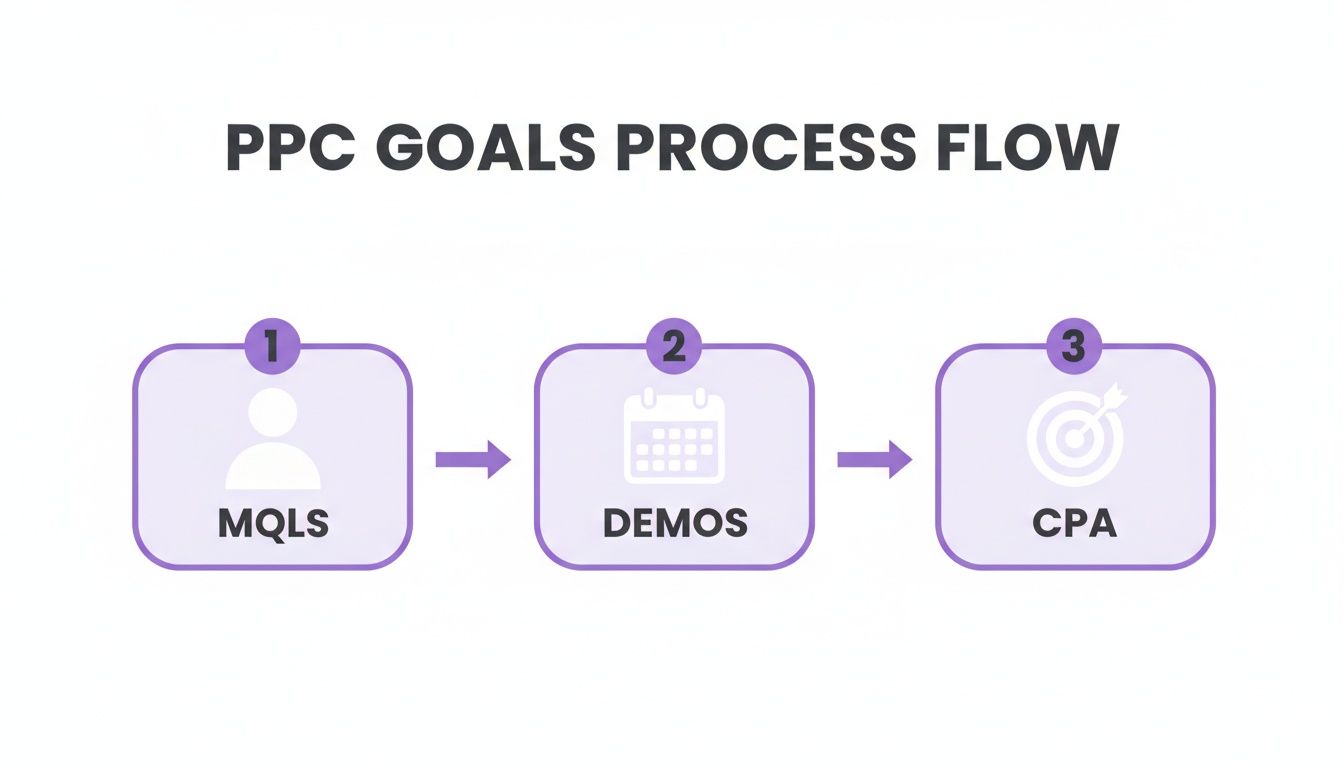
The key takeaway here is that success isn't just about clicks. It’s about generating qualified leads (MQLs) that convert into demos and ultimately achieve a profitable Cost Per Acquisition (CPA).
Probing for Genuine B2B Experience
When you start conversations, you need a checklist of questions designed to reveal an agency's strategic depth. A true B2B partner will have concrete answers and case studies ready to go.
Here are the critical questions you should be asking potential PPC services in Toronto:
- How do you adapt strategies for a 6–12 month sales cycle? Their answer should involve multi-channel remarketing, lead nurturing support, and tracking middle-of-funnel conversions—not just the initial click.
- Show me a B2B SaaS campaign you've managed. Ask them to walk you through the strategy, the targeting methods they used (especially on platforms like LinkedIn), and the results they achieved in terms of MQLs or demo sign-ups.
- How do you target specific job titles or company sizes in Canada and the U.S.? A skilled B2B agency will immediately talk about advanced LinkedIn Ads targeting, custom audience uploads, and using firmographic data—not just broad keyword targeting.
A generic agency might stumble here, but a specialist will light up, eager to share their expertise. This is how you separate the contenders from the pretenders. To get a broader perspective, you can explore our overview of leading PPC advertising agencies.
Verifying Their Technical and Integration Skills
Modern B2B marketing runs on data. A PPC campaign operating in a silo, completely disconnected from your CRM and sales data, is just an expensive black box. Verifying an agency’s technical chops is non-negotiable.
You need a partner who can connect the dots from ad click to closed deal. This requires a very specific technical skillset.
The most valuable insight you can get is closed-loop reporting. This means an agency can integrate your ad platforms (like Google Ads and LinkedIn) with your CRM (like HubSpot or Salesforce) to show you exactly which campaigns, ad groups, and keywords are generating actual revenue—not just leads.
Ask them directly: "Can you set up offline conversion tracking to import our CRM data back into Google Ads?" If they hesitate or seem unsure, it’s a major red flag. This capability allows the ad platform's algorithm to optimize for what truly matters: high-quality leads that become paying customers.
To help you compare your options, we've put together a checklist highlighting the key differences between a standard agency and a B2B specialist.
Agency Evaluation Checklist for B2B PPC Services
| Evaluation Criteria | Standard PPC Agency Focus | B2B Specialist Agency Focus |
|---|---|---|
| Sales Cycle Knowledge | Short-term, transactional conversions (e.g., e-commerce sales). | Long sales cycles (6-18 months), multi-touch attribution. |
| Targeting Methods | Broad keywords, demographic and interest-based targeting. | Firmographics (company size, industry), job titles, account-based lists. |
| Key Performance Indicators | Clicks, impressions, Cost Per Click (CPC), basic lead volume. | MQLs, SQLs, demo requests, pipeline value, Cost Per Acquisition (CPA). |
| Technical Integration | Basic conversion tracking (e.g., form fills on a thank-you page). | CRM integration (Salesforce, HubSpot), offline conversion tracking, closed-loop reporting. |
| Platform Expertise | Primarily Google Ads and Facebook/Instagram Ads. | Deep expertise in LinkedIn Ads, plus advanced Google Ads features. |
| Content Strategy | Focus on bottom-of-funnel, direct-response ad copy. | Aligns ad content with buyer journey stages (awareness, consideration, decision). |
This table should make it clear that while both types of agencies manage ads, only one truly understands the mechanics of B2B growth.
Real-World Success Stories
A great example comes from a Toronto-based FinTech SaaS client we worked with. Their previous agency was focused on maximizing clicks from broad financial keywords, which resulted in a flood of leads from individual consumers, not businesses.
We completely flipped the strategy.
- Platform Focus: We moved a significant chunk of the budget to LinkedIn Ads, targeting specific job titles like "Controller" and "VP of Finance" at companies with 50-500 employees in Canada and key U.S. states.
- Google Ads Refinement: On Google Search, we used hyper-specific, long-tail keywords combined with "in-market" audiences for financial software solutions.
- Technical Integration: We set up CRM integration to track which leads actually turned into qualified demos.
The results were stark. Within three months, their overall lead volume dropped by 20%, but the number of qualified demos booked by their sales team shot up by 60%. Their cost per qualified lead was cut in half.
That’s the power of combining true B2B strategy with deep technical execution. Finding an agency with this level of expertise is the key to unlocking real growth.
Digging Into Contracts, Pricing, and Reporting

Let’s be honest—this is where things can get uncomfortable. When the conversation shifts to contracts and pricing, the clarity you felt during the pitch can quickly turn into confusion. You're faced with complex fee structures and vague service agreements, leaving you wondering if you're making the right call.
A solid agreement does more than just spell out costs. It builds a foundation of accountability and ensures your agency’s success is directly tied to your own. For B2B firms in Canada and the United States, finding a structure that rewards genuine, long-term growth is everything.
Cracking the Code on Common Pricing Models
When you start evaluating PPC services in Toronto, you'll likely run into three main pricing structures. Each has its place, but the right one for you depends entirely on your business goals and the scale of your campaigns.
- Flat Retainer: Simple and predictable. You pay a fixed monthly fee for management. This is great for budgeting, but you need the scope of work nailed down tightly to make sure you're not paying for half-hearted effort.
- Percentage of Ad Spend: The agency takes a cut—often 10-20%—of what you spend on ads each month. This model scales with your investment, but be careful. It can tempt an agency to simply inflate your spend rather than dial in efficiency.
- Performance-Based Fees: This is where the agency's pay is tied directly to results, like generating a certain number of MQLs or hitting a target CPA. It offers perfect alignment but can be tricky to set up and often comes with a higher base fee.
For most B2B companies, a hybrid model is the sweet spot. Think a modest flat retainer to keep the lights on, plus performance bonuses for hitting the metrics that actually matter to your sales team, like qualified demo requests or SQLs. This gives the agency stability while rewarding them for delivering real business value.
What You Must Demand in Your Service Agreement
Your contract is your single source of truth. A trustworthy agency will gladly provide a transparent service-level agreement (SLA) that clearly outlines every expectation. Before you sign anything, there are a few non-negotiables.
You must retain 100% ownership of all ad accounts and data. An agency that builds campaigns inside their own accounts is a colossal red flag. If you part ways, they could walk off with your entire campaign history, data, and intellectual property, forcing you to start all over again from scratch.
Make sure your SLA explicitly states that all work happens within ad accounts your company owns. It should also detail the communication rhythm, who your main points of contact are, and a clear schedule for strategic reviews.
Moving from Vanity Metrics to Revenue-Focused Reporting
This is what separates the great agencies from the good ones. A bad report is a data dump—a spreadsheet crammed with clicks, impressions, and CPCs that tells you absolutely nothing about the impact on your business. A great report tells a story, connecting every dollar of ad spend directly to revenue.
Take a Toronto-based software company we recently partnered with. Their old agency sent weekly reports proudly highlighting a low $4 CPC. Fantastic, right? The problem was, their sales team was drowning in junk leads. Almost none of them were qualified.
We tore down their old dashboard and built one that focused on what really mattered:
- Tracking MQLs: First, we integrated their campaigns with their CRM to see how many leads actually met their "marketing qualified" criteria.
- Monitoring the Sales Pipeline: The new dashboard visualized how many of those MQLs turned into sales-accepted opportunities.
- Calculating True CPA: We stopped measuring the cost per click and started measuring the cost per qualified demo.
The new reports revealed their true CPA was hovering around $450—a number they could actually use to make strategic decisions. By optimizing for lead quality instead of cheap clicks, we helped them boost their sales-qualified leads by 73% in just six months, all without increasing their ad spend.
That’s the level of reporting you should be demanding. Insist on a dashboard that shows the entire journey, from the first ad click to the final closed deal.
Choosing the right partner means getting granular on contracts and demanding reporting that speaks the language of business, not just clicks.
If you're ready for a partnership built on clarity and measurable results, contact us to see how our reporting can deliver the insights your business needs to grow.
The Fractional CMO Advantage in Paid Media
For a lot of ambitious B2B companies, the real roadblock to scaling paid media isn't the day-to-day campaign work. The actual problem is the gaping hole where senior-level strategy should be. An agency can pull the levers, but who’s steering the ship? Who makes sure your PPC investment lines up perfectly with your bigger business goals?
This is exactly where the Fractional Chief Marketing Officer (CMO) model shines. It gives you the C-level strategic oversight your paid media program desperately needs, but without the hefty cost and commitment of a full-time executive. For scaling companies in Toronto and across North America, this approach is a total game-changer.
A Fractional CMO doesn’t just babysit your PPC agency; they act as a strategic bridge. They’re the one who connects the tactical execution happening inside Google Ads and LinkedIn with the high-level goals being tossed around in the boardroom.
Integrating PPC into a Cohesive Marketing Strategy
Here’s the thing: effective PPC doesn’t live on an island. It has to be woven into the fabric of your entire marketing ecosystem, from SEO and content to your account-based marketing (ABM) efforts. A Fractional CMO has seen it all and knows how to orchestrate this integration, making every single marketing dollar work harder.
For instance, insights from your top-performing PPC keywords can directly feed your SEO and content strategy. That targeted ABM list you built? It can be used to create hyper-specific PPC audiences, which dramatically improves ad relevance and conversion rates. This holistic view stops you from wasting effort and creates a powerful, unified marketing engine.
The greatest value a Fractional CMO brings is accountability. They are your internal advocate, ensuring your PPC agency is not just hitting campaign metrics, but contributing directly to pipeline growth and revenue. They speak both languages—agency-speak and CEO-speak.
A Real-World Example of Strategic Oversight
Let's look at a real scenario. A Toronto-based SaaS company was spending $15,000 a month on Google Ads with a well-regarded agency. They were getting tons of leads, but the sales team was frustrated—most were low-quality and a terrible fit. The agency was hitting its lead volume targets, but the business wasn't actually growing.
So, they brought in a Fractional CMO to figure out what was broken. The problem wasn't the agency's execution; it was a fundamental mismatch in strategy.
The Fractional CMO immediately made three critical changes:
- Redefined the Goal: The main KPI was switched from "cost per lead" to "cost per qualified demo." Simple, but huge.
- Connected the Dots: They integrated the company's CRM directly with Google Ads. This allowed the system to see which keywords and campaigns were actually generating real sales opportunities, not just form fills.
- Provided Clear Direction: With that data in hand, the Fractional CMO gave the agency a new, much clearer brief focused on attracting leads from specific industries and company sizes in Canada and the U.S.
The results were immediate and powerful. Within four months, the total number of leads dropped by 30%, but the number of sales-qualified opportunities doubled. They were spending the same amount of money but were now fueling their pipeline with high-value prospects. That’s the power of strategic leadership. For a deeper look at how this model works, you can learn more about our Fractional CMO services.
Comparing In-House vs. Agency vs. Fractional CMO Models
For a growing B2B company, deciding how to manage your PPC can feel overwhelming. Do you hire in-house, outsource completely, or is there a better way? This table breaks down the common approaches to help you see where the Fractional CMO model really fits in.
Comparing In-House vs. Agency vs. Fractional CMO Models
| Model | Key Advantages | Potential Challenges |
|---|---|---|
| In-House Team | Deep product knowledge and full control over strategy and execution. | High overhead costs and difficulty in attracting senior-level talent. |
| Standalone Agency | Access to specialized execution skills and platform expertise. | May lack deep business context and focus on campaign metrics over revenue. |
| Fractional CMO-Led | Combines C-level strategy with expert agency execution for a holistic approach. | Requires strong collaboration between the Fractional CMO and the agency partner. |
Ultimately, for B2B companies in search of sophisticated, revenue-focused PPC services in Toronto, the Fractional CMO model offers an ideal balance. It gives you the high-level strategic thinking of a seasoned executive and the specialized skills of a top-tier agency, all wrapped up in a flexible and cost-effective package.
If your PPC campaigns feel disconnected from your business goals, it might not be your agency that needs changing—it might be the absence of strategic leadership. Ready for that strategic advantage? Contact us to learn more.
Time to Put Your PPC Plan Into Action
You've done the hard work. You've walked through the critical steps of finding the right PPC partner, from setting clear B2B goals to understanding how a Fractional CMO can sharpen your strategy. Now you have a solid framework to make a smart decision. The final move? Turning all that knowledge into a decisive, growth-focused action plan.
For B2B companies in Canada and the United States trying to win in the crowded Toronto market, this means you can finally move forward with confidence. We saw this firsthand with a Toronto-based B2B software client who went from a fuzzy, undefined strategy to one laser-focused on outcomes. Their reward was a 60% jump in qualified sales demos in just four months after we aligned their PPC spend with real business goals.
Your Actionable Checklist
This isn't about throwing money at ads and hoping for the best; it's about executing a deliberate plan. Here’s a quick recap to guide your next move:
- Finalize B2B-centric goals: Pin down your targets for MQLs, cost-per-acquisition, and demo requests.
- Vet agencies on real B2B experience: Don't just look at their client list; ask about their technical skills, especially with CRM integrations.
- Scrutinize the contract: Make sure you own your data and that the reporting terms are crystal clear. No black boxes.
- Consider a Fractional CMO: Bring in senior-level oversight to keep your agency accountable and your strategy on track.
Once your plan is rolling, remember that the world of PPC is always shifting. Keep exploring the available paid search services for quick business growth to find new avenues for success.
The most crucial step is always the one you take next. A well-researched plan only delivers value when it's put into action with an expert partner who genuinely gets your B2B world.
Your investment in PPC services in Toronto should be a direct line to building a scalable marketing engine. If you're ready to build that engine and drive results you can actually measure, contact us today.
Burning Questions About Toronto PPC Services
If you're a B2B leader trying to make sense of paid advertising, you’ve probably got questions. It's a common scenario. Below are some straightforward answers to the queries we hear most often from businesses in Toronto and across North America.
How Much Should a B2B Company in Toronto Budget for PPC?
There’s no magic number, but let’s get real. For a competitive market like Toronto, a starting point for B2B ad spend often lands between $3,000 and $10,000 per month, and that's before agency fees.
A much smarter way to approach this, however, is to work backward from your revenue goals. Figure out your target Cost Per Acquisition (CPA) and how many leads you need to hit your sales targets. A sharp PPC partner or a Fractional CMO can help you build a budget based on those critical business metrics, ensuring your investment is directly tied to actual outcomes.
How Long Until We See Results From PPC Campaigns?
PPC is great because it can start driving traffic and even some initial leads almost immediately after a campaign goes live. But optimizing for true, sustainable profitability? That takes a bit more time.
You should expect to see initial performance data within the first 30 days. But the meaningful trends—the ones that help you refine lead quality and improve your CPA—typically start to emerge over the first 90 days as the campaigns gather enough data to make smart decisions.
For B2B companies with longer sales cycles, it’s crucial to track leading indicators like Marketing Qualified Leads (MQLs) and demo requests while you wait for the full revenue impact to become clear.
Should We Choose a Large Agency or a Boutique PPC Firm?
This decision really comes down to what you need and where you are as a business. A large agency might offer a massive suite of services, but you run the risk of being handed off to a junior account manager who is learning on your dime.
On the flip side, a boutique firm often provides more direct access to senior-level experts and highly specialized B2B knowledge.
Ultimately, the most important factor is an agency's proven experience in your specific world, whether that's SaaS, manufacturing, or professional services. For instance, we saw a specialized Toronto agency drive a 40% increase in qualified leads for a B2B client just by focusing on niche industrial targeting instead of broad, expensive national keywords.
Always ask who will be managing your account day-to-day and insist on seeing case studies that are genuinely relevant to your business model.
Ready to stop asking questions and start getting answers that work for your business? The team at B2Better brings the B2B marketing expertise needed to build a PPC strategy that delivers measurable growth. Let's talk about turning your ad spend into a predictable revenue engine. Contact us today.