

PPC advertising agencies are specialist firms that live and breathe paid ad campaigns, turning your ad spend into tangible business growth. They bring the strategic know-how, technical execution, and analytical firepower you need to generate a steady stream of high-quality leads—all without the overhead of a full-time, in-house team. This makes them an indispensable partner for B2B companies in the United States and Canada serious about scaling up.
Why a Great PPC Agency Is a Growth Engine, Not a Cost
For many B2B founders and marketing leaders in North America, finding a true PPC partner can feel like an impossible mission. You're tired of the feast-or-famine lead flow and need a reliable engine for scalable growth, not just another vendor on the books.
The right agency completely changes the conversation from "cost" to "investment." They deliver immediate traction and data-driven insights that a stretched-thin in-house team often struggles to produce. A study by WordStream found that businesses make an average of $2 in revenue for every $1 they spend on Google Ads, showcasing the powerful ROI potential when managed correctly.

This shift in thinking is becoming the norm across North America. The PPC agency world, especially in Canada and the United States, is booming. A recent report from over 220 agency leaders found a stunning 89% now rank PPC as their core service—a huge jump from a few years ago when SEO and web design were king. The trend is clear: businesses are recognizing that specialized paid media expertise is a primary driver of success.
Deciding between hiring in-house or partnering with an agency is a common crossroads for B2B leaders. To help clarify the decision, here’s a quick rundown of the key differences.
PPC Agency vs In-House Team Key Differences
| Factor | Specialized PPC Agency | In-House Team |
|---|---|---|
| Expertise | Access to a team of senior-level specialists with diverse industry experience across the US and Canada. | Expertise is limited to the knowledge of one or a few individuals. |
| Cost | Typically lower overall cost; no salaries, benefits, or training overhead. | Higher fixed costs, including salary, benefits, payroll taxes, and software. |
| Tools & Tech | Leverages enterprise-grade tools for analytics, bidding, and research. | Tool access is often limited by the company's budget. |
| Scalability | Can quickly scale campaigns up or down based on market needs and budget. | Scaling requires hiring, training, and potentially restructuring the team. |
| Perspective | Brings an objective, external viewpoint focused purely on performance. | Can be influenced by internal politics or competing priorities. |
While an in-house team offers deep company knowledge, a specialized agency often provides a faster, more cost-effective path to sophisticated campaign management and measurable results.
From Plateau to Pipeline
Think about a classic scenario for a North American SaaS company. After a strong start, growth stalls. Their small marketing team is juggling a dozen different things and just can't give the complex PPC campaigns the focus they demand. Ad spend becomes inefficient, leads dry up, and the cost per acquisition (CPA) starts to creep higher and higher.
This is exactly where top-tier PPC advertising agencies prove their worth. For example, a US-based B2B tech company was able to reduce their CPA by 60% and increase qualified leads by 200% within six months of partnering with a specialized agency that understood their niche market. They achieve this with game-changing advantages:
- Senior-Level Strategy: You get access to seasoned experts who understand the long, nuanced B2B sales cycle—not just the technical toggles inside an ad platform.
- Specialized Tools and Tech: Agencies invest in advanced software for deep competitive analysis, automated bid management, and insightful reporting that’s often too pricey for a single company.
- Objective, Data-Driven Insights: An external partner brings an unbiased perspective, focusing solely on the numbers and how they translate into revenue. They’ll help you truly understand and improve your marketing ROI. For a deeper dive, check out our guide on how to calculate and understand your marketing ROI.
A great agency doesn't just manage your account; they challenge your assumptions, uncover new market opportunities, and align every campaign with your ultimate business objectives. They become a strategic extension of your leadership team.
To get a better sense of how different agencies operate and the technology they use, exploring various agency operational use cases can offer some valuable perspective. By partnering with a specialist, that SaaS company can finally shatter its growth plateau, outmanoeuvre the competition, and get the predictable, measurable results it needs to scale.
Ready to turn your ad spend into a predictable growth engine? Contact us today for a no-obligation consultation to see how we can help.
Defining Your Goals and Budget Before the Search
Before you even think about Googling “PPC advertising agencies,” the most important work has to happen in-house. Trust me, jumping into discovery calls without a clear game plan is a surefire way to waste everyone’s time and end up in a mismatched partnership. The best agencies aren’t mind readers; they need a solid foundation from you to build a winning strategy.
This initial planning is all about turning vague wishes into concrete, measurable objectives. A goal like "we need more leads" is a starting point, not a destination. A great goal is specific and gives an agency a clear target to hit.
For instance, a Canadian SaaS company shouldn’t just ask for more leads. A powerful, actionable goal sounds more like this: "Acquire 50 marketing qualified leads (MQLs) per month from US-based technology firms with over 100 employees, at a cost per acquisition (CPA) under $500." That single sentence tells a potential partner exactly who you're after, what success looks like, and what your efficiency benchmark is.
Set a Realistic PPC Budget
Ah, the budget question. It’s often the trickiest part of the conversation. Many founders aren't sure what to spend, so they either underinvest and see zero results or overspend without a clear path to profitability. The secret is to work backward from your revenue goals.
A simple model for B2B companies in Canada and the United States looks something like this:
- Define Your Revenue Target: How much new monthly recurring revenue (MRR) or total contract value do you need from PPC?
- Calculate Required Customers: Based on your average deal size, how many new customers does that revenue target actually represent?
- Factor in Your Close Rate: What percentage of qualified sales opportunities (SQLs) actually become paying customers? This tells you how many SQLs you need.
- Consider Your MQL-to-SQL Rate: What percentage of those marketing leads (MQLs) get passed to sales and become SQLs? Now you know your MQL target.
Once you have that target MQL number, you can set a target CPA. If a new customer is worth $25,000 over their lifetime, paying $500 to acquire a lead that has a real chance of closing is a strategic investment, not just another expense. This data-driven approach turns your budget from a wild guess into a calculated part of your growth engine.
Remember, a better vacuum cleaner doesn't make the room bigger. Your PPC agency can be the best demand-capturing "vacuum" in the world, but if your business isn't ready to handle the growth or hasn't defined the "room" you're cleaning, even the best technical efforts will fall short.
Your Pre-Agency Internal Checklist
Walking into an agency conversation with clarity and alignment is your biggest advantage. It shows you’re a serious partner and lets the agency give you a much more accurate and strategic proposal. Before you start your search, grab your team and get these answers down on paper:
- Ideal Customer Profile (ICP):
- What specific industries in Canada or the US are you targeting?
- What is the ideal company size (employee count or annual revenue)?
- Who are the key decision-makers by job title? What are their biggest headaches?
- Core Value Proposition:
- What is the single biggest problem you solve for your ICP?
- How is your solution genuinely different from your top three competitors?
- What’s the clear, quantifiable outcome customers get from using your product or service?
- Business & Sales Metrics:
- What is your average customer lifetime value (LTV)?
- What is your current sales cycle length?
- What are your lead-to-customer conversion rates at each stage?
Having these answers ready empowers you to lead the conversation, properly vet potential PPC advertising agencies, and find a true partner who gets your business reality.
Ready to find a partner who understands your B2B growth goals in the US and Canadian markets? Contact us today to discuss how we can build a PPC strategy that delivers measurable results.
Your Vetting Checklist for Agency Capabilities
Once your internal game plan is solid, it’s time to separate the true strategic partners from the mere button-pushers. Not all PPC agencies are created equal, especially when it comes to the complex B2B sales cycles common in Canada and the US. Your vetting process has to go deeper than a slick presentation and dig into the core skills that actually drive pipeline.
This process starts with getting your own house in order. You need to align internally on your goals, define what success looks like, and set a clear budget.
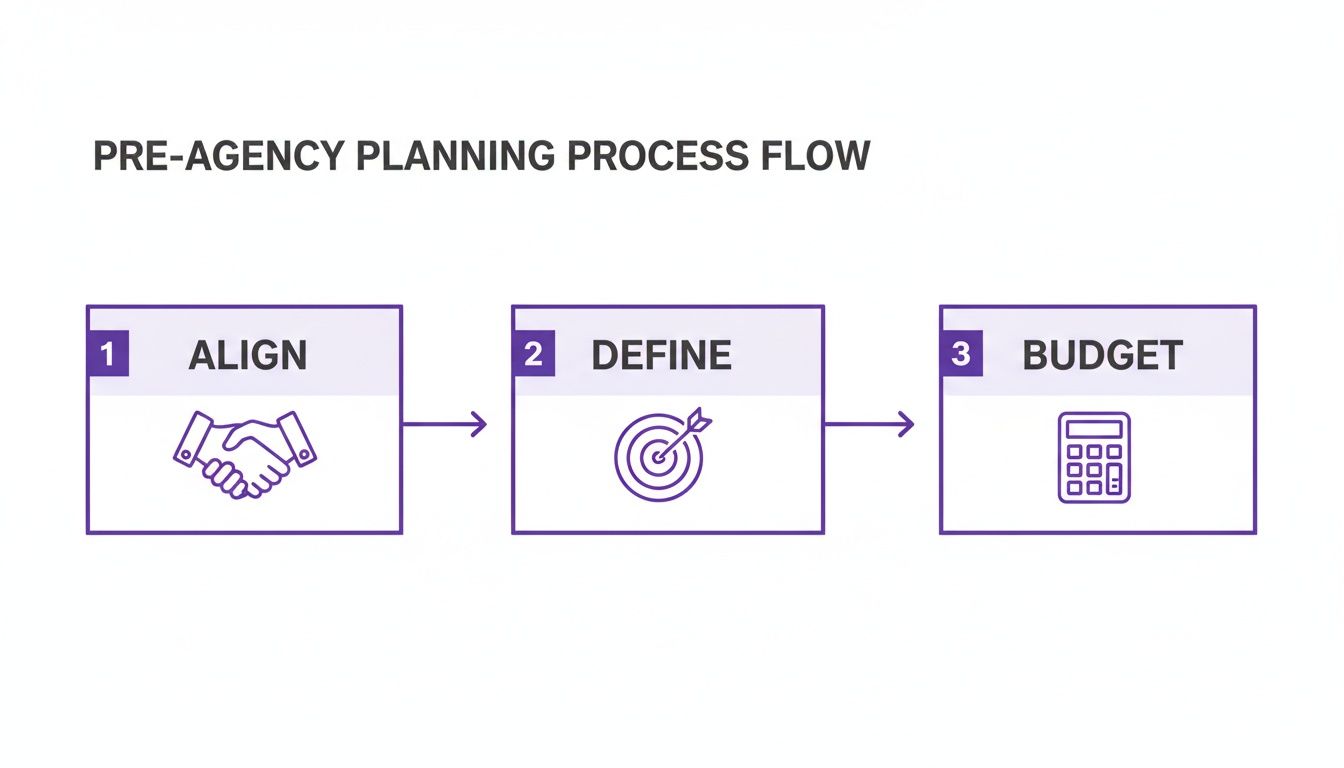
This simple flow—Align, Define, Budget—ensures you walk into every conversation with a clear vision, making it far easier to tell if an agency’s capabilities are the right fit.
Beyond the Platform Basics
Every single agency will tell you they’re experts in Google Ads. That’s table stakes. For a B2B company targeting customers in Canada and the United States, you need a partner with proven, deep experience on the platforms where your niche audience actually spends their time.
Here's what that looks like in practice:
- Multi-Platform Mastery: Do they have serious experience with LinkedIn Ads? For most B2B campaigns, this is non-negotiable. Can they show you success stories from Microsoft (Bing) Ads, which often captures a different, sometimes more senior, professional demographic in North America?
- Flawless Conversion Tracking: Ask them to walk you through their process for setting up and validating conversion tracking. They should be able to talk confidently about Google Tag Manager, offline conversion imports, and integrating with your CRM to track leads all the way to revenue.
- Strategic Depth: A great agency knows their job isn’t just to generate clicks; it’s to generate pipeline. They should be asking you about your sales cycle length, customer lifetime value (LTV), and how marketing-qualified leads (MQLs) are handed off to sales.
A basic credential to look for is an official certification, like being a certified Google Partner. Think of this as a baseline indicator of technical competence.
The Power of Niche Specialization
Here’s a real-world scenario we see all the time. A Canadian industrial manufacturing company is vetting two agencies. Agency A has a slick website filled with flashy e-commerce case studies showcasing massive ROAS for direct-to-consumer brands. Agency B’s presentation is less flashy, but they provide three detailed case studies from other niche industrial clients in North America.
Who do you choose?
Nine times out of ten, it’s Agency B. An agency that has already navigated the complexities of your industry understands the specific language, challenges, and buying behaviours of your audience. They won’t waste your budget learning your business from scratch.
Finding an agency with proven success in a similar B2B niche is your secret weapon. Their experience translates into faster results, smarter strategies, and a much lower risk of wasted ad spend.
This specialization is a hallmark of top-performing firms. To quantify this, research from Clutch.co on top PPC firms reveals that 75% of their services are focused squarely on Pay-Per-Click. This intense focus is why 100% of their client reviews praise their PPC expertise, showing a clear link between specialization and client success.
For B2B leaders, this data underscores a critical point: a generalist agency might be adequate, but a specialized performance marketing agency acts as a true strategic partner. They come equipped with the industry-specific knowledge needed to turn your ad spend into a powerful growth engine.
Agency Evaluation Scorecard
To make your evaluation process more structured, use a simple scorecard. It helps you compare agencies side-by-side and make a data-driven decision rather than relying on gut feelings alone.
| Capability | Agency A Score (1-5) | Agency B Score (1-5) | Notes |
|---|---|---|---|
| B2B Industry Experience | e.g., "Agency A has no SaaS clients in US/Canada, B has three." | ||
| LinkedIn Ads Expertise | e.g., "Agency B showed a detailed campaign structure." | ||
| CRM Integration & Tracking | e.g., "Agency A's plan was vague; B detailed their process." | ||
| Strategic Approach (vs. Tactical) | e.g., "Agency B asked about our sales cycle." | ||
| Reporting & Communication Style | e.g., "Agency A's dashboard looked generic." | ||
| Team & Cultural Fit | e.g., "Felt a better connection with Agency B's strategist." |
After your calls, fill out the scorecard while the details are still fresh. The agency with the consistently higher score across the capabilities that matter most to you is likely your strongest bet.
Asking Questions That Reveal True Expertise
When you're vetting a PPC agency, it’s tempting to jump straight to the pricing conversation. Don’t. The real test of a potential partner isn’t what they charge; it's how they think, solve problems, and communicate when things get tricky.
Leading with the right questions flips the script. Instead of sitting through a sales pitch, you’re running a strategic deep dive. This lets you control the conversation and make a decision based on substance, not just a polished slide deck.
Anyone can talk a good game about ROAS and conversion rates. True experts actually welcome tough questions—it’s their chance to show you what’s under the hood. Your goal is to get past the highlight reel and understand how they act when a campaign inevitably hits a snag.
Questions That Go Beyond the Pitch
Forget asking, “What results can you get me?” That’s a recipe for a generic answer. Instead, ask questions that force them to tell a story and reveal their actual process. The questions below are designed to test their experience with the realities of B2B marketing in the Canadian and US markets.
Here are a few powerful questions to have in your back pocket:
- "Walk me through a B2B campaign you managed for a client in the United States or Canada where initial results were poor. What went wrong, and what specific steps did you take to course-correct?"
- Why it works: This is a test of honesty, accountability, and problem-solving. Every single agency has campaigns that start slow. A great answer will involve a data-driven diagnosis, a clear hypothesis for what to test next, and proof of transparent communication with the client. Red flags? Blaming the platform, blaming the client’s product, or being vague about the fix.
- "How do you determine the right channel mix for a B2B client in our industry targeting North America?"
- Why it works: This question uncovers whether they have a strategic playbook or just a one-size-fits-all tactical list. A top-tier agency won't just say "Google and LinkedIn." They'll ask about your ideal customer profile, your sales cycle length, and your average contract value before recommending a specific channel mix. They’ll also justify each choice with data or relevant experience from past clients.
The best agencies operate like business detectives, not just channel technicians. They get that their job isn't just to manage bids and keywords but to diagnose the real bottlenecks preventing growth—even if those bottlenecks are outside the ad account.
Digging into Strategy and Failure
Success stories are easy to come by. An agency’s ability to navigate failure is a much better sign of true expertise. B2B PPC is rarely a straight line; it's a messy, iterative process of testing, learning, and optimizing. You want a partner who embraces that reality.
Take the example of a US-based software company that saw a 40% increase in qualified leads. They didn't achieve this by finding some magic keyword. They did it by hiring an agency that dug into their sales data and discovered that while the ads were driving form fills, the leads were a terrible fit for the sales team.
The agency shifted budget away from broad, top-of-funnel terms to hyper-specific long-tail keywords, pairing them with targeted LinkedIn Ads aimed at decision-makers in the US tech corridor. Lead quality shot up, proving their value went far beyond simply managing an ad account. That’s the kind of strategic thinking you're looking for.
What Great and Poor Answers Sound Like
Knowing what to ask is only half the battle; you need to know what to listen for in the response.
Let’s try a scenario. You ask: "Our sales cycle is six months long. How will your reporting show us the value of your campaigns before we see a closed deal?"
- A Great Answer: "That's a fantastic point. For long sales cycles in North America, we have to focus on leading indicators that correlate with revenue. We'll set up tracking for micro-conversions like demo requests, whitepaper downloads, and webinar registrations. We can integrate with your CRM to track MQLs and SQLs, showing pipeline velocity and influence long before a deal closes. Our monthly reports will connect ad spend directly to these pipeline metrics, not just clicks and impressions."
- A Red Flag Answer: "Don't worry, we'll track conversions and show you the ROI. Our dashboard makes it all really clear."
The first answer shows a deep understanding of B2B marketing challenges and offers a concrete plan. The second is a vague, dismissive response that signals a lack of strategic depth.
By arming yourself with these types of questions, you turn the vetting process from a sales pitch into a genuine strategic discussion. You’ll quickly separate the true growth partners from the button-pushers.
Ready to partner with a team that has the answers to these tough questions? Contact us today to see how our strategic approach to PPC can drive real results for your business.
Getting the Paperwork Right and Kicking Things Off
You’ve done the hard work, vetted the candidates, and found your front-runner. Now comes the critical final step: turning that handshake into a solid, long-term partnership.
This isn’t just about signing on the dotted line. Getting the contract, pricing, and onboarding right from the start is what separates a good agency relationship from a great one. It’s your chance to set the foundation for a transparent, results-focused alliance where everyone is pulling in the same direction.

Decoding Agency Pricing Models
For B2B companies in Canada and the U.S., agency pricing usually boils down to one of three models. Knowing the ins and outs of each is key to picking a structure that fits your budget and goals.
- Flat Monthly Retainer: This is the most straightforward and common model. You pay a fixed fee each month for a clearly defined scope of work. It’s predictable, makes budgeting a breeze, and encourages the agency to focus on overall strategy, not just cranking up your ad spend.
- Percentage of Ad Spend: Here, the agency's fee is a slice of your monthly ad budget, often between 10-20%. This can work for massive campaigns because it scales with your investment. But be warned—it can create a conflict of interest where the agency might be tempted to recommend higher spending, even if it’s not the most efficient path.
- Performance-Based: In this setup, the agency gets paid based on results, like the number of leads generated or cost per acquisition (CPA). It sounds like a dream, but these deals can be tricky to structure. You risk having the agency chase vanity metrics (like a flood of cheap, low-quality leads) just to hit their numbers.
For most B2B scale-ups in the US and Canada, a flat retainer or a hybrid approach usually strikes the best balance between predictability and performance.
A Good Onboarding Is Non-Negotiable
A thorough, well-structured onboarding process is one of the best signs you’ve chosen a top-tier PPC advertising agency. It should be much more than a welcome email and a request for account access. A proper onboarding lays the groundwork for everything to come, and it usually involves a couple of key meetings in the first few weeks.
- The Technical Kickoff: This first session is all about getting under the hood. The agency will need access to your ad accounts, analytics, Google Tag Manager, and CRM. They’ll work side-by-side with your team to make sure every tracking pixel and conversion point is set up and firing correctly. No guesswork allowed.
- The Strategic Deep Dive: This is where the real partnership sparks to life. The agency team should sit down with your key stakeholders to truly understand your business goals, ideal customer profile, competitors, and what makes you special. They need to walk away with a crystal-clear picture of what a "good lead" actually means to your sales team in your target markets of Canada and the United States.
A great agency won't even think about building a campaign until they're fluent in your business. Onboarding is their chance to become an extension of your team, and your final confirmation that you made the right call.
Setting Expectations for Communication and Reporting
Clear, consistent communication is the bedrock of a healthy agency relationship. Before you sign anything, get on the same page about how and when you'll talk.
A solid cadence might look something like this:
- Weekly Check-ins: A quick email or a 15-minute call to review high-level performance, flag any immediate issues, and align on the week’s priorities.
- Monthly Performance Reviews: A more formal meeting to walk through a detailed report. This is your time to discuss trends, measure results against your KPIs, and map out the strategy for the month ahead.
The best PPC agencies in Canada and the US are proving that expert management drives serious results. Top firms are hitting an average conversion rate of 2.55% on paid search campaigns. That’s the power of specialized expertise in action, especially when you consider that PPC traffic can convert 50% better than organic traffic, giving your sales pipeline a significant boost. You can dig into more Canadian PPC stats over at Nogood.io.
Your reports should go way beyond surface-level stats like clicks and impressions. Push for reporting that connects your ad spend to actual business outcomes. The key performance indicators (KPIs) that really matter are tied directly to revenue:
- Marketing Qualified Leads (MQLs)
- Cost per MQL
- Sales Qualified Leads (SQLs)
- Pipeline Generated
When you focus on these metrics, you ensure your PPC program is measured by its contribution to the bottom line. This alignment transforms your agency from a vendor into a true growth partner.
Get Expert PPC Strategy Without the Full-Time Overhead
Choosing the right PPC agency is one of the most important marketing decisions you’ll make. This guide has laid out a clear framework to help you find a true partner—one who can turn your ad spend into a reliable revenue engine, not just another cost centre.
For most B2B companies in Canada and the US, the sweet spot is a partner that blends high-level strategic thinking with meticulous, hands-on execution. You don’t just need a campaign manager; you need someone who sees the entire picture, from your market position right down to the nitty-gritty of a Google Ads campaign.
A great agency partner doesn’t just run campaigns; they act as an extension of your leadership team. They diagnose the real bottlenecks holding back your growth and make sure every dollar spent is tied directly to your core business goals. They’re obsessed with moving the needle on what actually matters.
A Partnership Built on Real Results
The right agency can deliver incredible returns. For example, a US-based software company, struggling with poor lead quality, achieved a 40% jump in qualified leads simply because their agency shifted focus from broad, vanity keywords to a laser-focused strategy combining specific search terms with LinkedIn Ads. That kind of win only comes from a deep, almost intuitive, understanding of B2B sales cycles in the North American market.
Our Fractional CMO services are built around this exact kind of integrated partnership. We don’t just manage ads; we build and run a complete PPC program designed to deliver tangible results, aligning every single dollar with your revenue targets. By focusing on metrics that the C-suite actually cares about, like Marketing Qualified Leads (MQLs) and pipeline value, we ensure our work contributes directly to your bottom line.
If you’re ready to stop guessing and start growing with a clear, data-driven PPC strategy for your US and Canadian audience, it’s time for a conversation. Take a look at our dedicated pay-per-click advertising services to see how we help businesses just like yours build scalable, predictable growth.
Ready for a PPC strategy that drives real growth for your B2B company? Contact us today for a consultation.
Common Questions from B2B Leaders
When you’re about to invest in a PPC partner, a few key questions always come up. Here are the straight answers B2B founders and marketing leaders in the US and Canada ask us most often.
How Much Should a B2B Company Budget for a PPC Agency?
This is the big one, and the honest answer is: it varies. For most B2B companies here in North America, you should plan for a management retainer somewhere between $3,000 and $10,000+ per month, on top of your actual ad spend. The final number really depends on the scope of work, how complex your ad budget is, and the agency’s depth of expertise.
But focusing only on the fee misses the point. The right question is about return on investment. A great agency won't just talk about clicks; they'll tie every dollar spent directly to your pipeline and revenue goals. That fee stops feeling like a cost and starts looking like a clear investment in growth.
What Are the Biggest Red Flags When Hiring an Agency?
It’s easy to get swayed by a slick sales pitch, so keep an eye out for a few major red flags. Be wary of any agency that promises the world or seems cagey with details.
Here’s what to watch for:
- "Guaranteed #1 Rankings": This is a classic overpromise. No one can guarantee specific results. Search algorithms, ad auctions, and your competitors in the US and Canadian markets are all constantly changing.
- Zero Experience in Your Niche: If they can’t show you successful case studies in a B2B space similar to yours, they’re going to be learning on your dime. That's a costly experiment.
- High-Pressure Sales Tactics: A true partner is genuinely curious about your business. They ask thoughtful questions about your goals and are upfront about potential challenges. They don’t just rush you to sign a contract.
How Long Does It Take to See Results From a New PPC Campaign?
Patience is key here. While you’ll see initial data like clicks and impressions almost immediately, it usually takes a good 60 to 90 days to gather enough meaningful performance data to start optimizing effectively. Think of this as the "learning and testing" phase.
Real, meaningful results—like a steady flow of qualified leads and conversions—come after that initial period, once the campaigns have been refined with real-world data. We’ve seen a B2B client in the United States achieve a 40% increase in qualified leads once their agency partner had a few months to dial in the strategy. It takes time, but the payoff is worth it.
Can a PPC Agency Help with More Than Just Google Ads?
Absolutely. In fact, they should. A top-tier PPC agency will have deep expertise across a mix of platforms that are crucial for reaching B2B audiences in North America. This means they should be just as comfortable with LinkedIn Ads and Microsoft Ads (formerly Bing) as they are with Google. Sometimes, their plan might even include targeted display or other social platforms.
The best agencies don't just stick to the platforms they know best. They build a channel strategy based on where your ideal customers are active, whether that's in the United States or Canada. Their recommendations should be driven by your goals, not by their comfort zone.
Ready to work with a team that has thoughtful answers to these questions and more? B2Better operates as a true extension of your team, building and managing a PPC program that delivers tangible results for clients in the US and Canada. Contact us for a consultation and let’s talk about how a tailored PPC strategy can hit your revenue goals.