

Performance marketing agencies are partners who only get paid when you do. Instead of charging a flat fee for just doing stuff, these specialists work on a results-driven model. You pay only for specific, measurable actions—like a new lead, a click, or a sale.
This simple shift turns marketing from a cost centre into a predictable investment engine. For businesses in the United States and Canada, where performance is paramount, this model isn't just an option—it's a competitive necessity.
Unpacking the Performance Marketing Agency Model
Let's cut through the jargon. At its core, a performance marketing agency operates on a powerful philosophy: pure accountability.
Think of it like hiring a salesperson who only earns a commission when they close a deal, versus one who draws a fixed salary no matter what. That alignment of incentives is a game-changer for businesses that demand a clear return on every dollar spent.
This model is especially potent in competitive North American markets. For startups and scale-ups across Canada and the United States, managing cash flow is everything. A pay-for-results structure minimizes your upfront financial risk while maximizing the impact of your marketing budget. You're not just buying effort; you're buying outcomes.
The Shift from Activities to Outcomes
Traditional marketing agencies often focus on delivering a set list of services for a monthly retainer. You might get a certain number of social media posts or a few blog articles, for example. While these activities feel productive, they don't always connect directly to revenue.
Performance marketing flips this script completely. An agency's entire strategy is built around driving tangible business results. It’s this fundamental difference that has so many B2B companies in the US and Canada making the switch. In fact, performance-based advertising spend in the U.S. alone is projected to reach $132.3 billion by 2027, a testament to its effectiveness.
Success is measured not by the volume of work produced, but by the value it generates. The partnership lives and breathes by metrics like these:
- Cost Per Acquisition (CPA): How much it costs to land one new customer.
- Return on Ad Spend (ROAS): The revenue generated for every dollar you put into advertising.
- Lead Generation: The number of qualified prospects handed over to your sales team.
This focus on measurable ROI is the new standard. A performance-based approach ensures your agency partner is just as invested in your growth as you are. It creates a powerful dynamic where everyone wins when the campaigns succeed.
A Growing Market Driven by Results
The demand for accountable marketing partners is fuelling some serious economic growth. Just look at the advertising industry across the United States, where performance marketing is a major driver.
This sector is projected to hit a massive market size, a clear sign of the immense value businesses place on ROI-focused advertising. For example, a leading North American e-commerce brand partnered with a performance agency and achieved a 350% increase in ROAS within six months by optimizing their Google Shopping and paid social campaigns.
This isn't just a fleeting trend. For businesses that need to prove the value of their marketing spend, it's the new benchmark. By partnering with performance marketing agencies, companies can build a far more resilient and predictable growth engine.
Ready to see how a results-driven approach can transform your B2B growth? Contact us for a no-obligation consultation to explore how our strategies can deliver the measurable ROI your business deserves.
The Core Services That Fuel Business Growth

This is where strategy meets action. A top-tier performance marketing agency doesn’t just run ads in isolation; they build a powerful growth engine by orchestrating a set of core services designed to drive specific, measurable outcomes.
Think of it like a finely tuned orchestra. Each channel is an instrument with a distinct role. The agency is the conductor, ensuring every part plays in harmony to guide potential customers from initial awareness right through to a final purchase. The end goal is always a predictable, scalable funnel that delivers consistent results for businesses in the US and Canada.
Let’s break down the key instruments in their toolkit.
Pay-Per-Click (PPC) Advertising
Pay-Per-Click (PPC) advertising is often the cornerstone of a performance marketing strategy, delivering immediate visibility and capturing high-intent customers the moment they’re searching for a solution. With platforms like Google Ads and Bing Ads, businesses pay only when someone clicks their ad, making it a direct, results-oriented channel.
For example, a SaaS company in the United States can use targeted Google Search ads to appear at the top of results when a prospect searches for "B2B project management software." This instantly puts their solution in front of an active buyer. It’s no surprise that businesses typically make an average of $2 in revenue for every $1 they spend on Google Ads.
This direct-response mechanism is what makes PPC a favourite for agencies focused on generating leads and sales quickly. You can learn more about how to master this channel with expert PPC advertising services designed for B2B growth.
Paid Social Media Advertising
While PPC is fantastic for capturing existing demand, paid social advertising is all about creating it. Platforms like LinkedIn, Meta (Facebook and Instagram), and X offer incredibly sophisticated targeting that lets agencies in Canada and the US reach precise audiences based on demographics, job titles, interests, and online behaviour.
A B2B tech firm in Toronto, for instance, might use LinkedIn ads to target Chief Technology Officers in the financial sector with content about cybersecurity. This hyper-targeting ensures the ad spend is focused exclusively on relevant decision-makers, dramatically increasing the odds of generating a qualified lead. A successful campaign for a Canadian fintech startup using this exact strategy resulted in a 47% reduction in cost-per-lead while increasing lead quality.
Paid social excels at building top-of-funnel awareness and nurturing prospects mid-funnel, creating an engaged audience that can later be converted through other channels.
Affiliate and Influencer Marketing
Affiliate marketing operates on a pure commission model, making it a true performance channel. Agencies build and manage a network of partners—from industry bloggers to established publications—who promote your product or service to their own audiences. Here’s the best part: you only pay the affiliate when they successfully drive a sale or a lead.
This model is incredibly effective for scaling. One notable success story saw a US-based subscription box company grow its revenue by 80% in its first year almost exclusively through an affiliate program managed by a performance agency.
- Low Risk: You only pay for successful conversions, guaranteeing a positive return.
- High Scalability: An agency can recruit hundreds or thousands of affiliates, rapidly expanding your reach.
- Credibility: Promotions from trusted sources act as powerful social proof for your brand.
By combining these services, performance marketing agencies in Canada and the United States create a multi-channel engine that doesn't just drive traffic—it builds a sustainable pipeline of new customers. Contact us to learn how we can build this engine for you.
Here's a quick look at how these channels map to common business goals, giving you a clearer picture of how an agency might build your strategy.
Key Performance Marketing Channels and Their Primary Use Case
| Channel | Typical Pricing Model | Best For (Business Objective) |
|---|---|---|
| PPC Advertising (Google, Bing) | CPC (Cost-Per-Click), CPA (Cost-Per-Acquisition) | Capturing high-intent demand; immediate lead generation and sales. |
| Paid Social (LinkedIn, Meta) | CPM (Cost-Per-Mille), CPC, CPL (Cost-Per-Lead) | Building brand awareness; creating demand; audience nurturing. |
| Affiliate & Influencer Marketing | CPA, Revenue Share | Driving sales at a guaranteed ROI; scaling reach through partners. |
| Content Syndication | CPL, CPV (Cost-Per-View) | Generating top-of-funnel leads with high-value content (e.g., whitepapers). |
| Programmatic Display & Video | CPM, CPC | Broad-scale brand awareness; retargeting interested website visitors. |
Each channel has its strengths, but the real power comes from integrating them into a cohesive strategy that addresses every stage of the buyer's journey.
How to Measure Real Success in Performance Marketing
In performance marketing, there's an old business saying that's truer than ever: if you can't measure it, you can't improve it. Success isn't about flashy creative or a viral social media post; it's a story told through cold, hard data. Elite performance marketing agencies in Canada and the US don't just glance at analytics—they live and breathe them, using data as a real-time compass to guide every strategic move.
This relentless focus on metrics is what separates a true performance partner from a more traditional agency. They don't just report on what happened last month. They use data to predict what’s coming next, making sharp adjustments to drive down costs and push returns higher. It's about turning numbers on a screen into actionable business intelligence that actually fuels growth.
But not all numbers are created equal. It's easy to get distracted by "vanity metrics" like impressions or page views. While they might provide some context, they don't have a direct line to your revenue. A high-value agency will steer you away from these distractions, homing in on the Key Performance Indicators (KPIs) that truly matter.
The KPIs That Drive Your Bottom Line
Your agency partner should build your entire strategy around a core set of business-critical KPIs. These are the numbers that connect your marketing spend directly to your company's financial health. Think of them as the vital signs of your marketing engine.
- Return on Ad Spend (ROAS): This is the ultimate measure of profitability. For every dollar you put into advertising, how many dollars in revenue are you getting back? A ROAS of 4:1, for example, means you're generating $4 for every $1 spent.
- Cost Per Acquisition (CPA): This KPI tells you exactly how much it costs to land a new customer. A lower CPA means your marketing is more efficient, allowing you to grow your customer base without breaking the bank.
- Customer Lifetime Value (CLV): This is a forward-looking metric that predicts the total revenue you can expect from a single customer over time. A great agency uses CLV to figure out how much you can afford to spend on acquisition while staying profitable in the long run.
These three metrics are the bedrock of any successful performance marketing campaign. They give you a clear, unambiguous picture of whether your investment is actually paying off.
Beyond Reporting to Real-Time Optimization
A great dashboard is more than a monthly report; it's a dynamic tool for making decisions on the fly. Top-tier performance marketing agencies give their clients transparent, easy-to-read dashboards that put these core KPIs front and centre. They cut through the noise to show you exactly how campaigns are performing against your business goals. For a deeper look, check out our guide on the essential elements of digital marketing reporting.
This data-first approach is a hallmark of the best agencies across North America. For instance, a US-based B2B software company worked with a performance agency to overhaul their LinkedIn strategy, resulting in a 215% increase in marketing-qualified leads (MQLs) and a 30% decrease in CPA in just four months.
The real value of an agency isn't just in tracking these numbers, but in their ability to influence them. If CPA is rising, they should be testing new ad copy. If ROAS is dipping, they should be reallocating budget to higher-performing channels.
This constant cycle of measuring, analyzing, and optimizing is what creates predictable, scalable growth. By focusing relentlessly on the data that matters, you and your agency partner can build a marketing machine that doesn't just run—it consistently delivers measurable, bottom-line results.
Are your marketing efforts tied to clear, measurable business outcomes? Contact us today for a complimentary consultation, and let's discuss how to build a performance marketing strategy that delivers the ROI your business demands.
Choosing the Right Agency Partner for Your Business
Picking the right agency is one of the most important marketing decisions you’ll make. This isn't about hiring a vendor to tick boxes; it's about finding a genuine growth partner who is financially and strategically aligned with your success. Get it right, and you’ll see predictable, scalable revenue. Get it wrong, and you’ll be stuck with stagnant budgets and missed targets.
The process demands a methodical approach, one that moves beyond slick sales pitches to rigorously evaluate an agency’s capabilities, expertise, and cultural fit. For business leaders from Toronto to Texas, the goal is to find a team that feels like an extension of your own—one with the strategic depth to navigate challenges and the transparency to build lasting trust.
Your Agency Evaluation Checklist
Before you even start interviewing potential partners, you need a clear framework for what "good" actually looks like. A structured checklist helps you compare agencies objectively, ensuring you cover all the essential bases. I always tell founders in the US and Canada to start by looking for verifiable proof of their expertise and past performance.
Use this checklist to systematically evaluate potential performance marketing agencies based on critical criteria for a successful partnership.
| Evaluation Criteria | What to Look For | Red Flags |
|---|---|---|
| Industry-Specific Experience | Proven track record with similar B2B models, clients, and challenges in the US and Canada. Do they speak your language? | Vague industry claims ("we work with tech companies") without specific examples. |
| Verifiable Case Studies | Detailed results with real numbers (CPA, ROAS, LTV). Examples that mirror your goals. | Claims of "great results" without data. No client references available. |
| Team and Communication | You meet the actual day-to-day account manager. Clear, proactive communication rhythm. | You only ever speak to the sales or leadership team. Vague answers about who manages your account. |
| Strategic Depth | They ask insightful questions about your business model, not just your ad budget. | They immediately jump to tactics (e.g., "we'll run Facebook ads") without a discovery phase. |
| Tool & Platform Proficiency | Mastery of the ad platforms, analytics tools, and marketing automation relevant to your stack. | Limited experience with the specific tools you use or want to implement. |
| Reporting & Transparency | Custom dashboards showing KPIs that matter to you. Clear explanations for performance dips. | Generic, templated reports. Evasive answers when campaigns underperform. |
By using a consistent scorecard, you can cut through the noise and focus on the partners who truly have what it takes to help you scale.
This simple decision tree illustrates how top agencies think about connecting marketing activities to real business growth.
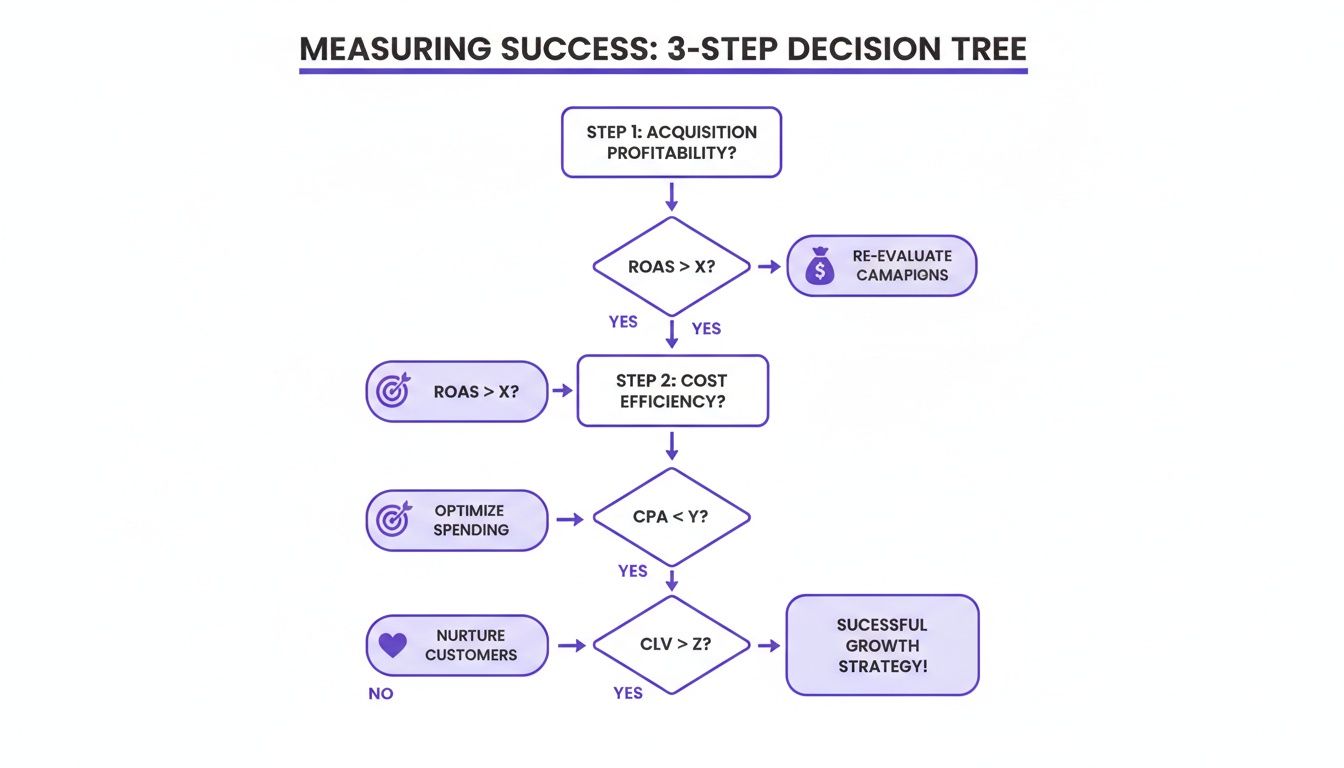
It’s not just about clicks and impressions. A mature agency focuses on core business metrics like ROAS, CPA, and LTV, giving you a complete picture of profitability from the first click to long-term customer value.
Sharp Questions to Uncover Strategic Depth
Once you’ve shortlisted a few agencies, it’s time to dig deeper. The questions you ask should be designed to move beyond canned answers and reveal how they truly think and operate. This is your chance to assess their strategic intelligence, problem-solving skills, and how they handle adversity.
Here are a few of my go-to questions:
-
"Walk me through a campaign that failed. What did you learn, and how did you pivot?" This question tests for honesty and resilience. A great partner isn't afraid to admit mistakes and will have a clear process for learning and improving. If all you hear are success stories, be skeptical.
-
"How will you tailor your approach for our B2B audience and longer sales cycle in the Canadian/US market?" This forces them to demonstrate an understanding of your unique business model and geography. If you're looking for a top-tier partner, discover more about what defines a great B2B marketing agency and the specific strategies they employ.
-
"What is your process for the first 90 days?" A skilled agency won’t just "start running ads." They'll have a structured onboarding and strategy development process with clear milestones for research, campaign setup, testing, and optimization.
The right agency doesn't just execute your ideas—they challenge them. They should bring new insights, data-backed recommendations, and a proactive approach to identifying growth opportunities you haven't seen yet.
The impact of finding a skilled partner can be immense. For instance, a US-based logistics company reported a 40% increase in qualified leads within three months after partnering with a performance agency that specialized in B2B PPC on Google and LinkedIn. Finding a partner with this level of expertise is the key to unlocking your own growth potential.
Take the time to be thorough in your evaluation—it’s an investment that will pay dividends for years to come. Contact us to see if we're the right fit for your business.
Understanding Agency Pricing and Avoiding Common Pitfalls
Let's get straight to the two things that keep founders up at night when hiring an agency: money and mistakes. How an agency structures its fees is the first clue to a healthy partnership. Get this wrong, and you’re headed for misaligned goals, budget blowouts, and a relationship that crumbles before it even gets off the ground.
But even with the perfect pricing model, a partnership can sour quickly. Vague goals, radio silence, and mismatched expectations can poison the well, turning what should be a smart investment into a frustrating expense.
Protecting your investment means knowing what to look for—and what to look out for. We'll break down the pricing models you'll encounter and flag the common traps that can derail your success, giving you practical advice to build a healthy, long-term partnership.
Decoding Agency Pricing Models
The way an agency charges says a lot about its confidence and philosophy. The right model for you depends on your budget, goals, and how much risk you're willing to take on. Here are the most common structures you'll see from performance marketing agencies in Canada and the US.
-
Percentage of Ad Spend: This is the classic model. The agency's fee is a set percentage of your monthly ad budget, often 10-20%. It’s simple and scales as you spend more. The catch? It can create a conflict where the agency is motivated to spend more of your money, not necessarily to spend it better.
-
Flat Monthly Retainer: You pay a fixed fee each month for a clearly defined scope of work. This is a huge plus for startups because it makes budgeting predictable. The downside is that the fee isn't directly tied to results, so you absolutely need clear performance clauses in your contract.
-
Hybrid Model (Retainer + Performance): This is often the sweet spot. It combines a lower flat retainer with performance-based bonuses for hitting specific KPIs, like a target ROAS or CPA. It gives the agency stable cash flow while giving them a serious incentive to knock it out of the park.
-
Pure Performance (Revenue Share / CPA): This is the ultimate "pay for results" setup. The agency only gets paid based on the revenue they generate or a fixed fee for each new customer. While it sounds like a dream with zero risk for you, it's rare. This model is usually reserved for businesses with a proven product, fat margins, and serious scale.
A hybrid model is often the best fit for most B2B businesses. It ensures the agency is a true partner, sharing both the risk and the reward. That's what a real performance-based relationship should feel like.
Steering Clear of Partnership Pitfalls
Even the best-laid plans can fall apart if the partnership fundamentals aren't rock-solid. One of the biggest performance marketing wins I've seen involved a US-based SaaS company that boosted its lead volume by 300% in six months. Their secret wasn't just a great agency; it was a transparent partnership that sidestepped these common traps.
1. Vague Goals and Murky KPIs
Starting a partnership without specific, measurable, achievable, relevant, and time-bound (SMART) goals is like sailing without a compass. Simply saying "we want more leads" is a recipe for disappointment.
- The Fix: Define exactly what a "qualified lead" looks like and agree on a target CPA. For example: "Our goal is to generate 50 marketing-qualified leads per month from LinkedIn in the US and Canada at a CPA of no more than $250 within the first quarter." Crystal clear.
2. Poor or Infrequent Communication
In an agency relationship, silence is not golden. A lack of proactive updates, transparent reports, and strategic chats breeds mistrust and leads to costly mistakes. You should never have to wonder, "What's actually happening with our campaigns?"
- The Fix: Set a clear communication rhythm from day one. This should include weekly check-in calls, a shared Slack channel for quick questions, and a monthly strategic review to go over performance, what you've learned, and what’s next.
3. Misaligned Expectations
Your agency needs to get your business realities—your sales cycle, customer lifetime value, and cash flow. In the same way, you need to understand that performance marketing is a process of testing and learning, not an overnight magic trick.
- The Fix: Have a brutally honest conversation during the proposal stage about timelines. A good agency will be upfront that the first 90 days are all about building foundations and gathering data. The real, scalable results start showing up after that initial phase.
By picking the right pricing model and actively managing the partnership, you’re setting the stage for a collaboration that drives real, measurable growth.
Is your current marketing partnership delivering clear, predictable results? Contact us today for a no-obligation consultation to see how a truly aligned performance marketing strategy can protect your investment and accelerate your success.
Ready to Build a Predictable Growth Engine?
You've made it through the complete playbook. By now, you should have a solid grasp of how to partner with a performance marketing agency to build a scalable, data-backed growth engine for your business.
The most important takeaway is this: it’s time to stop treating marketing as a cost centre and start seeing it for what it is—a powerful investment with a clear, measurable return. When done right, this partnership unlocks entirely new levels of customer acquisition and, most importantly, profitability.
For businesses across Canada and the United States, this results-driven approach is no longer a "nice-to-have." When every dollar counts, you need a partner who is just as obsessed with your bottom line as you are. The right agency provides the strategy, hands-on execution, and accountability needed to turn ambitious goals into real-world outcomes.
From Strategy to ROI: What Success Looks Like
The impact of a well-executed performance strategy can be massive. We've seen B2B tech companies in the United States generate a 300% increase in qualified leads within six months just by optimizing their paid channels. E-commerce brands we've worked with in Canada have hit a 4:1 ROAS or higher after bringing on a partner to refine their campaigns.
These wins aren't flukes; they're the direct result of a true partnership built on three pillars:
- Clear Goals: Defining exactly what success looks like, right down to the target CPA and ROAS.
- Data-Driven Decisions: Using analytics—not guesswork—to continuously optimize every campaign.
- Total Alignment: Tying the agency’s success directly to your own financial outcomes.
You’ve seen how the best performance marketing agencies operate, the metrics that matter, and the common pitfalls to sidestep. The only thing left to do is take action. This isn’t just about hiring a service; it’s about investing in a predictable path to growth.
If you’re serious about driving tangible results, let’s have a chat.
Contact us today for a no-obligation consultation to talk through your growth goals. We can explore how our strategies can deliver the ROI your business deserves.
Frequently Asked Questions
When you're thinking about bringing on a performance marketing agency, a lot of questions come to mind. To give you the clarity you need, we've pulled together straight answers to the most common queries we hear from business leaders across Canada and the United States.
What Is a Realistic Budget to Hire a Performance Marketing Agency?
There's no single magic number, but a realistic starting point for most small to medium-sized businesses in North America has two parts. You should expect a monthly management fee of around $3,000–$5,000, plus a minimum ad spend of $5,000–$10,000.
This level of investment is crucial because it allows an agency to actually gather enough data from channels like Google and LinkedIn to make smart decisions. It provides the volume needed to run meaningful tests, find out what’s working, and start generating tangible results in competitive markets. We've seen a Canadian B2B SaaS client use a similar budget to cut their cost-per-demo by 40% in just one quarter.
How Quickly Can We Expect to See Results?
While you'll see activity right away, meaningful and stable results from performance marketing campaigns typically start to show within 90 days. It helps to think of it as a three-month ramp-up.
- Month 1 (Days 1-30): This is all about setup, deep-dive research, and launching the first campaigns. The main goal here is to get baseline data and see how the market responds.
- Month 2 (Days 31-60): Now it’s time to optimize. Your agency will be analyzing the initial data and aggressively testing everything—ad creative, landing pages, and audience targeting—to find the winning combinations.
- Month 3 (Days 61-90): By the end of this month, you should see clear, positive trends in your key metrics. This is when you can expect to see a lower Cost Per Acquisition (CPA) and a higher Return on Ad Spend (ROAS).
What Is the Main Difference Between a Digital and a Performance Agency?
The real difference comes down to the business model and what they focus on. A general digital marketing agency often charges a fixed monthly retainer for a wide range of activities, like posting on social media or writing blog articles. Their job is to manage your presence.
On the other hand, a performance marketing agency is laser-focused on actions that directly drive revenue. Their success, and often their compensation, is tied to hitting specific, agreed-upon results. This ensures their goals are perfectly aligned with yours. This pay-for-results model is what defines a true performance marketing agency.
Ready to see how a results-driven partnership can build a predictable growth engine for your business? Contact B2Better today for a no-obligation consultation. We'll discuss your goals and explore how our strategies can deliver the ROI your business deserves.