
So, what exactly is a pay-per-click agency? Think of them as a specialized team of marketing pros who live and breathe paid ad campaigns on platforms like Google Ads and LinkedIn. Their entire focus is to maximize your return on investment by managing everything from keyword research and ad creation to bid management and performance analysis. They make sure your ad budget drives real, measurable business results.
Why B2B Startups Need a Specialized Pay Per Click Agency
The digital ad market is a dogfight, especially for B2B startups in Canadian tech hubs like Kitchener-Waterloo and Toronto or major US metros. Without a focused partner, your in-house team is left juggling complex ad platforms, endless targeting options, and tight budgets. Too often, this means failing to reach those high-value decision-makers you need to connect with in the United States and Canada.

Navigating a Crowded Digital Space
Let's be honest: B2B companies are fighting for attention in an incredibly saturated space. Just look at the Canadian digital marketing scene. The Information and Communications Technologies (ICT) sector alone has over 43,200 companies all competing for visibility. Digging deeper, a whopping 574 of those firms specialize in Pay-Per-Click services, which just goes to show how fierce the competition is for startups in tech, SaaS, and manufacturing.
This saturation really highlights the opportunity cost of DIY PPC. Every dollar you spend on poorly targeted ads or unoptimized campaigns is a dollar that could have been invested in core growth tasks.
The consequences are tangible and painful:
- Missed Impressions: Your ideal customers in the US and Canada never even see your ads because your bidding strategy is off.
- Wasted Spend: Clicks from irrelevant audiences drain your budget without generating a single qualified lead.
- Team Distraction: Your lean team burns valuable hours on ad management instead of product development or customer success.
Turning Ad Spend into Predictable Revenue
The right pay per click agency can transform your ad budget from a necessary evil into a predictable revenue stream. We've seen this happen time and time again. For a US-based SaaS founder, we doubled their qualified leads in just six weeks after handing off their campaign structure, bid strategies, and creative testing to our experts.
Another company in the manufacturing sector saved over $800,000 in agency fees and slashed their Cost Per Lead by 40% by moving away from manual PPC management to a more strategic, data-driven approach. These are not just numbers; they represent tangible growth and significant competitive advantages.
Ultimately, B2B startups partner with a specialized agency to implement proven lead generation solutions that actually drive business growth. An expert partner gets the nuances of B2B sales cycles and knows how to connect ad performance to bottom-line results. Our comprehensive pay-per-click services are designed to do exactly that: https://b2better.co/pay-per-click-services/
For founders and lean marketing teams, this partnership isn't just about outsourcing a task; it's about gaining a strategic ally dedicated to turning clicks into customers.
Ready to see how a specialized agency can unlock your growth potential? Contact us today to discuss how we can build a PPC strategy that delivers real results for your B2B startup.
Define Your Goals And Find The Right Agency
Before you even start Googling pay-per-click agencies, you need to get crystal clear on what winning actually looks like. I've seen too many B2B startups waste thousands on ad spend chasing vague goals like “more clicks” or “increased traffic.” That’s a recipe for disappointment.
Successful scale-ups in Canada and the United States map their PPC goals directly to revenue. It’s that simple.
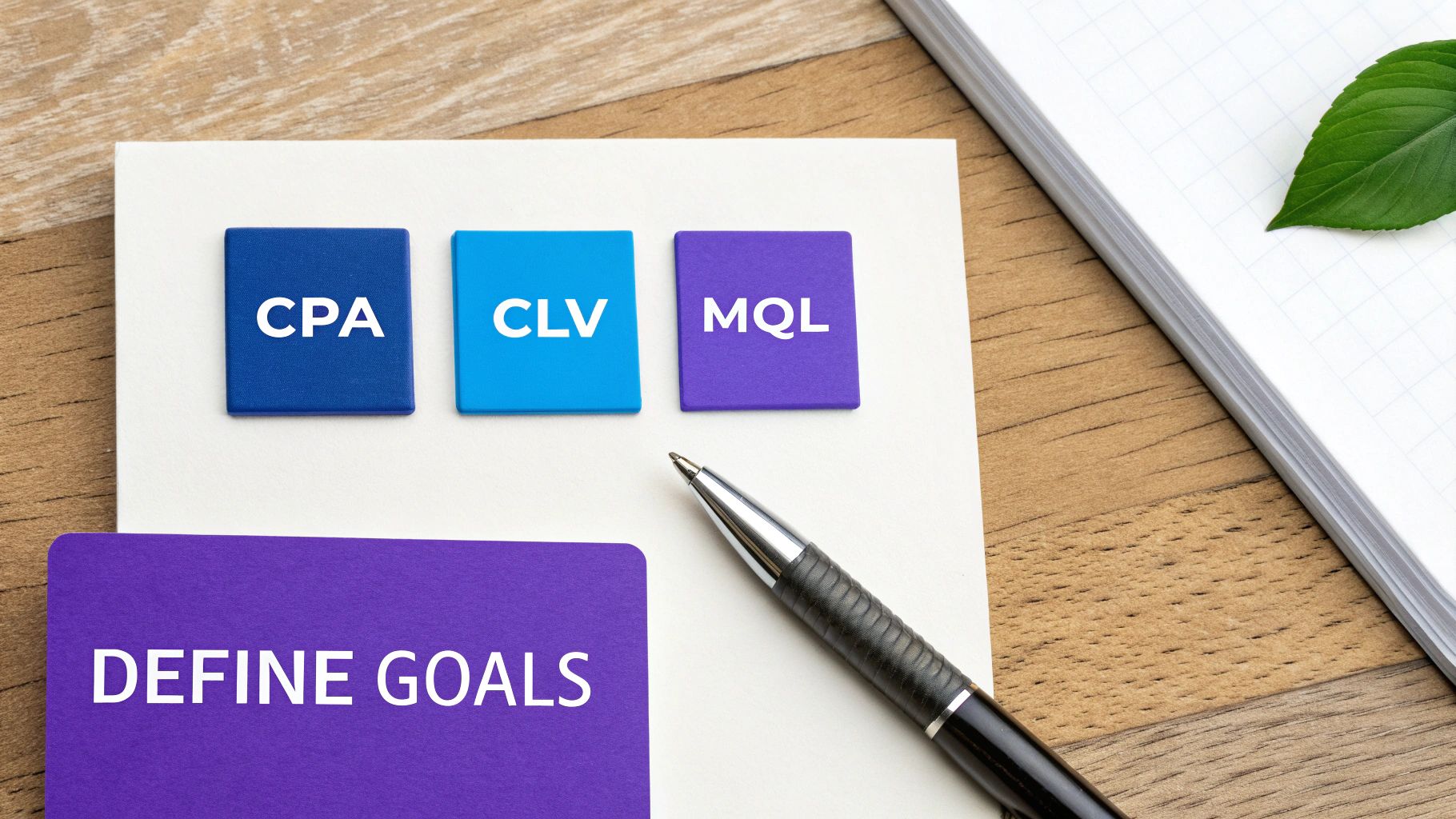
Think less about vanity metrics and more about the KPIs you'd report to your board. These core business objectives should be the compass that guides your entire search for the right agency partner.
Tying PPC Goals To Business Outcomes
To find a partner who can drive real growth, you have to speak their language—the language of data and results. This means pushing past surface-level stats and connecting every ad dollar to your sales pipeline.
Here’s a quick rundown of the metrics that matter:
- Cost Per Acquisition (CPA): How much are you really paying to land a new customer through your ads? This is your north star.
- Customer Lifetime Value (CLV): What's the total revenue you can expect from a single customer? Your CPA absolutely must be lower than your CLV for your campaigns to be profitable.
- Marketing Qualified Leads (MQLs): How many leads coming from PPC are genuinely ready for a sales conversation? Quality over quantity, always.
A sharp focus on these numbers is what separates a top-tier pay-per-click agency from the rest. For instance, one of our startup clients targeting the US market was initially obsessed with lead volume. By shifting their focus to CPA and aligning ad costs with their sales targets, we slashed their acquisition cost by 35% in just three months, leading to a 150% increase in ROAS.
Choosing the right partner is critical for B2B startups; you can learn more in our detailed guide on finding the ideal marketing agency for startups.
The most effective PPC partnerships begin with a shared definition of success. When your agency understands your business model and revenue goals, they can build campaigns that deliver customers, not just clicks.
To help you structure these conversations, here's a breakdown of the key metrics to discuss with any potential agency.
Key PPC Metrics for B2B Startups
| Metric | What It Measures | Why It Matters for B2B |
|---|---|---|
| Impressions & Clicks | How many people saw your ad and how many clicked on it. | Good for gauging initial reach, but tells you nothing about lead quality or sales impact. |
| Click-Through Rate (CTR) | The percentage of impressions that resulted in a click. | A strong CTR indicates your ad copy and targeting are resonating with your audience. |
| Cost Per Click (CPC) | The average amount you pay for each click on your ad. | Helps you manage your budget, but a low CPC doesn't guarantee a high-quality lead. |
| Conversion Rate | The percentage of clicks that result in a desired action (e.g., a form fill). | This is where you start connecting ad performance to actual business actions. |
| Cost Per Lead (CPL) | Your total ad spend divided by the number of leads generated. | Moves beyond clicks to measure the cost of acquiring a potential customer contact. |
| Marketing Qualified Leads (MQLs) | The number of leads that meet your pre-defined qualification criteria. | Filters out the noise and focuses on leads that are actually a good fit for your sales team. |
| Cost Per Acquisition (CPA) | The total cost to acquire a paying customer. | The ultimate metric for profitability—it tells you if your ad spend is actually generating revenue. |
| Customer Lifetime Value (CLV) | The total revenue a customer is expected to generate over their lifetime. | Puts your CPA in context. A profitable PPC program requires a healthy CLV:CPA ratio. |
Moving from top-of-funnel metrics like clicks to bottom-funnel metrics like CPA and CLV is essential for ensuring your PPC investment directly contributes to business growth.
Matching Niche Expertise To Your Needs
Not all agencies are created equal. Some are brilliant at generating leads for industrial manufacturing, while others are masters of driving SaaS free trials. Finding an agency with proven experience in your specific niche isn't just a "nice-to-have"—it's critical.
This specialization is huge because B2B sales cycles are long and complex. An agency that already gets your industry will understand your buyer personas, the competitive landscape, and the best channels to reach decision-makers in both Canada and the United States. They won't be learning your business from scratch on your dime.
As you start your search, hunt for case studies and client testimonials that look and sound like your company. An agency that has already solved similar challenges for a business like yours is far more likely to deliver the results you're after.
Questions You Need to Ask a Pay-Per-Click Agency
Not every pay-per-click agency is built the same. Once you’ve nailed down your goals, the real work begins: asking the right questions to figure out if an agency has the strategic chops, transparency, and cultural fit to be a true partner.
Vague, boilerplate answers are a massive red flag. You need a team that can give you a clear plan for your specific B2B challenges, not just rattle off generic "best practices." I recently audited a campaign for a Canadian SaaS company where their previous agency was running the exact same ads in Canada and the US. No surprise their lead quality was in the gutter.
Are They a Strategist or Just a Campaign Manager?
Your goal is to find a partner who thinks like an extension of your business, not just someone who pushes buttons in Google Ads. Their ability to connect PPC tactics to your long, complex sales cycle is absolutely critical.
Here are the questions I use to separate the thinkers from the doers:
- The Blueprint: "Walk me through your campaign blueprint for a B2B company with a six-month sales cycle. How do you structure campaigns to take a lead from 'just browsing' to 'ready to talk to sales'?"
- Audience Nuances: "We target both Canada and the United States. How would you approach audience segmentation and budget allocation differently for each country to account for regional differences?"
- The Budget Squeeze: "Let's say we have to cut our monthly budget by 20% mid-quarter. What's your game plan? How do you adapt bidding strategies to protect our best lead sources and prevent a total performance collapse?"
- Show Me the Proof: "Can you share a specific example of a B2B client in our space where you improved lead quality, not just volume? What were the key levers you pulled to make that happen?"
These questions force the conversation beyond jargon like CPCs and CTRs. They make an agency prove they understand the messy reality of B2B marketing, where one high-value lead is worth a hundred unqualified clicks.
How Transparent and Communicative Are They Really?
A great PPC agency feels like part of your in-house team. That requires seamless communication and total transparency on performance—good or bad. If you're not aligned on this, the relationship will sour fast.
A partnership built on clear, consistent communication is vital. According to one report, effective communication can increase a team's productivity by up to 25%—a huge edge when you're trying to move fast and grab market share.
To get a feel for their process, ask these questions:
- Reporting Rhythm: "What does your standard reporting look like? How often will we get it, and will we have a live dashboard we can access anytime?"
- Who's on the Account?: "Who will be our day-to-day contact, and how experienced are they? How often will we have strategic calls with senior people on your team?"
- When Things Go Wrong: "Tell me about a time a campaign wasn't hitting its targets. What was your process for spotting the problem, telling the client, and fixing it?"
Their answers will tell you everything you need to know about how they handle wins and losses. You’re looking for proactive problem-solvers who own their results, not people who make excuses.
Finding the right fit is about more than just technical skill; it’s about finding a shared commitment to your business goals. Taking the time to ask these pointed questions ensures you find a pay-per-click agency that will drive real, measurable growth for your B2B startup.
Ready to find a partner who can answer these questions with confidence? Contact us to start the conversation.
Explore Pricing Models And Contracts
Figuring out how a PPC agency structures its fees is critical to building a transparent, successful partnership. Agency pricing isn't one-size-fits-all; the right model for your B2B startup depends heavily on your budget, growth stage, and how much risk you're willing to take on. Getting this right ensures you find a structure that aligns with your financial reality from day one.
Most agency fees fall into a few common buckets. Each has its pros and cons, so you'll want to weigh them carefully against your specific business goals in both Canada and the US.
Common Agency Pricing Structures
Let's break down the most common fee structures you'll encounter.
- Percentage of Ad Spend: This is probably the most popular model. The agency charges a percentage of your monthly ad budget, typically 10-20%. So, if your B2B company has a $50,000 monthly ad spend, a 15% fee would come to $7,500. This model scales with your investment, but be aware that it can sometimes incentivize agencies to simply ramp up your spend rather than focus purely on efficiency.
- Flat-Rate Retainer: Many early-stage startups lean this way for its predictability. An agency might charge a fixed monthly fee—say, $5,000—regardless of your ad spend. It’s fantastic for budget forecasting, but it may not scale well if your campaigns become significantly more complex over time.
- Performance-Based Pricing: This model directly ties what you pay to the results you get, like cost-per-lead (CPL) or revenue generated. It’s great for aligning the agency’s success with your own, but it can be more complex to structure and track accurately.
I remember working with one medical SaaS client who saw a 25% improvement in lead quality after we shifted them from a spend-based model to a hybrid retainer. We added performance bonuses for hitting specific MQL targets, and that small change focused everyone on what truly mattered—generating qualified pipeline.
Comparing PPC Agency Pricing Models
To help you decide, here’s a quick overview of how these common agency fee structures stack up. Choosing the best fit for your budget and goals is a crucial first step.
| Pricing Model | How It Works | Best For |
|---|---|---|
| Percentage of Ad Spend | Agency fee is a fixed percentage (10-20%) of your total monthly ad budget. | Scale-ups with larger, fluctuating budgets where management complexity grows with spend. |
| Flat-Rate Retainer | A fixed monthly fee for a defined scope of work, regardless of ad spend. | Startups and SMEs needing predictable monthly costs and consistent management services. |
| Performance-Based | Fees are tied directly to specific KPIs like leads, sales, or ROAS. | Companies with clear conversion tracking and a high tolerance for variable monthly costs. |
Ultimately, the best model is one that feels fair and motivates the agency to act as a true partner in your growth. Don't be afraid to ask for a hybrid model if a single structure doesn't quite fit.
Decoding Contracts and Spotting Red Flags
Once you’ve settled on pricing, the contract becomes your roadmap. A crystal-clear Statement of Work (SOW) is non-negotiable. It needs to detail everything from campaign deliverables and reporting frequency to who owns the ad accounts and creative assets.
Keep an eye out for major red flags. Multi-year lock-ins without clear performance clauses or an escape hatch are a significant risk. Your contract should give you flexibility if key performance indicators aren't met. An agency that's confident in its ability to deliver results won't need to trap you in a long-term commitment.
A fair contract protects both parties. It should clearly define success, outline the scope of work, and establish a transparent framework for communication and accountability from day one.
Before you can pick the right model, you need to know your numbers inside and out. To make sure your campaigns are set up for profitability right from the start, use our break-even ROAS calculator to determine the exact return you need from your ad spend.
Choosing the right PPC agency and pricing model is a strategic decision that will directly impact your cash flow and growth trajectory. Take the time to get it right.
Onboard Your PPC Agency For Long-Term Success
You've signed the contract, but the real work starts now. The way you onboard your new PPC agency sets the stage for everything that follows. A sharp, clear process doesn't just prevent headaches and miscommunication; it's the fastest way to get a return on your investment.
In fact, our experience shows a structured onboarding can boost campaign performance by as much as 35% in the first quarter alone. It gets everyone on the same page quickly and builds the confidence needed for a strong partnership.
Here are the key things to get right from day one:
- Granting prompt access to Google Ads, LinkedIn, and Microsoft Advertising accounts.
- Installing tracking pixels and integrating your CRM for clean, accurate conversion data.
- Sharing brand guidelines, creative assets, and outlining approval workflows.
- Hosting an initial strategy workshop with your Fractional CMO and in-house team.
- Agreeing on the communication cadence, reporting templates, and who to call when issues pop up.
- Clarifying legal compliance requirements for both Canadian and US campaigns.
- Providing brand voice guidelines and competitive insights to shape compelling ad copy.
Kickoff Checklist Overview
At B2Better, we structure these tasks into a simple flow to keep everyone aligned. The goal is immediate access so campaigns can launch without any frustrating delays.
We also make sure to map out budget thresholds and approval matrices well before any campaigns go live. This simple step ensures there are no surprises when it's time to scale up your ad spend.
For an even deeper dive, this ultimate 8-step client onboarding checklist is a great resource. It expands on our core framework by adding client interviews and detailed asset audits—worth a look to ensure all your bases are covered.
- Confirm access permissions for both Canadian and US ad accounts.
- Implement and thoroughly verify all tracking pixels and CRM data flows.
- Facilitate a strategy workshop to align on goals, KPIs, and core messaging.
- Define the rhythm for weekly and monthly touchpoints for performance reviews.
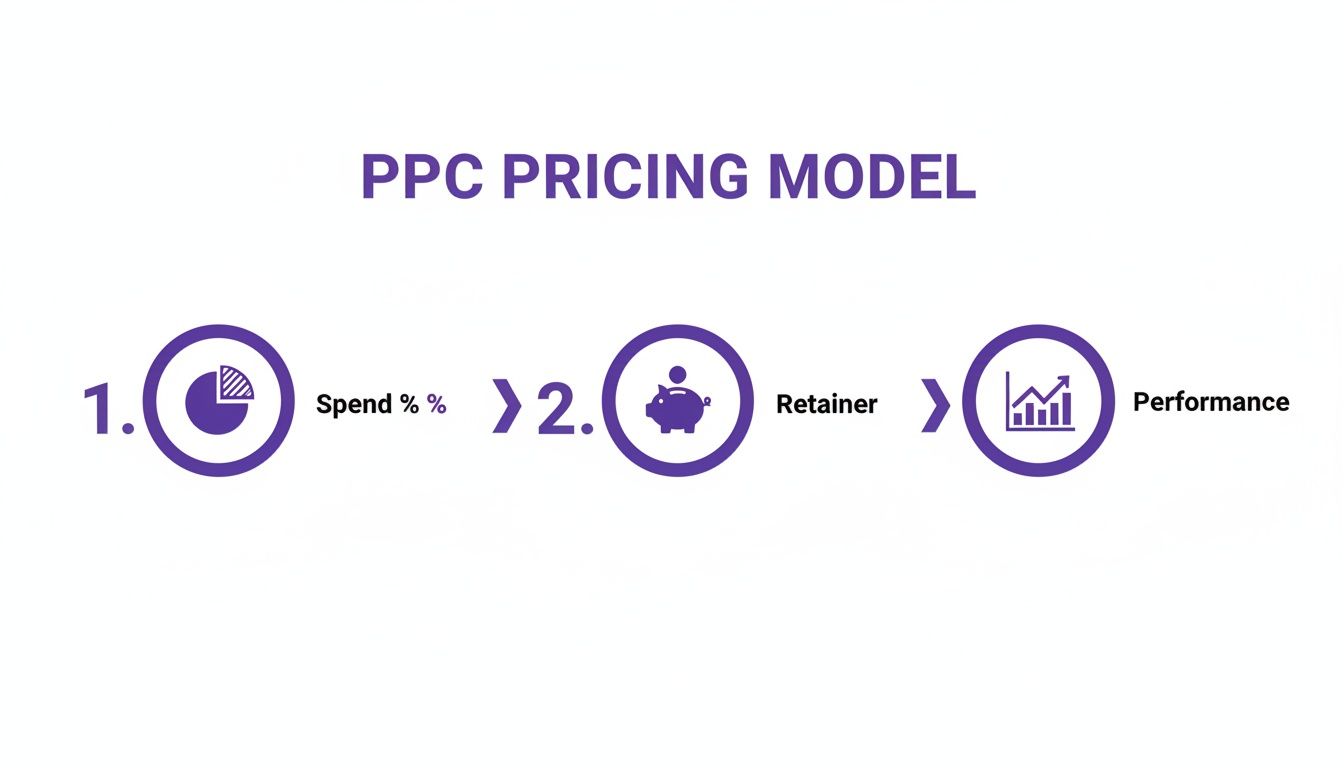
This visual breaks down how different pricing components—like spend percentage, retainers, and performance fees—come together. It’s a good reminder of why transparent pricing is so critical to establish during the onboarding phase.
Align Teams And Tools
Next, it's time to integrate your PPC agency with your internal marketing team and, if you have one, your Fractional CMO. Creating shared dashboards and dedicated collaboration channels cuts down on endless alignment meetings and speeds up decision-making.
A crucial detail for Canadian businesses is linking ad spend across both CAD and USD budgets. This ensures you have an accurate forecast across different regions. It's also wise to review compliance checklists for each target market to sidestep any potential policy issues down the line.
Here are a few best practices that work wonders:
- Embed the agency into your existing Slack or Teams channels.
- Link your CRM pipelines directly to ad analytics for real-time lead tracking.
- Schedule monthly sessions dedicated to performance and budget alignment.
| Meeting Type | Frequency |
|---|---|
| Stand-up | Weekly |
| Strategy Review | Monthly |
"Bringing everyone into one workspace cut approval cycles from seven days to two days." says a B2B scale-up marketing lead.
Using shared templates and folders for assets and reports also makes a huge difference. It feels small, but it significantly accelerates the entire process and reduces needless back-and-forth.
Maintain Ongoing Collaboration
The partnership doesn't end after the kickoff call. Consistent, ongoing communication is what cements a great agency relationship. Quarterly strategy reviews with your Fractional CMO are perfect for ensuring campaigns adapt to seasonal trends, new market opportunities, and any regulatory changes in the United States or Canada.
Bi-weekly performance touchpoints are also key, as they allow you to reallocate budgets to winning campaigns swiftly. Keep a close eye on metrics like CPA, CPL, and CLV every month to confirm you’re staying aligned with your core revenue goals.
Document all key insights in a shared space, like a wiki, and make sure you're iterating on ad copy and landing pages based on what the data tells you. Agencies that maintain these collaborative feedback loops typically achieve 50% better client retention over 12 months. It's a win-win.
Common Questions Answered
When B2B leaders in Canada and the US start exploring the world of paid advertising, a lot of questions pop up. Here are the answers to some of the most common ones we hear from companies just before they decide to partner with a pay-per-click agency.
How Soon Can I Expect to See Real Results?
While you'll start seeing traffic and impression data almost right away, meaningful B2B results—like qualified leads and demo requests—typically take 60 to 90 days to really kick in.
This initial period is crucial. It’s when the agency is gathering audience data, testing different ad copy like crazy, and tweaking your landing pages to make sure the leads you get are actually good ones. For example, one of our US tech clients saw their Cost Per Lead (CPL) drop by 40%, but it took two full months of rigorous testing and optimization to hit that number. The goal isn’t a temporary spike in clicks; it's about building sustainable growth.
What’s a Realistic Starting Budget for a B2B Startup?
For most B2B startups in North America, a good starting point is between $3,000 and $5,000 per month in pure ad spend, plus the agency’s management fee. This gives you enough budget to gather sufficient data for A/B testing on platforms like Google Ads and LinkedIn.
But in super-competitive spaces like fintech or enterprise software, you'll likely need to start closer to $10,000+ per month just to get meaningful traction and compete for those high-intent keywords in the US and Canada.
A classic mistake is spreading a small budget too thin across too many channels. A sharp pay-per-click agency will tell you to focus your initial spend on the one or two platforms most likely to deliver high-quality leads for your specific niche.
Can We Just Do PPC Instead of SEO?
Short answer: no. They really work best when they work together. PPC gives you immediate visibility and a goldmine of keyword insights that can sharpen your entire marketing strategy. On the other hand, SEO is your long game—it builds organic authority and brand credibility that pays off for years to come.
The smart move is to use them in a coordinated attack. For instance, the data from a successful PPC campaign can tell you exactly which keywords to target in your SEO efforts. Over time, strong organic rankings will lessen your dependence on paid ads, creating a more resilient and cost-effective marketing machine.
Ready to stop guessing and start getting real results from your paid advertising? The team at B2Better has the deep B2B expertise to build and manage a PPC program that drives measurable growth for your startup or scale-up. Contact us today to start the conversation.