

Your marketing mix distribution strategy is your master plan for getting a product or service into the hands of your target customer. It’s the often-overlooked “Place” in the classic 4 Ps of marketing (Product, Price, Place, Promotion), and it answers a simple but critical question: how and where will customers actually find and buy what you’re selling?
What Is Distribution in the Marketing Mix

Think of your product as a high-performance vehicle and your ideal customer as its final destination. Your distribution strategy is the entire network of highways, local roads, and last-mile driveways that connect the two. It’s so much more than just shipping and logistics; it’s the fundamental infrastructure that dictates how accessible, convenient, and available your solution is.
This piece of the marketing mix, often called 'Place', gets right to the heart of how you deliver your value proposition. The channels you pick—whether it's a direct sales team hitting the phones in the United States, an e-commerce site serving Canadian customers, or a web of trusted resellers—directly shape the entire customer experience and carve out your brand's footprint in the market.
The Foundation for Growth
A well-thought-out marketing mix distribution strategy isn’t just an operational chore; it’s a powerful competitive advantage. It quietly influences everything from how fast you can close deals to how customers perceive your brand. For instance, a complex B2B software sold only through specialized partners sends a clear message of premium quality, while a direct-to-consumer online model screams accessibility and efficiency.
A strong distribution strategy acts as a force multiplier for all your other marketing efforts. Companies with optimized omnichannel strategies achieve a 9.5% year-over-year increase in annual revenue, compared to just 3.4% for those with weak omnichannel programs.
This direct link between availability and revenue is what separates the winners from the also-rans, especially in competitive North American markets. Your choices here will determine:
- Market Reach: How many potential customers across Canada and the United States can you realistically get in front of?
- Customer Experience: Is the buying process smooth and in line with what your customers expect?
- Profit Margins: What does it really cost to get your product from your warehouse to your customer’s doorstep?
A Real-World Example of Success
Look at Shopify, the Canadian e-commerce titan. Their distribution strategy is a masterclass in itself. They offer their platform directly to merchants (that’s direct distribution), but they also built a massive ecosystem of app developers and agency partners who sell on their behalf (indirect distribution).
This dual-pronged approach is what allowed them to scale at a dizzying pace. It made their "product" accessible to everyone from solo entrepreneurs launching their first store to massive enterprises across North America. Their story proves that the right channels don't just deliver a product; they build an empire.
Ultimately, crafting your distribution strategy is about designing the most efficient and effective pathways to revenue. Get this right, and you've laid the bedrock for scalable, sustainable growth.
Ready to architect a distribution strategy that gives you a competitive edge? Contact us to see how our Fractional CMO expertise can build the right channels for your business.
Choosing Your Distribution Path: Direct vs. Indirect Channels
Every business eventually hits a fork in the road when building its marketing mix distribution strategy. One path is direct, where you carve your own highway straight to the customer. The other is indirect, where you join forces with partners who’ve already paved the way.
This isn't just about logistics; it's a foundational choice that dictates your costs, speed to market, and the very nature of your customer relationships. For B2B companies in competitive hubs like Toronto, Canada or Austin, Texas, getting this right is critical to reaching customers efficiently and outmanoeuvring the competition.
The Direct Channel Advantage
Going direct means you own the entire sales process, from the first handshake to the final invoice. You’re talking to your customers one-on-one, with no middlemen diluting your message. This gives you immense control over your brand, the customer experience, and—most importantly—your data.
Common direct channels include:
- In-House Sales Teams: Your own people building relationships and closing deals. This is a must for complex, high-value B2B solutions where trust and expertise are everything.
- E-commerce Websites: A digital storefront that you control completely, offering a seamless buying journey from discovery to checkout.
- Company-Owned Retail Locations: Brick-and-mortar spaces that let you curate the entire brand experience down to the last detail.
The biggest win with a direct distribution strategy is that raw, unfiltered connection to your customer. You get firsthand feedback, you keep your full margin, and you build fierce brand loyalty.
And that control pays dividends. A recent study found that 86% of buyers in the United States and Canada are willing to pay more for a great customer experience—something that’s far easier to deliver when you’re managing every touchpoint yourself.
Tapping into Indirect Channels
The indirect route brings partners into the fold. Think resellers, distributors, or strategic allies who sell your product for you. Here, the game is all about scale. You’re trading a bit of control for the massive reach and established customer bases your partners have already built.
Examples of indirect channels include:
- Value-Added Resellers (VARs): Partners who bundle your product with their own services, creating a more complete solution for the end customer.
- Distributors and Wholesalers: Intermediaries who purchase your product in bulk and sell it through their extensive network of retailers or businesses.
- Strategic Partners: Companies that integrate your solution into their own offerings or co-market it to their loyal audience.
This model is a powerhouse for breaking into new markets fast. In Canada, for instance, many B2B distribution strategies lean on short, efficient channels because 90% of prospective industrial buyers are clustered in just a handful of major cities. This density makes direct sales viable, but it also opens the door for specialized local partners to provide deep, immediate market access. You can explore this further in the Canadian Commercial Guide on distribution channels.
Deciding between these two paths often comes down to a simple trade-off analysis. Here’s a quick breakdown to help you compare the models side-by-side.
Direct vs. Indirect Distribution Channels for B2B
| Attribute | Direct Distribution (e.g., In-House Sales) | Indirect Distribution (e.g., Resellers) |
|---|---|---|
| Control | High. You own the brand message, pricing, and customer experience. | Low. You rely on partners to represent your brand and manage relationships. |
| Customer Relationship | Direct and personal. You gather firsthand feedback and build strong loyalty. | Indirect. The partner owns the primary customer relationship. |
| Upfront Costs | High. Requires investment in sales teams, e-commerce infrastructure, or retail space. | Low. You leverage the partner's existing infrastructure and sales force. |
| Speed to Market | Slower. Building your own reach and customer base takes time. | Faster. Instantly tap into the partner's established market presence. |
| Profit Margins | High. You keep the entire margin from each sale. | Lower. Margins are shared with distributors, resellers, and other partners. |
| Market Reach | Limited by your own resources and ability to scale. | Broad. Quickly expand into new geographic or vertical markets. |
| Best For | Complex, high-value products; niche markets; businesses prioritizing brand control. | Standardized products; mass markets; businesses prioritizing rapid growth. |
Ultimately, there’s no single right answer. The choice between direct, indirect—or even a hybrid model that blends both—boils down to your specific business goals, the complexity of your product, and the resources you have at hand. Are you chasing high margins and total control, or is rapid market penetration your top priority?
Answering that question is the first step toward building a distribution network that doesn’t just support your business, but actively fuels its growth.
Ready to map out the most profitable path to your customers? A tailored distribution strategy is critical for growth. Contact us today to learn how our Fractional CMO services can help you choose and build the right channels for your B2B business.
How to Build a B2B Distribution Strategy
Building a powerful B2B distribution strategy isn't about just picking channels off a list. It’s a methodical, customer-first process of building a network that gets your product into the right hands, efficiently and profitably. A winning plan is built on solid research, an honest look in the mirror, and clear-headed partner management.
Let's break down the practical, step-by-step framework for creating a distribution network that actually delivers. This is about understanding your customer's world, evaluating what your own company can handle, and then choosing the channels that bridge that gap perfectly.
Step 1 Understand Your Customer's Buying Journey
Before you decide where to sell, you have to know where your customers in Canada and the US are already looking for solutions. So many businesses build their strategy on what they think customers do, rather than the reality on the ground. To avoid that trap, you need to get inside your buyer's head.
Ask yourself the tough questions to map out their natural path to a purchase:
- Where do they do their homework? Are they reading specific industry publications, walking the floors of trade shows in Toronto or Chicago, or just typing their problems into Google?
- Whose opinion do they trust? Is it industry analysts, peer reviews on sites like G2 or Capterra, or a handful of trusted consultants in their field?
- How do they actually prefer to buy? Do they want the ease of a self-serve online checkout, a detailed demo from a sales rep, or are they locked into purchasing through established procurement portals?
The answers to these questions are the foundation of your entire marketing mix distribution strategy. You're not just finding channels; you're pinpointing the exact spots on the map where your sales efforts will make the biggest splash.
Step 2 Assess Your Product and Company Resources
Once you have a clear picture of your customer, it's time to turn the lens inward. The best distribution channel in the world won't work if it doesn’t align with your product's complexity and what your company can realistically support financially and operationally. A mismatch here is a recipe for frustrated customers and a strained budget.
A critical part of any successful go-to-market strategy is an honest inventory of your own strengths and limitations. You must align your distribution model with what your product demands and what your team can realistically support.
Think through these factors:
- Product Complexity: Does your solution need a ton of technical know-how, a hands-on implementation, or extensive training to get value from it? If the answer is yes, you’re probably looking at a direct sales team or a network of highly skilled Value-Added Resellers (VARs).
- Financial Resources: Have you got the capital to build, train, and manage an in-house sales team? Or would a commission-based partner model let you scale up with less cash tied up front?
- Support Capacity: Can your team handle a flood of direct customer questions and support tickets, or would leaning on a partner network to share that load make more sense?
This internal audit makes sure you choose a path you can actually stick with for the long haul.
Step 3 Map and Select Your Distribution Channels
Now it’s time to connect the dots. You'll take what you learned about your customer and what you know about your own capabilities to map out and choose the channels that fit best. Your goal is to find that sweet spot where your customers hang out and where you can operate effectively.
The diagram below shows the two main paths your product can take to get to the end user.
This visual breaks down the fundamental choice: selling directly yourself or working with intermediaries. Each path has its own steps and major implications for how you run your business.
A fantastic example of this in action is Salesforce, a US-based powerhouse. They built a massive direct sales team to land huge enterprise accounts. At the same time, they launched the AppExchange—an indirect channel where third-party developers build and sell apps on their platform. This hybrid model gave them both deep market penetration and incredible scale, turning them into the B2B SaaS giant they are today.
Step 4 Establish Clear Rules and KPIs
Once your channels are chosen—especially if you're using indirect partners—the final step is setting up a clear system for managing and measuring everything. A partnership without clear rules is just asking for conflict and poor performance. For manufacturers and businesses in the US and Canada trying to optimize their reach, understanding the finer points of outsourcing B2B sales can be a crucial piece of the puzzle.
Define these elements to keep everyone aligned and accountable:
- Rules of Engagement: Get a document down on paper that clearly outlines territories, how leads are shared, and how you’ll handle channel conflicts. This stops partners from stepping on each other's toes or competing with your own direct sales team.
- Training and Enablement: Give your partners the product knowledge, sales materials, and marketing support they need to win. Their success is your success, after all.
- Key Performance Indicators (KPIs): Don't just look at revenue. Track metrics like partner-sourced pipeline, the volume of registered deals, and customer satisfaction scores for implementations led by partners.
Building a B2B distribution strategy is a continuous cycle of analysis, selection, and fine-tuning. By following these four steps, you create a repeatable system for getting your product in front of the right customers, through the right channels, at exactly the right time. Need help defining your strategy? Contact us to get started.
Integrating Digital and Omnichannel Distribution
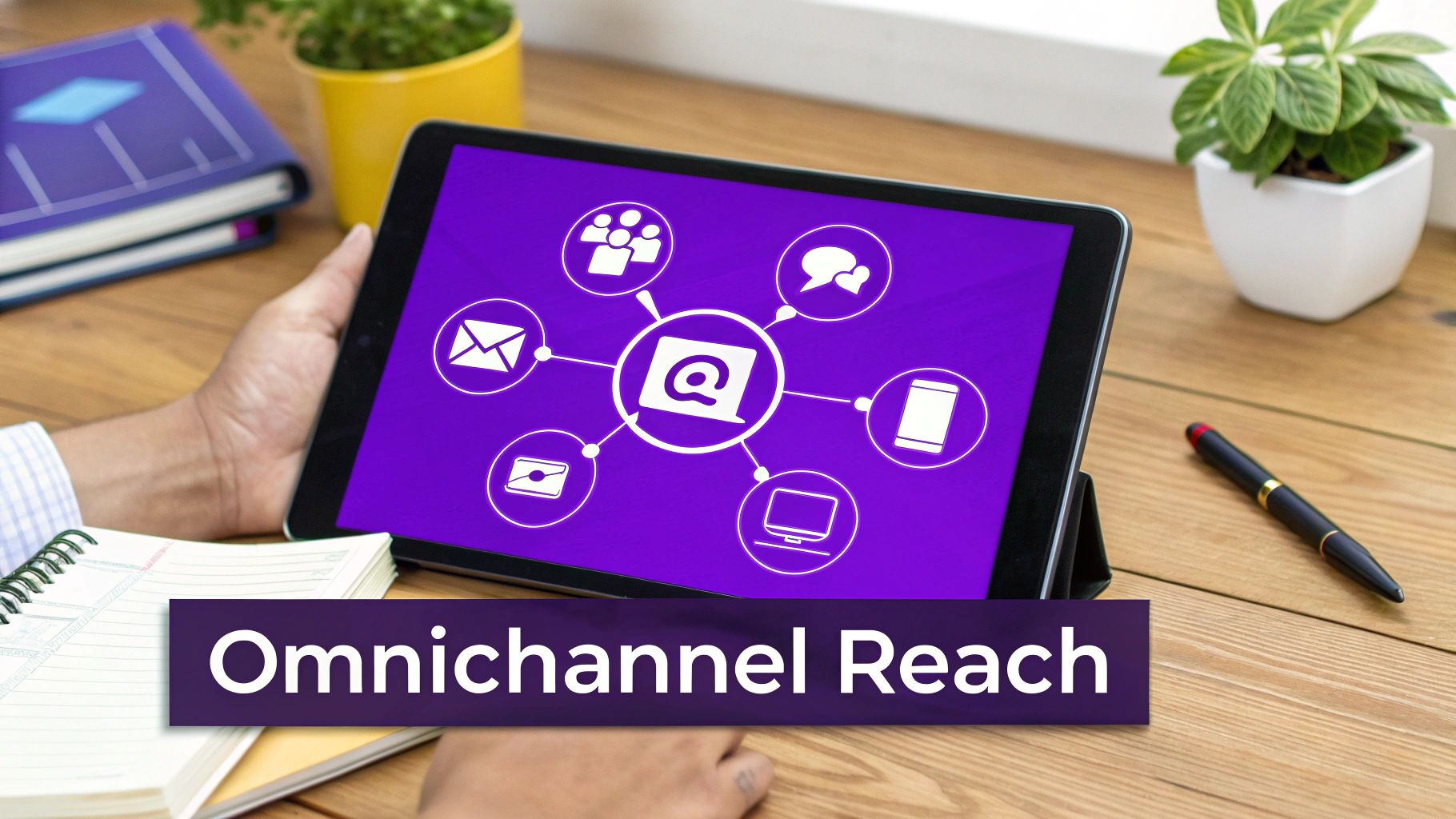
In the B2B world, the lines separating marketing, sales, and distribution have pretty much vanished. It’s all just one continuous customer conversation now. Your website, your social media accounts, your latest whitepaper—these aren’t just promotional tools anymore. They are your distribution channels.
This shift forces us to rethink what 'Place' in the marketing mix even means. It’s no longer about physical locations; it’s about being present at every digital touchpoint where a buyer might interact with your brand.
The modern B2B buying journey is anything but linear. A prospect might see a LinkedIn post, click through to your pricing page, jump over to a third-party review site, and then finally book a demo. A smart marketing mix distribution strategy has to be built for this messy reality, creating a single, seamless experience everywhere. This is the heart of an omnichannel approach.
The Rise of the Omnichannel B2B Buyer
Going omnichannel isn't just about showing up on multiple platforms. It's about weaving them together so the customer’s experience feels consistent and effortless, no matter how they engage. Think of it like a conversation you can pause on your phone and pick right back up on your laptop without missing a beat. This isn't just a "nice-to-have" anymore; it's what North American buyers expect.
Omnichannel distribution strategies are reshaping B2B marketing in Canada, with 82% of buyers expecting seamless cross-channel experiences and 97% prioritizing fast, simple online interactions. This makes digital integration a core 'place' tactic in the marketing mix.
Recent data shows B2B buyers now use 10 or more channels on average during their journey. A whopping 73% expect suppliers to be active across several platforms. This shift proves that an integrated digital and physical approach is no longer optional for companies that want to win in the US and Canada.
Building a Seamless Omnichannel Experience
To create a true omnichannel experience, you have to tear down the walls between your sales, marketing, and customer service teams. The goal is to present one cohesive brand to the customer at every single turn. And when you’re integrating digital channels, getting your e-commerce fulfilment strategies right is critical to actually reaching customers effectively.
Here are the key pillars for building this out:
- Unified Customer Data: Get all your customer data into one place. Every team needs a complete picture of every interaction, whether it happened over email, on a sales call, or through a website chatbot.
- Consistent Messaging: Make sure your value proposition, branding, and core messages are identical everywhere, from your website copy to your sales decks. No exceptions.
- Cross-Channel Support: Let customers start a support ticket via a chatbot and then continue the conversation over the phone without having to repeat their story.
Success Story: L'Oréal Canada
L'Oréal Canada offers a brilliant example of omnichannel done right. While they're known for B2C, their professional products division—which sells to salons and stylists—is a masterclass in blending B2B channels. They have a seamless online ordering portal for salon owners, which is supported by in-person sales reps who also provide training and product education.
This hybrid model lets them maintain strong personal relationships through their sales team while offering the 24/7 convenience of a digital platform. The data from online orders even tells reps which products are trending, so they can offer smarter advice during their visits. It’s a powerful, sticky ecosystem that keeps salon owners loyal.
This success highlights a critical point: an integrated distribution strategy creates a feedback loop where digital insights make traditional interactions better, and vice versa. By weaving your channels together, you don't just make it easier for customers to buy—you build a smarter, more responsive business.
Is your distribution strategy built for the modern B2B buyer? Contact us to explore how our Fractional CMO services can help you build an integrated omnichannel experience that drives growth.
Measuring and Optimizing Channel Performance
A distribution strategy without measurement is just expensive guesswork. To build a true growth engine, you need to stop having channels and start actively managing them with data. This is where you find out what’s working, what isn’t, and where your best opportunities are hiding.
Without clear metrics, you risk pouring your budget into channels that feel busy but deliver very little real value. A data-driven approach, on the other hand, lets you make smart, strategic bets that directly impact your bottom line. It’s the difference between hoping for growth and actually engineering it.
Essential KPIs for Your Distribution Strategy
To get a real handle on your marketing mix distribution strategy, you have to track more than just top-line revenue. You need metrics that paint a full picture of each channel’s health, efficiency, and profitability.
Key performance indicators to keep an eye on include:
- Channel-Specific Revenue: Don't just look at total sales. Attribute revenue directly back to each channel. Is your direct sales team bringing in more than your top reseller, or is it the other way around?
- Customer Acquisition Cost (CAC) per Channel: This one is critical. Figure out exactly what it costs to land a new customer through each channel. A high-revenue channel might look great on the surface, but it could actually be losing you money if its CAC is through the roof.
- Partner Engagement Score: For your indirect channels, how active are your partners? Track things like deal registrations, training participation, and co-marketing campaigns to see how committed and effective they really are.
- Sales Velocity: How fast does a lead move through the pipeline to become a customer in each channel? A faster sales velocity usually points to a more efficient, well-oiled channel.
Turning Data Into Decisive Action
Gathering data is just step one. The real magic happens when you use that data to make informed choices. Your KPIs should fuel a constant cycle of review and optimization, helping you put your resources where they’ll make the biggest splash.
Businesses that use data analytics to make decisions are 23 times more likely to acquire customers and 19 times more likely to be profitable. This shows just how powerful it is to move from gut feelings to data-backed actions in your distribution plan.
For example, let's say your data shows that a particular value-added reseller in the United States has a low CAC and a high sales velocity. That’s a crystal-clear signal to double down. You could give them more marketing funds, offer dedicated support, or even grant them exclusive access to new product features.
On the flip side, a channel with a soaring CAC and partners who’ve gone quiet might need a serious rethink—or you might have to cut it loose. To go deeper on setting up this kind of measurement, check out our complete guide on digital marketing reporting.
Ultimately, a well-measured distribution strategy gives you a clear roadmap for growth. It shows you which paths are paving the way to profitability and which are just leading to dead ends.
Ready to build a data-driven distribution strategy that delivers clear ROI? Contact us today to see how our Fractional CMO expertise can help you measure, optimize, and scale your channels for maximum impact.
Accelerate Your Strategy with a Fractional CMO
For startups and scale-ups in competitive North American markets, hammering out a sophisticated marketing mix distribution strategy is one thing. Having the senior expertise to actually pull it off is another challenge entirely. This is where strategic leadership becomes a game-changer, especially when resources are tight.
Many growing companies get stuck in this execution gap. They know they need C-level guidance to build scalable channels and align their go-to-market motion, but just can't justify the cost of a full-time executive. This is precisely the problem a Fractional Chief Marketing Officer (CMO) is built to solve.
C-Level Guidance Without the Full-Time Overhead
A Fractional CMO brings the high-level strategic direction needed to build a robust distribution network, all on a flexible, part-time basis. You don't just get another consultant; you get an experienced partner who embeds within your team to drive real results.
This model is especially powerful for navigating those tough, make-or-break decisions, such as:
- Channel Selection: Objectively analyzing which direct, indirect, or hybrid channels will actually deliver the best ROI for your specific business—not just what’s trendy.
- Framework Implementation: Building the measurement systems and KPIs needed to track channel performance and make sharp, data-driven decisions.
- Go-to-Market Alignment: Ensuring your distribution plan works hand-in-glove with your sales, product, and marketing efforts for maximum impact.
The right leadership doesn't just manage tasks; it builds the systems that fuel sustainable growth. A Fractional CMO brings the playbook for scaling distribution that many startups are missing.
In Canada, the shift towards digital distribution has been dramatic. For B2B startups in tech hubs like Kitchener-Waterloo, Ontario, this means leveraging digital channels for efficient reach without massive overhead is non-negotiable. As an experienced Fractional CMO partner, B2Better helps firms integrate these digital channels seamlessly into their place strategy. You can learn more about the rising share of B2B revenue from digital channels in Canada to see just how critical this is.
An expert partner helps you sidestep the common pitfalls and fast-tracks your path from awareness to revenue. By tapping into years of hard-won experience, you can build a distribution machine that not only reaches customers but also carves out a significant competitive advantage.
Ready to build a scalable path to market with expert leadership? Explore our Fractional CMO services to see how we can drive your growth.
Contact us today to discuss how our strategic expertise can accelerate your distribution strategy.
Got Questions About Your Distribution Strategy?
Running a business means you’re constantly thinking about how to get your product into the right hands. When it comes to your marketing mix distribution strategy, a few key questions always seem to pop up for leaders across Canada and the US. Here are the straight answers to the ones we hear most often.
What’s the Most Critical Factor for a B2B Channel?
While a lot of things matter, the one thing you absolutely can’t get wrong is deep alignment with your ideal customer's buying behaviour. It’s that simple. You have to meet your customers where they’re already looking for solutions.
It doesn’t matter if a channel looks great on a spreadsheet. If your target buyers don't use it or, worse, don't trust it, you're just wasting your time and money.
Think about it: a dedicated sales team is a perfect fit for selling complex, high-ticket enterprise software where trust is everything. But it’s complete overkill for a simple, low-cost SaaS tool that people would rather try and buy on their own online. Your first step should always be to understand your customer, not to pick a channel out of a hat.
How Often Should We Review Our Distribution Strategy?
Think of your distribution strategy as a living document, not a stone tablet. You should give it a thorough review at least once a year, but be ready to revisit it any time something major happens.
That could be an internal trigger, like a new product launch, or an external one, like expanding from the US into Canada or seeing a competitor make a big move.
A static distribution plan is a liability. According to recent research, products with five or more positive reviews see a 270% higher purchase rate than those with none. If your current channels aren't generating that kind of social proof, it's time to re-evaluate.
This constant process of checking in and adjusting ensures your channels are always pulling their weight and aligned with where your business is headed. It prevents you from pouring resources into tactics that just don't work anymore.
How Can a Startup Build an Effective Distribution Plan?
For startups, especially those with tight budgets, the mantra should be "less is more." Don't try to be everywhere at once. You'll just spread your resources too thin and make zero impact.
Instead, find one or two channels that give you the best access to your early adopters and absolutely dominate them. Often, this means starting with low-cost direct channels like smart content marketing and a solid e-commerce site. Or, you might find a single, highly motivated channel partner who truly gets what you’re doing and is fired up to sell it.
Dropbox is the classic example here. They skipped the expensive sales teams and went all-in on a viral referral program—a brilliant digital distribution move. This let them build a massive user base with a tiny upfront investment. Focus and surgical execution are everything.
What’s the Biggest Mistake with Indirect Channels?
The number one mistake we see is the "set it and forget it" mindset. Companies get excited, sign up a bunch of partners, hand them a product spec sheet, and then just wait for the sales to pour in. It almost never works.
Building a successful indirect channel is an ongoing commitment. It demands constant engagement, like running co-marketing campaigns, providing regular training, and keeping the lines of communication wide open. You have to treat your partners like an extension of your own team. Their success is your success, and they need just as much support and resources from you to go out there and win.
Building and refining a high-performance marketing mix distribution strategy requires expertise and a data-driven approach. At B2Better, we provide the senior marketing leadership needed to architect the right channels for your B2B business, ensuring a scalable path from awareness to revenue.
Ready to build a distribution network that delivers measurable results? Contact us today to see how our Fractional CMO services can accelerate your growth.