

A modern marketing agency for B2B isn’t just an executor of tasks—they’re a strategic partner responsible for building a predictable sales pipeline. Their entire focus is on aligning marketing efforts with your revenue goals, helping your business achieve measurable growth and a solid ROI in competitive North American markets.
The Modern B2B Growth Challenge
If you're a B2B leader in Canada or the United States, you know the pressure to deliver a predictable sales pipeline is relentless. Yet, so many tech, SaaS, and industrial companies find themselves completely stalled out.
In-house marketing teams are stretched thin, the strategies feel stale, and the results just aren't hitting the revenue targets. It’s a frustrating cycle of endless activity with very little real-world impact.
The heart of the problem lies in just how complex today's B2B buyer's journey has become. It's not a straight line anymore; it's a messy web of digital touchpoints, from a quick Google search to deep dives on LinkedIn and scanning peer reviews. Simply hiring a junior marketer or throwing a few scattered tactics at the wall is no longer enough to build a growth engine that can actually scale.
Why Outdated Approaches Fail
Many B2B companies are stuck because their marketing efforts are all over the place, lacking any real strategic direction. Random acts of content creation and unfocused ad spending burn through the budget fast, all without generating leads that sales can actually use. This leads to some all-too-common pain points for founders and CEOs:
- Inability to prove ROI: It’s almost impossible to connect marketing spend to actual sales closed.
- Overwhelmed internal teams: Small teams can't possibly be experts in everything from SEO to paid media.
- Stagnant lead flow: The pipeline either dries up completely, or the leads that do trickle in are low-quality.
This reality is especially sharp in Canada and the United States, where the shift to digital is happening at lightning speed. The B2B marketing world has been turned upside down, with digital channels now sitting at the very centre of revenue generation. For startups and scale-ups, this means the cost of just keeping up a competitive online presence has skyrocketed, making expert partnerships more essential than ever.
A great example comes from a U.S.-based industrial SaaS company that was really struggling with lead generation. They partnered with a B2B marketing agency and rolled out a targeted content and SEO strategy. Within just 12 months, their organic traffic shot up by 300%, and their marketing-qualified leads grew by 75%, contributing directly to a record-breaking sales year.
This is the kind of outcome a focused marketing agency for B2B can deliver. By moving beyond isolated tasks and building a connected, cohesive system, they transform marketing from a cost centre into a predictable revenue driver. To learn more about building this kind of foundation, check out our guide on creating a B2B digital marketing strategy.
Choosing Your Growth Partner: Full-Service Agency vs. Fractional CMO
So, your B2B company is ready to grow, and you know you need outside marketing expertise to get there. This brings you to a critical fork in the road, one we see leaders in Canada and the U.S. face all the time: do you hire a traditional full-service agency or bring in a Fractional CMO?
Getting this choice right is everything. It’s the difference between buying a list of services and investing in strategic leadership.
A full-service agency often works like a vendor. You give them a list of tasks—run these ads, write those blog posts, manage our social media—and their specialists get it done. They are fantastic at execution, providing the tactical horsepower you need to check things off the list.
A Fractional CMO, however, plays a completely different role. They embed directly into your leadership team. They don’t just execute tasks; they own the entire marketing strategy, the budget, and—most importantly—the results. They are a strategic partner, accountable for making sure marketing drives real business growth.
This flowchart helps map out the decision process when your growth has stalled.
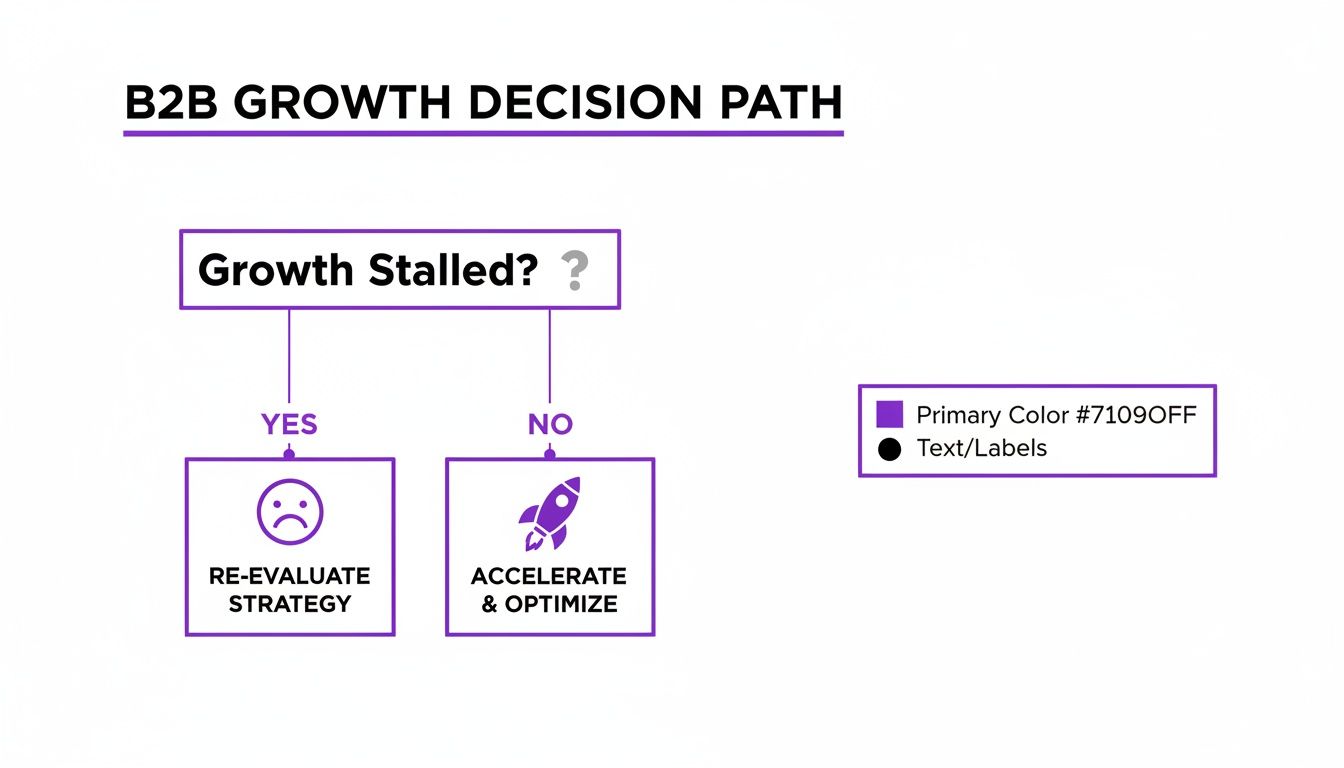
As you can see, hitting a plateau calls for a strategic rethink, not just more activity.
The Architect vs. The Builder Analogy
Here’s an analogy we use a lot: think of building a custom home.
A full-service agency is your crew of skilled builders—the electricians, plumbers, and carpenters. They are masters of their craft, but they work from a blueprint someone else created. They don’t design the house or make sure it fits your family’s needs ten years from now.
A Fractional CMO is the architect. They sit down with you to understand your vision, design the blueprint, choose the right materials, and then oversee the entire construction. Their job is to ensure the final home is exactly what you dreamed of and is built to last. For a CEO, that distinction makes all the difference.
Choosing the right partner model is one of the most significant decisions a B2B founder will make. In fact, a study shows that higher-growth companies in the United States and Canada often spend 40% more on marketing than their slower-growing counterparts, highlighting the impact of strategic investment and leadership.
To help clarify which path is right for you, we’ve put together a quick comparison.
Full-Service Agency vs. Fractional CMO Partner
| Attribute | Full-Service Agency | Fractional CMO Partner |
|---|---|---|
| Primary Role | Tactical execution (a doer) | Strategic leadership (a thinker & leader) |
| Relationship | Vendor | Integrated team member |
| Focus | Completing tasks and projects | Driving business outcomes and revenue |
| Accountability | Delivers on the scope of work | Owns the marketing P&L and results |
| Best For | Companies with a defined strategy needing execution | Companies lacking strategy and leadership |
| Analogy | The builder | The architect |
This table should make the core differences pop. An agency gives you hands; a Fractional CMO gives you a brain and a leader to guide those hands.
When to Hire a Full-Service Agency
A full-service agency is an excellent choice when you already have a solid marketing strategy and a leader in place. You just need more horsepower to get it all done.
This model is your best bet if:
- You have an in-house marketing director who can manage the agency relationship.
- Your needs are project-based, like a website redesign or a specific campaign launch.
- You need specialized skills for a short-term push, like a trade show or product release.
For example, a U.S.-based manufacturing firm with a savvy marketing director might hire an agency to run their Google Ads and LinkedIn campaigns. The director sets the strategy, and the agency executes flawlessly, delivering detailed reports on performance.
When to Partner with a Fractional CMO
A Fractional CMO partnership is the right move when you need C-level strategic thinking but aren't ready for a full-time executive salary.
This model is a perfect fit if:
- You have no cohesive marketing strategy that ties back to revenue.
- Your marketing efforts feel random, producing inconsistent results and no clear ROI.
- You need to build a marketing function from scratch and require senior leadership to do it right.
A great example is a Canadian tech startup that was struggling for traction. By bringing on a Fractional CMO, they built a go-to-market strategy, sharpened their messaging, and created a content engine that started attracting their ideal customers. Within a year, their lead generation shot up by over 200%, setting them up perfectly for their next funding round.
As part of that strategy, a specialized partner like a B2B SEO agency can be crucial, and a Fractional CMO is the one to identify that need and manage the relationship.
Ultimately, the choice comes down to one question: do you need someone to execute a plan, or do you need someone to build the plan and lead the charge? Answering that will point you to the right growth partner for your business.
You can learn more about how we deliver senior-level expertise by exploring our Fractional CMO services.
Core Services a B2B Marketing Agency Must Master
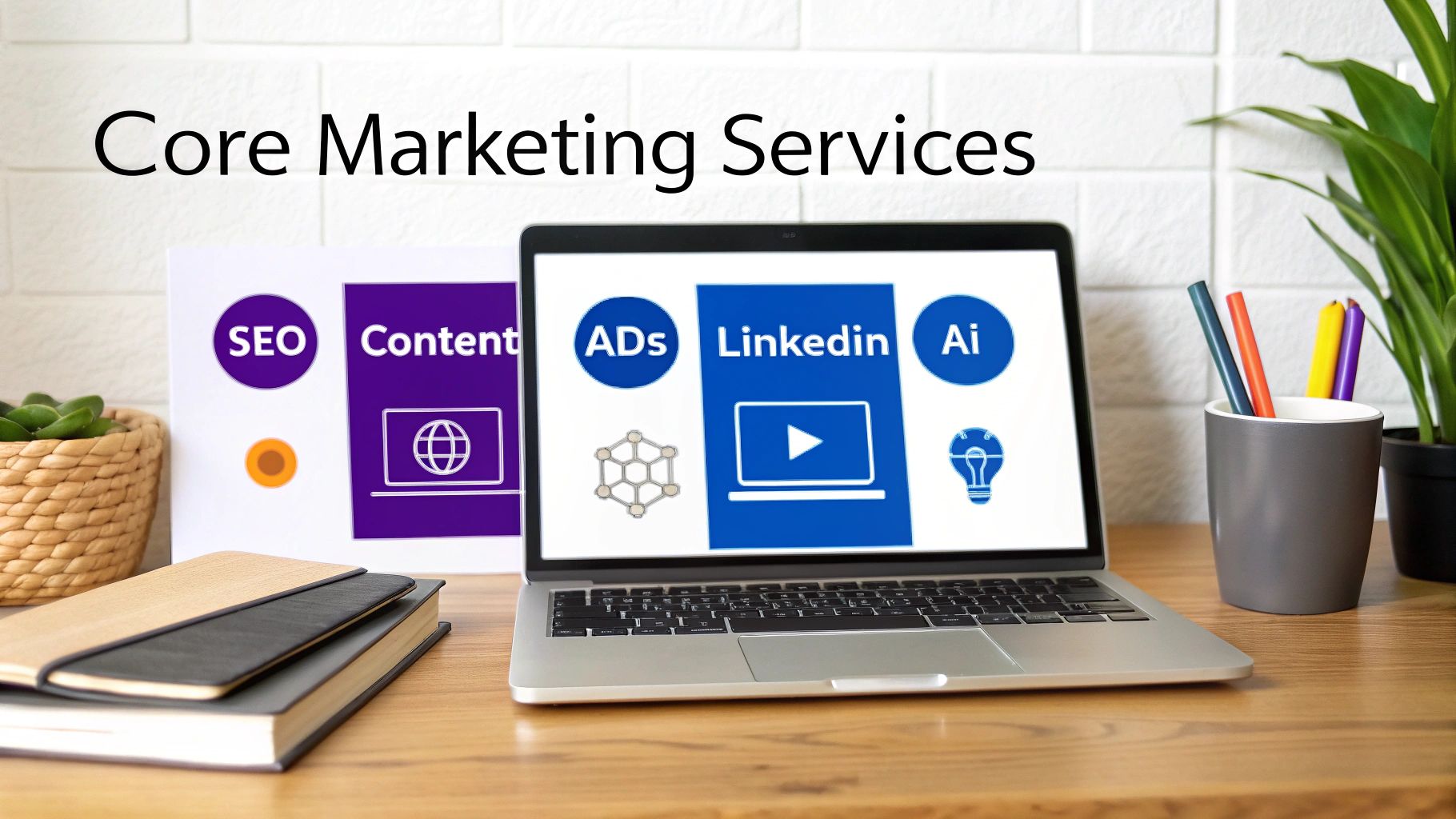
Winning in B2B marketing isn’t about chasing every shiny new trend. It’s about mastering a handful of core disciplines that actually generate measurable results. A proper marketing agency for B2B builds its entire practice on these essential services, all designed to move your business from obscurity to authority—and from simple awareness to real revenue.
Think of these services less as a checklist and more as interconnected parts of a growth engine. Let's break down the non-negotiables you should expect from any potential partner, whether they're in Canada or the United States.
Foundational Marketing Strategy
Before a single ad gets run or one blog post is written, everything has to start with strategy. This is the blueprint for your entire marketing program. Without it, you're just performing random acts of marketing instead of executing a coordinated, revenue-focused plan.
A solid strategy clearly defines:
- Who you're targeting: This means going deep on Ideal Customer Profiles (ICPs) and buyer personas.
- What you're saying: It’s about crafting a value proposition and messaging that hits on your audience's actual pain points.
- Where you'll engage: You need to pinpoint the most effective channels, whether that’s Google, LinkedIn, or niche industry publications.
- How you'll measure success: This involves establishing key performance indicators (KPIs) that directly connect marketing efforts to sales outcomes.
For a B2B tech firm in the U.S., for instance, a strategy might identify that their ideal buyers are CTOs in the finance sector who spend their time on LinkedIn. The plan would then outline content focused on data security and compliance—topics that build immediate trust with that specific audience.
SEO and Content Marketing
Search Engine Optimization (SEO) and content marketing are the long-term pillars of B2B growth. Paid ads can deliver a quick hit of visibility, but a powerful content and SEO engine builds a sustainable asset that generates leads for years to come.
B2B companies that blog consistently generate 67% more leads per month than those that don't. This isn't just about getting more traffic; it's about attracting the right traffic—decision-makers in the United States and Canada actively searching for the solutions you provide.
Imagine a specialty manufacturing company in Canada. A skilled marketing agency for B2B would create in-depth articles, case studies, and technical guides that answer the precise questions their engineering audience is typing into Google. Over time, this content starts to rank, establishing the company as the go-to expert and driving a steady flow of high-quality inbound leads. That’s a level of trust and authority paid ads just can't buy.
SEM and Paid Media
While SEO is building for the future, Search Engine Marketing (SEM) and paid media are all about delivering results now. For any B2B company in a competitive North American market, targeted ad campaigns on platforms like Google Ads and LinkedIn are crucial for capturing immediate demand.
A great agency doesn’t just "set and forget" these campaigns. They are in the weeds, meticulously managing budgets, A/B testing ad copy, and optimizing landing pages to squeeze every possible conversion out of your spend.
Example in Action:
A Toronto-based SaaS startup needs to generate demo requests, fast. Their agency launches a LinkedIn Ads campaign targeting professionals with specific job titles (like "VP of Operations") at companies of a certain size. The ads point to a dedicated landing page with a crystal-clear call to action, turning high-intent prospects into qualified sales opportunities in a matter of weeks. To capture these valuable leads efficiently, a B2B marketing agency often relies on specialized form software for marketing agencies.
Strategic Social Media
Let's be clear: for B2B, social media is not about viral dance videos. It's about professional networking and value-driven engagement. And in this arena, LinkedIn is the undisputed king—an incredible 80% of B2B leads from social media come from the platform, a critical stat for any North American B2B business.
A top-tier agency uses LinkedIn for much more than just posting company updates. They focus on:
- Building executive presence: Helping your leadership team share insights and become recognized thought leaders in your industry.
- Engaging in relevant conversations: Actively participating in industry groups and discussions to build genuine relationships.
- Driving targeted traffic: Promoting high-value content like whitepapers and webinars to a precise professional audience.
Integrating AI for Efficiency
Finally, any modern agency worth its salt must be adept at integrating Artificial Intelligence (AI) tools. AI doesn't replace strategy, but it's a massive accelerator. It can be used to analyze market data for deeper insights, optimize ad campaign bidding, and even help create first drafts of content. This frees up the human strategists to focus on what they do best: high-level thinking and creativity.
By mastering these five core services, a B2B marketing partner can build a comprehensive growth program that delivers both immediate wins and lasting value.
Ready to see how these services can build a predictable revenue engine for your business? Contact us today for a strategic consultation.
How to Evaluate and Select the Right B2B Partner
Choosing a marketing partner is one of the biggest investments you’ll make—a decision that will shape your growth for years. This isn’t about hiring a vendor to tick off tasks; it’s about finding a core partner who will help you drive revenue. For B2B leaders in Canada and the United States, that means looking past the sales pitch and using a clear, practical framework to make the right call.
The stakes are high. A great partner can become a powerful growth engine. The wrong one will burn through your budget with little to show for it. To avoid that painful lesson, you need to assess any potential agency or consultant on a few non-negotiable criteria.
Look for Proven Industry Experience
First and foremost, your partner has to get your world. Generic marketing experience just doesn’t cut it in the complex B2B space, especially in specialized sectors like tech, SaaS, or industrial manufacturing. You need a team that already speaks your language and understands your buyers' biggest headaches.
That specialized knowledge is everything. An agency with deep SaaS experience knows that a free trial conversion rate matters more than social media likes. They get the nuances of a long sales cycle and understand how to build trust with highly technical decision-makers.
One of our clients, a U.S.-based fintech company, is a perfect example. They partnered with an agency that understood the specific compliance and security concerns of financial buyers. Because of that, they were able to craft a content strategy that built immediate authority. The result? A 150% increase in marketing-qualified leads in the first year alone.
Demand a Documented Process and Transparent Reporting
A top-tier marketing agency for B2B doesn’t operate on gut feelings—they run on a proven, documented process. During your evaluation, they should be able to walk you through exactly how they onboard clients, develop strategy, execute campaigns, and report on results.
Ask them directly: "What does your process look like from day one to day ninety?" If they can't give you a clear, confident answer, it's a major red flag. This process is your insurance policy, ensuring nothing falls through the cracks and that everyone is aligned on goals.
Transparency in reporting is just as crucial. You should expect regular, easy-to-understand reports that connect marketing activities directly to business outcomes—not just a spreadsheet of vanity metrics.
The best partners don't just show you clicks and impressions. They report on what truly matters to your business growth: customer acquisition cost (CAC), sales pipeline contribution, and return on investment (ROI).
Assess for True Cultural Alignment
Beyond skills and processes, you're looking for a partner who can operate as a genuine extension of your team. This cultural fit is often the secret ingredient to a successful, long-term relationship. A true partner challenges your assumptions, brings new ideas to the table, and is as invested in your success as you are.
They should feel like a senior leader in your organization, not just an external supplier you have to constantly manage. This alignment fosters the open communication and mutual trust needed to navigate challenges and seize opportunities together.
The Right Questions to Ask a Potential Partner
To cut through the noise and find a partner who is genuinely committed to your goals, you need to ask questions that reveal their strategic thinking and past performance.
Here are a few essential questions to add to your evaluation checklist:
- How do you define and measure success for a client like us? Their answer should be laser-focused on revenue and pipeline, not just marketing activity.
- Walk me through a case study of a company that faced similar challenges. This forces them to provide concrete proof of their capabilities and results.
- What will you need from my team to be successful? This shows they understand that a true partnership is a two-way street.
- How do you handle strategy when a campaign isn't performing as expected? This reveals their problem-solving skills and commitment to continuous improvement.
By asking these questions, you empower yourself to make a decision based on evidence, not just promises. Choosing the right marketing agency for B2B is one of the most important growth decisions you'll make.
Ready to find a partner who understands your vision and is ready to deliver measurable results? Let's talk about how we can help build your growth engine.
Understanding B2B Marketing Costs and Budgeting
So, let's talk about the money. Figuring out the cost is usually the biggest question mark when you're thinking about hiring a marketing agency for B2B. We'll break down the common pricing models you'll see in Canada and the United States, so you can stop seeing it as an expense and start seeing it as an investment in your revenue engine.
Most partnerships fit into a couple of standard structures. Project-based pricing is perfect for one-off jobs, like a website overhaul or a specific campaign launch. You pay a single, fixed fee for a clearly defined scope of work. No surprises, just predictable costs.
Then there's the retainer model, where you pay a fixed monthly fee for a bundle of ongoing services—think SEO, content creation, and paid media management. This is the go-to for long-term strategic partnerships, as it allows the agency to build real momentum and drive consistent results month after month.
The Fractional CMO Engagement
A Fractional CMO engagement is a different beast altogether. It's a unique and highly strategic pricing model where you're not just buying a list of tasks; you're investing in senior-level leadership and accountability. It's typically a monthly retainer that covers strategy, team management, budget oversight, and performance reporting, all for a fraction of what a full-time executive salary would cost.
This model is a game-changer for startups and scale-ups across North America that need that C-level brainpower to build a scalable marketing function from the ground up but aren't ready for the full-time overhead.
Budget Benchmarks and Allocation
Alright, what should you actually expect to invest? While every business is unique, a solid benchmark for B2B companies is to allocate 7–12% of total revenue to marketing. If you're a high-growth tech or SaaS company in the United States or Canada trying to grab market share, you might even push that up to 20%.
But where that money goes is just as critical as how much you spend. A true strategic partner will make sure every dollar is allocated for maximum impact.
Take a U.S.-based industrial tech company we know. They were struggling with scattered ad spend that wasn't getting them anywhere. After bringing in a Fractional CMO, they reallocated their budget to focus on high-intent Google search terms and hyper-targeted LinkedIn campaigns. That one strategic shift led to a 40% reduction in their customer acquisition cost and a 60% spike in qualified leads within six months.
Smart budget allocation is everything. Right now, the average B2B marketing budget directs 42% to search ads and 27% to social advertising, with LinkedIn eating up over 30% of B2B SaaS annual ad spend. For Canadian B2B companies, a winning strategy often means splitting the budget between Google Ads (35–45%), LinkedIn Ads (25–35%), and Microsoft Bing (15–20%). This is exactly why expert guidance is so crucial—optimizing that spend can be the difference between wasted dollars and targeted, measurable growth. You can learn more about how B2B PPC trends impact ROI on The Digital Bloom.
Ultimately, the right marketing agency for B2B will work with you to build a budget that ties directly to your revenue goals, turning your marketing investment into a predictable growth machine.
Ready to build a budget that drives real results? Contact us today to discuss your growth goals.
Measuring Success and True Marketing ROI
So, how do you know if your investment in a marketing agency for B2B is actually paying off? In a world of clicks, likes, and impressions, it’s easy to get lost in vanity metrics that feel good but don’t add a single dollar to your bottom line. Real success isn't about looking busy; it's about the measurable impact on revenue.

This means shifting focus from fuzzy numbers to the key performance indicators (KPIs) that directly track the journey from marketing spend to closed deals. A true strategic partner builds their entire reporting structure around these critical business metrics.
KPIs That Actually Matter
For B2B leaders in Canada and the U.S., three KPIs stand out as non-negotiable for gauging marketing performance. Everything else is secondary.
- Customer Acquisition Cost (CAC): This is the total cost of your marketing and sales efforts to acquire a single new customer. A great partner constantly works to lower your CAC while making sure lead quality stays high.
- Marketing-Qualified Leads (MQLs) to Sales-Qualified Leads (SQLs) Conversion Rate: This number tells you how many of the leads marketing generates are actually good enough for the sales team to pursue. It's a vital health check on lead quality.
- Sales Pipeline Contribution: This tracks the total dollar value of sales opportunities generated directly from marketing. It's the cleanest link between what you spend and what you stand to gain.
When these numbers are moving in the right direction, you know your marketing is working. Top-tier programs often see strategic SEO and content campaigns return $20+ for every $1 invested. Strong B2B programs convert 50–60% of MQLs to SQLs and generate 30–50% of the sales pipeline from marketing efforts. For Canadian B2B leaders, these benchmarks are an essential reference point for evaluating performance. To see more digital marketing benchmarks, read the full analysis on Martal.ca.
A Success Story in Action
Take a North American B2B technology firm that was struggling to connect its marketing spend to actual sales. They brought in a Fractional CMO who immediately shifted their focus away from website traffic and toward pipeline contribution.
By concentrating on a targeted account-based marketing (ABM) strategy and relentlessly optimizing their CAC, they achieved a 300% increase in marketing-generated pipeline within 18 months. Their MQL-to-SQL conversion rate jumped from a dismal 15% to over 55%, proving the power of a strategy built on real ROI. You can get a deeper understanding of this critical metric by reading our article on what marketing ROI is.
This philosophy of driving measurable results is at the core of what we do. We believe marketing must be held accountable to the same revenue goals as every other department in your organization.
This kind of turnaround doesn't happen by accident; it's the direct result of a disciplined, data-driven approach. It’s what happens when you partner with a marketing agency for b2b that obsesses over your business outcomes as much as you do.
Ready to achieve this level of success for your business? Contact us today to build a marketing program that drives real, measurable growth.
Frequently Asked Questions
Deciding to bring on a marketing partner is a big move, and it always sparks a few important questions. For B2B leaders across Canada and the US, getting straight answers is the first step toward making a smart investment in your company’s future.
Here are a few of the most common things we hear from founders, CEOs, and marketing managers as they weigh their options.
How Much Should a B2B Company Budget for Marketing?
Every business is different, but a solid rule of thumb for B2B companies is to set aside 7-12% of your total annual revenue for marketing. If you're a startup in a serious growth sprint, especially in a crowded tech space in the United States or Canada, that number might climb closer to 20% to really grab market share.
A great marketing agency for B2B won't just throw a generic percentage at you. They'll work with you to build a budget that’s tied directly to your revenue goals and growth targets. The whole point is to fund activities that feed your sales pipeline, period.
When Is the Right Time to Hire an Agency?
Honestly, the best time to hire an expert partner is usually when you feel the most stuck. If growth has plateaued, your in-house team is stretched thin, or you just don't have the senior-level strategy to punch above your weight, it’s time to call in reinforcements.
Another clear sign? You're struggling to generate a predictable stream of qualified leads and can't prove the ROI on what you're already spending. That’s a signal that you need a strategic partner to build a system that actually works.
How Long Does It Take to See Results?
The timeline really depends on the strategy we put in place. Some tactics are built for speed, while others are designed for the long haul.
- Short-Term Wins (1-3 Months): Paid media campaigns, like targeted Google Ads or LinkedIn Ads, can start bringing in leads and website traffic within just a few weeks of launch.
- Long-Term Growth (6-12+ Months): Foundational plays like SEO and content marketing are investments. You'll see early signs of life pretty quickly, but they deliver significant, compounding returns in about 6-12 months. Think of it as building a powerful, cost-effective asset that pays you back for years.
A perfect example is a Canadian SaaS company we worked with. They committed to a long-term SEO strategy, and after 12 months, their organic traffic was up by 250%, and their cost-per-lead had plummeted by 70% compared to their paid channels.
It just goes to show how powerful a balanced approach can be—combining quick wins with strategies that build sustainable, long-term growth.
Ready to stop asking questions and start seeing action? At B2Better, we build marketing programs that deliver clear strategy and measurable results. Contact us today to talk about building a predictable revenue engine for your business.