

Law firm SEO is all about making your website visible in search engine results to bring in more clients. It’s the difference between having a simple digital brochure and a powerful, predictable lead-generation engine. For law firms in competitive markets across the United States and Canada, this isn't just a nice-to-have anymore—it’s absolutely essential for sustainable growth.
Why SEO Is Your Most Powerful Client Acquisition Engine
In a world where 96% of people seeking legal advice use a search engine, relying solely on referrals is a huge misstep. Word-of-mouth will always be valuable, of course. But a smart law firm SEO strategy is the single most effective way to connect with a steady stream of high-intent clients who are actively looking for your exact services. This isn't just about getting more traffic; it's about attracting the right kind of traffic.
Think about two firms. One, a practice in Toronto, sticks to the referral network it’s had for decades. The other, a similar firm in Los Angeles, decides to invest in a solid SEO strategy.
While the Toronto firm waits for the phone to ring, the L.A. firm is consistently showing up at the top of Google for searches like "commercial litigation attorney Los Angeles." They are capturing clients at the precise moment of need, building a scalable system for growth that isn't left to chance. This strategic approach is why organic search is now the number one source of leads for law firms, outperforming all other marketing channels.
Moving From Passive to Proactive Marketing
Good SEO shifts your marketing from a passive hope into a proactive strategy. Your website stops being a static online placeholder and becomes an asset that works for you 24/7.
Here’s what that strategic approach really delivers:
- Tangible Authority: When you rank for key legal topics, you establish your firm as a credible expert. That builds trust before a potential client even picks up the phone.
- Predictable Lead Flow: SEO creates a reliable pipeline of inquiries, which helps smooth out the unpredictable peaks and valleys that come with referral-based business.
- Measurable ROI: Unlike a print ad, every single aspect of an SEO campaign can be tracked. You get a crystal-clear picture of the return on your marketing investment.
This visual below really highlights how client acquisition has evolved, moving from older methods to a digitally-driven approach that puts you in control.
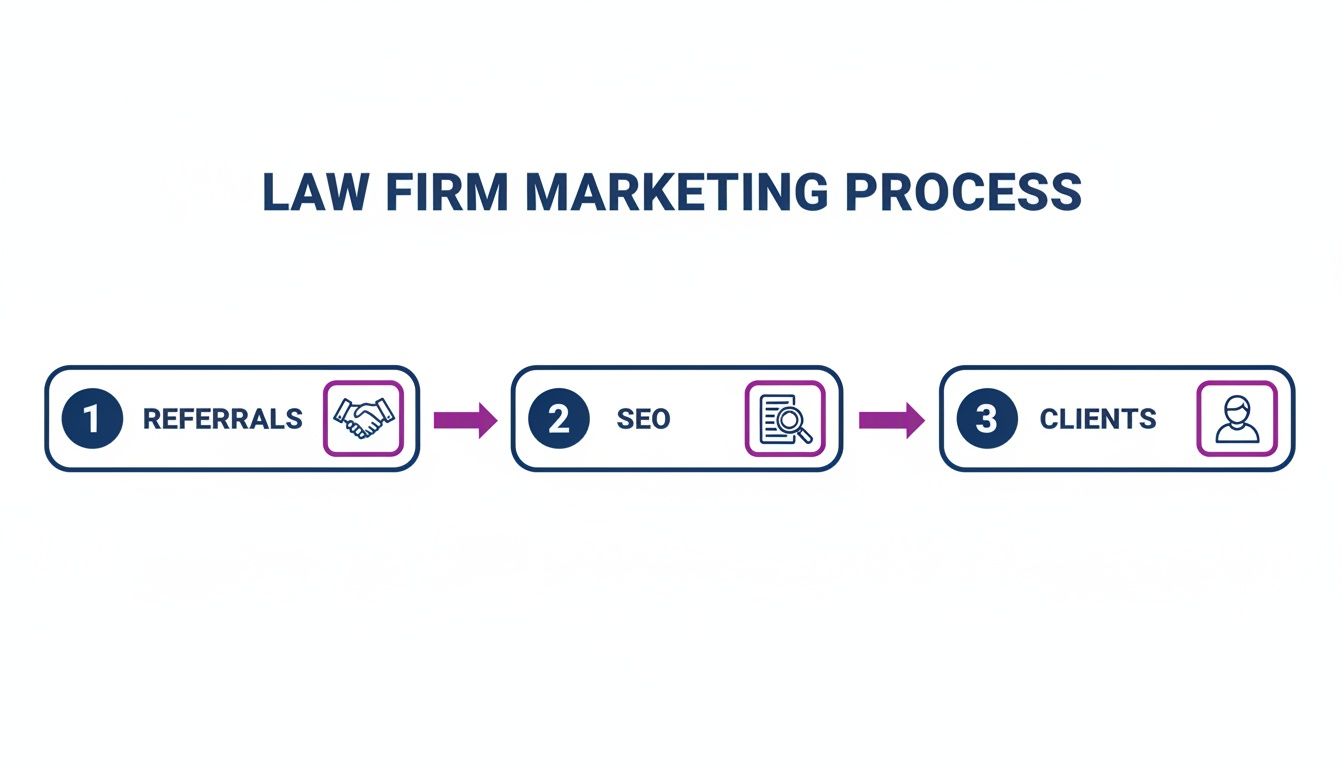
The key takeaway is that while referrals are great, SEO actively intercepts clients while they're searching. This creates brand-new opportunities instead of just recycling existing networks. You can dive deeper into the nuts and bolts in our guide on how to improve SEO.
The Bottom-Line Impact of Digital Visibility
Let's look at a real-world example of great success. One California firm went from getting almost zero web traffic to generating over 1,100 qualified leads per month after launching a targeted SEO campaign. This wasn't magic. It was the direct result of understanding what potential clients were searching for and strategically positioning the firm to be the answer.
To really make this kind of digital growth happen, many firms find they need to staff up their efforts, sometimes by hiring marketing assistants to handle the day-to-day execution. The message is clear: investing in your firm's digital presence is a direct investment in its future profitability.
Ready to turn your website into a client acquisition powerhouse? Contact us today to discuss a strategy that delivers measurable results.
Auditing Your Digital Footprint to Find Opportunities
Before you can build a client-generating machine, you need a blueprint of your current digital presence. An effective law firm SEO strategy always starts with a thorough audit, uncovering the foundational issues and hidden opportunities that will shape every move you make. It’s all about establishing a clear baseline so you can measure progress and put your energy where it’ll have the biggest impact.
Too many firms jump straight into creating content without checking if their website's technical health is sabotaging their efforts from the get-go. It’s like trying to build a beautiful house on a crumbling foundation; no matter how stunning the design, the whole thing is doomed. A proper audit gives you the roadmap to build a strategy that actually lasts.
Performing a Technical SEO Health Check
Your website's technical performance is a huge, yet often overlooked, ranking factor. Google prioritizes sites that offer a smooth, fast, and secure experience for users. If your site is slow or a pain to use—especially on a phone—potential clients will bounce, and search engines will absolutely take note.
Start by digging into these core technical elements:
- Page Speed: How quickly do your pages load? A delay of even a few seconds can send your bounce rate through the roof. Tools like Google's PageSpeed Insights can pinpoint exactly what's slowing you down.
- Mobile Usability: With most searches in the US and Canada happening on smartphones, your site has to be flawless on mobile. Are the buttons easy to tap? Is the text readable without pinching and zooming? Google's Mobile-Friendly Test will give you the straight answer.
- Crawlability: Can search engine bots easily find and understand all the important pages on your site? You need to hunt for broken links (404 errors) or incorrect "noindex" tags that might be blocking pages from ever showing up in search results.
A technical audit isn't a one-and-done task. Think of it as a regular health check-up for your firm's most important digital asset. Small fixes here can lead to surprisingly big gains in visibility down the line.
Uncovering High-Intent Keywords for Your Practice
Once your technical house is in order, it's time for keyword research. This isn't about guessing what clients search for; it's about using data to understand their exact language and, more importantly, their intent. The goal is to get way beyond broad, hyper-competitive terms like "lawyer" and lock onto specific phrases that signal someone is ready to pick up the phone.
The real gold is in long-tail keywords. These are the longer, more specific search queries that might have lower search volume but carry a much higher conversion rate.
For example, a potential client in Canada or the United States isn't just searching for "lawyer." They're typing in things like:
- "Wrongful dismissal lawyer Calgary"
- "Commercial real estate lawyer Miami"
- "How to file for divorce in Ontario"
These specific searches show clear, immediate needs. Tools like Ahrefs and AnswerThePublic are brilliant for uncovering these gems, showing you the exact questions and problems your target audience is trying to solve.
The impact of this targeted approach is massive. Just look at Cali Lemon Lawyers. This is a great success story: the firm went from almost zero traffic to 54,700 monthly visitors and 1,100 leads by 2023 after rolling out an advanced keyword research campaign. In a market like California, where 70% of digital traffic comes from organic and local search, ignoring this is like leaving your firm's front door wide open for competitors. You can dig into more detailed lawyer statistics on how SEO drives growth.
By running a thorough audit of your technical SEO and keyword landscape, you lay the essential groundwork for a strategy that doesn’t just attract traffic—it attracts the right clients.
Ready to uncover the hidden opportunities in your digital footprint? Contact us to schedule a comprehensive SEO audit for your law firm today.
Dominating Local Search and Google Business Profile
For most law firms, the real fight for new clients is won and lost right here in your local market. While a big digital footprint is nice, your most important law firm SEO efforts need to be laser-focused on local search. This is where people in American and Canadian cities turn when they have an urgent legal need, and your visibility here is what drives phone calls and books consultations.
At the very centre of this strategy is your Google Business Profile (GBP). It’s so much more than just a business listing; it’s your firm’s digital front door. For many potential clients, an optimized GBP will be their first and only interaction with your practice.
When a staggering 70% of digital traffic for law firms comes from local and organic searches, getting your GBP right isn't just a good idea—it's non-negotiable.

Your Playbook for Google Business Profile Success
Optimizing your GBP isn't just about filling in boxes. It’s about creating a compelling, trustworthy snapshot of your firm that Google feels confident showing to people in need.
Here’s your immediate action plan:
- Get Specific with Service Categories: Don't just list "Lawyer." Dig deeper. Choose the most precise categories available, like "Family Law Attorney," "Personal Injury Attorney," or "Corporate Lawyer." This simple step helps Google connect you with much more relevant, high-intent searches.
- Write a Compelling Business Description: Max out the character count to explain what your firm does, who you help, and what sets you apart. Weave in local keywords naturally, like "divorce lawyer in Vancouver" or "business litigation in Chicago," to signal your local expertise.
- Lock Down Your NAP: Your firm's Name, Address, and Phone number (NAP) must be identical everywhere online—your website, GBP, and every other directory. Even a tiny mismatch, like using "St." in one place and "Street" in another, confuses search engines and hurts your ranking.
An incomplete or inaccurate Google Business Profile is a massive missed opportunity. It’s the digital equivalent of having a broken sign in front of your office—it signals a lack of care and undermines trust before a client even picks up the phone.
Building Trust Through Reviews and Engagement
In the legal world, social proof is everything. Your GBP is the main stage for client feedback, so managing it actively is critical. Make it a habit to ask satisfied clients for reviews. This not only builds a bank of positive sentiment but also shows Google your business is active and engaged.
Responding to every single review—good and bad—is just as important. A thoughtful reply to a positive review shows you’re grateful. A professional, calm response to a negative one demonstrates your commitment to client satisfaction. Often, how you handle criticism publicly is more persuasive than the original review itself.
Expanding Your Local SEO Reach
Beyond your GBP, a solid local strategy means creating a consistent digital footprint. A big part of this is building local citations—getting your firm's NAP mentioned on other reputable websites and directories. Think of legal-specific directories like Avvo, your local chamber of commerce site, and industry association pages. Each consistent citation is another vote of confidence for your firm's location and practice areas.
You should also create geo-targeted landing pages on your website. For example, if you're a family law practice in Toronto but also serve clients in Mississauga and Brampton, build out dedicated pages for each city. These pages should feature locally-focused content, testimonials from clients in that specific area, and case information relevant to that jurisdiction. For a deeper dive, check out this comprehensive guide to local SEO.
This kind of multi-pronged local approach really works. Properly optimizing your Google Business Profile is a foundational step, and we've seen it lift local visits by a remarkable 70%. You can see how we do it in this ultimate Google My Business optimization checklist. In a hyper-competitive market like California, which has nearly 200,000 attorneys, this localized strategy isn't just a nice-to-have; it's absolutely essential for survival.
Here's a prioritized checklist to help you get started on the most critical local SEO actions for your law firm.
Essential Local SEO Checklist for Law Firms
| Action Item | Impact on Ranking | Implementation Priority |
|---|---|---|
| Complete and verify Google Business Profile | High | Immediate |
| Select specific primary and secondary categories | High | Immediate |
| Ensure NAP consistency across all directories | High | Immediate |
| Generate a steady stream of positive client reviews | High | Ongoing |
| Respond to all reviews (positive and negative) | Medium | Ongoing |
| Build citations in legal and local directories | Medium | High |
| Create geo-targeted landing pages for each service area | Medium | High |
| Upload high-quality, geotagged photos to GBP | Medium | Medium |
| Utilize Google Posts and Q&A features regularly | Low | Medium |
Getting these fundamental pieces right will put you miles ahead of competitors who treat local SEO as an afterthought. It’s a continuous effort, but the return—more calls, more clients, and a stronger local reputation—is well worth it. Don't let your competitors get ahead. Contact us to start optimizing your local presence today.
Creating Content That Builds Authority and Earns Links
Great rankings don't just happen. They’re built on a solid foundation of expert content and authoritative backlinks. For any modern law firm SEO strategy, these two elements are completely intertwined—you simply can't have one without the other.
Think of your content as the asset. The links are the endorsements telling Google that your asset is trustworthy and valuable. It’s a powerful combination that’s essential for climbing the search results.
The goal here is to get far away from those generic, 500-word blog posts that barely scratch the surface of a topic. Instead, you need to create comprehensive resources that genuinely answer the most urgent questions your potential clients are asking. This is how you build true authority and become the go-to resource in your specific practice area and city.
Moving Beyond the Basic Blog Post
Your website's core practice area pages are your most valuable content assets, hands down. These pages need to be much more than simple service descriptions. They should be definitive guides that walk a potential client through their legal issue from start to finish, showcasing your firm's deep expertise.
For instance, a personal injury firm in Vancouver shouldn't settle for a page just titled "ICBC Claims." That's thinking too small. They should create a comprehensive resource, something like, "The Ultimate Guide to the ICBC Claim Process in British Columbia."
A guide like this could include:
- A step-by-step timeline of the entire claim process.
- Common mistakes people make that could jeopardize a claim.
- Detailed explanations of key legal terms like "no-fault benefits" and "tort claims."
- A solid FAQ section that addresses the specific questions you hear from clients every single day.
This type of in-depth content directly targets the phrases people are actually searching for when they need help. It immediately positions your firm as the clear expert. It’s not just about attracting traffic; it's about attracting the right traffic and building trust from the very first click.
The Power of Link Building for Law Firms
Once you've created this kind of high-value content, you can start the crucial process of link building. Backlinks are essentially votes of confidence from other websites. When a reputable site links to your content, it sends a powerful signal to Google that your firm is a credible authority on the subject.
The key is to focus on quality over quantity. A single link from a respected legal association is worth more than a hundred links from low-quality, spammy directories.
Building a strong backlink profile is one of the most challenging but highest-impact activities in SEO. It requires a proactive, strategic outreach effort, not a passive "build it and they will come" approach.
Start by identifying potential link opportunities from relevant sources in Canada and the United States:
- Legal Associations: Think bar associations or specialty practice groups.
- Local News Outlets: Offer your expert commentary on a local legal story.
- Industry Publications: Write a guest article for a journal relevant to your niche.
- Educational Institutions: Law school blogs or alumni resource pages are great targets.
Each high-quality backlink you earn not only sends valuable referral traffic but also boosts the authority of your entire website, lifting the rankings for all your important pages.
A Case Study in Explosive Growth
When you combine targeted content with strategic link building, the results can be incredible. This is a great example of success. In the fiercely competitive California legal market, one lemon law firm saw its Google organic traffic explode from just 240 visitors per month in 2021 to an astounding 54,700 per month by 2023.
How did they do it? Through a focused content strategy that included 30 geographically targeted landing pages and 39 manufacturer-specific pages, all supported by smart link-building efforts. The outcome was over 1,100 qualified leads every single month from organic search alone. You can read the full case study on this remarkable lawyer SEO success.
This example perfectly illustrates how creating specific, genuinely helpful content that targets precise user needs is the key to unlocking massive growth. By creating pages that answered very specific questions, they were able to completely dominate a valuable niche.
This process of creating cornerstone content and earning authoritative links is a long-term investment. But it’s the most sustainable way to build a dominant online presence that consistently attracts high-value clients for years to come.
Are you ready to build the content and authority needed to dominate your market? Contact us today to discuss a content and link-building strategy for your firm.
Turning Website Traffic into High-Value Clients
Getting visitors to your law firm's website is a huge win, but it's only half the battle. Traffic is just a means to an end; the real goal is turning those clicks into signed retainers. This is the critical stage where all your SEO efforts finally translate into revenue.
Too many firms get caught up in vanity metrics—like total website visits—that look impressive on a report but don't actually move the needle on business growth. The key is to shift your focus from "how many people visited?" to "how many qualified clients did we sign?"

Tracking What Actually Drives Revenue
To measure the real return on your SEO investment, you have to be brutally honest about which metrics matter. This means prioritizing data that connects directly to your firm's bottom line and ignoring the numbers that just stroke the ego.
Here’s where you should focus your attention:
- Organic Lead Volume: This is the raw count of phone calls, contact form submissions, and consultation requests coming directly from organic search. It’s the clearest sign that your SEO is attracting people who genuinely need your help.
- Keyword Rankings for "Money" Terms: Keep a close eye on your position for high-intent keywords like "personal injury lawyer in Houston" or "business litigation Toronto." Ranking well for these phrases is directly tied to lead generation.
- Client Acquisition Cost (CAC) from Organic Search: You need to know exactly how much you're spending on SEO to land a single new client. This powerful metric lets you compare SEO's efficiency against other channels like paid ads.
Focusing on these KPIs gives you a clear, actionable picture of your marketing performance. It helps you make smarter decisions and continuously sharpen your strategy for better results.
Key SEO Metrics vs. Vanity Metrics for Law Firms
It’s easy to get distracted by flashy numbers that don’t contribute to your firm’s growth. This table breaks down the metrics that truly matter (your KPIs) versus the vanity metrics that often lead marketing efforts astray.
| Metric to Track (KPI) | Why It Matters | Vanity Metric to Avoid |
|---|---|---|
| Organic Lead Volume | Directly measures how many potential clients your SEO efforts are generating. | Total Website Traffic |
| Conversion Rate | Shows the percentage of visitors who take a desired action (e.g., call or fill out a form). | Page Views |
| Keyword Rankings (High-Intent) | Tracks visibility for terms that signal a user is ready to hire an attorney. | Total Number of Keywords Ranked |
| Client Acquisition Cost (CAC) | Calculates the direct ROI of your SEO by tying investment to new business. | Time on Page |
| Bounce Rate on Key Pages | Indicates if your landing pages are effectively engaging users or causing them to leave. | Social Media Likes/Followers |
By focusing on the left column, you ensure your SEO strategy is always aligned with what grows the firm: acquiring new, profitable clients.
Optimizing Your Website for Conversions
Once you're tracking the right metrics, the next step is to actively improve them through Conversion Rate Optimization (CRO). CRO is all about making strategic tweaks to your website that make it easier and more compelling for visitors to contact you.
A beautifully designed website that confuses visitors or hides contact information is failing at its primary job. Every element should guide a potential client toward taking the next step.
For law firms in Canada and the United States, this means creating a frictionless path from the moment someone lands on your site to the moment they book a consultation. A firm that nails this process can see a huge spike in leads without needing a single extra visitor. For example, we've seen firms increase calls by 20% or more just by moving their phone number to a more prominent position.
Start with these high-impact CRO tactics:
- Place Clear Calls-to-Action (CTAs): Use direct, action-oriented language on your buttons and links. Phrases like "Book Your Free Consultation" or "Call Us Now for a Case Review" leave no doubt about what the user should do next.
- Ensure a Seamless Mobile Experience: With over 60% of legal searches now happening on mobile devices, your site has to be flawless on a smartphone. Forms should be a breeze to fill out, and phone numbers must be "click-to-call."
- Leverage Social Proof: Strategically display case results, client testimonials, and awards. This builds immediate trust and credibility, showing potential clients you have a proven track record of success.
By systematically applying these CRO principles, you transform your website from a passive brochure into an active client-generation machine. Our expertise in full-funnel marketing extends to these crucial final steps; you can learn more about our approach in our guide on website optimization services.
A successful law firm SEO program doesn't stop at traffic—it follows through all the way to conversion. By focusing on the right KPIs and continuously optimizing your site for action, you can build a reliable, revenue-driving engine for your practice.
Ready to turn your website traffic into a predictable stream of high-value clients? Contact us today, and let's build a strategy that delivers measurable growth for your firm.
Your Law Firm SEO Questions, Answered
Even with a solid plan, stepping into the world of SEO for your law firm can feel like navigating uncharted territory. We get it. Over the years, we’ve heard the same pressing questions from managing partners and marketing leaders across Canada and the US. Here are the straight answers to help you move forward.
How Long Does SEO Take to Show Real Results?
This is the big one, and the honest-to-goodness answer is: it’s not an overnight fix. You should expect to see meaningful traction within four to six months. It’s a marathon, not a sprint.
Of course, factors like how competitive your legal market is, your website’s current authority, and how aggressively you pursue your strategy will all play a role. You’ll likely see some early signs of life—like better rankings for less competitive keywords—within the first three months.
But the real impact, the kind that drives qualified leads and affects your bottom line, comes as you build authority over time. Think of it like building your firm's reputation in the community; it requires consistent, high-quality effort.
Is SEO a Better Investment Than Paid Ads?
SEO and paid ads (like Google Ads) are different tools for different jobs, but for long-term, sustainable growth, SEO almost always delivers a better return on your investment.
Paid ads get you immediate visibility. You pay, and—poof!—your firm is at the top of the search results. The second you stop paying, that visibility evaporates. It's like renting a billboard; the traffic stops when the cheque does.
SEO, on the other hand, is about building a lasting asset. By creating valuable content and earning authority, you build an online presence that keeps generating organic traffic long after you’ve made the initial investment. The cost per lead from SEO typically drops over time, while with paid ads, it stays flat or even creeps up. A 2023 report backed this up, confirming Google organic search was the top lead source for law firms.
SEO builds compounding value. Each piece of content and every backlink you earn continues to work for your firm for years, creating a powerful and cost-effective client acquisition engine.
Do We Really Need a Blog for Our Law Firm Website?
While you could do SEO without one, a blog is one of the most powerful tools in your entire arsenal. We strongly recommend it. A regularly updated blog is your firm’s secret weapon to:
- Target Long-Tail Keywords: You can create articles that answer the incredibly specific questions potential clients are typing into Google, like "how is spousal support calculated in Ontario?" This is how you attract high-intent traffic.
- Demonstrate Your Expertise: Every post reinforces your firm's authority in its practice areas. This builds trust with potential clients and signals to search engines that you’re the real deal.
- Create Linkable Assets: A well-researched article or guide is exactly the kind of content that earns backlinks from other reputable websites—a critical factor for boosting your site’s overall authority.
What Is a Realistic Budget for Law Firm SEO?
SEO costs can vary quite a bit, but if you’re in a competitive market like a major North American city, a realistic monthly investment for a comprehensive strategy typically falls between $3,000 to $10,000+.
That investment covers the workhorses of a successful campaign: technical SEO, content creation, link building, and local optimization.
Need proof it works? Look at the California lemon law firm that went from basically zero traffic to over 54,700 monthly visitors and 1,100 qualified leads a month. That didn't happen by accident. It was the direct result of a sustained and properly funded SEO campaign. Investing in a robust law firm SEO program isn't an expense—it's a direct investment in a predictable client acquisition channel.
Ready to stop guessing and start growing? At B2Better, we build practical, results-driven SEO strategies that turn your website into your most valuable business development tool. Contact us today to schedule your consultation.