

Getting more website traffic isn’t about luck. It’s about building a deliberate, data-driven system that consistently pulls in your ideal buyers. This means getting real about your current performance, building a strong SEO foundation, and creating content that genuinely solves problems for your target audience in key markets like Canada and the United States.
Pinpoint Your Traffic Opportunities with a Data Audit

Before you can map out a plan to get more traffic, you have to know where you’re starting from. Jumping straight into tactics without a clear picture is like starting a road trip without a map—you’ll be moving, sure, but probably in the wrong direction. A diagnostic audit is the essential first step, giving you a growth plan based on evidence, not assumptions.
This process isn’t about getting lost in vanity metrics. For B2B tech companies, especially those in competitive Canadian hubs like Kitchener-Waterloo or major US tech centres, the goal is to uncover actionable insights that lead directly to qualified leads and, ultimately, revenue.
Start with the Right Tools and Questions
Your journey starts with tools like Google Analytics 4 (GA4) and Ahrefs. These platforms hold the raw data you need to find those hidden gems. But instead of just glancing at overall page views, you need to dig deeper by asking the right questions.
- Where does our best traffic come from? Check your traffic acquisition reports. See which channels—Organic Search, Direct, Referral, Paid Social—are delivering not just visitors, but engaged users who actually convert.
- Which content is really driving business? Pinpoint the top-performing pages and blog posts that are contributing to lead generation. Is it your case studies? Your technical guides? Your main service pages?
- Who is our audience and what do they actually care about? Look at the demographic and geographic data. Are you successfully reaching decision-makers in Canada and the United States?
- Where are the critical drop-off points? Find the pages with high exit rates. These are the weak links in your user journey that need fixing.
This initial analysis becomes the baseline for every single decision you make from here on out. For a deeper look at what to track, check out our complete guide to digital marketing reporting.
Uncovering the "Why" Behind the Numbers
Data tells you what is happening, but the real goal is to understand why. A B2B web design company, for example, might find out that a single blog post about "Integrating HubSpot with Shopify" is driving 30% of their qualified leads from the United States, despite having only modest traffic. That’s a massive success signal.
Success Story: By implementing a focused content strategy, Backlinko grew its organic traffic by 261.3% in one year, demonstrating how a data-driven audit can uncover topics that resonate powerfully with a target audience in competitive markets like the US.
This is the power of a proper audit. For the design company, the win isn't just about that one blog post; it's about the topic, the audience's intent, and the format. The audit reveals their ideal customers in the US and Canada are searching for specific, technical integration solutions. That insight is pure gold.
Your audit should end with a prioritized action plan. Instead of a fuzzy goal like "increase traffic," you'll have specific, data-backed objectives.
- Objective: Increase organic traffic from Canadian tech founders.
- Action: Create a content cluster around "SaaS startup challenges in Canada," using the same structure as our most successful posts.
This evidence-based approach takes the guesswork out of the equation and puts your resources where they’ll have the highest impact. If you're ready to stop guessing and start building a predictable traffic engine, contact us to discuss a diagnostic audit for your website.
Build an Unshakeable SEO Foundation

Real, long-term traffic growth doesn't come from viral gimmicks or chasing fleeting trends. It's built methodically, brick by brick, on a solid SEO foundation. For B2B companies trying to cut through the noise in competitive North American markets, this means getting the fundamentals right: technical health, on-page relevance, and content that search engines see as authoritative.
Sure, quick hacks might give you a temporary spike, but they won't deliver the predictable, high-quality traffic you need to fill your sales pipeline. Building this foundation is a deliberate process, an investment that pays dividends for years to come. It’s how you turn your website into your most powerful lead-generation asset.
Master the Technical Essentials
Before you even think about writing a new blog post, you have to make sure your website is technically sound. Search engine crawlers need to find, understand, and index your pages without any friction. If they can't, it creates a bottleneck that will choke your traffic potential, no matter how brilliant your content is.
There are a few key areas that demand your immediate attention:
- Site Speed: A slow site is a conversion killer. Google research shows that as page load time goes from 1 to 3 seconds, the probability of a bounce increases by 32%. For busy B2B buyers in Canada and the US, a fast, snappy experience isn't a luxury; it's a basic expectation.
- Mobile-First Indexing: This is non-negotiable. Google primarily uses the mobile version of your site for indexing and ranking. If your mobile experience is an afterthought, your rankings will suffer.
- Schema Markup: This structured data helps search engines understand the context of your content. According to one study, pages with schema markup can achieve up to 30% higher click-through rates in search results.
Getting this technical groundwork right is the bedrock of your SEO. It ensures nothing stands in the way of your content getting the visibility it deserves. For a deeper look at these components, you can explore our SEO services for Canadian businesses.
Prioritize a Flawless Mobile Experience
In a competitive tech hub like Kitchener-Waterloo, and really across Canada and the United States, the numbers don't lie. According to Statista, over 60% of organic search traffic in the US now comes from mobile devices. Businesses that drop the ball on mobile optimization are essentially turning away the majority of their audience.
With 93% of B2B buying processes starting with an online search, a mobile-first approach is absolutely critical for being seen by decision-makers in Canada and the United States.
Success Story: After optimizing their site for mobile and improving page speed, the team at luxury car brand Genesis saw a 50% increase in leads and a 60% decrease in bounce rate, proving that a superior technical experience directly translates to business results.
Optimize Your Core Pages for Buyer Intent
Once your technical house is in order, it’s time to shift focus to on-page SEO. This is all about aligning your core service pages and blog posts with the specific problems your ideal customers are trying to solve. It’s about speaking their language and answering their questions before they even have to ask.
Start with your most important pages—the ones that spell out what you do and who you do it for. Every headline, subheading, and paragraph needs to be crafted around the keywords and phrases your target audience in the United States and Canada would actually type into a search bar.
And think beyond single keywords. A SaaS company doesn’t just want to rank for "project management software." They want to hit terms like "project management software for remote construction teams in the USA" or "how to improve manufacturing efficiency with Canadian-made software." That level of specificity attracts higher-quality traffic that is far more likely to convert into a real lead.
This alignment transforms your website from a static brochure into a powerful magnet for qualified prospects. To really get this right, I recommend diving into this practical guide to getting organic traffic. For expert help building your SEO foundation, contact our team today.
Create Content Your Ideal Buyers Actually Want
A solid technical foundation gets you in the game, but it’s exceptional content that ultimately wins it. Generic articles pull in lukewarm, low-quality traffic that almost never converts. To consistently attract decision-makers from B2B companies across Canada and the United States, your content has to be a direct answer to their most pressing challenges.
This isn’t about chasing page views for the sake of it. The real goal is to build a strategic library of assets that pulls your ideal buyers through their decision-making process, from recognizing they have a problem to choosing you as the solution. This is how you improve website traffic in a way that actually fuels your sales pipeline.

Map Content to the Buyer’s Journey
Every single piece of content you create needs to have a job. To make sure it does that job well, you have to align it with one of three key stages in the buyer’s journey. This simple discipline ensures you’re meeting prospects where they are with information they genuinely need.
- Awareness Stage: The buyer is feeling the pain of a problem but hasn’t put a name to it yet. Your content here should be educational and diagnostic, helping them define their challenge. Think blog posts, original research reports, and eBooks.
- Consideration Stage: The buyer has defined their problem and is now actively researching potential solutions. This is where you introduce your company as a credible option with solution guides, webinars, and comparison whitepapers.
- Decision Stage: The buyer is ready to pick a provider. Your content has to build trust and prove your value with case studies, free trials, product demos, and detailed implementation guides.
This structured approach transforms your blog from a collection of random thoughts into a predictable lead-generation machine.
Create Content for Specific North American B2B Personas
Let’s get practical for a moment. Imagine a SaaS company based in Kitchener-Waterloo targeting VP-level manufacturing managers in the American Midwest. Generic content about "efficiency" is just noise. They need content that speaks directly to that persona’s world.
Awareness Stage Example
An article titled, “5 Hidden Production Bottlenecks Costing US Manufacturers Millions,” hits a nerve. It educates the VP without a hard sell, building trust right from the first interaction.
Consideration Stage Example
Now, a webinar titled, “How to Automate Your Production Line Reporting and Reclaim 10 Hours a Week,” offers a tangible solution. This positions the SaaS company as an expert guide capable of solving their specific, painful problem.
Success Story: HubSpot, a master of B2B content marketing, generates over 12 million monthly visits to its blog. They achieved this by creating a massive library of high-quality content that directly answers the questions of their target audience in the US, Canada, and beyond, establishing authority and a steady stream of traffic.
This targeted approach works because it’s built on empathy. You understand their challenges and provide genuine solutions, which is the most powerful way to improve website traffic with buyers who actually matter.
Prioritize Formats That Drive Qualified Leads
Not all content formats are created equal, especially in the B2B world. While short blog posts are great for top-of-funnel awareness, high-stakes decisions demand more substantial, authoritative content.
For reaching technical buyers and senior leaders in Canada and the US, put your energy into these high-impact formats:
- In-Depth Whitepapers and Research Reports: These demonstrate your deep expertise and provide unique data that positions you as a thought leader.
- Technical Webinars: A live or on-demand webinar lets you showcase your solution in action and field specific questions from qualified prospects.
- Detailed Case Studies: Nothing proves ROI like a real-world success story from a peer company. Showcase tangible results with hard data points.
Focusing on these formats signals to your audience that you understand the complexity of their business challenges and have the depth of knowledge required to solve them. Creating content your buyers actually want isn't a mystery; it’s a repeatable process.
If you’re ready to stop creating content that gets ignored and start building a library that attracts high-value customers, contact us today. We can help you build a content strategy that drives measurable growth.
Amplify Your Reach with Smart Paid Strategies
While your organic efforts are building momentum, waiting for SEO to kick in can feel like watching paint dry. This is where a smart paid media strategy becomes your accelerator, delivering immediate, predictable traffic from high-intent buyers in Canada and the United States.
Think of it as a two-pronged attack. Your SEO and content are the long-term investments, steadily building your brand’s authority. Paid strategies, on the other hand, are the tactical strikes that generate qualified leads today, bridging the gap while that organic foundation solidifies. It’s how you inject speed and precision into your traffic-building mission.
Capture High-Intent Leads with Google Ads
When a B2B buyer has a problem they need to solve now, their first stop is almost always Google. They aren't just browsing; they're on a mission. A well-crafted Google Ads campaign lets you meet them at that exact moment of need, placing your solution front and centre.
Success here isn’t about throwing money at broad, expensive keywords. For B2B startups, the magic is in the details. Instead of bidding on a generic term like "logistics software," a campaign targeting "inventory management software for Canadian manufacturers" will attract much higher-quality traffic and deliver a far better return.
Success Story: A WordStream analysis of thousands of accounts found that the average conversion rate for Google Search ads across all industries was 4.40%. For B2B services, that number climbed to 5.10%, proving that when search intent is high, paid search is exceptionally good at generating real leads from markets like the US and Canada.
Your ad copy has to speak directly to the searcher's pain point, and the landing page needs to deliver on that promise with a seamless, conversion-focused experience. Get this right, and you’ve built a direct pipeline from a prospect's problem straight to your sales team. To dive deeper on building these campaigns, check out our complete guide to search engine marketing in Canada.
Target Decision-Makers with LinkedIn Ads
While Google is fantastic for capturing active searchers, LinkedIn lets you proactively get in front of the exact people you want to reach. For B2B companies, this is an absolute game-changer. You can filter your audience by job title, industry, company size, and even specific skills, ensuring your budget is spent reaching relevant decision-makers across the US and Canada.
Imagine you're a cybersecurity firm in the Kitchener-Waterloo tech corridor. With LinkedIn Ads, you can run a campaign that exclusively targets CISOs and IT Directors at financial services companies with over 500 employees in major American financial hubs. That level of precision is just unmatched.
Here are a few ways we’ve seen this work brilliantly:
- Promote High-Value Content: Share your latest whitepaper or industry report with a finely-tuned audience to generate leads.
- Drive Webinar Registrations: Target professionals in a specific vertical to sign up for your next educational event.
- Showcase Case Studies: Use powerful success stories to build credibility and drive consideration among your ideal customer profiles.
This is how you start conversations and build brand awareness with the people who hold the purchasing power, warming them up long before they even realize they need a solution like yours.
Forge Strategic Alliances for Shared Audiences
Sometimes the fastest way to find new traffic is to tap into an audience someone else has already built. Strategic partnerships can introduce your brand to a perfectly aligned group of potential customers with trust already baked in.
This isn’t about finding direct competitors. Look for non-competing tech firms or service providers who serve the same customer profile. For instance, a B2B project management SaaS company in Canada could partner with an American accounting software firm. Their services are complementary, and their audiences overlap perfectly.
Consider these high-impact partnership activities:
- Co-host a Webinar: Jointly present on a topic of mutual interest to both of your audiences.
- Guest Post on Industry Blogs: Contribute a valuable article to a major industry publication to borrow their authority and reach.
- Feature in a Partner's Newsletter: Arrange a simple swap where you promote each other's content to your respective email lists.
These collaborations provide a warm introduction to a new, relevant audience, often at a fraction of the cost of traditional advertising.
Paid strategies are a vital part of a balanced traffic generation plan. If you're ready to amplify your reach and accelerate your growth with smart paid campaigns, contact us to discuss a strategy that fits your business.
Measure and Optimize Like a Fractional CMO
Increasing website traffic isn't a "one-and-done" project. Far from it. It’s a continuous cycle of execution, measurement, and optimization. When you start thinking like a Fractional CMO, you stop treating marketing as a cost centre and begin running it like a predictable revenue engine, making data-driven decisions to refine your campaigns.
This mindset is especially crucial for B2B scale-ups in competitive markets across Canada and the United States. It's about building a system where every dollar spent and every hour invested is accountable to clear, measurable goals.
Establishing Your Key Performance Indicators
Before you can optimize anything, you need to define what success actually looks like. Let's be clear: generic metrics like "page views" just won't cut it. A Fractional CMO zeroes in on the numbers that connect directly to business growth.
Your Key Performance Indicators (KPIs) are the vital signs of your marketing health. They tell you if your efforts are actually attracting the right people—the potential customers who will fill your sales pipeline.
For a B2B startup targeting Canadian and American markets, your essential KPIs should include:
- Qualified Leads per Channel: This tells you which channels (like Organic Search or LinkedIn Ads) are delivering prospects who actually fit your ideal customer profile.
- Cost Per Acquisition (CPA): Get granular here. Track exactly how much you're spending to acquire a new customer from each specific campaign.
- Content-Assisted Conversions: This metric is gold. It reveals which blog posts or whitepapers are influencing deals, even if they aren't the final click.
- Lead-to-Customer Conversion Rate: This is the ultimate measure of traffic quality, showing what percentage of your leads become paying customers.
Tracking these KPIs transforms your perspective. You move from just "doing marketing" to strategically investing in activities with a proven return. A huge part of acting like a Fractional CMO is learning how to measure marketing performance and showing its real-world value.
A Sample 90-Day Growth Plan
To make this practical, let's map out a 90-day growth plan. Imagine a B2B SaaS company right here in Kitchener-Waterloo that's targeting US-based manufacturing firms. This timeline shows how SEO and paid strategies can work in tandem to build momentum.
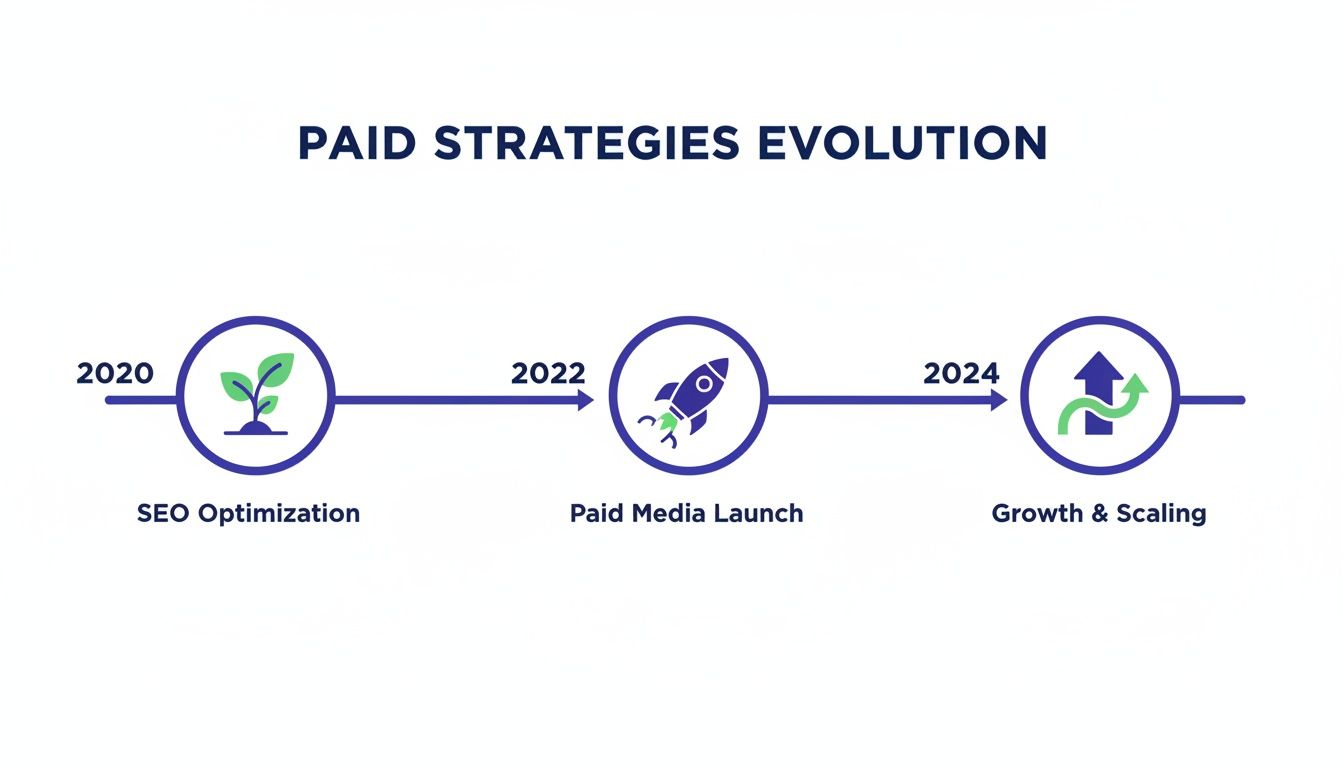
As you can see, foundational SEO efforts create a solid base. Then, you layer on faster, targeted paid campaigns to accelerate growth and achieve a sustainable lift in website traffic. It’s a common journey for a reason—it works.
Here’s a practical timeline illustrating how a B2B startup can systematically increase qualified website traffic from Canada and the US over a single quarter.
| Sample 90-Day Traffic Growth Timeline |
| :— | :— | :— | :— |
| Month | Primary Focus | Key Activities | Success Metric |
| Month 1 | SEO Foundation | Technical SEO audit, on-page optimization for 10 core pages, keyword mapping, 2 pillar blog posts targeting US/CAN terms. | 15% increase in keyword rankings for core terms; 5% lift in organic traffic from North America. |
| Month 2 | Content Velocity | Publish 4 supporting blog posts, create 1 lead magnet (whitepaper), launch company LinkedIn page. | 50 new marketing qualified leads (MQLs) from organic content; 200 new LinkedIn followers from target countries. |
| Month 3 | Paid Amplification | Launch LinkedIn Ads targeting US manufacturing roles, A/B test landing pages for the whitepaper. | Cost Per Lead (CPL) under $75; 10 sales qualified leads (SQLs) generated from paid channel. |
This structured plan provides a clear roadmap, turning abstract goals into concrete actions. It also sets expectations for when and where to expect results, allowing for smarter budget allocation as you go.
The Iterative Process of Optimization
Your 90-day plan isn't set in stone; think of it as a starting hypothesis. The real magic happens in the weekly and monthly review cycles where you dig into the data and make adjustments. This is the core of optimization.
For instance, did your Google Ads campaign targeting "inventory management software for US manufacturers" have a high click-through rate but a terrible conversion rate? Time to scrutinize the landing page. Is the messaging misaligned with the ad? Is the call-to-action buried or unclear?
Or maybe you notice one particular blog post is generating 25% of your organic leads from Canada. That’s a massive signal from the market. Your next move is to build a content cluster around that topic, creating more articles that solve related problems for your American and Canadian audiences.
This constant loop of Execute -> Measure -> Optimize is what separates high-growth companies from the ones that stagnate. It requires discipline and a commitment to letting data—not just gut feelings—guide your next move.
This iterative process ensures your marketing spend gets more efficient over time, your messaging gets sharper, and your website transforms into a reliable source of high-quality leads. To implement a rigorous optimization process for your business, contact our team of experts for a consultation.
Your B2B Website Traffic Questions, Answered
Driving website traffic is a common headache for B2B leaders, and it’s a topic that brings up a lot of questions. From setting realistic timelines to figuring out where to put your budget, the challenges are real. Here are some straight-up, practical answers to the questions we hear most often from B2B companies across Canada and the US.
How Long Does It Realistically Take to See Traffic Growth?
This is always the first question, and the honest answer is: it depends entirely on your strategy and starting point.
If you're building from the ground up with SEO, you need to be patient. It generally takes a solid four to six months to see meaningful, consistent organic traffic from competitive markets like the US and Canada. Think of SEO as a long-term investment; you're building a digital asset that will pay you back for years to come.
On the flip side, a well-targeted paid media campaign on a platform like LinkedIn or Google can start driving traffic—and generating leads—within just a few days of launch. The smartest approach is usually a blend of both: use paid channels for immediate results while your foundational SEO work starts to build momentum.
What Is the Biggest Mistake B2B Companies Make?
Easy. Inconsistency. So many companies get a burst of energy, publish five blog posts in a single month, run one ad campaign targeting the US market, and then just… stop when they don’t see immediate viral results.
A Lesson in Consistency: Take the B2B SaaS company Gong. By consistently publishing high-quality, data-driven content, they grew their blog traffic to over 100,000 monthly visitors. Their success didn't come from a magical one-hit-wonder post. It came from a disciplined, consistent content engine that methodically built authority and a reliable stream of traffic from key markets like the United States.
Real growth comes from sustained, methodical effort. Sporadic activities only ever get you sporadic results. A simple strategy executed consistently will always outperform a complex one that’s followed hit-or-miss.
What Are the Best Traffic Channels for SaaS Companies?
For B2B SaaS companies focused on the North American market, a few channels almost always deliver the goods.
- Organic Search (SEO): This is your most valuable channel in the long run, period. Creating in-depth content that solves a very specific problem for your ideal buyer—think articles like "how to improve manufacturing efficiency with software"—attracts high-intent prospects from Canada and the US for free.
- LinkedIn Ads: No other platform comes close for its ability to target professionals by job title, industry, and company size in Canada and the US. It's the perfect place to promote your whitepapers, case studies, and webinar sign-ups directly to the decision-makers you need to reach.
- Google Ads: This is absolutely essential for capturing prospects who are at the bottom of the funnel and ready to buy. When someone is actively searching for a solution you provide, you have to be there. The average conversion rate for B2B search ads is a respectable 5.10%, proving just how effective it is for generating qualified leads from North American searchers.
How Should I Allocate My Budget for Traffic Growth?
For an early-stage B2B company trying to get traction in the US and Canada, a 60/40 split is a smart place to start. Put 60% of your budget toward foundational, long-term plays like SEO and content creation. These are the activities that build your core marketing assets.
The other 40% should go toward paid amplification—things like Google and LinkedIn Ads—to drive near-term leads and gather valuable market data. As your organic traffic starts to grow and become more predictable, you can start tweaking that ratio to favour your most cost-effective channels.
Ready to stop wondering and start building a predictable traffic engine for your business? The team at B2Better has over 45 years of combined experience helping B2B companies across North America turn their websites into powerful lead-generation machines. Contact us today to build a custom traffic growth plan.