

Crafting a marketing strategy isn't about guesswork; it's about making intentional choices. It's the master plan that spells out who you're trying to reach, what message will actually connect with them, and how you’ll deliver it to drive real business growth. A solid strategy ensures every dollar and minute you spend is a calculated move toward your goals. In fact, organizations that plan their marketing strategy are 313% more likely to report success than those who don't.
Building Your Foundation With Market Intelligence

Diving straight into tactics like social media ads or email campaigns without a solid foundation is like setting sail without a map. You’ll be busy, sure, but you won't get where you need to go.
The real starting point for any powerful B2B marketing strategy is deep discovery and market intelligence. This isn't just about collecting data points; it’s about turning that information into a genuine competitive advantage that grounds your strategy in reality, not assumptions.
This foundational work prevents you from wasting resources on campaigns that completely miss the mark. For B2B companies in Canada and the United States, this means digging into the specific market dynamics, regulatory environments, and cultural nuances that shape buyer behaviour.
The payoff can be huge when strategy directs spending. Just look at Visit California's 2023-24 fiscal year: a $72.4 million investment in strategic marketing generated an incremental $31.5 billion in visitor spending. That's the kind of return you see from intelligence-led campaigns.
Understand Your Market Landscape
Before you can win, you have to know the playing field. Market research is your floodlight, illuminating opportunities and threats you’d otherwise miss. It’s the process of gathering hard facts about your industry, market trends, and the broader economic environment.
For businesses in North America, that means getting answers to questions like:
- Market Size and Growth: Is the market expanding or shrinking? What are the key growth drivers in the US versus Canada?
- Industry Trends: What shifts are affecting your industry? Think about the rise of AI in B2B sales or the growing importance of sustainability in supply chains.
- Economic Factors: How do inflation rates, business confidence, and trade policies in each country impact purchasing decisions?
This isn’t just an academic exercise. The answers directly inform your positioning, messaging, and channel selection. For a deeper dive, check out our guide on how to conduct market research for your business.
Create Detailed Buyer Personas
You can't market effectively to a faceless crowd. You need to understand your ideal customers as if they were real people, and that's where buyer personas come in. These are semi-fictional profiles of your ideal clients, built from market research and real data on your existing customers. Marketing strategies built on detailed buyer personas make websites 2 to 5 times more effective for targeted users.
A strong persona goes way beyond basic demographics like age and job title. It gets into the psychographics—the motivations, frustrations, and goals that actually drive decisions.
A great buyer persona should feel like a real person. It includes their goals, daily challenges, the publications they read, the social media platforms they frequent, and what "success" looks like in their role.
For instance, a B2B SaaS company in Toronto might target "Startup Sarah," a 35-year-old founder overwhelmed by operational tasks. Her main goal is efficiency, her biggest pain point is a lack of time, and she relies on LinkedIn and tech newsletters for information. Knowing this lets you create content that speaks directly to her problems and put it right where she’ll see it.
Analyze Your Competitors
The final piece of your foundation is understanding who you're up against. A competitive analysis isn't just about listing your rivals; it's about dissecting how they operate. You need to look at their strengths, weaknesses, and—most importantly—the strategic gaps you can exploit.
So, what should you be looking at?
- Their Messaging: What value proposition are they pushing? How are they positioning themselves?
- Their Content: What topics are they owning? What formats (blogs, videos, webinars) are they using?
- Their Channels: Where are they most active and getting real engagement?
- Their Reviews: What do customers absolutely love and hate about them? G2 and Capterra are goldmines for this.
This intelligence helps you find your unique opening. If a competitor is crushing SEO but has a ghost town of a social media presence, you've just found a channel to own. If their messaging is all about features, you can win by focusing on benefits and customer outcomes.
Once you’ve mapped the competitive terrain and dialed in on your ideal customer, it’s time to claim your ground. This isn’t just about what you sell; it’s about what you stand for. Defining your unique market position is all about articulating why your business is the only logical choice for your target audience.
This process is what turns you from just another option into the solution. It’s about crafting a clear, powerful message that cuts through the noise and connects directly with the deepest needs of your buyer personas. Without this clarity, even the most well-funded marketing campaigns can fall completely flat.
Crafting a Compelling Value Proposition
Your value proposition is the heart and soul of your market position. Think of it as a concise promise that clearly communicates three things: the specific benefit you provide, how you solve your customer's problem, and what sets you apart from everyone else.
Take Slack's early value proposition: "Be less busy." It didn't drone on about features; it sold an outcome. It spoke directly to the pain of cluttered inboxes and chaotic team communication that was a daily headache for teams across North America. The message was simple, powerful, and it clicked instantly with their target audience, helping them grow to a valuation of over $20 billion.
A strong value proposition should be the first thing a visitor understands when they land on your website. To get there, you need to answer a few key questions:
- What’s the number one problem our customer is trying to solve?
- What tangible results will they see from using our product or service?
- Why are we the absolute best choice to deliver those results?
Nailing this is a huge step. For a detailed walkthrough, check out our guide on how to write a value proposition that truly connects.
Developing Your Brand Voice and Messaging
With your value proposition locked in, you need a consistent way to talk about it. This is where your brand voice and messaging framework come into play. Your voice is your brand’s personality—are you an authoritative expert or a friendly, supportive partner? Your messaging is the core set of ideas and language you use everywhere.
Consider Shopify, the Canadian e-commerce giant. Their brand voice is all about being empowering and accessible. They don't just sell a platform; they champion entrepreneurship. Their messaging consistently revolves around making it easy for anyone to start and grow a business, a theme that echoes from their blog posts right through to their social media feeds. This consistent messaging helped them attract over 2 million merchants in the United States and Canada.
Your messaging framework should act as the source of truth for your entire organization. It ensures that everyone, from sales to customer support, is telling the same compelling story about your brand.
This consistency is what builds trust and recognition. It ensures that whether a potential customer sees a LinkedIn ad, gets a sales email, or reads a blog post, they get a cohesive and reinforcing brand experience every single time.
Differentiating in Crowded Markets
In a competitive field, clear positioning isn't just nice to have—it's non-negotiable. The demand for skilled marketers who can craft these strategies is intense, especially in major economic hubs. In fact, California has the highest demand for marketing jobs in the U.S., with approximately 60,000 marketing managers employed in the state. This just goes to show how critical a sharp, well-defined strategy is for cutting through the noise. You can read more about the vibrant marketing industry on odwyerpr.com.
To truly stand out, you have to anchor your position in a unique strength. This could be anything from superior technology and exceptional customer service to deep niche expertise or a more sustainable business model. The key is to find that one thing that is both valuable to your customers and incredibly difficult for your competitors to copy.
By defining your unique position, you give your marketing a clear direction and a real purpose. It informs every piece of content you create, every channel you choose, and every campaign you launch. If you're struggling to pinpoint what makes your B2B business truly unique, contact us. We can help you uncover your competitive edge and build a marketing strategy that commands attention.
You’ve carved out your unique space in the market. Fantastic. But a great position is just the starting point. The real challenge is translating that advantage into tangible results.
A strategy without clear goals is just a collection of random activities—expensive hobbies, really. This is where we shift from vision to a measurable roadmap, ensuring every dollar you spend and every hour your team works is a deliberate step toward growth.
Setting SMART Marketing Goals
Let's get one thing straight: vague ambitions like "increase sales" don't cut it. To get real results, especially in competitive North American markets, you need specific, measurable targets.
This is where the SMART goal framework comes in. It’s a classic for a reason. It forces you to move from fuzzy ideas to a concrete plan, stopping you from chasing vanity metrics that look good in a report but don’t actually help your bottom line.
A SMART goal is:
- Specific: Nail down exactly what you want to accomplish. Instead of "get more leads," try "generate 50 new marketing qualified leads (MQLs) from our target B2B SaaS audience in Ontario."
- Measurable: Define how you’ll track progress. Identify your key performance indicators (KPIs) like conversion rates, customer acquisition cost, or organic traffic from specific regions.
- Achievable: Be ambitious, but realistic. Aiming to double your revenue in one month is a recipe for burnout. A 20% increase in qualified pipeline value next quarter? That’s a stretch goal that feels possible.
- Relevant: Your marketing goals must directly support the company's bigger picture. If the business priority is breaking into the Western Canadian market, your marketing goal should focus on building brand awareness and generating leads in Alberta and British Columbia.
- Time-bound: Every goal needs a deadline. "Increase organic search traffic by 30% over the next six months" creates urgency and a clear timeline for your team to work against.
This structured approach forces you to think critically about what success actually looks like and how you'll prove it.
Matching Your Goals to the Right Channels
With your SMART goals locked in, the next step is picking the right marketing channels to hit them. It’s tempting to jump on every new platform, but that’s a surefire way to spread your budget too thin.
A strategic approach means going where your buyers are already active and where your message will land with the most impact. Don’t try to be everywhere at once. Focus your fire.
This simple decision tree helps visualize how your market position informs your channel choices.
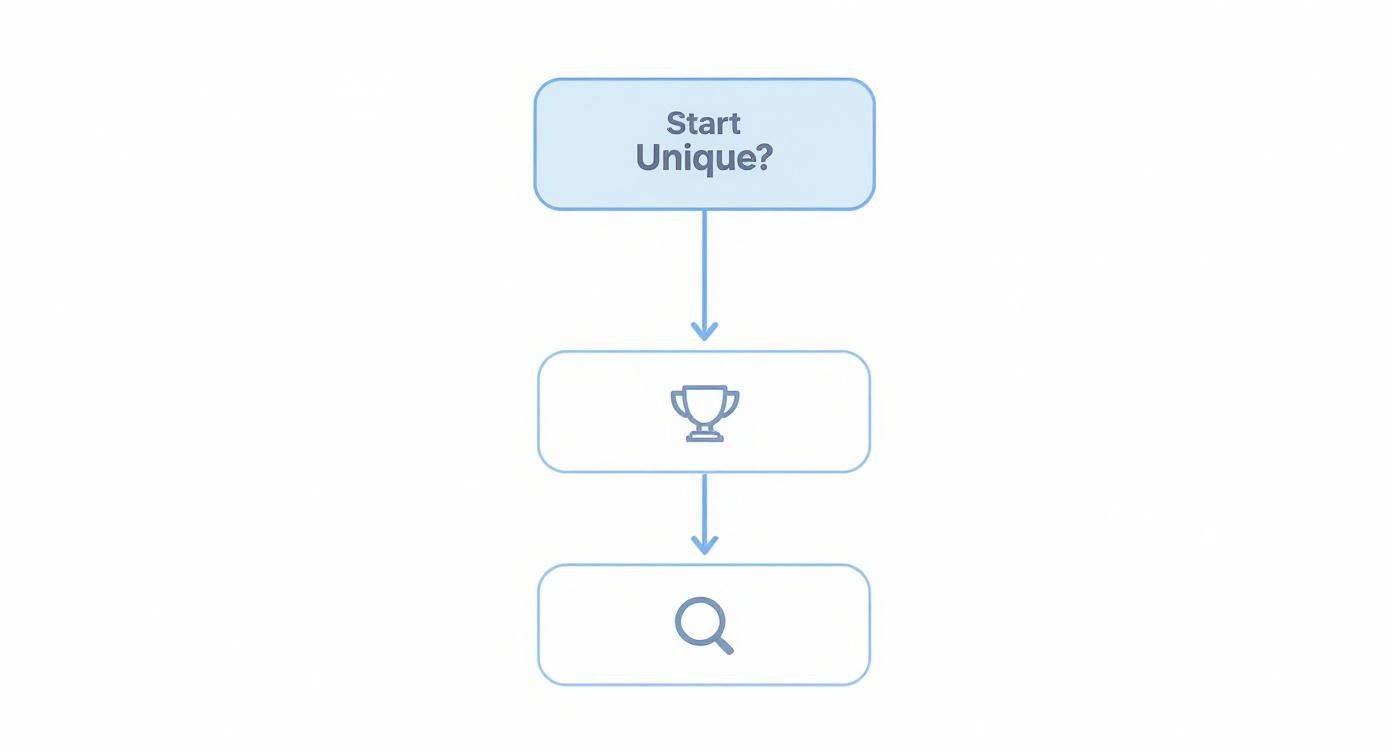
If you have a truly unique and defensible position, you can lean into channels that shout it from the rooftops. If your differentiation is less clear, you’ll need to focus on channels that help you build authority and carve out a niche.
To help you decide, here’s a framework that breaks down some of the most common B2B channels and how they align with different business goals.
Marketing Channel Selection Framework
Choosing the right mix of channels is critical for reaching B2B buyers in North America. Each platform serves a different purpose and appeals to different audiences at various stages of their journey. This table breaks down the strengths and typical use cases for the most effective B2B channels.
| Channel | Primary Audience | Typical B2B Use Case | Key Metrics (KPIs) |
|---|---|---|---|
| Content Marketing & SEO | Decision-makers conducting early-stage research; technical evaluators looking for in-depth solutions. | Building brand authority, generating long-term organic leads, educating the market, and answering buyer questions. | Organic Traffic, Keyword Rankings, Time on Page, Conversion Rate from Blog, MQLs from Gated Content. |
| Pay-Per-Click (PPC) | High-intent buyers actively searching for solutions right now. Specific roles and industries you want to target. | Driving immediate demo requests, capturing leads for specific offers (e.g., webinars), and testing messaging quickly. | Click-Through Rate (CTR), Cost Per Acquisition (CPA), Conversion Rate, Quality Score, Return on Ad Spend (ROAS). |
| LinkedIn Marketing | Specific job titles, company sizes, and industries across North America. Ideal for Account-Based Marketing (ABM). | Generating high-quality B2B leads, building professional networks, and distributing thought leadership content to key accounts. | Engagement Rate, Lead Form Completions, Follower Growth, Cost Per Lead (CPL). |
| Email Marketing | Your existing database of prospects, leads, and current customers. | Nurturing leads through the sales funnel, retaining customers with valuable updates, and driving upsell/cross-sell opportunities. | Open Rate, Click-Through Rate (CTR), Unsubscribe Rate, Conversion Rate from Email Campaigns. |
This framework isn't about picking just one channel. The best strategies weave multiple channels together to create a cohesive experience for the buyer.
A killer B2B marketing strategy is rarely about finding a single "silver bullet" channel. It’s about creating an integrated system where multiple channels work together, reinforcing your message and guiding buyers seamlessly from one touchpoint to the next.
For instance, a B2B software company in Kitchener-Waterloo might use an SEO-driven blog post to attract a prospect researching a problem. They could capture an email with a downloadable guide, then use targeted LinkedIn ads and an email nurture sequence to steer that lead toward a product demo.
It all works together.
Choosing the right goals and channels is where your strategy starts to take shape. If you’re struggling to connect your business objectives to an effective channel mix, let's talk. Our expertise is in building B2B marketing strategies that deliver measurable growth.
Budgeting and Resourcing Your Marketing Plan
A brilliant marketing strategy is just a document gathering dust without the fuel to make it run. This is where your grand vision meets the day-to-day reality of budgets and headcount. You have to connect your goals to a practical financial plan and find the right people to bring it all to life.
A lot of businesses stumble right here. They either underfund their ambitions, leaving great ideas on the table, or throw money at tactics without a clear plan. A structured approach ensures every dollar you spend directly supports your core objectives, whether that's generating leads in the United States or building brand awareness across Canada.
Choosing Your Budgeting Model
There’s no magic number for a marketing budget. The best method really depends on your company's stage, industry, and specific goals. Simply guessing a number is a fast track to wasted spend. Instead, it’s better to start with a logical framework to guide your financial planning.
Here are a few common models I see B2B companies use:
-
Percentage of Revenue: This is the most straightforward approach. You allocate a fixed percentage of your total (or projected) revenue to marketing. Most businesses spend between 7% to 10% of their annual revenue here, but that number can swing wildly. It’s simple, but it can feel restrictive when you're in a heavy growth phase.
-
Objective-and-Task Based: This is my preferred, more strategic method. You start with your SMART goals (e.g., "generate 100 MQLs from Ontario") and then list every single tactic and resource needed to hit that number. You cost out each item—from ad spend to software subscriptions—to build your budget from the ground up.
-
Competitive Parity: This model involves trying to match your marketing spend to your direct competitors. While it might help you keep pace, it makes two dangerous assumptions: that your competitors actually know what they’re doing, and that their goals are the same as yours.
The most effective budgeting isn't about picking just one model. I always recommend using the objective-and-task method to build a realistic plan, then cross-referencing it against a percentage of revenue to make sure it’s sustainable for the business.
Structuring Your Marketing Team
Once you know how much you can spend, you have to decide who is going to do the work. Your team structure is just as critical as your budget. The right talent—whether it's in-house or outsourced—is what ultimately breathes life into your strategy.
For many B2B companies, especially those in competitive North American markets, a hybrid model often works best. For example, creating a marketing strategy in a hub like California means understanding its advanced digital ecosystem. The state accounts for roughly 15% of the US GDP, and its market demands sophisticated approaches to deliver the kind of hyper-personalization buyers now expect. You can discover more insights about California's digital marketing landscape on rsunbeatsoftware.com.
In-House vs. Agency vs. Fractional CMO
Deciding on your team structure is a classic balancing act between control, cost, and expertise.
| Resourcing Model | Pros | Cons |
|---|---|---|
| In-House Team | Deep product knowledge, total control over brand voice, strong company culture fit. | High overhead (salaries, benefits), can lead to skill gaps, slow to scale up or down. |
| Marketing Agency | Access to a wide range of specialized skills, immediate scalability, exposure to diverse industry best practices. | Less dedicated focus than an in-house team, potential for communication gaps, retainers can be pricey. |
| Fractional CMO | C-level strategic leadership without a full-time executive salary. Bridges the gap between vision and execution. | Not a full-time employee, so they still need a team (in-house or agency) to execute the day-to-day tasks. |
For many small to mid-sized businesses, a Fractional CMO provides the perfect balance. You get high-level strategic direction to build the plan and guide the team, while using your in-house staff or specialized freelancers for the hands-on execution. This model is incredibly cost-effective and ensures your efforts are guided by seasoned expertise from day one.
Of course, you'll also need to keep a close eye on your spending efficiency. A key part of that is understanding your numbers, so be sure to check out our guide on how to calculate customer acquisition cost.
If your great ideas are struggling to get off the ground due to budget or resourcing challenges, contact us. We specialize in building practical, results-driven marketing plans that fit your resources and deliver measurable growth.
Putting Your Strategy to Work (And Keeping It Sharp)

Here’s a hard truth: your marketing strategy isn’t worth much as a static document sitting in a folder. It’s a living roadmap, and its real value only emerges when you bring it to life, measure what’s working, and relentlessly refine it based on real-world data.
This is where the rubber meets the road. All that deep work on research and positioning comes down to execution. The most successful B2B companies I've worked with, both in Canada and the United States, thrive on a disciplined cycle of action, measurement, and optimization. It's a rhythm.
Building Your Execution Roadmap
To get from high-level strategy to daily action, you need a clear execution roadmap. Think of it as the bridge between your ambitious goals and what your team is actually doing next Tuesday. It breaks down the big picture into tangible projects with clear owners and deadlines.
A solid roadmap should spell out:
- Key Initiatives: The big-ticket items for the quarter, like a "Q3 Lead Generation Campaign" or a complete "Website SEO Overhaul."
- Specific Tasks: The nitty-gritty actions needed for each initiative. This could be anything from writing five blog posts to designing ad creative or mapping out an email nurture sequence.
- Owners: Who is responsible for getting each task done? Accountability is everything.
- Timelines: Hard start and end dates for every single task and the larger initiative. No ambiguity.
A content calendar is a non-negotiable part of this roadmap. It’s your command centre for every blog post, LinkedIn update, webinar, and case study. Having everything scheduled ensures you maintain a steady, authoritative voice in your market and keeps the team from scrambling at the last minute.
Measuring What Actually Matters
You can't improve what you don't measure. The challenge today isn’t a lack of data; it's a flood of it. The trick is to tune out the noise and focus on the key performance indicators (KPIs) that tell you if your strategy is actually contributing to the bottom line.
Chasing vanity metrics like social media likes feels productive, but they don't keep the lights on. You have to connect marketing activity directly to revenue.
"Half the money I spend on advertising is wasted; the trouble is I don’t know which half." This classic line from John Wanamaker perfectly captures a problem that, thankfully, we no longer have. Digital analytics give us the power to see exactly which half is working—and double down on it.
By tracking the right KPIs, you can finally prove marketing’s value and make smart, data-driven decisions on where to invest your next dollar.
The Core KPIs for B2B Marketing Success
For most B2B outfits in North America, a few core metrics paint the clearest picture of performance. While you might add a few specific to your model, these are the KPIs that almost always tell the real story:
- Customer Acquisition Cost (CAC): How much does it cost, in total marketing and sales spend, to land one new customer? If your CAC is trending down, your strategy is getting more efficient. Simple as that.
- Marketing Qualified Leads (MQLs): The raw number of leads your team generates that are solid enough to pass over to sales. It’s the clearest indicator of your top-of-funnel health.
- MQL-to-SQL Conversion Rate: What percentage of those MQLs does the sales team accept as Sales Qualified Leads (SQLs)? This is a crucial gut-check on lead quality and the alignment between marketing and sales.
- Customer Lifetime Value (CLV): The total revenue you can expect from a single customer over their entire relationship with you. For a sustainable business, your CLV must be significantly higher than your CAC. A 3:1 ratio is a widely accepted benchmark for a healthy model.
- Return on Investment (ROI): This is the ultimate bottom line. It calculates the revenue generated from your marketing efforts against what you spent. It answers the one question your CEO really cares about: "Is our marketing making us money?"
The Rhythm of Review and Refinement
Your market, your buyers, and your competitors are constantly shifting. Your strategy has to be just as dynamic. This means baking in a regular rhythm of performance reviews to dig into the data, find the insights, and make smart adjustments.
Here's a cadence that I’ve seen work wonders:
- Weekly Check-ins: These are quick, tactical huddles. Look at campaign-level data. Is a specific ad tanking? Is a landing page not converting? Make small tweaks on the fly.
- Monthly KPI Reviews: This is a deeper dive into your core metrics. Are you on track to hit your MQL target for the month? How is your CAC looking? You're looking for trends here.
- Quarterly Strategy Reviews: Zoom all the way out. Assess the entire strategy. Are the big assumptions we made still holding true? Should we shift budget from one channel to another? Are we still on pace to hit our annual business goals?
This disciplined process is what separates the marketing teams that tread water from those that drive real, sustained growth. It turns your strategy from a document into a living system that gets smarter and more effective over time.
Executing a winning B2B marketing strategy isn't about perfection from day one. It's about having a solid plan, the discipline to execute it, and an unwavering commitment to continuous improvement. If you're ready to build a plan that delivers measurable, long-term growth, contact us. We can help you navigate every step, from the initial whiteboard session to flawless execution and optimization.
Common Marketing Strategy Questions
You’ve put in the work, building your strategy from the ground up and connecting deep market intelligence to a clear execution plan. That’s a huge step. But as businesses in Canada and the United States start to roll things out, a few practical questions almost always come up.
Let's tackle some of the most common ones I hear. These aren't just theoretical—getting the details right can be the difference between a plan that delivers and one that fizzles out on the launchpad.
How Often Should I Review My Marketing Strategy?
Think of your strategy as your North Star, not a rigid set of turn-by-turn directions. For most businesses, a comprehensive, top-to-bottom review should happen annually. This is your chance to zoom out and ask the big questions: do our core assumptions about the market, our buyers, and our competitors still hold true?
But waiting a full year to check in is a mistake. The day-to-day execution needs more frequent attention.
- Monthly Reviews: This is where you get tactical. Dive into your key performance indicators (KPIs). Are you on track to hit your lead targets? How’s your ad spend efficiency looking? This is all about course correction.
- Quarterly Reviews: Here, you’re looking at broader trends. Are certain channels clearly outperforming others? Is it time to shift budget from one initiative to another?
And crucially, you have to revisit your strategy immediately if there's a major external shift. A disruptive competitor launching, a significant regulatory change in your industry, or new economic pressures in the US or Canada are all valid reasons to pull the team together and re-evaluate. A great strategy is one that can adapt.
What Is the Biggest Mistake Businesses Make?
Easy. Jumping straight to tactics without a solid strategic foundation. It’s the classic "we need to be on TikTok" or "let's run some Google Ads" approach without first answering the most fundamental questions: who are we talking to, what do they actually care about, and why should they choose us over everyone else?
This tactics-first mindset almost always leads to wasted money, burned-out teams, and disappointing results. It's like trying to build a house by putting up the walls before you've even poured the foundation.
A successful strategy is always built on a foundation of deep market and customer insight. Without it, you’re just guessing, and guessing is an expensive way to do marketing.
Take the time to do the upfront work—the market research, the persona development, the competitive analysis. Every hour you invest there will save you ten hours of misguided effort down the road.
How Can I Create a Marketing Strategy on a Small Budget?
A limited budget doesn’t mean you can't have a powerful strategy. In fact, it forces you to be laser-focused. Scarcity breeds creativity and discipline. Instead of trying to do a little bit of everything, you have to concentrate your efforts where they’ll have the biggest impact.
Here’s where I’d start:
- Identify High-Impact Channels: Find the one or two channels where your target audience is most active and engaged. Don't spread a small budget thinly across five different platforms. Go deep, not wide.
- Prioritize Organic Growth: Lean heavily into content marketing and SEO. Creating high-quality, genuinely helpful content that solves your customers' biggest problems is an investment that builds long-term, sustainable value. One study found 73% of B2B marketers rate content marketing as a top priority for achieving their goals.
- Get Creative with Partnerships: Who else serves your audience? Collaborate with non-competing businesses. This could mean co-hosting a webinar, writing a guest blog post, or running a joint social media campaign to expand your reach without a big ad spend.
Does My Marketing Strategy Need to Be Different for Canada and the US?
Absolutely. While your overarching brand message can and should remain consistent, a one-size-fits-all tactical approach for North America will fall short. Your strategy must account for some important regional differences.
For example, marketing in Canada means navigating specific regulations like Canada's Anti-Spam Legislation (CASL), which has much stricter consent rules than its US counterpart. On top of that, you have to consider the linguistic and cultural uniqueness of Quebec, which often requires dedicated French-language campaigns to be truly effective.
Consumer behaviour, the competitive landscape, and even preferred social platforms can vary between the two countries. Tailoring your channel mix, messaging nuances, and promotional offers to each market isn't just a nice-to-have; it's essential for getting the best results.
Crafting a robust marketing strategy is a critical step, but it's just the beginning. The real work lies in executing, measuring, and refining that plan with discipline. If you’re ready to move from planning to achieving measurable growth, B2Better can provide the senior strategic leadership to guide you.
Contact us to build a B2B marketing strategy that drives real results.