

When we talk about e-commerce SEO, we’re really just talking about making your online store impossible for search engines like Google to ignore. It’s the art and science of driving more organic traffic and sales to your site without having to pay for every single click. This means fine-tuning everything from your website’s technical guts and product pages to your blog content, all with one goal: to show up before your competitors when a potential customer in the United States or Canada starts searching.
Why B2B E-Commerce SEO Is Your Greatest Untapped Asset
Imagine you’ve just built a stunning, state-of-the-art B2B showroom, but you tucked it away in an unmarked alley with no sign. That’s exactly what your e-commerce store is without a smart SEO strategy. For B2B founders and marketers in the competitive Canadian and US markets, getting seen isn’t just a nice-to-have—it's the very foundation of sustainable growth.
This isn’t just theory; it’s proven practice. A specialized B2B electronics supplier in the United States, for example, saw a 150% spike in qualified organic leads within a year after we helped them implement a targeted e-commerce SEO strategy. We shifted their focus from generic, broad terms to the specific, high-intent keywords that engineers and procurement managers actually use, turning their site into a magnet for ready-to-buy customers.
Turning Searchers into Customers
The journey from a Google search to a signed purchase order is shorter than most people think. Professional e-commerce SEO services close that gap by making sure your products appear at the exact moment a buyer is looking for a solution. This is especially true for businesses in major North American tech hubs.
Think about a B2B startup in Kitchener-Waterloo, Ontario. Here, over 90% of online experiences in Canada kick off with a search engine. That single statistic makes it crystal clear why optimizing for Google is non-negotiable, particularly in cutthroat sectors like tech, SaaS, and manufacturing where buyers do their homework online. If you want to dig deeper, you can explore more about how SEO impacts Canadian businesses to understand its full potential.
Ultimately, good SEO builds a long-term, revenue-generating asset. Unlike paid ads that vanish the second you stop feeding them money, a well-optimized site keeps generating traffic and leads month after month. It builds your brand’s authority and credibility, transforming your e-commerce platform into your most powerful sales channel. The core components always boil down to:
- Technical SEO: Making sure your site is fast, secure, and easy for search engines to crawl and understand.
- On-Page Optimization: Refining product descriptions, titles, and images to perfectly match what your customers in the US and Canada are searching for.
- Content Strategy: Creating genuinely useful content that answers buyer questions and attracts high-quality links from other sites.
- Authority Building: Earning Google’s trust by getting backlinks from reputable, relevant industry websites.
Ready to stop hiding your digital showroom in that alleyway and start attracting high-value B2B clients from across North America? Contact us today to discuss how a tailored e-commerce SEO strategy can drive real, measurable growth for your business.
The Core Components of E-Commerce SEO Services
To really get what goes into effective e-commerce SEO services, it helps to think of your website as a high-performance vehicle. You can have a beautiful exterior, but if the engine is poorly built, the steering is misaligned, or the GPS is broken, you won’t get very far. In the same way, a winning SEO strategy is built on several core components working together flawlessly.
For B2B businesses in Canada and the US, this isn't about casting a wide, generic net; it's about precision engineering to attract high-value clients. It all comes down to three essential pillars: technical SEO, on-page SEO, and off-page SEO. Each one tackles a different part of your site's performance, and together, they turn your online store into a powerful, discoverable asset.
The Three Pillars of B2B E-Commerce SEO
Every solid e-commerce SEO strategy rests on these three pillars. Think of them as the foundation, the structure, and the reputation of your digital storefront. Get them right, and you build a powerful engine for attracting and converting qualified B2B buyers in the United States and Canada.
| SEO Pillar | Primary Focus | Key Business Impact |
|---|---|---|
| Technical SEO | The "engine room" of your site. Focuses on speed, security, and how easily search engines can crawl and understand your content. | A fast, secure, and easily crawlable site ranks higher, provides a better user experience, and reduces lost sales from slow load times. |
| On-Page SEO | The "showroom" and "sales pitch." Optimizing visible elements like product titles, descriptions, and content for specific keywords. | Attracts the right customers by matching their search terms, improves click-through rates, and clearly communicates your value proposition. |
| Off-Page SEO | Building your "reputation" across the web. Earning high-quality backlinks and mentions from other authoritative websites. | Signals to Google that you're a credible industry leader, which significantly boosts your site's authority and rankings for competitive terms. |
Each pillar is critical. A technically perfect site with poor on-page content won't attract buyers, and great content on a slow, broken site will never get seen. A holistic approach that balances all three is what drives sustainable growth.
Technical SEO: The Engine of Your Site
Technical SEO is all the foundational work that happens behind the scenes. It’s the engine, chassis, and electrical system of your website. If this foundation is shaky, all your other efforts—from beautiful product photography to compelling descriptions—are undermined from the start. Search engines like Google need to be able to find, crawl, and index your pages efficiently.
A huge piece of this is site speed. For example, Deloitte found that a mere 0.1-second improvement in mobile site speed led to an 8.4% increase in conversions for retail brands. For a B2B supplier in a competitive US market, that could mean thousands in potential orders every month. A real-world success story is TheBattery.com, which, after getting its technical foundation in order, saw organic traffic drive a massive 77% of its sales.
Proper technical SEO ensures your site is:
- Fast and Responsive: Pages load quickly on all devices, especially mobile, where a majority of searches in Canada and the US now happen.
- Crawlable and Indexable: A clean site structure and an optimized XML sitemap allow search engine bots to easily discover all your important product and category pages.
- Secure: HTTPS encryption is a non-negotiable standard that builds trust with both users and search engines.
On-Page SEO: The Showroom and Sales Pitch
Once your site’s technical foundation is solid, the focus shifts to on-page SEO. This is everything your customer sees and interacts with—the showroom, the product displays, and the sales pitch. It’s all about optimizing individual pages to rank higher and earn more relevant traffic.
The cornerstone here is meticulous keyword research to understand precisely what your customers are searching for. You can go deeper with a comprehensive guide to keyword research for SEO. By understanding the exact terms a procurement manager in Calgary might use versus an engineer in Chicago, you can tailor your content perfectly.
A SaaS company in Kitchener–Waterloo doesn't just want to rank for "software." They need to rank for "inventory management software for manufacturers" to attract qualified buyers from the United States and Canada. That's the level of specificity that drives real B2B success.
This pillar involves carefully optimizing product descriptions, page titles, and implementing schema markup. Schema is what helps your products stand out in search results with rich snippets like pricing, availability, and review ratings, giving your click-through rates a serious boost.
The hierarchy below shows how e-commerce and SEO are foundational tiers supporting your overall business growth.
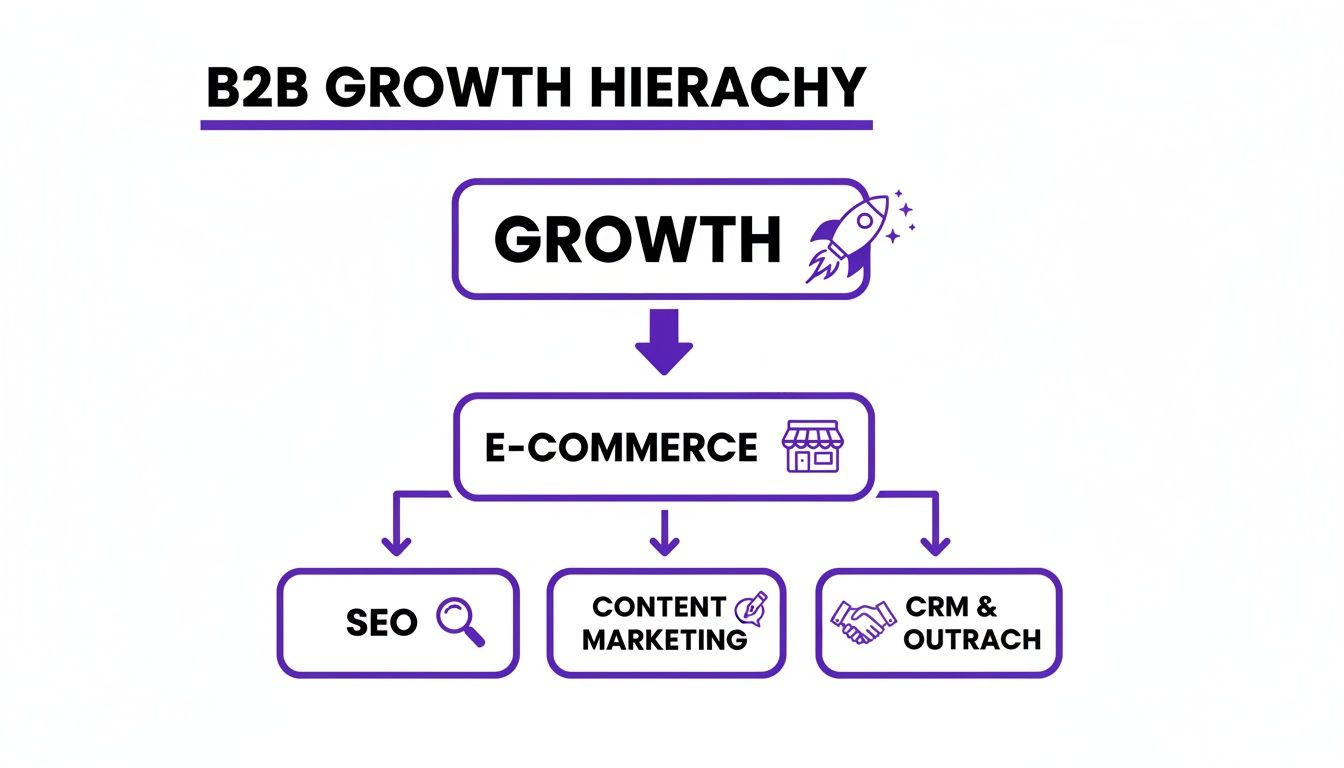
This structure makes it clear: without a solid SEO foundation, the potential of your e-commerce platform—and your growth—is severely limited. For B2B businesses, each layer builds on the last to create a powerful engine for attracting high-value clients. Our guide on how to improve SEO provides actionable steps you can take to strengthen this foundation today.
Off-Page SEO: Building Your Reputation
Finally, off-page SEO is all about building your website’s authority and reputation across the web. Think of it as generating positive word-of-mouth. This primarily involves earning high-quality backlinks from other reputable websites in your industry.
These backlinks act as votes of confidence. When an authoritative industry publication links to your B2B company's case study, they are effectively telling search engines that your content is credible and valuable. This "link equity" significantly boosts your rankings.
For a Canadian tech startup, this might mean creating a data-driven report on industry trends that gets picked up by tech blogs across North America. The report itself might not sell a product directly, but the authority it builds can lift the rankings of all their commercial pages. That’s how one blog post that earned 44 organic referring domains can indirectly drive sales.
These three pillars—technical, on-page, and off-page—are the heart of what professional e-commerce SEO services deliver. When executed strategically, they work together to build a sustainable, long-term asset that drives traffic, generates leads, and grows your revenue.
Measuring the True ROI of Your SEO Investment
Shifting the conversation from marketing activities to business outcomes is where the real value of e-commerce SEO services becomes crystal clear. Unlike paid advertising, which only rents you traffic for as long as you keep paying, a smart SEO investment builds a permanent, revenue-generating asset for your business. The results compound, creating a sustainable advantage that your competitors in the United States and Canada can't easily replicate.
This isn’t just some theoretical benefit; it’s a proven growth model. Take a Canadian manufacturing supplier that decided to pivot away from a costly, high-maintenance PPC strategy. By funnelling their budget into a targeted SEO approach, they completely transformed their digital footprint.
In just one year, they saw a staggering 250% increase in qualified organic leads. Even better, this flood of high-intent traffic directly led to a 60% reduction in their overall customer acquisition cost. They stopped renting traffic and started owning it, proving the long-term ROI of SEO crushes the short-term visibility of paid ads.
Key Performance Indicators That Actually Matter
Measuring SEO success goes way beyond just watching your website traffic go up. An increase in visitors is a nice ego boost, but it’s a vanity metric unless it translates into real business growth. A data-driven approach focuses on KPIs that connect directly to your bottom line.
To get a true picture of your return on investment, your reporting needs to zero in on these core metrics:
- Organic Revenue Growth: This is the big one. It measures the total revenue generated specifically from visitors who found you through a search engine, no ads involved.
- Rankings for High-Intent Keywords: Tracking your position for commercial keywords (think "buy industrial automation parts" or "enterprise SaaS solutions") shows you're reaching customers right when they’re ready to make a decision.
- Organic Conversion Rate: This tells you what percentage of your organic visitors are taking the action you want, like requesting a quote or making a purchase. If this number is climbing, you know you're attracting the right kind of traffic.
- Customer Acquisition Cost (CAC) from Organic: By comparing your SEO spend to the number of customers you gain from it, you can see just how much more cost-effective it is than other channels.
Getting a firm grip on these numbers is essential. For a deeper dive, check out our guide on mastering your digital marketing reporting.
The Mobile-First ROI Multiplier
In today's market, ignoring mobile is simply not an option. With over 60% of B2B searches in the United States now happening on mobile devices, a mobile-first SEO strategy acts as a massive ROI multiplier. This is especially true for B2B startups and scale-ups in hubs like Kitchener–Waterloo targeting growth across North America.
Your B2B buyers are researching solutions and vetting suppliers on their phones—whether they're on a factory floor, in an airport, or at a conference. A seamless, fast mobile experience isn't just a technical check-box; it's a critical part of your sales process.
By focusing on these clear, data-driven outcomes, you can move past vague promises and see exactly how professional e-commerce SEO services contribute directly to your revenue. It builds an undeniable case for continued investment in sustainable, long-term growth.
Choosing the Right E-Commerce SEO Partner
Picking the right partner is probably the most important decision you'll make on your entire SEO journey. It's the difference between building a genuine revenue-generating asset and just burning through your budget on activities that go nowhere. For B2B leaders in Canada and the US, this isn't about finding a vendor to tick off a list of tasks; it’s about bringing on a strategic ally who gets your complex market.
The stakes are high. A great partner can turn your digital presence into your best sales channel, while the wrong one can set you back months, or even years. This is especially true when you're weighing the choice between a big, generalist agency and a specialized expert like a Fractional CMO who provides senior-level direction.
Your Non-Negotiable Selection Checklist
When you're vetting potential partners for your e-commerce SEO services, don't get sidetracked by flashy slide decks or vanity metrics. Keep your focus on the stuff that actually translates into business growth. Your checklist needs to prioritize real-world experience and a strategic brain.
Here’s what should be non-negotiable:
- Proven B2B Industry Experience: Ask to see case studies from tech, SaaS, or industrial companies. Someone who has successfully ranked a B2B software company in the United States understands the long sales cycle and technical buyers in a way a B2C-focused agency simply won't.
- A Strategic Mindset: You're not looking for an order-taker. Your partner needs to ask "why" and connect every SEO activity directly back to your revenue goals. They should be able to explain exactly how a technical site audit leads to more qualified leads, not just a better site health score.
- Commitment to Transparent Reporting: Insist on seeing sample reports before you sign anything. They should be clear, concise, and zeroed in on the KPIs that matter—organic revenue, conversion rates, and rankings for high-intent commercial keywords. Vague reports stuffed with jargon are a massive red flag.
A US-based industrial parts supplier is a great example of a successful partnership. They picked a specialist who understood their niche. The result? Within 18 months, they saw a 300% increase in organic revenue and were able to slash their reliance on expensive paid search by over 50%. That fundamentally changed their business for the better.
Red Flags to Avoid at All Costs
Knowing what to look for is only half the battle; you also need to know what to run away from. The wrong partnership can do more than waste money—it can actively damage your website's reputation with search engines, leading to penalties that are a nightmare to recover from.
Keep an eye out for these tell-tale warning signs:
- Guaranteed Rankings: This is the oldest and biggest red flag in the SEO industry. Nobody can guarantee a #1 ranking on Google. Anyone making that promise is either a rookie or willing to use risky, black-hat tactics that could get your site penalized.
- Reliance on Shady Tactics: Be wary of anyone who's secretive about their methods or talks about a "secret sauce." Ask specifically about their link-building strategies. If you hear terms like private blog networks (PBNs) or buying links, that's your cue to end the conversation. These tactics violate Google's guidelines and can lead to severe penalties.
- Generic, One-Size-Fits-All Packages: Your B2B business in the Kitchener-Waterloo tech corridor has completely different needs than an e-commerce fashion brand in Los Angeles. If a potential partner pushes a rigid, tiered package without first doing a deep dive into your specific business goals and competitive landscape, they aren't a strategic partner.
Your SEO partner should function as an extension of your leadership team, providing the senior-level strategic guidance necessary for long-term success. They must understand the unique challenges and opportunities within the Canadian and American B2B markets to drive meaningful results.
Choosing the right expert in e-commerce SEO services is a serious investment in your company's future. It demands due diligence, asking tough questions, and prioritizing strategic alignment over cheap, pre-packaged solutions. A partner who meets these criteria will help you build a powerful, sustainable engine for growth.
Ready to find a strategic partner who understands the unique demands of the B2B landscape in the US and Canada? Contact us today to build a roadmap for your e-commerce success.
Winning Locally and Expanding Internationally
A complete B2B strategy for e-commerce SEO services needs to conquer two fronts at once: dominating your home turf and strategically pushing across borders. For ambitious companies in Canada and the United States, this dual approach isn’t just an option; it's the blueprint for sustainable growth. You have to win the customers right outside your door while laying the groundwork for cross-border success.
It all starts by building a rock-solid local foundation before you even think about looking outward. Think of it like a sports team that first masters its home-field advantage before competing for a national championship. The same principle applies here.

Dominating Your Home Market With Local SEO
For B2B companies, local SEO is a potent tool for snagging high-intent buyers in your immediate service area. It’s all about making sure that when a purchasing manager in your city searches for a solution you provide, your business is the first one they see.
Take the success of an Ontario-based industrial equipment supplier. They were getting completely lost in the noise of national competitors. By optimizing their Google Business Profile and building out location-specific pages for cities like Kitchener-Waterloo and Toronto, they saw a massive shift. The result? A 75% increase in regional quote requests in just six months. They tapped into a local customer base that was ready to buy, proving just how valuable hyperlocal targeting can be.
To effectively capture customers in specific geographic areas, it's crucial to get the nuances of implementing local SEO strategies right. If you want to build a strong foundation, you can learn more by exploring our comprehensive guide to local SEO.
Expanding Your Reach Across North America
Once you've established dominance in your local market, the next logical move is to expand internationally, especially between the tightly connected economies of Canada and the United States. But this requires more than just adding "shipping to the US" on your website. International SEO is a technical and strategic discipline.
The goal is to provide a seamless, localized experience for users in each country. This tells search engines that you're a relevant authority in that specific market, not just a foreign company trying to make a sale.
To successfully target the US market from Canada (or vice-versa), you have to nail several critical steps:
- Implement Hreflang Tags: This bit of code tells Google you have multiple versions of a page for different languages or regions. It’s what ensures a user in Boston sees your US-specific site (with USD pricing), while a user in Vancouver sees the Canadian version (with CAD pricing).
- Adapt to Regional Keywords: Language nuances matter—a lot. A Canadian firm might optimize for "industrial coatings," while its US counterpart targets "industrial finishes." Understanding and using these regional variations is key to connecting with the right audience.
- Craft Resonant Content: Buyer personas can differ significantly across borders. Your content needs to be tailored to address the specific pain points, business culture, and decision-making processes of your target audience in each country.
By mastering both local and international SEO, you build a powerful, scalable growth engine. This dual approach lets you achieve hyperlocal dominance while executing a successful cross-border expansion.
You’re no longer wondering if e-commerce SEO is just another marketing channel—you know it's a core pillar of your B2B growth. Getting it right demands a strategic, all-in approach tailored to the tough realities of your industry and the specific needs of high-value buyers in Canada and the United States.
Success here isn’t just possible; it’s game-changing. Just look at TheBattery.com. By nailing their SEO foundation, they now pull in a massive 77% of their sales from organic traffic. That doesn’t happen by accident. It's the direct result of a deliberate, expert-led strategy. On the technical side, plenty of online retailers see conversion rates jump by over 8% just by trimming page load speed by a single second.
Think of strategic e-commerce SEO not as a cost, but as an investment in a compounding asset. Unlike paid ads that vanish when you stop paying, the authority and traffic you build today keep generating revenue for years, cementing your spot in the market.
If you're a B2B founder or marketer in Canada or the US, you don't just need a vendor who ticks boxes. You need a strategic partner who brings senior-level thinking to the table, aligning every action with your actual business goals. You need someone who builds and manages a growth engine, not just a keyword list.
Ready to Build Your Growth Engine?
For businesses in competitive hubs like Kitchener-Waterloo or anywhere across North America, a Fractional CMO offers the seasoned leadership of a marketing executive without the full-time overhead. We don't just run campaigns; we build the roadmap that turns your e-commerce platform into your most powerful sales channel.
Are you ready to stop chasing tactics and start building a real digital presence that drives sustainable growth?
Contact us today to schedule a consultation and we’ll build a clear, actionable roadmap for your e-commerce success.
Your E-Commerce SEO Questions, Answered
Making a strategic investment in professional e-commerce SEO services is a big step, so it’s only natural to have a few questions before you commit. Here are some of the most common ones we hear from B2B leaders, with clear, straightforward answers to help you make the right choice.
How Long Until We See SEO Results?
This is always the first question, and for good reason. SEO is a long-term play, not an overnight fix, but you should still expect to see early signs of life within 4-6 months. That's typically when initial signals like improved keyword rankings and a noticeable uptick in organic traffic start to appear.
But the real, revenue-driving results—the kind that makes a tangible impact on your bottom line—usually start building momentum over 6-12 months. This runway gives your site’s authority time to grow, earning trust from search engines and cementing your position as a credible voice in your industry. To give you a real-world example, a US-based industrial parts supplier we worked with saw a 300% increase in organic revenue after 18 months of steady, focused effort. It’s a perfect illustration of the compounding power of a well-executed strategy.
How Is B2B E-Commerce SEO Different?
B2B and B2C SEO might share the same playground (Google), but they’re playing entirely different games. B2C often targets a massive audience with broad, emotional appeals. B2B SEO, on the other hand, is a precision sport aimed at a much smaller, highly specialized group of decision-makers. The keywords are more technical, the search intent is all about research and due diligence, and the sales cycle is significantly longer.
The goal of B2B e-commerce SEO isn't to snag an impulse buy. It's about methodically building unshakable trust, demonstrating deep expertise, and educating high-value clients over time. You’re positioning your company as the only logical choice when they’re finally ready to pull the trigger.
What Is a Realistic Budget for US & Canadian Markets?
Budgeting correctly from the get-go is critical. For a comprehensive, professionally managed B2B e-commerce SEO strategy targeting competitive markets in Canada or the US, small and mid-sized businesses should plan to invest between $3,000 and $10,000+ per month.
This investment isn't just for a list of tasks; it buys you senior-level strategic expertise, technical execution, and the high-quality content creation required to not just compete, but to win. It funds the resources needed to generate a significant and sustainable return, transforming your e-commerce site from a simple catalogue into a powerful, lead-generating machine.
At B2Better, we build growth strategies that align with your business objectives, not just a checklist. Ready to turn your e-commerce platform into your most powerful sales channel?
Contact us today to schedule a consultation and build a roadmap for your e-commerce success.