

Think of a digital marketing technologist as the master architect for your marketing. They’re the one who designs, builds, and connects all the complex tech systems that make modern marketing actually work. They’re much more than just a tech-savvy marketer; they are the engineer who turns a lofty marketing vision into a high-performance engine for measurable growth.
The Indispensable Rise of the Marketing Technologist
In an age overflowing with data and automation, the gap between a great marketing strategy and its technical execution has become a chasm. Businesses across North America are drowning in tools. The marketing technology landscape has absolutely exploded to over 15,000 solutions—a mind-boggling 100-fold increase since 2011. This sheer complexity creates a critical need for a specialist.
This is where the digital marketing technologist steps in to tame the chaos. They don’t just manage tools; they build a cohesive, efficient ecosystem. One where data flows seamlessly between platforms, automation works without a hitch, and every dollar of your marketing spend is completely accountable. For businesses in Canada and the United States, this professional transforms a messy collection of disconnected software into a powerful, revenue-generating machine.
AI: The New Superpower for Marketers
With the recent explosion in AI, this role has become even more vital. Far from replacing marketers, AI is making them exponentially more powerful—but only when guided by a skilled hand. Marketers who use AI correctly are becoming more effective than ever, seeing incredible results. For instance, businesses using AI for personalization have reported a 40% increase in qualified leads. The digital marketing technologist is the expert who implements these sophisticated AI-powered systems, turning marketing departments from cost centres into strategic growth drivers.
They are the vital link between a great marketing idea and its successful, scalable execution. Without this role, even the best strategies fall flat due to technical friction, bad data, and broken processes.
By building and fine-tuning the technical foundation, a digital marketing technologist ensures every campaign, customer interaction, and piece of data contributes directly to the bottom line. For any B2B company in Canada or the United States looking to achieve sustainable growth, they are no longer a luxury—they are a necessity.
Ready to bridge the gap between your marketing vision and technical reality? Contact us to see how an expert technologist can accelerate your growth.
The Core Functions That Drive Business Growth
A digital marketing technologist isn’t just some IT person who manages software for the marketing team. Think of them as the chief engineer of your entire customer engagement engine. They are the critical link between a brilliant marketing idea and its flawless, profitable execution in the real world.
Their whole world revolves around building a smooth, connected customer journey. This means getting all your technology—from your CRM to your marketing automation tools—to speak the same language. Data has to flow cleanly from one system to the next, giving everyone a single, unified view of every prospect and customer.
From Technical Tasks to Tangible Results
The hands-on work of a marketing technologist directly fuels business growth. For example, they might build a sophisticated lead scoring model in a platform like HubSpot or Marketo. When a prospect in the United States downloads a whitepaper and then visits your pricing page, their score automatically jumps. That action can trigger an instant alert for your Canadian sales team.
That simple, automated workflow has a massive impact. Sales reps engage with high-intent leads faster, which significantly boosts conversion rates. The numbers back this up: businesses with tightly aligned sales and marketing operations achieve 209% more revenue from their marketing efforts. A digital marketing technologist is the one who forges that alignment through technology.
This visual shows the direct line from a marketing vision, through the technologist's work, to measurable business growth.
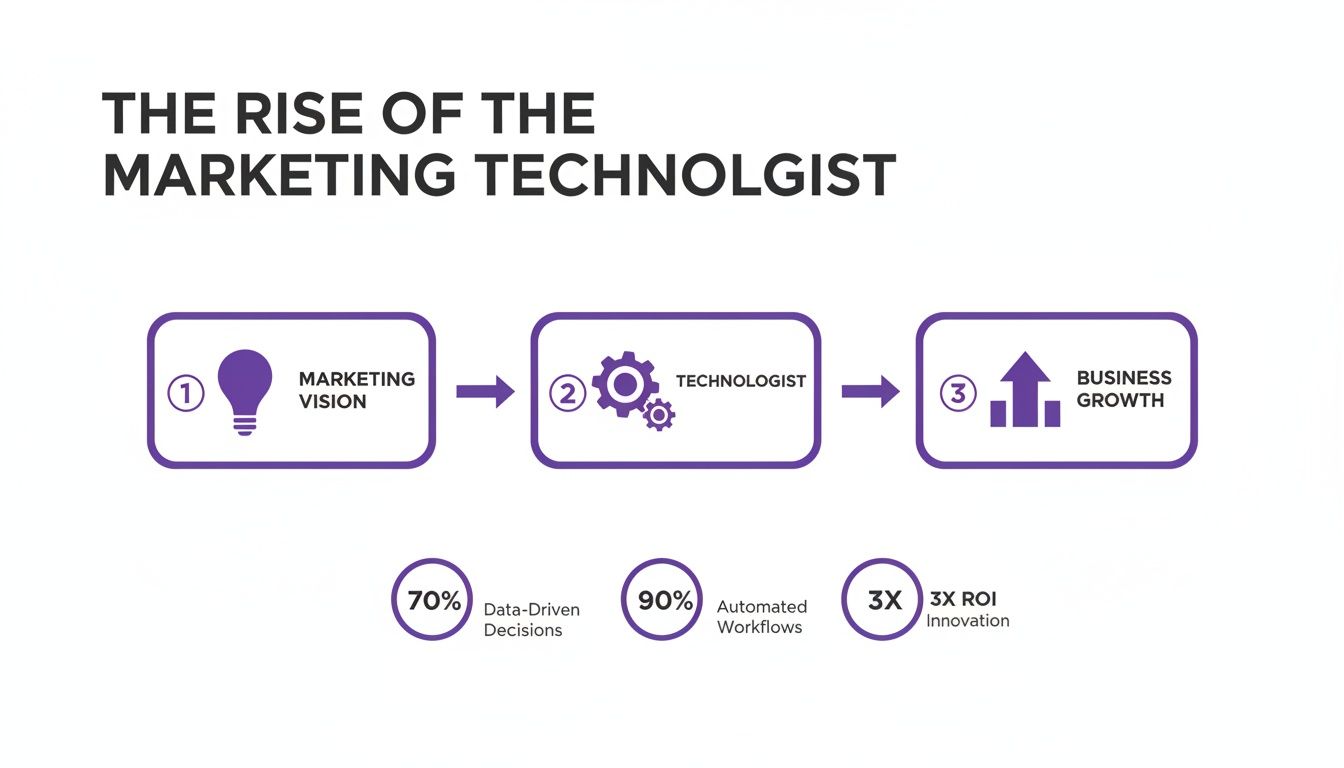
The key takeaway? This isn't a support role. It's a central driver, responsible for turning strategic goals into a functional, revenue-generating system.
The Power of AI in Modern Marketing
With the explosion of AI, the power of a skilled marketer has been amplified. AI isn't here to replace marketers; it’s here to give them superpowers—but only if the tools are implemented and managed correctly. The digital marketing technologist is the expert who makes that happen, turning marketers into more effective, data-driven professionals.
By integrating AI-powered personalization engines, companies can deliver hyper-relevant experiences at scale. Research shows that effective personalization can lift revenues by 5–15% and increase marketing spend efficiency by 10–30%.
To help you see exactly how their work connects to the bottom line, the table below breaks down some of their core functions and the direct business impact of each.
Digital Marketing Technologist Functions and Their Business Impact
| Core Function | Example Tool or Platform | Direct Business Impact |
|---|---|---|
| MarTech Stack Integration | Zapier, Workato | Eliminates data silos, automates workflows between sales and marketing, and creates a single source of truth for customer data. |
| Lead Scoring & Automation | HubSpot, Pardot | Prioritizes high-intent leads for sales, shortens the sales cycle, and increases conversion rates by ensuring timely follow-up. |
| Data Analytics & Reporting | Google Analytics, Tableau | Provides clear, actionable insights into campaign performance, proves marketing ROI, and enables data-driven budget decisions. |
| Website Personalization | Optimizely, VWO | Delivers tailored content and offers to different audience segments, boosting engagement, lead quality, and customer loyalty. |
| AI Tool Implementation | Jasper, ChatGPT | Enhances content creation speed and quality, enables hyper-personalization at scale, and improves campaign targeting and efficiency. |
Ultimately, a marketing technologist ensures every piece of technology delivers a clear return on investment. It's more than just connecting apps; it’s about architecting a system where performance is transparent and actionable. You can learn more about translating this complex data into clear insights in our guide to digital marketing reporting. This clarity empowers leaders to make smarter decisions and finally prove marketing’s undeniable value.
The Essential Skills of a Modern Marketing Technologist
A great digital marketing technologist is a rare breed—a true hybrid who's equally comfortable talking about API integrations and lead conversion funnels. On one hand, they speak the language of data analytics and know the technical architecture of platforms like Salesforce, Marketo, and Google Analytics inside and out. They see how systems should talk to each other to create a seamless flow of information.

But their real value isn’t just in knowing how to operate software. It’s in their knack for translating high-level business goals into practical, technical solutions. This requires sharp problem-solving skills, solid project management, and a deep grasp of core marketing principles. They are the architects who audit, select, and wire together the tools that form a cohesive MarTech stack.
Mastering the Technical and the Strategic
The role demands a unique skillset that bridges two worlds that have traditionally been kept separate. A top-tier technologist can easily discuss campaign ROI with a CMO, then turn around and troubleshoot a data sync issue with a developer.
Here’s what that looks like in practice:
- Technical Proficiency: Mastery of marketing automation platforms, CRMs, and analytics tools is the baseline. This includes a firm understanding of system architecture and data models.
- Data Analysis: They must be able to dive into complex datasets, spot meaningful trends, and translate those findings into actionable marketing strategies.
- Integration Expertise: Experience with APIs and middleware tools (like Zapier or Workato) is critical for connecting disparate systems and ensuring data flows cleanly.
- Strategic Marketing Acumen: A solid grasp of the entire customer lifecycle—from awareness to retention—and how technology can optimize every single stage.
With the rise of AI, these skills have become even more vital. A technologist's ability to properly implement and integrate AI-powered analytics and automation tools is what turns a cool new technology into measurable revenue growth, making the entire marketing function more skilled and efficient.
A Growing Field of Opportunity
The demand for these specialized skills is surging, especially in Canada and the United States. The Canada digital marketing sector was valued at USD 15.89 billion in 2025 and is projected to skyrocket to USD 56.13 billion by 2035. This explosive growth, fuelled by hubs like Toronto and Vancouver, is creating a massive need for technologists who can wrangle increasingly complex marketing systems. You can read more about the trends shaping the Canadian digital marketing market.
A digital marketing technologist doesn't just manage the tools in the toolbox. They are the ones who design and build a custom toolbox perfectly suited to the company's specific growth objectives, ensuring every tool works together flawlessly.
Ultimately, they build the technological foundation that allows a business to not only meet today's needs but also to scale efficiently for tomorrow's growth.
Are your marketing tools working in harmony, or just creating friction? Contact us to find out how a digital marketing technologist can build you a seamless, growth-oriented tech stack.
How AI Supercharges Marketing Effectiveness
The rapid arrival of artificial intelligence isn't a threat to skilled marketers; it's their single greatest opportunity. AI tools are multiplying marketers' capabilities, making them more powerful and effective than ever before. However, they need a skilled operator to translate raw potential into real-world profit. This is exactly where the digital marketing technologist becomes indispensable, acting as the bridge between AI's promise and its practical application.

This specialist is the one who actually implements AI for predictive lead scoring, ensuring sales teams in Canada and the United States focus only on the most promising prospects. They deploy generative AI to scale high-quality content production and build AI-powered personalization engines that deliver unique customer experiences with incredible efficiency.
Amplifying Human Creativity, Not Replacing It
Far from replacing human ingenuity, AI acts as an amplifier, making good marketers great. Research shows 54% of marketers already use AI in their roles for tasks like market research and campaign optimization. By automating the repetitive, data-heavy work, AI frees up marketing teams to focus on what they do best: strategy, innovation, and building meaningful customer relationships.
A digital marketing technologist ensures AI is not just a shiny new toy but a fully integrated component of the growth engine, directly tied to business outcomes like lead quality and revenue.
For example, a US-based B2B software company struggled with generic outreach that failed to connect with key accounts. Their new marketing technologist integrated an AI personalization tool that analyzed prospect data from LinkedIn and their CRM to automatically customize email sequences and website content for different industries.
The result? A remarkable 40% increase in qualified leads within a single quarter. This success story proves that human expertise is the critical ingredient needed to turn AI’s capabilities into measurable profit. The technologist didn't just switch on a tool; they strategically integrated it into the existing tech stack to solve a specific business problem.
The Strategic Implementation of AI
A technologist ensures AI isn't used in a vacuum. They understand how different AI tools fit together and connect to the broader marketing ecosystem. This strategic oversight prevents data silos and ensures that insights from one AI-powered system inform actions in another, creating a virtuous cycle of continuous improvement.
Their role includes:
- Selecting the Right Tools: Vetting and choosing AI platforms that align with specific business goals, not just chasing trends.
- Ensuring Data Integrity: Making sure AI systems are fed clean, accurate data to produce reliable outputs and predictions.
- Training and Adoption: Guiding the rest of the marketing team on how to use new AI tools effectively and ethically.
By mastering the technical side of AI, the digital marketing technologist transforms the marketing function from a creative department into a data-driven, hyper-efficient growth centre. You can explore more about implementing these systems in our detailed guide to AI marketing strategies for B2B campaigns.
The Power Duo of a Fractional CMO and a Technologist
For many growing B2B companies, pairing a Fractional CMO with a digital marketing technologist is the ultimate growth formula. It creates a partnership between high-level vision and flawless technical execution, delivering immense value without the overhead of two full-time executive salaries.
Think of it like building a custom home. The Fractional CMO is the architect who designs the blueprint, defining the overarching marketing strategy and specifying exactly what success looks like. They determine the goals, the channels, and the messaging needed to win in competitive markets like the US and Canada. You can learn more about how this role drives growth by checking out our guide on maximizing growth with a Fractional CMO for B2B success.
The technologist, on the other hand, is the master builder. They take that strategic blueprint and construct the technical infrastructure needed to bring it to life. This means building the automation, wiring the integrations, and setting up the tracking systems to ensure every part of the strategy runs efficiently and is fully measurable.
From Strategy to Systemized Growth
This synergy allows businesses to launch complex campaigns that would be impossible for a traditional marketing team to handle. A Fractional CMO might identify a high-value account-based marketing (ABM) opportunity, for example. The technologist then builds the system to make it happen, integrating the CRM with a personalization engine and setting up automated workflows that trigger tailored content based on a prospect's behaviour.
The rise of AI has made this partnership even more potent. A skilled technologist can implement AI tools that supercharge the CMO’s strategy, making marketers more effective and turning creative ideas into scalable, data-driven campaigns that deliver exceptional results. This combination of strategic leadership and technical expertise is a game-changer.
This duo bridges the common gap between a brilliant marketing idea and the technical ability to execute it at scale. It’s where strategy meets a system, ensuring no great idea is lost due to technical limitations.
The demand for such hybrid skills is surging. In Canada alone, 44,100 projected job openings for roles like this are expected by 2029, as digital advertising now commands 76.7% of total ad spending. This underscores the critical need for experts who can navigate both strategy and technology. Discover more insights about the booming Canadian digital sector on DataReportal.
Is your marketing strategy held back by technical hurdles? Contact us today to learn how our expert team can bridge that gap and build your engine for growth.
Finding and Hiring Your First Marketing Technologist
Bringing a digital marketing technologist into your organization is a game-changing move. For businesses in the United States and Canada, finding the right talent means looking beyond a typical marketing resume. You’re not just hiring a marketer; you’re looking for a hybrid thinker who is just as comfortable talking about strategic revenue goals as they are getting into the technical weeds of data integration.
When you start the hiring process, one of the first decisions is whether to bring someone on full-time or to work with a fractional expert. A full-time hire becomes deeply embedded in your company culture and processes. On the other hand, a fractional technologist or a specialized agency offers deep expertise without the long-term overhead, making it a flexible and powerful option for many scaling businesses.
Key Skills and Interview Questions
As you screen candidates, look for a proven track record of untangling complex system issues. Their resume should scream experience with CRMs, marketing automation platforms, and data analytics tools. And with the rise of AI, practical experience implementing AI-powered marketing tools has quickly become a must-have skill, making modern marketers more effective than ever.
To really get to the heart of their abilities, you need to move beyond standard interview questions.
- Go with scenario-based questions: "Walk me through a time you solved a major data-sync issue between two platforms." This isn't about a right or wrong answer; it's about seeing their problem-solving process in action.
- Include a practical technical assessment: A small, real-world test can confirm their ability to translate a business problem into a concrete technical solution. Can they connect the dots?
A Success Story From a Canadian Startup
The impact of this role can be immediate and incredibly measurable. Take a Canadian SaaS startup that was wrestling with a completely disconnected sales and marketing system. They brought in a digital marketing technologist who integrated their CRM and marketing automation platform, finally creating a seamless flow of data between the two.
That single project enabled accurate lead scoring and much more timely sales follow-ups. The result? They doubled their sales-qualified leads in just six months—a clear testament to the role's immense value.
A great digital marketing technologist doesn't just manage your tech stack; they architect it for revenue growth. Their work directly connects marketing activities to bottom-line results, proving the ROI of every campaign and tool.
The demand for these professionals is exploding. By 2025, Canada's digital marketing ecosystem is projected to become a USD 14.01 billion market, with job demand expected to hit 44,100 openings by 2029. This trend underscores the growing need for hybrid thinkers who can master cross-platform strategy. You can discover more insights about Canada's hiring trends on TalentTank.
Ready to find the expert who can connect your marketing vision to technical reality? Contact us today to discuss how we can help you hire the right talent.
Your Questions About Marketing Technologists, Answered
Let's dig into some of the most common questions we hear from business leaders across the United States and Canada. These are the practical, real-world queries that come up when you start thinking seriously about the digital marketing technologist role.
Manager vs. Technologist: What’s the Difference?
It’s a great question, and the distinction is crucial. Think of it like building a race car.
A Digital Marketing Manager is the driver. They’re focused on the race strategy—when to accelerate, which corners to take, and how to outmanoeuvre the competition. They answer the ‘what’ and ‘why’ of your marketing campaigns, planning the overall direction and messaging.
The digital marketing technologist, on the other hand, is the chief engineer. They’re the ones under the hood, building and tuning the engine. They build the ‘how’—the underlying systems, tools, and data infrastructure that make the car go faster, run more efficiently, and provide pinpoint-accurate performance data.
How Do You Measure the Return on Investment?
The ROI of a marketing technologist isn’t measured in fuzzy metrics; it shows up directly in your business results. When a skilled technologist gets your systems humming, the gains are significant and easy to spot.
Take lead nurturing, for instance. Companies that get this right generate 50% more sales-ready leads at a 33% lower cost. That doesn't happen by accident. It's the direct result of better targeting, seamless automation, and efficient workflows—all core functions of a technologist.
Other places you'll see a clear return include:
- Higher conversion rates from marketing leads to sales opportunities.
- Better lead velocity and overall quality hitting the sales team.
- Countless hours saved by the marketing team as manual tasks get automated.
What Are the Best First Projects for High Impact?
When a new digital marketing technologist joins your team, their first move shouldn't be to buy a shiny new tool. It should be a comprehensive audit of your existing martech stack and data flows. Think of it as a plumbing inspection.
Their first project is almost always to find and fix the biggest 'leaks' in the system.
This could be as simple as cleaning up messy data in your CRM that’s crippling your sales team, fixing a broken integration that’s dropping leads, or finally setting up proper conversion tracking so you know what’s actually working. By delivering a quick, high-impact win, they immediately prove their worth and build a much stronger foundation for every single marketing initiative that follows.
Ready to see how a dedicated digital marketing technologist can stop you from wasting marketing spend and start turning it into a predictable revenue engine? The expert team at B2Better builds the technical foundation your business needs to accelerate growth. Contact us today to discuss your specific needs.