

Picture a master key that can open dozens of different doors. That’s the real power behind a sub-brand strategy, a structure that lets a parent company create distinct, secondary brands to zero in on specific markets. It’s how successful companies like Toyota built a powerful portfolio, launching Lexus to capture the luxury auto segment without muddying its core identity. In its first year alone, Lexus sold over 16,000 vehicles, proving the strategy's immediate impact and growing to become one of the best-selling luxury brands in the US.
Why Smart Companies Use Sub-Brands
Think of a strong brand as a family tree. The parent company is the trunk—sturdy, established, and representing the core values and reputation built over years of hard work. Each sub-brand is a branch, growing in its own direction to capture sunlight (or market share), but it's still fundamentally connected to and supported by that trunk. This structure lets a business be many things to many people, all at once.
Creating distinct sub-brands is a savvy way for a parent company to connect with wildly different audiences. A single brand would struggle to appeal to both budget-conscious families and high-end luxury buyers at the same time. By launching separate sub-brands for each segment, you can tailor your messaging, pricing, and products to resonate deeply with each group. A study by McKinsey found that companies with strong capabilities in segment-based marketing achieve up to 20% higher growth rates than their peers.
Expanding Reach and Minimizing Risk
One of the biggest strategic wins here is the ability to break into new markets or experiment with new products without diluting the parent brand. If a new venture feels a bit risky or targets a completely different customer, a sub-brand acts as a protective buffer.
For example, a company known for its wholesome, family-friendly image can launch an edgier sub-brand for a younger crowd. If that new venture doesn't quite take off, any damage to the parent company’s reputation is minimal. This kind of controlled risk-taking is absolutely essential for growth.
It's not just a gut feeling; research shows that organizations with a clear brand architecture achieve 3.5 times more visibility than those without one. This really drives home how a structured portfolio amplifies your market presence instead of confusing it.
The Strategic Advantages of a Sub-Brand Portfolio
When you manage it well, a portfolio of sub-brands creates a business model that's both resilient and adaptable. The benefits are clear and genuinely impactful:
- Targeted Market Penetration: You can craft specific products and marketing campaigns for niche demographics without having to change the core brand's message. Toyota did this perfectly with Scion, which was created specifically to target younger drivers and successfully sold over a million vehicles in its lifetime.
- Enhanced Innovation: Sub-brands give you a safe space to test new ideas, technologies, or business models. If they hit the mark, these innovations can later be integrated back into the parent company.
- Increased Shelf Space: In the retail world, having multiple brands means you can occupy more physical or digital shelf space, pushing out competitors and boosting your overall visibility.
Ultimately, this strategy is all about building a scalable architecture for growth. Once you grasp these fundamental principles, you’ll be ready to start creating your own powerful and profitable brand family.
Is your brand architecture optimised for growth? Contact us to explore how a sub-brand strategy could unlock new opportunities for your business.
Choosing Your Brand Architecture Model
Figuring out how to structure your brand family is one of the most critical strategic choices you'll make. Not all brands with sub-brands operate the same way; their internal relationships are what define their market power and potential for growth.
Getting the architecture right provides a clear blueprint for how your parent brand and its various offerings connect. It brings clarity for your customers and builds a solid foundation for future expansion. The structure you choose dictates how much independence each sub-brand has and how closely it’s tied to the parent company’s reputation. Making the right call aligns your entire portfolio with your long-term vision, preventing customer confusion and making your marketing spend far more efficient.
The Branded House: A Unified Front
The Branded House model is like a family where everyone shares the same famous last name. Think of Google. Whether you're using Google Maps, Google Drive, or Google Calendar, you never forget who's behind the technology. The parent brand is the star, and every sub-brand or product is a clear extension of it.
This approach builds immense brand equity and loyalty. Apple is a masterclass in this, where the master brand's reputation for quality and design excellence elevates every single product, from the iPhone to the Apple Watch. One study even revealed that a strong parent brand can increase a consumer's likelihood of purchasing a new product by 8%.
But there's a flip side. The biggest risk is that a failure in one area can tarnish the entire family's reputation.
The House of Brands: A Portfolio of Powerhouses
In stark contrast, the House of Brands model is like a powerful investment firm that owns multiple, independent companies. Procter & Gamble (P&G) is the textbook example. Most people know Tide, Gillette, and Pampers, but many don't realise they all live under the P&G roof. Each brand stands on its own, with a unique identity, audience, and marketing strategy.
The major advantage here is market domination through sharp segmentation. P&G’s portfolio includes over 20 billion-dollar brands, a testament to the model's success. You can launch brands that cater to different price points, demographics, and consumer needs without diluting one another. This model also contains risk; if one brand faces a public relations crisis, the others are safely insulated. The downside? It takes a significant investment to build and market each brand from the ground up.
This visual below illustrates the basic hierarchy, showing how different sub-brands can connect back to a single parent brand.
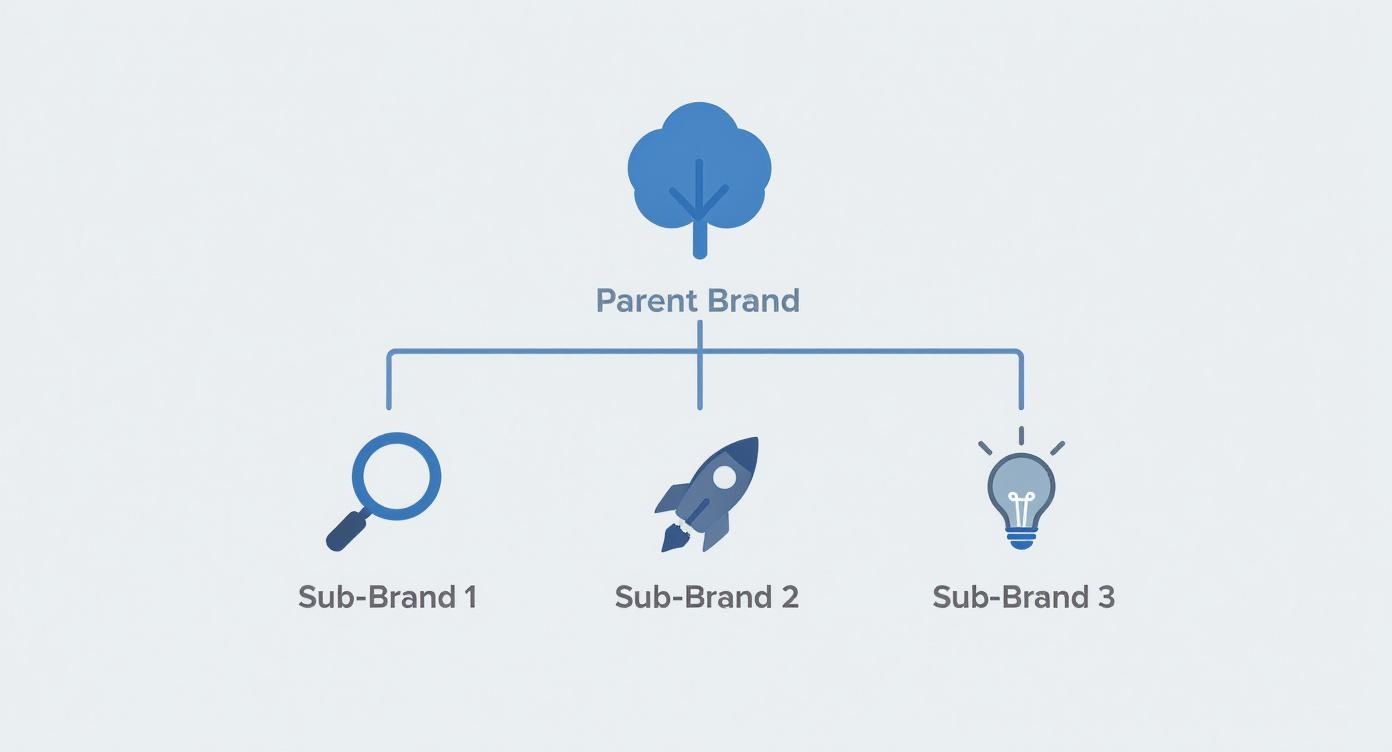
The diagram highlights that while sub-brands have their own focus—represented by unique icons for search, growth, and ideas—they all originate from the same parent brand, the foundational tree.
Endorsed Brands: A Stamp of Approval
The Endorsed Brands model offers a middle ground. Here, sub-brands have their own distinct identities but get a visible nod of approval from the parent brand. Think of Marriott, which endorses a whole range of hotel brands like Courtyard by Marriott and Fairfield by Marriott. The parent brand provides a quiet vote of confidence, lending its credibility and trust.
This "stamp of approval" helps new sub-brands gain traction much more quickly. It tells consumers, "You may not know this new brand yet, but you know and trust us." This strategy is particularly effective when you're entering new markets or launching products that need an extra layer of reassurance. For more on how this works for non-physical products, our guide on the branding of services offers some valuable perspectives.
A well-structured brand architecture does more than just organize your portfolio; it can lead to 3.5 times more visibility in the market compared to businesses with a confusing or undefined structure.
The Hybrid Model: The Best of Both Worlds
Finally, the Hybrid Model mixes and matches elements from the other architectures. This flexible approach is common for large corporations that have grown through mergers and acquisitions over time. The Coca-Cola Company is a perfect example. It uses a branded house approach for its core products (Diet Coke, Coke Zero) while also managing a house of brands with completely independent names like Minute Maid and Powerade.
This model allows for maximum adaptability but requires careful, disciplined management to maintain clarity. It’s a pragmatic solution for complex companies navigating diverse markets. By choosing the right elements for each situation, a hybrid structure can support a wide range of business goals, from reinforcing a core identity to launching stealth brands in new sectors.
Before we move on, here's a quick summary of the four models to help you see how they stack up against each other.
Brand Architecture Models at a Glance
| Architecture Model | Core Concept | Key Benefit | Best For |
|---|---|---|---|
| Branded House | One master brand dominates all sub-brands (e.g., Google). | Builds strong, unified brand equity and loyalty. | Companies with a strong, single value proposition across all offerings. |
| House of Brands | A portfolio of distinct, standalone brands (e.g., P&G). | Allows for targeted market segmentation and contains risk. | Businesses targeting diverse customer segments with unique needs. |
| Endorsed Brand | Sub-brands have their own identity but are endorsed by the parent (e.g., Courtyard by Marriott). | Lends credibility to new offerings while allowing them to stand apart. | Expanding into new markets or launching products that benefit from a trust signal. |
| Hybrid Model | A mix of Branded House and House of Brands strategies (e.g., Coca-Cola). | Offers flexibility to adapt to complex market conditions and acquisitions. | Large, diversified corporations managing a wide range of products and brands. |
Each of these models offers a different path forward. Selecting the right one is a foundational decision that demands a deep understanding of your business goals, target audiences, and long-term vision. Need help choosing the right model? Contact us for a strategic consultation.
Real-World Examples of Winning Sub-Brand Strategies

It’s one thing to understand brand architecture in theory, but seeing it drive real-world success makes the whole concept click. The most effective brands with sub-brands don't just cook up new logos; they build strategic ecosystems where every brand has a specific, calculated role to play.
Let's look at how theory translates into market dominance and a healthier bottom line. By digging into how a few iconic companies manage their portfolios, you can see the direct line between a smart architecture and serious growth.
Toyota and Lexus: Mastering Market Segmentation
Toyota Motor Corporation offers a masterclass in using sub-brands to conquer different market segments without muddying its core identity. For decades, the Toyota name has stood for reliability, efficiency, and value. That reputation is a massive asset, but it’s also a ceiling when you want to play in the high-end luxury market, where prestige is the name of the game.
So, what did they do? In 1989, Toyota launched Lexus. This wasn't just a new car; it was an entirely new brand, meticulously crafted from the ground up to go head-to-head with the established European luxury giants.
By creating a distinct sub-brand, Toyota put a protective ring around its core identity. Lexus was free to build its own narrative of sophisticated design and premium features, while Toyota could keep owning the dependability story for the mass market.
The move was a monumental success. It allowed Toyota to capture a lucrative customer base that would have never considered a car with a Toyota badge, no matter how well-made it was. Lexus quickly became the top-selling luxury import brand in the US, a position it held for 15 consecutive years, demonstrating the incredible power of this strategy.
Levi Strauss & Co.: Weaving a Multi-Tiered Apparel Empire
In the brutal world of fashion, trying to be everything to everyone is a recipe for disaster. One of California's most prominent examples of a brand with multiple sub-brands, Levi Strauss & Co., has expertly navigated this for decades. The core Levi's brand is an American icon, but its classic, rugged appeal doesn't fit every price point or consumer style.
To cast a wider net, the company strategically deployed other brands. Dockers, for example, was created to own the business-casual space—a segment where the denim-focused Levi's brand just didn't have the same authority. This approach lets it capture diverse slices of the apparel market, from premium denim to everyday casual wear.
Even with a varied portfolio, the core remains strong. The Levi's namesake label recently drove a 5% revenue growth, its best in two years, proving that a focused primary brand supported by a diverse portfolio is a powerful combination. You can read more about the trends shaping California's top fashion brands.
This strategy shows how sub-brands can be used to:
- Enter adjacent markets where the parent brand lacks credibility.
- Target different price points without devaluing the premium core offering.
- Speak to different consumer lifestyles all under one corporate roof.
Honda and Acura: A Tale of Performance and Prestige
Much like Toyota, Honda built its global reputation on bulletproof reliability, fuel efficiency, and clever engineering. When it decided to jump into the North American luxury and performance arena, it hit the same perception wall. Their solution? Acura, launched in 1986 as Honda's luxury division.
Acura was carefully positioned to blend performance with refinement, targeting a younger, more dynamic luxury buyer than Lexus aimed for. This new sub-brand gave Honda a playground to introduce advanced technologies and sportier designs that might have felt out of place under the practical Honda banner.
The key takeaway here is that sub-brands can act as innovation hubs. They create a safe space to explore new brand promises—like performance-oriented luxury—while the parent brand sticks to its consistent, trusted identity. The success of brands with sub-brands like Acura proves that a carefully positioned offshoot can forge its own powerful identity while contributing significantly to the parent company's market share and profit.
As you can see, a winning sub-brand strategy isn't just about diversification. It's a precision tool for targeted growth, risk management, and market leadership.
Ready to build a brand architecture that drives measurable results? Contact us today to discuss how a tailored sub-brand strategy can unlock your company's full potential.
When to Launch a New Sub-Brand
Deciding to launch a sub-brand is a major strategic move, not just another marketing tactic. Think of it like building an extension on your house—get it right, and you create valuable new space for growth. Get it wrong, and you can weaken the entire foundation.
So, how do you know when it’s the right time to start construction?
The decision demands a clear-eyed look at your goals, your customers, and your market. It’s a choice that goes far beyond designing a new logo. A sub-brand needs its own resources, budget, and strategic focus to have any chance of succeeding.
Rushing in without a clear purpose can confuse customers, drain your resources, and dilute the hard-earned equity of your parent brand. A confident, data-backed decision is non-negotiable.
Strategic Triggers for a New Sub-Brand
Certain business challenges are strong signals that a sub-brand might be the best path forward. If you find yourself nodding along to one or more of these scenarios, it’s time to give the idea serious thought. These are the moments when a single master brand starts to feel restrictive rather than powerful.
A thoughtfully organised brand architecture can deliver 3.5 times more visibility in the market. This isn't just about adding another name to your portfolio; it's about strategically amplifying your overall market presence and clarity.
Ask yourself and your leadership team these critical questions to see if a sub-brand is the right solution for your company's next phase of growth.
- Are you targeting a completely different customer? If a new product is for an audience with different needs, values, and buying habits than your core customers, a sub-brand can speak their language without alienating your existing base.
- Does the new offering carry unique risks? When venturing into an unproven market or launching a high-risk product, a sub-brand acts as a strategic firewall. It protects the parent brand’s reputation if the new venture doesn't pan out.
- Is a different price point causing conflict? Introducing a much cheaper or a premium luxury offering under your master brand can create confusion and devalue your core products. A distinct sub-brand lets you compete at different price tiers without muddying the waters. Toyota did this perfectly when it created Lexus to enter the luxury market—a space where the main Toyota brand's value-focused image would have been a hindrance.
- Do you need to break into a new market category? If your parent brand is strongly associated with one specific industry (like "reliable family cars"), launching a sub-brand can give you the credibility to enter a completely different one (like "performance sports cars").
Weighing the Benefits Against the Costs
The potential rewards of launching a sub-brand are huge. You can dial in your messaging, capture new market segments, and foster innovation in a protected space. But these benefits come with significant costs that you absolutely have to factor into your decision.
Launching and supporting a new brand is a resource-intensive effort. You’ll need a dedicated budget for everything from brand development and trademarking to marketing campaigns and staffing. It also introduces a new layer of complexity to your operations.
Before you even think about moving forward, you need to perform a detailed market assessment. A crucial part of this is figuring out where your potential new brand would fit in the competitive landscape, which is why learning how to conduct competitor analysis is a non-negotiable first step.
Ultimately, the decision to launch a sub-brand boils down to one core idea: creating focused value. If a new brand allows you to serve a specific audience in a way your parent brand simply can't, the investment can unlock powerful new avenues for growth for all brands with sub brands in your portfolio.
Ready to determine if a sub-brand is the right strategic move for your business? Contact us to help you analyse the opportunities and build a data-backed plan for your brand's future.
Building and Governing Your Brand Portfolio

A brilliant brand strategy is only as good as its execution. Once you’ve made the call to launch a new sub-brand, the real work begins. The goal isn’t just to add another logo to the family, but to build a powerful, cohesive portfolio where each brand thrives on its own while making the parent company stronger.
This requires a deliberate approach to both implementation and governance. Without clear rules and consistent management, even the most promising collection of brands with sub brands can descend into chaos. You risk customer confusion, internal competition, and a watered-down brand. A clear roadmap is essential for long-term success.
Creating a Distinct Brand Identity
First things first: your new sub-brand needs its own unique identity. This goes far beyond a logo and a colour palette; it’s about carving out its core purpose and personality. A strong identity ensures the sub-brand can connect with its specific audience on its own terms, without leaning too heavily on the parent.
To get there, you have to develop a clear and compelling value proposition. It needs to answer one simple question for the customer: "What’s in it for me?" Our guide on how to write a value proposition offers a structured way to craft this critical message. This distinct promise is what will set your sub-brand apart from competitors and, just as importantly, from its own parent brand.
Establishing Clear Governance Guidelines
With a solid identity in place, the next job is to establish the rules of engagement for your entire brand family. This is where governance comes in. Think of a brand governance model as a formal system that outlines how all the brands in your portfolio should interact with each other and present themselves to the world.
It’s basically a constitution for your brand family. It should clearly define:
- Visual Identity Systems: Specify how logos, typography, and colour palettes should be used for the parent brand and each sub-brand. This maintains consistency while still allowing for distinction.
- Messaging and Tone of Voice: Document the unique voice, personality, and key messaging pillars for each brand. This ensures they communicate a consistent story to their specific audiences.
- Brand Relationship Rules: Clarify how sub-brands relate to the parent. Is it an endorsed relationship like "Courtyard by Marriott," or a standalone one like P&G’s Tide? These rules prevent overlap and confusion.
A well-governed portfolio ensures that as you add more sub-brands, you are building a stronger, more organized structure, not just a bigger, more complicated one. The goal is synergy, not sibling rivalry.
This disciplined approach is what allows massive companies to manage incredibly complex portfolios without ever losing control.
Learning from the Masters of Brand Portfolios
Entertainment giants like Disney showcase the immense power of a well-governed sub-brand portfolio. The company masterfully manages iconic names like Pixar, Marvel, and Lucasfilm, each with its own fiercely loyal fanbase and distinct identity. Yet, they all contribute to the overarching Disney magic.
The secret to Disney’s success lies in its governance. Marvel stays edgy and action-packed, while Pixar focuses on heartfelt, family-friendly storytelling. These boundaries are crystal clear and strictly respected, which prevents brand dilution and allows each sub-brand to dominate its niche. The structure has been wildly profitable, with the Marvel Cinematic Universe alone generating over $29 billion in global box office revenue.
This proves that with the right framework, a family of brands can be far more powerful than a single entity. By defining each brand's role, establishing clear guidelines, and managing the portfolio with discipline, you can build a resilient and valuable asset that drives long-term growth.
Common Questions About Sub-Branding
Deciding to grow your brand family always kicks up some tough questions. I've seen leaders wrestle with the strategy and the day-to-day headaches that come with managing more than one brand. This section tackles those lingering uncertainties head-on, giving you clear answers so you can move forward with confidence.
Let's clear up the line between a product and a brand, figure out how to protect the equity you've worked so hard to build, and make sure your growth is built to last.
When Does a New Product Need to Become a Sub-Brand?
An offering should graduate from a simple product line to a full-on sub-brand when it’s chasing a totally different audience or making a promise your core brand can’t. Think about it: if your parent brand's reputation could actually hold the new product back—like a budget-friendly brand trying to crack the luxury market—a sub-brand isn't just an option; it's a necessity.
Here’s a simple way to look at it: if you're just creating a variation for your existing customers, a product line usually does the trick. But if you’re trying to tell a whole new story to a new crowd, you need a new brand to tell it. A smart sub-brand can open up massive new revenue streams. Just look at Toyota, which launched Lexus to capture the high-end luxury market—a space its core brand simply couldn't touch.
Good brand architecture isn’t just about being organised; it’s about being understood. Research shows that companies with a clear brand framework achieve 3.5 times more visibility than those without one. That's the power of a well-defined portfolio.
Making this distinction is vital. It keeps your parent brand's integrity intact while giving the new venture the room it needs to breathe and succeed on its own.
How Do You Stop a Sub-Brand from Competing with the Parent Brand?
Preventing your brands from eating each other's lunch—a classic case of cannibalisation—comes down to sharp, disciplined positioning. The secret is giving each brand in your portfolio its own distinct "swim lane," defined by a unique audience, price point, and value proposition. When you get this right, your brands work together to dominate the market instead of fighting over the same customers.
Honda, for instance, created Acura to go after the North American luxury and performance segment. The practical, reliable Honda brand just didn't have the same credibility there. Acura’s focus on performance-oriented refinement was so different from Honda’s core promise that the two could thrive side-by-side without poaching each other's sales. The strategy worked: in just its second year, Acura outsold every European luxury import brand in the US.
To pull this off, you need to create clear governance guidelines that map out the territory for each brand. Think of it as an internal rulebook that details:
- Specific customer personas for each brand.
- Defined price ranges and product features.
- Unique messaging pillars and tone of voice.
This strategic separation lets you own multiple market segments at once, turning potential internal conflict into a powerful market advantage.
What Are the First Legal Steps to Protect a New Sub-Brand?
The absolute first thing you must do to legally protect a new sub-brand is a thorough trademark search. This step ensures the name, logo, and other identifiers you've chosen are actually available and won't land you in hot water. Skipping this can lead to incredibly expensive legal fights and even force you to rebrand entirely down the road.
Once you’ve confirmed the name is clear, you need to file for trademark registration with the right intellectual property offices, like the Canadian Intellectual Property Office (CIPO) here in Canada. Securing that registration gives you exclusive legal rights to your new brand identity, stopping anyone else from using a similar name or logo that could confuse your customers.
Protecting your sub-brand isn’t just a legal checkbox; it's a core business decision. It safeguards the investment you're pouring into building the brand's identity and reputation, ensuring it remains a distinct and valuable asset in your portfolio.
Navigating the world of brand architecture takes a clear vision and real expertise. At B2Better, we partner with businesses to build powerful brand portfolios that drive real growth and market leadership. If you're ready to see how a sub-brand strategy can open up new doors for your business, we're here to help.
Contact us today to build a brand architecture that delivers results.