

When you’re selling a service, your expertise is invisible. Clients can't see it, touch it, or test it out before they commit. This is where branding comes in. For service businesses, branding isn’t about flashy logos; it's the disciplined work of building a reputation that screams trust, credibility, and consistent value, making your intangible expertise feel solid and real. It’s what turns your service from just another option into the solution.
Why Branding Is Your Strongest Competitive Edge
Unlike a physical product, a service is an experience delivered by people. Your brand is the promise you make and, more importantly, the feeling a client is left with after every single interaction. In hyper-competitive North American markets like tech and professional services, where expertise is everything, a strong brand becomes your most defensible asset. A study by McKinsey found that B2B companies with strong brands outperform weaker ones by up to 20% in shareholder returns.
Think about a major success story like Deloitte. Clients in Toronto or New York don’t hire them just for their slide decks. They hire them for the certainty and prestige the firm’s name represents. That reputation is built piece by piece through consistent delivery, sharp thought leadership, and an impeccable client experience—all core elements of strategic service branding.
Turning Intangibles into Trust
The number one job of a service brand is to build trust. Since clients can't kick the tires on your work beforehand, they look for signals to reduce their risk. A cohesive, professional brand is the ultimate reassurance that they’re making the right choice.
Here’s how it works:
- It Screams Professionalism: A well-defined brand identity—from your website to your proposals—tells prospects you're a serious, buttoned-up organization.
- It Sets Clear Expectations: Your brand messaging clarifies exactly what clients can expect, creating a benchmark for the entire service experience.
- It Builds an Emotional Connection: Branding helps clients connect with your company's purpose and values, fostering loyalty that lasts long after a project ends.
A strong brand delivers a consistently positive experience, which is the lifeblood of any service-based business. In fact, consistently presented brands are 3 to 4 times more likely to achieve brand visibility. That visibility is critical for attracting high-value B2B clients looking for a reliable partner, not just another vendor.
From Commodity to Premium Solution
Without a distinct brand, professional services can quickly become commoditized, forcing you into a race to the bottom on price. Strong branding lets you anchor your value in outcomes and expertise, giving you the power to command a premium.
A perfect example is the global success of Accenture. While countless firms offer IT and consulting services, Accenture's powerful brand—built on a reputation for innovation and large-scale digital transformation—allows them to attract the most lucrative enterprise-level contracts, far outpacing competitors on value, not just price.
Ultimately, branding in the service world is about proactively shaping perceptions and managing your reputation. It’s the invisible force that converts prospects into clients and clients into your most passionate advocates.
Ready to build a brand that elevates your service business and attracts the clients you deserve? Contact us today to learn how our strategic approach can give you a competitive edge.
Building Your B2B Service Brand Foundation
A powerful B2B service brand doesn't just happen. It’s built brick by brick with a solid, strategic foundation. We're moving beyond fuzzy ideas here and getting into the core components that shift your company from just another vendor into the only logical choice for your ideal clients.
It all starts with claiming your unique space in the market.
This process, known as brand positioning, is about finding a defensible spot where your firm's expertise and approach are truly distinct. For service businesses swimming in competitive North American markets, this isn't a fluffy marketing exercise—it's a survival imperative.
Think about it: a remarkable 86% of buyers are willing to pay more for a great customer experience, proving how you position your service delivery matters immensely.
Defining Your Unique Value
Once you've carved out your position, the next step is to shout it from the rooftops with a compelling value proposition. This is your clear, concise promise of the value you deliver, and it must speak directly to the challenges keeping your B2B clients up at night.
Your value proposition answers their most pressing question: "Why should I choose you?"
Crafting this statement demands real empathy for your customers. To get this crucial step right, check out our guide on how to write a value proposition. A well-defined proposition becomes the north star for every single marketing and sales effort you make.
This visual shows how B2B clients perceive service brands, starting with trust as the bedrock and building toward a premium status.
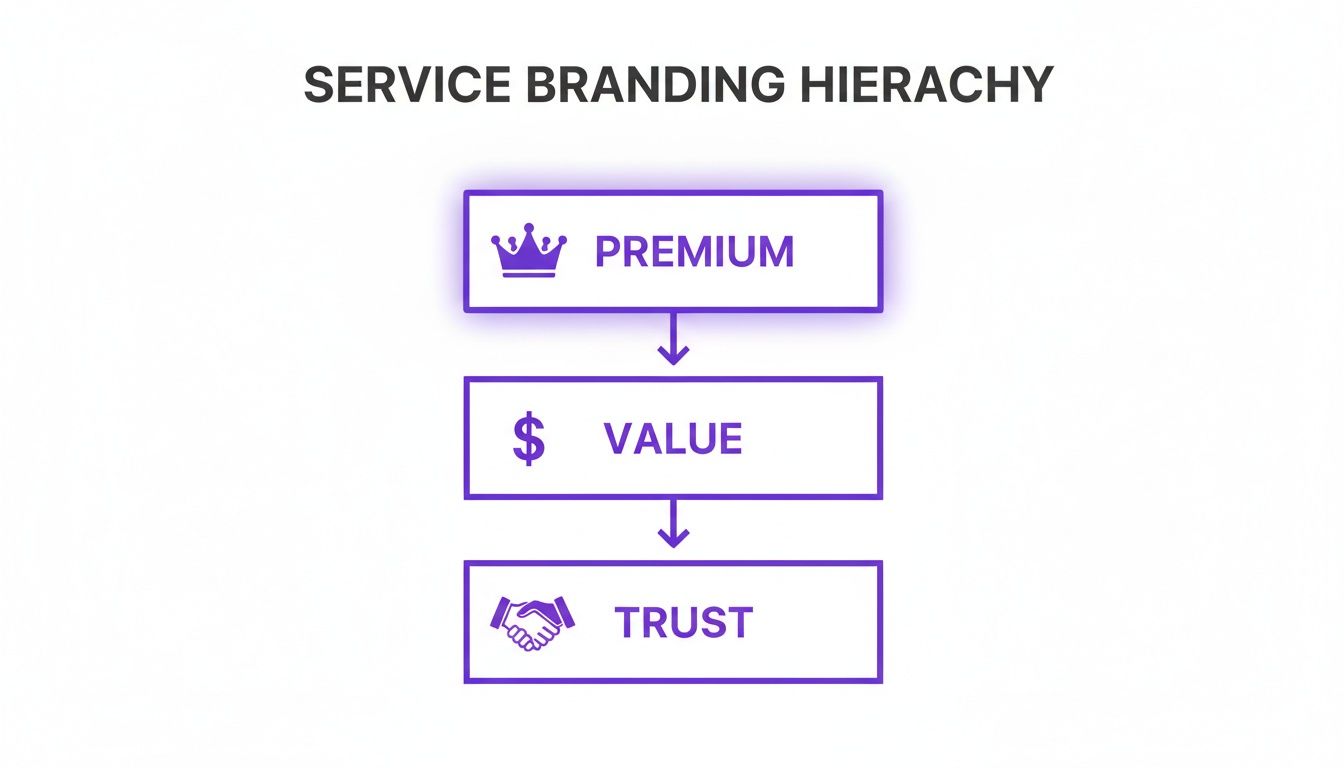
As you can see, without that foundational trust, it's impossible to be seen as a high-value partner or command premium pricing.
Understanding Your Ideal Client
The final piece of your foundation is developing detailed buyer personas. These are semi-fictional profiles of your ideal clients, pieced together from market research and real data.
Personas help you get inside the heads of the key decision-makers you need to influence, uncovering their motivations, pain points, and buying triggers.
Building a strong B2B service brand today leans heavily on managing your digital presence. Resources on AI reputation management for consultants offer some great insights into protecting and enhancing your brand's image in a crowded online world.
By combining sharp positioning, a crystal-clear value proposition, and a deep understanding of your customer, you establish a powerful brand identity before you spend a single dollar on a campaign. This foundational work ensures all your future marketing efforts are focused, efficient, and actually work. Contact us to start building your brand's strategic foundation today.
Designing a Signature Client Experience
For any service business, the client experience isn't just part of the brand—it is the brand. Every single email, phone call, and project update is a chance to either reinforce the promises you’ve made or start chipping away at them. This is where you move branding from an abstract idea into tangible, memorable value.
Designing a signature client experience is what separates the commodity providers from the true premium partners.

After all, research shows that 80% of customers say the experience a company provides is as important as its products or services. In a B2B context, that means proving you have a deep, proactive understanding of a client's business, not just during the sales pitch, but at every single stage of your relationship.
Mapping Every Brand Touchpoint
The first step is to map every single interaction a client could possibly have with your firm. This process, known as service touchpoint mapping, gives you a bird's-eye view of the entire customer journey. It starts the moment they first hear about you and continues long after a project is complete.
A touchpoint map lets you pinpoint the key moments where your brand can either shine or falter. Think about these common B2B interactions:
- Initial Discovery: A prospect’s first visit to your website.
- Sales Process: The initial discovery call and proposal presentation.
- Onboarding: The formal client kickoff meeting.
- Project Delivery: Milestone reviews and the final handoff.
- Ongoing Support: Follow-up calls and future check-ins.
By analyzing each of these points, you can standardize excellence and infuse your brand promise into every action. A great client experience isn't just about avoiding mistakes; it’s about creating moments of unexpected value. To dive deeper into this, check out our guide on how to drive your customer experience.
Success Story: Differentiating Through Experience
Consider the great success of American financial services firm Charles Schwab. While many firms offered similar investment products, Schwab differentiated itself by branding its entire client experience around accessibility and education. They invested heavily in customer service, transparent pricing, and educational resources, building a brand synonymous with client empowerment. This experience-led approach transformed them from a discount broker into a trusted financial partner for millions, demonstrating that how you deliver your service is the most powerful brand differentiator.
By focusing on the experience, a firm can transform its brand from "another vendor" to "a strategic partner." This is a perfect example of service branding in action.
Your team is the most critical vehicle for delivering this branded experience. Every employee, from sales to project management, must understand and embody the brand promise. It's that consistency that turns satisfied clients into loyal advocates who drive referrals and repeat business for years to come. Ready to design an unforgettable client experience? Contact us to get started.
Connecting Your Brand to Lead Generation
A powerful brand is only an asset if it actually drives business. The real test of branding in services is turning that well-crafted identity into a predictable pipeline of qualified leads. It’s about taking your brand promise off the page and transforming it into a digital presence that consistently attracts and converts your ideal B2B clients in the United States and Canada.

This starts by making sure all your digital channels—your website, content, and social media—are singing from the same hymn sheet. Every article, every post, every download should act as a magnet for your buyer personas, pulling them in with valuable insights that cement your expertise.
Translating Brand Identity into Digital Performance
For most service businesses in North America, SEO is non-negotiable. When you target brand-aligned keywords, you ensure prospects find your firm when they’re searching for solutions, not your competitors. This goes beyond technical tweaks; it’s about creating thought leadership that answers your clients' most urgent questions, positioning your brand as the go-to resource in your field.
To effectively connect your brand with new prospects, you need to implement targeted and data-driven methods, like the ones found in these B2B lead generation strategies. A consistent message builds trust, and trust is what boosts conversion rates across all your marketing efforts.
The digital advertising space in the United States is also booming. A recent report showed that B2B digital ad spending in the US is projected to reach $14.5 billion. Combine that with transactional spikes during key periods, and you’ve got powerful windows for targeted campaigns. For B2B service firms, this underscores the need to invest in focused digital channels and local SEO to capture buyer intent in major hubs like New York, Chicago, and San Francisco.
A strong brand acts as a performance multiplier. A consistently presented brand can increase revenue by up to 23%. When your branding is clear and authoritative, every lead generation dollar you spend simply works harder.
Creating a Predictable Sales Pipeline
Ultimately, the goal is a system where your brand consistently delivers qualified opportunities right to your sales team. You get there by mapping your brand messaging to each stage of the buyer's journey and using the right channels to deliver it.
This integrated approach turns your brand from a cost centre into a true revenue driver. For a closer look at how this works in practice, you can review a list of powerful marketing tactics examples that bring a brand strategy to life.
Ready to connect your brand to a reliable stream of high-quality leads? Contact us to learn how a strategic digital presence can build your sales pipeline.
How to Play the Home-Field Advantage in Canada
For B2B service firms rooted in Canada, your location isn’t just a mailing address—it’s a powerful competitive edge. In major hubs like Toronto, Vancouver, and the Kitchener-Waterloo corridor, B2B buyers are showing an undeniable preference for homegrown providers. This creates a massive opening for brands that lean into their Canadian identity.
This isn’t just about national pride; it’s a tangible shift in buying behaviour. When you weave a "Canadian-owned" or "local expert" narrative into your brand, you’re tapping into a deep-seated desire to work with partners who truly get the local landscape. It’s an instant shortcut to building a connection based on shared culture and economic alignment.
Tapping into the Canadian Brand Premium
Emphasizing your local presence lets you highlight real-world benefits that American or international competitors simply can’t offer. These value propositions are critical differentiators, especially when it comes to branding in services, where trust and local knowledge are everything.
Here are the key advantages to put front and centre:
- Regulatory Smarts: Deep expertise in Canadian compliance, privacy laws like PIPEDA, and the complex regulations governing your specific industry.
- Data Sovereignty: The peace of mind that comes from knowing sensitive client data is stored and managed securely within Canadian borders.
- Cultural Fluency: An intuitive grasp of Canadian business etiquette and communication styles—no awkward cultural missteps.
- Bilingual Capabilities: The ability to serve clients seamlessly in both English and French, a non-negotiable for any national campaign.
By focusing on these points, your brand stops being just another service provider and becomes a localized, expert partner.
The Data Backs It Up
The value of a strong national identity is crystal clear. In 2023, the combined worth of Canada’s top 40 most valuable brands soared to US$211.8 billion, marking a 10% jump from the previous year. A prime success story is Shopify, which leveraged its Canadian roots and understanding of the global e-commerce landscape to become a dominant player, trusted by businesses worldwide.
With 56% of Canadians planning to buy more from local businesses, regional firms are perfectly positioned to win market share. For B2B companies, articulating a clear Canadian value proposition can dramatically shorten sales cycles and boost your perceived value. You can dig deeper into these trends and the strength of Canadian brands on Kantar.com.
A strong local brand isn't just about patriotism; it's a strategic tool. It reassures Canadian clients that you understand their world, their challenges, and their opportunities better than any outside firm ever could.
This local positioning transforms your service from a commodity into a trusted partnership. It’s a powerful way to build a brand that resonates deeply within the Canadian B2B market and fuels sustainable growth.
Ready to build a brand that cashes in on your Canadian advantage? Contact us today to see how a tailored brand strategy can shorten your sales cycle and connect you with high-value local clients.
Putting Your Brand Strategy into Action
Having a brilliant brand plan is one thing. Actually bringing it to life is what separates the winners from the rest.
For many growing B2B service firms across Canada and the United States, the biggest hurdle is a lack of senior marketing expertise to drive the strategy forward. It’s a classic chicken-and-egg problem, but there’s a practical and powerful solution.
The Fractional CMO model offers you C-level marketing leadership on a flexible, part-time basis. It’s built for businesses that need high-level strategic direction for their brand without the cost and commitment of a full-time executive.
A Modern Solution for Brand Execution
A Fractional CMO steps in to own your entire brand implementation, from the foundational strategy right through to campaign execution and performance measurement. They provide the leadership needed to turn your brand vision into a predictable growth engine.
This isn’t just a trend; it's a strategic answer to the needs of modern business. You get access to top-tier talent and experience precisely when you need it, ensuring your brand investment delivers a real return.
Bringing in senior expertise can have a significant impact. According to the U.S. Small Business Administration, companies that receive expert mentorship have a significantly higher survival rate, with 70% surviving more than five years—nearly double the rate of non-mentored businesses. This same principle applies to brand strategy execution.
This flexible approach makes high-level brand leadership both accessible and cost-effective. It's the ideal path for North American B2B firms ready to get measurable results. A Fractional CMO ensures your brand strategy doesn't just sit on a shelf—it gets put into action.
If you're ready to build a brand that drives real revenue, contact us to see how a tailored Fractional CMO engagement can help you achieve your goals.
Got Questions About Service Branding? We've Got Answers
What’s the Very First Step in Service Branding?
It all starts with brand positioning. Before you even think about logos or taglines, you need to carve out a unique, defensible space in the market. The goal is to make your expertise the only logical choice for your ideal B2B clients in the United States and Canada. Get your clarity first, then get creative.
How Is B2B Service Branding Different from Product Branding?
When you’re branding a product, you can lean on tangible features and physical attributes. But branding for a service business is a different game entirely—it’s about building trust and proving the value of something your clients can’t see or touch. The focus shifts to the client experience, your team's expertise, and consistently delivering on what you promise.
How Does Branding Actually Help with Lead Generation?
A strong brand is your best salesperson. It builds authority and trust long before a prospect ever talks to your team. When potential clients in key North American markets recognize and respect your brand, they’re far more likely to engage with your content, believe in your expertise, and ultimately, convert into qualified leads. Your brand stops being just a "look" and becomes a reliable engine for growth.
Is It a Good Idea to Emphasize Our Canadian Identity?
Absolutely. Leaning into your Canadian roots can be a powerful move for businesses targeting the Canadian market. Recent data from Statistics Canada shows that 20.8% of Canadian businesses are actively shifting their marketing to promote domestic services. This isn't just a trend; it taps into a clear buyer preference for local expertise. You can dig into the full Statistics Canada report on Canadian business trends for more on that.
Ready to transform your service business with a brand that drives predictable growth? The expert team at B2Better is here to help. Contact us today to schedule a consultation.