

A sub-brand is your secret weapon for growth. It’s a distinct, secondary brand you create that’s clearly linked to your parent company but built to conquer a specific niche or market segment. For established B2B companies, it's a powerful way to expand into new territory without diluting the hard-won strength of your core identity. This lets you tailor your messaging and positioning while still drafting off the parent brand's reputation.
The B2B Growth Dilemma and The Sub-Brand Solution
Sooner or later, many B2B leaders in Canada and the United States hit a growth ceiling. You ask yourself: How do we break into new markets, serve a super-specific customer, or launch a totally different service model without confusing our existing clients or weakening the brand equity we’ve spent years building?
That’s the expansion puzzle that keeps CEOs and marketing heads up at night.
The answer often lies in a smart sub-brand strategy. Think of your main company as a master toolkit—trusted, reliable, and known for exceptional quality. Your sub-brands are the specialized instruments inside that kit, each one perfectly designed for a precise job. This structure lets tech, SaaS, and industrial firms keep their core reputation intact while deploying targeted solutions for new opportunities.
Why This Strategy Works for North American B2B Companies
In B2B, a one-size-fits-all message almost never works. A sub-brand lets you craft a separate identity with its own unique voice, value proposition, and go-to-market plan that connects deeply with a new buyer persona. For instance, a software company known for its enterprise-level solutions could launch a sub-brand aimed at startups, using completely different pricing, features, and marketing channels.
This kind of precision is incredibly valuable. In the competitive Canadian market, sub-brands are a powerhouse for major corporations. The Royal Bank of Canada (RBC) topped the Kantar BrandZ Most Valuable Canadian Brands report for the sixth year in a row in 2023 with a brand value of US$35.6 billion. RBC uses sub-brands like RBC Wealth Management and RBC Ventures to zero in on specific B2B segments, enabling customized messaging for founders and CEOs who need scalable revenue strategies. You can discover more insights about Canada's most valuable brands on Kantar.com.
A well-executed sub-brand strategy isn’t just about creating a new logo. It's about building a focused business unit designed to capture a specific market opportunity with maximum impact. It balances the security of the parent brand with the agility of a new venture.
Understanding Your Architectural Options
Before you dive in, it’s crucial to understand where a sub-brand fits within the wider world of brand architecture. Each approach serves a different strategic purpose, and picking the right one from the start is half the battle.
To help you see the options clearly, here’s a quick comparison of the core branding approaches.
Brand Architecture At-a-Glance
| Strategy Type | Core Concept | Best For… | Example |
|---|---|---|---|
| Branded House | A single master brand with descriptive sub-brands. | Companies with strong brand equity and similar target audiences. | Google (Google Maps, Google Docs) |
| House of Brands | A portfolio of distinct, individual brands. | Companies serving diverse markets with no brand overlap. | Procter & Gamble (Tide, Gillette) |
| Hybrid Model | A mix of Branded House and House of Brands strategies. | Companies that have grown through acquisition or serve both distinct and related markets. | Microsoft (Microsoft Azure, Xbox) |
Each of these models has its place. A Branded House works when your offerings are closely related, while a House of Brands is ideal for managing a diverse portfolio where you don't want the brands to be associated.
This guide will focus on the hybrid approach, specifically on creating endorsed sub-brands that help you grow methodically and strategically.
Ready to explore how a sub-brand strategy could solve your growth challenges? Contact us today to speak with our team and build a branding framework that delivers measurable results.
Decoding Your Brand Architecture Options
Before you build a house, you need a blueprint. The same logic applies to your brand. Making a strategic choice about your brand architecture—the underlying structure that organizes your company, products, and services—is the foundational step that dictates how you grow, how customers perceive you, and how efficiently you can operate.
This structure isn't just an organizational chart for your marketing department; it's the strategic framework that defines the relationship between your parent company and any new ventures. For B2B companies in Canada and the United States, getting this right prevents market confusion, preserves brand equity, and creates a clear path to expansion.
Let's explore the three core models.
The Branded House: A Family Affair
Imagine a family where everyone shares a powerful, well-respected last name. That’s the Branded House model. Here, a single master brand acts as the dominant force, and all products or services are presented as extensions of it, often with descriptive names.
Google is the classic example. Google Maps, Google Ads, and Google Workspace all benefit from the immense trust and recognition of the parent brand. The connection is direct and intentional.
- Pros: This model is incredibly efficient. Marketing efforts for the master brand automatically lift all the sub-brands, creating a powerful halo effect. It builds a unified market presence and simplifies the customer journey.
- Cons: The risk is concentrated. If one sub-brand fails or faces a PR crisis, it can tarnish the entire family's reputation. This model can also feel restrictive if you need to enter a market that is fundamentally different from your core audience.
The House of Brands: A Portfolio of Stars
Now, picture a holding company that owns a diverse portfolio of independent businesses, each a star in its own right. This is the House of Brands architecture. The parent company often remains invisible to the public, allowing each brand to cultivate its own unique identity, target audience, and market position.
Procter & Gamble (P&G) is the quintessential example. Most consumers buy Tide, Gillette, and Pampers without ever thinking about P&G. Each brand stands entirely on its own, with a distinct promise and personality.
- Pros: This structure allows for maximum market penetration across different segments without brand conflict. It also insulates brands from one another; a failure in one area doesn't impact the others.
- Cons: It's expensive. Each brand requires its own dedicated marketing budget, team, and strategy. There are few, if any, cross-promotional efficiencies to be gained.
The Hybrid Model: The Best of Both Worlds
The Hybrid model is exactly what it sounds like: a flexible mix of the first two approaches. For scaling B2B companies, it's often the most practical choice. It allows a business to use endorsed sub-brands that borrow credibility from the parent while carving out their own distinct space. This brand-sub-brand relationship is all about balance.
Microsoft is a master of this strategy. The parent brand "Microsoft" endorses specific sub-brands like Azure, which has its own identity tailored to developers and IT professionals. At the same time, it owns completely separate brands like Xbox, which operates in a totally different market.
A hybrid strategy offers a strategic advantage: it allows a company to leverage its established reputation where it helps and create distance where it's necessary. This adaptability is key for navigating complex B2B markets.
Studies show that companies with well-defined brand architectures see stronger financial performance. According to Interbrand, a strong brand can account for more than 20% of a company's market capitalization, and choosing the right model—Branded House, House of Brands, or Hybrid—is a critical decision that directly impacts that value. To dive deeper into these structures, you can learn more about the Branded House vs House of Brands models in our detailed guide.
Understanding these blueprints is the first step. The next is deciding which one aligns with your specific business goals, risk tolerance, and resources.
Is your brand architecture built for growth? Contact us to assess your strategy and build a framework that drives real business results.
The Strategic Framework for Launching a Sub-Brand
Okay, you’ve debated the theory. Now it’s time to get real. Deciding to actually launch a sub-brand is where the conversation shifts from “what if” to “how.” For B2B leaders across Canada and the United States, this isn’t just a branding exercise—it's a major business decision demanding a clear-headed, logical framework.
A solid decision-making process validates the need for a sub-brand before a single dollar is spent on design. It’s the same disciplined approach a strategic partner would take, grounding the choice in business reality, not just creative impulse.
Key Questions to Guide Your Decision
Before you commit any resources, your leadership team needs to wrestle with a few critical questions. Each answer tells you whether a sub-brand is a strategic necessity or an expensive distraction.
- Is this new market opportunity genuinely distinct? If you’re chasing a new industry, buyer persona, or price point your parent brand just can’t reach, a sub-brand makes a lot of sense. Think of a Canadian manufacturing software firm known for enterprise solutions creating a sub-brand for small fabrication shops—their needs and buying habits are worlds apart.
- Could this new venture put our parent brand’s equity at risk? Sometimes a new product is experimental or targets a lower-margin segment. A sub-brand acts as a firebreak, protecting the parent brand’s premium reputation from getting diluted.
- What’s the real cost of launching and sustaining this thing? This goes way beyond a new logo. You have to factor in legal trademarking, a separate website build, dedicated marketing campaigns, and maybe even a separate sales team. The commitment is significant.
This decision tree gives you a quick visual for that initial, high-level choice.
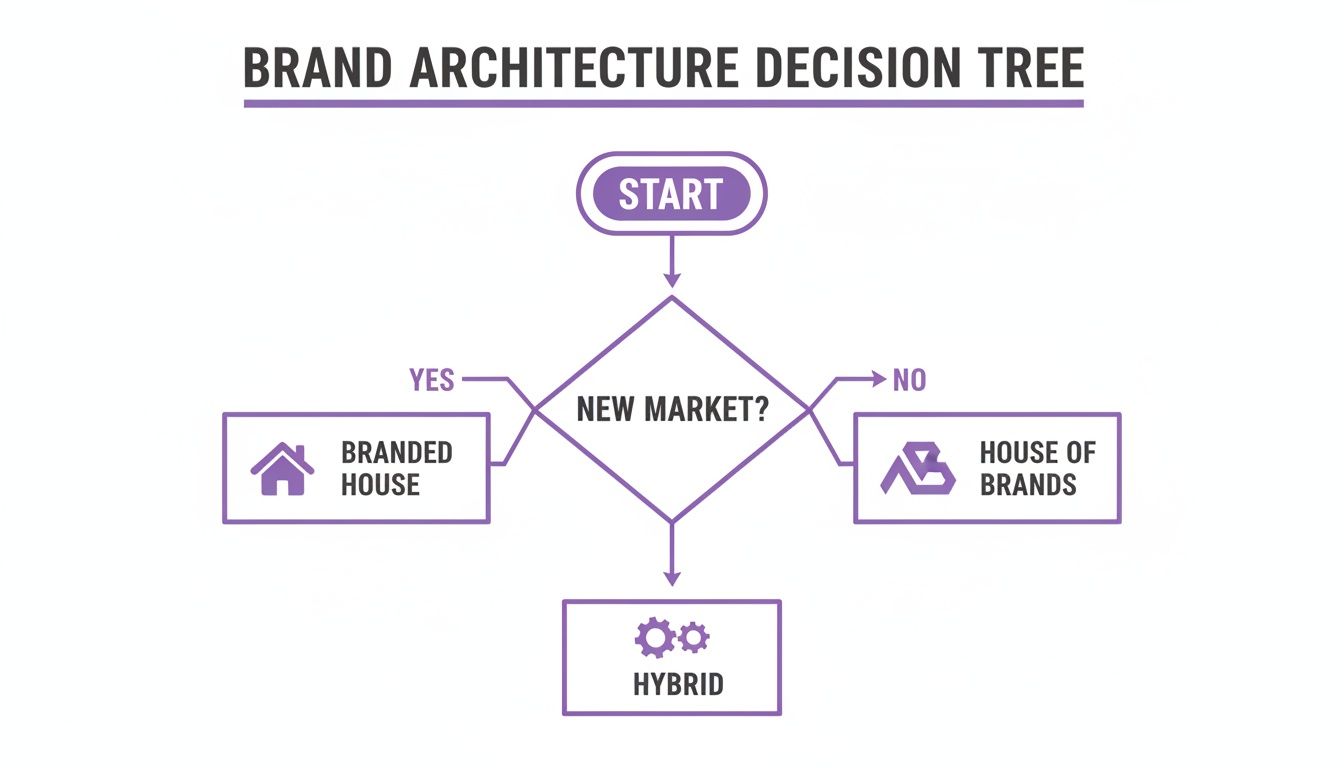
As the visual shows, the path to a hybrid model—which is where sub-brands live—usually starts when you need to enter a market your current structure just isn’t built for.
Validating the Strategic Fit
Answering those first few questions just gets you to the starting line. A strategic partner would dig deeper, validating the sub-brand’s potential by scrutinizing the market, the message, and the money.
A huge piece of this is defining your brand's voice to make sure the new entity sounds authentic to its purpose while still feeling connected to the parent brand’s core values.
Let’s say a U.S.-based SaaS company sells complex data analytics tools to Fortune 500s. They decide to launch a sub-brand offering a simplified, self-serve tool for marketing agencies.
- The market is distinct (agencies vs. enterprise).
- The brand voice would be totally different—less formal, more focused on speed and simplicity.
- The financial model would be low-touch and subscription-based, a stark contrast to the parent company's high-touch, long sales cycle.
A successful sub-brand needs its own clear reason to exist. It requires a distinct audience, a tailored message, and a viable business model that justifies the investment. Without that clarity, it’s doomed to struggle and might even start eating into the parent brand’s market share.
This validation phase is non-negotiable. Brands are one of a company's most valuable assets. Launching a sub-brand is a move to build that asset base, not water it down. When planned properly, this strategy can seriously increase a company's overall market valuation. For more on this, you can learn about the fundamentals of what is brand positioning in our detailed article.
Making the Final Go/No-Go Decision
To help formalize this process, we use a simple matrix to weigh the key factors. It forces an honest conversation about whether the conditions are truly right for a sub-brand launch.
Sub-Brand Go/No-Go Decision Matrix
| Consideration | Key Question | High-Potential Scenario (Go) | High-Risk Scenario (No-Go) |
|---|---|---|---|
| Market Distinction | Is the target audience fundamentally different from our core customer base? | Yes, new buyer persona, industry, or price point that the parent brand cannot credibly serve. | No, there is significant overlap with our existing audience; the parent brand can adapt. |
| Brand Equity Risk | Could this new offering dilute or damage the parent brand’s reputation? | Yes, it's an experimental product, a lower-priced tier, or targets a market with conflicting values. | No, the new offering reinforces the parent brand's core promise and positioning. |
| Strategic Focus | Does the sub-brand require a unique value proposition and go-to-market strategy? | Yes, it needs its own messaging, channels, and sales motion to succeed. | No, it can be sold effectively through our existing marketing and sales channels. |
| Resource Commitment | Do we have the dedicated budget and team bandwidth to build and sustain a separate brand? | Yes, we've allocated specific funding and personnel for at least 18-24 months. | No, resources would be pulled from core brand initiatives, spreading the team too thin. |
| Cannibalization Risk | Is there a high probability the sub-brand will steal customers from the parent brand? | No, the target segments are clearly separated with minimal overlap. | Yes, it's likely to confuse existing customers and split our market share. |
| Financial Viability | Does the potential revenue and market share justify the long-term investment? | Yes, the ROI model shows significant upside that outweighs the costs of a separate launch. | No, the financial projections are weak and don't support the required investment. |
Ultimately, the decision comes down to a clear-eyed look at the ROI. The potential revenue from this new segment has to outweigh the very real costs of building and maintaining a separate brand identity.
Think about the operational strain. Does your team have the bandwidth to manage another website, another set of marketing campaigns, another sales playbook? These practical questions are what separate a successful launch from a failed experiment.
A "go" decision means you've confirmed the market gap, protected your core brand, and committed the necessary resources. It's a calculated bet to capture new territory.
Is a sub-brand the right move for your B2B growth? Contact us to schedule a consultation and build a strategic framework that drives real business results.
B2B Sub-Branding Success Stories in North America
Theory and frameworks are great, but seeing a sub-brand strategy deliver real-world results is what truly matters. For B2B leaders in Canada and the United States, these examples prove this approach isn’t just an academic exercise—it’s a powerful engine for market domination.
Let’s unpack how some of North America’s most successful companies used sub-brands to solve complex business challenges, capture new revenue streams, and build lasting competitive advantages.
Microsoft Azure: The Cloud Computing Behemoth
In the early 2010s, Microsoft was at a crossroads. Known almost exclusively for Windows and Office, it was being outmanoeuvred in the booming cloud computing space by a nimbler competitor, Amazon Web Services (AWS). To fight back, Microsoft couldn’t just launch another product; it needed a distinct brand that spoke to an entirely different audience of developers and IT pros.
The Strategic Logic
The company launched Azure, a sub-brand that felt modern, technical, and innovative. While it clearly borrowed trust from the Microsoft parent brand, Azure was given its own identity, messaging, and community-building efforts. This let it speak the language of its technical audience without being boxed in by Microsoft’s broader corporate image.
The Impressive Outcome
The results have been nothing short of staggering. Azure has become a titan in the cloud industry, now generating over $100 billion in annualized revenue and claiming a massive chunk of the global cloud infrastructure market. It's a textbook case of how a sub-brand can pivot a legacy giant to dominate an entirely new B2B category.
The endorsement of a parent brand like Microsoft is especially powerful in markets like Canada. In the Ipsos Most Influential Brands 2023 report, Microsoft jumped to No. 8, largely due to its AI integrations and the muscle of sub-brands like Azure. This is critical for the thousands of Canadian SaaS firms, 42.1% of which call Ontario home. You can read the full analysis of Canada's most influential brands at Ipsos.com.
FedEx Freight: The Logistics Specialist
FedEx built its empire on getting parcels from A to B, fast. But as the logistics world grew more complex, the company saw an opportunity in a specialized, high-value B2B segment: less-than-truckload (LTL) freight shipping. Simply slapping the main FedEx brand on this service would have caused confusion, since LTL freight involves different pricing, handling, and customer needs than a standard envelope.
A successful sub-brand carves out its own territory. It tells a specific audience, "This is for you," while still borrowing the credibility and trust established by the parent company.
The Strategic Logic
FedEx’s solution was FedEx Freight, an endorsed sub-brand that immediately clarified its purpose. The name is descriptive and direct, while the logo uses the core FedEx colours and font. This brand relationship signalled reliability (from FedEx) and specialization (from Freight) all at once.
The Impressive Outcome
Today, FedEx Freight is a leader in the LTL industry, pulling in billions in annual revenue. The strategy allowed FedEx to march into a lucrative B2B vertical and dominate it—without diluting the core promise of its express parcel service.
Shopify Plus: The Enterprise Innovator
Canadian e-commerce giant Shopify was the undisputed champion for small and medium-sized businesses (SMBs). But as larger, more complex businesses started knocking on their door, Shopify spotted a new opportunity: an enterprise-level solution for high-volume merchants. The standard Shopify offering wasn't built for that scale, and its brand was firmly tied to the startup world.
The Strategic Logic
Enter Shopify Plus, a premium sub-brand tailored for enterprise clients. Shopify Plus offers advanced features, dedicated support, and deeper customization, all at a higher price. This sub-brand enabled Shopify to build a completely separate go-to-market strategy, complete with a dedicated sales team and partner network, to effectively win over larger organizations.
The Impressive Outcome
Shopify Plus has been a runaway success, now accounting for a huge portion of Shopify's monthly recurring revenue. A 2022 report highlighted that Shopify Plus contributed 33% of the company’s MRR, up from 28% the prior year, proving that a well-executed sub-brand can elevate a parent company into a more profitable and prestigious market segment.
These examples show that a strategic sub-brand approach is a proven path to growth. Are you ready to explore how this strategy could unlock new markets for your business?
Contact us today to schedule a consultation with our team of branding experts.
Your Practical Sub-Brand Launch Plan
Once your leadership team gives the green light, the strategy document gets real. It's time to turn those plans into a living, breathing part of your business. Launching a sub-brand isn’t just another marketing project; it’s a full-on business initiative that demands precision, tight coordination, and a clear roadmap.
From picking the perfect name to arming your sales team with the right talk tracks, every single step needs to be handled with care. A strong market entry and long-term success depend on it. This guide breaks down the essential steps for B2B teams in Canada and the United States, turning that strategic approval into a market-ready reality.

Naming, Positioning, and Visual Identity
First things first: your sub-brand needs a name and a face. This is where its personality starts to take shape. The goal is to strike that delicate balance between standing out and still feeling like part of the family.
- Naming: The name has to reflect the sub-brand's unique value. Are you going for something descriptive and straightforward (like FedEx Freight) or more evocative (like Microsoft Azure)? Whatever you choose, you absolutely must conduct thorough trademark searches in both Canada and the United States to make sure the name is legally available before you get attached.
- Positioning: This is your core message, boiled down. You need a crystal-clear positioning statement that answers three questions: Who are we talking to? What problem do we solve for them? And why are we the best choice? This statement becomes the north star for every piece of marketing and sales collateral you create.
- Visual Identity: The logo, colour palette, and typography need to feel distinct enough to have their own identity, but they must also contain visual cues that tie back to the parent brand. Think of it as a "visual endorsement." Research on brand extensions shows that the perceived fit between a parent and its offshoot is a huge driver of customer acceptance, and a smart visual link reinforces that connection instantly.
A sub-brand’s identity must be strong enough to capture its intended market yet familiar enough to borrow credibility from its parent. This balance prevents market confusion and accelerates trust-building.
Defining Your SEO and Domain Strategy
In the B2B world, your digital footprint is your storefront. A critical—and often debated—decision is where your new sub-brand will live online. This choice has massive long-term implications for your search engine optimization (SEO) and overall digital authority.
You really have two main paths:
- Subdomain (e.g., plus.yourbrand.com): Search engines see a subdomain as part of the main domain. This means it inherits some of the parent site's authority right out of the gate, which can give it a nice initial SEO boost. It’s a great option when the sub-brand is very closely aligned with the parent.
- New Domain (e.g., yournewsubbrand.com): A brand-new domain starts with zero authority, so you're building its SEO foundation from scratch. The upside? It offers maximum separation, allowing for a hyper-targeted keyword strategy without any risk of confusing Google about what your parent brand is all about.
The right choice comes down to your strategy. If the goal is tight integration and leveraging existing authority, a subdomain is efficient. If you need a clean break to go after a completely different market, a new domain is the cleaner, safer path.
Building a Go-To-Market and Sales Enablement Plan
A great brand with no plan to sell it is just a creative exercise. Your go-to-market (GTM) strategy is the engine that will drive awareness, generate leads, and ultimately close deals. For B2B organizations, this has to be a tightly coordinated dance between marketing and sales.
Your GTM plan should lock in these key pieces:
- Launch Campaign: A multi-channel blitz to announce the new sub-brand. You'll want to target your specific buyer personas through channels like LinkedIn, key industry publications, and carefully targeted paid media.
- Content Strategy: Get your foundational content ready. This means website copy, blog posts, case studies, and whitepapers that speak directly to the new audience's specific pain points.
- Sales Enablement Materials: Your sales team needs the right tools to win. Arm them with a separate pitch deck, battle cards detailing how the sub-brand stacks up against competitors (and even the parent brand), and tailored email templates for outreach.
Don't sleep on sales enablement. A staggering 90% of B2B sellers feel unprepared for their first meeting with a potential client. Equipping your team with sub-brand-specific materials ensures they can articulate its unique value with confidence and clarity from day one.
Finally, establish clear internal governance. Create brand guidelines that dictate how the new logo is used, the tone of voice for all communications, and the official relationship between the parent brand and the sub-brand. This discipline prevents brand dilution and ensures consistency as you scale. A successful launch is a marathon, not a sprint, and this approach builds the foundation for lasting growth.
Ready to build a launch plan that delivers real results? Contact us today to schedule a consultation and turn your strategic vision into a market success.
Measuring Success and Navigating Common Pitfalls
Getting your sub-brand launched is a huge milestone, but it's really just the starting line. Now the real work begins: tracking its performance to make sure it’s delivering a solid return without accidentally tripping up the parent company.
This means looking past vanity metrics. We need to focus on the numbers that actually signal business growth and brand health.
Defining Your Key Performance Indicators
Effective measurement starts with a clear-eyed look at market share. Is the sub-brand actually capturing the new segment it was built for? You’ll want to monitor its penetration rate against the key competitors in that specific niche.
Equally important is the quality of the leads it generates. A successful sub-brand should bring in prospects that have a higher conversion rate or a larger average deal size than your parent brand’s more general inquiries.
To get the full picture, your measurement framework needs a healthy mix of financial and brand-related metrics. These KPIs give you a balanced view of both immediate performance and long-term strategic value.
- Customer Lifetime Value (CLV): Are the customers you’re acquiring through the sub-brand more profitable over time? A high CLV from this new segment is a fantastic sign that your strategy is working.
- Parent Brand Perception: You’ll need to run some brand sentiment analysis to see how the sub-brand launch is affecting the parent brand. You’re aiming for a positive “halo effect,” not brand confusion or dilution.
- Cost Per Acquisition (CPA): Is the sub-brand winning customers more efficiently than the parent brand could in this new market? This is a critical metric for proving the financial logic behind the launch.
Avoiding Costly Sub-Brand Mistakes
Even the best-laid plans can hit a few snags. There are some common pitfalls that can derail a sub-brand strategy, so it pays to be proactive and protect your investment—and your core brand equity.
One of the biggest dangers is brand cannibalization. This is when the sub-brand starts poaching customers from your main offering instead of attracting new ones from the target segment. It’s a subtle but serious threat.
Inconsistent messaging is another all-too-common problem. If the sub-brand’s voice clashes with the parent brand’s, it just creates confusion in the market and chips away at the trust you’ve built in both. This can quickly turn into a resource drain as marketing teams end up fighting internal battles instead of external ones.
Clear governance and distinct positioning are your best lines of defence. Make sure both brands have sharply defined target audiences and value propositions that keep any overlap to a bare minimum.
If you want to explore how to calculate the financial impact of your marketing efforts in more detail, have a read through our guide on what is marketing ROI.
A well-managed sub-brand is a powerful asset for growth. Are you prepared to measure its impact and navigate the risks?
Contact us today to build a high-growth branding strategy that delivers measurable results for your B2B organization in Canada or the United States.
Got Questions About Sub-Brand Strategy? We've Got Answers.
Even the best-laid plans run into practical questions. When you’re considering a shift as significant as launching a sub-brand, leaders across Canada and the United States inevitably hit the same roadblocks. Here are some straight answers to the questions that come up time and time again.
How Much Does It Cost to Launch a New Sub-Brand?
The short answer? It varies wildly. A full B2B launch in North America is a serious undertaking, involving everything from initial strategy and brand identity design to legal trademarking, website development, and a full-court press on the marketing front.
A lean, focused rollout could start around $25,000, while a full-scale launch with deep market research and a multi-channel campaign can easily top $100,000. This is where an experienced strategic partner can be invaluable—they'll help you build a realistic budget that’s tied directly to your revenue goals, not just vanity metrics.
How Do I Manage SEO for a Main Brand and a Sub-Brand?
Your search strategy really comes down to your domain structure. If you go with a subdomain (like plus.mainbrand.com), you get a nice head start by borrowing some of the SEO authority from your parent site.
On the other hand, a completely separate domain (like newsubbrand.com) has to build its authority from scratch. The upside? It gives you a clean slate for a highly targeted keyword strategy. The biggest thing to watch out for is keyword cannibalization—you need to make sure each site is aimed at a distinct user intent and use a smart internal linking strategy to connect them without confusion.
What Is the Difference Between a Sub-Brand and a Product Line Extension?
This is a critical distinction, and one that trips up a lot of teams. A product line extension is just a new flavour of what you already offer under the parent brand—think a new software tier or a different service package. It uses the same brand identity you already have.
A sub-brand is a distinct brand, created to capture a new audience or carve out a new market. It gets its own name and identity but keeps a clear, strategic link to the parent. Think Toyota (the parent) versus Lexus (the sub-brand for luxury), not Coke versus Diet Coke (a product line extension).
Developing a winning sub-brand strategy takes more than just a good idea; it requires deep expertise and a clear-eyed view of the market. The team at B2Better brings over 45 years of combined B2B experience, helping companies in Canada and the US build branding frameworks that drive real, measurable growth.
Ready to build a strategy that actually delivers? Contact us today to schedule a consultation.