

So, what exactly is B2B online marketing?
It’s the art and science of selling your company's products or services to other businesses using digital channels. But forget quick, transactional sales. This isn't about impulse buys. It’s about building long-term, trust-based relationships with professional buyers who rely on logic, education, and proven value to make decisions.
What B2B Online Marketing Really Means Today

Let’s cut through the jargon. At its heart, B2B online marketing is about earning the trust of professionals making complex, high-stakes decisions. Unlike B2C (business-to-consumer) marketing, which often plays on a single buyer’s emotions, B2B involves patiently convincing entire teams over weeks, months, or even longer.
Think of it less like a vending machine and more like a strategic partnership. The goal isn't just to close a deal; it's to become a trusted advisor and an indispensable resource for another company. This distinction is critical for businesses in Canada and the United States, where professional buyers are more empowered and informed than ever before. According to Forrester, a staggering 68% of B2B buyers prefer to research online on their own, making a strong digital presence non-negotiable.
The Modern Buyer's Journey
Today’s B2B buyers do a huge amount of online research long before they ever dream of speaking to a sales rep. They are actively hunting for solutions to their problems, which means your digital presence must provide the answers they’re looking for.
The modern buyer's journey now involves an average of 62+ touchpoints over 6+ months, and buyers will conduct around 12 Google searches before even engaging with a specific brand. This online-first behaviour is precisely why SEO yields a 15% close rate compared to just 2% for old-school cold calling. A strong digital footprint isn't just nice to have—it's non-negotiable. You can dive into the full research about these B2B buyer behaviours to understand just how much has shifted.
This new reality means your marketing must educate, inform, and build credibility from the very first click. Establishing digital authority isn't just a tactic—it's the foundation for all modern B2B growth.
Key Differences from B2C Marketing
Getting your head around the key differences between B2B and B2C is the first step to building a strategy that actually works. While both use similar digital tools, how they're applied couldn't be more different.
The table below breaks down the core distinctions at a glance.
B2B vs B2C Online Marketing at a Glance
| Characteristic | B2B Online Marketing | B2C Online Marketing |
|---|---|---|
| Audience | Niche, specific roles & industries | Broad consumer segments |
| Decision-Making | Logical, data-driven, involves a committee | Emotional, individual, often impulsive |
| Sales Cycle | Long (months to years) | Short (minutes to days) |
| Goals | Build relationships, generate qualified leads | Drive high-volume sales, build brand loyalty |
| Content Focus | ROI, efficiency, expertise (white papers, case studies) | Storytelling, entertainment, reviews (social media, blogs) |
| Relationship | Long-term partnership & support | Transactional, focused on the immediate sale |
As you can see, the B2B process is far more intricate. It demands a patient, value-driven approach that speaks to the logical needs of an entire organization, not just the impulse of one person.
Ready to build a strategy that connects with today's professional buyers in the United States and Canada? Contact us for a personalized consultation today.
Choosing Your B2B Digital Battlegrounds

Here’s the biggest mistake I see in B2B online marketing: trying to be everywhere at once. With limited time and money, a scattered approach guarantees one thing—mediocre results across the board. The real key is to strategically pick your battlegrounds. You need to master the few digital channels where your ideal customers in Canada and the United States are actively looking for solutions.
Instead of a generic checklist, think of your channel strategy like building a specialized toolkit. Every tool has a specific job, and they work best when used together. For consistent B2B success, four channels almost always deliver the biggest impact: SEO & Content, Account-Based Marketing (ABM), LinkedIn, and Email Marketing.
SEO and Content Marketing: The Foundation of Attraction
The modern B2B buyer’s journey almost always starts with a question typed into Google. Your first job is to be the one providing the best answer. That's the entire game when you combine Search Engine Optimization (SEO) with great content marketing.
SEO is the technical side of the coin—it’s about making your website visible and attractive to search engines. Content marketing is the art of creating genuinely valuable articles, guides, and resources that solve your audience's specific problems. A great example is HubSpot, a U.S.-based company that built a billion-dollar business by providing free, high-quality blog posts, templates, and guides that answered virtually every marketing and sales question, attracting millions of potential customers organically.
When you get these two working in harmony, you build a powerful inbound engine. You stop interrupting prospects and start attracting them at the exact moment they need help. For B2B firms, this means focusing on long-form, educational content that builds trust and proves you know what you’re talking about. Forget the quick, salesy blog posts; great content shows you understand the buyer’s world, making you a credible partner long before a sale is even on the table.
Account-Based Marketing: For High-Value Targets
While SEO casts a wide net to attract anyone with a relevant problem, Account-Based Marketing (ABM) is like a spear. It’s a highly focused strategy where your marketing and sales teams join forces to go after a hand-picked list of high-value "dream" accounts. Instead of marketing to an entire industry, you market to a single company as if it were a market of one.
This approach completely flips the traditional marketing funnel upside down.
- Identify: You begin by pinpointing the key accounts that would make the biggest difference to your bottom line.
- Personalize: Next, you craft hyper-personalized campaigns and content designed for the specific challenges and decision-makers inside those companies.
- Engage: Finally, you use a coordinated mix of channels—like targeted LinkedIn ads, bespoke emails, and direct outreach—to get your message in front of those key players.
ABM is incredibly effective for B2B companies with long sales cycles and big deal sizes because it aligns your most expensive efforts directly with revenue. A survey by the Information Technology Services Marketing Association (ITSMA) found that 87% of marketers who measure ROI say ABM outperforms every other marketing investment.
LinkedIn: The Professional Networking Powerhouse
For any B2B marketer in North America, LinkedIn isn't just another social media site—it's the digital town square for professionals. An incredible 80% of B2B leads from social media come straight from LinkedIn, making it a non-negotiable part of your toolkit.
But being successful on LinkedIn isn't about spamming connection requests with sales pitches. It's about building genuine authority and relationships.
- Sharing Expertise: Consistently post insightful content that helps solve your industry's biggest challenges.
- Engaging in Conversations: Jump into relevant discussions in groups and on other people's posts to add value and get noticed.
- Building Your Network: Strategically connect with the decision-makers at the companies you want to work with.
When you treat LinkedIn like a networking and educational platform, you build a strong professional brand that naturally draws in leads and opens doors. To dig deeper, check out our guide on effective B2B marketing tactics examples you can put into action.
The goal on LinkedIn isn't just to be present; it's to become a recognized and trusted voice in your field. This is how you move from being a vendor to becoming a valuable partner in the eyes of potential clients.
Email Marketing: The Unbeatable ROI Champion
Even with all the new channels popping up, email marketing is still a dominant force in the B2B world. The numbers are just staggering. It delivers a 3600% ROI, pulling in $36 for every $1 spent. This unbelievable performance is why 70% of B2B marketers are now planning to use AI to make their email content even more personal and effective.
The secret to great B2B email isn't blasting a generic newsletter to your whole list. It’s all about segmentation and automation. By sending the right message to the right person at the right time—based on their behaviour and where they are in the buying journey—you can nurture leads effectively and drive conversions at scale.
Choosing the right combination of these channels is what creates an integrated strategy that purposefully moves buyers from awareness to decision. Need help selecting the right channels for your U.S. or Canadian business? Contact us for a personalized consultation today.
Mapping the Journey from Stranger to Customer
Great B2B marketing isn't just a collection of random tactics thrown at a wall to see what sticks. It's a deliberate system designed to turn complete strangers into loyal customers. Think of it as building a predictable revenue engine, where you deeply understand who your ideal clients are and then guide them along a path that builds trust and proves your value every step of the way.
This structured approach is non-negotiable because B2B buyers in Canada and the United States don’t make impulse buys. They’re on a deliberate journey of research, comparison, and evaluation. Your marketing needs to meet them exactly where they are, with the right message at precisely the right time.
Building Your Ideal Customer Blueprint
Before you can map out a journey, you need to know who’s taking it. This is where buyer personas come in. These aren’t just flimsy demographic profiles; they are detailed, semi-fictional representations of your perfect client, built on real data and solid market research.
A powerful persona digs much deeper than just a job title or company size. It gets to the human being behind the business decision.
- Pain Points: What are the real-world challenges keeping them up at night? What frustrations in their role are they desperate to solve?
- Goals and Motivations: What does success look like for them professionally? Are they trying to slash costs, boost efficiency, or drive a new innovation?
- Buying Triggers: What specific event or circumstance lights a fire under them to start actively looking for a solution like yours?
- Watering Holes: Where do they hang out online to get information? Do they read certain industry blogs in Canada and the U.S., tune into specific webinars, or follow key influencers on LinkedIn?
Companies that nail persona-based marketing see incredible results. One American B2B tech firm saw a 171% increase in marketing-generated revenue after rolling out a detailed persona strategy. It’s simple: when you know your audience this intimately, every piece of content feels like it was written just for them.
Guiding Prospects Through the B2B Marketing Funnel
Once you’ve defined your buyer personas, you can map their path through the marketing funnel. The funnel is just a way to visualize the stages a prospect moves through, with your content serving as the trusted guide. Each stage has a very specific job to do in your B2B online marketing process.
The core idea is simple: you can’t ask for a sale on the first date. You have to offer value, build your credibility, and earn the right to ask for their business. This patient, educational approach is what separates the most successful B2B marketers from everyone else.
Let’s break down the three main stages.
Top of Funnel (ToFu): Awareness
At the top of the funnel, your prospects know they have a problem, but they don't know about the solutions yet. They're asking broad questions and hunting for educational resources. Your goal here isn't to sell—it's to help.
- Objective: Attract a wide audience and establish your brand as a helpful, go-to authority.
- Content Types: Blog posts ("How to Solve X"), ultimate guides, industry reports, and informative social media updates.
- Example: A Canadian logistics company publishes a blog post titled, "5 Ways to Reduce Shipping Costs in North America." It provides genuinely useful advice without a sales pitch, attracting business owners who are trying to solve that exact problem.
Middle of Funnel (MoFu): Consideration
After a prospect has engaged with your ToFu content, they slide into the middle of the funnel. Now, they're aware of different solutions and are actively comparing their options. Your job is to show them why your approach is the smartest one.
- Objective: Nurture these leads by showcasing your expertise and the specific value of your solution.
- Content Types: Detailed case studies, webinars, white papers, and comparison guides.
- Example: A U.S.-based SaaS company hosts a webinar showing how a client, who looks a lot like the prospect, used their software to increase productivity by 35%. This isn't just a claim; it's concrete proof that helps the prospect see themselves achieving the same success.
Bottom of Funnel (BoFu): Decision
Finally, at the bottom of the funnel, the prospect is ready to pull the trigger. They’ve narrowed their choices and are looking for that last piece of assurance to choose you. Your content here should be direct, clear, and make it incredibly easy for them to take the next step.
- Objective: Convert a warm, qualified lead into a paying customer.
- Content Types: Free demos, consultations, transparent pricing pages, and detailed feature breakdowns.
- Example: After reading a compelling case study, a prospect lands on a page offering a "Free, No-Obligation Demo." The call to action is clear and risk-free, making it an easy yes to engage with your sales team.
By thoughtfully mapping out this entire journey, you create a seamless, logical path that nurtures leads from their very first click all the way to the final sale. This blueprint is the key to building a B2B online marketing machine that’s both scalable and effective.
If you're ready to build a customer journey that drives real results for your business in the United States or Canada, Contact us for a personalized consultation today.
Measuring What Matters for B2B Growth
If you can’t measure your marketing, you can’t improve it. It's a cliché for a reason. In B2B online marketing, it’s far too easy to get distracted by flashy but ultimately empty numbers—social media likes, page views, you name it. Real growth, however, comes from tracking the key performance indicators (KPIs) that connect directly to your company's bottom line.
Moving past these "vanity metrics" is non-negotiable. The goal is to build a clear story with your data, one that shows exactly how your marketing efforts are creating tangible business value. That means focusing on the figures that measure lead quality, sales alignment, and the all-important return on investment.
This visual shows how prospects move through a typical marketing funnel, from just hearing about you to becoming a loyal customer.
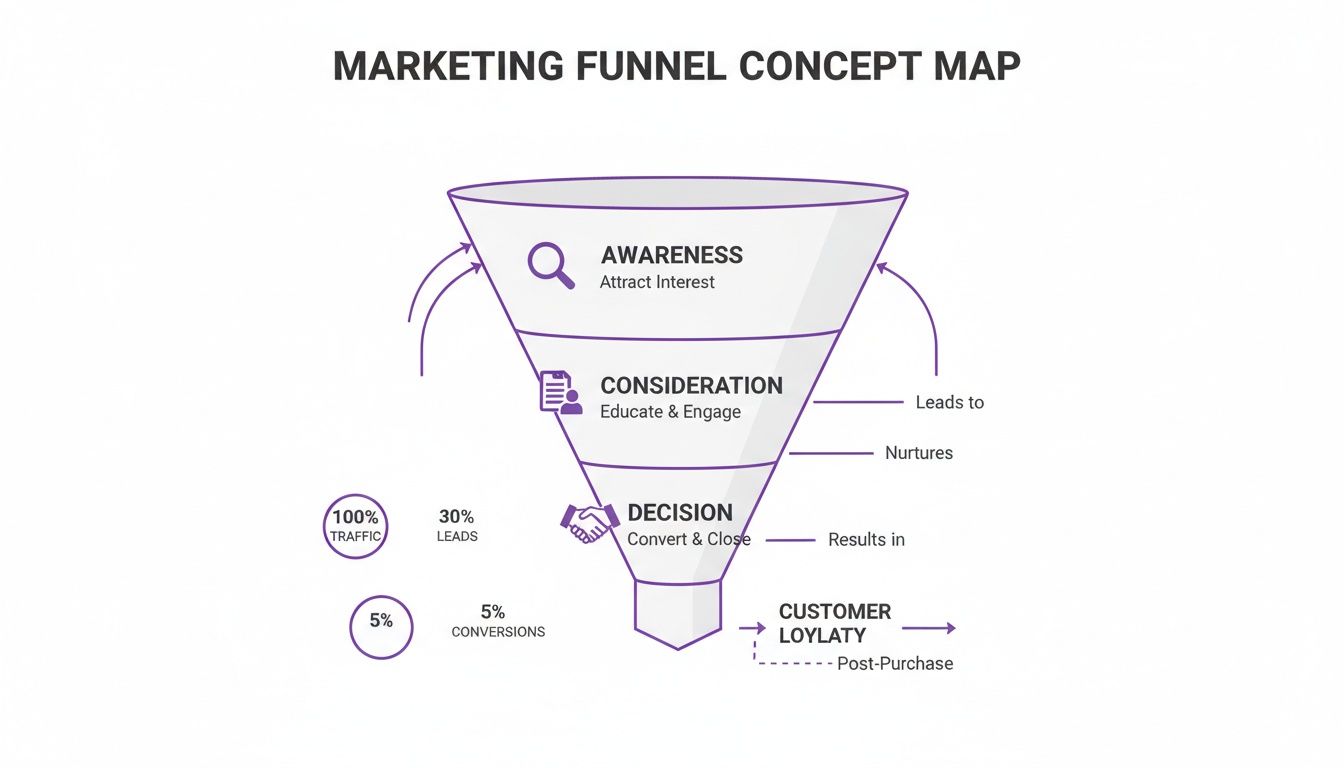
It’s a perfect illustration of how targeted content at each stage is crucial for guiding potential customers on their journey from stranger to buyer.
From Leads to Revenue: The Metrics That Count
To prove your marketing’s worth, you need to track the specific metrics that stakeholders in Canada and the United States actually care about: revenue and cost. Let’s break down the most important ones.
-
Marketing Qualified Leads (MQLs): This isn't just a random website visitor. An MQL is a lead who has shown genuine interest by their actions—like downloading a white paper or attending a webinar—and also fits your ideal customer profile. It’s a clear signal that they’re ready for a conversation.
-
MQL-to-SQL Conversion Rate: This metric tracks the percentage of MQLs that your sales team accepts as legitimate opportunities, turning them into Sales Qualified Leads (SQLs). A high rate here means marketing and sales are perfectly aligned, proving you’re delivering high-quality, relevant leads.
-
Customer Acquisition Cost (CAC): Quite simply, this is the total cost of your sales and marketing efforts divided by the number of new customers you landed in a specific period. A low CAC means your marketing is efficient and profitable.
-
Sales Pipeline Contribution: This powerful metric reveals the percentage of the sales pipeline that came directly from marketing activities. It’s one of the clearest ways to show marketing’s direct impact on generating revenue.
An effective B2B online marketing strategy should drive 30-50% of the total sales pipeline. In fact, top performers often see MQL-to-SQL conversion rates hitting 50-60%, alongside website conversion rates of 2-5%. These numbers show the direct impact a well-run digital strategy has on a company’s financial health. You can explore more about these crucial B2B marketing benchmarks and see how you stack up.
The table below breaks down these essential KPIs, what they really mean, and what a good benchmark looks like for businesses in North America.
Essential B2B Marketing KPIs and Their Meaning
| Metric (KPI) | What It Measures | Industry Benchmark (North America) |
|---|---|---|
| Marketing Qualified Leads (MQLs) | The volume of leads fitting the ICP who have shown buying intent through specific actions. | Varies by industry; focus on growth rate. |
| MQL-to-SQL Conversion Rate | The percentage of MQLs accepted by sales, indicating lead quality and sales alignment. | 30-60% for high-performing teams. |
| Customer Acquisition Cost (CAC) | The total sales and marketing cost to acquire a single new customer. | Highly variable; aim for CAC < LTV. |
| Sales Pipeline Contribution | The percentage of the sales pipeline value originating from marketing-led efforts. | 30-50% is a strong target. |
| Website Conversion Rate | The percentage of visitors completing a desired action (e.g., form fill, demo request). | 2-5% for B2B websites. |
| Customer Lifetime Value (LTV) | The total revenue a business can expect from a single customer account over time. | Aim for an LTV:CAC ratio of 3:1 or higher. |
Tracking these metrics gives you a 360-degree view of your marketing engine’s health, from top-of-funnel attraction right through to long-term profitability.
Building Your B2B Marketing Dashboard
Tracking these KPIs one by one is a good start, but their real power is unlocked when you see them together in a dashboard. A dashboard gives you a live, at-a-glance view of your marketing performance, helping you make smarter, faster decisions.
A great dashboard doesn't just report numbers; it tells a story. It answers critical questions like: "Are we attracting the right people?" "Are our leads converting?" and "Is our marketing actually making the company money?"
A smart way to organize your dashboard is to structure it around the customer journey. This lets you follow leads as they move through the funnel, from initial awareness to a closed deal, helping you pinpoint exactly where your strategy is killing it and where it needs a tune-up. For a deeper look into creating reports that matter, check out our guide on building a comprehensive digital marketing report.
By focusing on these core metrics, you shift the conversation from "marketing is a cost" to "marketing is an investment." You gain the power to prove your ROI, justify your budget, and guide every strategic decision with hard data and confidence. Need help tracking the right KPIs? Contact us for a personalized consultation today.
Your First 90 Days to B2B Marketing Momentum
Strategy is just a plan on paper. Turning it into actual results demands a structured, intentional approach. This practical 90-day roadmap is all about building momentum for your B2B online marketing, cutting out the guesswork and focusing on tasks that deliver real progress right from week one.
We've built this framework to create a strong base, activate your key channels, and then refine everything based on real-world data. It's a proven method for businesses in Canada and the United States to launch or reboot their marketing with purpose.
Month 1: The Foundation Phase
The first 30 days are about getting your house in order. Jumping into campaigns without a solid foundation is like building a house on sand—it’s just not going to last. This month is dedicated to smart planning and essential setup.
Your main goals are to define what success actually looks like, truly understand your audience in the U.S. and Canada, and make sure you can measure everything you do.
- Define Clear Goals: Get specific and measurable. Are you aiming for 20 new MQLs per month? Do you want to increase website demo requests by 25%? Your goals will steer every single decision from here on out.
- Create Buyer Personas: Build out detailed profiles of your ideal clients. You need to go beyond just job titles and dig into their real pain points, what drives them, and where they hang out online to find information. This is how you create content that actually connects.
- Set Up Analytics: Install and properly configure Google Analytics 4, set up goal tracking, and get your key marketing platforms talking to each other. If you can't measure it, you can't improve it.
Month 2: The Activation Phase
With your foundation secure, month two is all about getting your first initiatives out the door. This is where you start actively engaging potential customers and putting your assumptions to the test. The focus shifts to execution and gathering those crucial initial data points.
You’ll be putting content in front of your target audience in the U.S. and Canada and starting conversations through strategic outreach.
One of the most effective first moves is a targeted pilot campaign. For instance, a US-based SaaS company targeting enterprise clients could run a small, highly focused LinkedIn campaign. By promoting a single, high-value case study to a curated list of 500 decision-makers, they generated 15 qualified leads in just two weeks. This proved the model worked before they scaled up their spending.
The goal of the activation phase isn't perfection; it's progress. Launching your initial campaigns will provide invaluable feedback that no amount of planning can replicate.
Key activation steps include:
- Launch Content & SEO: Publish your first two blog posts, written specifically for your personas and optimized for long-tail keywords. This kicks off the long-term process of building organic authority.
- Run a LinkedIn Pilot: Execute a small, targeted ad campaign or an organic outreach sequence aimed at a specific segment of your buyer persona. This gives you quick feedback on whether your messaging is hitting the mark.
- Build an Email Nurture Sequence: Create a simple 3-email automated follow-up for new leads who download a resource. This makes sure no opportunity goes cold.
Month 3: The Optimization Phase
In the final month of this initial push, your focus shifts to analysis and refinement. You now have 30-60 days of real-world performance data from your B2B online marketing efforts. It’s time to dig in, see what’s working (and what isn't), and double down on your wins.
This is where you turn that initial flurry of activity into a smarter, more efficient marketing engine. Dive into your campaign data: Which blog post drove the most traffic from Canada? Which LinkedIn ad had the highest click-through rate in the U.S.? Use these insights to adjust your content calendar and ad creative for the next quarter.
This continuous loop of action, analysis, and adjustment is the absolute key to sustainable growth.
Ready to implement a 90-day plan that delivers real results? Contact us for a personalized consultation today.
Ready to Accelerate Your Growth with an Expert Partner?
You now have the blueprint for a powerful B2B online marketing strategy. This guide has walked you through the ‘what’ and the ‘why’—from picking the right channels to tracking the metrics that actually move the needle. But knowing what to do is one thing; doing it is another. Execution is where most businesses get stuck, tripped up by a lack of time, resources, or specialized skills.
Mastering the ‘how’ takes dedicated, consistent effort. It means staying ahead of algorithm shifts, creating genuinely valuable content, and digging into complex data to make smart pivots. For most in-house teams across Canada and the United States, that’s a tall order when you’re also juggling the demands of day-to-day operations.
This is where a strategic partner can change the game entirely.
Turning Knowledge into Revenue
Bringing on an expert partner isn’t just about handing off tasks. It’s about gaining a strategic ally who is obsessed with your growth. It’s for businesses that are ready to stop planning and start seeing tangible results—like a pipeline full of high-quality leads, a shorter sales cycle, and a clear return on every dollar spent.
A recent study found that companies working with specialized marketing agencies grow 62% faster than those managing everything in-house. That acceleration comes from tapping into proven systems, deep industry experience, and relentless, focused execution.
Instead of learning through costly trial and error, you can immediately implement strategies that have already been proven to work in the competitive North American market. It’s like getting a shortcut to results.
What an Expert Partner Actually Delivers
A true partner does more than just run campaigns. They operate as an extension of your team, providing the C-level strategic oversight needed to tie every marketing activity directly to your revenue goals. This is the core function of an effective B2B marketing agency, making sure every dollar is an investment, not an expense.
Take the example of a mid-sized Canadian manufacturing firm. By bringing on a fractional CMO, they sharpened their buyer personas and launched a hyper-targeted content strategy. Within six months, they saw a 45% jump in qualified leads and cut their sales cycle by 20%. That’s a direct impact on the bottom line, all without the overhead of a full-time executive salary.
This is the power of expert execution. You gain instant access to:
- Proven Frameworks: Roadmaps that have already successfully scaled businesses just like yours.
- Specialized Skills: Immediate expertise in SEO, paid media, content, and analytics without a lengthy hiring process.
- Objective Insights: Data-driven recommendations that are free from internal politics or biases.
- Scalable Resources: The ability to dial your marketing firepower up or down as your business needs change.
If you’re ready to move from planning to winning, the right partner can provide the momentum you need to get there.
Are you ready to accelerate your growth and see a real return on your marketing investment? The team at B2Better can implement these proven strategies for your business. Contact us for a personalized consultation today.