

B2B internet marketing isn't about blasting sales pitches into the void. It’s the art of using digital channels to sell products or services to other businesses by building real, long-term relationships and establishing your company as a trusted expert.
This approach is fundamentally different from chasing quick, emotional purchases, and it’s non-negotiable for any company serious about winning business clients in the United States and Canada today.
What Modern B2B Internet Marketing Really Means
Forget the old playbook of cold calls and stuffy trade shows. Modern B2B internet marketing is about forging strategic, high-value partnerships in a digital-first world. Think less like a quick retail sale and more like a carefully negotiated merger—where trust, deep expertise, and lasting relationships are the only currency that matters. This is especially true in the competitive United States and Canadian markets, where an estimated 70-80% of B2B buyers prefer remote human interactions or digital self-service.
Marketing to a business is a whole different ball game than selling to an individual consumer. Instead of one person making a snap decision, you're navigating a complex web of multiple stakeholders, formal procurement processes, and sales cycles that can stretch for months, not minutes. This journey demands a much more thoughtful, educational, and patient approach.
The Shift to Digital Revenue
The reliance on digital channels isn't just a trend anymore; it's the core of how business gets done. In Canada, for instance, the share of B2B revenue coming from digital channels has exploded, driven by manufacturers and tech companies embracing e-commerce. By 2024-2025, digital is expected to account for a much larger slice of total revenue than it did just a few years ago, signalling a permanent shift in how businesses buy. You can explore detailed Canadian commerce reports about this digital revenue shift to get a better handle on the market.
Before we dive into the nitty-gritty, it's crucial to understand the strategic DNA that separates B2B from its consumer-focused cousin, B2C.
Here's a quick comparison table to highlight the core differences.
B2B vs. B2C Marketing The Core Differences
| Factor | B2B (Business-to-Business) | B2C (Business-to-Consumer) |
|---|---|---|
| Audience | Niche, multiple stakeholders (buying committees) | Broad, individual decision-makers |
| Sales Cycle | Long (months to years), complex, high-touch | Short (minutes to days), simple, low-touch |
| Decision Drivers | Logic, ROI, efficiency, expertise | Emotion, brand, status, immediate need |
| Marketing Goal | Build relationships, educate, generate qualified leads | Drive transactions, build brand awareness |
| Content Focus | In-depth, educational (whitepapers, case studies) | Entertaining, shareable (social posts, videos) |
| Relationship | Long-term partnership, consultative selling | Transactional, fleeting |
As you can see, B2B is a marathon, not a sprint. Your entire strategy needs to be built around providing value and proving your expertise over the long haul.
A perfect example of this philosophy in action is HubSpot. They didn't just sell marketing software; they practically invented the "inbound marketing" movement. By creating a massive library of genuinely useful, free content—blogs, ebooks, and certification courses—they became the go-to educational resource for marketers everywhere. This built immense trust and positioned them as an industry authority, attracting over 194,000 customers globally by putting relationships first.
HubSpot's success hammers home the central principle of B2B internet marketing: Lead with value, not a sales pitch. Your goal is to educate, inform, and build credibility long before anyone even thinks about making a purchase. Your digital presence must function as a resource centre for your prospects, helping them solve their problems and see you as an indispensable partner.
If you're ready to build a marketing engine that drives measurable growth and cements your company's status as a trusted authority, the journey starts with a solid strategy. Let's talk about how our expertise can build and execute that plan for you. Contact us today to get started.
Mapping Your Strategy to the B2B Buyer Journey
Solid B2B internet marketing isn’t about guesswork; it’s about precision. Firing up a campaign without a deep understanding of your buyer is like trying to navigate the Canadian Rockies without a map—you might be moving, but you’re definitely not headed toward your destination. Real success starts with a crystal-clear picture of who you're actually selling to.
This means building out detailed B2B buyer personas that go miles beyond a simple job title. You need to dig into their real-world pain points, figure out what triggers them to even start searching for a solution, and know exactly where they go online for information. A staggering 77% of B2B buyers do their own extensive research before they even think about talking to a salesperson, making your online presence the first—and most critical—impression.
Building Your Buyer Persona
To really connect with prospects in the US and Canada, your personas have to be grounded in reality. Forget the assumptions and focus on getting answers to these core questions:
- What are their biggest responsibilities and professional headaches? Think about the pressure they're under from their boss and the daily hurdles that get in the way of their success.
- What does a "win" look like in their role? Get a handle on the metrics they’re judged by—is it cutting operational costs, boosting team productivity, or driving revenue growth?
- Where do they hang out online for professional content? Pinpoint the specific industry blogs, LinkedIn groups, trade publications, and newsletters they actually trust for solid information.
Answering these turns a generic "IT Manager" into "Michael, a 45-year-old IT Director in Toronto managing a team of ten, who's struggling to secure his company's data against new cyber threats while staying on a tight budget." That level of detail is what lets you create content that genuinely hits home.
Aligning Content with the Buyer Journey
Once you know who you're talking to, you have to match your message to where they are in their decision-making process. The B2B buyer journey is a structured path, not a random walk. This diagram shows how B2B marketing is ultimately about creating valuable partnerships, which is a fundamentally different goal than the direct transaction focus of B2C.
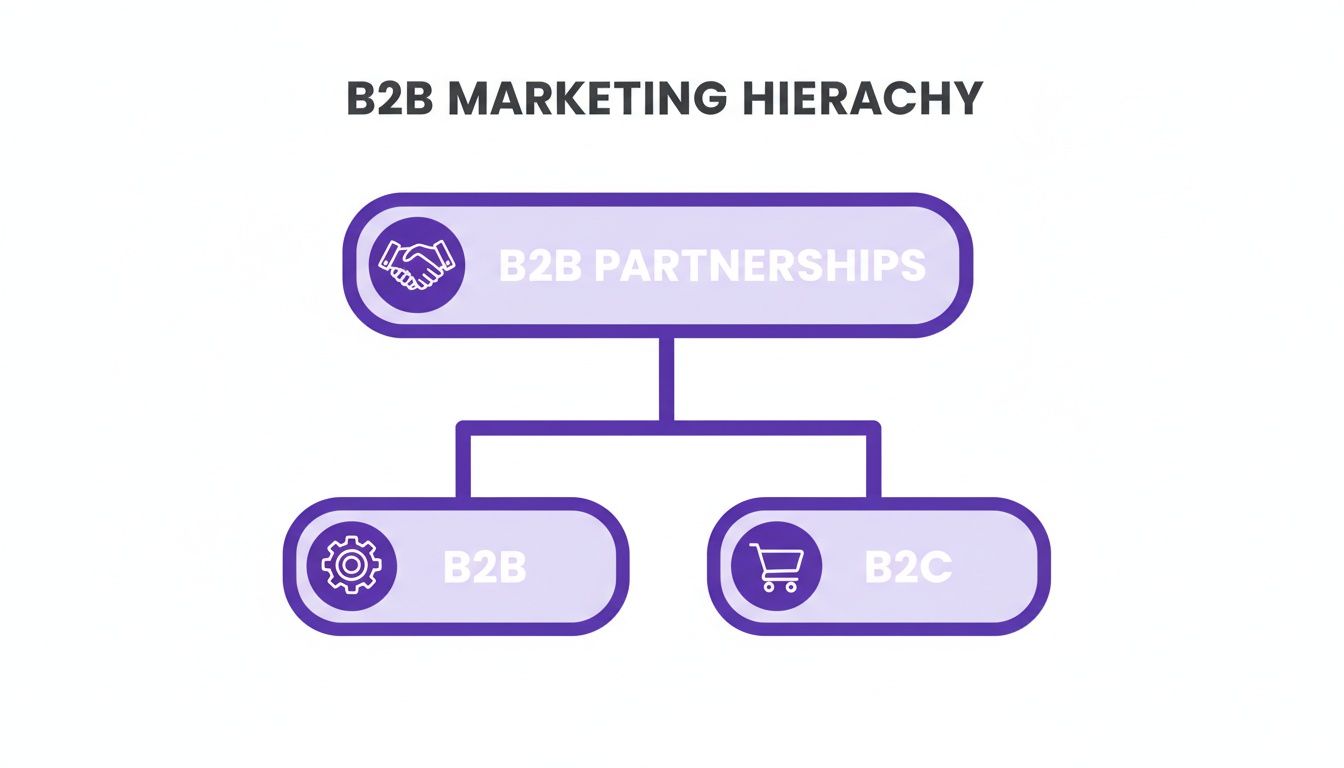
This hierarchy drives home that B2B efforts are built on a foundation of trust and expertise. The end game is a long-term, collaborative relationship, not just a quick sale. Your content has to be a guide that walks prospects through each stage.
A Real-World Example: Just look at Salesforce. In the Awareness stage, they publish articles on broad topics like "Improving Customer Relationships." For the Consideration stage, they offer detailed whitepapers comparing CRM features. Finally, in the Decision stage, they roll out customer success stories and tailored demos, perfectly mapping their content to the buyer's needs every step of the way. This strategy has helped them achieve a 25% market share in the global CRM market.
This kind of strategic mapping ensures your efforts aren't wasted. You provide real value, you build trust, and you become the obvious choice when it’s finally time to buy.
Feeling overwhelmed by persona creation and journey mapping? You don't have to tackle it alone. We specialize in building data-driven strategies that connect with your ideal clients in the US and Canada. Contact us to map your path to predictable growth.
The High-Impact Channels Driving B2B Growth
Once you have a clear map of your buyer's journey, it's time to pick the right vehicles to get you there. Smart B2B internet marketing isn't about being everywhere at once; it's about mastering the specific channels where your best prospects are already searching for answers. This is your playbook for execution.

The goal is to build an integrated machine where every channel reinforces the others. This creates a seamless, persuasive experience for your future customers, whether they're in the United States or Canada. Let's break down the channels that consistently move the needle.
Search Engine Optimization: Capturing Active Demand
When a potential client has a problem, their first instinct is almost always a Google search. In fact, 89% of B2B researchers use the internet during their research process. B2B SEO is the art and science of making sure your business is the solution they find. We're not just chasing traffic here; we're attracting high-intent visitors who are actively looking for what you sell.
The real leverage comes from long-tail keywords—those specific, multi-word phrases that signal someone is close to making a decision. Instead of a broad term like "cloud services," a strategic B2B player would aim to rank for "secure cloud storage for Canadian healthcare providers." This specificity brings in fewer clicks, but the leads are far more qualified.
A fantastic example of SEO mastery is Ahrefs, an SEO software company. They built their entire business by creating immensely valuable content that ranks for thousands of B2B marketing keywords. Their blog posts and free tools attract their ideal customers—marketers—who then convert into paying users. This content-led SEO strategy helped them grow to over $100 million in annual recurring revenue.
Content Marketing: Fuelling Your Authority
Content is the fuel for your entire B2B marketing engine. It’s how you prove your expertise, build trust, and guide prospects through what can be a very long sales cycle. Think of it as the evidence that backs up your promises.
Your content strategy should directly tackle the pain points you identified in your buyer personas, tailored for each stage of their journey.
- Awareness Stage: Educate prospects with comprehensive blog posts, original research reports, and insightful webinars. The goal is to become their go-to resource.
- Consideration Stage: Go deeper with detailed case studies, whitepapers, and comparison guides that highlight why your solution is different—and better.
- Decision Stage: Instill confidence with customer testimonials, implementation guides, and free demos that make the final choice feel easy and obvious.
For a closer look at how these content types work in the real world, you can explore a variety of proven B2B marketing tactics and examples.
Paid Media and Account-Based Marketing: Precision Targeting
While SEO builds your organic authority for the long term, paid media delivers speed and laser-focused precision. For most B2B companies, LinkedIn Ads are the most potent tool in the toolbox, with marketers reporting they see 2x higher conversion rates compared to other platforms. The platform’s ability to target by job title, company size, industry, and seniority is simply unmatched.
This same precision is the bedrock of Account-Based Marketing (ABM). Instead of casting a wide net and hoping for the best, ABM concentrates all your marketing and sales firepower on a hand-picked list of high-value target accounts.
A great success story here is the software company Terminus. They used their own ABM platform to identify and target key accounts with personalized ads, direct mail, and coordinated sales outreach. This hyper-focused approach led to a 90% increase in pipeline from their target accounts, proving the power of concentrating resources on the right prospects.
Each of these channels is powerful on its own. But when you integrate them into a cohesive strategy, they create a growth engine that attracts, educates, and converts your ideal clients. Ready to master the right channels? Contact our experts today.
Measuring What Matters: Proving Marketing ROI
In B2B internet marketing, being busy doesn't mean you're being effective. Sure, impressions and clicks might look good on a report, but executives in Canada and the United States care about one thing above all else: revenue.
If you can't draw a straight line from your marketing efforts to business growth, you’re flying blind and putting your budget at risk. The goal isn't just activity; it's profitability. Proving your strategy's ROI is how you secure bigger budgets and earn a seat at the leadership table.
The KPIs That Actually Drive Business Decisions
To show real business impact, you need to track the metrics that tell a financial story. These three KPIs are the foundation of any serious B2B marketing program, showing exactly how your campaigns contribute to the bottom line.
- Customer Acquisition Cost (CAC): This is the total cost of your marketing and sales efforts to win a single new customer. When your CAC is falling, it’s a clear sign your marketing is getting more efficient.
- Customer Lifetime Value (LTV): This metric forecasts the total revenue you can expect from a single customer over the entire relationship. A high LTV proves you're not just attracting customers, but the right customers—the kind that stick around.
- Marketing-Influenced Revenue: This tracks the total revenue from all deals that marketing touched at some point. It’s a powerful way to show your team's broad impact, even when you weren't the very last click before the sale.
A healthy B2B growth engine keeps a strong LTV to CAC ratio. You should be aiming for at least 3:1. This means for every dollar you spend to acquire a customer, you're generating at least three dollars in lifetime revenue.
Understanding Marketing Attribution Models
The B2B buyer's journey is rarely a straight line. A prospect might read a blog post, see a LinkedIn ad, and attend a webinar before ever talking to a salesperson. So, which channel gets the credit for the win?
This is where marketing attribution comes in. It’s the framework you use to assign value to each of those touchpoints along the customer's path.
Different models exist, from simple “first-touch” or “last-touch” to more complex multi-touch models that distribute credit across all interactions. Picking the right one helps you understand which channels are truly driving conversions, so you can double down on what works. For a deeper dive, check out our guide on creating an effective digital marketing reporting framework.
"Effective measurement separates high-growth B2B companies from the rest. When you can confidently show executives how marketing dollars are generating pipeline and revenue, you transform marketing from a cost centre into a predictable growth engine."
For Canadian B2B teams, using local data is crucial for setting realistic goals. Recent practitioner reports for 2024–2025 show that typical website conversion rates often fall in the 2–5% range. The average cost per lead (CPL) is around CA$200, though high-value demo requests can cost between CA$600–$800. These benchmarks are essential for evaluating channel performance and ROI. Discover more insights about Canadian B2B marketing performance on martal.ca.
Feeling unsure how to connect your marketing activities to revenue? We specialize in building measurement frameworks that prove your impact. Contact us today to start tracking what truly matters.
Building Your Modern B2B Marketing Tech Stack
Think of technology as the engine powering your entire B2B marketing program. The right tools don’t just automate a few tasks here and there. They weave together to create an intelligent, seamless system that paints a complete picture of your customer, letting you deliver the perfect message at exactly the right moment.

Your tech stack is really the central nervous system of your strategy. It connects every single piece—from the first lead capture to the final sale and beyond—into one cohesive unit. It’s this integration that transforms a bunch of disconnected activities into a predictable growth machine, especially in the competitive Canadian and American markets.
The Core Components of Your Tech Stack
While the sheer number of software options can feel overwhelming, a powerful B2B marketing stack is really built on a few core pillars. Each platform has a distinct job, but they become exponentially more powerful when they’re all talking to each other. Nailing these foundational pieces is the first step toward building an unbeatable advantage.
For a detailed look at specific platforms, check out our guide on the top ten B2B marketing tech stack tools that can really fuel your growth.
A fantastic real-world example is the software giant Adobe. They’ve masterfully integrated their marketing automation platform, Marketo, with their CRM. This setup allows them to track every digital interaction, score leads based on their behaviour, and automatically hand off the hottest prospects to the sales team with a complete history of their engagement. This tight alignment has been a massive driver of their market dominance, contributing to over $19 billion in annual revenue.
The Rise of AI and Automation in North America
These days, just having the core tools isn't quite enough. The leading B2B companies are now aggressively adopting AI and automation to make their marketing smarter, faster, and far more personal. These technologies are popping up everywhere, from predictive lead scoring to personalising website content in real time.
And the adoption rate is climbing fast. Recent data from Statistics Canada shows that marketing automation use among Canadian businesses hit 23.1% in the second quarter of 2025, a huge jump from just 15.2% a year earlier. In that same timeframe, the use of AI in delivering goods or services doubled, rising from 6.1% to 12.2%. This signals a major shift in how B2B marketing gets done. You can learn more about these AI and automation adoption findings and what they mean for the industry.
To give you a clearer picture, here’s a look at the essential software categories that form the foundation of a modern B2B marketing operation.
Essential B2B Marketing Tech Stack Components
| Tool Category | Primary Function | Popular Examples |
|---|---|---|
| CRM | Manages all customer relationships and sales data. | Salesforce, HubSpot |
| Marketing Automation | Nurtures leads at scale with automated campaigns. | Marketo, Pardot |
| SEO Tools | Optimises content and tracks search engine rankings. | Ahrefs, Semrush |
| Analytics Platform | Measures website traffic and user behaviour. | Google Analytics |
Building the right tech stack might feel like a daunting task, but it’s a critical investment in your company’s future growth.
Are you ready to build a technology foundation that drives real revenue? We can help you select, integrate, and manage the tools you need to win. Contact us today for a consultation.
Your Action Plan for B2B Marketing Success
Theory is good, but results come from action. This is where the rubber meets the road—where we take all the strategic pieces we’ve discussed (personas, channels, metrics, and tech) and forge them into a real-world roadmap for growth. A plan is what turns ambition into a predictable process.
Without a clear action plan, even the most brilliant strategies gather dust. A documented roadmap forces alignment between your marketing and sales teams, ensures your budget is spent wisely, and ties every single activity back to a business goal. That alignment is everything; when sales and marketing are in sync, companies see 36% higher customer retention rates.
Phased Implementation for Sustainable Growth
Trying to boil the ocean is a classic recipe for burnout and wasted cash. A phased approach is smarter. It allows you to chalk up some early wins, learn from actual data, and scale your efforts without tripping over your own feet.
Here’s a simple, three-phase framework to get you started:
- Phase 1: Foundation (Months 1-3): Stick to the absolute essentials. This means finalizing your buyer personas for the US and Canadian markets, nailing down your initial keyword research, getting your core tech stack live (CRM and analytics), and launching a single, high-potential campaign. Think a sharply targeted LinkedIn Ads initiative.
- Phase 2: Expansion (Months 4-6): Time to build on that early momentum. Use the data from Phase 1 to sharpen your targeting. Start publishing SEO-focused blog content consistently, build out a lead-nurturing email sequence, and get a high-value content asset—like a whitepaper or a killer case study—into production.
- Phase 3: Optimization and Scale (Months 7-12): Now you can double down on what’s actually working. With a steady stream of data coming in, you can start optimizing your campaign spending, A/B testing your landing pages, and maybe even expand into a new channel like Google Ads or a more sophisticated Account-Based Marketing (ABM) program.
How a North American Tech Firm Did It
A US-based B2B SaaS company in the logistics space followed this exact model. They kicked off with highly targeted LinkedIn ads (Phase 1), which brought in their first 50 marketing-qualified leads. Using what they learned from those initial leads, they built an SEO content strategy around their customers' biggest headaches (Phase 2). Fast forward a few months, and they were ranking on page one for several key industry terms. By month nine (Phase 3), their organic traffic had tripled, and their cost per lead had dropped by a massive 40%.
This step-by-step process takes the guesswork out of the equation. It creates a clear, logical path from your initial investment to measurable ROI. The journey to mastering B2B internet marketing is complex, but you don’t have to walk it alone.
If you're ready to accelerate your growth with a strategy built for revenue, we’re here to help. Contact us today to discuss how our expertise can build and execute your plan for success.
Frequently Asked Questions
When it comes to B2B internet marketing, a few practical questions always come up around timelines, budgets, and what to tackle first. Getting straight answers is the first step toward building a strategy that actually drives business results. Here are some of the most common queries we hear from business leaders across Canada and the United States.
How Long Does It Take to See B2B Marketing Results?
The honest answer? It depends entirely on the channels you choose.
SEO and content marketing are the long game. Think of them like planting an orchard—it takes time to cultivate, but eventually, you get a sustainable source of fruit. You're building your brand's authority and organic traffic, which often takes 6 to 12 months to gain real momentum. These efforts create a valuable, long-term asset for your business.
On the flip side, paid channels like LinkedIn Ads or Google Ads can generate leads within days of a campaign launch. The best strategies balance both, using paid ads for immediate impact while building a powerful, long-term lead generation engine with SEO.
What Is the Most Important B2B Lead Generation Channel?
There’s no magic bullet or single "best" channel for every business. Its effectiveness is tied directly to who you're trying to reach and what industry you're in. For many tech and professional services firms in the US and Canada, LinkedIn is invaluable for its laser-focused targeting that lets you reach specific decision-makers.
But if your company solves an urgent, immediate problem, then SEO and Google Ads are critical. You need to be there to capture high-intent buyers who are actively searching for a solution right now. The most successful approach is always an integrated, multi-channel strategy where your content, SEO, paid ads, and email work in concert to guide buyers through their entire journey.
How Much Should a B2B Company Budget for Internet Marketing?
A common rule of thumb suggests B2B companies should allocate 5% to 12% of their total revenue to marketing. But a far more strategic approach is to work backwards from your business goals, like hitting a target number of qualified leads or achieving a specific Customer Acquisition Cost (CAC).
We once worked with a B2B SaaS company that started with a small pilot budget for LinkedIn Ads. They quickly discovered their CAC was $450. Knowing their customer lifetime value was over $5,000, they confidently scaled their ad spend, certain that the investment would deliver a healthy return, ultimately increasing their pipeline by 250% in six months.
Our advice is to start with a pilot budget. Test a few different channels, measure the ROI like a hawk, and then double down on the tactics that prove most effective for your business.
Ready to stop guessing and start building a predictable revenue engine? The team at B2Better has over 45 years of combined experience helping North American businesses like yours execute winning B2B internet marketing strategies. Contact us today for a no-obligation consultation.