

Forget the generic advice you've read a thousand times. A winning B2B digital marketing strategy isn’t built on broad tactics; it's built on a deep, almost obsessive, understanding of your specific market.
It’s all about creating a rock-solid foundation that connects every single action back to real business growth. We're moving past vanity metrics and focusing on what actually drives revenue. A prime example is Adobe, which shifted its focus to a B2B SaaS model and saw its revenue grow by over 300% in five years by mastering digital lead nurturing and content marketing.
Building a B2B Digital Marketing Foundation That Wins
In the world of B2B, sales decisions are rarely impulsive. They're complicated, involving multiple stakeholders, long consideration periods, and a huge demand for trust. A solid B2B digital marketing foundation acknowledges these realities from the very beginning, ensuring your efforts hit the right people at exactly the right time.
For businesses here in Canada and across the United States, this means getting specific and moving beyond theory.
The goal isn't to chase the latest shiny object or fleeting trend. It's to build a repeatable, measurable system for attracting and converting your ideal customers. And that system starts with two things: knowing exactly who you're selling to and what you want to achieve.
Defining Your Ideal Buyer Personas
Let's get one thing straight: you can't market to a faceless company. You market to the people inside it. This is why developing detailed buyer personas is your first—and most critical—step.
A persona is a semi-fictional sketch of your ideal customer, pieced together from market research and real data on your existing clients. But you need to go deeper than just job titles. What are their daily challenges? What motivates them? What keeps them up at night?
Imagine a SaaS company targeting mid-sized manufacturing firms in the United States and Canada. They likely have at least two key personas:
- "Plant Manager Pete": He’s laser-focused on operational efficiency, uptime, and safety. His biggest pain points are equipment failures and production delays. You'll find him reading trade publications and looking for practical case studies, not flashy marketing fluff.
- "CFO Catherine": She lives and breathes ROI, total cost of ownership, and budget predictability. For her, it's all about the financial justification. She’s much more likely to engage with a white paper that details financial benefits and long-term value.
Understanding these distinct needs lets you craft messaging that speaks directly to each person involved in the decision. According to a study by MarketingSherpa, using buyer personas can make websites 2-5 times easier to use for targeted users, significantly boosting engagement.
Setting Goals That Drive Revenue
Once you know who you're talking to, you need to define what a "win" actually looks like. Vague goals like "increase website traffic" just won't cut it. Your objectives must be tied directly to business outcomes.
The most effective B2B marketing strategies are built on a bedrock of clear, revenue-focused goals. Instead of just aiming for more traffic, successful teams target metrics like qualified lead volume, sales pipeline value, and customer acquisition cost.
For a North American tech startup, a strong goal sounds something like this: "Generate 50 marketing-qualified leads (MQLs) from our target enterprise accounts in the next quarter with an average pipeline value of $25,000 per lead."
See the difference? This goal is specific, measurable, and directly linked to revenue, making it easy to prove marketing's contribution. To hit these high-value prospects in the Canadian and U.S. markets, it's also smart to integrate modern tactics like AI SEO strategies into your planning from the get-go.
Structuring Your Strategic Framework
With your personas and goals locked in, you can finally build your strategic framework. This is the blueprint that guides everything else—your channel selection, content creation, and budget allocation.
The process flow is actually pretty straightforward.
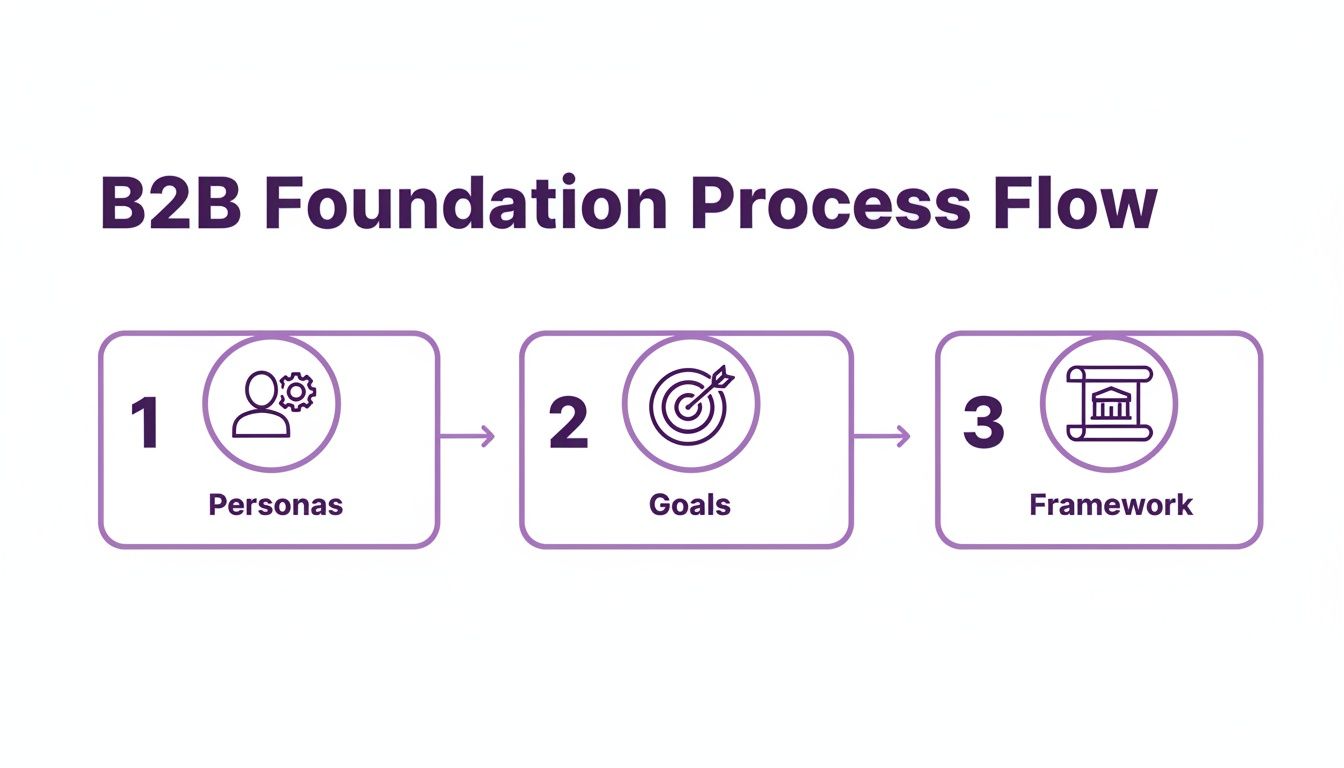
This visual sums it up perfectly: understanding your personas informs your goals, and your goals dictate the framework you build for execution.
This foundational work isn't just a preliminary step; it's the very core of a successful growth engine. In fact, research from the Annuitas Group shows that B2B companies with a strong framework for lead nurturing generate 50% more sales-ready leads at a 33% lower cost. This is where predictable results come from.
Building Your Omnichannel Marketing Engine
Your B2B buyers don't follow a straight line from discovery to purchase anymore. They might see your ad on LinkedIn during their morning coffee, search for a solution on Google that afternoon, and read one of your blog posts a week later. Each of these moments is a chance to build trust and guide them forward.
This is the heart of an omnichannel marketing engine: creating a seamless, interconnected experience across every single channel. It's about moving away from siloed tactics—where your SEO team and your paid media team barely speak—and toward a unified strategy where the customer experience feels consistent and logical, no matter where it happens.

This integrated approach isn't just a "nice-to-have." It's essential for modern B2B digital marketing, especially in competitive North American markets. Today's buyers in Canada and the United States expect multiple digital interactions before they ever engage with a sales rep. In fact, research from Gartner shows they use 10 or more touchpoints—from email and search to social media—during their buying journey.
The payoff for getting this right is huge. Companies with strong omnichannel strategies see 89% customer retention, a massive leap compared to the 33% for those with weak approaches.
Key B2B Digital Marketing Channels and Their Roles
To help you get started, this table breaks down the primary B2B digital marketing channels, their main objectives, and the key performance indicators (KPIs) you should be tracking for success in the U.S. and Canadian markets.
| Channel | Primary Objective | Key KPIs |
|---|---|---|
| SEO | Drive high-intent organic traffic, build long-term authority | Organic Traffic, Keyword Rankings, Organic Lead Conversions |
| Content Marketing | Educate the audience, generate leads, establish expertise | Downloads, Time on Page, Shares, MQLs Generated |
| Paid Media (SEM/Social) | Target specific personas quickly, accelerate lead generation | Cost Per Lead (CPL), Click-Through Rate (CTR), Conversion Rate |
| Account-Based Marketing | Deepen engagement with high-value target accounts | Account Engagement Score, Pipeline Velocity, Deal Size |
| Email Marketing | Nurture leads, build relationships, drive conversions | Open Rate, Click-Through Rate, Unsubscribe Rate, MQL-to-SQL Conversion Rate |
Think of these channels not as separate tools but as interlocking gears. Each one has a specific job, but they only create real momentum when they move in sync.
Weaving the Channels into a Seamless Journey
The real magic happens when these channels support each other. An integrated B2B digital marketing strategy creates a journey that feels natural and helpful to the buyer, not jarring or repetitive.
Let’s walk through a real-world example. Imagine a B2B SaaS company based in Canada that sells project management software to marketing agencies. Here’s what an omnichannel journey could look like:
-
Awareness through Paid Social: The journey kicks off on LinkedIn. The company runs a targeted ad campaign aimed at "Marketing Directors" at agencies in the United States and Canada. The ad isn't a hard sell; it promotes a valuable new research report: "The State of Agency Profitability in 2024."
-
Value through Content: The ad directs the Marketing Director to a landing page where they can download the report in exchange for their email. This provides immediate value and positions the company as a helpful expert, not just another vendor.
-
Nurturing via Email: With the download, an automated email sequence begins. The first email delivers the report, while later emails share related blog posts, case studies of other agencies, and an invite to a webinar on improving project workflows. It's all value, no pressure.
-
Capturing Intent with SEO: A few weeks later, our Marketing Director realizes their current tool is a bottleneck. They google "best project management tool for marketing agencies." Thanks to a strong SEO strategy, our SaaS company's comprehensive comparison guide ranks on the first page.
-
Conversion with Retargeting: After visiting the website from their Google search, the Marketing Director starts seeing subtle retargeting ads on other sites, reminding them of the software's key benefits and offering a free demo. The message is consistent, timely, and helpful.
This connected experience ensures the brand remains top-of-mind at every stage. It’s no longer about a single touchpoint but about creating a web of reinforcing interactions that guide the prospect toward a decision.
This multi-channel coordination is what separates high-growth companies from the rest. For a closer look at how these individual tactics are executed, you can explore these actionable B2B marketing tactic examples and see how they fit into a larger strategy.
Advanced Strategies for High-Value Lead Generation
Once your foundational channels are humming, it’s time to shift from casting a wide net to fishing with a spear. While standard lead generation fills the top of your funnel, landing high-value accounts demands a more precise and personalized approach. This is where you graduate to advanced B2B digital marketing tactics like Account-Based Marketing (ABM).
ABM completely flips the traditional marketing funnel. Instead of blasting a broad audience and hoping to find a few qualified leads, you start by identifying your most valuable target accounts. From there, you build hyper-personalized campaigns engineered to engage key decision-makers within those specific companies.

This razor-sharp focus delivers. Companies that get ABM right generate 208% more revenue from their marketing efforts, according to ITSMA. It's a strategy built for the realities of complex B2B sales cycles, especially in North American markets where building deep, genuine relationships is the only way to win.
Identifying Your Ideal Target Accounts
The first real step in any ABM program is pinpointing your "whale" accounts—those high-value clients that can truly move the needle for your business. This isn’t a guessing game. It's a data-driven exercise that combines the best insights from both your sales and marketing teams.
Start by refining your Ideal Customer Profile (ICP). Take a hard look at your best current customers and find the common threads:
- Firmographics: What industry are they in? What’s their company size or annual revenue? Where are they located—are they in a major U.S. tech hub like Austin or a Canadian centre like Toronto?
- Technographics: What’s in their current tech stack? Do they use a complementary tool that makes them a perfect fit for your solution?
- Behavioural Signals: Are they showing signs of being ready to buy? Maybe they’ve recently hit your pricing page, downloaded a bottom-of-funnel resource, or started engaging with a competitor’s content.
This data lets you build a tight, focused list of target accounts with the highest probability of closing.
Crafting Hyper-Personalized Outreach
With your target list locked in, generic messaging goes out the window. The goal is to create content and outreach that speaks directly to the specific pain points and strategic priorities of each account. This is where all that hard work you put into your buyer personas really pays off.
So, instead of a generic email blast, you might launch a coordinated, multi-touch campaign targeting a single enterprise account.
A truly effective ABM campaign feels less like marketing and more like a helpful, one-to-one conversation. It demonstrates a deep understanding of the prospect's business, making your outreach impossible to ignore.
A great example comes from the U.S. tech sector. A cybersecurity firm identified a major financial institution as a key target. Instead of sending generic brochures, they created a bespoke "Threat Assessment Report" by analyzing publicly available info about the bank's digital footprint and highlighting potential vulnerabilities. This hyper-relevant content got the C-suite’s attention immediately, leading directly to a high-stakes sales conversation. This level of dedication is a core piece of many successful B2B lead generation strategies.
Activating LinkedIn for Strategic Engagement
LinkedIn is the ultimate playground for B2B marketers, but most barely scratch the surface. For ABM, it’s not just a networking tool—it’s a platform for strategic intelligence and targeted engagement, especially for reaching decision-makers in the United States and Canada.
Use LinkedIn to map out the entire buying committee at your target accounts. Identify the key decision-makers, the influencers, and even the potential blockers. Then, use a smart mix of content and personalized outreach to start building relationships:
- Engage with their content: Leave thoughtful comments on their posts to get on their radar. Don't just say "great post!"—add a real insight.
- Share relevant content: Tag key individuals in posts that directly address a challenge you know they’re facing.
- Use personalized InMail: Craft messages that reference their company's recent news or a post they shared. Show them you've done your homework.
This consistent, value-first engagement builds familiarity and trust long before you ever make a sales pitch. It's a powerful way to warm up cold accounts and position your brand as a genuinely helpful partner. And as your campaigns scale, you can bring in AI-powered marketing tools to automate parts of this outreach, letting even a lean team run sophisticated ABM plays.
Resourcing Your Marketing Strategy for Growth
A brilliant strategy is only as good as the team and technology you give it. After mapping out your channels and tactics, the next real-world hurdle is resourcing your B2B digital marketing. For growing startups and SMBs in Canada and the U.S., this is often where ambitious plans collide with the hard realities of budgets and headcount.
Making the right resourcing decisions here is critical. The choices you make will directly impact your ability to scale, adapt, and ultimately, hit the revenue targets you’ve set.
Choosing the Right Team Structure
For many businesses in Canada and the United States, the default move seems to be building an in-house team. While dedicated internal staff bring deep product knowledge and a strong cultural fit, that path also comes with serious overhead, long hiring cycles, and the risk of skill gaps. A single marketing generalist can get overwhelmed fast trying to master SEO, paid ads, and content all at once.
Another well-trodden path is to outsource everything to a digital marketing agency. This gives you immediate access to a wide range of specialists, but it can also lead to a cookie-cutter approach where your unique business context gets lost in the shuffle. Agencies are often juggling dozens of clients, which can dilute the focus and strategic depth your company really needs.
This is why a third model has become such a game-changer, especially for tech firms and B2B service providers.
The Fractional CMO Advantage
The Fractional Chief Marketing Officer (CMO) model gives you a powerful hybrid solution. You get C-level strategic leadership—the kind that builds frameworks, sets budgets, and aligns marketing with sales—without the full-time executive salary. A Fractional CMO slots into your leadership team on a part-time basis, providing the high-level direction that an in-house specialist or a conventional agency often lacks.
This model is particularly effective for a few key reasons:
- Expertise on Demand: You get decades of senior-level B2B marketing experience right away, sidestepping the long and expensive executive search process.
- Cost Efficiency: You access top-tier strategic talent for a fraction of the cost of a full-time hire. This frees up capital to invest in other growth areas.
- Strategic and Tactical Blend: A Fractional CMO can build the top-level strategy and then help you resource the execution, whether that means mentoring a junior in-house marketer or managing a team of specialized freelancers.
For a startup or SMB, a Fractional CMO isn't just another consultant—they are a strategic partner invested in your growth. They bridge the critical gap between your business goals and the tactical execution required to achieve them.
This approach is perfectly suited for today's market. North America's B2B digital marketing sector, with strong influence from Canadian and U.S. growth, is set for major expansion. As 45-50% of B2B payments shift to digital channels, the pressure on overextended teams is immense. Engaging fractional expertise aligns with market trends where effective multi-channel strategies, guided by the right leadership, can boost ROI by as much as 24%. You can find more insights on B2B digital market trends at datainsightsmarket.com.
Building Your Essential MarTech Stack
Your team, no matter how it’s structured, needs the right tools to win. Your marketing technology (MarTech) stack is the collection of software that helps your team work efficiently and prove its impact. But it's all too easy to get lost in a sea of shiny new platforms.
The trick is to build a lean, functional stack that delivers clear ROI. Start with the essentials:
- Customer Relationship Management (CRM): This is your single source of truth for all customer and lead data. HubSpot and Salesforce are the heavyweights in the B2B world.
- Email Marketing & Automation: A platform like Mailchimp or ActiveCampaign is crucial for nurturing leads and communicating with your audience at scale.
- Analytics & SEO Tools: You can't improve what you don't measure. Google Analytics is non-negotiable, and you'll want to supplement it with SEO tools like Ahrefs or Semrush to guide your content and search strategy.
- Social Media Management: A tool like Buffer or Hootsuite helps you schedule content and manage engagement across multiple platforms without losing your mind.
The key is to pick tools that play nicely together and solve specific problems you actually have. A well-chosen MarTech stack, combined with the right team structure, creates a powerful engine for sustainable growth.
Ready to build a team and strategy that drives predictable revenue? Contact us to explore how a Fractional CMO can provide the leadership your business needs to scale.
Measuring What Matters to Prove Marketing ROI
Marketing activities that don’t connect to revenue are just expensive hobbies. If there's one thing I've learned, it's that to get a real seat at the leadership table, marketing needs to speak the language of the C-suite: Return on Investment (ROI).
Forget vanity metrics like likes and shares. Proving ROI demystifies your efforts. It transforms marketing from a perceived cost centre into what it should be—a predictable and measurable growth engine for the business. A classic success story is Xerox, which used targeted landing pages and content to generate a 70% increase in leads within the first three months of a campaign, directly demonstrating the value of its digital efforts.
Connecting Marketing Actions to Business Outcomes
Every click, download, and form submission is a breadcrumb on your customer's journey. The trick is to follow that trail all the way to the bank, tracking metrics that directly tie back to sales pipeline and revenue, not just top-of-funnel noise.
So many businesses get stuck here. They celebrate website traffic and keyword rankings, which are fine health indicators, but they don't tell the whole story. The real magic happens when you connect those top-level metrics to bottom-line results.
Top-tier B2B marketers don't just report on what happened. They explain why it matters to the business. They can confidently walk into a meeting and say, "Our content marketing efforts last quarter generated 45 MQLs, which directly influenced $150,000 in new sales pipeline."
Getting to this point means you need a crystal-clear view of the entire funnel, from the first touchpoint to the final handshake. It’s all about attributing value correctly and knowing which channels are genuinely driving growth.
Key Performance Indicators That Actually Matter
To have confident, data-backed conversations with your leadership team, you need to zero in on the right KPIs. Here’s a no-fluff breakdown of the metrics that count at different stages of the B2B buyer's journey.
-
Top-of-Funnel (Awareness):
- Website Traffic: Overall visitors, broken down by channel (organic, direct, paid). This shows you where people are coming from.
- New vs. Returning Users: Are you attracting new eyeballs or just preaching to the choir? You need both.
-
Mid-Funnel (Consideration & Engagement):
- Marketing-Qualified Leads (MQLs): The number of leads that hit your pre-defined criteria. These are the hand-raisers, the ones showing real intent.
- Cost Per Lead (CPL): A crucial efficiency metric. How much are you paying to get one of those MQLs in the door?
-
Bottom-of-Funnel (Decision & Revenue):
- Customer Acquisition Cost (CAC): The total sales and marketing cost to land a new customer. This is the ultimate bottom-line metric.
- Marketing-Influenced Revenue: The dollar amount of revenue from deals where marketing had a significant touchpoint. Being able to prove marketing influenced 40% of all new revenue is a massive win.
Tracking these KPIs gives you a clear line of sight from your marketing budget to the revenue it helps create. For a deeper dive, check out our guide on building an effective digital marketing reporting dashboard.
Setting a Realistic Budget
Think of your marketing budget as an investment, not an expense. A common starting point for Canadian and US SMBs is to allocate 7-12% of total revenue to marketing. For startups in aggressive growth mode, this can easily climb to 20% or more.
Here’s how a U.S. or Canadian SMB might break down a $10,000 monthly marketing budget:
| Category | Allocation | Why It Makes Sense |
|---|---|---|
| Paid Media (SEM/Social) | 40% ($4,000) | Drives immediate traffic and leads while your long-term SEO efforts ramp up. |
| Content & SEO | 30% ($3,000) | Builds the organic foundation and creates assets that pay dividends over time. |
| Technology & Tools | 10% ($1,000) | Covers your CRM, automation, and analytics platform subscriptions. |
| People/Resources | 20% ($2,000) | Funds freelancers, agency support, or a Fractional CMO to guide the strategy. |
This investment is only growing. Projections show that Canadian businesses are set to spend around $18.9 billion on digital marketing in 2025. With digital ads now making up 76.7% of total ad spend in Canada, it’s clear where B2B buyers are focusing their attention. The U.S. market is even larger, with B2B digital ad spending expected to surpass $14 billion.
The key is to use data to make agile adjustments. If your paid channels are delivering a killer CAC, shift more budget there. If organic leads are converting at a higher rate, double down on your content and SEO.
Ready to build a marketing function that proves its impact on the bottom line? Contact us to discuss how we can build a measurable growth strategy for your business.
From Playbook to Pipeline: It's Time to Execute
We’ve covered a lot of ground together, walking through the entire B2B digital marketing playbook—from defining your buyers and goals to building an omnichannel engine, resourcing your team, and tying it all back to ROI. You have the blueprint. The only thing left to do is turn that plan into action.
This is the exact point where most businesses get stuck. They have the strategy on paper, but the leap to execution never happens. Yet, the data shows just how critical that leap is. Companies that successfully align their sales and marketing teams through a documented plan achieve 36% higher customer retention and see 38% higher sales win rates. It’s the proof in the numbers—a clear strategy is what turns random acts of marketing into real, measurable achievement.
Building a predictable growth engine isn't about chasing a secret silver bullet. It's about consistently executing the right fundamentals and making data-driven decisions that draw a straight line from your marketing spend to your revenue.
If you're ready to build that clear path from strategy to pipeline, my team and I are here to help. Contact us to talk through your specific growth challenges and see how we can build a predictable growth engine for your business.
Common B2B Digital Marketing Questions, Answered
Over the years, I've heard the same core questions from B2B leaders all across Canada and the US. Everyone's trying to figure out how to build a digital presence that actually drives growth. Let's cut through the noise and tackle the most common ones with clear, no-fluff answers to guide your strategy.
How Much Should a Canadian or U.S. B2B Company Really Budget for Digital Marketing?
There’s no magic number, but a solid rule of thumb for an established B2B company is to set aside 7-12% of your total revenue for marketing.
Now, if you're a high-growth startup or slugging it out in a super-competitive market, that figure can easily climb to 20% or more. You have to spend aggressively to carve out market share.
Think of it this way: a Toronto-based SaaS company pulling in $2 million in annual revenue should probably be investing between $140,000 and $240,000 a year. That budget has to cover everything—paid ads, content creation, your tech stack, and the people to run it all.
What Are the Absolute First Steps for a Startup with No Marketing Team?
If you’re starting from ground zero, the biggest mistake is trying to do everything at once. You'll spread yourself too thin and get nowhere. Instead, get focused.
- Nail Down Your Ideal Customer Profile (ICP): Before you spend a single dollar, get crystal clear on who your absolute best customer is. What industry are they in? What’s their job title? What problem keeps them up at night? Don't move on until you can answer this.
- Pick One Core Channel and Master It: Don't try to be on LinkedIn, Twitter, Google, and TikTok all at the same time. Find out where your ICP actually spends their time and go deep on that one channel. For most B2B in North America, that’s either LinkedIn or Google. Master one before you even think about adding a second.
- Create One Killer Piece of Content: Focus your energy on developing one incredible, high-value asset that solves a major problem for your ICP. This could be an in-depth guide, an original research report, or a webinar. Make it the cornerstone of your early efforts.
How Long Does B2B SEO Actually Take to Show Results?
Here’s the hard truth about SEO: it’s a long game. Unlike paid ads that can bring traffic tomorrow, organic growth is an investment in your future. Be patient and be consistent.
You can generally expect to see some early signs of life—like better keyword rankings and a small bump in organic traffic—within 4-6 months.
But for significant, lead-generating results? That often takes a solid 6-12 months of consistent, quality work.
Think of a great SEO strategy like planting an oak tree. The real value you get in year two is a direct result of the seeds you planted and watered consistently in year one. It compounds over time, eventually becoming one of your most powerful and cost-effective assets.
Ready to turn these answers into a concrete action plan for your business? The team at B2Better specializes in building measurable growth strategies for B2B companies across North America. Let's talk and figure out your next steps.