

Let's be honest, "AI in marketing" sounds like another buzzword destined for a PowerPoint slide. But what does it actually do?
At its core, it’s about using smart technology—like machine learning—to handle marketing tasks that were once slow, manual, and often based on guesswork. It helps you analyze data, figure out what customers will do next, and create personalized experiences for them, all at a scale that would be impossible for a human team.
This isn't some far-off concept anymore. For businesses in the United States and Canada, it’s the difference between flying blind and having a data-driven co-pilot, and it's becoming essential for growth. In fact, 83% of marketers credit AI for making their campaigns more successful.
What Is AI in Marketing and Why It Matters Now

Think of your marketing department as an orchestra. Traditionally, each section—email, social media, content, ads—plays its own tune. They might sound good individually, but they're not always in sync. AI acts as the conductor, ensuring every part works together to create a single, powerful piece of music. It processes huge amounts of customer data instantly and cues the right action at the right time, automatically.
For B2B companies in the United States and Canada, this isn't just about being more efficient; it's a matter of staying competitive. Instead of your sales team manually digging through spreadsheets to find a few good leads, an AI algorithm can sift through thousands of data points to predict which prospects are genuinely ready to buy. This frees up your team from the grunt work and lets them focus on what they do best: building relationships and closing deals.
The Driving Force Behind AI Adoption
The rush to adopt AI is pretty simple: it delivers real, measurable results. Businesses are no longer asking if they should use AI, but how they can get it running to get ahead. That urgency is lighting a fire under the market.
In 2023, the North American AI in marketing sector was valued at a massive $7.5 billion. That number is expected to explode to over $48 billion by 2030. This isn't slow-and-steady growth; it's a rocket ship fueled by a 29.8% annual growth rate, making the US and Canada the most dominant markets for this tech. You can dig into more details about the AI marketing market size and its regional growth if you're curious.
The core promise of AI in marketing is to help you do more with less. It gives smaller teams at startups and SMBs the kind of sophisticated personalization and campaign power that was once reserved for massive corporations with bottomless budgets.
The tangible benefits pushing this adoption forward are clear:
- Hyper-Personalization: Forget basic "Hi [First Name]" emails. AI looks at individual behaviour to serve up genuinely customized content, product recommendations, and offers that actually connect with each person. Netflix famously saves $1 billion per year through personalization, a testament to its power.
- Predictive Analytics: By spotting patterns in past data, AI can forecast what customers will do next. It can flag at-risk accounts or highlight upselling opportunities long before a human would notice.
- Enhanced Efficiency: Automating the repetitive stuff—like data entry, report generation, and social media scheduling—gives your marketing team the breathing room to be creative and strategic.
To get a clearer picture, let's break down how AI fundamentally changes the day-to-day.
How AI Transforms Core Marketing Functions
This table offers a quick snapshot of the shift from manual, often reactive marketing to an intelligent, proactive approach.
| Marketing Function | Traditional Approach (Manual) | AI-Powered Approach (Automated & Intelligent) |
|---|---|---|
| Lead Scoring | Based on simple demographics and a few actions. | Dynamically scores leads using hundreds of behavioural and firmographic data points to predict conversion likelihood. |
| Content Creation | Relies on brainstorming and keyword research. | Suggests topics based on trends, generates drafts, and optimizes content for SEO and engagement in real-time. |
| Ad Campaign Bidding | Manual bid adjustments based on weekly reports. | Adjusts bids in real-time across thousands of keywords to maximize ROI and capture high-intent audiences. |
| Customer Segmentation | Broad segments based on industry or company size. | Creates micro-segments based on individual behaviour, purchase history, and predicted needs for true 1:1 personalization. |
| Email Nurturing | Pre-set drip campaigns for all leads. | Triggers unique email sequences based on a prospect's specific actions, sending the right message at the perfect moment. |
As you can see, the AI-powered approach isn't just a faster version of the old way—it’s a smarter, more strategic one.
Ultimately, bringing AI into your marketing turns a collection of separate activities into a cohesive, intelligent engine for growth.
Ready to build a smarter marketing function for your business?
Contact us today to explore how a Fractional CMO can guide your AI implementation and drive measurable results.
Practical AI Use Cases for B2B Growth

The real magic of AI in marketing happens when you move past the buzzwords and start applying it to solve real, revenue-driving problems. For B2B companies, this means using intelligent systems to tackle specific challenges that directly impact your sales pipeline and bottom line.
Think of it less as replacing your team and more as giving them superpowers. Instead of just automating tasks, AI makes them smarter. It adds a layer of intelligence that helps you understand your customers on a deeper level, focus your efforts where they'll count most, and run campaigns with a precision that was simply impossible before.
Let's dig into four concrete ways B2B businesses in the US and Canada are getting tangible results with AI today.
Hyper-Personalized Lead Nurturing
Let's be honest: generic, one-size-fits-all email drips are dead on arrival. Today’s B2B buyers have high expectations. They want interactions that show you've done your homework and understand their specific business context. AI is what makes this level of personalization possible at scale.
Picture this: an AI system is tracking a key prospect’s activity. It notices they downloaded a whitepaper on logistics, then browsed your pricing page for enterprise solutions. Instead of blasting them with a generic follow-up, the AI crafts a custom email. This email references their interest in logistics and points them to a case study about a similar company that achieved a 30% efficiency gain with your product.
This isn’t just theory; it delivers real wins. Tech giant NVIDIA used AI-powered personalization to analyze user behaviour and serve up tailored content. The result? A 25% increase in qualified leads and a 10% jump in sales conversions. It’s a perfect example of how sending the right message at the right time shortens the sales cycle.
Predictive Lead Scoring
Your sales team’s time is their most precious resource. Predictive lead scoring makes sure they spend it talking to prospects who are actually ready to buy, not just kicking tires. Old-school lead scoring relied on a few basic data points, like job title or company size, which often painted an incomplete picture.
AI models, on the other hand, analyze hundreds of signals in real time. They crunch behavioural data (website visits, content downloads), firmographic data (company size, industry), and even third-party intent data (what topics a company is actively researching online). The system then assigns a dynamic score that accurately predicts how likely a lead is to convert.
AI transforms lead scoring from a static checklist into a dynamic, predictive engine. It answers the crucial question: "Of these 100 new leads, which ones should my team call right now to have the best shot at closing a deal?"
This shift has a direct impact on revenue. Businesses using AI for lead scoring have reported up to a 50% increase in lead-to-sale conversions. It proves that focusing on quality over quantity is the key to efficient growth and ensures your marketing and sales teams are perfectly aligned on the opportunities that truly matter.
Intelligent Content Operations
Too often, content creation is a mix of educated guesses, manual research, and hoping for the best. AI brings a data-driven structure to the entire workflow, from brainstorming ideas to optimizing performance. For any B2B company focused on growth, knowing how to use AI for SEO is a huge competitive advantage.
AI tools can scan competitor content, pinpoint trending topics in your industry, and even generate detailed content briefs. These briefs outline target keywords, common user questions, and the optimal structure for a new article, ensuring every piece you create is engineered to rank well and meet your audience’s needs from day one.
HubSpot is a great example of this in action. They use their own AI tools to help customers generate blog ideas, draft outlines, and even write entire first drafts. By taking the friction out of the content workflow, they empower businesses to produce high-quality, relevant content more consistently—which is the secret to building authority and driving organic traffic.
Dynamic Campaign Optimization
Running digital ad campaigns can feel like a constant juggling act of manual bid adjustments and endless A/B testing. AI automates and sharpens this entire process, optimizing your ad spend for maximum return. It can analyze campaign performance across dozens of channels and adjust bids, targeting, and ad creative in real time to capitalize on what's working.
For example, an AI platform might notice that ads featuring a customer testimonial perform best with financial services decision-makers on LinkedIn between 9 and 11 a.m. It will automatically shift more budget to that specific segment during that two-hour window, making sure your ad dollars are working as hard as possible.
This isn't a niche trend; it's becoming standard practice. Recent data from Statistics Canada shows that 23.1% of Canadian businesses now use AI for marketing automation. That’s a massive jump from just 15.2% the year before, signaling a clear shift in how companies are competing. The adoption rate is even higher in the United States, where companies are leading the charge in leveraging AI for a competitive edge.
AI can also power the conversational tools on your website. To learn how you can qualify leads and provide instant support 24/7, check out our guide to boost engagement with AI chatbots.
These practical applications show that AI in marketing is no longer a futuristic concept—it’s a set of powerful, accessible tools that can drive real, measurable B2B growth today.
Ready to find out which AI use case could have the biggest impact on your bottom line?
Contact us for a consultation to build your custom AI growth strategy.
Measuring Success with AI Marketing KPIs
Putting AI into your marketing mix isn’t just about playing with cool new tech; it’s about delivering clear, measurable results that the C-suite can get behind. The ultimate question is always, “So what?” To answer it, we have to move past vanity metrics like social media likes and focus on the Key Performance Indicators (KPIs) that prove the value of your investment.
This means drawing a straight line from AI activities to bottom-line impact. When your AI campaign tools are humming, how does that show up on the P&L? When predictive lead scoring is working perfectly, what does that mean for your sales team’s efficiency? We need to answer these questions with hard data.
From AI Actions to Business Outcomes
The most effective way to show the ROI of AI is by connecting it directly to core business metrics. Instead of just reporting that an AI tool boosted email open rates, you need to show how that lift led to more qualified leads and, ultimately, more revenue.
Here are the critical KPIs to keep your eyes on:
- Customer Acquisition Cost (CAC): AI should make your marketing more efficient, which means it should cost you less to bring in each new customer. By fine-tuning ad spend and sharpening your targeting, you spend less to get the same—or better—results.
- Customer Lifetime Value (CLV): With AI-driven personalization and predictive analytics, you can spot at-risk customers before they leave and uncover smart upselling opportunities. This keeps customers around longer and increases the total revenue you generate from them.
- MQL-to-SQL Conversion Rate: This is where predictive lead scoring really shines. By using AI to pinpoint the prospects most likely to buy, you’re feeding your sales team high-quality leads, which dramatically improves the rate at which marketing leads become sales-qualified.
Real-World Success Stories
The proof is in the numbers. Companies all across North America are already seeing serious returns from their AI marketing efforts.
Take a mid-sized B2B SaaS firm that was battling high customer churn. They brought in an AI tool to analyze user behaviour and flag accounts at risk of cancelling. This allowed them to step in proactively with targeted support and special offers. Within six months, they reduced customer churn by 15%, directly boosting their CLV and stabilizing revenue.
In another case, a professional services company in the US used an AI platform to analyze intent data and refine its lead scoring. This helped them identify and prioritize prospects who were actively researching solutions like theirs. The result? A 40% increase in sales-qualified leads without touching their marketing budget, which slashed their CAC.
The goal is to build an undeniable business case for AI. When you can walk into a boardroom and say, "We invested in this AI tool, and it directly led to a 15% reduction in churn," you're speaking the language of results.
Getting the full picture of your performance requires a solid reporting framework. For a deeper dive into creating reports that effectively communicate value, explore our guide on building a digital marketing reporting dashboard. And to accurately credit your marketing efforts, mastering advanced digital marketing attribution models—which are often powered by AI—is a must.
Tracking these KPIs proves that AI isn't just another cost centre—it's a revenue driver. It gives you the concrete evidence you need to justify current spending and secure the budget for future AI projects that will keep fuelling your growth.
Ready to translate your AI investment into measurable revenue?
Contact us today to discuss how we can help you track the right KPIs and prove the ROI of your marketing efforts.
Your AI Implementation Roadmap
Jumping into AI marketing can feel like trying to drink from a firehose. Everywhere you look, there's another tool, another acronym, another promise of transformation. The secret isn't trying to do everything at once; it's about having a clear, manageable plan.
For B2B companies in the United States and Canada, a phased approach is the only way to go. It lets you build momentum, prove the value of your investment, and sidestep those costly mistakes that come from rushing in blind. This isn't about a massive, disruptive overhaul. It's about taking deliberate steps to integrate smart technology where it will deliver the biggest, fastest impact.
Phase 1: Audit and Goal Setting
Before you even glance at a single AI tool, you need to look inward. Step one is to get brutally honest about your biggest operational bottlenecks. Where is your marketing or sales process creaking at the seams? Where are you leaking time, money, or opportunities?
Start by asking the tough questions:
- Lead Generation: Is our sales team burning hours chasing down unqualified leads?
- Content Creation: Are we stuck on a content treadmill, struggling to produce enough relevant material to stay competitive?
- Customer Retention: Are we getting blindsided by customer churn we really should have seen coming?
- Campaign Performance: Do we actually know if our ad spend is delivering a positive, measurable return?
Answering these will point you straight to the high-impact areas where AI can make a real difference. For instance, 63% of businesses say their number one challenge is just generating traffic and leads. If that's you, your goal might be to use AI to improve lead qualification by 30% in six months. A clear, measurable goal is your north star.
Phase 2: Building a Solid Data Foundation
Let's be clear: AI is only as smart as the data you feed it. Think of your data as the fuel for your AI engine—if the fuel is dirty, the engine is going to sputter and stall. Before you even think about implementing new tech, you have to get your core data sources, especially your CRM and analytics platforms, clean and organized.
This doesn't mean your data has to be pristine, but it does need to be reliable. A simple data hygiene check is the perfect place to start. Focus on standardizing formats, zapping duplicate entries, and making sure key fields are consistently filled out. A clean data foundation isn't just a "nice-to-have"; it's non-negotiable for getting accurate, trustworthy results.
This infographic hammers home how a solid AI strategy, built on good data, directly boosts the financial metrics that actually matter.
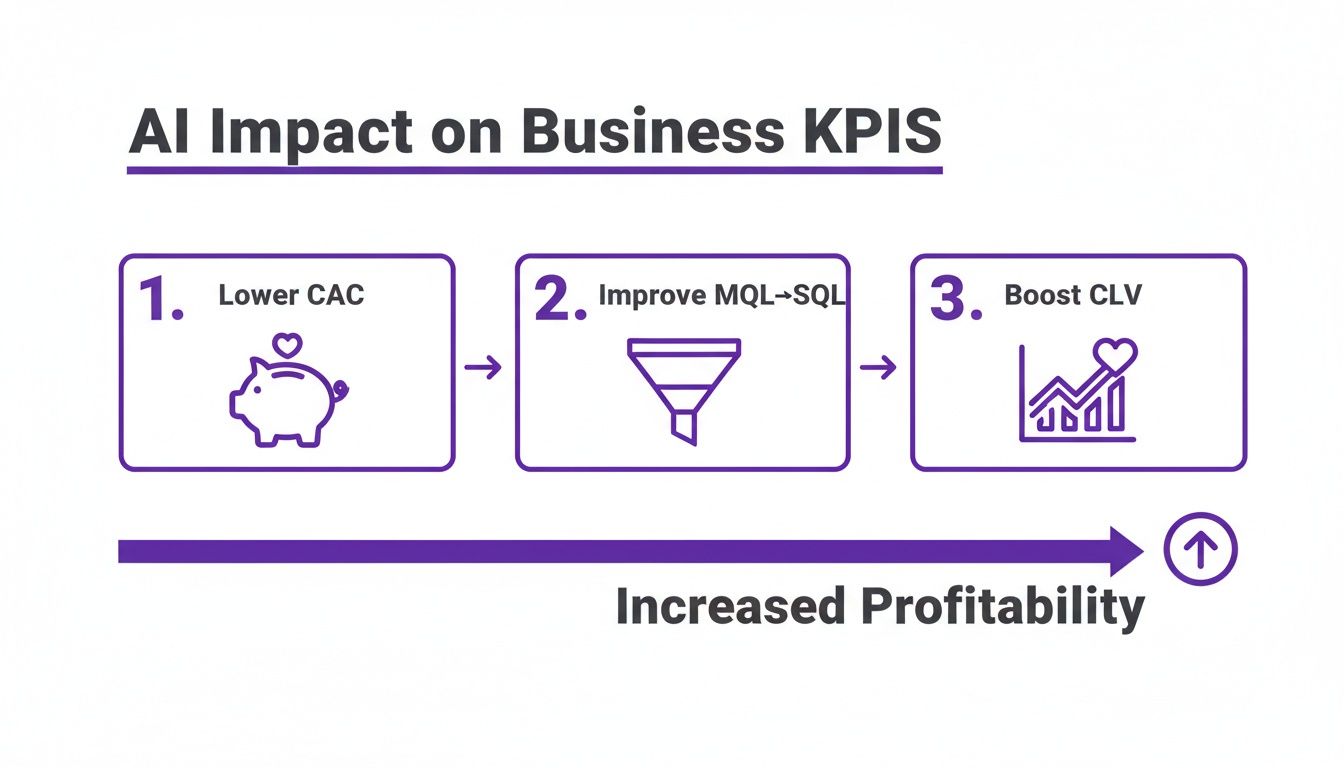
As you can see, AI initiatives are directly tied to lowering customer acquisition costs, improving lead conversion rates, and boosting customer lifetime value. It's all connected.
Phase 3: Launching a Pilot Project
Now it's time to get your hands dirty, but start small. A pilot project is a low-risk, high-reward way to test an AI solution on one specific problem you found in your audit. This lets you learn the ropes, score a quick win, and build internal support for what comes next.
A successful pilot project is your best internal marketing tool. It transforms AI from an abstract buzzword into a tangible success story that gets everyone from your marketing team to your CEO excited about the future.
For many B2B outfits, an AI-powered chatbot for lead qualification is a perfect first project. It tackles a common pain point (sales reps wasting time), it’s relatively easy to implement, and it provides immediate, measurable results—more sales-qualified leads.
Phase 4: Selecting Tools and Scaling Up
With a successful pilot under your belt, you’ve got the data and the momentum to make bigger decisions. Now you can confidently start picking tools that fit your long-term goals and begin integrating them more deeply across your marketing function.
When you're looking at vendors, there's a lot of noise out there. Before you start taking demos, you need a clear framework for making the right choice for your business.
How to Choose Your First AI Marketing Tool
This decision matrix is designed to cut through the marketing fluff and help you evaluate vendors based on what truly matters for a growing business in the US or Canada.
| Consideration | Key Questions to Ask | Why It Matters |
|---|---|---|
| Problem-Solution Fit | Does this tool directly solve the #1 bottleneck we identified in our audit? Does it offer features we'll actually use today, not just "nice-to-haves"? | Avoids "shiny object syndrome." You're buying a solution to a real business problem, not just cool tech. |
| Integration Capability | How easily does it connect with our current CRM (e.g., Salesforce, HubSpot)? What about our email platform or analytics tools? | A tool that doesn't talk to your existing systems creates data silos and manual work, defeating the whole purpose of automation. |
| Ease of Use | Can our current team learn to use this without needing a data scientist on staff? What does the onboarding and training process look like? | The best tool is useless if no one on your team can figure it out. Look for intuitive interfaces and strong customer support. |
| Data & Security | Where is our data stored? Is the vendor compliant with US & Canadian privacy laws like PIPEDA & CCPA? | For North American businesses, data sovereignty and compliance are non-negotiable. Ensure your customer data is handled securely and legally. |
| Scalability & Pricing | What does the pricing model look like as we grow? Are there hidden fees for more contacts, users, or features? | You need a tool that can grow with you. A transparent, scalable pricing model prevents nasty surprises down the road. |
Use this table as your checklist during vendor demos. It will keep you focused on your core needs and help you make a choice that delivers real, sustainable value.
The journey to implementing AI in marketing is a marathon, not a sprint. By following a structured roadmap—auditing your needs, cleaning your data, proving value with a pilot, and then scaling thoughtfully—you set your business up for sustainable, data-driven growth.
Ready to build your own roadmap but not sure where to start?
Contact us today. Our Fractional CMO services provide the strategic guidance to ensure your first steps with AI are the right ones.
Navigating the Risks and Ethics of AI
Jumping into AI in marketing is exciting, but it’s not without its pitfalls. Getting this right isn't just about dodging legal bullets; it’s about earning and keeping your customers’ trust. For any business in Canada or the United States, that means getting serious about data privacy, being transparent, and tackling the very real problem of algorithmic bias head-on.
When you handle this technology responsibly, you turn a potential minefield into a competitive edge. Customers who see you’re treating their data with respect are far more likely to stick around. The trick is to build a solid governance framework before you let these powerful tools loose on your marketing operations.
Upholding Data Privacy and Trust
In this day and age, data privacy isn't optional. Customers know their information is valuable, and regulations like Canada's Personal Information Protection and Electronic Documents Act (PIPEDA) and state-level laws in the US have sharp teeth when it comes to data handling. AI adds another wrinkle, as machine learning models chew through huge amounts of personal data to create those personalized experiences we’re all chasing.
The antidote is transparency. Your privacy policy needs to spell out, in plain English, how AI uses customer data and why. For instance, if you’re using an AI tool to score leads based on their website behaviour, you have to be upfront about it. A Salesforce survey found that a whopping 86% of business buyers are more loyal to companies that are clear about how their information is used. This isn't just about ethics—it's just smart business.
Avoiding Algorithmic Bias
One of the sneakiest—and most significant—risks with AI is algorithmic bias. Here’s the thing: an AI model is only as smart as the data you feed it. If your historical data is skewed by old-school biases around gender, ethnicity, or location, your shiny new AI will learn those prejudices and amplify them at scale.
Imagine you task an AI with segmenting your audience for a new ad campaign. If the training data historically ignored a certain demographic, the AI might just decide that group isn't worth targeting. Not only do you miss out on a valuable market, but you also end up reinforcing unfair stereotypes.
The real danger of AI bias is that it operates at scale, creating a negative feedback loop that reinforces skewed results. It's a critical blind spot that can damage your brand's reputation and alienate entire customer groups if left unchecked.
To keep this from happening, you need to be proactive:
- Audit Your Data: Regularly comb through your training datasets. Make sure they’re diverse and actually reflect your total addressable market, not just the customers you’ve always had.
- Maintain Human Oversight: Never let AI run on autopilot. Your marketing team needs to have the final say on segmentation, targeting, and messaging. A real person should be there to catch biases before a campaign goes live.
- Seek Feedback: Give customers an easy way to tell you what they think of your marketing. This can help you spot instances where personalization went wrong or felt a little too creepy.
Getting a handle on the risks of AI in marketing demands a thoughtful, hands-on approach. By putting data privacy first, staying transparent, and working tirelessly to root out bias, you can build an AI strategy that’s not only powerful but also ethical—driving real growth while strengthening the trust you have with your customers.
Need help building a responsible AI framework that aligns with your business goals?
Contact us for a consultation to ensure your AI strategy is both effective and ethical.
Finding Your Path to AI-Driven Growth
The journey into AI-driven marketing isn't a single giant leap. It’s more like a series of smart, strategic steps. For B2B businesses across Canada and the US, the opportunity is immense—it’s about finally turning marketing from a cost centre into a predictable engine for revenue.
The key is starting with a clear purpose and a defined problem to solve.
But navigating this new territory alone can feel daunting. Without C-level strategic oversight, it's all too easy to get bogged down by technical details or chase shiny new tools that don't actually line up with your business goals. This is where expert guidance becomes absolutely invaluable.
Why a Strategic Partner Matters
A Fractional CMO gives you the senior-level strategy needed to build and execute a focused AI marketing plan, all without the overhead of a full-time executive. It's about getting years of hard-won experience to make sure your first steps are confident ones and your investments deliver returns you can actually measure.
Our process is designed to translate AI’s potential into tangible results for your business:
- Discover & Define: We kick things off by pinpointing your biggest growth barriers. From there, we identify the single highest-impact AI use case for your specific needs.
- Strategize & Structure: Next, we build a clear, actionable roadmap. This includes selecting the right tools and establishing the KPIs we'll use to measure success.
- Execute & Evaluate: Finally, we manage the implementation and constantly refine the strategy based on real performance data, ensuring there's a direct line between adopting AI and growing your pipeline.
The momentum is building across North America. Canadian small businesses have rapidly increased their AI usage to 54% by 2024, a huge jump from just 32% back in 2020. With 73% of those users planning to expand their AI initiatives, the gap between early adopters and the competition is only going to get wider. In the United States, adoption is even more advanced, setting a competitive pace for the entire continent.
Adopting AI isn't just about plugging in new technology; it's about fundamentally rethinking how your marketing creates value and drives revenue.
Partnering with an experienced B2B marketing agency ensures you have the expertise to make that transition smoothly and effectively. You get the strategic clarity needed to make confident decisions and a dedicated partner focused on turning your AI vision into a reality that shows up on your bottom line.
If you’re ready to build a smarter, more effective marketing operation, the time to start is now.
Contact us for a consultation, and let's build your AI growth strategy together.
Your Top AI in Marketing Questions, Answered
We’ve covered the strategy, the tools, and the roadmap for bringing AI into your marketing. But even with a solid plan, a few practical questions always come up just before you take the leap. Let's tackle some of the most common ones we hear from B2B leaders in the United States and Canada.
Is AI in Marketing Too Expensive for a Small Business?
Not anymore. It’s a common myth that AI is only for massive enterprises with bottomless budgets. The reality is that many powerful, subscription-based AI tools are now well within reach for small and mid-sized businesses.
The trick is to start small. Don’t try to boil the ocean. Pick one specific, high-impact use case that offers a clear and quick return. For example, setting up an AI-powered chatbot to qualify website leads can immediately free up hours of your sales team's time. A good partner can help you find these cost-effective quick wins to prove the value of AI in marketing before you even think about larger investments.
Will AI Replace Our Marketing Team?
Think of AI as a powerful assistant, not a pink slip. Its real value lies in augmenting your team’s capabilities, not replacing them. AI is brilliant at automating the repetitive, data-heavy tasks that eat up your team's day—things like sifting through mountains of analytics or segmenting contact lists.
This frees up your marketers to double down on what they do best, the things AI can't touch: high-level strategy, genuine creativity, and building real customer relationships. In fact, a Salesforce survey found that high-performing marketers are 2.8x more likely to be using AI. It's a force multiplier, empowering your existing team to be more effective, not showing them the door.
How Can We Start If Our Company Data Is a Mess?
You’re not alone—this is probably the biggest and most valid concern we hear. The good news is you don't need perfectly pristine data across your entire organization to get started. Far from it.
The answer is a focused data audit. Pick one critical area and clean that up first. For instance, you could focus on tidying up your primary CRM contacts before you launch a pilot project for sales automation. By tackling data hygiene in manageable chunks, you build your AI strategy on a solid foundation without getting overwhelmed. A strategic partner can help turn this major obstacle into an achievable first step.
Ready to get clear, practical answers to your specific questions about AI in marketing? B2Better provides the strategic guidance to build and implement a plan that delivers measurable results.
Contact us today for a no-obligation consultation to build your AI growth strategy.