

Picture your marketing team suddenly having a crew of tireless, data-savvy assistants who never sleep. That's the power of AI for marketing in a nutshell. It’s not about replacing talented people; it’s about amplifying their ability to analyze customer data, create personalized content, and automate repetitive work at scale. For businesses in Canada and the United States, this isn't just an upgrade—it's the new standard for competitive growth.
The New Competitive Edge: AI for Marketing Explained

Think of artificial intelligence as a strategic amplifier for your marketing team's creativity and expertise. For B2B organizations in Canada and the United States, it acts like a powerful lens, bringing massive amounts of customer data into sharp focus.
Instead of your team spending hours manually sifting through spreadsheets to spot trends, AI can analyze customer interactions in real-time. It can predict behaviours and personalize content almost instantly. This shift is less about complex technology and more about gaining a significant competitive advantage.
From Manual Labour to Strategic Impact
Historically, marketing success relied on a mix of intuition, experience, and time-consuming manual analysis. Today, AI handles the heavy lifting, freeing your team to concentrate on strategy and creative execution.
The results are compelling. A notable 93% of marketers report creating content faster with AI assistance. This efficiency translates directly to business growth. For instance, Netflix saves an estimated $1 billion annually through AI-powered content personalization, a success story that demonstrates the massive potential for businesses of all sizes. B2B service firms in North America have boosted lead conversions by over 40% by using AI to demonstrate specialized knowledge before the first sales call even happens. This isn't a futuristic concept—it's happening now.
AI isn’t here to take your marketing job. It’s here to be taken by a person who knows how to use AI to achieve better, faster results. This shift makes strategic adoption a top priority for forward-thinking leaders.
Making AI Adoption Accessible
For many B2B leaders, especially in tech hubs across Canada and the US, the idea of implementing AI can feel daunting. It often brings to mind massive budgets and highly specialized technical teams. The reality, however, is that AI for marketing has become incredibly accessible.
The key isn’t just acquiring the technology but integrating it with a clear business strategy. This is where experienced guidance becomes invaluable. A partner, like a Fractional CMO, can demystify the process by:
- Identifying the highest-impact areas for AI within your current marketing efforts.
- Selecting the right tools that align with your specific business goals and budget.
- Building a phased adoption plan that delivers quick wins and demonstrates clear ROI.
By starting with a focused strategy, B2B companies can make what seems like a complex challenge a measurable driver of growth.
Are you ready to explore how AI can amplify your marketing results? Contact us to discuss how a strategic approach can build your competitive edge.
Why AI Is No Longer Optional for B2B Success
In the world of B2B marketing, standing still is the same as falling behind. The conversation around AI has shifted—it's no longer about if your team should adopt it, but how quickly you can get started. Across North America, smart companies are realizing that artificial intelligence isn't just a shiny new toy; it's the new baseline for staying competitive.
Let’s be blunt: if your team isn't using AI to sharpen its strategy, your competitors in the United States and Canada almost certainly are. This isn’t about chasing trends. It's about securing your spot in a market where speed, precision, and customer insight are the new table stakes.
The Unmistakable Market Momentum
The numbers don't lie. Globally, the AI marketing space has exploded, and North American businesses need to pay attention. In 2020, the market was valued at $12.05 billion USD. By 2025, it had rocketed to $47.32 billion—a nearly fourfold expansion in just five years.
Projections show this sector will blow past $107.5 billion by 2028. Right now, 92% of businesses are planning to invest in AI marketing, fueled by the fact that 81% of marketers already report seeing a jump in brand awareness and sales from using it. This acceleration is real, and you can dig deeper into the Canadian context with insights from The Conference Board of Canada.
This isn't just a global phenomenon; it’s happening right here in innovation hubs across Canada and the US. Holding back means letting nimbler competitors use AI to eat your market share for lunch.
From Inefficiency to Intelligent Operations
Think about where your marketing team’s time really goes. Without AI, they’re likely bogged down by manual, repetitive work. Hours vanish into analyzing spreadsheets, segmenting email lists, drafting routine social posts, and tweaking campaign bids—all tasks that AI can now handle in minutes.
This isn't just inefficient; it's a huge opportunity cost. While your team is buried in the operational weeds, your AI-equipped competitors are focused on big-picture strategy and creative breakthroughs. The problem isn't just about saving time. It's about freeing up your most valuable resource—human expertise—to do the work that actually drives growth.
"Your job will not be taken by AI. It will be taken by a person who knows how to use AI."
This saying has become a cliché for a reason. It hits on a fundamental truth: the real threat isn't the technology itself, but the competitive disadvantage of ignoring it.
When you bring AI into the fold, you flip the script. Instead of just reacting to the market, your team can start predicting it. AI tools can sift through mountains of data to spot emerging trends, forecast customer behaviour, and pinpoint the next best action. You move from playing defence to playing offence. It’s a complete game-changer.
Tangible Business Outcomes You Can’t Ignore
Let's cut through the buzzwords. Adopting AI for marketing isn't an abstract exercise; it delivers concrete, measurable results that hit your bottom line.
- Hyper-Efficient Content Creation: AI can help draft everything from blog posts and ad copy to social media updates at an incredible clip. This lets you build brand authority and stay visible without burning out your content team.
- Predictive Sales Focus: Forget guesswork. AI-powered lead scoring analyzes customer data to flag which prospects are most likely to buy. Your sales team can stop chasing cold leads and focus their energy on high-value opportunities, leading to shorter sales cycles and higher close rates. A great example is U.S. Bank, which saw a 3-5x increase in sales after implementing an AI lead prioritization system.
- Deeper Customer Insight: AI finds the subtle patterns in customer behaviour that are invisible to the human eye. This level of understanding makes true personalization possible at scale, so every interaction feels relevant and tailored.
For B2B organizations across Canada and the US, the message is crystal clear. AI is no longer a "nice-to-have" feature; it's a foundational part of any modern marketing strategy. The choice is simple: adapt now and grab the opportunity for growth, or risk becoming a footnote in your industry.
Ready to explore how AI can secure your company’s future success? Contact us for a consultation to build a winning AI marketing strategy.
Practical AI Marketing Use Cases That Drive ROI
Theory is great, but let's talk results. The real power of AI for marketing isn't in the buzzwords; it's in the practical, bottom-line impact it can have on your B2B organization. Across Canada and the United States, savvy businesses are already using AI to work smarter, forge deeper customer relationships, and speed up revenue growth.
The trick is to start small and focused. Don't try to "boil the ocean." The most successful AI adoptions begin with specific, high-impact applications that solve a genuine problem and deliver a clear, measurable return. Here are four powerful examples that are making a real difference today.
Intelligent and Scalable Content Creation
Let's be honest: creating a steady stream of high-quality content is a grind for most B2B marketing teams. It’s a massive time sink and demands serious resources. AI-powered content tools can act as an incredibly powerful assistant, helping your team draft everything from blog posts and whitepapers to ad copy and social media updates at a speed that was once unthinkable.
This isn’t about replacing your team's creativity. It's about amplifying it. Think of AI as the junior team member who handles the initial research, outlines, and first drafts. This frees up your senior experts to do what they do best: refine the message, inject unique industry insights, and ensure every word aligns with your brand's voice. If you're looking to get started, checking out a review of the best AI content creation tools is a great place to see what's possible.
A recent report found that 93% of marketers are creating content faster with AI. That efficiency isn't just about saving hours; it's about scaling your thought leadership and staying top-of-mind without completely burning out your team.
Hyper-Personalization That Builds Relationships
Generic, one-size-fits-all marketing just doesn't cut it anymore. Today's B2B buyers in the US and Canada have high expectations—they want interactions that speak directly to their specific needs and pain points. AI finally makes this kind of hyper-personalization possible at a scale we could only dream of before. It crunches massive datasets to deliver the right message, to the right person, at exactly the right time.
Take your email campaigns, for example. Instead of just blasting segmented lists, AI can:
- Customize subject lines and body copy based on a prospect’s industry, role, or past behaviour.
- Recommend relevant content or solutions based on the pages they've visited on your website.
- Trigger smart follow-up sequences that adapt on the fly based on how a user engages.
This level of personalization shows prospects you've been listening. It builds trust, and it has a direct, positive impact on conversion rates. Amazon's recommendation engine, a classic AI success, drives 35% of its sales.
Predictive Lead Scoring for Smarter Sales
One of the oldest tugs-of-war in business is between sales and marketing over lead quality. Marketing delivers a pile of leads, and sales complains they’re chasing ghosts. AI-powered predictive lead scoring puts an end to that debate. It uses machine learning to analyze your historical sales data and figure out the exact DNA of your best customers.
The model then scores every new lead based on their likelihood to convert, weighing dozens of signals like company size, industry, website activity, and content downloads. This lets your sales team stop wasting time on low-potential leads and focus their energy exclusively on the opportunities that are actually ready to close. The result? Shorter sales cycles and more revenue. It's that simple.
Enhanced Customer Engagement with Smart Chatbots
For many prospects, your website is their first handshake with your brand. AI-powered chatbots can turn that passive browsing experience into an active, helpful conversation, 24/7.
These aren't the clunky, rules-based bots of a few years ago. Modern AI chatbots understand natural language. They can answer complex questions, qualify leads on the spot, and even book meetings directly into a sales rep's calendar. They act as a tireless front line for customer service and lead generation, ensuring no opportunity slips through the cracks, no matter the time of day. That immediate, helpful engagement makes for a great first impression and moves buyers along their journey much faster.
The momentum here is undeniable, especially in the North American business world. Projections show that 71% of Canadian SMBs will be using AI to streamline their marketing by 2025. We're already seeing the proof: Ottawa-based designer Jacquie Newberry used ChatGPT to slash her admin workload by 40%, while some B2B service firms have seen lead conversion rates jump by over 40%. In the end, every one of these use cases is built to improve your marketing ROI by making you more efficient and helping you bring in more revenue.
Don't let your competitors get ahead. Contact us today to explore these AI use cases for your business.
Your Phased Roadmap for AI Marketing Adoption
Jumping into AI for marketing isn't about flipping a switch and hoping for the best. For B2B organizations in Canada and the United States, a gradual, deliberate approach is the key to de-risking the investment and building the internal support you need for long-term success.
I've seen the best results come from a simple three-phase roadmap: Assess, Pilot, and Scale. This approach transforms what feels like an overwhelming project into a series of manageable, value-driven steps. It prevents those costly missteps that happen with a big-bang rollout, letting you prove the technology’s impact on your specific challenges first. That builds confidence and gives you a rock-solid business case for going bigger.
Phase 1: Assess and Strategize
Before you even think about tools, you need to know where you're going. This first phase is all about a deep dive into your current marketing operations to pinpoint the biggest bottlenecks and opportunities. Where is your team losing the most time? Which manual processes are holding back your growth?
This strategic assessment involves a few key steps:
- Identify Pain Points: Is your content production painfully slow? Is the sales team complaining about the quality of leads they’re getting? Map out the specific, real-world problems you want AI to solve.
- Set Clear Goals: You need to define what success actually looks like. Is it reducing content creation time by 25%? Or maybe increasing marketing-qualified leads by 15%? Your goals have to be specific, measurable, and tied directly to business outcomes.
- Audit Your Data: AI runs on data. Simple as that. Take a hard look at the quality and accessibility of your customer data to make sure you have the fuel needed for AI initiatives like personalization or lead scoring.
Phase 2: Pilot and Prove
With clear goals in hand, it’s time to prove the concept. Instead of launching a massive, company-wide project, pick one high-impact, low-risk area for a pilot program. This is your chance to score some quick wins and build momentum.
For example, a US-based SaaS company noticed its content team was spending a staggering 60% of its time on routine first drafts for blog posts. Their pilot project? Using an AI writing assistant to generate those initial drafts. Within two months, they cut production time in half and reallocated that time to high-level strategy and promotion. This directly contributed to a 20% bump in organic traffic.
The goal of the pilot isn't perfection; it's proof. By demonstrating tangible ROI on a small scale, you create internal champions and secure the buy-in needed to expand your efforts.
This is exactly how AI acts as an accelerator, streamlining key marketing activities to drive real business value.
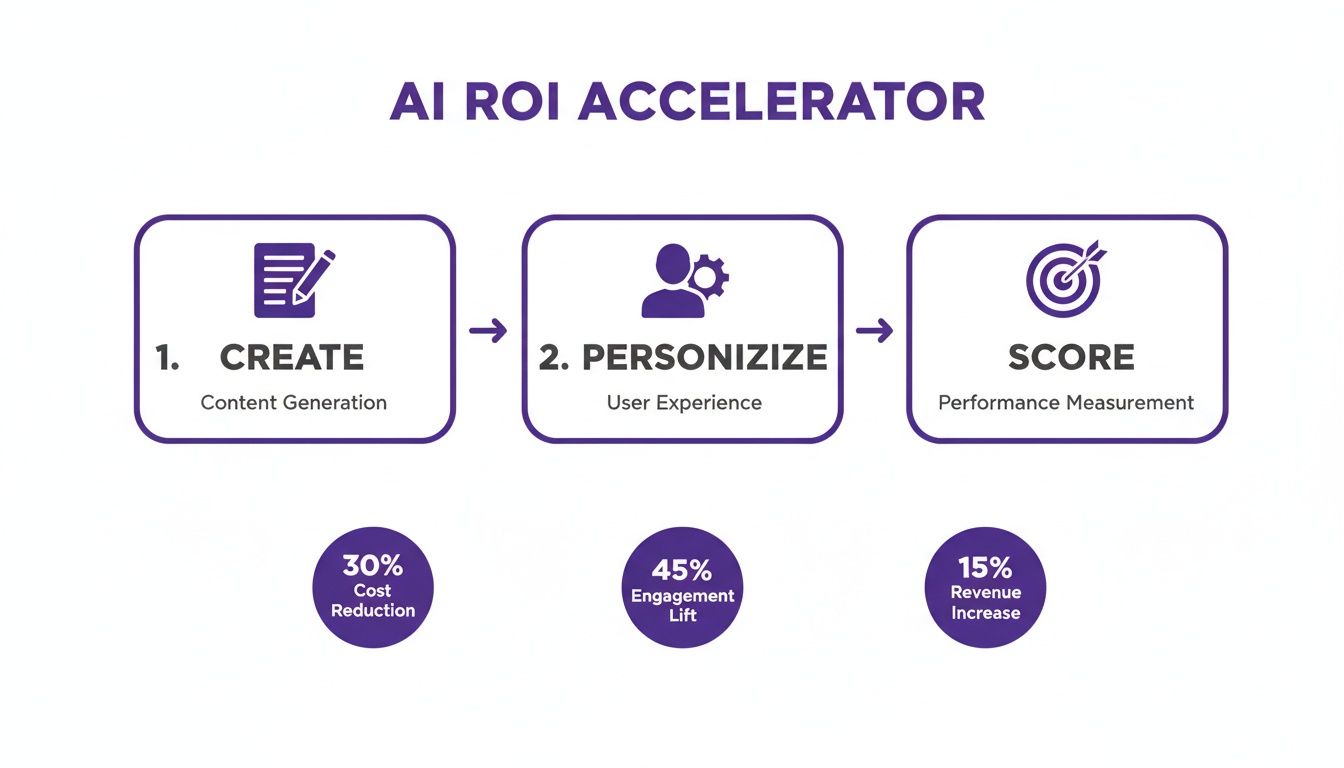
This flow shows how AI becomes a multiplier—turning efficient content creation into highly personalized customer journeys and, ultimately, better-qualified leads for your sales team.
Phase 3: Scale and Integrate
Once your pilot has delivered proven results, you're ready to scale. This is the final phase, where you take the lessons learned from your successful test and systematically roll out AI capabilities across other parts of your marketing function.
But scaling successfully means more than just buying more software licenses. It requires documenting best practices, training your team, and adjusting workflows to make AI a core part of how you operate. This is where strategic oversight is absolutely critical.
To help visualize this journey, here’s a simple table outlining the entire process.
AI Marketing Adoption Roadmap
A three-phase approach to successfully integrating AI into your B2B marketing strategy, from initial assessment to full-scale implementation.
| Phase | Key Activities | Primary Goal |
|---|---|---|
| 1. Assess | Identify pain points, set measurable goals, audit data quality, and build a strategic business case. | To create a clear, data-backed plan that aligns AI initiatives with core business objectives. |
| 2. Pilot | Select a high-impact, low-risk project, choose a vendor, run a time-bound test, and measure ROI. | To demonstrate tangible value and secure internal buy-in with a quick, measurable win. |
| 3. Scale | Document best practices, train the broader team, integrate AI into core workflows, and monitor performance. | To embed AI capabilities across the marketing function and achieve compounding returns on investment. |
A Fractional CMO can guide this entire process, ensuring your technology choices, team training, and integration roadmap align perfectly with your broader business objectives. It’s about making sure every step you take builds on the last, turning your initial AI experiment into a sustainable competitive advantage. Contact us to get started on your AI roadmap today.
Navigating the North American AI Business Landscape
Adopting AI for marketing isn't just a tech project; it’s a strategic business decision that plays out differently on each side of the border. Canadian and American B2B companies are both staring down a unique mix of opportunities, regulations, and cultural quirks. Getting these factors right is what separates a high-ROI AI program from a costly experiment.
The momentum is impossible to ignore. Across North America, businesses are quickly shifting from curiosity to implementation, pushed by obvious efficiency gains and the simple pressure to keep up. This isn't just a game for enterprise giants anymore—it's fast becoming a core piece of the puzzle for small and mid-sized businesses looking to punch above their weight.
The Acceleration of AI Adoption in Canada
Canadian businesses are hitting the accelerator on AI adoption for marketing and operations. Fresh data from Statistics Canada reveals that in Q2 2025, 12.2% of Canadian firms were already using AI to produce goods or deliver services. That’s a staggering jump from just 6.1% in Q2 2024. This isn't just a trend; it's a clear signal that AI's practical value is being recognized and put to work. You can dig into the numbers yourself by reviewing the full findings from Statistics Canada.
This growth is especially sharp in customer-facing tools. Among businesses planning to bring AI on board, virtual agents and chatbots were the most anticipated tools, with 34.8% of firms aiming to deploy them. That figure has nearly doubled from 18.7% the previous year, highlighting a massive shift toward automated, intelligent customer conversations.
Turning Regulations into a Competitive Advantage
While the technology opens up a world of potential, it also comes with some serious responsibilities. Data privacy and ethical guardrails aren't just obstacles; they’re your chance to build deeper, more meaningful trust with your customers.
In Canada, that means working within the Personal Information Protection and Electronic Documents Act (PIPEDA). Down south, American companies have to navigate a patchwork of state-level rules like the California Consumer Privacy Act (CCPA).
Instead of treating these regulations like compliance headaches, think of them as a blueprint for building trust. When you're transparent and ethical about how you use AI and data, you're sending a powerful message to your customers: we respect your privacy. That's a brand differentiator you can't buy.
By proactively building an ethical AI framework, you’re not just dodging fines—you're creating a more resilient and reputable brand. This approach is a non-negotiable part of any sustainable digital marketing strategy in the B2B space.
Managing the Human Side of AI Implementation
The tech is only half the battle. You could have the most brilliant AI strategy in the world, but it's doomed to fail if your team isn't on board. Getting the change management piece right is absolutely critical to making sure your AI investment actually pays off.
Here are three things to keep in mind for a smooth transition:
- Communicate the 'Why,' Not Just the 'What': Your team needs to hear how AI is going to help them, not replace them. Frame these new tools as assistants that will take over repetitive tasks, freeing them up to focus on the higher-value, strategic work they were hired to do.
- Invest in Training and Upskilling: Roll out hands-on training to build confidence and competence. When people feel empowered to use new tools, they’re far more likely to become advocates for the tech instead of roadblocks to its adoption.
- Start Small and Showcase Wins: As we laid out in our phased roadmap, kicking things off with a small pilot project is essential. Celebrating the success of that pilot—whether it’s hours saved or new leads generated—builds crucial momentum and helps calm fears across the organization.
Making AI work in the distinct business cultures of Canada and the United States requires more than just technical skill; it demands strategic foresight. From understanding regional adoption trends to mastering regulatory compliance and leading your team through change, the path to AI success is a complex one.
This is where experienced guidance becomes invaluable. A partner who gets both the technology and the nuanced business environment can help you sidestep common pitfalls and get to a positive return on your investment, faster.
Are you ready to build an AI strategy that respects regulations and empowers your team? Contact us to discuss how our expert guidance can help you navigate the landscape with confidence.
Your Next Move: Build Your AI Future with Strategic Guidance

We've covered a lot of ground in this guide, and one thing is clear: AI for marketing is no longer a "nice-to-have" for B2B companies. It’s now a fundamental part of staying competitive and finding real, measurable growth in Canada and the United States. The question isn't if you should adopt it, but how.
But here’s the thing. Just buying the flashiest AI tools is only half the battle. Real success comes from having the C-level strategic leadership to build the right roadmap, pick the tech that actually fits your business goals, and see the execution through without a hitch.
From a Shiny New Tool to a Business Game-Changer
Too many companies fall into the trap of treating AI like any other software subscription. They invest in powerful platforms but get frustrated when the returns don't show up. That’s because the tech was never truly woven into their core marketing strategy. This is where high-level guidance makes all the difference.
A true transformation starts with a leader who isn't afraid to ask the tough questions:
- Which specific business pain point is this AI tool actually going to solve for us?
- How are we going to measure its real-world impact on leads and revenue?
- What skills or workflow changes does our team need to make this work?
Without clear answers, even the most impressive AI platform becomes a very expensive distraction. Lasting success is built on a solid strategy, not just powerful software.
It's no surprise that companies with a defined AI strategy are 63% more likely to see revenue gains from it than those winging it. That number says it all—expert oversight is what turns potential into profit.
The Fractional CMO Advantage
For many growing businesses in Canada and the United States, bringing on a full-time, senior marketing executive is a huge financial leap. This is where a Fractional CMO comes in. You get the expert guidance you need without the hefty price tag and overhead of a full-time executive salary.
This model gives you direct access to a seasoned leader who can build your AI marketing strategy from the ground up, guide your team through the adoption process, and make sure every dollar you spend is tied to tangible business results. They're your digital marketing technologist, closing the gap between your big-picture goals and what happens on the ground every day.
If you’re ready to build an AI marketing program that delivers a clear, undeniable return on your investment, we’re here to help. Our strategic guidance ensures your journey into AI is built for success right from the start.
Contact us for a consultation and let's start building your AI-powered future today.
Frequently Asked Questions About AI for Marketing
Jumping into any new technology brings up good questions. For B2B leaders in Canada and the US, moving ahead with AI for marketing means you need clarity and confidence. Here are some straight answers to the questions we hear most often from organizations just like yours.
Our goal is to cut through the noise and give you the practical insights needed to make the right call.
What Is the Real Cost to Get Started with AI?
The barrier to entry for AI can be surprisingly low. Many businesses in North America get started with accessible, subscription-based tools that cost just a few hundred dollars a month. A pilot project using an AI content generator or a social media scheduler is a great low-risk way to dip your toes in.
The bigger investment isn't just the software; it's the strategic thinking and team training needed to get real value from it. The trick is to start small, prove the ROI on one specific use case, and then scale your investment based on what you know works—instead of committing to a massive upfront cost.
Will AI Replace My Current Marketing Team?
This is a big one, but the most successful AI rollouts are about augmenting your team, not replacing them. AI is at its best when it's handling the repetitive, data-heavy tasks that bog down creative people. A recent study noted employers cited AI for 54,694 job cuts in 2025, but these were overwhelmingly in routine, data-entry-style roles.
For marketers, AI is more like a powerful assistant. It frees your team from grinding through manual analysis and churning out first drafts, letting them focus on high-level strategy, creative direction, and building customer relationships—the work that still needs a human touch.
"Your job will not be taken by AI. It will be taken by a person who knows how to use AI." This popular saying gets it right: the real opportunity is in upskilling your current team to use these new tools effectively.
How Do I Measure the Return on Investment?
Measuring AI's impact is non-negotiable and should be tied directly to your business goals. Before you implement any new tool, benchmark your current performance.
- For Efficiency: Track the time spent on specific tasks. If an AI tool cuts content creation time from 10 hours down to 4, that’s a 60% efficiency gain.
- For Lead Generation: Keep an eye on metrics like Marketing Qualified Leads (MQLs) or conversion rates. Successful AI campaigns have boosted lead conversions by over 40% for some B2B firms.
- For Sales Alignment: Measure your lead-to-close rate. If AI-powered lead scoring helps your sales team focus on better prospects, you should see this number improve.
By connecting AI to these concrete metrics, you can build a clear and compelling business case for its value.
Ready to move from questions to a clear action plan? The journey to an AI-powered marketing strategy starts with expert guidance. At B2Better, we help B2B organizations in Canada and across North America build practical, results-driven AI roadmaps.
Contact us for a no-obligation consultation to start building your competitive edge.