

Ecommerce search engine optimization services are all about one thing: making sure your online store shows up when potential customers in Canada and the United States are looking for products like yours on Google. It’s a mix of behind-the-scenes technical work, smart content, and building your site’s authority so you attract the right kind of traffic—the kind that turns into sales.
Why Ecommerce SEO Is Your Greatest Untapped Growth Lever
Picture this: your ideal B2B buyer in Toronto, Chicago, or Vancouver is searching for a specific industrial component or software solution you sell. In that make-or-break moment, do they find you? Or your competitor?
Winning that moment is the whole game in modern digital commerce. A solid ecommerce SEO strategy is how you win it, time and time again.
Think of your spot on Google as prime real estate. A top ranking is like having the best booth at the industry’s biggest trade show, but with a massive advantage: it’s open 24/7, works for you nonstop, and costs you nothing in travel or setup fees. When you ignore organic search, you're leaving that prime location wide open for your competition to move in and scoop up predictable, high-intent revenue that should have been yours. For instance, a leading US-based electronics component distributor saw a 75% increase in qualified organic leads within 18 months of committing to a targeted SEO strategy, demonstrating the immense potential waiting to be unlocked.
The Scale of the North American Opportunity
The digital marketplace in North America isn’t just big; it's a massive engine for B2B growth. Across tech, SaaS, and manufacturing, companies are finally realising that their best prospects are using search engines to vet suppliers long before they ever talk to a sales rep. Not showing up in those searches is no longer a small marketing gap—it’s a major business risk.
A quick look at the data shows just how critical this is for any B2B leader with an eye on growth in the Canadian and US markets.
Key Ecommerce SEO Statistics for Canadian & US B2B Leaders
| Statistic | What This Means for Your Growth |
|---|---|
| The Canadian B2B ecommerce market is projected to hit $969.85 billion. | A huge, active market is right at your doorstep. A small slice of this pie, captured through organic search, can fundamentally change your revenue trajectory. |
| 53% of all ecommerce traffic comes from organic Google searches. | This is your single largest source of potential customers. Neglecting SEO means you're invisible to over half of your addressable market in the United States and Canada. |
| 89% of B2B researchers use the internet during their product research process. | Your buyers in North America are online, actively looking for solutions. SEO puts your products directly in their path when their intent to buy is highest. |
These numbers aren't just abstract figures; they represent real buyers with real budgets looking for suppliers they can trust. Showing up on page one is how you start that conversation.
For B2B firms, especially in tech and manufacturing, appearing on the first page of Google for a commercial search query isn't just a marketing win. It's a direct line to qualified buyers who have already identified a need and are actively seeking a solution. This is the definition of a high-value lead.
Moving Beyond a Technical Checklist
Good ecommerce SEO is so much more than a technical to-do list. It’s a core pillar of a modern growth strategy. It demands a deep understanding of your customer's journey, the language they use every day, and the problems that keep them up at night.
When you align your digital presence with those factors, you turn your website from a passive online catalogue into an active, lead-generating machine. If you're just starting to wrap your head around the basics, our guide on how to improve website traffic is a great place to begin.
Ultimately, investing in professional ecommerce search engine optimization services is about securing your company’s future in an increasingly digital-first B2B world. It’s about making sure that when your ideal customer in Canada or the US has a problem, your solution is the first one they find.
Ready to claim your spot at the top? Contact us for a no-obligation discovery call to explore your growth potential.
What High-Impact Ecommerce SEO Services Actually Include
Diving into ecommerce search engine optimization can feel like you’re trying to learn a new language. But behind all the industry jargon are real, tangible actions designed to build a powerful, revenue-generating machine. A truly effective strategy is so much more than a simple checklist; it's a layered approach that turns your online store into a magnet for qualified buyers in Canada and the United States.
Think of it like building a high-performance retail store. You wouldn't just throw products on the shelves and hope for the best, right? You’d need a solid foundation, clear signage, logical aisle layouts, and an appealing storefront to draw people in. High-impact SEO services apply that same thinking to your digital presence, engineering every single element for discovery and conversion.
At its heart, a comprehensive service package tackles four critical areas. Each one builds on the last, creating a powerful synergy that drives sustainable growth and separates the market leaders from everyone else.
This hierarchy shows how targeted strategies for market reach, traffic acquisition, and ranking improvements all feed into overall ecommerce growth.
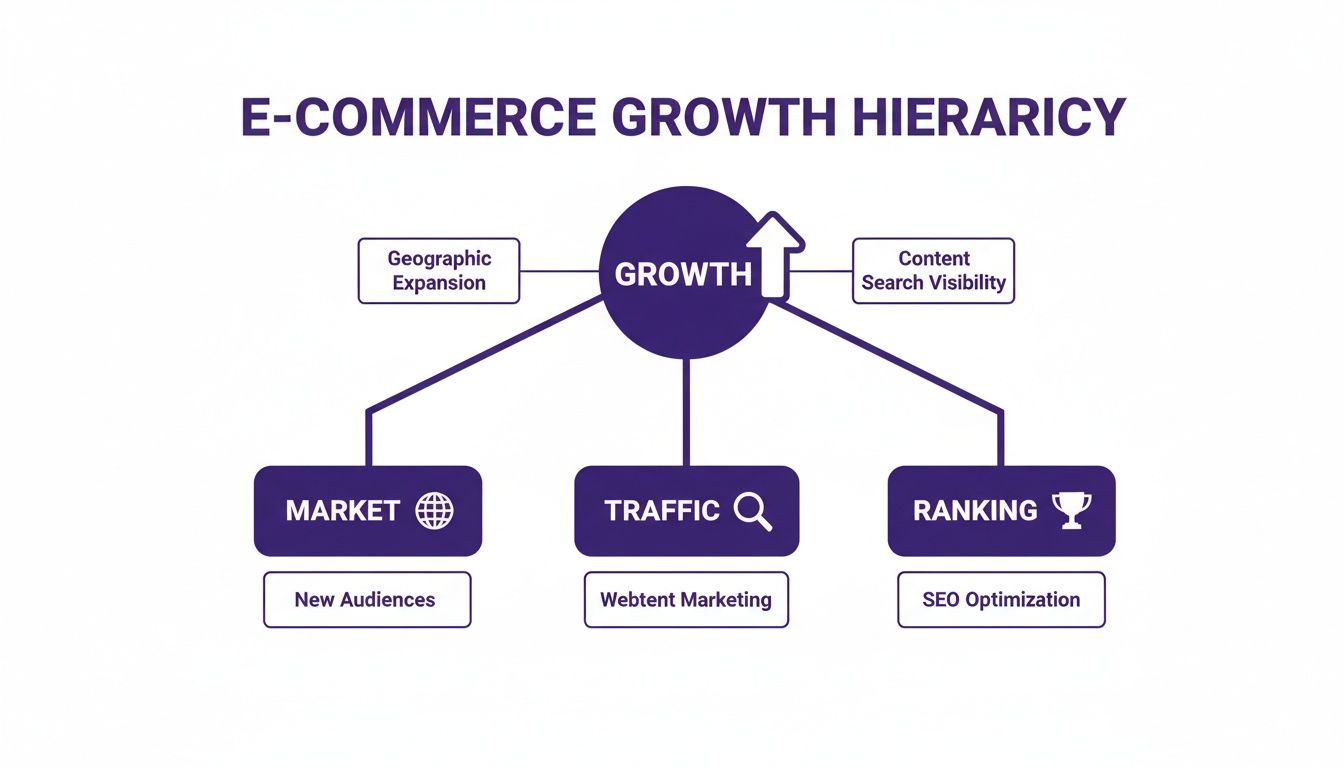
The key takeaway here is that growth isn't accidental. It’s the direct result of a structured approach that strategically improves both your visibility and how users engage with your site.
Technical SEO: The Foundational Blueprint
Long before a single customer finds you, search engine "crawlers" need to be able to explore your site effortlessly. This is the realm of technical SEO—the absolute, non-negotiable foundation of your entire strategy. It’s all the behind-the-scenes work that makes your site accessible, fast, and secure.
Key components usually include:
- Site Speed Optimization: A slow website is a conversion killer. In fact, just a one-second delay in page load time can lead to a 7% reduction in conversions. Good services will focus on compressing images, improving server response times, and refining code so your pages load almost instantly.
- Mobile-First Indexing: With over half of all web traffic now coming from mobile devices, Google prioritizes the mobile version of your site for ranking. A quality service ensures your site delivers a flawless experience on smartphones and tablets across the US and Canada.
- Crawlability and Indexing: This involves creating a clean XML sitemap and a logical
robots.txtfile. Think of these as a map and a set of instructions that guide search engines, making sure they can find and understand all your important product and category pages.
On-Page and Product Page Optimization
Once your foundation is solid, the next move is to optimize the pages your customers actually see. This is where you connect your products to the specific problems your buyers are trying to solve. For B2B ecommerce in the US and Canada, this means zeroing in on technical specifications, use cases, and industry-specific language.
Grainger, a major B2B supplier in the US, is a masterclass in this. Their product pages are loaded with detailed specs, model numbers, user manuals, and Q&As. This lets them capture a massive range of very specific, high-intent search queries from professional buyers who know exactly what they’re looking for.
A successful ecommerce SEO service doesn't just rank products; it answers customer questions before they're even asked. This builds trust and positions your brand as a helpful expert, which directly influences the purchase decision.
Strategic Site Architecture and Rich Snippets
How your pages are organized is absolutely critical. A logical site architecture acts like a clear map for both users and search engines, guiding them from broad categories down to specific products with ease. This structure helps spread ranking authority (or "link equity") throughout your site and massively improves the user experience—a huge ranking factor in itself.
On top of that, advanced services implement schema markup, also known as rich snippets. This is special code that helps search engines understand the content on your pages and display it more attractively in the search results. For an ecommerce site, this can mean showing star ratings, pricing, and stock availability right on the Google results page. That makes your listing pop, dramatically increasing the chances someone will click on your link instead of a competitor's.
Many high-impact ecommerce SEO services include robust content strategies, and understanding the benefits of monthly SEO content services can be a game-changer for building authority and attracting buyers.
By integrating these core components, you create a system that doesn't just chase rankings but builds a sustainable asset for your business to grow on. Ready to strengthen your technical foundation? Contact us for a free site audit and consultation.
Aligning SEO with the Modern B2B Buyer's Journey
B2B ecommerce SEO plays by a completely different set of rules than its B2C cousin. This isn't about sparking a quick, impulsive purchase. It's about strategically guiding a long and often complex decision-making process that involves multiple stakeholders.
Today’s B2B buyers in Canada and the US are researchers first. They conduct deep online investigations long before they ever dream of speaking to a sales rep. This means your SEO and content strategy must be meticulously mapped to every single stage of their journey, serving up the right information at precisely the right time.
This is the difference between generating a flood of unfocused website traffic and attracting a steady stream of highly qualified, sales-ready leads.

This new reality is especially true in the Canadian and US markets, where buyers are increasingly digital-first. A staggering 71% start their purchase journey with a generic search, making ecommerce search engine optimization services a genuine game-changer.
Consider this: in Canada and the United States, 53% of all ecommerce traffic flows from organic Google searches. And for sites that get it right, average SEO traffic conversion rates hit 2.4% for ecommerce. It’s no surprise that prioritizing SEO is surging in popularity. You can find more data on this trend in a detailed analysis of SEO statistics and benchmarks.
Mapping Content to the Three Core Stages
To truly connect with your audience, your content has to evolve with their needs as they move through the buying cycle. Let’s break down how this works for a B2B business.
- Awareness Stage: The buyer is just starting to identify a problem or an opportunity. They aren’t looking for your product yet; they’re looking for answers and expert insights. Your goal? Be the helpful authority they find first.
- Consideration Stage: Now, the buyer has put a name to their problem and is actively researching potential solutions. They’re comparing different approaches, vendors, and product categories. Your job is to frame your solution as the best possible choice.
- Decision Stage: The buyer is finally ready to pick a vendor and make the purchase. At this point, they're hunting for proof, validation, and solid reasons to choose you over the competition. This is where you close the deal with trust-building content.
B2B Keywords: A Canadian Example
The keywords you target are a direct reflection of the journey stage you’re aiming for. A generic, B2C-style approach will attract the wrong crowd and burn through your marketing budget. Specificity is everything.
Imagine you sell industrial-grade 3D printers in Canada. Here’s how your keyword strategy would adapt to each stage of the buyer's journey:
| Buyer Stage | B2C-Style Keyword (Low Intent) | B2B-Focused Keyword (High Intent) |
|---|---|---|
| Awareness | "3D printing ideas" | "benefits of additive manufacturing in aerospace" |
| Consideration | "best 3D printer" | "metal 3D printer for prototypes comparison" |
| Decision | "3D printer for sale" | "industrial 3D printer supplier in Ontario" |
The crucial difference here is intent. A B2B keyword strategy hones in on the specific language professionals use when they are trying to solve a real business problem, not the general terms a hobbyist might search for. This kind of precision targeting is the foundation of an effective lead generation engine.
To get a better handle on your ideal buyer, it can be helpful to understand how to ethically scrape LinkedIn data for market analysis. This lets you build out more accurate personas based on real-world professional context.
By aligning your ecommerce search engine optimization services with the B2B buyer’s journey, you transform your website from a simple digital storefront into a strategic asset. You'll start conversations with the right people, build authority in your industry, and create a predictable pipeline of qualified leads from both Canada and the United States.
Are you ready to build an SEO strategy that speaks directly to your ideal buyers? Contact us today to discuss how we can map your path to growth.
Winning Your Local Market with Targeted SEO Strategies
While the North American B2B market is massive, some of your best, highest-converting customers are often right in your own backyard. For many Canadian and US businesses, a powerful local SEO strategy isn’t just an add-on; it’s one of the most direct, high-ROI ways to generate sales-ready leads.
This is especially true for companies serving specific regions, like a parts supplier in the Greater Toronto Area or an industrial services provider in Alberta's energy sector. When you win the local search game, you become the default, go-to provider for buyers actively searching for suppliers "near me."
Why Local SEO Is a Competitive Advantage
Local search is powerful because it’s built on immediacy and trust. When a B2B buyer in Calgary searches for "industrial pump repair Calgary," they aren’t just looking for any provider—they need a local expert who can solve their problem fast. By showing up at the top of those results, you instantly establish your relevance and credibility.
Better yet, a well-executed local strategy for eCommerce in Canada or the US can deliver a 35% higher conversion rate for local mobile searches compared to non-local ones. And with nearly 50% of all Google searches being for local information, having a strong, visible local presence is non-negotiable.
The "Buy Local" movement isn't just a feel-good slogan; it's a powerful trust signal that search engines recognize. Highlighting your local presence in cities across Canada and the United States taps into this preference, giving you an immediate edge over international or non-local competitors.
Actionable Tactics for Local Dominance
Building a strong local footprint comes down to a few key, targeted actions that work together to signal your relevance to both search engines and potential customers.
- Google Business Profile (GBP) Optimization: Think of your GBP listing as your digital storefront for local search. A fully built-out profile—complete with accurate service areas, product catalogues, quality photos, and a steady stream of positive reviews—is your single most powerful tool for capturing those "near me" searches.
- Building Local Citations: Citations are simply mentions of your business's name, address, and phone number (NAP) on other reputable local websites, like industry directories or the local Chamber of Commerce. Consistent NAP information across the web builds authority and confirms your connection to a specific area.
- Creating Region-Specific Content: Develop content that speaks directly to the challenges and needs of your local market. This could be a case study about a project you completed in a specific city or a blog post on industry regulations relevant to your province or state.
By implementing these strategies, you create a powerful signal that your business is the premier choice for buyers in your region. You can learn more about how we apply these tactics in our overview of Ottawa SEO services.
This targeted approach transforms your website from a general B2B ecommerce store into a vital local resource. For businesses in Canada and the United States, this focus creates a deep competitive moat that national or global players simply can't cross. Contact us to start dominating your local market.
Choosing the Right Growth Partner: Agency vs. Fractional CMO
Picking the right partner for your ecommerce SEO is probably one of the most important decisions you'll make for your company's growth. This isn't just about hiring a vendor; it’s about finding a co-pilot to help steer your business. For B2B companies in North America, that choice usually boils down to two models: a traditional SEO agency or a Fractional CMO.
Understanding the core difference here is crucial. One is built for execution, the other for strategic leadership.
The Traditional SEO Agency Model
A traditional SEO agency is an execution powerhouse. They're the specialists you call for well-defined tasks like keyword research, link building, and technical audits. If you already have a strong, clear marketing strategy and just need skilled hands to bring it to life, this model can work beautifully.
The catch? The agency model often operates in a silo. Their world revolves around delivering SEO-specific KPIs—rankings, traffic, and backlinks. And while those metrics are certainly important, they don't always connect directly to what really matters to your business: leads, sales, and revenue.
The Fractional CMO Partner Approach
A Fractional CMO, on the other hand, acts as a strategic partner who integrates right into your leadership team. This approach goes way beyond just executing tasks; it’s about having C-level marketing leadership on a part-time basis. Instead of focusing only on SEO metrics, a Fractional CMO weaves your ecommerce SEO strategy into the very fabric of your company's broader business goals.
This integrated approach makes sure every SEO initiative is directly tied to revenue. For example, a leading North American SaaS company boosted its qualified organic leads by over 150% in a single year by switching from a task-based agency to a Fractional CMO partner. The partner completely realigned their SEO and content strategy to target specific, high-value customer personas in the United States and Canada, transforming their website from a passive brochure into an active lead-generation engine.
The real value of a Fractional CMO is alignment. They make sure SEO doesn’t just bring in traffic, but brings in traffic that actually converts into customers, contributing directly to your bottom line and overall business growth.
Comparing Ecommerce SEO Partners: Agency vs. Fractional CMO
Deciding between these two models really comes down to your company's current needs, resources, and strategic maturity. This side-by-side analysis should help you decide which model best aligns with your company's strategic growth objectives and resources, particularly for leaders in Canada and the US.
| Factor | Traditional SEO Agency | Fractional CMO Partner |
|---|---|---|
| Primary Role | Executes specific SEO tasks and campaigns. | Provides strategic marketing leadership and direction. |
| Key Focus | SEO metrics like keyword rankings and organic traffic. | Business outcomes like lead generation and revenue growth. |
| Integration | Acts as an external vendor, often with a single point of contact. | Becomes part of the leadership team, collaborating across departments. |
| Best For | Companies with an existing, well-defined marketing strategy. | Companies needing senior strategic guidance to build and scale growth. |
So, what’s the bottom line? Your decision really hinges on one simple question: do you need a doer, or do you need a leader? If you’ve got a fully baked strategy and just need more hands on deck, an agency can be a fantastic fit. But if you’re looking for a senior partner to help you build that strategy, connect marketing to sales, and drive measurable business results, a Fractional CMO is almost always the better choice.
The right partner can completely transform your approach to growth. Learn more about how a strategic B2B marketing agency in Canada can help you achieve your goals.
Putting Your B2B Ecommerce Plan Into Action
Inspiration is one thing; turning that into tangible action is what separates market leaders from the rest. This is your straightforward roadmap to start capturing the immense growth opportunities waiting in the North American B2B ecommerce market. The path forward is clear and hinges on a few critical next steps.
We've covered a lot of ground, but it all boils down to three core truths: the opportunity in Canadian and US B2B ecommerce is massive, an effective strategy has many moving parts, and the right strategic partner can be a powerful multiplier for your success.
Your Three-Step Action Plan
To move from planning to actual progress, focus your efforts on this simple, three-part plan. This approach cuts through the noise and ensures your first steps are the right ones.
-
Run a Practical Digital Audit: Before you can map out where you're going, you need to know where you stand. Start with an honest look at your current digital footprint. Where do you rank for your most important product keywords? How does your website’s performance stack up against key competitors in the United States and Canada? This initial benchmark is non-negotiable.
-
Define Your Ideal Customer’s Search Habits: Go deeper than basic demographics. What specific technical terms, part numbers, or compliance codes are your ideal buyers typing into Google? What questions are they asking during their research phase, long before they're ready to talk to sales? Understanding their search intent is the bedrock of any successful ecommerce search engine optimization services strategy.
-
Bring in an Expert Perspective: You don’t have to figure this all out in a vacuum. Sometimes you're too close to the business to see the full picture. Gaining an outside perspective can uncover blind spots you didn't know you had and reveal growth opportunities you haven’t even considered.
Take one of our clients, a specialized B2B electronics supplier in North America. By shifting to a targeted ecommerce SEO strategy, they increased their organic lead conversion rate by over 65% in just nine months. They stopped chasing vanity traffic and started attracting qualified buyers from the US and Canada who were actually ready to make a purchase.
Success like this isn't an accident. It’s the direct result of a clear strategy paired with expert execution. The potential to grow your business through organic search is undeniable.
Ready to gain clarity on your own growth potential and see how a strategic marketing approach can transform your business?
Contact us for a no-obligation discovery call. We'll help you build your action plan.
Common Questions About Ecommerce SEO
Investing in professional ecommerce search engine optimization is a big decision. To help leaders across Canada and the United States make a confident choice, we’ve put together straight answers to the questions we hear most often.
How Long Does It Take to See SEO Results?
While you might spot minor improvements in the first few months, real, sustainable results from SEO typically take 6 to 12 months to materialize. Think of it like planting a tree, not flipping a switch. The first few months are all about building a solid foundation—fixing technical glitches, publishing core content, and establishing your site’s authority.
The reward for this patience is substantial. Unlike paid ads that disappear the moment you stop paying, the organic traffic and authority built through SEO become a long-term asset that compounds over time.
Is SEO More Important Than Paid Ads?
SEO and paid ads (like Google Ads) aren't competitors; they're partners in a winning strategy. Paid ads are brilliant for driving immediate, targeted traffic and testing out new product pages. SEO, on the other hand, builds sustainable, long-term organic traffic and credibility that lasts.
The numbers speak for themselves: organic search drives over 53% of all website traffic, far outpacing paid search. The most successful B2B companies in Canada and the US use paid ads for short-term goals while building a powerful organic foundation with SEO for lasting growth.
What is the ROI of Ecommerce SEO?
The return on investment for ecommerce SEO can be massive, but it’s measured in more than just immediate sales. While a direct lift in revenue is the ultimate goal, SEO also delivers immense value by:
- Lowering Customer Acquisition Costs: Organic leads are often significantly cheaper to acquire than leads from paid channels.
- Increasing Brand Authority: Ranking at the top of search results positions you as a trusted leader in your industry.
- Improving User Experience: Many SEO best practices, like improving site speed and navigation, directly lead to higher conversion rates for all your traffic sources.
One North American B2B equipment supplier we know saw a 400% ROI within 18 months of partnering with an expert on their ecommerce SEO. They not only increased organic sales but also reduced their reliance on expensive paid advertising in the US and Canada, dramatically improving their overall marketing efficiency.
Can We Do SEO In-House?
While some basic SEO tasks can certainly be managed in-house, a comprehensive strategy demands deep, specialized expertise. The rules of search are constantly shifting, and a dedicated expert can navigate these changes to keep you ahead of the competition. For most B2B companies, a partnership model provides the strategic leadership and focused execution needed to drive real business results.
Ready to stop asking questions and start seeing results? The team at B2Better acts as your strategic partner, building an ecommerce SEO plan that aligns directly with your revenue goals. Contact us for a no-obligation discovery call and let's build your path to sustainable growth.