

True thought leadership isn't just about churning out content. It's about consistently providing the most insightful and forward-thinking answers to your audience's biggest questions, becoming their go-to authority. Done right, it shifts your position from a mere seller to a trusted advisor who genuinely shapes the industry conversation. For companies in the United States and Canada, this is a critical strategy for standing out in crowded B2B markets.
Defining Thought Leadership Beyond the Buzzwords

Many companies mistake content marketing for thought leadership, but they're not the same beast at all.
Think of it this way: imagine you’re planning a tough mountain expedition. You could grab a generic map from a reseller who has never actually set foot on the trail. That's basic content marketing—it's useful, sure, but it's also limited.
Now, picture hiring an experienced guide instead. This guide doesn't just hand you the map; they know the terrain inside and out. They can point out unmarked shortcuts, warn you about hidden dangers, and adapt the route based on the weather. They give you perspective you simply can't get anywhere else.
That guide is the true thought leader. They don't just report on what exists; they interpret, analyze, and predict, building deep trust and making themselves indispensable.
This distinction is mission-critical for B2B decision-makers in competitive North American markets like tech, SaaS, and manufacturing. When they're facing complex, high-stakes decisions, they aren't looking for a map-seller; they're looking for the guide.
The Strategic Value in B2B
Becoming that trusted guide creates a powerful competitive advantage that paid ads alone can't buy. It actually shortens sales cycles, because prospects show up already convinced of your expertise. This approach is gaining serious traction across Canada and the United States for a reason.
In fact, a joint study by Edelman and LinkedIn revealed that 54% of decision-makers in North America spend at least one hour per week reading and reviewing thought leadership content. Furthermore, 61% of them are more willing to pay premium prices to work with a company that has articulated a clear vision through thought leadership.
This clear guide to building influence offers a deeper dive into how this translates into real-world impact.
By consistently delivering unique insights, you build an audience that trusts your judgment, values your perspective, and turns to you first when they're finally ready to buy. This isn't about being the loudest voice in the room; it's about being the most credible one.
Ready to become the trusted guide in your industry? Contact us to discuss your thought leadership strategy.
Why Thought Leadership Is a Growth Engine for B2B Companies
Investing in thought leadership isn’t just another line item in the marketing budget. Think of it as a direct investment in your company’s growth, reputation, and long-term stability.
For B2B firms here in North America—especially those with long sales cycles and complex decisions—becoming a recognized authority is one of the most powerful ways to build a real competitive advantage. It fundamentally changes how potential customers see your brand long before they ever talk to a sales rep.
Today's B2B buyers are sharp, informed, and deeply skeptical. A staggering 89% of business decision-makers say that thought leadership is effective in improving their perception of a company. They’re actively looking for insightful content to help them understand their problems, weigh their options, and vet potential partners. When your company provides those definitive answers, you stop being just another vendor and become the indispensable partner they were looking for.
Attract High-Quality Leads and Shorten Sales Cycles
Done right, thought leadership acts like a magnet for your ideal clients. Instead of chasing down cold leads, you build a system that draws in prospects who are already educated about their problem and see your company as the go-to expert for the solution.
This is the very essence of attraction marketing, where you deliver value before you ever make a sales pitch.
This shift has a massive impact on your sales funnel. Leads that come through thought leadership are almost always more qualified. A prime example is HubSpot, which pioneered the concept of "inbound marketing." By creating a massive library of high-quality blogs, guides, and tools, they became the go-to resource for marketers worldwide, generating a continuous stream of highly qualified inbound leads and growing into a multi-billion dollar company.
According to one study, 61% of C-suite executives are more willing to pay a premium to work with a brand that has clearly articulated its vision through thought leadership.
That pre-built trust lets your sales team skip the early-stage skepticism and get straight to solving the client’s specific challenges. The result? A much shorter path from first contact to a signed deal.
Build Unshakeable Trust and Command Premium Pricing
In industries like technology, professional services, and specialized manufacturing across the United States and Canada, trust is the ultimate currency.
Consistently publishing high-value thought leadership content does more than just show off your expertise. It proves you’re committed to your clients' success, not just hitting your own sales targets. This deepens relationships, builds unshakeable customer loyalty, and ultimately reduces churn while increasing lifetime value.
Better yet, being seen as an industry leader gives you serious pricing power. When you're the go-to source for insights and innovative solutions, you're no longer competing on price. You're competing on value and vision, which allows you to command premium rates for your products and services.
Bridge the Innovation Gap and Attract Top Talent
For many Canadian and American companies, staying ahead means driving innovation. But there’s a catch.
Reports from RBC Thought Leadership have highlighted a puzzling gap. Despite having the most educated workforce in the G7—with 63% of Canadians aged 25-64 holding postsecondary credentials—our national productivity lags. A big reason for this is that Canadian firms invest only 1.7% of GDP in R&D, which is below the OECD average and slows down the adoption of new ideas.
Thought leadership tackles this head-on by showcasing your company's expertise, proving the value of new strategies, and encouraging the market to embrace innovation.
This forward-thinking stance doesn’t just pull in customers; it attracts top talent, too. In competitive job markets across North America, the best professionals want to work for companies that are shaping the future of their industry. A strong thought leadership presence signals a culture of innovation and expertise, making your organization a magnet for A-players.
Ready to turn your company’s expertise into a powerful growth engine? Contact us to learn how our Fractional CMO services can build a thought leadership program that delivers measurable results.
The Three Pillars of a Powerful Thought Leadership Strategy
An effective thought leadership strategy doesn't just happen. It's deliberately built on three core pillars that work together to establish your authority and connect with your audience. If you master these, you’ll move from simply creating content to genuinely shaping your industry’s conversation.
It’s not about being the loudest voice in the room, but the most trusted one. This framework gives you a practical roadmap to focus your efforts where they’ll have the biggest impact.
Pillar 1: Expertise and a Unique Point of View
The first and most critical pillar is your expertise. This isn’t about rehashing common knowledge or summarizing what everyone else is already saying. Real thought leadership starts with a unique, defensible point of view that delivers genuine insight.
Think of your expertise as your "why"—the reason people should listen to you over anyone else. It's the intellectual property that sets you apart.
This unique perspective can come from a few places:
- Proprietary Data: Analyzing your own customer data, survey results, or platform metrics to uncover trends nobody else has seen. A SaaS company, for example, could publish an annual report on user behaviour that quickly becomes an industry benchmark.
- Hard-Won Experience: Turning years of hands-on work in your field into strategic frameworks, models, or even cautionary tales. This is where a manufacturing consultant can share a specific methodology for reducing waste that they've perfected over decades.
- Novel Analysis: Connecting seemingly unrelated ideas or applying a theory from one field to another to create a breakthrough insight.
Without a distinct point of view, your content is just another echo in an already crowded chamber. Your expertise is the anchor.
Pillar 2: An Authentic and Authoritative Voice
Once you have your expertise locked down, the next pillar is your voice. This is all about how you communicate your unique perspective. An authentic and authoritative voice is consistent, recognizable, and connects deeply with your target audience across Canada and the United States.
A study by Edelman and LinkedIn found that 64% of decision-makers believe an organization's thought leadership content is a more trustworthy way to assess its capabilities than its marketing materials. An authentic voice is what fuels that trust.
Think about the companies you admire—their tone is often unmistakable. Some are academic and data-driven; others are provocative and challenging. The goal is to cultivate a voice that’s both true to your brand and compelling to your ideal buyers. This means being confident, clear, and consistent across every piece of communication, from a detailed white paper to a short LinkedIn post. To dig deeper, explore the fundamentals in our article on the power of content marketing for B2B.
Pillar 3: Strategic Channel Selection
The final pillar is the channel—the platforms you choose to deliver your insights to your audience. A classic mistake is trying to be everywhere at once. A strategic thought leader knows it’s far more effective to dominate a few key channels where their ideal customers are actively looking for information.
The right channel depends entirely on your audience and content format:
- For technical B2B buyers: In-depth technical reports, webinars, or appearances on specialized industry podcasts might be the most effective.
- For C-suite executives: High-level insights on LinkedIn, exclusive roundtable events, or bylined articles in major business publications often work best.
- For demonstrating practical expertise: A YouTube series showing your product or process in action can build immense credibility.
The goal is to go where the conversation is already happening. Great success stories, like HubSpot’s rise through inbound marketing or Salesforce’s dominance with its Dreamforce event, show the power of choosing the right channels and owning them. By aligning your unique expertise and authentic voice with the right platforms, you create a powerful, self-reinforcing strategy that builds authority and drives real business growth.
Ready to build these pillars for your own organization? Contact us to see how our Fractional CMOs develop strategies that deliver measurable results.
Building Your Thought Leadership Program Step By Step
Knowing the pillars of thought leadership is one thing; actually building a program is another. It’s time to move from theory to a clear, actionable plan—a playbook for turning ambitious goals into a sustainable, results-driven program. For busy B2B teams across Canada and the United States, this step-by-step approach breaks it all down into manageable stages.
A successful program isn't about guesswork. It’s a deliberate process of defining your territory, crafting your message, and delivering it with real impact. These steps provide a structured framework to get started or refine your efforts, ensuring every piece of content you create serves a strategic purpose.
This whole process rests on the foundational pillars we've discussed—Expertise, Voice, and Channel—which you can see visualized below.
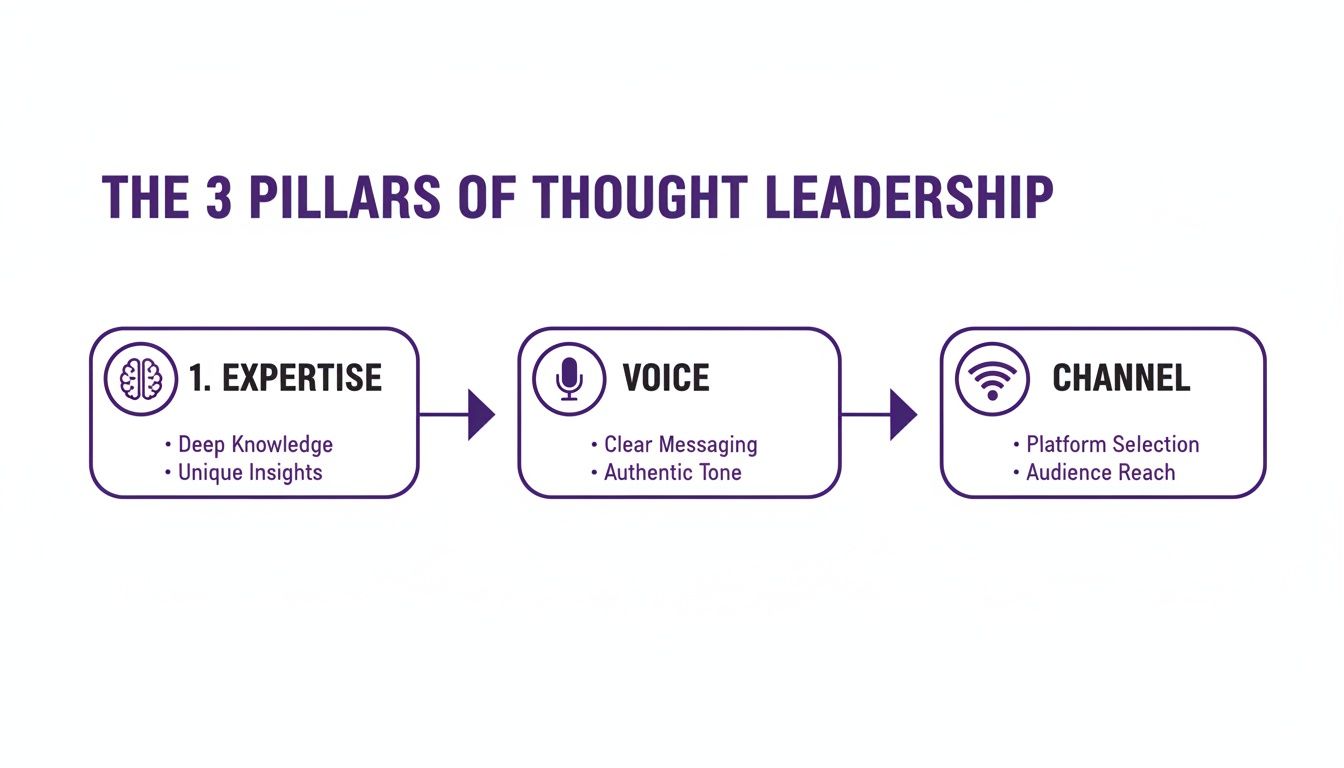
Think of it this way: your program must start with what you know (Expertise), be delivered in a way that resonates (Voice), and be shared where it will actually be seen (Channel).
Step 1: Identify Your Authority Niche
Before you write a single word, you have to define your specific area of authority. This isn't just your industry; it’s the unique intersection of your expertise, your audience's most pressing problems, and what your competitors are completely overlooking. A real thought leader doesn’t try to be an expert on everything.
Instead, they dominate a well-defined niche. For a Canadian SaaS company in supply chain logistics, the niche isn't "supply chain management." It's "using predictive analytics to slash cross-border shipping delays for North American manufacturers." That level of specificity is what cuts through the noise and attracts a high-quality audience.
To lock down your niche, ask these questions:
- What unique problems can we solve better than anyone else?
- Where does our hands-on experience or proprietary data give us an undeniable edge?
- What important conversations are our competitors failing to lead?
Step 2: Develop Core Content Themes
Once your niche is set, the next move is to develop three to five core content themes. These are the big ideas you will own in the market, guiding your content calendar for months or even years. They act as the narrative pillars that hold up your authority niche.
Let’s go back to our logistics SaaS company. Their themes might be:
- Navigating Cross-Border Compliance: Simplifying customs, tariffs, and regulations between Canada and the US.
- The Future of Warehouse Automation: Exploring how AI and robotics are changing inventory management for good.
- Sustainable Supply Chains: Focusing on eco-friendly practices that also boost efficiency and profitability.
These themes are broad enough to generate an endless stream of topic ideas but focused enough to consistently reinforce your expertise.
Step 3: Choose Your Primary Content Formats
Now it’s time to decide how you’ll package your insights. The trick is to pick formats that play to your team's strengths and match how your audience actually consumes content. Trying to master every format at once is a classic recipe for burnout and mediocre output.
A recent report highlighted that 54% of B2B decision-makers spend at least an hour a week digging into thought leadership content. Choosing the right format is your ticket to being part of that hour.
Consider these options and pick just one or two to truly excel at first:
- Flagship Data Reports: If you have unique data, an annual industry report can become a cornerstone asset, generating backlinks and media mentions for years.
- Pillar Articles or Guides: In-depth, long-form articles that comprehensively cover a core theme can become massive organic traffic drivers.
- Video Series or Webinars: Perfect for showing complex processes or featuring expert interviews, video builds a personal connection and drives high engagement.
- Podcasts: A powerful format for building a loyal, subscribed audience through deep-dive discussions and interviews.
Step 4: Create a Distribution and Amplification Plan
The biggest mistake companies make is adopting a "publish and pray" mentality. Your distribution plan is every bit as important as the content itself. This plan spells out exactly how you'll get your insights in front of the right audience, again and again.
Your plan needs to be multi-channel and proactive. Mastering platforms like LinkedIn is non-negotiable for any B2B thought leadership program. It's smart to implement a proven four-step strategy for winning at LinkedIn to connect with decision-makers where they are actively looking for insights.
A solid amplification strategy includes:
- Search Engine Optimization (SEO): Optimizing every single asset for relevant keywords to capture organic search demand.
- Social Media Promotion: Sharing content natively on platforms like LinkedIn, including posts from company leaders to add personal authority and credibility.
- Email Marketing: Distributing your best content to your subscriber list to nurture leads and engage existing customers.
- Targeted Outreach: Proactively sharing content with industry influencers, journalists, and potential partners who can amplify its reach.
By following these four steps, you create a structured, repeatable process for building real authority. This methodical approach turns the abstract idea of thought leadership into a measurable program that drives tangible business results. Contact us today to start building your plan.
Real-World Examples of B2B Thought Leadership Success

Theory and frameworks are one thing, but seeing thought leadership in action is what makes the concept truly click. Let's break down how a few successful B2B companies across North America are turning their expertise into a tangible asset that drives real business growth.
These examples are a clear blueprint for success. They prove you don't need a massive budget to lead the conversation in your industry—you just need a unique point of view, a commitment to quality, and a smart plan to reach your audience.
The SaaS Leader Who Owns the Data
One of the most powerful ways to build authority is by becoming the primary source of industry data. A U.S.-based SaaS company in the marketing automation space does this brilliantly with its annual "State of Marketing" report.
This isn't just another blog post. It's a cornerstone asset built on proprietary data from millions of users. They analyze trends, benchmark performance, and offer predictions on the future of digital marketing.
- Strategy: Their plan is simple: answer their customers' biggest questions with concrete, exclusive data. By publishing this report every year, they’ve created an event that journalists, analysts, and potential customers actually look forward to.
- Execution: The report is a full multi-format campaign. It includes a gated, in-depth PDF for lead generation, a public microsite with interactive charts, a summary webinar with their top experts, and dozens of social media posts breaking down key stats.
- Impact: This single initiative generates thousands of high-quality leads, earns hundreds of backlinks from major media outlets, and cements their position as the definitive expert. Given that a staggering 78% of B2B buyers use webinars to make purchasing decisions, this is a highly effective part of their funnel.
The Canadian Manufacturer Driving Leads with Education
A mid-sized Canadian manufacturing firm specializing in custom robotics wanted to move beyond competing on price alone. They knew their real value was their deep expertise in process optimization, so they built a thought leadership program around education.
Their core initiative is a webinar series called "The Lean Automation Workshop." Held quarterly, these live events don't just show off their robots; they teach manufacturing plant managers practical methods for reducing waste and improving efficiency.
The success of this approach lies in its generosity. By giving away valuable knowledge, they build immense trust and attract an audience of ideal buyers who are actively looking to solve the exact problems their solutions address.
This educational focus has completely transformed their lead generation. Instead of making cold calls, their sales team now follows up with highly engaged attendees who have already learned from their experts. This has directly led to shorter sales cycles and a higher close rate.
The Professional Services Firm Mastering LinkedIn
A boutique consulting firm in the United States uses the personal brands of its senior partners on LinkedIn to attract ideal clients. Their approach is focused, consistent, and built on demonstrating expertise—not just broadcasting services.
Each partner concentrates on a specific niche—one on financial modeling for tech startups, another on change management for enterprise clients. They post daily, sharing insightful text posts, short video analyses of recent news, and detailed carousels that break down complex frameworks.
This strategy positions them as trusted advisors, not salespeople. Decision-makers follow them for their insights, and when a need arises, this firm is the first one they call. This direct line to their target audience has allowed them to grow exclusively through inbound inquiries, eliminating the need for a traditional outbound sales team.
Ready to build your own success story? Contact us to explore how a Fractional CMO can turn your expertise into your most powerful marketing asset.
Build Your Authority with a Fractional CMO
You know that thought leadership is powerful. But actually building and running a program that gets consistent results? That’s a whole different challenge. It takes C-level strategic thinking, deep industry insight, and a ton of dedicated work—resources most ambitious B2B firms in Canada and the United States just don’t have sitting on the bench.
This is where a strategic partner makes all the difference. That gap between ambition and execution is exactly why the Fractional CMO model works so well for North American companies. It’s the perfect way to build real authority without the massive cost and commitment of hiring a full-time marketing executive.
Gain C-Level Strategy Without the Overhead
A Fractional Chief Marketing Officer delivers the high-level strategic direction you need to build a thought leadership program that’s wired directly to your revenue goals. You're not just getting someone to create content; you're getting an experienced B2B marketing leader who can pinpoint your unique authority niche, nail down your core messaging, and build a sustainable system to make it all happen. It’s a game-changer for tech, SaaS, and manufacturing companies where deep subject matter expertise is non-negotiable.
Consistency is one of the biggest hurdles. In fact, a startling 47% of B2B marketers say creating content consistently is their biggest challenge. A Fractional CMO puts the frameworks and processes in place to solve that problem, turning sporadic efforts into a reliable engine for growth.
A Fractional CMO doesn’t just hand you a plan and walk away. They become part of your team to build, manage, and scale an authority-driving program that generates qualified leads and measurable revenue. The model gives you the expertise to connect your marketing activities directly to business outcomes.
Your Next Step to Industry Leadership
At B2Better, we live and breathe the complexities of the North American B2B market. We build thought leadership programs designed to make your company the undeniable go-to authority in your space. We help you stop competing on features and start winning on expertise and trust.
Our approach is straightforward:
- Pinpoint your unique point of view so you stand out from the noise.
- Develop a multi-channel content strategy that gets you in front of decision-makers wherever they are.
- Establish clear KPIs to track the real-world impact on lead quality, sales velocity, and brand perception.
If you’re ready to stop just participating in your industry and start leading the conversation, this is your next move. Learn more about how our Fractional CMO services can provide the strategic leadership your company needs to build lasting authority.
Ready to turn your expertise into a measurable competitive advantage? Contact us today to discuss how a Fractional CMO can build a thought leadership program that drives real growth for your business.
Common Questions About Thought Leadership
Even with a clear vision, B2B leaders have practical questions before they invest in a thought leadership program. Here are straightforward answers to the queries we hear most often from companies across Canada and the United States.
How Long Does It Take to See Results From Thought Leadership?
While you'll likely spot early signals like better social media engagement or more website traffic in the first 1-3 months, the real business impact takes a bit longer to mature. You can expect to see tangible results—like higher-quality inbound leads and a shorter sales cycle—within 6-12 months of consistent effort.
Think of thought leadership as a strategic asset that builds compounding value. It’s a marathon, not a sprint, and the payoff is a durable competitive advantage that keeps delivering for years to come.
Do I Need to Be a Famous CEO to Be a Thought Leader?
Absolutely not. Real thought leadership hinges on the quality of your ideas, not the fame of the person sharing them. Authority can be built by any subject matter expert in your organization who has a unique and valuable perspective.
A lead engineer explaining a technical breakthrough or a senior consultant detailing a proven methodology can be incredibly powerful. In fact, a study by Edelman and LinkedIn found that 53% of decision-makers awarded business to a company based on the quality of its thought leadership. Your insights and consistency matter far more than your job title.
The most credible voices often come from the front lines. Your audience wants authentic expertise from practitioners who are deep in the work, not just a high-level message from the executive suite. Authenticity is what builds trust, and trust is what drives business.
What Is the Difference Between Thought Leadership and Content Marketing?
This is a crucial distinction, and one that trips up a lot of teams. Content marketing is the broad discipline of creating and sharing valuable content to attract an audience. Thought leadership is a highly specialized type of content marketing.
Here’s an easy way to think about it: all thought leadership is content marketing, but not all content marketing is thought leadership.
- Content Marketing answers the question, "What is X?"
- Thought Leadership answers the question, "What should we be doing about X?"
The first informs your audience; the second shapes their opinion and guides their actions, cementing your unique point of view as the industry standard.
Ready to build a program that answers your customers' biggest questions and positions you as the go-to authority in your industry? B2Better specializes in creating and executing revenue-focused thought leadership strategies for North American B2B companies.