

Trying to win at social media marketing in Canada with a generic, one-size-fits-all playbook just doesn't work. It’s a strategic game that demands a real understanding of the country's unique digital fabric. Your buyers—both in Canada and the United States—are absolutely here, and they're paying close attention.
Understanding The Canadian Social Media Landscape
For B2B companies in tech, SaaS, and industrial sectors, a cookie-cutter social media approach will fall flat. The Canadian market isn't a monolith; it’s a mosaic of regional economic hubs, linguistic dualities, and distinct professional cultures. What gets a nod from a SaaS founder in the Toronto-Waterloo corridor might not land with an engineering lead in Alberta's energy sector.
This complexity, however, is your biggest opportunity. A well-played social media strategy can put you directly in front of C-level executives, specialized buyers, and technical experts who are actively using these platforms for professional development and research before they buy. A prime example is Canadian software giant Shopify, which built its empire by mastering social channels to connect with entrepreneurs across Canada and the US, turning a platform into a global community.
Why A Canada-Specific Strategy Is Essential
Ignoring the nuances of the Canadian and cross-border US market is like leaving money on the table. A program that actually works needs to be built around a few key truths:
- Regional Economic Differences: From Vancouver's bustling tech scene to Montréal's AI clusters and Ontario's manufacturing heartland, each region has its own business priorities and ways of communicating.
- Linguistic Duality: Engaging the Francophone market in Québec and beyond requires more than just a quick translation. It demands a true cultural adaptation of your message and your creative.
- Platform Behaviour: Canadian and American professionals use platforms like LinkedIn, YouTube, and even Facebook in specific ways. Knowing this is the key to creating content that adds genuine value and builds trust.
The core challenge isn’t just being present on social media; it’s being relevant. True success comes from crafting a strategy that speaks directly to the distinct professional communities across Canada and the United States, transforming your social channels from a simple broadcast tool into a powerful engine for business growth.
The Numbers Tell The Story
The sheer scale of social media use in Canada makes it impossible to ignore for B2B outreach. The data shows a highly connected professional audience that's well within your reach.
Canada boasts 31.7 million active social media user identities. Of those, 28.3 million are adults aged 18 and over—that's a massive 86.7% of that demographic. This makes social platforms indispensable for reaching decision-makers in tech, SaaS, and manufacturing firms across North America.
With 94% of Canadian small businesses using social media monthly—and 52% using it daily—it's clear the channel is ripe for smart, tailored execution. For a deeper dive into Canadian digital trends, you can explore the full report from Datareportal.
Ready to build a social media program that truly connects with your Canadian and US B2B audience? Our expertise in B2B digital marketing can help you navigate this unique market for measurable results. Contact us today to start the conversation.
Choosing The Right Platforms For Canadian B2B Audiences
Picking the right social media platforms is where your Canadian B2B strategy gets real. It’s not just about planting a flag everywhere; it’s about showing up where your actual buyers in Canada and the United States are looking for answers. The old "we have to be on LinkedIn" mentality is a decent starting point, but hitting your goals in the North American market demands a much sharper, more focused approach.
Think of each platform as a different professional venue. LinkedIn is the formal industry conference—perfect for networking with the C-suite and sharing high-level thought leadership. On the other hand, a platform like YouTube is more like a technical workshop, the ideal spot for detailed product demos that resonate with engineers or IT managers.
Even niche forums like Reddit can be surprisingly powerful. Picture them as hyper-focused breakout sessions where you can connect with specific professional groups, like software developers in Vancouver or mechanical engineers in Alberta’s energy sector. The mission is to map your buyer personas to the digital venues they actually use.
Aligning Platforms with Canadian Business Goals
Your platform choices should be a direct line to your business goals, whether that's generating qualified leads, building unshakeable brand authority, or educating a highly technical audience. The trick is to understand what each network does best within the Canadian and US context.
Recent data shows just how wired Canadian professionals are. A massive 95% of Canadian online adults have at least one social media account. While Facebook (82%) and YouTube (73%) dominate overall usage, LinkedIn's 49% penetration is a goldmine for targeting CEOs, founders, and decision-makers in professional services and industrial firms. You can get the full picture by reviewing the 2024 Canadian social media statistics.
This data reveals huge opportunities beyond the obvious. The explosive growth of platforms like YouTube and even Reddit—which has tripled its Canadian user base—tells us that B2B buyers are changing how they consume information, moving toward more visual and community-driven content.
This decision tree breaks down how to choose the right social media platform for your Canadian B2B marketing goals.
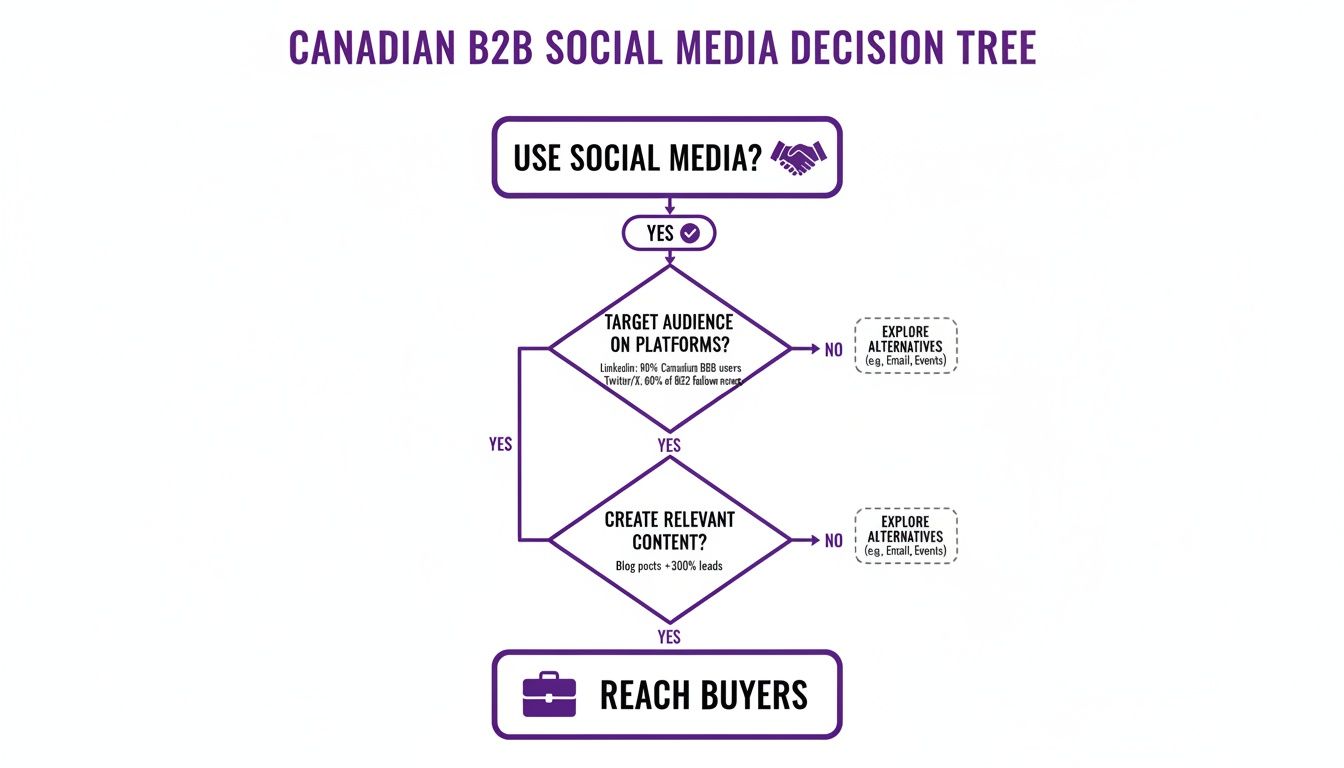
As the visual shows, it all starts with your goal. Once that’s clear, the path to the most effective platform and the right buyers becomes obvious.
B2B Social Media Platform Selection Matrix for Canadian Businesses
To make this even clearer, let's compare the top platforms head-to-head. This matrix evaluates each network's effectiveness for different B2B marketing objectives specifically within the Canadian market, helping you prioritize where to invest your time and budget.
| Platform | Primary Canadian B2B Audience | Best Use Case (Lead Gen, Brand, etc.) | Key Content Formats | Consideration for Tech/SaaS |
|---|---|---|---|---|
| C-Suite, VPs, Directors, Technical Decision-Makers (Nationwide) | Lead Generation, Brand Authority, ABM | In-depth articles, case studies, company news, video explainers | Non-negotiable. Hyper-targeting by job title and company is essential for reaching CTOs, engineers, and procurement leads. | |
| YouTube | Engineers, IT Managers, Operations Staff, R&D Teams | Education, Product Demos, Brand Trust | How-to videos, technical deep dives, client testimonials, factory tours | A secret weapon. Perfect for showing complex software in action or explaining technical integrations to evaluation committees. |
| Niche Professional Groups, Small Business Owners, Event Attendees | Community Building, Niche Targeting, Brand Humanization | Live Q&As, event promotion, behind-the-scenes photos, customer stories | Powerful for retargeting and reaching specific interest-based audiences (e.g., "members of engineering associations") at a lower cost. | |
| Developers, IT professionals, highly specialized technical experts | Niche Engagement, Market Research, Problem Solving | Text-based discussions (AMAs), sharing technical articles, seeking feedback in relevant subreddits | High-risk, high-reward. Requires authentic participation, not broadcasting. Great for engaging developer communities without a hard sell. | |
| X (Twitter) | Industry Journalists, Tech Influencers, Conference Attendees | Real-Time News, Event Engagement, Thought Leadership | Short video clips, infographics, industry news commentary, polls | Best for joining timely industry conversations, live-tweeting events, and connecting with media and influencers in the Canadian tech scene. |
This matrix isn't about picking just one winner; it's about building the right mix. The most effective strategies often use a combination of these platforms to engage different stakeholders across the buying committee.
A Closer Look at High-Impact Platforms
Let's dig into some practical applications for Canadian B2B companies. Each platform has a unique toolkit for reaching your ideal customer.
-
LinkedIn: The B2B Powerhouse
For any serious B2B player in Canada and the US, this is non-negotiable. Use it to build executive credibility, share in-depth articles, and run hyper-targeted ad campaigns. A Waterloo-based SaaS company used targeted LinkedIn articles to engage CTOs across North America, resulting in a 35% increase in demo requests from their key accounts in both Canada and the United States. -
YouTube: The Unsung Hero of B2B
Often overlooked in B2B, YouTube is a secret weapon. It’s the perfect home for technical demos and client testimonials. A Canadian industrial equipment manufacturer created simple "how-to" videos showcasing their machinery's efficiency. These videos were viewed thousands of times by operations managers in both Canada and the US, directly contributing to a 15% year-over-year increase in cross-border sales. -
Facebook and Instagram for Niche Targeting
While they feel more B2C, their ad-targeting engines are incredibly powerful for B2B. You can build custom audiences to reach professionals with specific interests related to your industry, often at a much lower cost per click than LinkedIn.
The strongest strategies almost always involve a multi-platform approach. Use LinkedIn to connect with the C-suite, YouTube to educate the technical evaluators, and Facebook to build a community around your brand's expertise. It's about meeting each stakeholder where they are most comfortable.
Making these data-driven decisions is what separates simply posting content from building a genuine sales pipeline. If you’re ready to build a platform strategy that drives real business results in the Canadian and US markets, contact us today.
Mastering Bilingual And Regional Targeting
Thinking you can just run your English social media posts through a translation app is the fastest way to fail in Canada. To really get traction in North America, you need a much smarter strategy, one that respects Canada's deep linguistic and regional divides. This isn’t just about dodging mistakes; it’s about seizing a huge competitive advantage.
A generic "North American" approach treats Canada like a monolith, totally missing Québec’s unique professional culture and the distinct economic identities of each province. This is where you can stand out. Move beyond simple translation to achieve genuine cultural adaptation. The goal? A B2B buyer in Montréal should feel just as understood as one in Calgary or a prospect in Chicago.
Connecting With Québec The Right Way
Engaging Québec’s professional market is a masterclass in nuance. With 22.8% of Canadians identifying French as their first official spoken language, a French-first or at least bilingual approach is non-negotiable for any national campaign. But it goes way beyond just the words you use.
To communicate effectively in Québec, you need to adapt your:
- Tonality: Professional interactions often lean more formal and are built on relationships.
- Imagery: Using visuals of Montréal or Québec City landmarks creates instant local relevance.
- Values: Messaging that emphasizes community, collaboration, and innovation will often resonate more than aggressive, growth-at-all-costs talk.
A fantastic success story is Cirque du Soleil. While a B2C brand, their B2B marketing to secure corporate partnerships masterfully uses culturally specific French content that celebrates Québec artistry, leading to deep-rooted local and international business relationships that a generic approach could never achieve.
For any content creator in Canada, mastering efficient translation French to English audio is a vital skill, especially when trying to reach audiences across the linguistic divide in markets like Quebec.
Tailoring Content To Regional Economic Identities
Look beyond Québec, and you’ll find Canada’s regional economies demand just as much attention. What gets a Vancouver tech startup excited is worlds away from the challenges facing a manufacturer in Ontario or an energy company in Alberta. Your value proposition has to pivot to match.
Think about a B2B company selling project management software. Their marketing could look like this:
- For Vancouver's Startup Scene: Focus on agility, scalability, and how the tool integrates with other modern tech. Use case studies featuring fast-growing local startups.
- For Ontario's Manufacturing Heartland: Highlight efficiency gains, supply chain optimization, and shop-floor productivity. Show how the software tames complex industrial projects.
- For Alberta's Energy Sector: Emphasize safety compliance, coordination for remote field teams, and robust documentation for regulatory headaches.
This kind of regional specificity shows you actually get your customer's world. It turns your brand from just another generic solution into a trusted partner who understands their industry inside and out.
A Success Story In Regional Targeting
A SaaS company specializing in logistics software is a perfect example. At first, they ran a single national campaign hammering "cost savings." Engagement was flat. So they segmented their strategy, targeting British Columbia with messages about port efficiency and Ontario with content on cross-border trucking optimization for US trade routes.
The result? A 60% lift in engagement in those provinces and a shorter sales cycle because leads from both Canada and the US were already warmed up with relevant use cases. This is what a localized approach does—it moves beyond surface-level chatter to drive real business outcomes.
Mastering bilingual and regional targeting is how you build authentic connections and generate high-quality leads across Canada and into the US. If you're ready to create a social media strategy that truly speaks to every corner of the North American market, contact us today to see how we can help you build brand loyalty and drive growth.
Staying Compliant With Canadian Privacy And Anti-Spam Laws
In B2B marketing, trust is everything. It’s the currency that turns prospects into customers and customers into advocates. In Canada, one of the fastest ways to lose that trust—and invite serious legal trouble—is to get compliance wrong.
Navigating Canada’s digital regulations isn’t just about ticking boxes to avoid penalties; it’s about building a brand that people know they can rely on. A single misstep here can crater your reputation far more effectively than any fine. That means you need to understand the rules of engagement before you send your first DM or launch that lead-gen form. Our legal framework is different from what you’ll find in the US, and it demands a specific, careful approach.
Understanding Canada's Anti-Spam Legislation (CASL)
Don't underestimate this one. Canada's Anti-Spam Legislation, or CASL, is one of the toughest laws of its kind anywhere in the world. It governs every single commercial electronic message (CEM) you send, which covers everything from emails to social media direct messages. It’s shocking how many businesses get this wrong and find themselves facing fines that can hit $10 million for corporations.
The heart of CASL is all about consent. You simply cannot send marketing messages without permission. There are two main types you need to know:
- Implied Consent: This can exist if you have a current business relationship (like with an existing client) or if someone has publicly posted their contact info (like a business email on their company website) without saying they don't want to be contacted. It’s a grey area, and it has an expiry date.
- Express Consent: This is the gold standard, no question. It's when someone actively opts in to hear from you—they check a box on a form, subscribe to your newsletter, and give you a clear "yes." This consent is yours to keep until they decide to withdraw it.
Here’s where so many B2B marketers trip up: sending a LinkedIn connection request does not give you a free pass to immediately spam their inbox with your sales pitch. CASL was designed to stop exactly that kind of behaviour. The law puts the recipient's consent first, not your marketing goals.
PIPEDA and Protecting User Privacy
Beyond CASL, you have the Personal Information Protection and Electronic Documents Act (PIPEDA). This is the big one that governs how private-sector companies collect, use, and share personal information during any commercial activity. And yes, this absolutely applies to your social media marketing in Canada.
Any time you run a contest, ask for user-generated content, or use tracking pixels for advertising, you're handling personal data. PIPEDA demands that you be completely transparent about what you’re collecting, why you’re collecting it, and how you’ll use it.
A few years back, a major Canadian retailer learned this the hard way. They ran a big social media contest that hoovered up a ton of personal data but buried the details in a vague privacy policy. The backlash was swift, eroding customer trust and generating a wave of negative press. The lesson is simple: be upfront about what you're doing with people's data. Always.
Building a social media presence that’s both compliant and trustworthy isn’t optional in Canada; it’s the foundation for any long-term success. It shows you respect your audience and protects your brand from major legal and reputational headaches down the road.
Navigating these complex regulations can feel like a minefield. If you want to build a strategy that's both powerful and fully compliant, contact us today to see how our expertise can safeguard your brand and drive sustainable growth.
Crafting A Winning B2B Content And Paid Media Strategy
Great content is the engine of your social media program, but a smart paid strategy is the high-octane fuel that drives it forward. A winning approach to social media marketing in Canada for B2B requires both working in perfect sync.
Without a plan, you're just creating noise. With one, you turn your social channels into a reliable revenue driver.
The digital ad landscape in Canada is massive, with total spending hitting $18.9 billion. Social media plays a huge role in this, powering 31% of revenues. For founders and CEOs in tech, SaaS, and manufacturing, this confirms that social is a critical channel for lead generation, especially with 95.2% of the country having internet access.

Content Formats That Connect With Canadian B2B Buyers
Your content needs to solve problems for your audience. Broadcasting sales pitches is a losing game; providing genuine value builds the trust needed to earn a sale.
For Canadian and American B2B buyers in technical fields, certain content formats perform exceptionally well:
- Technical Deep Dives: Detailed articles, whitepapers, or video explainers that break down a complex industry challenge show you have real expertise.
- Client Success Stories: Showcase a Canadian client (mentioning their region for bonus relevance) and detail the specific, measurable results you achieved for them. This provides powerful social proof.
- Behind-the-Scenes Looks: Give a glimpse into your operations, culture, or product development process. This humanizes your brand and builds a stronger connection with your audience.
One of our B2B SaaS clients in Waterloo, Ontario, saw a 40% increase in qualified demo requests after shifting from generic product posts to a series of LinkedIn articles breaking down specific workflow problems their software solved for Canadian manufacturers. They proved their value before asking for the meeting.
To keep everything running smoothly, it's worth looking into an AI-powered social media management and scheduling tool. This helps you manage your content cadence and ensure you’re publishing at optimal times without missing a beat.
Building A Hyper-Targeted Paid Media Plan
Organic reach is important for building community, but a targeted paid media strategy is essential for generating leads at scale. Platforms like LinkedIn and Facebook offer incredibly powerful tools for reaching the exact decision-makers you need to influence in Canada and the United States. For more detail on building effective campaigns, you can check out our guide on Pay-Per-Click services.
A successful paid strategy for the North American market relies on precision. You can build campaigns using:
- Firmographic Data: Target companies based on their industry, size, and even revenue.
- Job Title Targeting: Serve ads directly to VPs of Engineering, CTOs, or Plant Managers.
- Geographic Targeting: Focus your budget on key economic hubs like the Toronto-Waterloo corridor, Metro Vancouver, or the Calgary-Edmonton region.
This level of detail means every ad dollar is spent reaching someone who can actually make a purchasing decision.
A Success Story In Paid Social
A Canadian industrial automation company wanted to break into the manufacturing sector in Southwestern Ontario. They ran a highly targeted LinkedIn campaign aimed at Plant Managers and Operations Directors within a 150km radius of their office.
The campaign promoted a single, high-value case study detailing how they helped a similar local company reduce downtime by 20%. The results were immediate and impressive: they generated 15 high-quality MQLs (Marketing Qualified Leads) in just one quarter, directly attributing two major sales to the campaign worth over $250,000.
This is the power of combining great content with a precise paid strategy.
Your content and paid media should not operate in silos. They are two halves of a whole, designed to capture attention, build trust, and drive measurable action. Crafting this integrated strategy is key to unlocking the full potential of social media marketing in Canada and the US. Contact us today to build your strategy.
Accelerating Growth With A Fractional CMO
You have the playbook. You know the platforms, the regional quirks, and the compliance rules for social media in Canada. So, what’s next? The real question is who’s going to run the plays and put points on the board.
For many ambitious tech, SaaS, and industrial companies, the cost of a full-time, C-level marketing executive is a non-starter. This creates a dangerous gap where a perfectly good strategy sits on a shelf, collecting dust. That's exactly the problem a Fractional CMO was designed to solve.
A Fractional CMO gives you the strategic horsepower of a seasoned executive at a fraction of the cost. Think of it as plugging an expert marketing partner into your team—someone who can build, manage, and scale your program without the full-time overhead. It’s a model built for lean, growth-hungry teams.
From Plan To Pipeline
A Fractional CMO does more than just give advice; they roll up their sleeves and get to work. They take the complex, Canada-specific strategies we've talked about and turn them into a high-performing marketing engine that delivers clarity, accountability, and most importantly, results you can measure.
Their entire focus is tying every single activity back to your main goal: growing revenue. This means turning your social media efforts into a predictable and scalable source of high-quality leads from both Canada and the US. For instance, a Fractional CMO can run the whole show, from fine-tuning your LinkedIn ad targeting to reach decision-makers in Calgary’s energy sector to ensuring your French-language content for Québec is authentic and resonates culturally.
The impact is immediate. We worked with a B2B software company that saw a 3x increase in marketing-qualified leads within six months of bringing on a Fractional CMO. The difference-maker was having an expert dedicated to executing a focused strategy, week in and week out.
A great plan without expert execution is just a document. A Fractional CMO is the bridge between your strategic vision and tangible results, ensuring your investment in social media marketing in Canada generates a powerful return.
The Fractional CMO Advantage
Bringing a Fractional CMO on board offers a few key benefits, especially for B2B companies navigating the Canadian market:
- Expert Leadership: You get C-level strategic guidance without the executive salary, benefits, and long-term commitment.
- Accountability and Measurement: They set up the right KPIs, build dashboards, and report on performance regularly, making sure every dollar is accounted for.
- Efficient Execution: They know how to build and manage the right team—whether it’s your internal staff or outside vendors—to get the job done right.
- Scalability: The model is flexible. As your company grows, your Fractional CMO’s involvement can scale up or down to match your needs.
This is your most direct path to growing your pipeline with an expert at the helm. For a closer look at how we put these principles into action, learn more about our work as a leading B2B marketing agency in Canada.
If you’re ready to stop planning and start executing a social media strategy that drives real business growth, contact us today to see how our Fractional CMO services can build your success story.
Have Questions? We Have Answers.
Running B2B social media in Canada comes with its own set of questions. Here are clear, straightforward answers to the most common queries we hear from founders and marketing leaders, designed to give you the clarity you need to move forward.
How Much Should a Canadian B2B Company Budget For Social Media?
Every company's situation is different, but a smart starting point is to earmark 7-12% of your total marketing budget for social media. This figure should cover both your organic content efforts and your paid advertising, as the two work hand-in-hand to drive growth.
To get any real, meaningful data from paid campaigns on a platform like LinkedIn, you'll want to plan for a minimum ad spend of $1,500-$3,000 per month. But don't forget, the true cost includes creating the content and managing the strategy. We saw a Vancouver-based SaaS company achieve a 200% ROI on their ad spend precisely because they paired it with high-quality video testimonials. Great content makes your paid budget work much, much harder.
A Fractional CMO model helps you get the most out of this budget by zeroing in on high-impact activities, giving you executive-level thinking without the full-time salary.
Is LinkedIn The Only Platform That Matters For B2B In Canada?
No question, LinkedIn is a B2B powerhouse in Canada. But stopping there is a massive missed opportunity. A diversified strategy almost always wins because it lets you connect with different people on the buying committee, right where they're most comfortable.
The thing is, 73% of Canadian online adults use YouTube. That makes it an incredible platform for educational deep-dives and product demos that build serious trust with technical buyers. We’ve seen industrial clients in Alberta get major traction with simple "how-it-works" videos that directly influenced procurement decisions.
Don't sleep on other platforms, either. Facebook's ad targeting can be surprisingly powerful for reaching niche professional groups at a lower cost, and Reddit is full of valuable professional communities where you can engage authentically. The right strategy isn't about being everywhere; it's about being on the platforms where your specific Canadian and American buyers spend their time.
What Are The Biggest Mistakes B2B Companies Make In Canada?
The most common pitfalls we see are completely avoidable if you have the right strategy from the start. Knowing what they are helps you sidestep costly errors and get to results faster.
The top mistakes usually fall into one of these buckets:
- Copy-pasting a generic US strategy that completely ignores Canada's deep regional and linguistic diversity.
- Broadcasting promotional noise instead of creating genuine value and building a community around your expertise.
- Ignoring compliance with Canadian laws like CASL, which can lead to hefty fines and serious damage to your brand.
- Flying blind without clear, measurable KPIs, making it impossible to prove ROI to the leadership team.
Working with an expert in Canadian B2B social media ensures you avoid these common traps and build a program designed for sustainable, long-term growth. If you have more questions, don't hesitate to contact us.
Ready to turn these insights into a powerful growth engine for your business? The team at B2Better specializes in building and executing data-driven B2B marketing strategies tailored for the Canadian and US markets. Contact us today to see how our Fractional CMO services can deliver clarity, accountability, and measurable results.