

So, what exactly is a business to business marketing agency? Think of them as a strategic partner, a specialized crew laser-focused on helping you sell your products or services to other businesses in markets like Canada and the United States. Their world revolves around navigating complex sales cycles and building genuine, long-term relationships with decision-makers, a far cry from the mass-market tactics of consumer marketing.
What Is a Business to Business Marketing Agency

Imagine a B2B agency as the architects and builders of your company’s growth engine. Instead of drawing up blueprints for a building, they design a data-driven strategy to construct a direct path to your ideal business customers. Their entire mission is to generate a steady stream of qualified leads and build a predictable revenue machine for you. A recent study found that companies with strong B2B marketing alignment achieve 208% more revenue from their marketing efforts.
This is a world away from business-to-consumer (B2C) marketing, which often feels like casting a wide net and hoping for the best. A true business to business marketing agency zeroes in on creating valuable, lasting relationships with other companies through a much more nuanced and strategic process.
Navigating Complex B2B Sales Cycles
The journey from a first handshake to a signed contract is almost always longer and more complicated in the B2B space. It’s not a single decision; it’s a committee. Agencies are the seasoned guides for this trek. They create the in-depth content—think whitepapers, detailed case studies, and expert-led webinars—needed to educate and build trust with every stakeholder over time.
This is non-negotiable. The data shows that over 81% of B2B referrals come from people who aren’t even clients but simply recognize a firm’s deep expertise. Building a strong, visible brand is everything.
A classic example is HubSpot. They didn't just sell software; they became a B2B marketing powerhouse by giving away immense value through free guides, blogs, and tools. They built a massive, loyal audience that eventually converted into high-value customers, proving the power of a long-term, content-first strategy. For founders navigating the competitive Canadian and US markets, this is the playbook.
The True Value for Your Business
When you partner with the right agency, marketing stops being a cost centre and becomes a measurable growth driver. They bring a fresh, outside perspective and a full team of specialists—from SEO pros to content strategists—that most small or mid-sized businesses simply couldn't afford to hire in-house. It’s this focused expertise that delivers tangible results.
For many B2B companies, especially in tech and SaaS, an agency isn't just a vendor. They are a core strategic partner, directly responsible for building the sales pipeline that fuels the entire organization.
This kind of partnership is about much more than just lead counts. It’s about starting a meaningful conversation with your next big client and turning your marketing spend into predictable, scalable revenue.
Ready to build a powerful growth engine for your business in the US or Canada? Contact us today to see how our specialized B2B marketing strategies can deliver the results you need.
Core Services B2B Marketing Agencies Provide
Knowing what a business-to-business marketing agency is gets you started, but the real value is in what they actually do. A great agency doesn’t just tick off a list of random tasks; they deliver a connected set of services designed to build a predictable growth engine for your company.
These services usually fall into three pillars: strategy, execution, and measurement. This structured approach makes sure every action has a purpose, every dollar is accounted for, and the entire program is moving your business forward. It's the difference between guessing what works and knowing what drives revenue.
The Strategic Blueprint for Growth
Before a single ad runs or a blog post gets written, a top-tier agency lays the groundwork with a solid strategy. Think of it as the architectural phase, where the plan for success is meticulously designed. Without this foundation, marketing efforts become scattered and ineffective, wasting precious time and budget.
Key strategic services include:
- Market and Competitor Research: A deep dive into your industry to spot opportunities and understand what your competitors are doing right—and wrong.
- Buyer Persona Development: Moving beyond basic demographics to build a rich, detailed profile of your ideal customers, including their pain points, goals, and the journey they take before buying.
- Positioning and Messaging: Crafting a clear, compelling value proposition that makes your brand stand out in a crowded North American marketplace.
Execution: Where Strategy Meets Action
With a clear strategy locked in, the agency shifts to execution—the "doing" part of marketing. This is where specialized teams use their expertise to build your brand’s presence, engage your target audience, and generate qualified leads. Our research shows that 80% of B2B buyers check a company’s website when sizing them up, making a strong digital footprint absolutely critical.
This pillar covers a wide range of hands-on activities, from creating content to running targeted ad campaigns. A skilled business-to-business marketing agency will pick the right mix of tactics for your specific goals, ensuring a multi-channel approach that meets buyers right where they are. Among the core services, agencies often use advanced tools like marketing automation for agencies to run campaigns more efficiently and deliver measurable outcomes.
Measurement: Proving the Return on Investment
The final, and arguably most important, pillar is measurement. This is where an agency proves its worth by connecting marketing activities directly to business results. Modern B2B marketing is a science, and data is its language.
A great B2B marketing agency doesn't just report on clicks and impressions; they report on pipeline generated, customer acquisition cost, and revenue growth. They translate marketing metrics into business impact.
For instance, a Toronto-based SaaS firm was struggling to generate enterprise-level leads. Their agency developed a content strategy focused on in-depth whitepapers targeting CTOs in the financial sector. By promoting this content on LinkedIn and tracking downloads, they generated 47 highly qualified leads in one quarter. Those leads turned into three major enterprise deals worth over $350,000 in ARR. This success was only possible because they meticulously measured every single stage of the funnel.
The table below breaks down how these core services create real business value, making it clear what you get for your investment.
Core B2B Marketing Agency Services and Business Impact
| Service Category | Specific Deliverables | Primary Business Goal |
|---|---|---|
| Strategy | Buyer Persona Profiles, Competitive Analysis, Go-to-Market Plan | Increase Market Share & Brand Clarity |
| Execution | SEO, Content Marketing (Blogs, Whitepapers), LinkedIn Ads | Generate Qualified Leads & Build Authority |
| Measurement | KPI Dashboards, ROI Reports, Funnel Analysis | Optimize Spend & Prove Marketing's Value |
By weaving these three pillars together, a B2B marketing agency provides a complete solution that turns your marketing function into a powerful and predictable driver of growth.
Ready to see how these services can build a revenue engine for your business? Contact us for a no-obligation consultation today.
Agency vs In-House vs Fractional CMO
Figuring out the right marketing structure is a huge decision for any growing B2B company, whether you're in Canada or the United States. You’re essentially choosing between three very different ways of getting the job done, and each one comes with its own perks and trade-offs.
The best path forward really depends on where your company is right now, what your budget looks like, and what your big-picture growth plans are. It’s a classic fork in the road: do you partner with a specialized business to business marketing agency, build your own team from scratch, or bring in a part-time executive for strategic guidance?
The Full-Service B2B Agency
Working with a full-service agency is like getting an entire marketing department overnight. You instantly get an SEO expert, a content writer, a paid ads manager, and a strategist without having to go through the pain of recruiting, hiring, and training. This model is built for one thing: getting things done, fast.
Agencies also bring a ton of experience from working with all sorts of clients, often in different industries. That cross-pollination of ideas can spark fresh strategies you might not have thought of on your own. For instance, a tactic that crushed it for a SaaS company in the US could be tweaked to generate leads for a manufacturing firm in Ontario.
The biggest challenge, though, is integration. An agency is still an external partner. It takes real, deliberate effort to make sure they’re truly plugged into your company culture, understand the nuts and bolts of your product, and are in sync with your sales team.
The In-House Marketing Team
Of course, many businesses weigh the pros and cons of building an in-house creative team. The number one advantage here is unmatched product and brand knowledge. An in-house team lives and breathes your company culture every single day, and that authenticity shines through in their marketing.
This setup gives you maximum control over day-to-day priorities and your brand’s voice. But it comes with some serious overhead. Salaries, benefits, software licenses, and training costs pile up fast. Research shows that high-growth companies often spend 20% more on sales and 40% more on marketing—a hefty investment if you're spinning up a new department.
Hiring can also be a slow grind, and finding one person who’s a master of multiple marketing disciplines is next to impossible. You might find a brilliant content marketer who knows very little about SEO, leaving you with skill gaps that can really slow you down.
The Fractional CMO Model
There’s a third option that’s become incredibly popular: the Fractional Chief Marketing Officer (CMO). This model gives you C-level strategic leadership on a part-time, contract basis. It’s the perfect middle ground for small to mid-sized businesses that need top-tier direction but aren’t quite ready to commit to a full-time executive salary.
A Fractional CMO’s job is to build your foundational marketing strategy—the "why" and "how"—before you start spending big on execution. They help you nail down your target market, set the right KPIs, and build a marketing plan that can actually scale. This ensures every dollar in your marketing budget is spent as effectively as possible from day one.
For many SMBs, a Fractional CMO provides the strategic oversight of an experienced executive with the flexibility of a consultant. It's about getting the right strategy in place first to maximize the ROI of every subsequent marketing dollar spent.
This approach is especially powerful when you're setting up a marketing function for the first time or getting the company ready for its next big growth spurt. You can learn more about how Fractional CMO services provide this high-level guidance without the executive overhead.
The decision tree below can help you visualize how agency services are usually broken down into strategy, execution, and measurement.
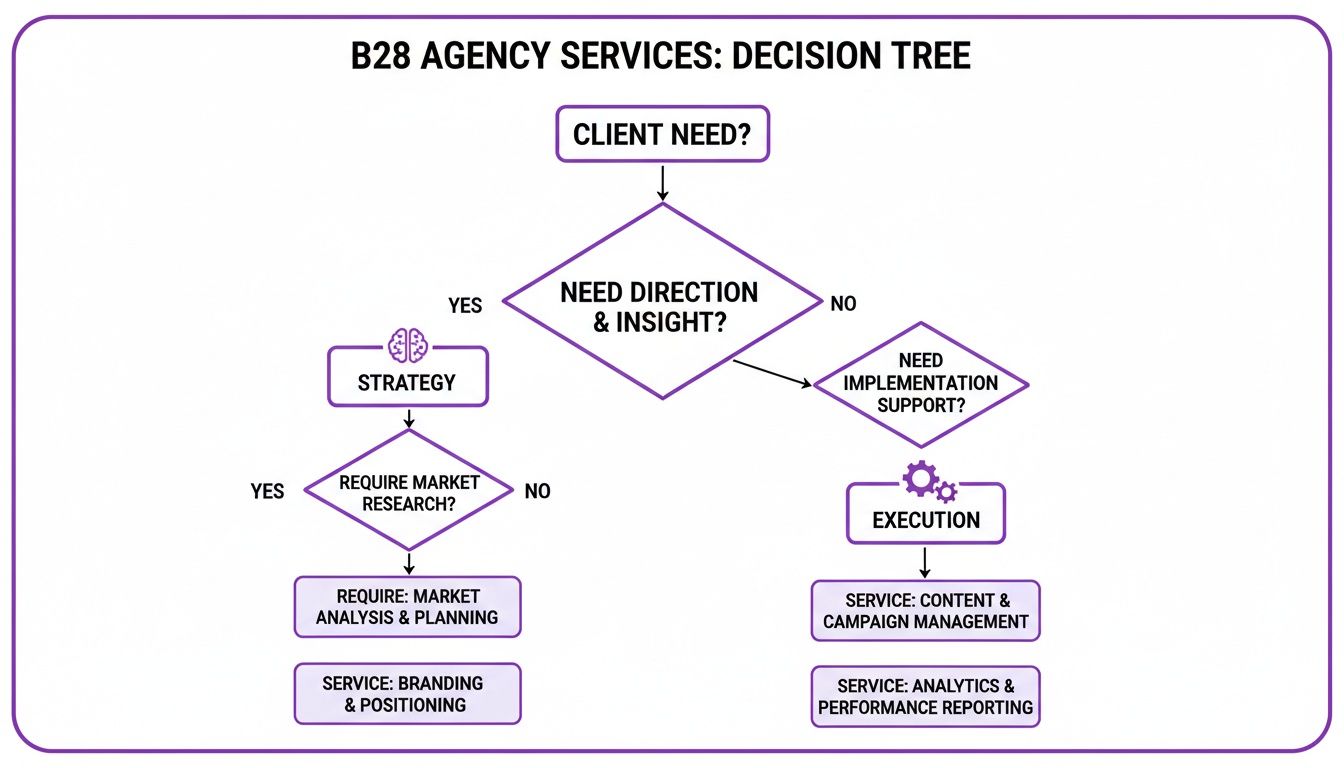
This visual helps show how a structured approach makes sure all your marketing activities are aligned with your business goals, from the initial planning right through to the final reports.
Comparing Marketing Models Agency vs In-House vs Fractional CMO
To help you weigh the options, we’ve put together a table that breaks down how each model stacks up against key business criteria. Use this as a guide to figure out which approach best fits your company’s current needs and resources.
| Criterion | Full-Service Agency | In-House Team | Fractional CMO |
|---|---|---|---|
| Speed to Impact | High. An agency has a ready-made team and can start executing almost immediately. | Low to Medium. Takes time to recruit, hire, and onboard the right people. | High. A Fractional CMO can start developing a strategy within weeks. |
| Cost | Medium to High. Retainers can be significant but are often less than a full team’s salary. | High. Includes salaries, benefits, software, and other overhead costs. | Low to Medium. Pay for strategic guidance without the full-time executive salary. |
| Expertise | Broad. Access to a diverse team of specialists in SEO, content, ads, etc. | Narrow. Expertise is limited to the specific skills of the individuals you hire. | Strategic. Deep expertise in high-level strategy, planning, and leadership. |
| Control & Integration | Medium. They are an external partner, requiring effort to align with company culture. | High. Fully integrated into the company culture and deeply knowledgeable about the product. | High. Acts as part of the leadership team, driving strategy from within. |
| Best For | Companies needing fast execution and a wide range of skills without the hiring headache. | Well-funded companies that need deep brand and product integration and have the resources to build. | SMBs that need expert strategic direction before scaling their marketing execution. |
Ultimately, the best choice really boils down to your specific situation.
- Are you looking for a full team to execute a plan quickly? An agency is a strong contender.
- Do you need deep brand integration and have the resources to build your own team? In-house might be the answer.
- Do you need an expert to build a solid strategic foundation first? A Fractional CMO could be the perfect fit.
Understanding your unique needs is the first step toward building a marketing function that drives real, measurable growth for your business. Let us help you figure out the right path. Contact us to discuss your goals.
When to Hire a B2B Marketing Agency

Knowing the right time to bring in an agency can be a game-changer. It’s rarely a single event but more of a slow burn—a series of signs that your current marketing approach has hit a wall.
Hiring a business to business marketing agency isn’t just about outsourcing tasks. It's a strategic move to pour fuel on the fire when you've reached a critical turning point. These signals often show up as persistent headaches that many founders and CEOs in Canada’s competitive market know all too well. Spotting them early is the first step.
Diagnosing Common Pain Points
If your internal conversations sound like the ones below, it might be time for outside help. These are classic tells that your marketing engine is either sputtering or completely stalled. Continuing down the same path will only burn more time and money.
Here are the key warning signs:
- A Stagnant Sales Pipeline: Your sales team is consistently missing its targets because the top of the funnel has run dry. There simply aren't enough new conversations happening to keep the engine running.
- Poor Quality Leads: The sales team complains that the leads they do get are tire-kickers. They’re spending more time disqualifying prospects than closing deals—a sure sign of a disconnect between marketing and sales.
- Lack of In-House Expertise: You have a small, hardworking team, but they're generalists. You don't have the deep, specialized knowledge in SEO, paid media, or content strategy needed to actually compete.
Think about this: studies show over 81% of B2B referrals come from people who recognize a firm's deep expertise, not just from existing clients. If your marketing isn't showing off that expertise, you’re leaving a massive source of growth untapped.
Capitalizing on Growth Opportunities
Hiring an agency isn’t just about putting out fires; it’s also about seizing opportunities. In fact, positive momentum often creates the perfect moment to bring in a partner who can help you scale responsibly without breaking things.
Consider these growth-oriented triggers:
- Scaling After Funding: You've just closed a significant funding round. Your investors expect rapid, measurable growth, and an agency gives you the immediate firepower to execute a plan that delivers.
- Expanding into New Markets: A Canadian firm aiming to crack the US market (or vice-versa) is stepping into a whole new arena. A specialized business to business marketing agency brings crucial local knowledge and proven strategies for a successful launch.
- Launching a New Product: You're introducing a new service or product into a crowded field. An agency can build and execute a go-to-market strategy that cuts through the noise and grabs early market share.
For example, a Vancouver-based tech company secured $5 million in Series A funding to expand into the United States. Instead of slowly building an in-house team, they partnered with an agency. This let them launch a multi-channel lead generation campaign within six weeks, landing their first three major US clients in under a quarter—a timeline that would have been impossible on their own.
If these challenges or opportunities feel familiar, it’s a strong signal you've outgrown your current setup. An agency can provide the strategic framework and expert execution you need to get to the next level.
Ready to explore if an agency partnership is the right next step for your business? Contact us today for a free consultation.
How to Choose the Right B2B Marketing Partner
Picking the right agency is one of the most important investments you'll make. This isn't about finding a vendor to tick boxes; it's about securing a strategic partner who gets your business, shares your vision for growth, and can deliver results you can actually measure. Getting this decision right takes a structured approach that goes way beyond a slick sales pitch.
To find the best fit, you need to arm yourself with the right questions and know what to look for in their answers. A great business to business marketing agency won't just tell you what they do—they’ll show you how their work translated into real revenue for companies just like yours. This vetting process is your best defence against a bad partnership and a wasted budget.
Questions to Ask Any Potential Agency
Before you even think about signing a contract, you need to conduct a thorough interview. Treat it like you're hiring a senior leader for your team. Their answers will reveal their depth of experience, how they think strategically, and whether they're genuinely invested in your success.
Start with these critical questions:
- Industry Experience: "Can you share examples of clients you've worked with in our industry or a similar B2B tech/SaaS space in the US or Canada?"
- Success Stories: "Walk us through a case study for a client who had a similar challenge to ours. What was your strategy, what did you execute, and what were the specific results?"
- Measuring ROI: "How do you define and measure success? What key performance indicators (KPIs) will you report on, and how do they connect back to our revenue goals?"
These questions force potential partners to move from abstract promises to concrete proof. An agency that can confidently point to tangible outcomes—like a 35% increase in marketing-qualified leads or a 20% reduction in customer acquisition cost for a past client—is one that understands what really matters.
Demystifying Agency Pricing Models
Once proposals start rolling in, you’ll see a few different pricing structures. Understanding how they work is key to choosing a model that aligns with your budget and what you’re trying to achieve. There’s no single "best" option; the right choice really depends on your needs.
- Retainer: This is a fixed monthly fee for an agreed-upon scope of work. It’s ideal for ongoing, long-term partnerships where you need consistent effort on things like SEO and content marketing. The big win here is predictability in your budget.
- Project-Based: You pay a one-time fee for a specific, defined project, like a website redesign or a new product launch campaign. This works best for short-term initiatives with a clear start and end date.
- Performance-Based: In this model, the agency's compensation is tied directly to results, such as the number of qualified leads they generate. While it sounds appealing, these arrangements often come with a higher base fee and require crystal-clear definitions of what success looks like.
When you're looking over proposals, keep an eye out for transparency. A trustworthy agency will give you a detailed breakdown of what’s included in their fee, making sure there are no hidden costs or surprises down the line.
The stakes are particularly high for Canadian businesses. In tech-heavy regions like Ontario's Kitchener-Waterloo and Toronto, the average cost per lead (CPL) for B2B companies is around $200. High-intent demo requests can push that figure up to a staggering $600–$800. You can dig into more of these Canadian digital marketing benchmarks that really highlight why efficiency is non-negotiable.
Choosing a partner who can show you a clear path to profitability isn't just a nice-to-have; it's essential for survival and growth. For a deeper dive into finding a partner tailored to the local market, check out our guide on selecting a B2B marketing agency in Canada.
Ready to find a partner that delivers results? Contact us today for a consultation and let's discuss how we can build a profitable growth strategy for your business.
Measuring Success and Maximizing Agency ROI

Signing the contract with a business to business marketing agency isn't the finish line; it's the starting gun. The real work is just getting started, and it’s all about forging a partnership that delivers a tangible return on your investment. Success isn't about chasing vanity metrics like clicks and impressions. It’s about tracking the numbers that directly hit your bottom line.
To get the most out of your partnership, the conversation has to shift to business outcomes. A great agency will not just welcome this—they’ll insist on it. They’ll help you set up clear communication channels, a steady reporting rhythm, and a shared definition of what winning actually looks like. That alignment is the foundation of any long-term relationship that drives real growth.
Focusing on KPIs That Matter
In B2B marketing, some metrics are more equal than others. If you want to accurately gauge your agency’s performance, you need to focus on key performance indicators (KPIs) that connect their efforts directly to revenue. These are the numbers your sales team and your board actually care about.
Key metrics to obsess over include:
- Marketing Qualified Leads (MQLs): This number tells you the volume of leads your marketing is generating that meet your minimum criteria for engagement and fit your ideal customer profile.
- Sales Qualified Leads (SQLs): This tracks how many MQLs the sales team accepts as legitimate opportunities. A healthy MQL-to-SQL rate is a great sign of a strong marketing-to-sales handoff.
- Customer Acquisition Cost (CAC): A vital efficiency metric. CAC tells you exactly how much you're spending across sales and marketing to land each new customer.
- Sales Pipeline Value: This is the total dollar value of all qualified opportunities in your sales pipeline that were generated or influenced by your agency’s activities.
A partnership with a results-driven agency means your reports should look less like an activity log and more like a business case. They need to clearly show how your marketing investment is building pipeline and bringing down the cost to acquire new customers.
Creating a Seamless Revenue Engine
The most successful agency relationships are the ones where the agency becomes a genuine extension of your internal team—especially your sales department. Creating a tight, constant feedback loop between marketing and sales is absolutely non-negotiable.
When your sales team provides regular, honest feedback on lead quality, your agency can fine-tune its targeting and messaging to attract better-fit prospects from the get-go. This turns marketing from a cost centre into a true revenue engine. For example, a US-based logistics company saw their lead-to-customer conversion rate jump by 40% in six months simply by implementing a weekly feedback session between their agency and their lead sales rep.
By integrating your agency with your sales team, you create a powerful, unified machine where every part is working together toward the same goal: profitable growth. For a deeper dive into this crucial metric, you might find our guide on what marketing ROI is and how to calculate it helpful. Ready to maximize your ROI? Contact us to build a data-driven strategy.
Got Questions? We’ve Got Answers.
Stepping into the world of B2B marketing agencies can feel like learning a new language. For founders and business leaders across Canada and the US, a lot of the same questions pop up. Here are some straight-up answers to the things we hear most often.
Think of this as the quick-start guide to clear up the big questions, so you can make a smarter call on how to grow your business.
What Does a B2B Marketing Agency Actually Cost?
This is always the first question, and the honest answer is: it depends. In North America, you'll see retainers starting around $5,000 a month for foundational work like SEO and content. For a full-blown strategy with paid ads, complex analytics, and multiple channels, that figure can easily climb north of $25,000 a month.
But here’s the thing: focusing on cost alone is a trap. A cheap agency that delivers zero results is infinitely more expensive than a premium partner that fills your sales pipeline. The real question is about value and return.
How Long Until I See Real Results?
B2B marketing is a marathon, not a sprint. While you might spot some early green shoots—like a bump in website traffic—within the first 90 days, building a reliable stream of quality leads is a 6- to 12-month game.
Think of it like building a reputation. You can't do it overnight. Earning authority with great content and solid SEO takes patience. A good agency partnership is an investment in growth that lasts.
We once worked with a US-based industrial software company that was practically invisible online. They committed to a 12-month content and SEO plan. A year later, they were on the first page for over 20 of their most valuable keywords. The payoff? A 300% jump in qualified demo requests in their second year.
What’s the Real Difference Between B2B and B2C Marketing?
The biggest difference is who you're talking to and how they buy. B2C marketing is all about speaking to an individual, often tapping into emotion for a quick, sometimes impulsive, purchase.
B2B is a different beast entirely. You're usually selling to a committee—engineers, finance folks, executives—who are making a logical, high-stakes decision over a long period.
This is why B2B marketing leans so heavily on education, building trust, and proving a clear return on investment. It’s why in-depth whitepapers and detailed case studies aren’t just nice-to-haves; they’re essential sales tools. Our own research shows that over 80% of B2B buyers check out a company’s website to gauge their expertise before ever reaching out.
Can a Small Business Even Afford an Agency?
Yes, absolutely. A good agency, particularly one that works with SMBs in Canada and the US, won't try to lock you into a massive, one-size-fits-all contract. Many offer flexible ways to get started.
A project-based engagement is a great first step. Need a website overhaul or a campaign for a new product launch? You can hire an agency for just that. It's a cost-effective way to get expert help without a long-term retainer.
Another route we see work well is starting with a Fractional CMO. They'll help you build a rock-solid strategy first, so that when you're ready to spend on execution, you know every single dollar is going to the right place.
Have a few more questions rattling around? The best answers are the ones tailored to your business.
At B2Better, we don’t do fluff. We build practical marketing programs that get real, measurable results.
Talk to us today for a no-obligation consultation and let's map out your path to predictable growth.