

Attraction marketing is all about pulling customers toward your brand, not shoving your message at them. It’s a complete flip of the old script. Instead of interrupting people with ads, you draw them in by offering real value, building trust, and proving you’re the expert in your field. This simple shift turns your marketing from a megaphone into a magnet, a strategy that has proven to increase marketing ROI by more than 12 times compared to traditional methods for some businesses.
What Is Attraction Marketing?
So, what is attraction marketing, really? Think of it this way: are you a lighthouse or a foghorn? A foghorn just blasts its message out into the void, hoping someone nearby pays attention. A lighthouse, on the other hand, is a steady, guiding light that ships actively look for when they need direction. This “lighthouse approach” is the only one that works with savvy B2B buyers in Canada and the United States today.
These buyers do their own homework. In fact, research shows that modern B2B buyers complete up to 90% of their journey before they even think about talking to a salesperson. They’ve trained themselves to ignore disruptive ads and cold calls, preferring to find solutions on their own time. Attraction marketing meets them right where they are, with the exact information they’re searching for.
From Interruption to Invitation
Traditional outbound marketing is an interruption. It’s a sales pitch that lands in the middle of someone’s day, uninvited and often unwelcome. That’s a one-way conversation. Attraction marketing, however, is an invitation to a genuine dialogue.
By creating genuinely helpful content—like insightful blog posts, detailed guides, or useful social media updates—you start solving your audience’s problems before they ever pay you a dime. This builds incredible credibility and positions your brand as a trusted advisor, not just another vendor trying to make a sale. A prime example is GE, which used its "GE Reports" platform to share stories of innovation, attracting a massive audience of engineers and tech leaders, positioning them as forward-thinking experts.
"Instead of finding customers, attraction marketing is about helping customers find you. It flips the script from 'buy from me' to 'let me help you,' which is a far more powerful position in a crowded market."
Building a Foundation of Trust
This strategy is a game-changer for B2B startups and scale-ups, especially in competitive markets like Canada and the United States, because it lets them compete without needing a massive advertising budget. When you consistently deliver value, you create a loyal following and a brand that people remember and respect. It’s a long-term play that’s all about cultivating relationships before ever asking for the sale.
At its heart, attraction marketing is powered by a solid content marketing strategy designed to give your audience what they need, when they need it. People often mix this up with inbound marketing. While the two are very close cousins, there are some subtle differences, which you can read more about in our guide on what inbound marketing is.
This is the fundamental shift in action—moving away from the disruptive megaphone of traditional marketing to the inviting magnet of attraction marketing.
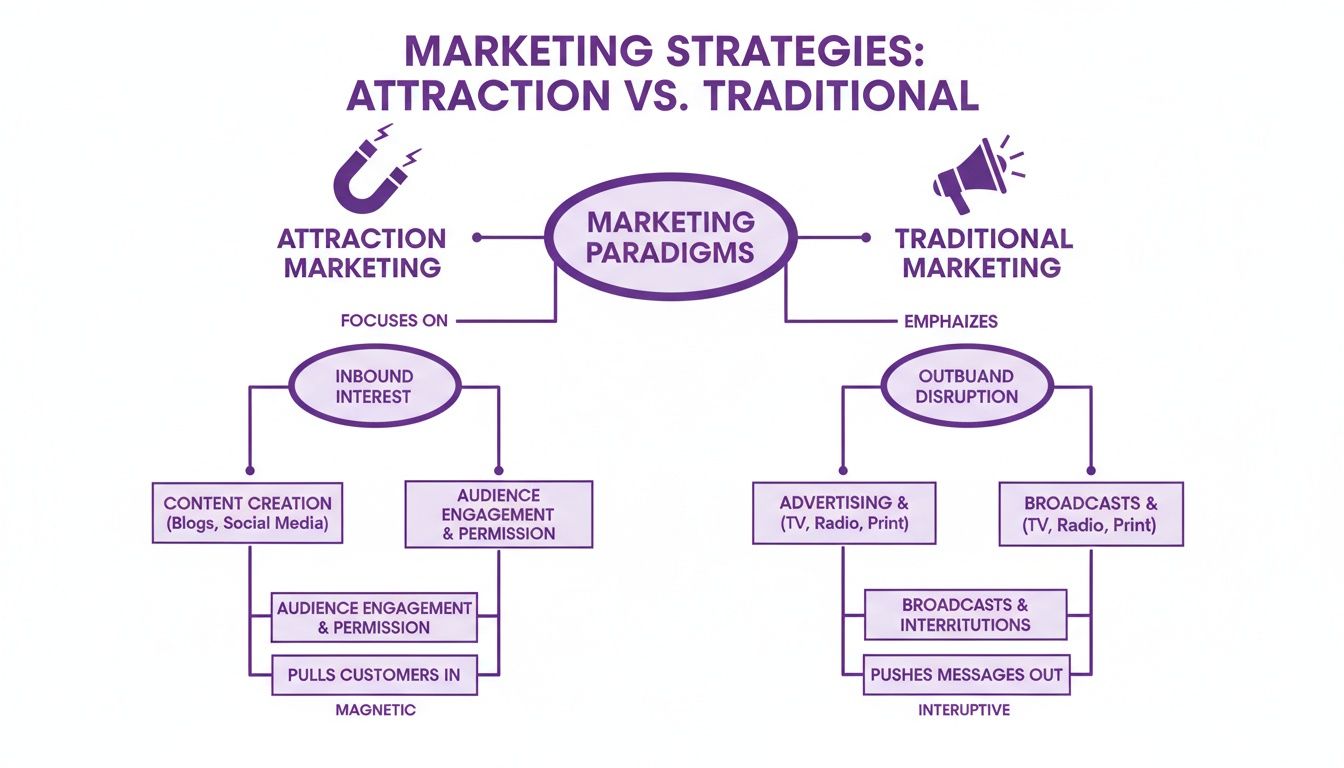
The table below breaks down these differences even further, showing just how different the two philosophies are in their approach to winning customers.
Attraction Marketing vs. Traditional Outbound Marketing
| Attribute | Attraction Marketing (Inbound) | Traditional Marketing (Outbound) |
|---|---|---|
| Approach | Pulls customers in with valuable content (magnetic) | Pushes messages out to a broad audience (interruptive) |
| Goal | Educate, build trust, and establish authority | Generate immediate sales or leads |
| Communication | Two-way dialogue; seeks to help and engage | One-way broadcast; focused on the company’s message |
| Customer Experience | Feels helpful, relevant, and empowering | Often feels intrusive, generic, and disruptive |
| Focus | Customer-centric: Addresses pain points and needs | Company-centric: Highlights products and features |
| Asset Type | Long-term assets like blog posts, SEO, and guides | Short-term campaigns like ads, cold calls, and direct mail |
The core insight is simple but powerful: it’s a move from a company-centric "push" to a customer-centric "pull." By prioritizing education and relationship-building over aggressive selling, you lay the foundation for a stronger, more qualified, and more loyal sales pipeline. Ready to make the switch? Contact us to build your magnetic marketing strategy.
The Three Pillars of a Powerful Attraction marketing Strategy

Attraction marketing isn’t a single tactic you can just switch on. It’s a complete shift in mindset, built on a foundation of three core pillars.
Mastering these principles is what separates the brands that just make noise from those that build a loyal audience and a predictable pipeline. Think of them as the legs of a stool—if you remove one, the whole strategy falls apart.
These pillars work in tandem to turn your marketing from an expense into a genuine asset, one that consistently pulls in high-value leads across Canada and the US. Let’s break down each one.
Pillar 1: Create Relentless Value
The first and most important pillar is an unwavering commitment to creating value. This is so much more than just publishing another blog post or a quick social media update. It means you have to deeply understand the biggest challenges, burning questions, and critical goals of your ideal customers in Canada and the United States—and then create resources that genuinely help them.
When your content actually solves a real problem, you stop being just another vendor and become an indispensable resource. This is how you earn attention in an incredibly crowded market. It’s no surprise that companies nailing this see their content marketing get 6x higher conversion rates than those that don’t.
"True attraction marketing begins when you stop selling and start solving. Your goal is to create content so useful that your audience would happily pay for it if you asked them to."
For instance, a Toronto-based cybersecurity firm could publish a detailed checklist helping small businesses conduct their own initial security audit. This free resource provides immediate, tangible value. It also positions the firm as a helpful expert long before a sales conversation ever needs to happen.
Pillar 2: Build Authentic Relationships
The second pillar is all about turning a monologue into a dialogue. Creating value gets your foot in the door, but building authentic relationships is what keeps your audience engaged and moves them closer to becoming customers. It means showing up where your audience hangs out and taking part in real conversations.
At its core, this is about human-to-human connection. A staggering 82% of consumers feel more positive about a brand after reading custom content, and that feeling gets supercharged through real interaction. Don’t just broadcast your message. Engage with comments on LinkedIn, answer questions in industry forums, and use your email list to share personal insights, not just promotions.
- Listen Actively: Pay close attention to the questions and discussions happening in your niche. What are the recurring pain points people keep bringing up?
- Engage Genuinely: Respond to comments with thoughtful answers, not canned, generic replies. Ask follow-up questions to show you're actually listening.
- Be Human: Share behind-the-scenes content or stories about your team's journey. Authenticity builds trust far more effectively than a polished corporate facade ever could.
Pillar 3: Establish Unshakeable Authority
The final pillar is about becoming the absolute go-to expert in your niche. When you consistently deliver value and build relationships, you naturally start to establish authority. This is the ultimate goal: to be the first name that pops into a prospect’s head when they’re finally ready to buy.
This pillar leans heavily on a strong approach to thought leadership, which involves publishing original research, sharing data-backed insights, and taking a clear stance on industry trends. When you become a credible authority, prospects start seeking you out. For a deeper look, you can explore our complete guide explaining what is thought leadership.
HubSpot is a masterclass in this, having built a multi-billion dollar company by becoming the undisputed authority on inbound marketing through its blog and free tools. By consistently showing deep expertise, you make your brand the obvious and safest choice for high-value leads looking for a trusted partner.
Ready to build these pillars into your marketing foundation? Contact us today to see how a Fractional CMO can implement a powerful attraction marketing strategy for your business.
Your Tactical Playbook for Attracting B2B Customers

Understanding the theory behind attraction marketing is one thing, but translating that strategy into action is where the real work begins. To pull it off, you need a tactical playbook—a clear set of plays designed to consistently deliver value and draw in high-quality leads. This is where you roll up your sleeves and start creating the assets that will become the foundation of your marketing.
The goal isn't to be everywhere at once. It's about being in the right places with the right message, especially on the platforms where your ideal B2B customers in Canada and the United States are actively looking for solutions.
Let’s break down the essential channels and tactics you can use to start attracting customers today.
Master High-Impact Content Marketing
Content is the fuel for your entire attraction marketing engine. Without it, you have nothing to offer, nothing to share, and no real way to prove your expertise. But not all content is created equal. To succeed, you need to focus on high-impact pieces that solve genuine, significant problems for your audience.
Think of these cornerstone assets as your digital lighthouses, guiding prospects straight to your brand.
- In-Depth Blog Posts: Move beyond surface-level articles. Create comprehensive guides that answer your customers' most pressing questions in detail. For a B2B SaaS company, this could be a 3,000-word post on "How to Reduce Customer Churn with Automation."
- Technical Whitepapers and E-books: For complex B2B sales, a detailed whitepaper or e-book is invaluable. This content shows deep expertise and is a powerful tool for capturing leads who are deep in the research phase of their journey.
- Case Studies and Success Stories: Nothing builds trust like social proof. Detailed case studies show potential customers that you can deliver real results for businesses just like theirs.
Capture Intent with Targeted SEO
Your incredible content is useless if no one can find it. This is why Search Engine Optimization (SEO) is a non-negotiable part of your playbook. SEO ensures that when a prospect in Vancouver or New York searches for a solution, your brand shows up at the top of the results.
Think of SEO as the distribution network for your value. It connects your expertise directly with the people who have actively raised their hands and said, "I need help with this." By targeting specific keywords your customers are using, you capture high-intent traffic—visitors who are much closer to making a purchasing decision. For B2B firms, this is particularly powerful, as 71% of B2B researchers start their process with a generic search.
"Effective SEO isn't about tricking search engines. It's about creating content so valuable and well-structured that search engines have no choice but to show it to people who need it. You're simply aligning your expertise with user intent."
Build Authority on Strategic Social Platforms
For B2B companies, not all social media platforms are created equal. Your focus should be on the channels where you can engage in professional conversations and establish real authority. For most B2B startups and scale-ups in North America, this means one platform stands above all others: LinkedIn.
LinkedIn is where your buyers are. A staggering 80% of B2B leads generated from social media come directly from LinkedIn. Use it to:
- Share your high-impact content like blog posts and whitepapers.
- Engage in industry discussions and offer expert insights in relevant groups.
- Build the personal brands of your leadership team as thought leaders.
This consistent engagement transforms your company page and employee profiles from static digital résumés into dynamic hubs of expertise.
The growing investment in digital channels reflects this strategic shift. The Canadian digital advertising market, which underpins attraction marketing, exploded to $10.51 billion in revenues by 2023, boasting a robust compound annual growth rate (CAGR) of 9.6% from 2018 to 2023. This surge shows how B2B firms like those served by B2Better in Kitchener-Waterloo are using attraction tactics to captivate overextended teams and CEOs of tech and SaaS startups across Ontario and North America. You can discover more about the growth of the Canadian advertising market on Research and Markets.
To put it all together, imagine a SaaS company based in Kitchener-Waterloo that sells logistics software to manufacturing firms. Instead of cold-calling plant managers, they could publish a definitive guide titled "The Ultimate Guide to Reducing Supply Chain Inefficiencies in Canadian Manufacturing." They would then optimize this guide for keywords like "supply chain software Canada" and share insightful excerpts on LinkedIn, tagging industry associations.
That single piece of high-value content becomes a magnet, attracting qualified leads from their ideal customer profile across the country. This is the playbook in action—a repeatable system for turning expertise into a powerful lead-generation machine.
Real-World Examples of Attraction Marketing Success

Theory and tactics are great, but the real proof is in the pipeline. Seeing attraction marketing deliver tangible business results is what truly shows its power. Let's move past the abstract and break down how real B2B companies have used this approach to build empires and own their markets.
These stories aren't just about getting more website traffic. They're about generating high-value leads, building unshakeable brand authority, and creating a sustainable engine for growth. They connect the strategies we’ve discussed to real-world outcomes, showing the incredible ROI of this customer-first philosophy.
HubSpot: The Multi-Billion Dollar Content Machine
You can't talk about attraction marketing without mentioning HubSpot. They didn't just adopt the strategy; they literally wrote the playbook for an entire industry. Instead of burning millions on aggressive outbound ads, they invested in becoming the single most helpful resource on marketing and sales on the planet.
Their entire empire was built on giving away immense value for free. Their strategy included:
- A World-Class Blog: The HubSpot blog became the definitive source for anyone with a marketing question. It now pulls in millions of visitors every single month.
- Free Tools: Tools like their Website Grader and free CRM gave users a taste of their product's power by solving a real problem without ever asking for a credit card.
- HubSpot Academy: By offering comprehensive, free certifications, they educated an entire generation of marketers on their methodology, building a fiercely loyal global community in the process.
The result? A company with a market cap of over $25 billion, built almost entirely on the idea of attracting customers with value instead of chasing them with sales pitches.
Buffer: From Zero to 1 Million Users with Guest Blogging
Buffer, the social media management tool, is a legendary success story in attraction marketing, particularly for early-stage startups in the US and Canada. Co-founder Leo Widrich wrote around 150 guest posts in the company's first nine months. He didn't just write for anyone; he targeted high-authority blogs where his ideal customers were already spending their time.
This relentless focus on providing value on other platforms drove their first 100,000 users. It was a masterclass in borrowing an audience to build your own. This strategy proves you don't need a huge budget to succeed; you need a relentless commitment to helping your audience, wherever they are.
By shifting their budget from event booths to content-driven SEO, they started attracting high-value engineering leads who were actively searching for the precise solutions they offered. This move didn't just cut costs; it dramatically improved lead quality.
This strategic shift mirrors what’s happening in the broader market. Canada's advertising sector saw revenues climb 7.8% to $14.4 billion in 2023, confirming the growing dominance of digital pull strategies. With Ontario alone contributing $680.4 million to that growth, it's clear B2B firms in hubs like Kitchener-Waterloo are successfully using content and SEO to attract their ideal clients.
For a concrete example of this in action, check out how Interact became #1 in its category in ChatGPT, a perfect showcase of effective content visibility. These examples prove that whether you're a global SaaS giant or a niche Canadian manufacturer, attraction marketing just works.
Ready to build your own success story? Contact us to explore how a tailored attraction marketing strategy can drive measurable growth for your business.
How to Measure What Truly Matters in Your Strategy
So, how do you prove your attraction marketing strategy is actually paying off? Likes, shares, and follows are nice ego boosts, but they don't exactly keep the lights on. To show real business impact, you have to look past these vanity metrics and zero in on the Key Performance Indicators (KPIs) that CEOs and founders actually care about.
Measuring what matters means drawing a straight line from your marketing efforts to bottom-line results. This simple framework will help you make data-driven decisions, prove your ROI, and show exactly how your content is building a predictable growth engine.
Top-of-Funnel Health Indicators
At the top of the funnel (ToFu), your entire goal is to attract the right kind of audience. The health of this stage is all about getting discovered by potential customers who are out there actively looking for solutions you provide. These metrics tell you if your content is successfully pulling people into your orbit.
- Organic Traffic: This is simply the number of visitors landing on your site from search engines. A steady, upward trend is a clear signal that your SEO and content efforts are hitting the mark.
- Keyword Rankings: Tracking your position for critical, high-intent keywords shows whether you’re gaining visibility with your target audience across Canada and the United States. Are you showing up when it counts?
- Backlinks Acquired: When other reputable sites link to your content, it’s a massive vote of confidence. It boosts your authority with both real people and search engines, making it a powerful signal of relevance.
Middle-of-Funnel Engagement Metrics
Once you’ve attracted visitors, the game shifts to converting them into leads. Middle-of-funnel (MoFu) metrics track how well your content keeps their attention and persuades them to take the next step. This is where you see flickers of interest turn into genuine trust.
"Measurement is the first step that leads to control and eventually to improvement. If you can’t measure something, you can’t understand it. If you can’t understand it, you can’t control it. If you can’t control it, you can’t improve it."
Key metrics to watch here include lead conversion rates—the percentage of visitors who trade their contact info for a valuable resource—and time on page. When people stick around to read your key pages, it's a sure sign your content is delivering real value. For a deeper dive, check out our guide on building an effective digital marketing reporting dashboard.
This digital-first approach is becoming the norm across North America. Take the Canadian government's advertising strategy for 2023-2024: digital media claimed a whopping 64% of total expenditures, which works out to $39.18 million. This pivot shows just how effectively B2B scale-ups can pull in new clients by sticking to the core principles of attraction marketing. You can see the full breakdown in the Government of Canada’s annual advertising report.
Bottom-of-Funnel Business Impact
Finally, we get to the bottom-of-funnel (BoFu) metrics that connect your marketing activities directly to revenue. This is where you prove that your attraction marketing strategy isn't just a cost centre—it's a profit driver.
- Marketing Qualified Leads (MQLs): Keep a close eye on the number of high-quality leads your marketing efforts are handing off to the sales team.
- Pipeline Value: Measure the total dollar value of the sales opportunities generated from your attraction marketing channels. This is marketing's contribution made tangible.
- Customer Acquisition Cost (CAC): This is the ultimate metric. A declining CAC over time proves you’re getting more efficient at bringing in new, paying customers.
By tracking these KPIs across the entire funnel, you can tell a clear and compelling story about how your attraction marketing is building a sustainable path to growth.
Ready to implement a strategy with measurable results? Contact us to see how we can build and track a powerful attraction marketing engine for your business.
Launch Your Attraction Marketing Engine Without the Overhead
The principles of attraction marketing probably make perfect sense to you. The problem is, for most busy founders and lean B2B teams in Canada and the United States, the idea of actually running a sophisticated, multi-channel strategy feels completely overwhelming.
There are blogs to write, SEO to manage, and leads to nurture—all while you’re trying to build a product and run a business. This is where bringing in a strategic partner makes all the difference. You don't need the massive expense or long-term commitment of a full-time executive to get C-level results. There's a more flexible, cost-effective way to build a powerful growth engine.
The Fractional CMO Advantage
A Fractional Chief Marketing Officer (CMO) is a seasoned marketing leader who works with your business on a part-time, contractual basis. This model is built for the unique challenges facing startups and scale-ups across Canada and the United States. It gives you access to top-tier strategic expertise without the overhead of a full-time salary, which can easily top $200,000 plus benefits in North America.
Instead of hiring a junior marketer who needs constant direction, you get an experienced partner who can design, implement, and manage a high-performance attraction marketing program from day one. It’s the perfect blend of senior leadership and hands-on execution.
A Fractional CMO doesn't just offer advice; they roll up their sleeves and build the entire system for you. This includes everything from content strategy and SEO implementation to analytics and reporting, ensuring your attraction marketing efforts are directly tied to revenue.
How This Model Drives Growth
The Fractional CMO model is built for impact, plain and simple. It’s about delivering measurable results by tying every marketing activity directly to your core business objectives. Here’s how it works in practice:
- Strategic Roadmap: We start by building a clear, customized attraction marketing plan that nails down your ideal customers, defines your core messaging, and selects the most effective channels to reach them.
- Efficient Execution: We then get to work managing the execution of that plan, whether it's creating high-value content, optimizing your website for search, or launching targeted social media campaigns.
- Data-Driven Optimization: Finally, we track performance against the KPIs that actually matter—like Marketing Qualified Leads (MQLs) and Customer Acquisition Cost (CAC)—and constantly refine the strategy to maximize your return on investment.
This approach gives you a scalable, predictable engine for growth. It’s the ideal solution for businesses in competitive markets like the Kitchener-Waterloo tech corridor or other hubs across North America that need to punch above their weight. You get the expert leadership required to build a powerful brand presence and a steady pipeline of qualified leads, all for a fraction of the cost of a full-time hire.
If you're ready to build a powerful attraction marketing engine without the executive overhead, it's time to talk. Contact us today for a consultation and let's start building your path to scalable, measurable growth.
Got Questions About Attraction Marketing? We’ve Got Answers.
Even with a solid game plan, a few practical questions always pop up when you’re about to shift your marketing approach. We hear the same ones from B2B leaders across Canada and the US, so we’ve gathered them here to clear up any lingering doubts.
Our goal is to give you the confidence to dive in and start building a marketing engine that pulls customers in, rather than chasing them down.
How Long Does Attraction Marketing Take to Show Results?
Let’s be upfront: this isn't an overnight fix. If you’re looking for instant clicks, a paid ad campaign is your tool. Attraction marketing, on the other hand, is a long-term investment in building a valuable brand asset.
You can expect to see early indicators—like a noticeable uptick in organic traffic and more chatter on social media—within 3-6 months. But the real prize, a consistent flow of high-quality leads, typically takes 6-12 months of dedicated, focused effort. The payoff is huge: a sustainable lead generation machine that keeps working for you, long after you’ve switched off your ad spend.
Is Attraction Marketing a Good Fit for Every B2B Business?
It’s a perfect match for businesses with a considered purchase process—where buyers do their homework and genuinely value expertise. We see it work wonders for B2B tech, SaaS companies, professional services firms, and specialized manufacturers all over North America.
If your customers are searching for a trusted partner and need to be educated before they commit, this strategy is tailor-made for you. A study found that 82% of consumers feel more positive about a brand after reading its custom content, and that’s the heart of this approach. It’s less effective for purely transactional, low-cost commodity products where the buying decision comes down to a single factor: price.
The core principle is universal: if your business solves a complex problem, attraction marketing provides the perfect framework to demonstrate how you solve it, building trust long before a sales call is ever needed.
Can a Small Team Realistically Execute This Strategy?
Absolutely, but it demands focus. A small team can't afford to be everywhere at once, and trying to do so is a recipe for burnout. The secret is to concentrate your energy on the one or two channels where your ideal customers are most active. For many B2B companies in Canada and the US, that’s LinkedIn and a targeted SEO strategy.
Start by creating one high-value piece of cornerstone content each month, like an in-depth guide or a practical webinar. From there, you can slice and dice that single asset into smaller, digestible pieces: blog posts, social media updates, and email newsletters. This "create once, distribute many" approach lets even a one-person marketing team make a significant impact without getting overwhelmed.
Ready to build a powerful attraction marketing engine with C-level expertise, but without the full-time overhead? At B2Better, we specialize in creating and executing these strategies for B2B companies across North America. Contact us today for a consultation.