

Brand positioning is all about carving out a distinct and valuable space for your brand inside your target audience’s mind. It’s less about what you sell and more about the specific idea you own. A study by McKinsey found that brands that are consistently presented can see a revenue increase of up to 23%.
Think of it as the go-to reason a customer chooses you over every other option on the table.
What Is Brand Positioning and Why It Matters

Let’s use an analogy. Imagine your ideal B2B customer is looking for a specialist. They aren’t just searching for any doctor; they need a top cardiologist known for solving complex heart conditions. Brand positioning is how you become that specialist in your industry. It’s the art of being known for something specific, making you the default choice for a particular problem.
This isn’t about flashy slogans or a slick logo; it’s a core business strategy. For B2B companies navigating the competitive markets in Canada and the United States, a clear position is the bedrock of every sales and marketing move you make.
It dictates:
- Who You Attract: The right position acts like a magnet, pulling in your ideal clients.
- How You Compete: It shifts the conversation from price to value, giving you a real edge. A PwC survey revealed that 86% of buyers are willing to pay more for a great customer experience, which is a direct result of strong positioning.
- Why Customers Stay: A strong position builds deep trust and loyalty, which is key to reducing churn.
The Tangible Value of a Strong Position
In North America, brand positioning isn't some vague, fluffy concept—it's a measurable business asset. A 2023 report showed that Canada’s most valuable brands accounted for over CAD 250 billion in brand value. In the United States, the top 100 brands are worth over $3 trillion. Those numbers are built directly on how clearly each brand is positioned in its market. This proves that a brand's promise and differentiation are real economic levers.
That kind of strategic clarity is priceless. When your position is sharply defined, it simplifies decision-making across the entire company. Your sales team knows exactly what makes you different. Your marketing team can craft messages that truly resonate. Your product team can build features that reinforce your market leadership.
Ultimately, great positioning means you're no longer just another vendor; you are the only logical solution.
A strong brand position means that when your target customer thinks of a problem you solve, your name is the first one that comes to mind. It’s about owning that mental real estate.
Positioning as Your Strategic Compass
Without a clear position, marketing efforts often feel scattered and ineffective. You end up trying to be everything to everyone, which usually means you become nothing special to anyone.
To get this right, you need to understand the interplay between your overall brand and your specific products. While this guide is focused on your brand as a whole, understanding product positioning offers a valuable, complementary perspective. For even more context, our guide on what is brand marketing is a great next step.
To quickly summarize the core ideas we've covered, the table below breaks down the key components of brand positioning.
Brand Positioning At a Glance
| Component | What It Is | Why It Matters for B2B |
|---|---|---|
| Target Audience | The specific group of customers you serve. | B2B sales cycles are long and involve multiple stakeholders. Precision targeting is essential. |
| Market Category | The competitive space where you operate. | Defines who you are up against and helps you find a unique angle to stand out. |
| Key Differentiator | The unique value or benefit you offer. | This is your competitive advantage—the primary reason a client chooses you over others. |
| Brand Promise | The consistent experience you deliver to customers. | Builds trust and loyalty, which are critical for long-term B2B relationships and referrals. |
Each of these elements works together to build a powerful, unified position in the market.
Ready to define your unique space in the market and turn your brand into a powerful revenue-driving asset? Contact us to see how B2Better can help.
The Four Pillars of a Winning Brand Position
A powerful brand position isn’t built on feelings or guesswork; it's constructed with architectural precision. Just like a sturdy building, a winning brand position rests on four essential pillars. When these components work together, they create a defensible, memorable, and profitable space in your customer's mind.
Think of it this way: your brand is telling a story, and these pillars ensure the plot is clear, compelling, and believable. Neglect even one, and the entire structure starts to feel unstable. Let's break down each pillar to see how you can start building yours.
Pillar 1: Target Audience
The first and most critical pillar is your Target Audience. Who, specifically, are you trying to reach? In the B2B world, this goes far beyond simple demographics. You need to pinpoint the exact firmographics (company size, industry, location) and psychographics (challenges, goals, motivations) of the decision-makers you want to serve in the United States and Canada.
A vaguely defined audience leads to diluted messaging. You can't be "the best solution for businesses" and expect to stand out. Instead, you must be "the premier cybersecurity provider for mid-sized Canadian financial institutions." This level of focus is your greatest strength. Research shows that 80% of CEOs believe they deliver a superior customer experience, but only 8% of their customers agree. This massive gap often starts with a fundamental misunderstanding of who the customer truly is.
Pillar 2: Market Category
Next, you must clearly define your Market Category. This is the competitive arena where you operate—the frame of reference your customer uses to understand what you do. Are you a "CRM platform," an "enterprise resource planning system," or a "project management tool for creative agencies"?
Claiming a category tells customers how to classify you and who to compare you against. For example, FedEx didn't just promise fast delivery; it positioned itself to own the "overnight shipping" category. When a new category emerges, the first brand to claim and define it often becomes the leader, making it incredibly difficult for others to catch up. The success of this strategy is monumental; today, FedEx is a $70 billion company.
Defining your market category is like choosing the specific sport you want to compete in. If you don't define the game, you can't possibly win it.
This decision also influences your broader brand architecture. For instance, understanding your category helps you decide between different approaches, like a branded house vs. a house of brands, to manage your product portfolio effectively.
Pillar 3: Brand Promise
Your Brand Promise is the unique value you guarantee to your target audience. It's the core benefit they can expect to receive every single time they interact with you. This promise must be singular, compelling, and directly address a key pain point for your audience.
Volvo’s promise is safety. Apple’s is intuitive design and innovation. A great B2B example is Salesforce, which promises a complete, integrated CRM solution that helps companies connect with their customers. This isn't just a tagline; it's a commitment that guides their product development, customer service, and marketing. A clear promise transforms you from a commodity into a trusted partner.
Pillar 4: Evidence
Finally, you need Evidence to make your promise believable. This fourth pillar provides the proof points that substantiate your claims. Without evidence, your brand promise is just an empty slogan. In B2B, where purchase decisions are high-stakes and heavily scrutinized, proof is non-negotiable.
Evidence can take many forms:
- Case Studies: Detailed stories showing how you solved a specific problem for a client in your target audience.
- Client Testimonials: Direct quotes from happy customers that build social proof and trust.
- Data and Statistics: Quantifiable results, such as "We helped clients in the logistics sector reduce shipping errors by 35%."
- Awards and Certifications: Third-party validation that confirms your expertise and quality.
These four pillars—Target Audience, Market Category, Brand Promise, and Evidence—are the foundational elements of brand positioning. Together, they create a powerful narrative that resonates with buyers and carves out a unique space in the market.
Ready to build a brand position that drives real business growth? Contact us to explore how our Fractional CMO services can help.
Practical Frameworks to Define Your Market Position
Turning abstract ideas into a concrete strategy is where the real work begins. To define your market position, you need practical tools that give you structure and clarity. The good news? You don't need to reinvent the wheel. Proven frameworks can guide you through this critical process.
These tools are designed to translate your research and insights into a clear, defensible statement that becomes the foundation for your entire marketing and sales strategy. Let's dig into two powerful frameworks: the classic positioning statement and the visual perceptual map.
The Classic Positioning Statement Template
One of the most effective tools for nailing down your brand positioning is a simple, fill-in-the-blanks statement. This framework forces you to make specific choices about your audience, your category, and what makes you unique, leaving zero room for vague language.
Here's the template:
For [Your Target Customer] who [Has a Specific Need or Problem], our [Brand Name] is the [Market Category] that [Delivers a Key Benefit/Promise], unlike [the Key Competitor].
This structure might look simple, but it’s incredibly powerful. It ensures you cover all the essential pillars of a strong position in one tight, concise declaration. Breaking it down helps clarify the role each piece plays.
Putting the Template into Practice
Let's apply this framework to a fictional Canadian B2B SaaS company called "SecureFlow," which provides compliance management software.
- For: Mid-sized Canadian wealth management firms.
- Who: Struggle to keep up with constantly changing regulatory requirements and data privacy laws.
- Our: SecureFlow
- Is the: Automated compliance and reporting platform.
- That: Simplifies audit preparation and reduces the risk of costly fines by up to 70%.
- Unlike: Generic, US-based enterprise solutions that are complex and not tailored to Canadian regulations.
Put it all together, and SecureFlow’s positioning statement becomes:
"For mid-sized Canadian wealth management firms who struggle to keep up with constantly changing regulatory requirements, SecureFlow is the automated compliance and reporting platform that simplifies audit preparation and reduces the risk of costly fines, unlike generic US-based enterprise solutions."
This statement is focused, crystal clear, and shines a spotlight on a compelling differentiator. Of course, before you can position your brand this effectively, you have to know exactly who you're trying to reach. Going deep on identifying your target audience is the first, non-negotiable step.
Visualizing the Competitive Landscape with Perceptual Maps
While a positioning statement defines your space with words, a perceptual map helps you see it. This tool plots your brand and your competitors on a two-axis grid, where each axis represents a key attribute that customers care about.
Imagine you’re a B2B tech firm in the Kitchener-Waterloo corridor. Your key attributes might be "Ease of Use" (from complex to intuitive) on one axis and "Price Point" (from budget-friendly to premium) on the other.
By plotting where your company and its rivals land based on how the market sees you, you can instantly spot:
- Crowded Spaces: Areas where multiple competitors are clustered, signalling fierce competition.
- Market Gaps: Unoccupied quadrants that represent golden opportunities for a unique position.
- Your Current Position: A reality check on how customers actually see you, which might be different from how you see yourself.
This visual analysis is so important because it gives you a data-driven snapshot of the competitive landscape. It shows you exactly where you can differentiate most effectively. Strong positioning always starts with a deep understanding of the market, which is why our guide on how to conduct market research is the perfect companion for this exercise.
These frameworks give you a structured, repeatable process for carving out a powerful market position. They turn a complex strategic puzzle into a series of manageable steps, ensuring your brand stands for something specific, valuable, and—most importantly—different.
How North American B2B Leaders Use Brand Positioning
Theory is one thing, but seeing brand positioning in action is what really makes the concept click. To get a feel for what truly great positioning looks like, you just have to look at the B2B companies across Canada and the United States that completely own their space. These leaders aren’t just selling a product or a service; they’re selling a clear, undeniable idea.
Their success is anything but accidental. It’s the direct result of a deliberate strategy to claim a specific piece of real estate in the minds of their customers. This process nearly always follows a clear path: define the target, own the category, and hammer home the core benefit.
This simple flow is the foundation of any strong positioning strategy.
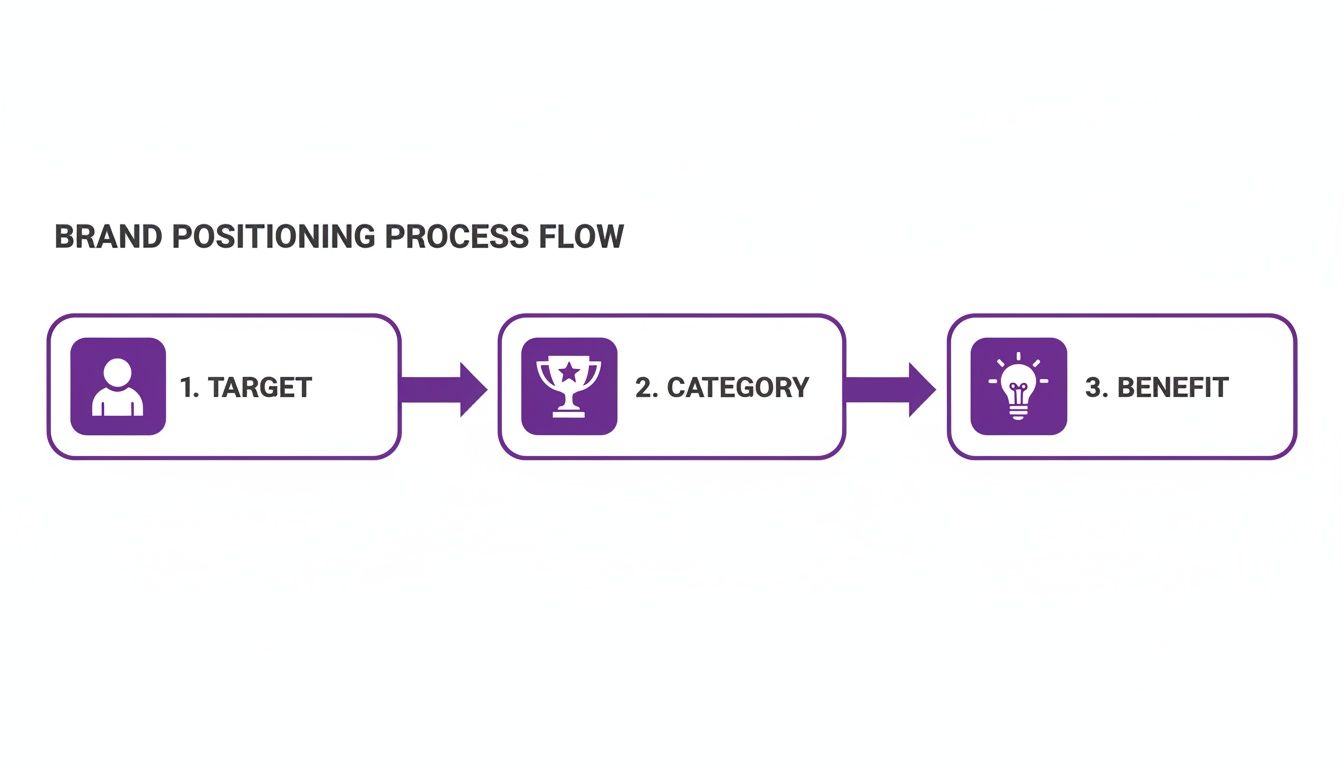
It all starts with a laser-focused target, moves to a well-defined category, and lands on a compelling benefit. Let’s break down how some real North American B2B champs have absolutely mastered this.
Shopify: The Entrepreneur’s Operating System
Ottawa-based Shopify is a masterclass in brand positioning. It could have easily been just another “website builder,” but instead, it claimed a much more powerful category: the ultimate e-commerce platform for entrepreneurs.
- Target Audience: Independent business owners and aspiring entrepreneurs, not massive enterprises.
- Brand Promise: To make it simple for anyone to start, run, and grow a business online.
- Key Differentiator: An all-in-one ecosystem that truly democratizes commerce, offering everything from payment processing to marketing tools, all in one spot.
By relentlessly focusing on the needs of the individual creator and the small business owner, Shopify became synonymous with entrepreneurship itself. This crystal-clear positioning has been wildly successful, powering millions of businesses globally and generating over $7 billion in revenue in 2023.
Slack: The Digital HQ for Modern Teams
Slack is another knockout example, this time from the US. Before Slack, team communication was a chaotic mess of emails, texts, and a mishmash of chat apps. Slack waded into this mess not as “another messaging app” but as the “digital headquarters” for modern work.
This positioning was brilliant because it completely reframed the problem. The company wasn't just selling chat; it was selling an organized, collaborative, and more efficient way of working.
For agile teams overwhelmed by email and disconnected tools, Slack is the channel-based messaging platform that brings all your communication and tools into one place, unlike fragmented and inefficient email chains.
This sharp position helped Slack become indispensable for modern teams. It now serves over 100,000 paid customers and was acquired by Salesforce for a staggering $27.7 billion, proving the immense value of owning a category.
These examples prove that a well-defined brand position is one of the most powerful tools you have for market domination. It gives you a clear blueprint for what excellence looks like, turning your brand into the definitive answer for a very specific customer need.
Are you ready to define your company’s unique position and dominate your market? Contact us today to learn how our Fractional CMO services can provide the strategic leadership you need.
Building a Position of Trust in the B2B Market

In the B2B world, a purchase decision is never taken lightly. It’s a major commitment involving significant capital, risk, and often, the careers of the people making the choice. This is especially true in the cautious business cultures of Canada and the US.
It’s precisely here that trust graduates from a nice-to-have virtue to your most powerful positioning tool.
While competitors are busy slashing prices or bolting on minor features, you can build an unshakeable advantage by positioning your brand around reliability, expertise, and integrity. These are the qualities that turn prospects into long-term partners, creating a durable competitive edge that a simple price cut can never match.
This means your brand positioning must be intentionally built to signal trustworthiness at every single touchpoint. It’s about more than just delivering a quality service; it's about consistently proving your credibility and competence.
Actionable Tactics for Building Trust
To move from an abstract idea to a tangible market position, you need to actively demonstrate why your company is the safest, most reliable choice. Merely claiming you’re trustworthy is not enough; you must provide irrefutable proof.
Here are three key tactics for signalling your brand’s dependability:
-
Develop In-Depth Case Studies: Go beyond surface-level success stories. Create detailed narratives that showcase the specific problem, your strategic solution, and, most importantly, the quantifiable results. A well-documented case study is hard evidence of your capabilities.
-
Showcase Authentic Client Testimonials: Feature real people from recognizable companies. Video testimonials are particularly powerful, as they add a human element and a layer of authenticity that written quotes can’t always match.
-
Maintain Consistent Messaging: Every piece of content, every sales call, and every customer interaction must reinforce the same core message of reliability and expertise. Inconsistency erodes trust faster than almost anything else.
This consistent, evidence-based approach is what cements your position as a credible partner.
Trust as a Tie-Breaker in the Canadian Market
In the North American B2B landscape, particularly in Canada, trust isn't just a soft metric—it's a critical decision-making factor. The Gustavson Brand Trust Index, based on a survey of 13,188 Canadians, shows that brand trust is fundamentally built on values, integrity, and customer experience.
For Canadian B2B and tech firms, these findings are vital. Executives and procurement teams are notoriously risk-averse and often use perceived competence and trust as the ultimate tie-breaker between two similar offerings. In a tech hub like Kitchener–Waterloo, for example, a deliberate positioning around reliability can elevate a brand from being one of many vendors to becoming a client’s most trusted partner. Discover more insights about Canada's most trusted brands from Retail Insider.
When a client signs a contract, they aren't just buying your service; they are buying peace of mind. A brand position built on trust promises them they've made the right decision before, during, and after the sale.
Ultimately, positioning your brand as the most trustworthy option in your market creates a protective moat around your business. While others compete on fleeting advantages, you build relationships founded on confidence and reliability—the bedrock of sustainable B2B success.
Are you ready to build a brand position that commands trust and wins more business? Contact us to learn how B2Better's strategic approach can help.
Executing Your Strategy with a Fractional CMO
Defining your brand position is a fantastic strategic exercise, but a strategy on paper doesn’t generate a single dollar of revenue. The real work starts when you bring that position to life across every customer touchpoint—and this is where many B2B companies stumble. It’s also exactly where an experienced Fractional CMO steps in to translate your carefully crafted positioning into measurable business results.
Think of execution as the bridge between your brand promise and your customer’s actual experience. A Fractional CMO acts as both the architect and the general contractor for this bridge, making sure every piece—from your website copy to your sales decks—is built to support your new position. It’s a hands-on process of turning strategic clarity into real market impact.
From Blueprint to Reality
The first step is translating your positioning statement into a compelling messaging framework. This framework becomes the single source of truth for how your company talks about its value. From there, we methodically roll this new messaging out across all your high-impact channels.
This rollout isn't a shotgun blast; it's a coordinated effort that typically includes:
- Website & SEO: Rewriting key pages and optimizing content to pull in your ideal customer profile like a magnet.
- Content Marketing: Developing blog posts, case studies, and white papers that don’t just state your brand promise but actually prove it.
- Sales Enablement: Arming your sales team with new presentations and collateral that tell a consistent, powerful story.
- Paid Media: Crafting ad campaigns that target your specific audience with laser-focused messaging.
This synchronized approach means that no matter where a prospect in Canada or the United States encounters your brand, they get the same clear, compelling message every time.
A great brand position only works if it’s lived and breathed by the entire organization. A Fractional CMO orchestrates this internal alignment, ensuring marketing, sales, and product teams are all speaking the same language.
Making Every Marketing Dollar Count
In today's competitive North American market, simply throwing more money at advertising is a losing game. Statistics Canada reports that while the Canadian advertising industry hit CAD 14.4 billion in 2023, profit margins actually went down. With costs on the rise, especially in tech hubs like Kitchener–Waterloo, you have to be efficient.
Strong positioning becomes your ultimate efficiency play. A Fractional CMO ensures your budget isn't fragmented across a dozen disconnected tactics. Instead, it’s focused on a unified brand narrative that cuts through the noise and directly supports real pipeline growth.
Working with a Fractional CMO gives you the senior-level expertise needed to navigate these complexities without the overhead of a full-time executive. It's a partnership designed to turn your brand position from a strategic document into your most powerful revenue-driving asset.
If you’re ready to finally execute your brand strategy and see a measurable return, it’s time to connect with an expert who can guide the way.
Contact us today to learn how B2Better's Fractional CMO services can bring your brand position to life.
Common Questions About Brand Positioning
Even with a clear strategy mapped out, B2B leaders usually have a few lingering questions about how brand positioning works in the real world. Putting these ideas into practice requires clarity. Here are some of the most common questions we hear from business leaders across Canada and the United States, along with our straight-to-the-point answers.
Brand Positioning vs Branding
One of the most frequent points of confusion is the difference between brand positioning, branding, and a mission statement. It helps to think of them as a hierarchy of ideas, each building on the last.
- Your Mission: This is your internal compass—the fundamental "why" your company exists. It’s the big idea that gets your team out of bed in the morning.
- Your Branding: This is your external appearance. Think of your logo, your colour palette, and the tone of voice you use. It's the sensory stuff that creates your company's look and feel.
- Your Brand Positioning: This is your strategic place in the market. It's the deliberate act of defining exactly how you want a specific customer to see you compared to your competitors. It’s the reason they should choose you over everyone else.
Revisiting Your Positioning
Another question we get all the time is about timing: how often should a B2B company actually review its brand positioning? While your position should be built to last, it's not set in stone forever. The smart move is to conduct an annual review to make sure your position still holds water in the current market. Keep in mind, a 2023 survey found that 73% of customers will walk away after just one bad experience, which shows just how quickly perceptions can shift.
A major repositioning effort is only needed during significant market shifts—like when a disruptive new competitor shows up, customer needs fundamentally change, or your core product evolves. Treat it as a strategic check-up, not a constant overhaul.
Competing as a Smaller Company
Can a smaller Canadian company really use positioning to compete against bigger, well-funded US brands? Absolutely. Positioning is the ultimate equalizer, especially for startups and scale-ups. It’s not about outspending your rivals; it’s about outsmarting them with focus.
A smaller Canadian business can carve out huge success by positioning itself as the dedicated expert for a very specific niche, industry, or region. For instance, instead of trying to compete with a generic American giant, you could become the go-to cybersecurity provider for Ontario's manufacturing sector. By offering deeper, more tailored expertise, you become the clear and logical choice for a high-value slice of the market. In the world of brand positioning, focus always beats scale.
Executing a brand positioning strategy that drives real growth requires expertise and focus. The team at B2Better has over 45 years of combined B2B experience, helping companies across North America turn strategic clarity into measurable revenue.
Ready to define your space in the market? Contact us to learn how our Fractional CMO services can help.