

A successful B2B digital marketing strategy isn't just a list of tactics. It's a blueprint connecting every single activity back to revenue. According to Forrester, B2B companies with a well-defined strategy grow 31.6% faster than those without one. It all starts with deeply understanding who you're selling to in the United States and Canada and how they actually make purchase decisions. Get this right, and your efforts will be targeted and effective from day one.
Building Your B2B Digital Marketing Foundation
Before you launch a single ad or publish one blog post, the most successful B2B companies invest time in building a solid strategic foundation.
Trying to do marketing without this groundwork is like building a house without a blueprint. You end up with wasted resources, disconnected tactics, and completely unpredictable results. A strong foundation, on the other hand, ensures every marketing dollar is spent with purpose—targeting the right people with the right message at exactly the right time.
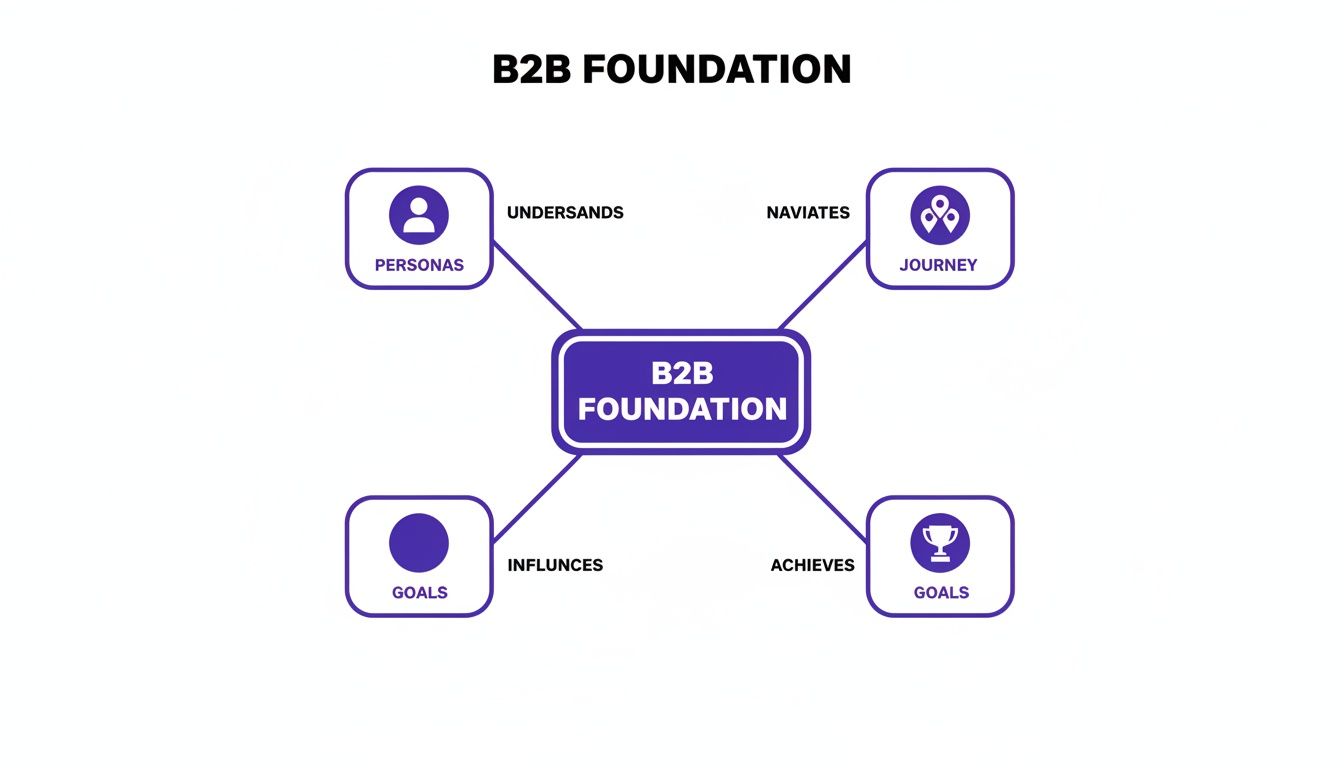
This foundational work really boils down to three core pillars: defining your buyer personas, mapping their journey, and tying every action back to clear business goals. Nail these, and you'll transform your marketing from a cost centre into a predictable engine for growth.
This is what that foundation looks like visually—three interconnected pillars that form the essential starting point for any effective strategy.
Let's break down each of these pillars.
Get Clear on Your Ideal Buyer Personas
You can't market to a faceless company. You have to understand the people behind the titles—their daily challenges, what motivates them, and the pressures they're under. This is where detailed buyer personas are invaluable.
A well-researched persona goes way beyond basic demographics. It paints a picture of a real person.
For instance, instead of just targeting "IT Managers at mid-sized companies," a detailed persona might be "Security Steve." He's an IT Director in the financial services sector in New York, he's completely overwhelmed by compliance demands, and his biggest fear is a data breach. He values vendors who offer robust security documentation and responsive tech support.
This level of detail dictates everything—your messaging, your content topics, and even the channels you use to reach him. It's no surprise that a stunning 93% of companies who exceed lead and revenue goals segment their database by buyer persona.
Map the B2B Customer Journey
The path from awareness to purchase in B2B is rarely a straight line. It usually involves multiple stakeholders, tons of research, and a long, drawn-out consideration phase. Mapping this journey helps you identify the critical touchpoints where you can build trust and influence the final decision.
Think about a Canadian manufacturing firm evaluating new automation software. Their journey might look something like this:
- Awareness: An engineer reads an article in an industry publication about improving production efficiency.
- Consideration: They start searching for "robotic arm integrators in Ontario" and begin comparing vendor websites, downloading a few case studies along the way.
- Decision: The engineering team, the plant manager, and the CFO all get involved to review proposals and watch demos before making a final choice.
Understanding these stages allows you to create targeted content for each touchpoint, guiding prospects smoothly through the funnel. A key part of this is knowing the proven strategies for finding B2B leads who are actively moving through this journey.
Connect Marketing Activities to Revenue Goals
Every single marketing activity should ultimately serve a business objective. The final piece of your foundation is setting clear, quantifiable goals.
Instead of a vague goal like "increase website traffic," a strategic objective would be, "Generate 50 marketing-qualified leads (MQLs) per quarter from organic search to achieve a $250,000 sales pipeline."
This approach creates accountability and makes your priorities crystal clear. We're seeing B2B buyers in Canada and the United States move decisively toward digital-first journeys, which raises the stakes for having a structured strategy. Even small improvements can have a massive impact. For example, North American benchmarks show typical B2B website conversion rates sit around 2–5%. Just moving that rate from 2% to 4% effectively doubles your pipeline from the same amount of traffic.
Before you get bogged down in tactics, make sure you've clearly defined these foundational elements. The table below summarises the core components you need to have in place.
Core Components of a B2B Marketing Foundation
| Component | Key Objective | Example Question to Answer |
|---|---|---|
| Ideal Customer Profile (ICP) | Define the characteristics of the companies you sell to best. | What industry, size, and region in the US or Canada do our most successful customers belong to? |
| Buyer Personas | Understand the individuals within the ICP who influence the buying decision. | Who is "Security Steve"? What are his daily pains, goals, and preferred channels? |
| Customer Journey Map | Visualize the path a persona takes from awareness to purchase. | What are the key touchpoints and questions at the Awareness, Consideration, and Decision stages? |
| Revenue-Tied Goals & KPIs | Connect marketing efforts directly to measurable business outcomes. | How many MQLs from organic search do we need to hit our pipeline target of $250k? |
| Value Proposition | Articulate a clear, compelling reason why customers should choose you. | Why are we the best choice for "Security Steve" over our top three competitors? |
Nailing down these components ensures that every marketing decision you make is deliberate, informed, and built for growth.
A solid foundation turns marketing from a series of random acts into a deliberate system for growth. When you know exactly who you're talking to, how they buy, and what you need to achieve, every decision becomes clearer and more impactful.
Building this strategic framework is a critical first step. For a deeper dive, check out our guide on how to create a marketing strategy that truly aligns with your business objectives. Ready to build a foundation that drives North American growth? Contact us to discuss your strategy.
Choosing High-Impact B2B Marketing Channels

With your foundation in place, the next critical decision is where to put your time and money. The most common mistake I see is companies spreading their budget across every platform imaginable. This guarantees one thing: mediocre results everywhere.
The key is to be ruthlessly selective. You need to choose only the channels where your ideal buyers are actually active and open to hearing from you. This isn’t about chasing trends; it’s about figuring out what works for your specific audience in Canada and the United States.
For B2B, this usually means focusing on platforms built for professional networking, deep research, and building relationships over a longer sales cycle. A focused channel strategy lets you dominate a few key areas instead of being a whisper in a crowded stadium.
Aligning Channels With Your Buyer Personas
The best channels flow directly from your buyer persona research. If your persona, “Security Steve,” lives in niche cybersecurity forums and on LinkedIn, then those are your battlegrounds. Trying to grab his attention on Instagram is just burning cash.
Think about how your buyers look for information. A US-based SaaS company targeting enterprise tech leaders will get incredible value from LinkedIn’s ad targeting, which can zero in on users by job title, company size, and industry. LinkedIn is still a B2B giant—a staggering 80% of B2B leads from social media come straight from the platform.
On the other hand, a Canadian manufacturing firm might find its best leads through technical SEO. Their prospects aren't scrolling social media for solutions; they're on Google, typing in hyper-specific terms like "CNC machining services in Southern Ontario." Winning that high-intent search traffic is infinitely more valuable than any social media blitz.
Creating an Integrated Channel Mix
The goal isn't to pick just one channel. It's about building a small, integrated mix where each platform boosts the others. A smart B2B digital marketing strategy makes sure your channels work together, creating a seamless experience for your customer.
Here’s what that looks like in practice:
- SEO and Content Marketing: You publish a detailed blog post optimized for a long-tail keyword your ideal buyer searches for. This article becomes your central hub of expertise.
- LinkedIn: You promote that blog post with targeted updates and a small ad spend, getting it in front of key decision-makers and amplifying its reach beyond organic search.
- Email Marketing: Anyone who downloads a related checklist from the blog post gets added to a lead nurturing sequence. They receive valuable follow-up content that builds trust over time.
This synergy transforms a single piece of content into a lead-generating machine that works across multiple channels. Every touchpoint reinforces your expertise and gently guides prospects on their journey.
The best B2B channel strategy isn’t about being everywhere. It's about being everywhere that matters to your specific customer, creating a seamless journey that feels helpful, not interruptive.
For a real-world example, look at how Adobe markets its Experience Cloud. Instead of broad, generic campaigns, they zeroed in on an integrated mix of account-based marketing (ABM) on LinkedIn, highly specific content for different enterprise roles, and exclusive executive events. This focused approach allowed them to engage key accounts on multiple fronts, which dramatically shortened their sales cycle and boosted their average deal size by over 20%.
Choosing the right channels is a make-or-break moment in your strategy. Get it right, and you build a powerful, efficient engine for growth.
Ready to build a channel strategy that delivers real ROI for your B2B firm in Canada or the US? Contact us to discuss how we can identify and dominate the platforms where your future customers are waiting.
Weaving Content and SEO Into a Plan That Actually Converts
In the B2B world, content isn't about churning out blog posts to fill a calendar. It’s your hardest-working salesperson, a strategic asset that builds trust and guides complex buying decisions. A generic, one-size-fits-all approach just falls flat when your audience is looking for deep, specific expertise.
The goal is to transform your website from a simple digital brochure into a lead-generating machine. This requires a deliberate shift away from random acts of content. Every single asset, from a technical whitepaper to a detailed case study, needs a clear job to do—meeting your ideal customer with the exact information they need, right when they're looking for it.
Mapping Content to the Buyer's Journey
The B2B sales cycle is a marathon, not a sprint. It involves multiple stakeholders, each with their own questions and concerns. Your content has to serve different needs at each stage of this long journey. By aligning every piece of content to a specific stage, you provide value at every touchpoint and build the authority needed to win the deal.
Here’s a practical way to structure it:
-
Awareness Stage: Buyers here are just starting to identify a problem; they aren't shopping for vendors yet. Your content should be educational and problem-focused. Think insightful blog posts, original research reports, and eBooks that address their core challenges without a heavy sales pitch.
-
Consideration Stage: Now they’re actively researching solutions. This is your chance to introduce your company as a credible option. This is where detailed case studies, expert-led webinars, and honest comparison guides shine by showcasing your expertise and proven results.
-
Decision Stage: The final hurdle is all about validation. Prospects need to feel confident they're making the right choice. Content like free consultations, transparent pricing pages, and clear implementation guides can help get the contract signed.
When you map your content this way, you create a natural, logical path that nurtures prospects from initial curiosity to a confident purchase. Each piece builds on the last, reinforcing your value every step of the way.
Uncovering High-Intent Keywords
Great content is useless if no one can find it. This is where a smart SEO strategy comes in. While broad, high-volume keywords have a place, the real gold in B2B is found in high-intent, long-tail phrases that signal a user is much closer to making a decision.
These aren't just one- or two-word terms. They're specific questions and detailed phrases that reveal a prospect's exact pain point.
For example, instead of targeting a broad term like "cybersecurity solutions," a California-based company would focus on a high-intent phrase like "SOC 2 compliance software for financial services in the US." The person searching for the latter isn't just browsing—they have a specific, urgent problem that needs solving.
Finding these gems requires digging deeper than basic keyword tools. Scour competitor content, browse industry forums on Reddit, and—most importantly—listen to the exact language your sales team hears on their calls. This on-the-ground research gives you the raw material for content that doesn't just rank, it converts. For a more detailed walkthrough, you can explore our complete guide on how to improve SEO for your B2B company.
Personalizing Content for Account-Based Marketing
For your most valuable target accounts, a generic approach simply won't cut it. Account-Based Marketing (ABM) is about creating bespoke content tailored to the specific challenges and goals of a single company.
This goes way beyond just adding a company name to an email template. True ABM personalization is about showing you've done your homework. It might involve:
- Custom Case Studies: Developing a case study that highlights results from a company in their direct industry.
- Industry-Specific Reports: Creating a version of a research report with a custom introduction that speaks directly to their market trends.
- Personalized Landing Pages: Building a unique landing page for the target account, complete with their logo and content addressing their known pain points.
This level of personalization demonstrates a genuine investment in solving their problems, making you stand out in a crowded market. Companies using ABM generate 200% more revenue for their marketing efforts than those that don't.
In the competitive Canadian landscape, this kind of strategic thinking is no longer optional. A recent analysis shows that over 88% of Canadian businesses use content marketing, and more than 90% have a documented plan. When the vast majority of your local competitors are already playing the game, you don't win by creating more content—you win by creating smarter, more targeted content. You can discover more insights about Canadian B2B trends to see why a focused plan is so critical.
A well-executed content and SEO plan is the foundation of any successful B2B digital marketing strategy. It builds authority, attracts high-quality leads, and fuels your entire sales pipeline.
Is your content strategy driving measurable results? Contact us today for a free consultation to see how we can build a content and SEO plan that converts high-value prospects into loyal customers.
Using Technology and AI to Amplify B2B Marketing

A modern B2B digital marketing strategy runs on a smart technology stack. The right tools don't just automate tedious work; they give you the critical insights needed to scale, personalize your outreach, and get a leg up on the competition. Building this stack isn't about collecting software—it’s about creating an integrated system that powers your entire marketing engine.
For most B2B firms in North America, this system starts with three core components: a Customer Relationship Management (CRM) platform, a marketing automation tool, and a robust analytics solution. These are the non-negotiables. They form the operational backbone of your strategy, letting you track relationships, nurture leads, and measure what’s actually moving the needle.
But today, the real competitive edge comes from layering artificial intelligence on top of this foundation. AI isn't some futuristic concept anymore; it's a practical tool that’s delivering measurable results right now.
Building Your Essential Martech Stack
Your marketing technology (or "martech") stack should be built to support your specific goals. You don't need every shiny new tool on the market. Instead, focus on a few key categories that solve real problems along your buyer's journey.
-
Customer Relationship Management (CRM): This is your single source of truth for all customer and prospect data. Think of it as your company's collective memory, tracking every interaction from sales calls to email opens, giving both marketing and sales a unified view of the entire relationship.
-
Marketing Automation: These platforms handle the repetitive tasks that are essential for lead nurturing. They automate email sequences, manage social media posts, and score leads based on their engagement, ensuring no opportunity falls through the cracks. This frees up your team to focus on high-value strategic work.
-
Analytics and Reporting: Beyond what your CRM offers, dedicated analytics tools help you connect marketing activities directly to revenue. They answer the big questions: Which channels are driving the most qualified pipeline? What is our customer acquisition cost? This is how you prove ROI.
When you assemble these pieces, you create a powerful system. For instance, a lead captured on your website can be automatically added to your CRM, dropped into a personalized email sequence via your automation platform, and tracked all the way to a closed deal in your analytics dashboard.
Essential B2B Martech Stack Comparison
Building the right tech foundation requires understanding how different tools fit together. Here’s a quick breakdown of the core categories, what they do, and how AI is making them even smarter.
| Tech Category | Core Function | Example Tools | AI Application |
|---|---|---|---|
| CRM | Manages all customer data and interactions in one central hub. | Salesforce, HubSpot | Predictive lead scoring, sentiment analysis on communications. |
| Marketing Automation | Automates repetitive marketing tasks like email, social media, and lead nurturing. | Marketo, Pardot, ActiveCampaign | Dynamic content personalization, automated journey optimization. |
| Analytics & BI | Tracks campaign performance and measures marketing's impact on revenue. | Google Analytics, Tableau, Looker Studio | Anomaly detection, attribution modeling, forecasting trends. |
| SEO & Content | Optimizes website content for search engines and manages content workflows. | Ahrefs, Semrush, Clearscope | Content brief generation, keyword clustering, SERP analysis. |
Choosing tools from each category creates a cohesive stack that not only automates work but also provides the deep insights needed to make smarter, faster decisions.
Practical AI Applications Driving B2B Growth
AI is quickly moving from a "nice-to-have" to a "must-have" in B2B marketing. Its real power is its ability to analyze massive amounts of data to find patterns and make predictions that a human simply couldn't.
One of the most impactful uses is predictive lead scoring. Instead of just assigning points based on simple actions (like downloading a whitepaper), AI models analyze thousands of data points—from firmographic data to behavioural signals—to predict which leads are most likely to close. This helps sales teams prioritize their efforts on the accounts with the highest potential, dramatically improving their efficiency and conversion rates.
Gong, the revenue intelligence platform, is a great example. They used their own AI to analyze sales conversations, identifying the specific language and behaviours that led to closed deals. By applying these insights, they were able to refine their sales and marketing messaging, which was a key factor in their explosive growth, leading to a $7.25 billion valuation.
Another powerful application is in paid media. To really get the most from your ad spend, you need to understand how to leverage AI for Facebook ads, which can automate budget allocation and improve targeting. To learn more about how these tools are reshaping campaigns, check out our guide to using AI in marketing.
In Canada, adopting these technologies has become a competitive baseline. Recent data shows that over 62% of Canadian B2B marketers now rely on AI-based analytics to personalize outreach and improve campaign ROI. This signals a clear shift: if two-thirds of your peers are using AI to sharpen their targeting, manual, intuition-only approaches are going to struggle to keep up.
Integrating the right technology and AI into your B2B digital marketing strategy isn't just about efficiency. It's about making smarter, data-driven decisions that generate a real return on your investment. Need help building your tech stack for the US and Canadian markets? Contact us for expert guidance.
Measuring Performance and Optimizing for Growth

Executing a strategy is only half the battle. A brilliant plan without clear metrics is just sophisticated guesswork.
The final, critical piece of any effective digital marketing strategy b2b is a relentless focus on performance measurement and continuous optimization. This is how you transform marketing from a cost centre into a predictable, data-driven engine for growth.
Too many teams get lost in vanity metrics like social media likes or total website visits. While these numbers can be interesting, they don't tell you if your marketing is actually making money. Instead, the focus must shift to metrics that are directly tied to revenue.
This means moving past surface-level data to track what truly matters for business health. The goal is to build a resilient marketing function that can confidently double down on what works and pivot away from what doesn't.
Defining Your Most Important KPIs
To get a clear picture of performance, you need to track a handful of key performance indicators (KPIs) that connect marketing efforts directly to sales outcomes. These are the numbers that your executive team and board actually care about.
For B2B firms in Canada and the United States, three of the most crucial metrics are:
- Customer Acquisition Cost (CAC): This is the total cost of your sales and marketing efforts to acquire one new customer. A healthy business model requires a CAC that can be recovered profitably over the customer's lifetime.
- Pipeline Velocity: This measures how quickly leads are moving through your sales funnel. A faster velocity means a shorter sales cycle and quicker revenue generation.
- Marketing-Influenced Revenue: This tracks the total revenue from deals where marketing played a role. It demonstrates marketing's direct contribution to the bottom line.
By focusing on these revenue-centric KPIs, you can have much more strategic conversations about budget and performance. It shifts the discussion from "how many clicks did we get?" to "how much qualified pipeline did we generate?"
Building a Powerful Marketing Dashboard
You can't manage what you don't measure. A simple, powerful marketing dashboard is essential for providing a clear, at-a-glance view of what’s working.
This doesn't need to be overly complex. Tools like Looker Studio (formerly Google Data Studio) can pull data from various sources into one central view.
Your dashboard should be built around your core KPIs. It should visually track trends over time, helping you spot opportunities and potential issues before they become major problems. A successful dashboard might show a month-over-month decrease in CAC alongside an increase in marketing-influenced revenue, clearly demonstrating a positive ROI.
The purpose of a dashboard isn't just to report data; it's to drive action. A well-designed dashboard should immediately answer your most important questions and guide your next strategic move.
Look at HubSpot's journey. By building a dashboard that connected every marketing activity to MQLs and, ultimately, new customers, they could precisely calculate the ROI of their content. This data-driven approach allowed them to confidently invest millions into their blog, turning it into one of the most successful B2B marketing assets in the world, now generating a significant portion of their $2 billion+ annual revenue.
This level of insight is crucial, as firms that systematically research and track their performance grow up to ten times faster than those that don't.
A Structured Process for Performance Reviews
Data is useless without a structured process to review it and take action. Set up a regular cadence for performance reviews—weekly for tactical campaign adjustments and monthly or quarterly for bigger strategic decisions.
During these reviews, your team should analyze the dashboard and ask critical questions:
- What Worked? Identify the campaigns, channels, or content pieces that exceeded their goals. What can we learn from them?
- What Didn't Work? Be honest about underperforming initiatives. Why did they fail to meet expectations?
- What's Next? Based on the data, what will you double down on, what will you stop, and what will you test next?
This structured review process creates a culture of accountability and continuous improvement. It ensures your B2B digital marketing strategy remains agile, responsive, and always optimized for growth.
Ready to build a data-driven marketing function that delivers predictable results? Contact us today to learn how we build and manage marketing engines that tie every action to measurable revenue growth.
Partnering For Success With a Fractional CMO
Executing a world-class B2B digital marketing strategy takes senior expertise that many scaling companies in Canada and the United States simply don’t have in-house. This is precisely where a Fractional Chief Marketing Officer (CMO) comes in, offering executive-level leadership without the full-time cost.
This model is especially potent for growing firms. Our research shows that companies conducting regular, expert-led strategic reviews grow three to ten times faster than peers who don’t. A Fractional CMO brings that structured, C-level oversight directly to your business.
Why Partner With a Fractional CMO
An experienced partner doesn't just hand you a plan; they build a scalable marketing engine from the ground up. They oversee execution, manage budgets, and ensure every dollar is tied back to measurable business outcomes.
Take, for example, a North American SaaS firm that was struggling with lead generation. They brought in a Fractional CMO who immediately refocused their efforts on a targeted ABM campaign combined with a deep dive into technical SEO. That strategic shift resulted in a 40% increase in qualified pipeline inside of six months.
A Fractional CMO bridges the critical gap between ambitious growth goals and the strategic execution required to achieve them, providing the C-level guidance needed to turn a marketing budget into a predictable revenue driver.
If you’re a B2B firm ready to translate your goals into a powerful, results-driven marketing plan, let's have a conversation.
Contact us today to learn how we build marketing engines that drive real, sustainable growth across North America.
We Get These Questions All The Time
When we talk to B2B leaders in Canada and the United States about building a new digital marketing strategy, a few key questions always come up. Here are the straight answers to the most common ones.
How Much Should We Really Be Budgeting for Digital Marketing?
Look, there’s no magic number, but a solid benchmark for B2B companies is 7-12% of total revenue. A high-growth SaaS startup in the US trying to grab market share will likely push the higher end of that range, while a more established Canadian industrial firm might sit comfortably at the lower end.
The real key isn't the percentage, though. It’s about tying every dollar back to your pipeline goals. Once you get a firm grip on your Customer Acquisition Cost (CAC), you can start making sure every marketing dollar is actually driving profitable growth.
What's the Single Most Important B2B Marketing Channel?
If I had to pick just one, especially for tech and professional services, it’s got to be LinkedIn. The data doesn't lie: a staggering 80% of B2B social media leads trace back to the platform. It’s simply where decision-makers in North America live and breathe online.
But honestly, the "most important" channel is wherever your buyer personas are hanging out. For most of the companies we work with in the United States and Canada, the killer combo is using SEO to catch people actively searching for solutions and using LinkedIn for proactive outreach and making sure your brand is seen as an authority.
How Long Until We Actually See Results from This?
This is the classic "it depends" answer, but I can give you some real timelines. Paid media campaigns, like ads on Google or LinkedIn, can start bringing in leads within days or weeks. They're great for a quick hit.
On the other hand, SEO and content marketing are the long game. Think of them as an investment. You're building an asset, and that usually takes a good 6-12 months to really gain momentum and start delivering a steady stream of organic traffic and leads. A truly effective B2B strategy doesn't choose one over the other; it balances short-term tactics for immediate results with long-term plays for sustainable, predictable growth.
Ready to build a strategy that delivers predictable growth for your business in Canada or the US? At B2Better, we provide the senior marketing leadership needed to turn ambitious goals into measurable results. Contact us today for a free consultation.