

When people ask about the cost of search engine optimization services, the honest answer is it depends. For most B2B companies in Canada and the United States, a realistic budget falls somewhere between $2,000 and $10,000+ per month. Think of it less like a fixed price tag and more like a strategic investment—the budget you set is tied directly to your growth goals, how tough your market is, and the actual work needed to get you there.
Your Guide to B2B SEO Investment

Trying to nail down an SEO budget can feel a bit abstract, so let’s use an analogy. Investing in SEO is a lot like building a high-performance sales team. The size, expertise, and resources you put behind that team will dictate the results you get. A small, focused team can absolutely dominate a local niche, but you’ll need a larger, better-equipped one to take on national competitors in the US and Canada.
This guide will walk you through the common pricing models, what drives your costs, and how to know if you're getting a good return. But before we get into the numbers, it’s worth taking a moment to understand what is search engine optimization and why it’s such a core driver for visibility and growth in the first place.
Setting Realistic Expectations for SEO
Let's get one thing straight: SEO is a long-term strategy, not a magic button for instant leads. A solid program builds value that compounds over time, driving predictable growth for years to come. In fact, according to a BrightEdge study, SEO drives 1000%+ more traffic than organic social media. That single statistic shows its power as a primary channel for finding high-intent customers in Canada and the United States who are actively looking for the solutions you offer.
Investing in SEO is a marathon, not a sprint. Businesses that commit for at least 6-12 months are far more likely to see a significant return, as foundational work gives way to sustained momentum and authority in search results.
This requires a strategic mindset. Your initial investment lays the groundwork—fixing technical glitches, creating foundational content, and building your website's authority. This first phase sets the stage for scaling your efforts and capturing more market share down the road.
Why a One-Size-Fits-All Price Doesn't Exist
The cost of SEO is tailored to your business. A B2B SaaS company aiming for competitive keywords across North America will need a much different investment than a specialized manufacturing firm serving a niche local market. It just makes sense.
Several key factors will shape your budget:
- Your Industry's Competitiveness: Crowded markets demand more aggressive tactics to stand out.
- Your Business Goals: Are you looking for steady lead growth or complete market domination?
- The Technical Health of Your Website: A site with a lot of technical debt needs more work upfront to get it into shape.
- Content and Link Building Needs: The pace at which you need to create content and build links to outrank competitors will directly influence the investment.
Getting a handle on these factors is the first step toward building a realistic budget. If you're looking for practical ways to get started, our guide on how to improve SEO offers some great foundational steps.
Ready to build a program that delivers real, measurable results? Contact us today for a personalized consultation and discover how a strategic SEO investment can fuel your growth.
How SEO Services Are Priced
Figuring out SEO costs starts with understanding how providers package their services. Think of it like a gym membership: you could pay a flat monthly fee for unlimited access, buy a 10-visit pass for specific goals, or hire a personal trainer by the hour for expert guidance. Each model fits a different need, and SEO pricing works the same way.
Picking the right structure makes sure your investment is directly tied to your business goals, whether you’re after steady, long-term growth or need to solve a specific, urgent problem. Knowing the various SEO service pricing models will help you walk into conversations with potential partners feeling confident and prepared.
The Monthly Retainer Model
The most common setup by far is the monthly retainer. You pay a fixed fee each month for a consistent, ongoing scope of SEO work. This is the go-to model for any business serious about long-term growth because SEO is a marathon, not a sprint. A retainer allows an agency to become a true partner, continuously refining your strategy month after month.
For example, a B2B SaaS company in Canada might pay a monthly retainer that results in a 150% increase in organic leads within 12 months. This is achieved by handling everything from creating regular blog content and building high-quality backlinks to monitoring technical site health and delivering performance reports. This sustained effort builds authority and traffic over time, much like a steady fitness routine delivers better long-term results than a few intense but sporadic workouts. It's a critical investment, especially when you consider SEO drives over 1,000% more traffic than organic social media.
The Project-Based Fee Model
In contrast, a project-based fee is a one-time cost for a specific, defined task with clear start and end dates. This model is perfect when you need to tackle a single, isolated objective. Think of it as calling in a specialist for a specific operation.
A great example is a comprehensive technical website audit for a US-based e-commerce site, which identified and fixed critical indexing issues that led to a 40% increase in organic traffic in just three months. Other projects include setting up local SEO for a new storefront or running a targeted link-building campaign to boost a specific service page. Once the project is done, the engagement ends. It’s an ideal choice when you have a well-defined problem that needs a concentrated burst of effort without a long-term commitment.
The Hourly Consulting Model
Finally, there’s hourly consulting. This is the most flexible option, where you pay an expert for their time—usually for high-level strategic advice, team training, or specialized troubleshooting. You might bring in an hourly consultant to get your in-house marketing team up to speed on the latest SEO best practices or to diagnose a sudden, mysterious drop in website traffic.
This model gives you direct access to senior-level expertise on an as-needed basis, providing targeted guidance without the overhead of a full retainer or project fee. It’s a great way to get an expert’s eyes on a specific challenge or to validate your current strategy.
Pricing varies wildly across these models. Enterprise SEO in a cutthroat market like California can easily command $10,000-$30,000+ monthly, but there are plenty of more accessible options. On average, North American agencies charge around $3,209 monthly, consultants bill at about $171 per hour, and freelancers might offer services for around $1,349 per month, giving cost-conscious startups a range of choices.
Ultimately, the best model depends entirely on your company’s needs, resources, and long-term goals. Ready to figure out which pricing structure is the right fit for your business? Contact us to discuss your goals and get a personalized plan.
What Drives Your SEO Costs? Let’s Break It Down
Ever wonder why one SEO proposal lands at $3,000 and another comes in at triple the price? It’s not random. The cost of good SEO is shaped by a few critical variables that dictate the scope, intensity, and resources needed to get you where you want to go.
Think of it like building a house. A small, single-storey home on a flat, clear lot is a world away from a multi-level structure on a tricky, sloped piece of land. Both are houses, but the time, expertise, and materials required are completely different. SEO is no different.
Understanding these drivers helps you look past the price tag and evaluate proposals based on real value and strategic fit.
Industry and Keyword Competitiveness
This is the big one. The single largest factor influencing your SEO budget is how crowded your market is. Are you stepping into a quiet, niche arena or a digital battlefield where giants have been investing for years?
For example, a specialized B2B manufacturing firm in a niche local market in Canada will face a very different fight than a B2B SaaS company aiming for high-value, national keywords like "best accounting software" across North America. To rank for a term like that, you're up against established brands with massive content libraries and powerful backlink profiles.
A study on SEO pricing found that campaigns in hyper-competitive industries, like finance or law, can cost 5-10 times more than those in less saturated markets. Why? Because it takes a monumental effort in content and authority-building just to make a dent.
To win in a competitive space, your campaign needs:
- Deeper, more authoritative content: Think comprehensive guides, original research, and detailed case studies that position you as an undeniable expert.
- Higher-quality backlinks: Earning links from top-tier publications and industry leaders is a resource-heavy process, but it’s non-negotiable for authority.
- Greater consistency: You’ll need a more frequent publishing and outreach cadence just to gain and maintain momentum.
Geographic Scope of Your Campaign
Your target geography directly scales the complexity—and cost—of your SEO program. A campaign can be laser-focused on a single city or span an entire continent, and each level demands a completely different strategy and investment.
A local SEO campaign for a professional services firm in Kitchener-Waterloo, for instance, zeroes in on optimizing their Google Business Profile, building local citations, and targeting location-specific keywords. Here, the competition is limited to other local businesses, making it a much more contained and affordable effort.
In contrast, a national or international SEO campaign is a much bigger beast. It involves competing with businesses across the United States and Canada, which requires a broader keyword strategy, extensive content creation, and a robust authority-building program to establish credibility on a national stage.
The Technical Health of Your Website
Your website is the foundation of your entire SEO strategy. If it's bogged down with technical issues, it’s like building that house on shaky ground. No matter how brilliant your content is, foundational problems will always hold you back.
An initial technical audit often uncovers nagging issues like:
- Slow page load speeds that kill user experience and tank rankings.
- Poor mobile-friendliness—a dealbreaker when over 60% of Google searches happen on mobile.
- A confusing site structure that makes it hard for search engines to crawl and index your pages.
- Duplicate content or broken links that dilute your site’s authority.
Fixing significant technical debt requires upfront work from developers and SEO specialists. This will either influence the initial project cost or become the main focus for the first few months of a retainer. A clean, technically sound website makes every other SEO effort far more effective right from the start.
To help you visualize how these factors play out, let's look at two different business scenarios.
How Business Factors Impact Your SEO Budget
This table illustrates how a company's goals and market position directly shape the scope and cost of an SEO program. A local business has a much more contained set of challenges compared to a national player in a crowded digital space.
| Factor | Low-Cost Scenario (e.g., Local Professional Service) | High-Cost Scenario (e.g., National SaaS Company) |
|---|---|---|
| Industry Competition | Low to moderate. Competing against a handful of local firms for keywords like "accountant in Kitchener." | Extremely high. Competing against established global brands for high-value keywords like "best CRM software." |
| Geographic Scope | Hyper-local. Focus on a single city or region and optimizing the Google Business Profile. | National or international. Requires extensive content, broad keyword targeting, and multi-region strategies for Canada and the US. |
| Technical Health | Often a simple brochure site built on a standard template. Technical fixes are usually straightforward and quick. | A complex, custom-built web application with potential for significant legacy code and technical debt. |
| Content Needs | Minimal. A few core service pages, a blog with monthly updates, and local case studies are often sufficient. | Massive. Requires a constant stream of high-authority content like whitepapers, original research, and webinars. |
| Link Building | Basic. Focus on building local citations and earning links from community partners and local business directories. | Extensive and resource-intensive. Requires digital PR and targeted outreach to earn links from top-tier media and industry publications. |
| Typical Monthly Budget | $1,500 – $4,000 CAD | $8,000 – $20,000+ CAD |
As you can see, the required investment isn't arbitrary—it's a direct reflection of the work needed to overcome the unique challenges and achieve the specific goals of the business.
Ready to figure out how these factors apply to your business? Contact us for a personalized consultation. We'll help you break down your specific needs and build a strategic plan that aligns with your growth goals.
What to Expect from B2B SEO Packages
Knowing the price is one thing, but what does that investment actually get you? When you partner with an SEO provider, that monthly retainer isn’t just a number on an invoice—it’s the fuel for a specific set of activities designed to drive real, organic growth for your B2B company.
The level of investment directly translates to the intensity and scope of the work. A smaller budget usually focuses on shoring up the foundations, while a larger one supports an aggressive campaign to capture market leadership. By looking at some clear benchmarks, you can see how an abstract cost becomes a tangible roadmap for success.
This infographic breaks down the core factors that stack up to determine your total SEO investment.
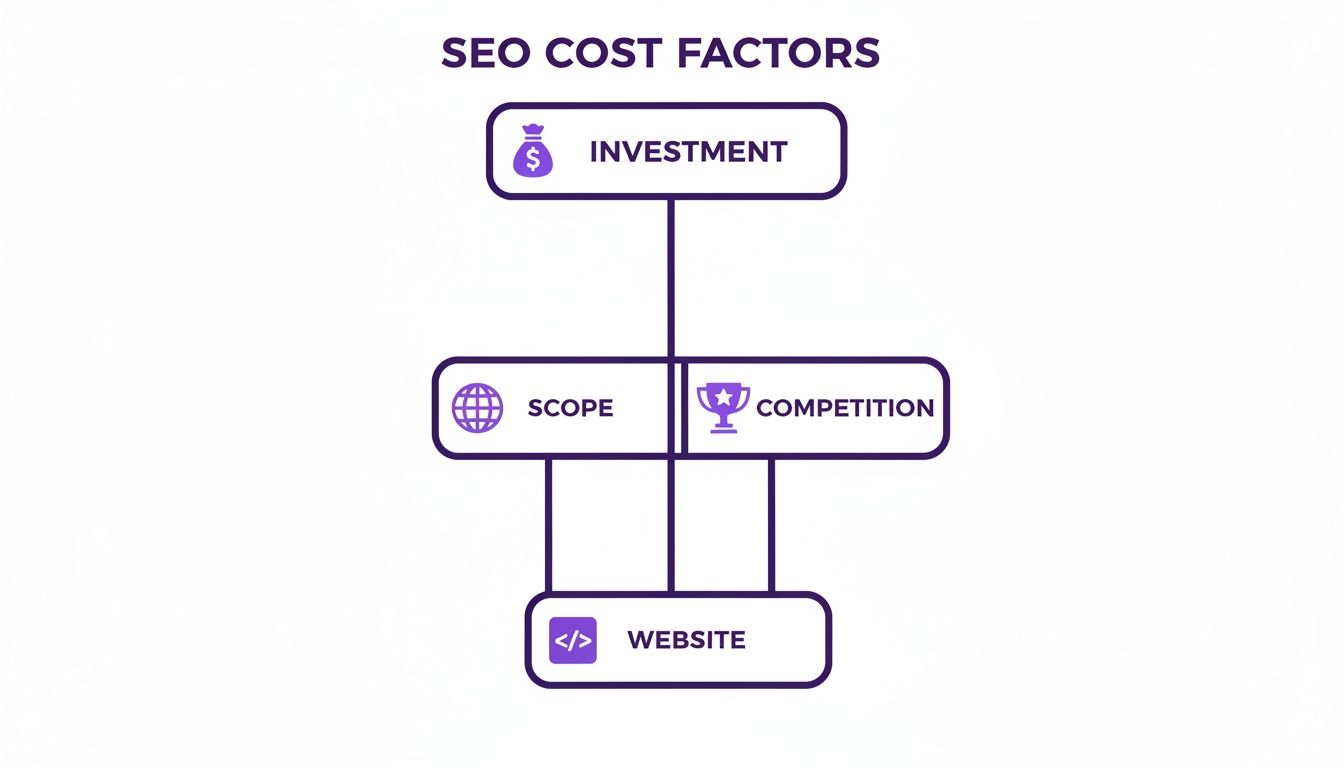
As you can see, the final price tag is a product of your website’s current health, how fierce the competition is in your market, and the sheer scale of your ambitions.
Foundational SEO Package for Startups and SMBs
For emerging B2B companies or those in less crowded local markets in Canada or the US, a foundational package is the perfect place to start. The main goal here is to build a solid base, fix the most critical issues, and start generating some forward momentum. It’s all about getting the essentials right so your website is technically sound and visible to search engines.
At this level, you should typically expect services like:
- Comprehensive Technical SEO Audit: Pinpointing and fixing core website problems like slow page speed, mobile usability headaches, and indexing errors.
- On-Page Optimization: Fine-tuning title tags, meta descriptions, and page content for up to 15-20 of your most important pages.
- Foundational Content Creation: Producing 1-2 high-quality blog posts or other content pieces each month to target strategic keywords and speak directly to your buyer’s pain points.
- Local SEO Management: For businesses serving a specific region, this means optimizing your Google Business Profile and building out local citations.
- Basic Link Building: Acquiring a handful of quality backlinks every month to begin building your site's authority in the eyes of Google.
- Monthly Performance Reporting: Keeping track of key metrics like organic traffic, keyword rankings, and, most importantly, conversions.
This kind of package gets your foot in the door and sets the stage for more aggressive growth as your business is ready to scale.
Growth SEO Package for Scale-Ups
When you're ready to move beyond the basics and start taking a serious bite out of your market share, a growth-focused package brings the necessary firepower. This tier is built for B2B companies in competitive national markets—think SaaS providers in the US or specialized consulting firms across Canada—that need to put the accelerator down on lead generation.
This mid-tier investment is where many B2B companies really start to see a transformative impact. You move beyond just fixing problems and start actively building the content and authority needed to become a recognized leader in your niche. Your website stops being a brochure and starts becoming a reliable lead-generation engine.
A growth package takes all the foundational services and injects a much deeper layer of strategy:
- Advanced Content Strategy: Developing topic clusters and pillar pages to establish true topical authority, often involving the creation of 3-4 strategic content assets per month.
- Strategic Link Building & Digital PR: Proactively earning high-authority backlinks through targeted outreach campaigns and digital PR efforts.
- Conversion Rate Optimization (CRO): Analyzing user behaviour and running A/B tests to improve your website's conversion rates, turning more of that hard-won traffic into actual leads.
- In-Depth Analytics and Reporting: Digging deeper into performance with competitor analysis and providing clear strategic recommendations for the next quarter.
This level of investment is all about building a competitive moat and cementing your brand as an authority. In a competitive US market like California, for example, growth plans can run anywhere from $2,500-$5,000 USD monthly, including multiple content assets and selective link partnerships. You can find more insights on SEO costs in California on 2marketing.com. It’s a perfect illustration of how investment scales with ambition and competition.
Ready to find the right package to fuel your growth? Contact us today for a personalized consultation to build a plan that matches your business goals.
Measuring the ROI of Your SEO Investment
A great SEO program isn't about climbing the search rankings for vanity's sake. It's about revenue. Shifting your focus from feel-good metrics to tangible business outcomes is the only way to understand the real value of what you’re paying for. You need to see a direct line from your SEO efforts to qualified leads, a growing sales pipeline, and new customer acquisitions.
After all, what good is a number-one ranking if the phone doesn't ring? The cost of search engine optimization services is just one side of the coin; the other, more important side is the return it generates. SEO is one of the few marketing channels that builds on itself, becoming a compounding asset that can drive predictable growth for years to come.
A Simple Framework for Calculating SEO ROI
Calculating your return on investment doesn't have to be a complicated mess of spreadsheets. A straightforward framework can help you connect your spending to the revenue it brings in, making it much easier to justify your budget and prove the program’s direct impact.
Here’s a practical, step-by-step example for a typical B2B company in the United States:
-
Calculate Total SEO Investment: Add up everything you’ve spent over a set period, like six months. This includes your agency retainer and any extra costs for things like content creation tools.
- Example: $5,000/month retainer x 6 months = $30,000 Total Investment
-
Track Organic Conversions: Figure out how many new leads came directly from organic search during that time. Your analytics platform can track form fills, demo requests, or even phone calls from people who found you on Google.
- Example: 100 new leads from organic search.
-
Determine Your Lead-to-Customer Rate: What percentage of those leads does your sales team usually turn into paying customers?
- Example: With a 10% close rate, you just landed 10 new customers (100 leads x 0.10).
-
Calculate Customer Lifetime Value (LTV): What’s the average total revenue a new customer brings in over their entire relationship with your business?
- Example: An LTV of $15,000 per customer.
-
Calculate Total Revenue from SEO: Multiply your new customers by your LTV to see the total value generated.
- Example: 10 customers x $15,000 LTV = $150,000 in Total Revenue.
-
Calculate Your ROI: Now, use the classic formula:
(Revenue - Investment) / Investment * 100.- Example:
($150,000 - $30,000) / $30,000 * 100= 400% ROI.
- Example:
In this scenario, for every dollar put into SEO, the business got five dollars back. Now that’s a conversation worth having.
Key Performance Indicators That Truly Matter
To calculate ROI accurately, you need to track the right Key Performance Indicators (KPIs). While rankings are a decent diagnostic tool, they don't tell you the whole story.
The most critical shift in mindset is moving from "How high do we rank?" to "How much qualified pipeline are we building?" This reframes SEO from a marketing expense to a core driver of business growth.
Focus on these business-centric KPIs instead:
- Organic Conversion Rate: What percentage of organic visitors actually do something valuable? This tells you if you're attracting the right kind of traffic.
- Customer Acquisition Cost (CAC) from SEO: How much are you spending to get a new customer through organic search? As your SEO gains traction, this number should steadily drop.
- Organic Lead Quality: Are the leads coming from search a good fit? You’ll need to work with your sales team to qualify these leads and track their journey through the sales pipeline.
Getting a handle on these metrics is fundamental. You can learn more about this in our detailed guide to digital marketing reporting.
This data-driven approach is what separates successful programs from money pits, especially in competitive markets. For instance, in California, SEO companies often charge between $100 and $300 per hour, while small businesses invest an average of $497.16 monthly. But here's the catch: data shows that companies spending just $500 per month are 75% more likely to be dissatisfied with their results. It’s a clear sign that you need to invest enough to actually see a meaningful return. You can discover more insights about California SEO spending on Digitalsilk.com.
Ultimately, measuring the right things empowers you to make smarter decisions and prove the undeniable value of a well-executed SEO strategy.
Ready to build a program that delivers a clear, positive return on investment? Contact us today to discuss your goals and how we can help you achieve them.
Choosing the Right SEO Partner for Growth

The ultimate success of your SEO strategy hinges on who you bring on board to guide it. The right expertise can put your growth on the fast track, but the wrong fit will burn through your budget and leave you with little to show for it.
For most B2B companies in Canada and the US, the decision boils down to a few familiar paths: hiring in-house, partnering with a big agency, or bringing on a freelance consultant. Each route has its own trade-offs in cost, accountability, and strategic depth. Making the right call means looking beyond the sticker price of the cost of search engine optimization services.
Comparing Your Options
Let's break down the typical choices a B2B startup or scale-up faces.
- Large Agency: You get a broad team of specialists, but this often comes with a hefty price tag. Growing companies can find these agencies lack the personalized attention and deep business understanding needed, with communication often filtered through account managers.
- Freelance Consultant: More affordable and flexible, a freelancer offers direct communication and a hands-on approach. The downside? A single person has limited capacity and a narrower skill set, which can quickly become a bottleneck as your needs get more complex.
- In-House Hire: This option provides a dedicated focus and deep company knowledge. But the high cost of a senior salary plus benefits is a major hurdle, not to mention the challenge of finding one person who’s an expert in all facets of modern SEO.
For many B2B leaders, none of these options feel quite right. They need high-level strategy combined with practical, roll-up-your-sleeves execution. Thankfully, there’s a powerful alternative that bridges this exact gap.
The Fractional CMO Advantage
The Fractional CMO model offers a unique solution, blending senior strategic leadership with cost-effective implementation. You get access to C-level marketing expertise without the hefty financial commitment of a full-time executive—a perfect fit for businesses that need both a strategic blueprint and a team to build it.
A study of B2B marketers revealed that 73% of companies that beat their revenue goals have a documented strategy. A Fractional CMO is purpose-built to create and oversee this strategy, ensuring every SEO tactic aligns with your core business objectives.
This model is especially powerful for SEO, where long-term success depends on a clear, sustained vision. Instead of just checking off a list of tasks, a Fractional CMO partner weaves SEO into your entire marketing and sales function, making sure your investment generates measurable pipeline growth. If you're weighing your options, our guide on selecting the best SEO services companies offers more valuable insights.
This approach delivers accountability, expert guidance, and a clear roadmap, turning your SEO program from a line item into a predictable engine for growth.
Ready to build a program that delivers measurable results? Contact us for a personalized consultation.
Questions B2B Leaders Ask About SEO Costs
Here are the straight answers to the most common questions we hear from B2B leaders in Canada and the United States when they're weighing the cost of an SEO program.
How Long Until I See SEO Results?
While you might see early movement from technical fixes in the first 1-3 months, real, meaningful gains in qualified traffic and leads typically take 6-12 months to materialize. SEO is a long game, not a quick fix. Think of it as an investment that builds compounding value over time.
For example, a US-based technology company we partnered with began seeing a steady 10-15% month-over-month increase in organic leads starting in their seventh month, culminating in a doubled lead volume by the end of the first year. This sustained effort is what ultimately separates market leaders from everyone else.
Are There Hidden Costs in SEO Services?
A transparent partner will lay out every single cost in their proposal. No surprises. However, it's smart to be aware of potential investments that might fall outside a core SEO retainer.
These could include things like:
- Content Promotion: A budget to amplify your content through paid channels.
- Specialized Software: Costs for advanced analytics or marketing automation tools you might need.
- Website Development: Charges for implementing complex technical recommendations that require a developer.
A crystal-clear scope of work is your best defence against unexpected bills. We believe in total transparency, so you know exactly where every dollar of your investment is going from day one.
Why Can't I Just Do SEO Myself?
It's certainly possible to learn the basics, but professional SEO is a full-time discipline that demands deep expertise and constant learning. Search engines make thousands of updates every year. What worked last year might be completely ineffective today.
A study of B2B marketers found that 73% of companies that beat their revenue goals have a documented strategy. An expert partner is purpose-built to create and execute that strategy, making sure every tactic aligns with your core business goals.
For most B2B leaders, the time required is better spent running the business. We worked with a Canadian manufacturing firm that saw a 300% increase in qualified leads within their first year of partnership. That freed up their internal team to focus on what they do best: sales and product innovation. Bringing in a specialist ensures your strategy is executed effectively and delivers a far greater return.
Ready to get clear, straightforward answers about how a strategic SEO investment can fuel your company's growth? The team at B2Better has over 45 years of combined B2B experience helping companies across North America turn their marketing into a predictable revenue engine. Contact us for a personalized consultation today.