

Let's be honest, marketing used to feel a bit like shouting into the wind. You'd craft a message, launch a campaign, and then wait… hoping the right people would hear you. AI intelligence marketing is what happens when you swap the megaphone for a sophisticated listening device—one that can hear, understand, and even predict what your customers want next.
It’s about using artificial intelligence to make smart, automated decisions that create incredibly relevant customer experiences, and doing it at a scale that would be impossible for a human team alone. Think of it as having a tireless team of analysts and strategists working 24/7. Their only job? To understand your customers, anticipate their behaviour, and fine-tune every single campaign for maximum impact.
This isn’t some far-off, futuristic concept anymore. For B2B businesses in Canada and the United States, it’s a present-day necessity for real growth.
What Is AI Intelligence Marketing and Why It Matters Now

Imagine your marketing could figure out exactly what a potential customer needs before they even type it into a search bar. That’s the real promise here. AI intelligence marketing moves way beyond the broad strokes of traditional methods, which often lean on historical data and educated guesses, into a much more precise and proactive model.
This isn't just about scheduling a few automated emails. It’s about building a dynamic, responsive system that learns from every click, download, and conversation. For B2B companies in Canada and the United States, that means turning long, complex sales cycles into more efficient, predictable revenue streams. For a solid primer on the principles behind this, it’s worth exploring what marketing intelligence truly entails.
Before we dig deeper, let's look at how fundamentally different this approach is.
Traditional Marketing vs AI Intelligence Marketing
| Aspect | Traditional Marketing | AI Intelligence Marketing |
|---|---|---|
| Data Analysis | Manual, often retrospective (looking back at past campaigns) | Automated, real-time, and predictive (forecasting future trends) |
| Audience Targeting | Broad segments based on demographics and firmographics | Hyper-targeted micro-segments based on behaviour and intent |
| Personalization | Generic or basic (e.g., using a first name in an email) | Deeply personalized 1:1 experiences across all channels |
| Decision Making | Based on intuition, experience, and historical data | Data-driven, powered by machine learning algorithms |
| Campaign Optimization | Manual adjustments made after a campaign concludes | Continuous, automated optimization in real-time |
| Pace & Scale | Limited by human bandwidth and manual processes | Operates 24/7 at a massive scale, handling millions of data points |
This table really just scratches the surface. The shift from a reactive to a predictive model changes the entire game.
The Shift from Reactive to Predictive Marketing
Traditionally, marketers have been stuck in a reactive loop. You launch a campaign, collect the data, and then your team spends hours trying to figure out what worked and why. AI flips that script completely.
By analyzing huge datasets in real time, AI spots patterns and predicts future outcomes with startling accuracy. This unlocks some serious capabilities:
- Deeper Customer Insights: AI sifts through everything from website clicks to social media comments to build rich, evolving buyer personas that go far beyond simple demographics.
- Predictive Lead Scoring: Instead of assigning static points to a lead, AI models continuously evaluate a lead's behaviour to pinpoint their true readiness to buy. This helps sales teams focus their energy where it counts most.
- Hyper-Personalization at Scale: AI makes it possible to serve up unique website experiences, email content, and ad creative to thousands of individuals at the same time, all based on their specific interests and actions.
One of the biggest wins here is the ability to connect with customers on a one-to-one level, even if your customer base is in the thousands. Just look at Netflix. They use AI to personalize content recommendations, a strategy that’s credited with saving the company an estimated $1 billion per year by keeping customers from churning.
Why This Matters for B2B Teams Right Now
The B2B world in North America is fiercely competitive. Lean teams—especially in startups and scale-ups in Canada and the United States—simply can't afford to be inefficient. AI intelligence marketing gives you a crucial advantage by automating the grunt work and delivering insights that were once only available to massive corporations. It allows smaller teams to punch way above their weight.
The adoption numbers tell the story. According to the Conference Board of Canada, 12.2% of Canadian businesses are now using AI, double the rate from the previous year, highlighting a rapid acceleration in adoption.
Bringing AI into your marketing isn't just a tech upgrade; it's a fundamental change in how you think about and drive growth. If you’re ready to build a smarter, more effective marketing engine, contact us. We can show you how a Fractional CMO can guide your journey.
Understanding the Core Capabilities of an AI Marketing Engine
At its heart, an AI marketing engine is about moving from educated guesses to data-backed certainty. It’s the difference between looking at a map and having a live GPS that reroutes you around traffic you can’t even see yet. For B2B companies, this engine has five core capabilities that work together to create a smarter, more efficient path to revenue.
These capabilities transform raw data into strategic actions, ensuring every marketing dollar and minute is spent with purpose. Let’s break down exactly what this looks like for businesses in Canada and the United States.
Uncovering Deep Customer Insights
Traditional buyer personas are often static documents, built from surveys and interviews conducted months or even years ago. AI intelligence marketing makes them dynamic and alive. It continuously analyzes thousands of data points—website behaviour, content downloads, social media interactions, and CRM data—to build rich, evolving profiles of your ideal customers.
Think of a Canadian SaaS company selling project management software. Their AI might notice that leads who download a whitepaper on "Agile Methodologies" and then visit the pricing page for enterprise plans are 5X more likely to convert. This insight allows the marketing team to create a targeted ad campaign for this specific micro-audience, dramatically improving its effectiveness.
Predictive Lead Scoring
Standard lead scoring is a step in the right direction, but it's often a blunt instrument. A lead gets 10 points for visiting a webpage and 20 for downloading a guide. It’s a system that treats all actions equally and can’t distinguish between a curious student and a C-suite executive with purchasing power.
Predictive lead scoring, powered by AI, is far more nuanced. It analyzes historical data to identify the subtle combination of actions and attributes that actually lead to a sale.
An AI model might learn that a lead from a mid-sized US manufacturing firm who watches 75% of a product demo video on a Tuesday morning is a prime candidate for a sales call within the next hour. This level of precision is impossible to achieve manually, leading to success stories where companies have increased their qualified leads by over 50%.
This capability ensures your sales team spends its valuable time on leads that are genuinely ready to buy, increasing efficiency and closing more deals.
Hyper-Personalization in Real Time
Today’s B2B buyers in the US and Canada expect the same personalized experience they get from services like Netflix or Amazon. AI makes this possible by tailoring every touchpoint to the individual user, instantly.
For example, a visitor on a tech company’s website can be greeted with a homepage banner that speaks directly to their industry, based on their IP address or past browsing behaviour. Follow-up emails can feature case studies most relevant to their company size, and even the chatbot's opening line can be adjusted based on the page they are currently viewing.
- Website Content: Dynamically change headlines, testimonials, and calls-to-action based on user data.
- Email Nurturing: Send emails with content recommendations that align with the specific blog posts a lead has read.
- Targeted Advertising: Serve ads on platforms like LinkedIn that feature messaging directly related to a prospect's recent website activity.
This isn’t just about inserting a first name into an email template; it's about creating a truly one-to-one conversation at scale, which has been shown by McKinsey to lift revenues by 5% to 15%.
Content Optimization and Creation
Content is the fuel for any B2B marketing engine, and AI acts as both a refinery and a co-pilot. AI tools can analyze top-ranking content for a target keyword, identify semantic terms to include, and even suggest headline variations that are more likely to earn clicks.
Furthermore, generative AI can assist in drafting initial blog post outlines, social media updates, and ad copy. It automates the tedious parts of content creation, freeing up your human marketers to focus on high-level strategy and creative storytelling. A US-based industrial supplier, for instance, could use AI to generate detailed product descriptions for hundreds of SKUs in a fraction of the time it would take manually, a strategy that can boost SEO traffic by over 30%.
Intelligent Campaign Automation
Finally, AI brings a new level of intelligence to campaign automation. While traditional marketing automation follows rigid, pre-set rules ("if a user does X, then send Y"), AI-powered automation learns and adapts. For a deeper look into this, our guide on what is marketing automation provides a solid foundation.
AI can analyze campaign performance in real time and make autonomous adjustments to optimize for the best results. It might reallocate budget from an underperforming ad to a more successful one, A/B test email subject lines and automatically select the winner, or adjust the timing of an email send based on when an individual lead is most likely to engage. This continuous optimization loop ensures your campaigns are always performing at their peak.
These five capabilities are the pillars of modern ai intelligence marketing. Ready to see how they can be put to work for your business? Contact us to discover how a Fractional CMO can build a powerful AI engine tailored to your growth goals.
Real-World B2B Success with AI Intelligence Marketing
All the talk about capabilities and potential is great, but what really matters are tangible results. The good news? B2B companies across North America are already moving past the hypotheticals and seeing remarkable returns from AI intelligence marketing. We're not talking minor tweaks here—these are game-changing outcomes that hit the bottom line.
By looking at a couple of real-world examples, we can see exactly how this technology translates into measurable growth. The abstract ideas of predictive analytics and hyper-personalization become concrete strategies that deliver more leads, higher conversion rates, and a much healthier sales pipeline.
From Leads to Revenue: A US Tech Company's Story
Consider a US-based B2B technology firm that was struggling with a high volume of leads but a low sales conversion rate. Their sales team spent too much time on prospects who weren't ready to buy. By implementing an AI-powered lead scoring system from Einstein (Salesforce), they were able to prioritize leads based on their likelihood to convert.
The results were phenomenal. The AI analyzed thousands of data points to identify the profiles of their best customers and used that to score new leads.
- They saw a 30% increase in lead-to-opportunity conversion rates.
- Sales productivity increased by 25% as teams focused only on the highest-potential leads.
- Their marketing ROI improved significantly, proving the direct financial benefit of AI intelligence.
This story is a perfect illustration of how AI doesn’t just add a layer of efficiency. It carves a direct, measurable path to more revenue by making sure the right conversations happen at precisely the right time.
Capturing More Opportunities: The Canadian Manufacturing Example
It’s not just tech companies cashing in. A Canadian manufacturer of specialized industrial components was struggling to handle inbound inquiries effectively. Potential customers browsing their website outside of business hours in North America often left without getting their questions answered, which meant lost opportunities.
They integrated an AI-powered chatbot on their website, armed with extensive product knowledge and programmed to qualify visitors in real-time. This wasn't just a simple FAQ bot; it could tackle complex technical questions, recommend specific parts based on user needs, and even schedule consultations with sales engineers.
The impact was immediate and profound. The chatbot worked 24/7, engaging prospects who would have otherwise vanished. This one addition quickly became one of their most powerful lead-generation tools.
The manufacturer achieved a 40% increase in inbound lead capture within the first quarter. On top of that, because the bot pre-qualified leads by asking targeted questions, the sales team received richer, more detailed information, dramatically improving the quality of their initial outreach.
The Accelerating Pace of Adoption
These examples aren't outliers; they're part of a much larger trend. Businesses across Canada and the United States are waking up to the fact that adopting AI is essential for staying competitive. And the pace of this shift is picking up speed.
Recent data from Statistics Canada reveals that 12.2% of Canadian businesses are now using AI in their core operations—a figure that has doubled from just 6.1% the previous year. Within that growth, marketing automation has emerged as a standout application, with adoption jumping to 23.1% from 15.2% in just twelve months. You can explore more about these findings and AI's growing role in Canadian business.
This rapid adoption underscores a simple truth: AI intelligence marketing works. From boosting lead quality to enhancing customer engagement, the benefits are clear, measurable, and accessible to B2B companies of all sizes.
Ready to write your own success story? Contact us today to learn how a Fractional CMO can help you build and execute an AI-driven marketing strategy that delivers real ROI.
Your Roadmap to Implementing AI Marketing
Jumping into AI intelligence marketing can feel like a huge undertaking, especially for lean B2B teams in Canada and the United States. The secret? Don’t try to boil the ocean. A phased, practical approach is your best bet, allowing you to build momentum, prove value, and get a solid return on your investment without needing a massive budget or an in-house data science team.
Breaking the journey down into four manageable stages makes the whole process less intimidating and sets you up for long-term success. This roadmap is all about being practical, focusing on clear actions and measurable results every step of the way.
Phase 1: Assess Needs and Build Your Strategy
Before you even think about looking at a single AI tool, you need to know where you're going. This first phase is all about discovery and strategy. Start by defining what a win looks like for you. Are you trying to boost qualified leads, shrink the sales cycle, or hang on to more customers? Your goals will shape everything that follows.
Next, take a hard look at your existing tech and data. What CRM, marketing automation, and analytics platforms are you already using? Even more important, what’s the quality of the data inside them? AI is only as good as the data it’s fed, so this initial audit is a non-negotiable step.
- Define Clear Goals: Set specific, measurable objectives. Think, "Increase marketing qualified leads by 25% in six months."
- Audit Your Tech Stack: Figure out what tools you have and how (or if) they talk to each other.
- Evaluate Data Quality: Get honest about the state of your customer data in your CRM and other systems. Is it clean and organized, or a bit of a mess?
This strategic groundwork ensures you invest in AI solutions that solve real business problems, not just chase the latest shiny object. The process can be a lot smoother with the right partner; to ensure a smooth and effective transition, consider seeking professional AI implementation support.
Phase 2: Start Small and Prove Value
With a clear strategy in your back pocket, it's time to launch a pilot project. The goal here is simple: get a quick win that shows the value of AI intelligence marketing to the rest of the organization. Fight the urge to launch some massive, company-wide initiative. Instead, pick a single, high-impact use case.
For a lot of B2B companies, a great starting point is an AI-powered chatbot on your website to capture and qualify leads 24/7. Another solid choice is a basic predictive lead scoring model that helps your sales team focus on the hottest prospects. One North American B2B firm saw a 20% lift in sales productivity just by using AI to pinpoint the top 10% of their most engaged leads.
This visual breaks down the B2B success journey, showing how AI tools like chatbots can seriously speed up the path from lead to conversion.
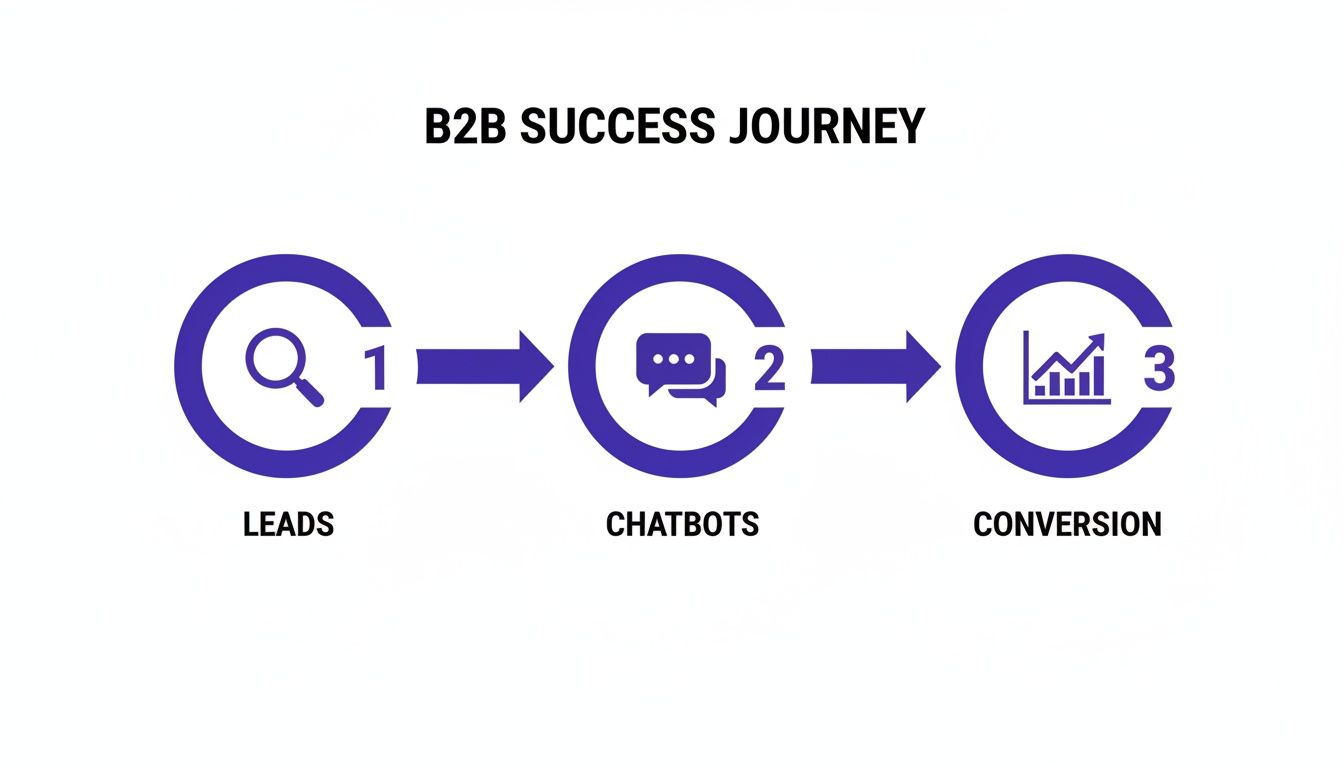
The key takeaway is that smart automation acts as a bridge, engaging potential customers the moment they show interest and moving them through your pipeline much more efficiently.
Phase 3: Integrate and Scale Your Efforts
Once your pilot project has delivered some real, measurable results, it’s time to expand. This phase is all about deeper integration and scaling up what’s already working. Connect your new AI tools with core systems like your CRM to create one unified data ecosystem. This creates a seamless flow of information that makes your AI smarter and your team’s workflow a whole lot smoother.
For instance, if your chatbot pilot was a hit, you can now integrate it with your CRM to automatically create new lead records and assign them to sales reps. If your lead scoring model worked wonders, you could expand it to trigger automated, personalized email nurture sequences for leads who aren't quite ready for a sales call. For a more complete picture, check out our detailed guide to using AI for marketing.
When you connect your AI tools to your central customer database, you create a powerful feedback loop. The AI learns from sales outcomes, and the sales team gets smarter, more accurate insights from the AI. This is where the real growth magic happens.
Phase 4: Measure and Optimize Continuously
The final phase is the one that never really ends. AI marketing isn't a "set it and forget it" deal; it’s a living system that needs constant monitoring and tweaking. You have to track the right key performance indicators (KPIs) to truly understand what’s working and where you can improve.
Focus on metrics that tie directly back to the business goals you set in Phase 1. These might include:
- Conversion Rate from MQL to SQL: Is AI helping you generate higher-quality leads that sales actually wants?
- Customer Acquisition Cost (CAC): Are you getting new customers more efficiently?
- Customer Lifetime Value (CLV): Is personalization improving retention and creating more upsell opportunities?
Review these metrics regularly and use what you learn to refine your AI models and marketing campaigns. This cycle of measuring, learning, and optimizing is what turns a good AI marketing strategy into a great one, ensuring your business sees sustainable growth.
Here's a simple, phased plan to help you get started without feeling overwhelmed.
AI Marketing Implementation Plan for Lean Teams
This checklist breaks down the journey into manageable steps, offering practical actions, tool suggestions, and clear metrics to keep you on track. It's designed specifically for startups, scale-ups, and teams led by a Fractional CMO who need to be efficient with their resources in the US and Canada.
| Phase | Key Actions | Example Tools | Success Metric |
|---|---|---|---|
| 1. Foundation | – Define 1-2 primary business goals. – Audit current data in CRM. – Identify top 3 pain points to solve. |
Google Analytics, HubSpot, Salesforce | Documented strategy with clear KPIs |
| 2. Pilot Project | – Select one high-impact use case (e.g., chatbot). – Launch a small, controlled test. – Gather initial performance data. |
Drift, Intercom, HubSpot Chatbot Builder | 10% increase in qualified leads from the pilot channel |
| 3. Integration | – Connect pilot tool to your CRM. – Automate a simple workflow (e.g., lead assignment). – Train the sales/marketing team on the new process. |
Zapier, native CRM integrations | 20% reduction in manual data entry time |
| 4. Scale & Optimize | – Expand the use case to other segments. – A/B test AI-driven messages or offers. – Set up a monthly performance review. |
Google Optimize, HubSpot Marketing Hub | Consistent month-over-month improvement in CAC or CLV |
By following a structured plan, even the smallest teams can make significant strides. The key is to start with a solid foundation and build from there, letting each small win fund the next step.
Feeling overwhelmed? You don't have to navigate this journey alone. Contact us to learn how a Fractional CMO can provide the expert guidance to build and scale your AI marketing engine effectively.
Navigating AI Governance and Ethical Marketing
Bringing AI into your marketing mix is about more than just slick technology; it’s a commitment to responsibility. As you begin weaving ai intelligence marketing into your operations, setting up clear governance and ethical guardrails isn't just a nice-to-have. For businesses in Canada and the United States, it’s absolutely essential for protecting your brand and building real, lasting customer relationships.
This isn’t about algorithms—it’s about integrity. You need to show your customers that any efficiency gains will never, ever come at the expense of their trust. For any business operating in Canada, this means building practices that honour regulations like the Personal Information Protection and Electronic Documents Act (PIPEDA), making data privacy your top priority.
The Human-in-the-Loop Philosophy
One of the most important principles in responsible AI is keeping a "human in the loop." This simply means that while AI can automate tasks and surface powerful recommendations, the final strategic decisions always stay in human hands. Think of it as a critical safeguard that ensures your brand's unique voice, values, and judgment remain in the driver's seat.
A human overseer can catch nuances an algorithm might miss, preventing off-brand messages or misguided campaign adjustments. This approach lets you benefit from AI's power without giving up the thoughtful oversight that defines great marketing. It’s about making your team smarter, not replacing their critical thinking.
A recent IBM report highlighted a crucial challenge for companies: the potential for AI to amplify existing biases. Without careful human oversight, algorithms trained on historical data can perpetuate unfair representations, damaging brand reputation and eroding customer trust. Keeping a human involved is the best defence against this risk.
Mitigating Bias and Ensuring Fairness
Algorithmic bias is a massive ethical landmine. If an AI model is trained on skewed or incomplete data, it can produce discriminatory outcomes, unfairly targeting or excluding certain customer segments. For B2B marketers in the United States and Canada, this could mean your lead scoring system quietly deprioritizes promising leads from underrepresented industries or regions.
To fight this, you need to be proactive:
- Audit Your Data: Regularly review the data feeding your AI models. Make sure it's diverse and truly represents your total addressable market.
- Test for Fairness: Actively check your AI outputs for biased patterns. Be ready to make adjustments to the underlying models when you find them.
- Establish Clear Guidelines: Create a formal internal policy for the ethical use of AI. Outline exactly what is and isn’t acceptable.
These steps aren't just about compliance; they're about building a more equitable and effective marketing engine. By tackling bias head-on, you ensure your ai intelligence marketing efforts are fair, inclusive, and ultimately, more successful.
Putting these governance structures in place sends a powerful message. It shows today's B2B buyers that you're a trustworthy partner in an increasingly complex world.
Ready to implement AI with a strategy that prioritizes both growth and governance? Contact us to learn how a Fractional CMO can help you build a responsible and powerful AI marketing framework.
Accelerate Your AI Journey with a Fractional CMO
Navigating the world of AI intelligence marketing can feel overwhelming, especially for lean teams already stretched thin. You know the potential is there, but turning that ambition into a clear, actionable plan is a monumental task when you don’t have the in-house expertise. This is where a strategic partner makes all the difference.
A Fractional CMO brings the C-level strategy and hands-on execution needed to build a smarter marketing engine—all without the hefty cost of a full-time executive. It’s a flexible model built specifically for B2B startups and scale-ups in Canada and the United States that need senior guidance to compete and win.
Bridging the Knowledge Gap
Think of us as the bridge between your business goals and the technology required to hit them. We guide you through every stage, from discovery and strategy to seamless execution and ongoing fine-tuning, ensuring you see a real return on your investment. We become an extension of your team, providing the focused expertise needed to accelerate growth.
For many businesses, the biggest question is simply, "Where do we start?" The trend is clear: Canadian businesses are increasingly prioritizing customer-facing AI. By Q3 2025, 34.8% plan to adopt virtual agents or chatbots, and 32.9% are focusing on data analytics tools. You can read more about the latest AI adoption trends in Canada. Our expert fractional CMO services help you cut through the noise and choose the right starting point for maximum impact.
If you're ready to unlock real revenue growth and build a competitive advantage with AI but aren't sure how to start, you don't have to do it alone.
Let's build a more intelligent marketing future for your business, together. Contact us for a consultation to see how we can help you achieve your goals.
Still Have Questions About AI Marketing?
As B2B leaders across Canada and the United States start looking into AI, a few practical questions almost always come up. We’ve answered the most common ones here to give you a clear picture of what AI intelligence marketing can really do for your business.
Is AI Marketing Too Expensive for a Startup?
Not at all. The secret is to start small with high-impact, affordable tools. Many of the best AI platforms offer flexible pricing, letting you dip your toes in with a specific function like an AI chatbot or a content optimization tool.
Frankly, the return you get from better efficiency and higher-quality leads often pays for the tech in no time. For instance, a simple AI lead scoring tool can boost sales productivity by 20% just by helping your team focus on the prospects most likely to close.
Do I Need a Team of Data Scientists to Use This Stuff?
Nope. Modern AI marketing platforms are built for marketers, not data scientists. They come with intuitive dashboards and straightforward reports that make sense without a PhD in statistics.
While you absolutely need a solid marketing strategy to guide the AI, you don’t need a technical background to manage the tools day-to-day. A strategic partner, like a Fractional CMO, can make sure the technology is perfectly aligned with your business goals, giving you the expertise without the hefty price tag of hiring a full-time data science team.
How Does AI Help B2B Companies with Long Sales Cycles?
AI is a game-changer for businesses with long, complex sales cycles. It’s brilliant at lead nurturing, delivering personalized content at every single stage of the buyer's journey. This keeps your brand top-of-mind, whether it takes weeks or months for a prospect to make a decision.
Predictive lead scoring is another huge win here. It helps your sales team zero in on the accounts showing the strongest buying signals, which makes them far more efficient and can even shorten the time to close. One Canadian SaaS firm we know cut its sales cycle by a whopping 22% using this exact approach.
Will AI Replace My Current Marketing Team?
Think of AI as a powerful assistant, not a replacement. It’s here to augment your team by automating the repetitive, data-heavy tasks that bog them down. This frees up your marketing pros to focus on what they do best: strategy, creative thinking, and building genuine relationships with clients.
AI gives your team superpowers, making them more effective and data-driven. It amplifies their impact, helping them drive more meaningful growth for the business.
Ready to see how AI can deliver real, measurable results for your business? The expert team at B2Better builds practical, results-driven AI marketing strategies tailored to your goals. Contact us for a consultation and let's get started.