

Pay-per-click advertising is all about getting in front of the right people, right now. Unlike organic search, which takes time to build momentum, PPC gives your business immediate visibility and traffic from buyers who are actively looking for solutions. For B2B companies in Canada and the United States, it’s a powerful way to generate qualified leads with speed and predictability. In fact, businesses on average make $2 in revenue for every $1 they spend on Google Ads, demonstrating its potential for a strong ROI.
What Are Pay Per Click Services for B2B?
Imagine setting up a booth at an exclusive trade show where your ideal buyers are already gathered, actively searching for what you sell. That’s the essence of pay-per-click (PPC) services for B2B companies. You’re not just buying random traffic; you’re creating a direct pipeline to high-intent customers at the exact moment they need you.
The model is straightforward: you only pay when an interested prospect actually clicks your ad. For B2B businesses navigating competitive North American markets, this delivers an incredible level of control and efficiency. You can target decision-makers with precision, filtering by their industry, job title, company size, and even the specific problems they’re trying to solve. For example, a US-based software company successfully increased its MQL-to-SQL conversion rate by 37% by targeting CFOs in the manufacturing sector on LinkedIn Ads.
The whole system works like a real-time auction. When a potential customer in Toronto searches for "enterprise resource planning software" or a procurement manager in Chicago looks up "industrial supply chain logistics," ad platforms like Google Ads and LinkedIn Ads run an instant auction to decide which ad wins the top spot.
The Core Components of PPC
Two key elements decide whether you win that auction: your bid and your Quality Score. Your bid is simply the maximum you’re willing to pay for a click. But your Quality Score is where the real magic happens—it’s how platforms like Google rate the relevance of your ad, keywords, and landing page.
A higher Quality Score can actually lead to a lower cost-per-click and a better ad position, even if a competitor outbids you. A highly relevant, well-crafted campaign can consistently outperform a bigger budget.
This dynamic is a game-changer in the B2B space. A thoughtful campaign targeting niche, long-tail keywords can deliver highly qualified leads far more cost-effectively than a broad, spray-and-pray approach.
The Canadian Advantage in Digital Advertising
The digital marketing landscape in North America holds a massive opportunity, especially for businesses targeting Canada. Digital ads are on track to claim 76.7% of Canada's total ad spending in 2025, with the market expected to swell to USD $43.62 billion by 2034.
Here’s the kicker for businesses running PPC campaigns: Canadian advertisers often enjoy a 29% cost-per-click (CPC) discount compared to the US average. This makes it a prime market for generating B2B leads in tech and industrial sectors without breaking the bank. You can explore more digital marketing trends in Canada to get a fuller picture.
Ultimately, pay-per-click services cut through the noise, putting your B2B solution directly in front of buyers who need it now. It’s a measurable, scalable, and immediate way to drive real growth. If you’re ready to turn targeted clicks into tangible business, contact us to discuss your PPC strategy.
What Goes Into a High-Performing PPC Campaign?
A successful PPC campaign is much more than just bidding on a few keywords. Think of it as a finely tuned engine built on four critical pillars. When these components work together seamlessly, they turn raw ad spend into a powerful, predictable revenue driver for B2B companies across Canada and the United States. Let's break down each part.
Foundational Keyword Research
Every great campaign starts with meticulous keyword research. This isn’t about chasing the most popular terms; it’s about uncovering the specific, high-intent phrases your ideal B2B buyers are typing into Google when they're actively looking for a solution. The goal is to match your service to their problem at the exact moment they need an answer.
For example, a general keyword like “CRM software” is like shouting into a crowded stadium hoping someone hears you. In contrast, a specific, long-tail keyword like “CRM software for Canadian manufacturing firms” is like having a direct, one-on-one conversation with a qualified prospect. Getting this right is the first step, which starts with finding the best keywords for PPC.
This is how PPC moves your business from simply being seen online to generating qualified leads and, ultimately, measurable results.
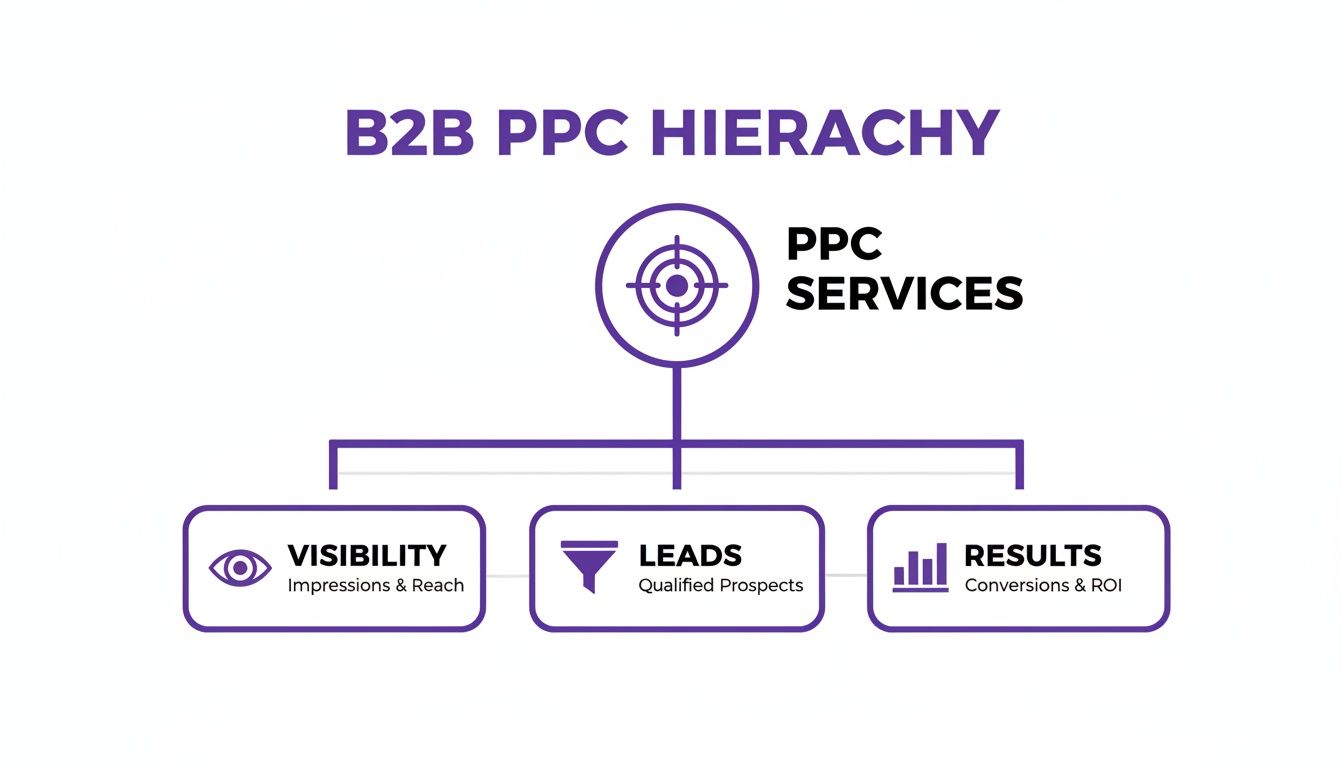
As the diagram shows, a strategic approach connects every campaign activity to the bottom-line outcomes that matter to B2B leaders.
Compelling Ad Copy and Creative
Once you have your keywords, you need ad copy that stops the scroll and earns the click. For B2B audiences, this means cutting the fluff and focusing on tangible benefits that speak directly to their pain points.
Effective ad copy needs to nail three things:
- A Headline That Grabs Attention: It must align with the search query and promise a clear solution.
- A Description That Builds Value: Briefly explain how your service solves their specific problem.
- A Strong Call to Action (CTA): Tell them exactly what to do next. Think "Request a Demo" or "Download Your Guide."
In the B2B world, ads that perform best are the ones promising efficiency gains, cost savings, or a competitive edge. A US-based logistics firm, for instance, achieved a 22% increase in click-through-rate by changing their headline to include the statistic "Reduce Shipping Costs by 30%". It’s not just about getting clicks; it’s about attracting the right clicks from qualified decision-makers. A higher click-through rate can even boost your Quality Score, leading to lower ad costs and better placements.
Strategic Landing Page Optimization
The ad is just the beginning. The landing page is where the real conversion happens. A common and costly mistake is sending high-intent traffic from a highly specific ad to a generic homepage. This creates a jarring disconnect and causes potential leads to bounce immediately.
A great landing page is a direct continuation of the ad's promise. The messaging, offer, and design should be perfectly aligned with the ad that brought the user there, creating a seamless and persuasive experience.
A high-converting B2B landing page in the US or Canada will have a single, clear objective, minimal distractions, and a form that’s simple to complete. To dive deeper into improving this part of your campaign, check out our guide on how to optimize a Google Ads campaign.
The table below breaks down these core components and how they apply specifically to the B2B landscape in North America.
Table: Key PPC Campaign Components and B2B Focus Areas
| Component | Description | B2B Application Example (Canada/US Focus) |
|---|---|---|
| Keyword Research | Identifying the search terms potential customers use. | Target "SOC 2 compliance software for Canadian fintechs" instead of just "compliance software" to attract highly qualified buyers. |
| Ad Copy & Creative | The text and visuals used in the ads themselves. | Write headlines like "Cut Accounts Payable Time by 40%" to resonate with US-based CFOs focused on efficiency. |
| Landing Page | The destination page a user reaches after clicking an ad. | Create a dedicated page for a "Free ROI Calculator for Manufacturers" that mirrors the ad's promise, rather than a generic homepage. |
| Bidding & Budget | Managing how much you pay per click and overall spend. | Use automated bidding to prioritize clicks from users in Toronto's financial district during business hours for a banking software campaign. |
Each element must be tailored to the unique B2B buyer's journey, where decisions are driven by logic, ROI, and solving complex business challenges.
Smart Bidding and Budget Management
Finally, smart bidding and budget management tie everything together. Instead of manually tweaking bids for every single keyword, modern PPC campaigns use automated strategies and machine learning to bid more effectively based on the likelihood of a conversion. This data-driven approach ensures your budget is channelled toward the keywords and campaigns that actually drive valuable business outcomes.
Ultimately, professional oversight is what transforms ad spend from a simple expense into a powerful growth engine. Ready to build a high-performing PPC campaign that delivers real results? Contact us today to get started.
Tapping into the Canadian PPC Advantage
For many North American businesses, the digital ad space—especially in the US—feels incredibly crowded and expensive. But a huge competitive edge is waiting just across the border. The Canadian market is a unique, often overlooked opportunity for companies using pay-per-click services to fuel their growth.
While the US market is completely saturated, Canada offers a less competitive and more budget-friendly environment. This isn't just a hunch; the data consistently shows that ad costs are much more favourable up north. For B2B companies looking to squeeze every drop of value from their return on ad spend (ROAS), this is an advantage you just can't afford to ignore.
A smart PPC strategy is all about putting your budget where it will have the biggest impact for the lowest cost. By deliberately targeting Canadian audiences, both American and Canadian businesses can land high-value customers far more efficiently, making their marketing dollars go a lot further.
The Cost-Effectiveness of Canadian Ad Spend
The numbers tell a compelling story. Even as demand and competition heat up in Canada, the cost to advertise is still significantly lower than in many other major markets. This creates a powerful financial incentive for businesses trying to scale up their lead generation without seeing their customer acquisition costs balloon.
Just look at the trends on the big platforms. One striking statistic from 2025 shows that even when Facebook Ads CPM for marketplaces in Canada shot up by 95% year-over-year, the average cost was still way below global benchmarks. Canadian CPMs sat at an average of $9.85, a full 51% below the global average of $20.16. This paints a clear picture of a cost-effective landscape, despite seasonal spikes in demand. You can dig into the numbers yourself by exploring these Facebook Ad cost trends in Canada.
What does this cost difference really mean? For every dollar you spend on PPC in Canada, you have the potential to reach a larger, highly relevant audience than you would for the same investment in the US. It’s a classic case of getting more bang for your buck.
This economic edge gives businesses the breathing room to test campaigns, gather data, and fine-tune their approach with less financial risk. It's the space you need to build a truly robust and profitable PPC engine.
Navigating Regional Nuances for Maximum ROAS
Lower costs are a major draw, but success in the Canadian market isn't a given. Canada is a diverse nation with distinct regional economies, cultural subtleties, and specific B2B buyer behaviours. A generic, one-size-fits-all approach is doomed to fail. To really cash in on this opportunity, you need a strategy that gets these local details right.
Running effective campaigns means doing more than just changing the currency and location settings. It involves:
- Localized Ad Copy: Writing messages that connect with specific regional industries, whether it's the tech hubs in Ontario or the energy sector in Alberta.
- Understanding Buyer Behaviour: Realizing that decision-making processes and timelines can be very different for a startup in Vancouver versus an established enterprise in Montreal.
- Platform Selection: Knowing which platforms—like Google Ads versus LinkedIn—are the most effective for reaching certain B2B professionals in different Canadian provinces.
This is where partnering with an expert in pay-per-click services who has deep-seated knowledge of the Canadian market becomes essential. A skilled partner can navigate these complexities, ensuring your campaigns are not just cost-effective but also incredibly relevant and impactful. They turn the Canadian advantage from a simple cost-saving tactic into a strategic engine for North American growth.
By combining the natural cost benefits with a nuanced, localized strategy, businesses can unlock exceptional ROAS and build a powerful foothold in this valuable market.
Ready to leverage the Canadian PPC advantage for your business? Contact us today to explore how our expertise can maximize your return on ad spend across North America.
Measuring PPC Performance with Revenue-Focused Metrics
Clicks and impressions are interesting, but they don’t pay the bills. For B2B leaders in Canada and the United States, the real test of pay per click services is their power to generate tangible revenue. It’s time to shift the conversation from vanity metrics to the KPIs that actually fund your growth.
Too many campaigns get stuck chasing a high Click-Through Rate (CTR) or a rock-bottom Cost Per Click (CPC). While those metrics have a place, they don’t tell the whole story. After all, a cheap click that never turns into a sales conversation is just a wasted expense.
The goal is simple: connect every dollar of ad spend directly to bottom-line results. This requires a disciplined approach to measurement, focusing on KPIs that speak the language of business, not just ad platform dashboards.
From Vanity Metrics to Revenue KPIs
To truly hold your PPC campaigns accountable for growth, you have to track metrics that reflect real business impact. While the ad platforms serve up dozens of data points, only a few really matter for B2B success.
This table contrasts the surface-level metrics that often distract teams with the business-focused KPIs that should guide your strategy.
| Vanity Metric (Avoid Focusing On) | Business KPI (Focus On) | Why It Matters for B2B Growth |
|---|---|---|
| Clicks, Impressions | Cost Per Acquisition (CPA) | Moves beyond traffic volume to tell you exactly how much you’re spending to land a new, paying customer. |
| Click-Through Rate (CTR) | Return on Ad Spend (ROAS) | The ultimate measure of profitability. It answers the question: "For every dollar we spend, how many dollars do we get back?" |
| Cost Per Click (CPC) | Customer Lifetime Value (CLV) | Recognises that a B2B sale is a long-term relationship. A higher CPA is justifiable if it lands a high-value, loyal client. |
Focusing on CPA, ROAS, and CLV moves the conversation from "How many clicks did we get?" to "How much revenue did our investment generate?" This is the only way to make smart, data-driven decisions about where your marketing budget goes.
Success isn't about driving cheap traffic; it's about acquiring profitable customers. For a B2B company, one high-quality lead from a C-suite decision-maker is worth more than a thousand low-cost clicks from the wrong audience.
Let's quickly break down why these three KPIs are non-negotiable for measuring the true performance of your PPC services.
-
Cost Per Acquisition (CPA): This is your total cost to win one new customer through a campaign. It’s a crystal-clear measure of efficiency, showing exactly how much investment it takes to close a deal.
-
Return on Ad Spend (ROAS): ROAS measures the gross revenue generated for every single dollar you put into advertising. A 3:1 ROAS means you’re generating $3 in revenue for every $1 spent. It’s the ultimate report card for campaign profitability.
-
Customer Lifetime Value (CLV): For most B2B businesses, especially in SaaS, the first sale is just the beginning. CLV estimates the total revenue you can expect from a single customer over the entire relationship, which helps justify a higher initial CPA to land the right kind of client.
Understanding these KPIs is fundamental to scaling your campaigns without burning cash. You can get started by figuring out your baseline profitability with tools like a break-even ROAS calculator to set clear, achievable targets for your campaigns.
A Canadian SaaS Success Story
The power of this revenue-first approach is easiest to see in action. Take a Toronto-based SaaS company that was burning through its ad budget. They were generating a high volume of leads, but their sales team was bogged down with calls to unqualified prospects.
Their previous agency was optimizing for a low Cost Per Lead (CPL), which only encouraged poor-quality inquiries. By shifting their entire strategy, they started optimizing for a much more specific goal: "demo requests" from companies with over 50 employees.
The results were dramatic. While their CPL went up slightly, the quality of leads shot through the roof. Within just six months, they had tripled their sales pipeline value and closed more enterprise-level deals than they had in the entire previous year.
This story proves it: focusing on revenue-centric goals—not just chasing cheap vanity metrics—is the key to unlocking scalable growth with pay per click services. To see how we can replicate this success for your business, contact us for a consultation.
How to Choose the Right PPC Services Partner

Picking a partner for your pay per click services is one of the biggest marketing decisions your B2B company will make. Get it right, and your agency becomes a growth engine, turning ad spend into predictable revenue. Get it wrong, and you can burn through your budget with nothing to show for it but vanity metrics.
For B2B companies in the United States and Canada, the stakes are even higher. Your partner needs to get the nuances of long sales cycles, niche industrial markets, and how to reach sophisticated decision-makers. Generic consumer-focused strategies just won’t cut it.
This isn’t about hiring a vendor to push buttons on an ad platform. It’s about finding a strategic ally who will dive deep into your business model, align with your sales team, and obsess over the same revenue-focused KPIs that keep you up at night.
Look for Proven B2B and Industry Experience
Your very first filter should be a proven track record in the B2B world. A team that excels at running e-commerce ads for fashion brands is unlikely to have the specific skills needed to generate qualified leads for a SaaS platform or a specialized manufacturing firm.
Ask potential partners for case studies from companies that look like yours. A fantastic success story to listen for is how they helped a US-based B2B tech firm slash its Customer Acquisition Cost (CPA) by 40% while simultaneously improving lead quality by 60%. That kind of result shows a deep grasp of B2B economics.
A top-tier B2B PPC partner doesn't just manage keywords; they manage a business growth strategy. They understand that a lead for a $100,000 enterprise software deal requires a completely different approach than a lead for a $50 consumer product.
You need a pay per click advertising agency that speaks your language and has real wins in your vertical. In the complex North American market, this kind of specialized experience is non-negotiable.
Prioritize a Revenue-Focused Mindset
As you vet agencies, listen carefully to the language they use. Do they get excited talking about clicks and impressions? Or do they steer the conversation toward Cost Per Acquisition (CPA), pipeline value, and Return on Ad Spend (ROAS)?
A true growth partner is obsessed with your bottom line. They should be asking sharp questions about your sales process, customer lifetime value (CLV), and your ultimate revenue goals. Their reporting should draw a straight, clear line from ad spend to closed deals.
This is especially critical in a market like Canada, where digital channels are king. Total ad spend in Canada hit 22.09 billion CAD in 2024, with a whopping 76.7% of all ad dollars flowing into digital advertising, including PPC. With that much money on the line, a revenue-focused partner is your best insurance against wasted budget. You can find more insights on the Canadian advertising market on Statista.
Essential Questions to Ask Potential Partners
To separate the real experts from the pretenders, you need to come prepared with the right questions. Use this checklist to guide your conversations and pinpoint a partner who can genuinely move the needle for your business.
- Strategy and Onboarding: "How will you build a PPC strategy that aligns with our specific business goals and target audience in the US and Canada?"
- B2B Experience: "Can you share specific examples of how you've navigated long B2B sales cycles to attribute revenue back to your PPC campaigns?"
- Reporting and KPIs: "What exact metrics will be on our weekly or monthly reports, and how will you connect them directly to our sales pipeline?"
- Technology and Tools: "What tools do you use for campaign management, reporting, and snooping on our competitors?"
- Team and Communication: "Who will be our day-to-day contact, and what's their level of experience running B2B PPC campaigns?"
Finding the right fit is all about ensuring deep alignment on strategy, communication, and—most importantly—results. Choosing a partner who understands the unique demands of the North American B2B landscape is the first step toward building a powerful and profitable advertising program. Ready to find that partner? Contact us today.
Integrating PPC with Strategy for Maximum Impact
Even the most technically brilliant pay per click services can misfire without a clear strategic vision behind them. When PPC campaigns are left to run in a silo, they often end up chasing vanity metrics instead of contributing to real business growth. True success comes when every click, every bid, and every ad is perfectly aligned with your company’s bigger picture.
Think of a PPC campaign like a high-performance race car. The ad platform is the engine and the keywords are the fuel. But without a skilled driver who knows the track—your overall business strategy—that car is just going to spin its wheels. This is exactly why plugging your PPC efforts into senior-level strategic oversight is so critical.
The Role of a Fractional CMO in PPC Success
This is where a Fractional Chief Marketing Officer (CMO) becomes a complete game-changer, especially for B2B companies in Canada and the United States. A Fractional CMO provides the high-level strategic direction that connects your PPC activities directly to your most important business goals, whether that’s breaking into a new market or driving more enterprise-level sales.
Instead of just focusing on getting a lower Cost Per Click, a Fractional CMO makes sure your campaigns are built to:
- Target the Right Audience: Aligning ad targeting with your ideal customer profiles and buyer personas, not just broad demographics.
- Support Sales Objectives: Designing campaigns that generate sales-qualified leads, not just cheap clicks that go nowhere.
- Reinforce Brand Positioning: Ensuring ad copy and creative are consistent with your brand’s unique voice and value proposition.
This integrated approach stops you from wasting ad spend and transforms PPC from an isolated tactic into a predictable, scalable growth engine.
A Story of Strategic Alignment and Explosive Growth
Take the case of a US-based B2B software firm that was struggling to get any real traction. Their PPC campaigns were bringing in plenty of traffic, but the leads were consistently low-quality. The sales team was getting frustrated, and the marketing budget was delivering a dismal return.
By bringing in strategic oversight, they completely reframed their approach. The focus shifted away from generic keywords toward highly specific, long-tail phrases that signalled strong purchase intent. Their ad copy was rewritten to speak directly to the C-suite, and the landing pages were optimized for demo requests instead of just content downloads.
The results were stunning. Within a single quarter, their lead quality score shot up by 70%, and their Cost Per Acquisition (CPA) for a qualified opportunity dropped by 40%. This wasn't just the result of better ad management; it was the direct outcome of aligning PPC execution with a clear, top-down business strategy. To make sure your own efforts are just as cohesive, implementing robust 10 Pay Per Click Strategies is essential for this kind of strategic execution.
Ultimately, integrating pay per click services with a comprehensive marketing strategy ensures that every dollar you invest is building a direct and powerful path from awareness to acquisition.
If you’re ready to stop guessing and start building a PPC program that delivers sustainable growth for your business, it’s time for a conversation. Contact us to learn how our integrated approach can work for you.
Got Questions About PPC Services? We've Got Answers.
When B2B leaders start exploring pay-per-click services, a lot of practical questions pop up. We hear them all the time from businesses across Canada and the US. Here are the answers to the most common ones to give you a bit more clarity.
How Much Should a B2B Company Actually Budget for PPC?
There’s no magic number here—it really depends on how competitive your industry is and what your revenue goals are. But for most B2B companies in North America, a sensible starting point for ad spend is usually between $5,000 to $15,000 per month, plus management fees.
That range gives you enough data to properly test campaigns and start optimizing. The real goal isn’t to find the lowest possible cost; it’s to hit a strong Return on Ad Spend (ROAS) that makes the investment a no-brainer.
How Long Until We Actually See Results from a New PPC Campaign?
You’ll get immediate traffic the second your ads go live, but meaningful business results—think qualified leads and sales—typically start to take shape within 60 to 90 days. The first month is all about gathering data and making quick adjustments.
By month three, you should have a clear picture of how the campaigns are performing, the quality of leads coming in, and your initial ROAS. For example, we saw a B2B tech firm based in the United States slash its cost-per-acquisition (CPA) by 40% in its second quarter just by using those first 90 days to aggressively test ad copy and zero in on the right audience.
Can PPC Work if Our Company Has a Super Niche Audience?
Absolutely. In fact, PPC is one of the best channels out there for reaching highly specific B2B audiences. The targeting capabilities on platforms like Google Ads and LinkedIn are practically built for specialized markets.
You can target people based on their exact job title, company size, industry, and what they’re actively searching for. It ensures your budget is only spent on reaching the decision-makers who matter, making it incredibly efficient.
For instance, a Canadian company selling compliance software to the mining industry used LinkedIn Ads to target "Health and Safety Managers" in Alberta. They generated high-quality leads that other, broader channels just couldn't touch. That level of precision is where PPC really shines.
What's the Real Difference Between PPC and SEO?
Think of it as renting versus owning a storefront.
PPC (Pay-Per-Click) is like renting a prime spot in a busy mall. You pay for ad placements to get immediate visibility right at the top of the search results. The moment you stop paying, that visibility vanishes.
SEO (Search Engine Optimization), on the other hand, is like building and owning your own flagship store. You optimize your website to earn high rankings organically over time. It’s a slow build, but the asset is yours.
PPC delivers fast, controllable results, while SEO builds long-term, sustainable authority online. The most powerful B2B marketing strategies don’t choose one or the other—they integrate both.
Ready to turn clicks into customers with a PPC strategy built for B2B growth? B2Better combines expert execution with senior-level strategic oversight to deliver measurable results. Contact us today to build your predictable revenue engine.