

When people talk about B2B digital marketing, they’re really talking about using online channels to sell products or services to other companies. But that definition doesn't quite capture the heart of it. Unlike B2C, where a quick sale is often the goal, B2B is all about building long-term relationships, patiently educating prospects with valuable content, and guiding them through a complex buying process that involves a whole committee of decision-makers.
Success here isn't about flashy ads; it hinges on establishing trust and proving your expertise, time and time again.
The Evolving Landscape of B2B Digital Marketing

The old playbook of broad, generic campaigns is being tossed out. The future of B2B digital marketing is all about focused, value-led conversations. By 2026, the most successful companies in Canada and the United States won't be the ones shouting the loudest. They'll be the ones that consistently demonstrate their expertise and build unshakeable trust with their target accounts.
Think of it this way: B2C marketing is often like a billboard on a busy highway, designed to grab the attention of thousands for a quick, emotional decision. B2B marketing is much more like a series of strategic meetings with a company’s board of directors, where each conversation carefully builds on the last.
This difference is only getting starker. The B2B buyer journey now involves an average of six to ten people in a single purchase decision. This committee-based reality means your marketing has to land with everyone from the technical engineer scrutinizing specs to the C-suite executive focused on ROI.
Building Trust Through Expertise
To win in this environment, your digital strategy can't be a collection of siloed tactics; it needs to be an integrated symphony of channels working together. A strong online presence is absolutely non-negotiable. Modern B2B buyers complete nearly 70% of their research online before ever speaking to a sales rep. This self-serve research phase is your single greatest opportunity to shine.
So, what does this shift mean for your strategy leading up to 2026?
- Value-Driven Content is King: Your content must solve real problems, not just pitch products. Think in-depth whitepapers, detailed case studies, and insightful webinars that educate and nurture leads.
- Personalization is Paramount: Generic, one-size-fits-all messaging is dead. Your campaigns must speak directly to the specific pain points and ambitions of your ideal customer profiles and key accounts.
- Integrated Channels are Essential: SEO, content marketing, targeted paid ads, and Account-Based Marketing (ABM) must work in concert to create a smooth, compelling buyer experience.
We saw this firsthand with a Canadian SaaS company that grew its qualified leads by over 200% in just one year. They didn't do it with aggressive ads. They did it by building a comprehensive resource hub filled with educational content tailored to their niche, cementing themselves as the go-to experts in their field.
This forward-looking approach positions your digital marketing not just as a way to get leads, but as the core engine for sustainable business growth. As we explore the latest B2B marketing trends, remember that the ultimate goal is to build relationships that last.
Forecasting Your 2026 Marketing Budget
When it comes to planning your marketing budget for 2026, guesswork just won't cut it. To compete in the high-stakes B2B markets across Canada and the US, you need a plan grounded in financial reality. It’s less about simply spending more and more about strategically fuelling the channels and technologies that actually drive growth. Think of your budget as the engine for your marketing—how much you invest, and where, will dictate how far and how fast you go.
Leading B2B firms are already showing their hand. The numbers reveal a major shift toward content marketing and AI-powered tools, and the logic is clear. It’s all about achieving personalization at scale, cranking up the speed of content production, and—most importantly—proving a real, tangible return on every dollar spent.
Benchmarking Your Investment
A competitive marketing budget isn't a rounding error on your P&L anymore; it’s a core investment in growth. As 2026 approaches, companies that skimp on their marketing spend will find it nearly impossible to gain any real traction. The costs of customer acquisition, content creation, and technology are all climbing, which means you need a more aggressive financial game plan.
We're seeing this play out in competitive tech hubs like California, where firms are pouring money into their digital presence. A 2025 industry report focused on California-based B2B companies found the average annual content budget hit roughly $1.2 million. The data showed 20% of these businesses spent between $250,000–$499,000, while a massive 89% planned to increase their content output. This surge is tied directly to new tech, with 78% of these companies using AI tools for content creation, which drove a 3–5x increase in production for almost half of them. You can discover more insights about California B2B marketing budgets on rsunbeatsoftware.com.
This data sets a clear benchmark for businesses in Canada and the US. If you aren't planning a budget that allows for serious content creation and technology adoption, you’re setting yourself up to be left behind.
Allocating Funds for Maximum Impact
Knowing how much to spend is only half the battle; knowing where to spend it is the other half. For 2026, a winning B2B digital marketing budget will funnel funds into a few key areas:
- Content Creation and Distribution: This is still the biggest and most critical line item. It covers everything from deep-dive whitepapers and case studies to high-quality video production and webinars.
- Marketing Technology (MarTech): Your tech stack is your command centre. This includes your CRM, marketing automation platform, SEO tools, and analytics software. AI-powered tools for content and personalization are quickly becoming non-negotiable.
- Paid Media: Organic reach is great, but paid channels like LinkedIn and Google Ads give you the surgical precision needed to target key accounts and decision-makers. A healthy budget here is a must for successful Account-Based Marketing (ABM).
- People and Expertise: Whether you build an in-house team or partner with outside experts, you need skilled talent to bring your strategy to life.
A mid-sized Canadian tech firm recently rebalanced its budget to go all-in on content and ABM. By dedicating 40% of their spend to creating pillar content for their niche and another 20% to hyper-targeted LinkedIn campaigns, they boosted their Marketing Qualified Leads (MQLs) from key accounts by 150% in just nine months.
This kind of strategic allocation ensures every dollar is tied to a specific business goal, from building brand authority to generating high-quality leads. It's about making smart investments that deliver returns long after the initial spend.
The Rise of Fractional Leadership
One of the biggest trends shaping B2B budgeting is the shift toward more agile and efficient talent. Many Canadian startups and scale-ups simply don't have the budget for a full-time, C-level marketing executive, but they desperately need that senior strategic guidance to grow.
This is where the Fractional CMO model changes the game. By partnering with a fractional leader, companies get C-suite expertise and battle-tested experience for a fraction of what a full-time hire would cost. This model allows you to build a rock-solid strategy and oversee execution without the hefty overhead, squeezing maximum impact out of every marketing dollar. It also helps you accurately calculate and optimize crucial metrics—if you need a hand with that, check out our guide on how to calculate customer acquisition cost.
As you map out your 2026 budget, think about how a fractional partner could help you hit ambitious goals more efficiently.
Ready to build a 2026 marketing budget that drives measurable growth? Contact us today to learn how our Fractional CMO services can provide the strategic leadership you need to succeed.
Driving High-Value Leads with Content and SEO
When it comes to B2B digital marketing, content and SEO are the twin pillars of sustainable growth. By 2026, the firms that pull ahead will treat these channels not as two separate tasks, but as a single engine that works around the clock. This engine’s job is to attract high-intent buyers early in their journey, building trust long before they’re ready for a sales call.
Think of your website as your best salesperson—one that never sleeps. To set it up for success, you need to arm it with exceptional content that answers your prospects' most urgent questions. SEO is what ensures those valuable insights actually get found by decision-makers across Canada and the United States right when they need them.
Today’s B2B buyer is a self-sufficient researcher. They do the lion's share of their homework online, comparing solutions and vetting vendors long before they ever pick up the phone. This self-guided journey makes a strong organic presence non-negotiable for building credibility and authority in your industry.
Building Authority with Strategic Content
Looking toward 2026, the smartest B2B content strategies will be built on topic clusters. Instead of chasing a random list of keywords, this approach means creating a central "pillar" page on a core business problem. This is then supported by a web of "cluster" articles that dive deep into related subtopics, signalling true expertise to both search engines and potential customers.
The very nature of search is evolving, too. With the rise of AI assistants, more people are using conversational, question-based searches. Your content needs to be ready to answer these natural language questions directly and with authority.
Here’s how to adapt your content game plan:
- Focus on Problems, Not Products: Craft content that speaks directly to the challenges your ideal customers are wrestling with. Instead of an article about your software’s features, write a definitive guide on solving the business problem your software was built for.
- Use Video to Simplify Complexity: Let's face it, some B2B solutions are tough to explain with text alone. Use short, engaging videos to show your product in action, break down technical concepts, and let your customers tell their own success stories.
- Prioritize In-Depth Resources: B2B buyers are looking for substance, not fluff. Invest your resources in creating comprehensive whitepapers, detailed case studies, and original research that provides genuine value and cements your position as a thought leader.
This chart shows just how seriously B2B companies are investing in content and AI to fuel their marketing machines.
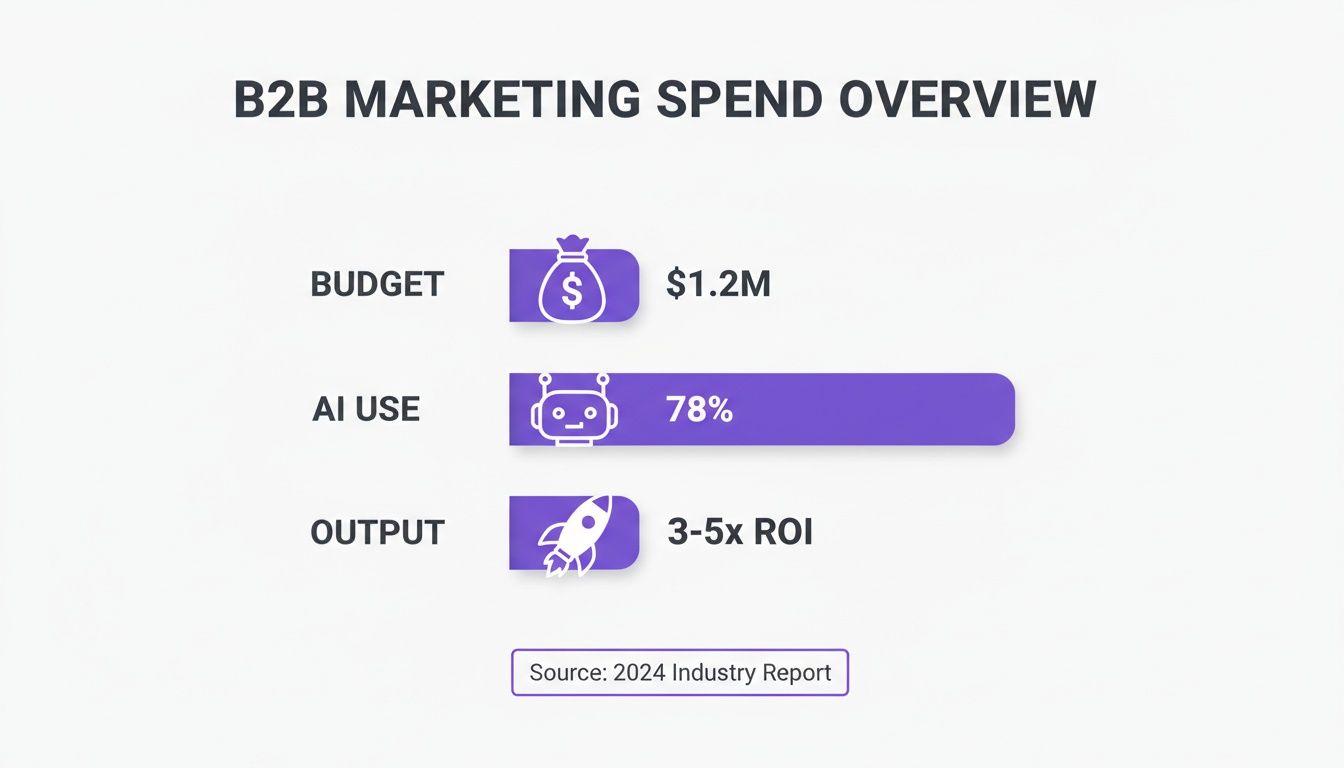
You can see a clear line connecting budget increases and AI adoption with a huge jump in content output—a sure sign that these are the keys to future growth.
The Unbeatable ROI of Organic Search
The business case for SEO and content is rock-solid. While outbound tactics like cold calling still have a pulse, the leads they bring in are often less qualified and more expensive to land. Organic search, on the other hand, pulls in prospects who are actively looking for a solution like yours. That means much warmer, more productive conversations for your sales team.
The numbers don't lie. Content and SEO are consistently the highest-leverage channels for firms across North America. Recent industry analysis found that 74% of B2B marketers saw more leads from their content efforts, while 84% said it helped build brand awareness.
Even better, SEO-driven leads have a dramatically higher close rate—hovering around 15%—compared to old-school outbound tactics, which struggle to break 2%. This makes organic search an absolute must-have for any B2B company, especially those with longer sales cycles.
To truly capitalize on this, mastering AI Search Engine Optimization is critical for staying ahead in an AI-driven search world. For a deeper dive on getting the fundamentals right, check out our guide on how to improve SEO for your B2B website.
Take a real-world example: a US-based industrial manufacturer was struggling to get in front of engineers online. They rolled out a series of highly technical blog posts and downloadable CAD files, all optimized for long-tail keywords. The result? They boosted their organic traffic from qualified prospects by 300% in 18 months and saw a 40% jump in quote requests coming straight from their website.
This story highlights a simple truth: when you invest in genuinely helping your audience, they reward you with their business.
Mastering Paid Channels and Account-Based Marketing
If content and SEO are about building a long-term, foundational pipeline, then paid channels are the tip of the spear. For B2B digital marketing in 2026, this isn't about casting a wide net with generic ads. It's about surgically targeting the exact decision-makers at your dream accounts and warming them up long before a sales call ever happens.
This is where paid advertising and Account-Based Marketing (ABM) come together with incredible force.
Forget basic pay-per-click (PPC). The real power for B2B marketers in Canada and the US is on platforms like LinkedIn, where you can target prospects by their job title, company size, industry, and even specific skills. This level of granularity is the fuel for a successful ABM strategy, which flips the traditional marketing funnel completely on its head.
The Power of Account-Based Marketing
Instead of marketing to a broad audience and just hoping the right people convert, ABM starts by identifying a list of high-value target companies first. From there, marketing and sales teams work in lockstep to create personalized campaigns designed to engage key stakeholders within those specific accounts.
Paid channels are the perfect delivery vehicle for this personalized content, ensuring your message lands directly in front of the right executives at the right time.
Imagine your sales team wants to land a major enterprise client. With an ABM approach, you could run a LinkedIn ad campaign showing a custom case study video specifically to VPs and Directors at that single company. It’s a powerful way to build awareness and credibility with the entire buying committee at once.
This coordinated effort means that when your sales team finally reaches out, they're not making a cold call. They’re following up on a series of helpful, relevant touchpoints that have already established your brand as a credible solution.
Understanding Paid Acquisition Costs
Of course, this kind of precision comes at a cost. It’s critical to have a realistic picture of paid acquisition benchmarks in North America to plan your budget effectively. Search and demand-generation channels are central to B2B customer acquisition, but the numbers reveal both opportunity and expense.
Industry benchmarks for 2025 show typical B2B website conversion rates between 2% and 5%. The average B2B cost per lead (CPL) hovers around $200, though high-intent demo requests can easily cost $600–$800. Google Search Ads convert at roughly 3.04% with an average cost-per-click (CPC) near $2.69. Meanwhile, LinkedIn—a core B2B channel—has substantially higher CPCs, often hitting $5–$6.
For a deeper dive into these numbers, you can explore more B2B digital marketing benchmarks on martal.ca. To get ideas for your own campaigns, resources like 100 B2B LinkedIn Ads to Generate More Leads are a great place to start.
A Success Story in Action
The incredible results of a coordinated, data-driven approach are best seen through an example. A US-based B2B technology company was determined to land a Fortune 500 manufacturing firm that had been unresponsive to traditional sales outreach for years.
They launched a multi-channel ABM campaign with three core elements:
- Personalized Content: They created a whitepaper detailing how their software solved a specific challenge unique to the manufacturing giant's industry.
- Targeted LinkedIn Ads: They ran ads promoting the whitepaper exclusively to senior engineers and operations managers at the target company.
- Coordinated Sales Outreach: As individuals engaged with the ads, the sales team followed up with personalized emails referencing the content they had just seen.
Within just three months, this highly focused campaign generated three meetings with key decision-makers. Six months later, the tech company closed a multi-year, seven-figure deal—a monumental success that started with a smart, targeted paid strategy.
Building Your 2026 B2B Digital Marketing Roadmap

This is where the rubber meets the road. Moving from a grand strategy to day-to-day execution is the moment many B2B marketing plans fall flat. To win in 2026, you need more than just good ideas; you need a practical, phased roadmap that guides every move.
Crucially, this plan must be tailored to your company's growth stage. The challenges facing a scrappy startup are worlds away from those of a scaling enterprise.
For companies navigating the competitive Canadian and US markets, a one-size-fits-all template is a recipe for wasted budget. The secret is focusing on the right activities at the right time, building a rock-solid foundation before you start chasing more advanced, flashy tactics.
Let's break down what that looks like for both startups and scale-ups.
The Startup Roadmap: Building Your Foundation
If you're an early-stage company, your primary goal is simple: establish a presence and build a repeatable system for generating leads. Forget about sophisticated automation for now. Your focus for 2026 should be on getting the fundamentals dialed in.
Think of it as building the engine before you try to win the race.
This first phase is all about clarity and creation. Your top priority is to genuinely understand who you're selling to.
- Define Your Ideal Customer Profile (ICP): Go way beyond basic demographics. Document their specific pain points, what triggers their search for a solution, and the exact language they use to describe their problems.
- Create Cornerstone Content: Develop a few high-value, in-depth content assets. This could be a comprehensive guide or an original research report that directly solves your ICP's biggest problem. This becomes the sun in your content solar system.
- Set Up Foundational Analytics: Install and properly configure tools like Google Analytics 4, making sure conversion tracking is working. You can't improve what you don't measure, and this baseline is critical for making smart decisions down the road.
A classic startup mistake is trying to be everywhere at once. A much better approach is to dominate one or two channels where your ICP actually spends their time. One Canadian tech startup we know focused solely on creating highly technical blog content and grew their organic demo requests by 75% in their first year.
The Scale-Up Roadmap: Accelerating Growth
Once you have a solid foundation and some market traction, the game changes completely. For scale-ups, the 2026 roadmap is all about optimization, expansion, and tying every single marketing activity directly to revenue.
You've got a fire started; now it's time to pour on the gasoline with more advanced systems and strategies. This is where you layer in technology and precision targeting to build a true revenue-generating machine.
Your focus shifts from foundational work to sophisticated, scalable execution. Your priorities should now include:
- Implement Marketing Automation: It’s time to choose and roll out a platform like HubSpot or Marketo. This lets you nurture leads at scale with personalized emails, score leads based on engagement, and seamlessly hand off sales-ready prospects.
- Launch Sophisticated ABM Campaigns: Move beyond basic ad targeting. Use your ICP data to build a specific list of high-value target accounts. Then, run coordinated, multi-channel campaigns with personalized messaging for key decision-makers within those companies.
- Build an Attribution Model: Work with sales and finance to develop a multi-touch attribution model. This helps you finally understand which marketing channels and campaigns are truly influencing deals, allowing you to double down on what works and justify your budget with hard data. With about 42% of B2B buyers using mobile devices during their research, your model must capture touchpoints across every device.
These are the advanced tactics that separate good marketing teams from great ones. They transform marketing from a cost centre into a predictable driver of business growth. A US-based SaaS company we worked with implemented this exact roadmap, using marketing automation and ABM to shorten their sales cycle by 30% and increase their average deal size by 45%.
Whether you're laying the foundation or preparing to scale, having an expert guide can make all the difference. Building and executing a roadmap for 2026 requires both strategic vision and deep tactical expertise.
Ready to build a future-proof marketing plan that drives real results? Contact us today to learn how our Fractional CMO services can provide the leadership and execution you need to accelerate your growth.
Common Questions About B2B Digital Marketing
Even with a perfect plan on paper, the real world of B2B digital marketing always throws a few curveballs. The long sales cycles and decision-making by committee often leave even seasoned pros wondering if they’re on the right track. Here, we tackle some of the most common questions we hear from B2B leaders in Canada and the US, offering straight-up answers to help you move forward with confidence.
Think of this as a quick-reference guide to reinforce the core strategies we've covered, getting you ready to navigate the road to 2026.
How Do You Measure ROI with Long B2B Sales Cycles?
Trying to measure B2B marketing ROI with last-click attribution is like giving all the credit to the person who scores the goal, ignoring the assists and the setup plays. It just doesn’t work. A deal that closes in December might have started with a blog post someone read back in March.
The key is to shift your focus to leading indicators—the milestones that prove you’re making progress long before a contract gets signed.
- Marketing Qualified Leads (MQLs): Are you generating more high-quality leads from your campaigns this quarter than last?
- Pipeline Velocity: How quickly are those leads moving through the funnel? If they’re getting to the demo stage faster, your content is doing its job.
- Target Account Engagement: Are the right people from your dream accounts showing up? Track how many decision-makers are downloading your whitepapers or attending your webinars.
Your CRM should be your single source of truth, connecting every marketing touchpoint to the final sale. It’s not about proving who closed the lead; it’s about showing how marketing built the relationship from the very first handshake.
What Role Does Social Media Play in B2B Marketing?
In B2B, social media is your digital boardroom, not your megaphone. Forget viral dances and fleeting trends. Here, platforms like LinkedIn are serious tools for building authority, nurturing professional relationships, and enabling social selling.
This is where you strategically share your best content—think insightful case studies and industry analysis—directly with the people inside your target accounts. In fact, a 2023 survey found that 75% of B2B buyers use social media to research and vet potential vendors.
Social media is where you warm up leads and stay top-of-mind during those long consideration phases. It’s also where executive branding shines. When your company's leaders consistently share their expertise on LinkedIn, they build incredible credibility not just for themselves, but for your entire organization.
How Long Does It Take for B2B SEO to Show Results?
Let’s be clear: B2B SEO is a long game. It’s an investment in building a sustainable, cost-effective lead engine, not a shortcut to hit next quarter’s target. You might see some early glimmers of hope within three to four months—like ranking for a few specific, long-tail keywords—but the real, meaningful results typically take 6 to 12 months to materialize.
The timeline depends on how competitive your industry is, your website's existing authority, and how consistently you publish valuable content. But the payoff is huge. Paid ads stop working the second you turn off the budget. A solid SEO strategy will keep delivering high-intent, organic leads for years to come.
We saw this with a US-based industrial automation client. After 18 months of disciplined investment in technical SEO and content, their organic traffic was generating 40% more qualified leads than their entire paid media spend, and at a fraction of the cost per lead. Patience pays off.
What Is the Single Most Common Mistake in B2B Marketing?
Hands down, the biggest mistake we see is creating content that is completely obsessed with your own products and features instead of your customer's problems. Early in their journey, your prospects couldn’t care less about your new dashboard or proprietary algorithm. They care about solving a painful, expensive business challenge.
B2B buyers are smart. They’re research-obsessed. They want to be educated and empowered, not cornered into a sales pitch. Your content has to lead with value, full stop.
To stay on the right side of this, run every piece of content through a simple filter: "Does this help my ideal customer solve a real problem, or does it just talk about us?" When you become their go-to resource, you earn the right to pitch your solution as the logical next step—but only when they're actually ready to listen.
Navigating the future of digital marketing in B2B requires a clear strategy, consistent execution, and the right expertise to guide you. At B2Better, we act as your strategic partner, providing the C-level leadership needed to build and execute a roadmap for measurable growth.
Ready to build your 2026 marketing engine? Contact us today to learn how our Fractional CMO services can help you achieve your goals.