

A marketing agency built for startups is your high-speed, data-obsessed growth partner. Unlike traditional agencies, they're laser-focused on the stuff that actually matters for a new venture: rapid growth, budget efficiency, and hitting measurable results like customer acquisition and revenue. These are the metrics that secure that next crucial funding round, especially in competitive markets like the United States and Canada.
Why Most Marketing Agencies Fail Startups
Startups aren't just small versions of big companies. They live in a totally different world—one defined by breakneck speed, constant pivots, and the desperate need to find product-market fit before the cash runs out. This is exactly where generic, one-size-fits-all marketing agencies stumble, burning through founder capital and killing momentum across Canada and the US. The problem is a fundamental mismatch in their DNA.

Think of it this way: a startup is a speedboat, and a traditional agency is an ocean liner. The startup needs to turn on a dime based on new user feedback or a sudden market shift. The big agency? It’s built for slow, steady journeys with predictable routes. This clash in operating styles creates gaps that almost always lead to failure.
The Mindset and Pace Disconnect
Many agencies are comfortable with 90-day planning cycles, exhaustive brand studies, and sprawling campaigns that might show results in a year. Startups, on the other hand, live and die by weekly or monthly sprints. They need a partner who gets the "test, measure, iterate" loop and can deliver results that keep demanding VCs in the United States and Canada happy. A recent report found that 67% of startups fail due to premature scaling or poor market fit—a risk that the wrong agency accelerates.
A prime example of a partnership that worked is how the tech startup Expandi scaled to $8M in Annual Recurring Revenue. They teamed up with an agency that zeroed in on high-intent SEO to drive actual signups, not just vanity traffic.
The reality is that for a startup, every single marketing dollar has to be accountable. An agency that talks about "brand awareness" without a clear path to revenue is a luxury that early-stage companies simply cannot afford.
Misaligned Priorities and Metrics
The wrong agency will often fixate on metrics that look impressive in a slide deck but do nothing for the bottom line. These are the usual suspects:
- Impressions and Clicks: They sound great, but they're meaningless without conversions.
- Social Media Follower Growth: A big audience doesn't guarantee a single sale.
- Website Traffic: Pouring unqualified traffic onto your site just burns through the budget without generating leads or trials.
A specialized marketing agency for startups knows the only metrics that truly count are tied to growth—things like Customer Acquisition Cost (CAC), lead velocity, and pipeline revenue. Their entire game plan is built around moving those numbers. For example, a successful campaign for a Canadian SaaS startup isn't about getting 100,000 views; it's about acquiring 100 high-LTV customers at a profitable CAC.
Ready to partner with an agency that actually gets the speed and demands of a startup? Contact us today to build a marketing engine that drives real growth.
The Core Services That Fuel Startup Growth
A high-growth marketing agency for startups doesn’t just run campaigns; it builds a cohesive engine designed to do one thing: produce measurable results. Forget vague promises of “brand awareness.” A true growth partner focuses on an integrated set of core services that directly feed your sales pipeline and drive revenue, targeting customers in key markets like the United States and Canada.
These services aren’t isolated tactics. They’re interconnected pillars that build on each other's momentum.

This kind of integrated engine is especially powerful in competitive North American markets. For instance, in California, where the digital marketing sector is forecasted to hit $843 billion by 2025, startups need a ruthlessly efficient approach to stand out. The success stories are compelling: startups often see sales increases of 40-300% within six months and a 50-200% jump in qualified leads when they get these core services working together.
At its heart, any agency worth its salt must excel at effective Lead Generation Marketing. It's the absolute foundation for building a robust sales pipeline and sustaining growth, and it's accomplished through a blend of specific, high-impact services.
To give you a clearer picture, here's a breakdown of the essential services a startup-focused agency provides and the kind of impact you can expect.
Key Startup Marketing Services and Their Impact
| Service | What It Achieves for a Startup | Typical 90-Day KPI |
|---|---|---|
| Demand Generation | Creates awareness and captures interest from ideal customers who may not be actively searching yet. | 20-50% increase in Marketing Qualified Leads (MQLs). |
| Performance Marketing | Drives immediate, high-intent traffic and leads through paid channels like Google and LinkedIn Ads. | 10-30% decrease in Cost Per Acquisition (CPA). |
| Content Strategy | Builds trust and authority by creating valuable, problem-solving content that attracts your target audience. | 50-100% growth in organic keyword rankings for target terms. |
| Conversion Optimisation | Turns more website visitors into actual leads or customers by improving user experience and calls-to-action. | 5-15% lift in landing page conversion rates. |
As you can see, each service targets a specific part of the growth puzzle, but they all work together to build a powerful and predictable revenue engine.
Demand Generation and Performance Marketing
Demand generation is the art and science of creating genuine interest in what you do. It’s not just about collecting email addresses; it's about building a pipeline of prospects who are actually trying to solve a problem your product can fix.
We often accelerate this with performance marketing, which uses paid channels to target your ideal customers with surgical precision.
Key activities here include:
- Paid Social Campaigns: Using platforms like LinkedIn to get in front of specific job titles, industries, or interests in key markets like the United States and Canada.
- Search Engine Marketing (SEM): Capturing high-intent prospects who are actively searching on Google for solutions like yours with targeted ads.
- Conversion Rate Optimisation (CRO): Methodically testing and improving your website and landing pages to make sure more visitors convert into leads.
These paid efforts give you immediate data. You can quickly find out which messages and audiences click, fuelling much faster growth cycles. One of our U.S.-based SaaS clients saw a 40% reduction in their CAC within 60 days by optimizing their LinkedIn ad targeting alone.
Content and SEO Strategy
While paid channels give you speed, content and Search Engine Optimisation (SEO) build a long-term, sustainable asset for your startup. Think of it as your engine for attracting organic traffic—visitors who find you on their own terms, without you paying for every single click.
An effective content and SEO strategy doesn't just attract traffic; it builds trust and authority. By consistently publishing valuable content that answers your audience's questions, you become the go-to resource in your industry, which is a powerful competitive advantage.
This pillar involves creating blog posts, case studies, and whitepapers that are fine-tuned to rank for the keywords your target customers in the U.S. and Canada are actually typing into Google. The result is a steady, growing stream of qualified, low-cost leads that reduces your reliance on ad spend over time. For example, a Canadian FinTech startup we partnered with grew their organic demo requests by 300% in one year through a targeted content strategy.
Ready to build a marketing engine that delivers real revenue? Contact us today to discuss a strategy that fits your startup's growth goals.
How a Fractional CMO Unlocks Senior Expertise
For an early-stage startup, hiring a full-time Chief Marketing Officer is a massive financial leap—and usually, one that’s made far too early. That six-figure salary, plus benefits and equity, can quickly burn through a precious runway that should be fuelling growth, not just covering overhead. This is where the Fractional CMO model offers a much smarter way forward, especially for startups in the United States and Canada that have just closed a seed or Series A round.
Think of it as having a top-tier strategic mind on your leadership team, but on a flexible, part-time basis. You get the high-level oversight, mentorship for your junior team, and investor-ready reporting without the hefty C-suite price tag. It's the perfect middle ground between having no senior marketing leadership and over-hiring before you're ready.
Strategic Leadership on Demand
A Fractional CMO steps in to build the foundational marketing function from the ground up. They aren’t just a consultant who drops off a plan and disappears; they become an integrated part of your team, accountable for the outcomes. Their primary role is to set the overarching strategy that ties every marketing activity directly to your revenue goals.
This strategic lens is critical. For example, a B2B SaaS startup in Toronto might be tempted to pour its first marketing dollars into Google Ads. A Fractional CMO would first pump the brakes and validate that move, asking tough questions about ideal customer profiles, unit economics, and competitive positioning to ensure every dollar is spent wisely. This strategic oversight is why companies leveraging fractional executives report an average of 20% higher revenue growth.
A key benefit of this model is the immediate injection of experience. Instead of a junior marketer learning on the job, a Fractional CMO brings years of battle-tested knowledge, helping you sidestep common, costly mistakes that can set a startup back months.
More Than Just a Strategist
Beyond high-level planning, a Fractional CMO performs several vital functions that accelerate growth and build a sustainable marketing operation.
- Team Mentorship: They guide and upskill your existing junior marketers, turning them into a more effective, self-sufficient team over time.
- Building the Growth Machine: They establish the processes, select the right technology stack, and define the key performance indicators (KPIs) needed to run a data-driven marketing department.
- Investor Confidence: They provide the professional, data-backed reporting that VCs and board members in North America expect, clearly demonstrating marketing’s contribution to the bottom line.
This model is proven to work. Tech businesses that bring in experienced, strategic leadership see major improvements; one notable example saw a 279% increase in Monthly Recurring Revenue in just nine months after implementing a clear, senior-led strategy.
By bringing in this level of expertise, you get a clear roadmap for success. To see how this model works in practice, you can explore what our Fractional CMO services include and how they are structured to scale with your startup. Are you ready to add C-suite expertise to your team without the C-suite cost? Contact us today to learn more.
Vetting Your Next Agency Partner
Choosing a marketing agency is one of those make-or-break decisions every founder faces. Get it right, and your partner becomes a true engine for growth, turning every dollar of investment into measurable revenue. Get it wrong, and you can burn through precious cash and time, setting your startup back months. To avoid a costly misstep, you need a clear, actionable playbook for evaluating who you bring to the table in the U.S. and Canadian markets.
This isn't about being wowed by a slick sales pitch; it's about cutting through the noise to find a team that genuinely gets the startup grind. The marketing agency world is crowded, especially in tech hubs. In California alone, the industry hit a massive $14.8 billion in revenue, which tells you just how vital these partners are for new ventures trying to scale. With thousands of agencies vying for your attention, a structured vetting process is your best defence against a bad fit.
This infographic breaks down the high-level decision: do you hire a full-time marketing lead, or opt for a more flexible, strategic partner?
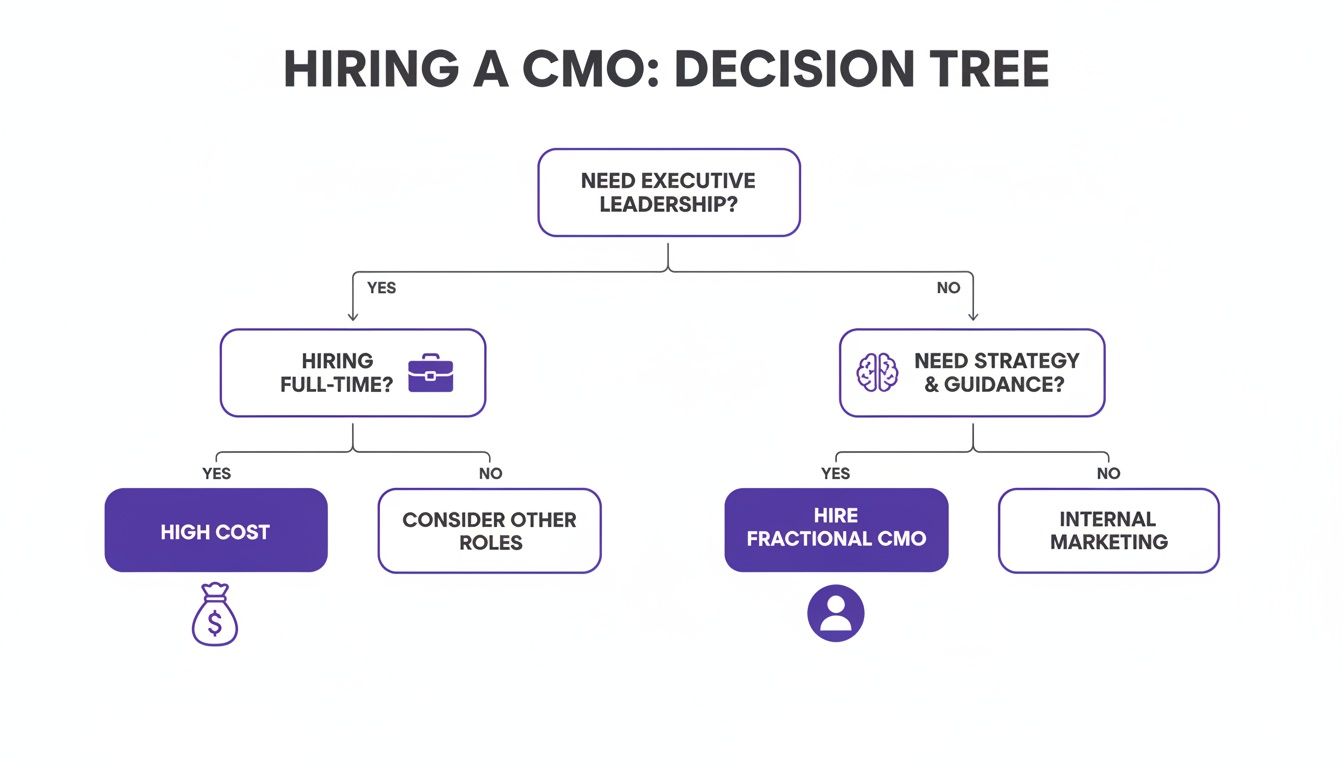
As the decision tree shows, when the primary need is high-level strategy, a fractional model often makes the most sense. It gives you senior-level expertise without the hefty price tag of a full-time executive salary.
Key Questions to Ask Potential Agencies
You need to arm yourself with precise questions that peel back the layers and reveal an agency's real capabilities and cultural fit. It’s time to go beyond their polished deck and dig into how they actually operate.
- Startup Experience: "Can you share case studies of startups at our stage, in our industry, that you've helped grow? What were the specific results, and what was your exact contribution?" For example, a great agency might point to a SaaS client where they boosted signups by 120% in three months by zeroing in on non-branded organic search, directly lifting monthly recurring revenue.
- Strategy and Process: "What does your 90-day onboarding and strategy process look like? How do you define and track success, and how often will we see performance reports?"
- Team Expertise: "Who exactly will be working on our account? What’s their experience, and will we have direct access to them?"
Red Flags to Watch Out For
Just as important as asking the right questions is knowing what warning signs to look for. These are the immediate red flags that should give you pause.
Be wary of any agency that promises guaranteed results, like "we'll get you on the first page of Google in 30 days." True marketing experts know that results depend on many variables and focus on a proven process, not unbreakable promises.
Other warning signs include:
- Vague Strategies: If they can't clearly articulate a plan with specific channels and KPIs, they likely don't have one.
- Focus on Vanity Metrics: Be cautious if their case studies are all about impressions and clicks instead of leads, conversions, and revenue.
- One-Size-Fits-All Approach: A great marketing agency for startups tailors its approach. If they're pushing a generic package without deeply understanding your business, it’s a poor fit.
- Lack of Transparency: They should be completely open about their pricing, their process, and who is on your team. No black boxes.
Choosing the right partner requires diligence. To learn more about how specific tactics are measured, explore our guide to finding the right performance marketing agency. Ready to find a partner you can trust? Contact us to start the conversation.
Figuring out how a marketing agency for startups bills for their time can feel like a maze, but it’s absolutely critical for protecting your runway and making sure you’re getting real value. Getting a handle on the common pricing models is the first step toward a transparent, successful partnership that will actually fuel your growth. Each model has its own perks, depending on your stage and what you’re trying to accomplish.
The most common structure you’ll run into is the monthly retainer. It’s a simple, fixed fee you pay each month for an agreed-upon set of services. The biggest advantage here is predictability; you know exactly what your marketing spend will be, which is a lifesaver for early-stage budgeting. A typical retainer for a B2B startup in North America might start around $5,000 per month and scale up from there based on the scope of work.
Finding the Right Fit for Your Stage
Another popular route is project-based pricing. This is perfect for specific, one-off needs like a website redesign, a foundational SEO audit, or hammering out a go-to-market strategy. You pay a single, upfront price for a clearly defined deliverable. This model gives you total clarity and is great for startups that aren't ready to commit long-term but need expert help on a crucial initiative.
Finally, there’s performance-based pricing, which directly links what you pay the agency to them hitting specific KPIs—like generating a certain number of qualified leads or hitting a target customer acquisition cost (CAC). While this model perfectly aligns everyone’s incentives, it’s usually part of a hybrid deal. For example, an agency might charge a smaller base retainer plus a bonus for knocking it out of the park on your targets.
A great partnership often blends these models. A startup might kick things off with a project to build its strategic foundation, then shift to a retainer for ongoing execution. Layering performance bonuses on top keeps everyone laser-focused on growth.
For instance, some agencies have helped tech clients achieve a 279% increase in Monthly Recurring Revenue over just nine months by aligning their strategic services with clear performance milestones. That kind of success story shows the power of finding a pricing structure that matches your growth ambitions. Choosing the right marketing agency for startups means finding a partner who’s willing to build a flexible and transparent pricing model that works for you.
Ready to find a pricing model that fits your budget and drives real growth? Contact us today to build a transparent and effective partnership.
Measuring Real Success and Hitting the Ground Running
Signing on the dotted line with a marketing agency is just the first step. The real work—and the real value—comes from execution and being crystal clear on how you'll measure success from day one. It's time to push past the vanity metrics like clicks and impressions and zero in on the key performance indicators (KPIs) that actually move the needle in competitive North American markets.
For a startup, genuine growth is about tangible business outcomes. That means ruthlessly tracking the numbers that directly impact your runway and valuation. Think less about sheer traffic volume and more about the quality and cost of that traffic. A great example is when Dropbox launched their referral program, which led to a 3900% growth in 15 months by focusing on a single, powerful metric: user acquisition via referrals.
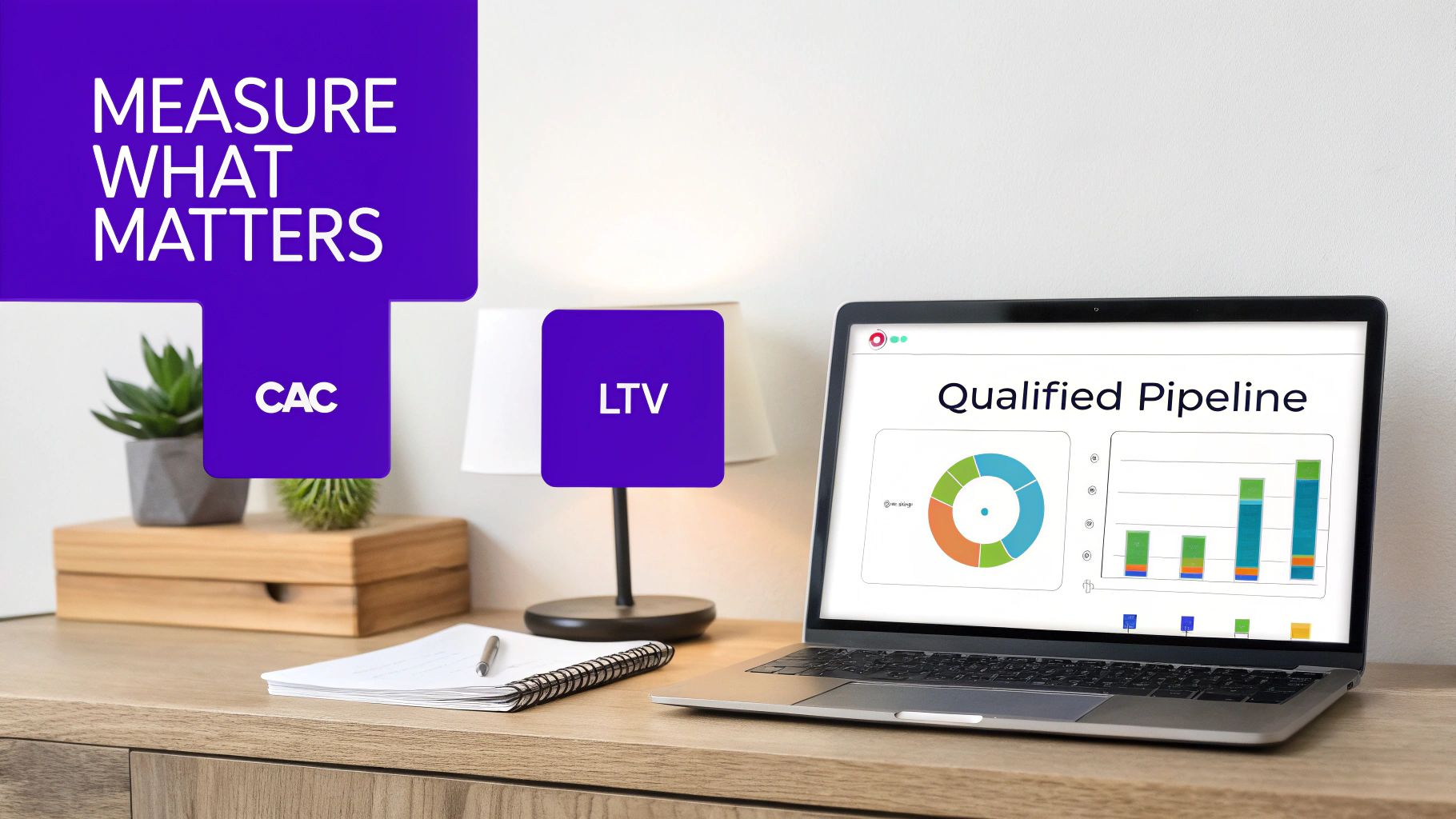
Key Metrics That Matter
A great agency partner will build their entire strategy around improving these core numbers. These are the metrics that keep your investors in the U.S. and Canada happy and your business healthy.
- Customer Acquisition Cost (CAC): This is the total cost to land a new paying customer. Your agency should be absolutely obsessed with driving this number down.
- Lifetime Value (LTV): This is the total revenue you can expect from a customer over their entire relationship with you. A strong LTV to CAC ratio—ideally 3:1 or better—is the hallmark of a scalable, sustainable business.
- Qualified Pipeline Growth: We're talking about the increase in sales-ready leads entering your funnel. It's a direct measure of marketing's contribution to future revenue.
- Customer Retention: At the end of the day, great marketing helps you keep the customers you've worked so hard to win. Mastering the customer retention rate formula is non-negotiable for long-term health.
A startup that can demonstrate a predictable, cost-effective model for acquiring high-LTV customers is one that's ready to scale. This data-driven approach is what separates successful ventures from those that burn out.
Your First 30 Days Onboarding Checklist
A smooth start sets the tone for a productive partnership. Your agency’s first month should feel like a structured sprint to get aligned, get access, and get moving. You can dive deeper into creating effective dashboards with our guide on digital marketing reporting.
- Kick-Off & Goal Alignment: This should be a deep-dive workshop to confirm your business objectives, lock in the KPIs, and set realistic 90-day targets. No ambiguity allowed.
- Access & Integration: It's time to hand over the keys. Granting access to all necessary tools—analytics, ad accounts, your CRM—ensures the agency has a complete, unfiltered view of the data.
- Communication Cadence: A clear rhythm for communication is vital. Establish a schedule for weekly check-ins, monthly strategy reviews, and a dedicated channel (like a shared Slack channel) for day-to-day collaboration.
Ready to partner with an expert team focused on the metrics that matter?
Contact us to build a growth plan that delivers measurable results.
Frequently Asked Questions
Jumping into a partnership with a marketing agency can feel like a big step. Founders across Canada and the United States often have similar questions, so let’s clear up a few of the most common ones.
When Is the Right Time for a Startup to Hire a Marketing Agency?
The sweet spot is usually right after you’ve nailed your initial product-market fit and closed a seed or Series A round. At this point, you know you have something people want, but you need a repeatable, scalable way to find more of them.
If you hire an agency too early, you risk burning cash on a product that isn't quite ready for the spotlight. Wait too long, and you lose precious momentum to competitors. It's all about timing it right to capitalize on your early traction and start delivering on those growth numbers your investors are looking for.
For instance, one B2B tech company timed their agency partnership perfectly and saw a 279% increase in Monthly Recurring Revenue. They had the product; the agency just built the engine to get it in front of the right people at scale.
What's the Difference Between an In-House Team and an Agency?
Think of it this way: an in-house team gives you deep, focused product knowledge. They live and breathe your company culture. But building out a full marketing team with specialists in SEO, paid media, and content is a slow, expensive process. A recent U.S. study shows the average time to hire for a single marketing role is 42 days.
An agency, on the other hand, gives you instant access to a whole team of vetted experts for what's often a fraction of the cost of hiring them all full-time. You get the strategist, the ad buyer, the writer, and the analyst from day one.
The best setup is often a hybrid model. You have a key marketing lead in-house—someone who owns the strategy and manages the relationship—while the agency handles the day-to-day tactical execution. It’s the perfect balance of internal alignment and specialized, external firepower.
How Much Should a Startup Budget for a Marketing Agency?
There's no single magic number, but a solid benchmark for venture-backed startups is to earmark 15-25% of the operating budget for marketing. When it comes to agency retainers in the U.S. and Canada, you'll often see starting points between $8,000 to $15,000 a month for foundational work.
For startups in hyper-growth mode running aggressive, multi-channel campaigns, that figure can easily climb north of $50,000. The key is to find a transparent marketing agency for startups that offers phased pricing. Your investment should scale alongside your funding rounds and revenue, ensuring the cost always makes sense for your stage of growth.
Ready to partner with an agency that gets the speed and intensity of startup life? B2Better becomes an extension of your team, building the marketing engine that drives real results. Contact us today to build a strategy that fits your goals.