

Let's be honest, the term "thought leadership" gets thrown around a lot. But what does it actually mean to lead with your thinking?
It’s the deliberate strategy of becoming the go-to authority in your field. This isn't about churning out more content; it's about consistently offering unique, actionable insights that solve your audience’s toughest problems. The goal is to shape the conversation, not just participate in it.
What Does Thought Leadership Actually Mean?
Forget the buzzwords for a minute. Many businesses in Canada and the United States claim they're doing thought leadership, but few truly grasp its purpose. It goes way beyond a few blog posts or a clever social media update. It's a long-term commitment to becoming an indispensable resource for the people you want to reach.
Here’s a simple way to think about it: standard content marketing is like a helpful tour guide with a map. It shows people the well-known landmarks and answers the questions they already have.
A true thought leader, on the other hand, is the seasoned local who reveals the hidden gems, explains the cultural significance behind everything, and anticipates questions before they’re even asked. They provide a much deeper, more valuable experience that builds genuine, lasting trust.
Moving Beyond Information to Insight
The real difference comes down to the value you deliver. Information is everywhere, but genuine insight? That’s rare, and it’s highly prized. B2B decision-makers in North America aren't drowning in a lack of data; they’re searching for perspective that helps them cut through the noise and make better strategic choices.
A true thought-leadership article is purpose-built. It’s written to help readers solve a complex problem, make an informed decision, or understand an issue from a new angle. It’s not just an expression of opinion—it’s an offering of expertise.
And that offering has a massive impact. A study by Edelman and LinkedIn found that 63% of C-suite executives said thought leadership is a crucial way they vet a company they’re considering doing business with. Another report showed that decision-makers are willing to pay a premium to work with organizations that clearly articulate a vision for the future.
To stand out, your content needs to be built on a foundation of unique perspective, credible expertise, and practical value. These three pillars are what separate authentic thought leadership from the noise of everyday content marketing.
The table below provides a quick summary of these core components.
The Core Pillars of Authentic Thought Leadership
| Pillar | Description | Business Impact |
|---|---|---|
| Unique Perspective | Offers a fresh, forward-looking viewpoint that challenges conventional wisdom or provides a new framework for solving a problem. | Differentiates your brand from competitors and positions you as an innovator, attracting a higher-quality audience. |
| Credible Expertise | Grounded in original research, proprietary data, or deep, hands-on experience that can't be easily replicated by others. | Builds unshakeable trust and authority, making your brand the default choice for complex challenges. |
| Actionable Value | Provides practical, non-promotional guidance that helps your audience do their jobs better, make smarter decisions, or achieve their goals. | Fosters deep loyalty and turns your audience into advocates, shortening sales cycles and driving referrals. |
By weaving these three elements into your strategy, you move beyond simply sharing information and start providing the kind of indispensable insight that builds real business relationships.
The Strategic Imperative for B2B Brands
For B2B companies, especially in competitive North American markets, this level of authority is no longer just a nice-to-have. It directly influences high-stakes buying decisions by building a foundation of credibility that slick advertising alone can't buy.
When you get this right, you can:
- De-commoditize Your Offerings: You start competing on value and insight, not just on price.
- Build Unshakeable Trust: Consistently providing valuable, non-promotional guidance proves your primary goal is your audience's success, which fosters incredible loyalty.
- Influence the Industry Narrative: Instead of just reacting to industry conversations, you start leading them, setting the agenda and defining what comes next.
This strategic approach transforms your brand from being just another vendor into an essential partner. It's a powerful engine for building brand equity, attracting top-tier clients, and driving sustainable growth.
Are you ready to stop just creating content and start shaping your industry? Contact us today to build a thought leadership strategy that delivers real business results.
Differentiating Thought Leadership From Content Marketing
Many B2B companies in Canada and the United States treat "thought leadership" and "content marketing" like they’re the same thing. They’re not. While they’re definitely related, they serve two very different strategic purposes. Getting this distinction right is the key to spending your resources wisely and building a brand that truly commands authority.
Content marketing is all about creating and sharing valuable, relevant stuff to pull in and keep a specific audience. Its job is to answer the questions your potential customers are already asking. Think of blog posts explaining how to use a tool, or checklists that make a common task easier. It's helpful, practical, and meets an immediate need.
Thought leadership, on the other hand, answers the questions your audience should be asking. It’s about introducing new ways of thinking, challenging the status quo, and offering a unique take on where your industry is headed. It lifts the conversation from the tactical "how-to" to the strategic "why" and "what if."
The Intent Behind The Content
The real difference is the strategic intent. Content marketing aims to be helpful and informative, building trust by solving today's problems. Thought leadership aims to be insightful and even a bit provocative, building authority by defining tomorrow's problems and solutions.
A recent study found that 63% of C-suite executives believe an organization's thought leadership is a more trustworthy way to judge its capabilities than its marketing materials. That’s a huge tell. Decision-makers in both the United States and Canada aren't just hunting for answers; they're looking for genuine perspective.
A content marketer might write an article titled, "5 Ways to Improve Your Team's Productivity." A thought leader, however, would publish a piece called, "Why Your Definition of Productivity Is Holding Your Team Back."
The first one is useful, no doubt. It solves a known problem. But the second one reframes the entire issue, showing a much deeper level of expertise and foresight that makes people sit up and listen.
This model breaks down the core components that make it all work.
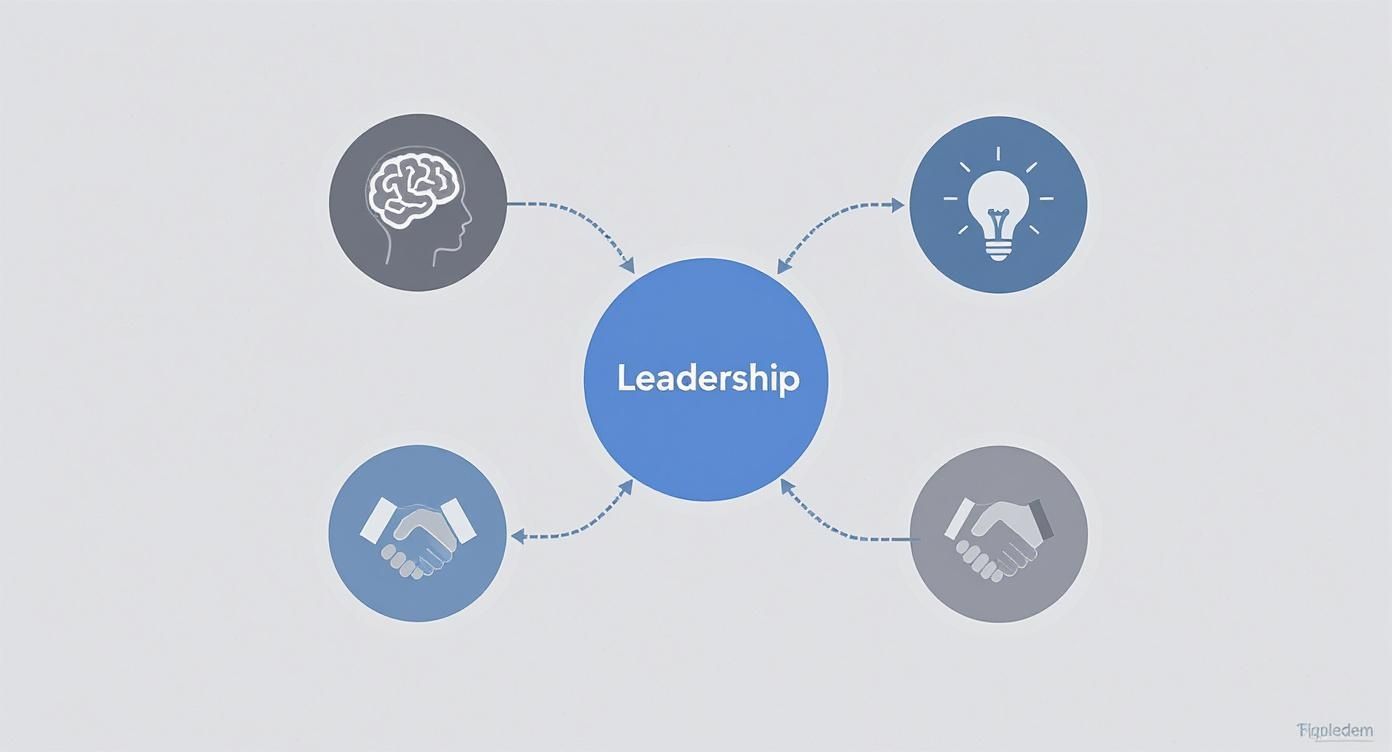
As you can see, real leadership isn't just about one thing. It's a blend of deep expertise, fresh insights, and the ability to build unshakable trust with your audience.
A Strategic Comparison
To make the distinction crystal clear, let’s look at them side-by-side. Both are absolutely vital, but they operate with different goals, create different types of assets, and are measured by different yardsticks. Understanding the power of content marketing for B2B is your foundation, but layering in true thought leadership is what separates the players from the market leaders.
This table breaks down the strategic differences between thought leadership, content marketing, and a related discipline, influencer marketing.
Thought Leadership vs Content Marketing A Strategic Comparison
| Attribute | Thought Leadership | Content Marketing | Influencer Marketing |
|---|---|---|---|
| Primary Goal | Shape industry perspective and build authority. | Answer audience questions and generate leads. | Leverage third-party credibility to build reach. |
| Audience Intent | Seeking new ideas and future-focused insights. | Looking for practical solutions to current problems. | Following trusted voices for recommendations. |
| Content Focus | Proprietary research, bold predictions, new frameworks. | How-to guides, best practices, case studies, checklists. | Product reviews, sponsored posts, expert endorsements. |
| Key Metric | Share of voice, media mentions, C-suite engagement. | Website traffic, lead conversions, content downloads. | Audience reach, engagement rates, referral traffic. |
While each has its own lane, they work best when they work together. A strong content marketing program answers the day-to-day questions, while a thought leadership program steers the bigger conversation.
Take HubSpot's annual "State of Marketing" report. It’s a masterclass in thought leadership. It doesn't just list marketing tactics; it analyzes huge datasets to define what's coming next, giving thousands of professionals a unique perspective they use to build their own strategies. This positions HubSpot not just as a software company, but as an indispensable authority.
Ultimately, content marketing draws people in by being useful. Thought leadership makes them stay by being essential. A winning strategy needs both, but knowing their unique roles is the first step to mastering them.
The True Business Value of Thought Leadership
So, beyond the definitions, what’s the real point? Why should any business leader sink time and resources into becoming a thought leader?
The answer comes down to tangible, measurable results that the C-suite actually cares about. This isn't a vanity project. Done right, thought leadership is a powerful engine for de-commoditizing your services and driving sustainable revenue.
When your company is seen as the authority, your entire market position changes. You stop competing on price and start competing on insight. This shift lets you command premium pricing because clients aren't just buying your services—they're buying your unique perspective. They see your expertise as a competitive advantage for their own business.
Accelerating the Complex B2B Sales Cycle
In the high-stakes world of B2B, the sales cycle can be painfully long, often involving a whole committee of decision-makers. Thought leadership is the secret lubricant that speeds up the entire process.
By consistently publishing insightful content, you’re educating prospects long before they ever talk to sales. You’re building a foundation of trust and credibility, answering their questions and knocking down objections before they're even raised. By the time they finally engage, they’re already sold on your expertise.
A landmark study from Edelman and LinkedIn found that 58% of decision-makers chose a business specifically because of its thought leadership. This shows that quality insights directly sway buying decisions, creating a much shorter path from prospect to paying client.
This "pre-suasion" shortens sales cycles dramatically. Your sales team can skip the 101-level education and jump straight into strategic conversations about partnership and implementation. The result? Faster conversions and a healthier pipeline.
Building Unshakeable Brand Equity and Trust
Brand equity is that intangible vibe that makes customers choose you over a competitor, even when the offerings look identical. Thought leadership is one of the most reliable ways to build this deep, lasting value.
Every piece of genuinely helpful, non-promotional content you share is like a deposit in your brand's trust account. It signals that your first priority is helping your audience succeed, not just closing a deal. This consistency builds a powerful moat around your brand that competitors will find nearly impossible to cross.
This is especially true in markets like Canada, where workplace demographics are shifting. Here, leadership is increasingly judged on authenticity and action, not just titles. As this Canadian perspective on evolving leadership points out, newer generations connect with leaders who demonstrate their values. True thought leadership is the perfect vehicle for that.
Attracting Top Talent and Strategic Partnerships
The ripple effects of a strong thought leadership platform go far beyond just winning new customers. It also turns your company into a magnet for top-tier talent and high-value strategic partnerships. A-players don't want to work for followers; they want to work for companies shaping the future of their industry.
When your organization is known for its expertise and forward-thinking culture, it becomes a destination for the best and brightest. This naturally reduces recruiting costs and helps you build a more capable, motivated team.
- Talent Attraction: High-calibre professionals are drawn to companies that invest in knowledge, seeing it as a place where they can grow their own expertise.
- Partnership Opportunities: Other industry leaders and complementary businesses will start seeking you out for collaborations, joint ventures, and co-marketing initiatives, opening up entirely new channels for growth.
- Media and Speaking Invitations: Your experts will get invited to speak at major conferences and contribute to industry publications, amplifying your reach and cementing your authority at scale.
Ultimately, investing in thought leadership is an investment in your company’s long-term influence and viability. It’s a strategic decision to build an asset that pays dividends across every single part of your business.
Are you ready to turn your expertise into measurable business value? Contact us today to build a thought leadership strategy that drives revenue and establishes your authority.
How Winning B2B Companies Execute Thought Leadership

Theory is one thing, but execution is everything. The B2B companies that truly dominate their markets don't just dabble in thought leadership—they build their entire presence around it. They get that defining an industry means owning a unique perspective and delivering it consistently through formats that command attention.
These winning firms don't just create content; they create intellectual property. They invest in proprietary research, develop signature frameworks, and build platforms that become indispensable resources for their audience. Let’s break down exactly how they pull it off.
The Power of Proprietary Research: HubSpot's State of Marketing Report
One of the most potent examples of thought leadership in action is HubSpot's annual "State of Marketing" report. This isn't just another blog post. It's a cornerstone asset built on original, large-scale research that has become a landmark publication for marketers across Canada and the United States.
What makes it so effective?
- It Answers Unasked Questions: HubSpot isn’t just rehashing known trends. It digs into massive datasets to uncover what’s next, giving marketers the foresight they need to build their strategies.
- It Builds Unshakeable Authority: By producing the data, HubSpot becomes the primary source. Other publications, blogs, and speakers all end up citing HubSpot’s findings, amplifying their brand and cementing their authority.
- It Fuels the Entire Marketing Engine: The report is repurposed into dozens of smaller assets—blog posts, webinars, social media graphics, and sales enablement materials. This one investment generates a full year's worth of content.
The result is a direct line from thought leadership to business growth. Companies come to rely on this report, which builds immense trust in the HubSpot brand. A study by Edelman found that 88% of decision-makers say high-quality thought leadership enhances their perception of an organization. HubSpot lives this statistic, turning its insights into market share.
Owning a Niche with a Distinctive Voice: Gong's Revenue Intelligence
You don’t need to be a massive corporation to execute world-class thought leadership. Gong, a company in the sales technology space, carved out its authority by pioneering the "Revenue Intelligence" category. They didn't just sell software; they created an entirely new way of thinking about sales.
Gong did this by analyzing sales conversations at an unheard-of scale and sharing data-backed insights on what top performers do differently. Their content is sharp, often counterintuitive, and relentlessly focused on providing advice you can actually use. They masterfully use LinkedIn and a no-fluff blog to get their findings out there.
Gong’s success proves a critical principle: thought leadership isn’t about being everything to everyone. It’s about being the undisputed expert on a specific, high-value problem for a very well-defined audience.
Their approach has paid off spectacularly. By defining and owning their category, Gong achieved a multi-billion dollar valuation and became the default platform for companies serious about improving sales performance. Their success wasn't just built on a great product; it was built on an even better perspective.
The Blueprint for Success
These examples reveal a repeatable blueprint that any B2B company can adopt. Whether you're a large enterprise or an agile innovator, the core principles hold true.
- Identify a Unique Point of View: What do you know that nobody else does? This could come from your internal data, customer experiences, or a contrarian take on a common industry headache.
- Choose the Right Format: Don't just default to blogging. A landmark research report, a must-listen podcast, or a data-driven webinar series might be the perfect vehicle for your unique insights.
- Distribute for Dominance: Create your cornerstone content, then atomize it. Turn your big ideas into a steady stream of content distributed across the channels where your audience, from Toronto to San Francisco, spends their time.
Following this model moves you beyond simply participating in the conversation. You begin to lead it, drawing a clear line from your intellectual capital to remarkable business growth.
Ready to build a thought leadership strategy that positions you as the undisputed leader in your market? Contact us today to get started.
Building Your Thought Leadership Strategy From The Ground Up

Alright, let's bridge the gap between understanding thought leadership and actually doing it. This is where the real work begins. Winning B2B companies don't just stumble into authority; they build it deliberately, piece by piece.
The journey starts not with brainstorming blog topics, but with some deep strategic thinking. You have to unearth your company's unique point of view—the one perspective that only you can offer. This is the bedrock of your entire strategy.
Define Your Unique Point of View
First things first: what do you know that nobody else does? This isn’t about rehashing common industry knowledge. It’s about finding that sweet spot where your deep experience, proprietary data, and your audience's biggest challenges all intersect.
What unconventional truths have you learned from years in the trenches with clients? What patterns are hiding in your data that contradict what everyone else is saying? This is your intellectual property, and it's gold.
True authority isn't about having an opinion on everything. It’s about having a sharp, defensible, and original perspective on a specific, high-value problem that your ideal customer is struggling to solve.
Once you’ve nailed that unique angle, you need to get laser-focused on who you’re trying to reach. A generic approach is doomed to fail. To create content that truly hits home, you need to understand that the needs of a CTO in Toronto are completely different from those of a VP of Sales in Chicago. Detailed buyer personas are non-negotiable.
Map Your Audience and Channels
Knowing your audience goes way beyond basic demographics. You need to understand their goals, their pain points, and—most importantly—where they actually go for information and ideas. The process of how to conduct market research is critical here. It gives you the data you need to make smart decisions instead of just guessing.
This research will tell you exactly where to show up. Are your ideal buyers constantly on LinkedIn? Do they listen to industry podcasts during their commute? Are they more likely to read an in-depth research report or watch a short, punchy video series?
In Canada, for instance, social media is central for reaching decision-makers. While research shows 67% of Canadians use Facebook weekly, LinkedIn is where the B2B action is. Canadian professionals on LinkedIn value authenticity and community; they’re looking for genuine insights, not another sales pitch. Your strategy has to lead with real value if you want to build trust.
Create and Repurpose Cornerstone Content
With your unique perspective defined and your audience mapped out, you’re ready to build your first cornerstone content pillar. Think of this as one massive, high-value asset—like a proprietary research report, a comprehensive guide, or a signature webinar—that becomes the foundation for dozens of other pieces.
This "create once, publish everywhere" model is incredibly efficient. A single research report can be broken down into:
- 10–15 Blog Posts: Each one dives deep into a specific finding from the report.
- A Webinar: Present the key insights in an interactive format to generate high-quality leads.
- An Infographic: Visualise the most compelling data points for easy sharing.
- Dozens of Social Media Snippets: Pull out key statistics and quotes to fuel your content calendar for months.
This system turns your internal expertise into a consistent stream of external influence. By building a process to capture, refine, and distribute what your team knows, you create a scalable engine for becoming a brand people recognise and trust.
Ready to build a thought leadership strategy that establishes your authority and drives real growth? Contact us to start building your actionable roadmap today.
How To Measure The Real ROI Of Thought Leadership
Proving the dollar-value of thought leadership is one of the toughest challenges for any B2B leader. It feels important, but connecting insightful content directly to revenue can seem abstract, even fuzzy.
With the right framework, however, you can move past superficial metrics like "likes" and focus on what executives in Canada and the United States truly care about: a measurable return on investment. The trick is to stop hunting for a single magic number and adopt a tiered measurement model instead.
This approach tracks how your efforts influence different stages of the buyer journey, from sparking initial awareness all the way to a closed deal. It gives you a complete, compelling story of its contribution.
A Tiered Model For Tracking Success
A robust measurement strategy connects high-level brand goals with tangible sales outcomes. By tracking metrics across three distinct tiers, you can build a clear narrative showing exactly how thought leadership impacts the bottom line.
Here’s how to structure it:
-
Tier 1 Brand Impact: This top-level tier is all about awareness and authority. Are you successfully shaping the conversation in your industry? Key metrics include share of voice (how often your brand is mentioned versus competitors), high-authority media mentions, and organic keyword rankings for your core topics.
-
Tier 2 Audience Growth: The next level measures engagement. It's not just about getting eyeballs; it's about attracting the right people and turning them into a loyal audience. Here, you'll want to track things like high-value subscriber growth (think newsletter sign-ups from target accounts), content downloads, and lead quality scores in your marketing automation platform.
-
Tier 3 Revenue Influence: This is where you connect your content to cash. The goal is to show how thought leadership shortens the sales cycle and contributes to closed-won deals. Metrics include pipeline acceleration (how quickly leads move through stages after engaging with your content) and content attribution right inside your CRM.
For example, a successful program might show that leads who downloaded your proprietary research report closed 30% faster and had a 15% higher average contract value than those who didn't. This is the kind of undeniable proof executives are looking for.
This tiered approach is especially relevant in markets like Canada, where thought leadership is often defined by innovation. The Canadian government's investment in AI, including $25 million for a program to measure its economic impact, shows a clear national interest in data-backed progress.
By leveraging your CRM and marketing automation tools, you can tag contacts based on the content they consume. This lets you run reports showing exactly which thought leadership assets influenced your most valuable deals. For a deeper dive into connecting data to results, check out our complete digital marketing report.
Building this measurement system provides the hard evidence needed to justify—and expand—your investment in thought leadership.
Ready to build a strategy with measurable ROI? Contact us to define a plan that connects your expertise to your revenue goals.
Your Path to Becoming an Industry Authority
We’ve covered a lot of ground, defining what thought leadership truly is and laying out a strategic blueprint to get you there. But now comes the most important part: taking action. Moving from theory to practice is the only way to build your brand’s legacy as a genuine authority in your space.
Remember, this isn’t about launching a short-term campaign. It's a long-term investment. It's a commitment to consistently delivering real value—the kind that builds unshakeable trust with your audience. Success here isn’t accidental; it’s the direct result of a deliberate, focused strategy.
Your First 90 Days
To make this journey feel less daunting, let's just focus on a simple, achievable plan for the next 90 days. Gaining momentum is everything.
-
Publish One Cornerstone Asset: Pour your resources into creating a single, high-value piece of proprietary research. Survey your clients, analyze your own internal data—whatever it takes to produce an asset that offers a unique perspective on a critical industry problem.
-
Launch an Internal Expert Series: Find three subject matter experts inside your own organization. Start a simple interview series—maybe a recorded video chat or a written Q&A—to begin mining and sharing their deep, practical knowledge.
This kind of disciplined focus pays off. A recent study found that 58% of decision-makers in the U.S. and Canada chose a business partner specifically because of their thought leadership. This proves that quality insights directly influence high-stakes buying decisions.
Becoming a thought leader is the most effective way to de-commoditize your business. When you compete on insight instead of price, you build a brand that is not just chosen, but preferred and trusted by high-value clients across North America.
This is your opportunity to stop just participating in the conversation and start leading it.
Are you a B2B leader ready to accelerate this journey? At B2Better, we build strategic thought leadership programs that translate expertise into measurable growth.
Contact us today to build your legacy as a true industry leader.