

Tired of wondering if your ads are actually making money? It’s a common blind spot for businesses across the United States and Canada. The one number that cuts through the noise is your Break-Even Return On Ad Spend (ROAS). This is the absolute minimum revenue you need to generate for every dollar you spend on ads just to cover your costs.
Anything less, and you're losing money. It's that simple.
Why Your Break-Even ROAS Is Your Most Important Metric

Too many businesses, especially across Canada and the US, get fixated on chasing a high ROAS without understanding the profit behind it. You might see a 4x ROAS and think you’re crushing it, but if your profit margins are thin, you could still be in the red on every single sale.
On the flip side, a modest-looking 2x ROAS can be wildly profitable for a business with healthy margins, which is often the case for SaaS companies.
This is where knowing your break-even point becomes a gut-check for your entire business model. It shifts your focus from vanity metrics to the only thing that really matters: profitability.
The Foundation of Profitable Advertising
Before you can even think about setting profit targets, you have to know where the floor is. Your break-even ROAS is that floor, and it all boils down to one thing: your profit margin.
Think about it. If your business runs on a 25% profit margin, you need a 4x ROAS just to get back to zero. But a company with a cushy 75% margin only needs a 1.33x ROAS to break even.
To get this margin right, you have to be honest about all your variable costs:
- Cost of Goods Sold (COGS): The direct cost to create your product or deliver your service.
- Transaction Fees: Those sneaky payment processing fees that take a bite out of every transaction.
- Shipping & Handling: A huge one for e-commerce that’s easy to forget in early calculations.
- Other Variable Costs: Think fulfillment, packaging, or any other expense tied directly to a sale.
Skipping over these details is the fastest way to scale unprofitably.
A study by U.S. Bank revealed a sobering statistic: 82% of business failures were due to poor cash flow management. A major contributor is misunderstanding core profitability metrics like break-even points, leading companies to pour money into campaigns that feel successful but are actually draining the bank.
This data table breaks down the key metrics you’ll need. Think of it as your pre-flight checklist before you start crunching the numbers.
Key Metrics for Your Break-Even ROAS Calculation
A quick reference for the essential inputs needed to calculate your break-even ROAS and understand their impact on your profitability.
| Metric | What It Measures | Why It's Critical |
|---|---|---|
| Profit Margin | The percentage of revenue left after all variable costs are paid. | The single biggest factor determining your break-even point. |
| Cost of Goods Sold (COGS) | The direct costs of producing what you sell. | Ensures you're not underestimating the cost of each sale. |
| Customer Acquisition Cost (CAC) | How much it costs to acquire a new customer. | Helps you set realistic ad spend limits. |
| Customer Lifetime Value (LTV) | The total revenue you expect from a single customer account. | Informs how much you can spend and remain profitable over time. |
Each of these inputs tells a piece of the story. Get them right, and your break-even ROAS becomes a powerful, reliable guide.
Beyond a Simple Calculation
Knowing this number does more than just prevent losses; it completely transforms your advertising strategy. You move from hopeful spending to data-driven decisions, which is the only way to build sustainable growth.
While there are plenty of online calculators for general business analysis—from real estate ratios to basic profit estimators—a dedicated break-even ROAS calculator is built for the specific nuances of digital advertising. Specificity is what separates guessing from knowing.
For a deeper look into measuring campaign success, check out our guide on understanding ROI in B2B marketing.
Ready to build a marketing strategy where every dollar is a clear investment in your growth?
Contact us today, and let's make sure your ad spend is working for you.
The Simple Formula for Your Break-Even ROAS
At its core, the formula to find your break-even point is beautifully simple. It cuts through the noise and gives you a hard number to aim for with your ad campaigns.
Break-Even ROAS = 1 / Profit Margin
This formula tells you the exact multiple of your ad spend you need to get back in revenue just to cover your costs. But the real work isn’t in the division; it’s in figuring out your true profit margin. A flawed margin leads to a flawed ROAS target—a common mistake that quietly costs advertisers in Canada and the United States thousands.
Calculating Your True Profit Margin
Your profit margin isn't just the sticker price of your product minus what you paid for it. To get an accurate number, you have to account for every single variable expense that chips away at your revenue on a per-sale basis.
These are the non-negotiable costs you must include:
- Cost of Goods Sold (COGS): This is the direct cost of creating or acquiring the product you're selling.
- Payment Processing Fees: Platforms like Stripe and PayPal take a cut of every transaction—typically around 2.9% + $0.30.
- Shipping & Handling: Don't forget packaging materials, the labour involved in fulfillment, and the actual postage costs.
- Other Variable Costs: Do you include special inserts in your packages? Pay for specific software per transaction? Every little bit counts.
For a deeper look, our guide on how to calculate customer acquisition cost adds valuable context on the full cost of winning a new customer.
Seeing the Formula in Action
Let's run the numbers for two very different businesses to see why your margin is everything.
Example 1: The E-commerce Brand
An online store in Toronto sells a product for $100. Their total variable costs—COGS, shipping, and fees—add up to $75 per sale.
- Profit Margin: ($100 Revenue – $75 Costs) / $100 Revenue = 25%
- Break-Even ROAS: 1 / 0.25 = 4.0x
This brand needs to generate $4 in revenue for every $1 of ad spend just to avoid losing money. Any ROAS below 4.0x means the campaign is in the red.
Example 2: The SaaS Company
A software company based in Austin sells a subscription for $100. Their variable costs for server usage and transaction fees are only $25.
- Profit Margin: ($100 Revenue – $25 Costs) / $100 Revenue = 75%
- Break-Even ROAS: 1 / 0.75 = 1.33x
This company starts turning a profit once their ROAS clears a modest 1.33x. The difference is night and day.
A B2B technology firm we worked with was frustrated, believing their 3.5x ROAS was a failure. After we helped them accurately calculate their 80% profit margin, we revealed their break-even ROAS was just 1.25x. They were far more profitable than they realized, which gave them the confidence to scale their campaigns aggressively. The result? A 65% increase in qualified leads the very next quarter.
Understanding this simple calculation is the first step toward building a truly profitable advertising machine.
Tired of guessing if your ad campaigns are truly profitable? Contact us today for a clear, data-driven strategy.
Build Your Own Interactive Break-Even ROAS Calculator
Doing the math by hand is a great way to understand the theory, but the real magic happens when you turn that formula into a tool you can use every single day. Building your own interactive break-even ROAS calculator in Google Sheets or Excel gives you a dynamic dashboard for your business. It lets you instantly see how a small change in your costs could impact your profitability targets.
This simple flowchart shows how your revenue and margins feed directly into the final ROAS calculation.
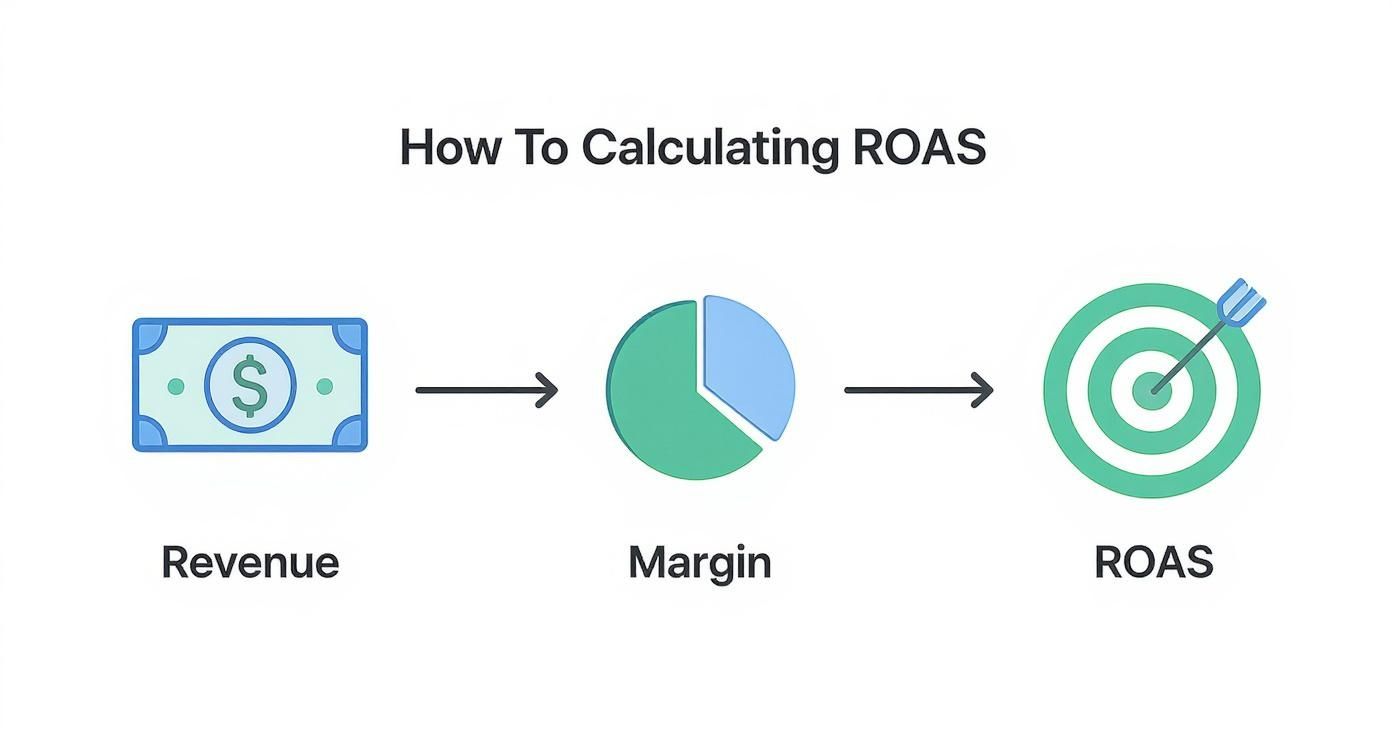
As you can see, you can’t truly understand your ROAS without a firm grip on your profit margins—something determined entirely by your revenue and costs.
Setting Up Your Calculator Spreadsheet
Creating your own calculator is surprisingly easy. Just open a new Google Sheet or Excel file and lay out columns for each of your key financial inputs. This simple structure will be the backbone of your tool.
Here are the essential columns you’ll need to set up:
- Product Price: The retail price your customer pays.
- Cost of Goods Sold (COGS): Your direct cost for that product.
- Shipping & Handling: The average cost to get an order out the door.
- Transaction Fees: A percentage for payment processing (e.g., 2.9%).
- Total Variable Costs: The sum of all your per-sale expenses.
- Profit Margin: The percentage of profit left on each sale.
- Break-Even ROAS: The final calculation showing your absolute baseline.
This setup makes sure every critical cost is accounted for, which helps you avoid the margin blind spots that can quietly sink a campaign.
Plugging in the Formulas
Once your columns are in place, a few simple formulas will bring your calculator to life. All it takes is some basic arithmetic to connect the inputs and calculate your final break-even point.
We recently worked with a B2B client in the United States who built this exact tool. By modelling a potential 15% increase in their supplier costs, they realised their break-even ROAS would jump from 2.5x to 3.1x. This insight allowed them to proactively adjust their Target ROAS goals before the price hike ever happened, protecting their bottom line without any last-minute guesswork.
That’s the real power of an interactive tool. It turns "what-if" scenarios into actionable data you can use immediately. Businesses across North America that adopt this level of financial clarity in their marketing are far better equipped to navigate market changes and scale their advertising with confidence.
Building this calculator gives you the financial clarity you need to make smarter, faster decisions.
Ready to stop guessing and start making data-backed decisions about your ad spend? Contact us today, and we'll help you build a profitable marketing strategy from the ground up.
How to Apply Your Break-Even ROAS to Ad Campaigns
Figuring out your break-even number is one thing. Actually using it to make money is where the real work begins. Your break-even ROAS isn’t just a safety net; it’s the solid foundation for your entire bidding strategy. It’s the number that turns ad spend from a vague cost into a calculated investment.
Think of this figure as the absolute floor for your campaign goals. If your calculation spits out a break-even point of 3.0x, any target you set below that number is a guaranteed loss. This kind of clarity lets you move with confidence inside platforms like Google Ads and Meta Ads.
Setting Profitable Targets in Your Ad Platforms
Once you know your floor, you can set a profitable ceiling. Your break-even ROAS is the launchpad for defining your Target ROAS (tROAS) goals. The trick is to build a healthy profit margin directly into your bidding from the start.
So, if your break-even is 3.0x, aiming for a 5.0x tROAS isn't just pulling a number out of thin air. It’s a deliberate strategy designed to generate a 40% profit margin on every dollar of ad spend. That simple shift takes you from just covering costs to actively building your bottom line with every single conversion.
This principle is fundamental to running successful campaigns. For a more detailed walkthrough, explore our guide on how to optimize a Google Ads campaign.
Making Smart Decisions to Scale or Kill Campaigns
Your break-even ROAS also becomes a clear, unemotional decision-making tool. It helps you quickly identify which campaigns are winners and which are just draining your budget.
- Campaigns Performing Above Break-Even: These are your proven winners and are prime candidates for scaling. You can start gradually increasing their budgets while keeping a close eye on performance to make sure efficiency stays high.
- Campaigns Performing Below Break-Even: These campaigns are actively losing you money. Before you hit the pause button, it's worth investigating why. Is it the creative? The targeting? The landing page? If your optimization efforts don't push them above your break-even threshold, it's time to pause them and reallocate that budget to your top performers.
One of our clients, a Canadian retailer, was running multiple campaigns with what seemed like a decent blended ROAS. After calculating their break-even point, we discovered half their ad spend was going to unprofitable campaigns. By reallocating that budget to the winning campaigns, they saw a 70% increase in overall profitability within a single quarter.
This strategic application is what separates high-growth businesses from those just trying to stay afloat. While many online tools offer basic break-even calculations, they often don't include historical data about ROAS break-even calculators, which can add important context to your strategy. Discover more insights about financial calculators on Omnicalculator.com.
Ready to apply these strategies to your own campaigns and drive measurable growth? Contact us today to see how our expertise can translate your break-even ROAS into real-world profits.
Common ROAS Mistakes That Can Cost You Thousands

It’s easy to get tunnel vision with Return on Ad Spend (ROAS). Seeing a high number feels great, but if that figure is built on shaky ground, you could be losing money on every click and not even know it. It’s one of the fastest ways to burn through a marketing budget, a trap advertisers across the US and Canada fall into all too often.
One of the biggest culprits is ignoring Customer Lifetime Value (LTV). By focusing only on the profit from that first transaction, you risk killing campaigns that are actually planting the seeds for incredible long-term growth.
The LTV Blind Spot
Let’s say you have a campaign hitting a 2.5x ROAS against a break-even target of 3.0x. On paper, it’s a failure. Time to pull the plug, right?
Not so fast. What if that same customer comes back and makes two more purchases over the next year? Suddenly, their total value skyrockets. That acquisition you wrote off as "unprofitable" is now a massive win for the business.
We saw this exact scenario play out with a SaaS company in the United States. They were seconds away from axing a campaign with a weak initial ROAS. After digging into their LTV, we discovered these customers had a 300% higher retention rate than average. That made the initial acquisition cost a bargain over a six-month window.
They shifted their focus from immediate ROAS to LTV-adjusted profitability. With that new clarity, they confidently scaled the campaign and grew their customer base by 40% the following year. That long-term view is a total game-changer.
Inaccurate Margins and Hidden Costs
The other classic mistake? Calculating your break-even point with incomplete data. It's tempting to plug in a simple profit margin and call it a day, but advertisers constantly forget about the small, variable costs that chip away at every single sale.
These are the usual suspects that get missed, and they’ll throw your break-even point way off:
- Return Rates: If 10% of your orders come back, your real revenue is 10% lower than what your reports are telling you.
- Software Fees: Are you paying a per-transaction fee on your payment gateway or fulfilment platform?
- Packaging and Inserts: Little things like custom boxes, thank-you cards, or marketing flyers add up fast when you're scaling.
Forgetting these details gives you a dangerously optimistic break-even target. You might think you're making money at a 2.5x ROAS when, in reality, your true break-even is closer to 3.2x. That's a gap where thousands of dollars can vanish without a trace.
While specific advertising ROI benchmarks for Canada can be elusive, the fundamentals of proper cost accounting are universal. You can learn more about the different components of a break-even calculation on AccurateCalculators.com.
Avoiding these common pitfalls means taking a more holistic view of your business finances. By factoring in LTV and accounting for every last hidden cost, your break-even ROAS calculator stops being a simple metric and becomes a powerful tool for building sustainable, profitable growth.
Ready to build a marketing strategy based on true profitability, not just surface-level numbers? Contact us today, and let's make sure your advertising dollars are delivering real returns.
Answering Your Top ROAS Questions
Even with a reliable break-even ROAS calculator at your fingertips, you'll find that applying these insights to your own business sparks a few important questions. Getting clear on the details is what separates a decent strategy from a truly profitable one.
Let’s tackle some of the most common questions we hear from clients across Canada and the United States.
What Is a Good ROAS to Aim For?
This is easily one of the most misleading questions in marketing. You’ll often hear a 4:1 ROAS tossed around as the industry standard, but that benchmark is meaningless without knowing your profit margin.
A business with a 25% margin is only just breaking even at 4:1. Meanwhile, a SaaS company with an 80% margin is wildly profitable at a ROAS of just 2:1. Your real benchmark is always your own break-even ROAS—once you know that number, you can set a target that’s significantly higher to ensure every conversion actually adds to your bottom line.
How Does Customer Lifetime Value Affect My ROAS Goals?
Factoring in Customer Lifetime Value (LTV) changes the game entirely. Your basic break-even ROAS focuses on a single, initial purchase. But if you know that customers tend to stick around for repeat business, you can afford to acquire them at a lower ROAS upfront.
For example, we worked with a US-based subscription box company that discovered their average customer's LTV was 3.5x their first purchase. This insight gave them the confidence to acquire new subscribers at what initially looked like a break-even ROAS, knowing the long-term profit was substantial. It’s a powerful strategy that lets you outbid competitors and scale much more aggressively.
Should I Use the Same Break-Even ROAS for All My Products?
Absolutely not. If your products have different profit margins, each one needs its own break-even ROAS. A high-margin flagship product can stay profitable at a much lower ROAS than a low-margin accessory or entry-level item.
For the most accurate campaign optimization, calculate a unique break-even ROAS for individual products or, at the very least, for categories of products with similar margins.
This granular approach allows you to set precise bidding targets and intelligently allocate your ad spend toward the items that generate the most actual profit for your business.
Stop guessing and start building a marketing strategy based on true profitability. As a Fractional CMO partner for B2B companies across North America, B2Better delivers the senior expertise you need to drive measurable growth.
Contact us today to ensure every marketing dollar is an investment in your bottom line.