

Before you even think about firing up a spreadsheet or diving into analytics, you need a clear map of the competitive terrain. Just listing a few rivals you already know isn't enough. A powerful analysis starts with a structured plan to figure out who really matters and what you’re trying to accomplish.
Without that clarity, you’ll end up drowning in irrelevant data that leads nowhere. A focused approach, on the other hand, transforms this from a simple data-gathering chore into a strategic initiative that can genuinely shape your market position, product roadmap, and marketing campaigns. Businesses that conduct regular competitor analysis report being 30% more likely to achieve their revenue goals.
Identify and Categorize Your Competitors
First things first: your competition is more than just the company selling a nearly identical product. It's a whole spectrum of businesses all fighting for your customer's attention and budget. To get organized, you need to group them into different buckets. This initial sorting is one of the most vital parts of the different types of market research you can conduct.
This simple framework shows the core process. You identify every potential rival, sort them by how much they matter, and then set clear goals for your analysis. Sticking to this flow keeps your efforts strategic and pointed at the companies that pose the biggest threat—or the greatest opportunity.
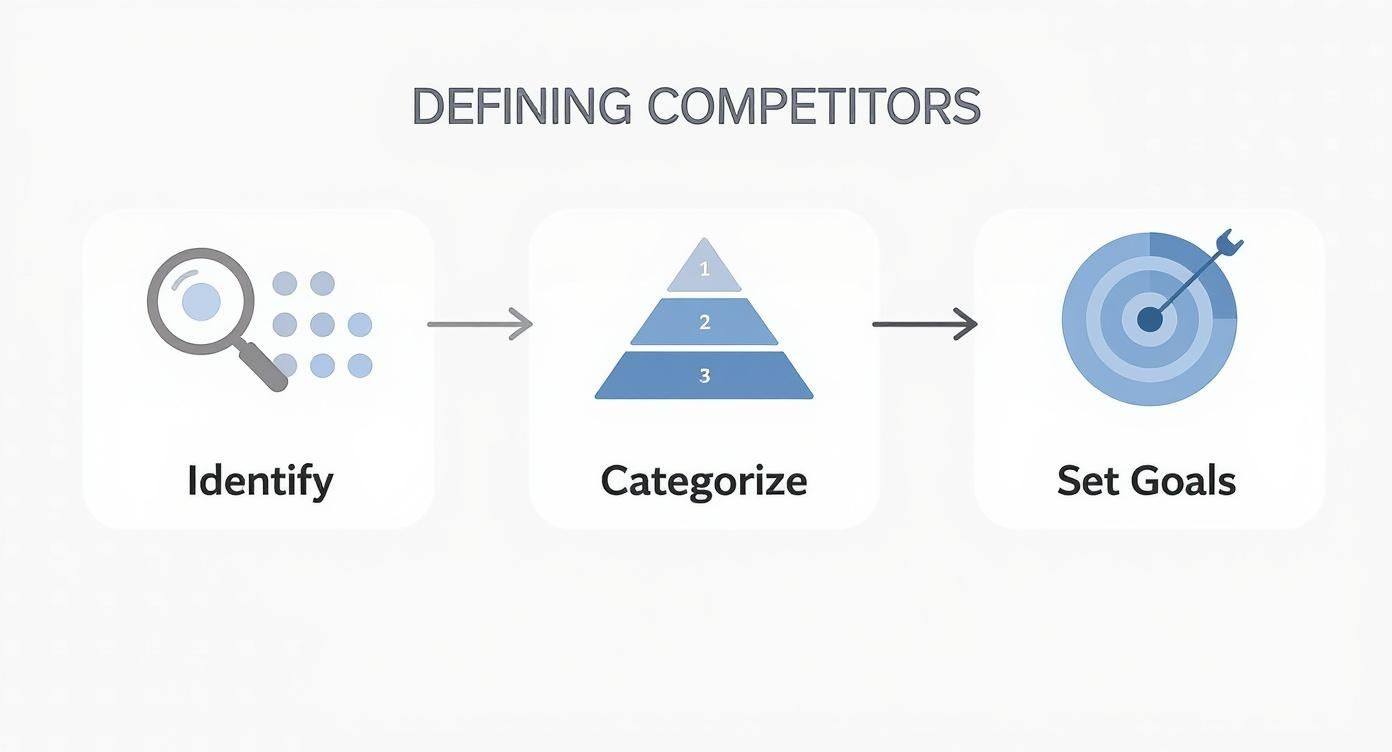
This three-step process—Identify, Categorize, Set Goals—is your safeguard against getting lost in the weeds. It ensures your analysis stays tied to real, measurable business outcomes.
Breaking down your competitors helps you allocate your time and resources effectively. Not every competitor deserves the same level of scrutiny, so categorizing them is a crucial first step.
| Competitor Type | Definition | Example (for a B2B SaaS company) | Why Analyze Them |
|---|---|---|---|
| Direct Competitors | Companies offering a very similar product to the same target market. | A company that sells project management software with nearly identical features. | To benchmark your product, pricing, and marketing against your closest rivals. |
| Indirect Competitors | Companies offering a different product that solves the same core problem for your customer. | A company that sells team collaboration suites (like Slack or Teams) which include basic task management. | To understand alternative solutions and how customers perceive the value of different approaches. |
| Tertiary Competitors | Companies with products that are tangentially related and could potentially enter your market. | A CRM provider that could add project management features to its platform in the future. | To anticipate future threats and shifts in the market landscape. |
| Aspirational Competitors | Market leaders or innovators you admire, even if they aren't in your direct space. | A well-known B2B brand like HubSpot, recognized for its exceptional content marketing and customer experience. | To learn from their strategies, branding, and customer engagement tactics. |
By mapping out these different types, you ensure your analysis is comprehensive and forward-looking, not just a snapshot of the current, most obvious threats.
Set Clear Objectives for Your Analysis
Let's be blunt: why are you even doing this? Your goals will dictate every single piece of data you collect and how you interpret it. Without specific objectives, your analysis will be unfocused and, frankly, a waste of time.
Common goals for our clients in the United States and Canada include:
- Sharpening a marketing strategy: Figure out what messaging and channels are actually working for others in your space.
- Spotting product gaps: Find features your competitors have that you don't (or, just as importantly, features you have that they don't).
- Fine-tuning a pricing model: See how your pricing stacks up and what kind of value others are offering for their price point.
- Scoping out a new market: Get a feel for the key players and challenges before you make a big move.
Think about a dynamic market like California, which stands as the world's fourth-largest economy as of 2024. A business there isn't just competing with local players; they’re up against global firms and indirect competitors from entirely different sectors. An analysis in that environment has to be multi-dimensional to be useful.
A study by Co-op found that businesses with a structured, ongoing competitive analysis program are 20% more likely to see revenue growth. This isn't just an academic exercise; it's a direct driver of performance.
Nailing this foundational work—defining your landscape and setting clear goals—is non-negotiable. It makes sure that the deep-dive analysis to come is targeted, relevant, and ultimately, something you can act on.
Gathering Actionable Competitive Intelligence
A winning strategy is built on superior intelligence. To really get a handle on your competitors, you need to move past surface-level observations and dig into the data that reveals their playbook. We're talking about looking at what they do, why they do it, and how well it's actually working.
You don't have to guess, either. There’s a ton of digital tools and public information out there that can give you the intel you need. The goal is to piece together a mosaic of their strengths and weaknesses, one data point at a time.

This isn't about copying them. It's about strategic deconstruction. When you map out a competitor's moves, you can pinpoint the tactics driving their success and—more importantly—find the gaps they’ve left wide open for you to own.
Uncovering Digital Footprints with SEO Tools
Your competitors' digital marketing efforts leave a trail of breadcrumbs, and SEO platforms are the best way to follow it. Tools like Ahrefs and Semrush are non-negotiable for any serious analysis, offering a deep dive into how rivals attract and engage their audience online. A staggering 44% of companies admit to having minimal visibility into their competition, a gap you can easily close with the right tools.
Here’s where you should focus your initial investigation:
- Keyword Strategy: See which organic and paid keywords are driving the most traffic to their site. This tells you what problems they are positioning themselves to solve and which search terms they value most.
- Top-Performing Content: Identify their most successful blog posts, landing pages, and case studies based on traffic and backlinks. This reveals what topics resonate with your shared target audience.
- Backlink Profile: Analyze who is linking to them. A strong backlink profile from authoritative sites in the US or Canada indicates credibility and a robust PR or content marketing engine.
One of our clients, a B2B tech firm in Ontario, discovered their primary American competitor was ranking for a set of high-intent keywords they had completely overlooked. By creating superior content targeting those terms, they captured a significant portion of that search traffic within six months, directly boosting their lead generation by 25%.
Decoding Customer Voice and Market Sentiment
While SEO tools show you what your competitors do, customer reviews and social media tell you how it's being received. This qualitative data is gold for understanding their true strengths and, more often than not, their hidden weaknesses.
Platforms like G2, Capterra, and TrustRadius are absolute treasure troves of B2B customer feedback. Don't just glance at the star ratings; read the actual reviews. What specific features do customers love? What parts of their service consistently cause headaches? These insights can directly inform your product roadmap and sales messaging.
On a similar note, check out their social media presence on platforms like LinkedIn. Look for:
- Engagement rates: Are people actually interacting with their content, or are they just shouting into the void?
- Audience comments: What questions are their followers asking? Are there complaints or pain points you can solve?
- Messaging and tone: How do they talk about themselves and the industry? This reveals their brand positioning.
For a deeper look at industry-wide trends and benchmarks, our comprehensive digital marketing report provides data-driven insights that can add valuable context to your findings.
Tapping into Primary and Financial Data
Your intelligence gathering shouldn't be limited to digital sources. For publicly traded companies in the United States and Canada, quarterly and annual financial reports are required reading. These documents offer unfiltered insight into revenue, profitability, and strategic priorities.
Also, consider some ethical primary research. Attending the same industry events and webinars can reveal a great deal about a competitor’s sales pitch and upcoming product announcements. Customer surveys can also help you benchmark your brand against rivals on factors like awareness and perception. By combining digital metrics with real-world intelligence, you create a complete picture, ensuring your competitive analysis is both thorough and actionable.
Essential Competitor Analysis Data Sources
Pulling all this information together can feel overwhelming, but focusing on the right sources makes all the difference. The table below breaks down the key places to look and what you can expect to find.
| Data Source | Information Gathered | Key Metrics to Track | Recommended Tools |
|---|---|---|---|
| SEO Platforms | Keyword rankings, backlink profiles, top content, paid search ads. | Organic Traffic, Keyword Positions, Domain Authority, Ad Spend. | Ahrefs, Semrush, Moz |
| Customer Review Sites | User sentiment, feature strengths/weaknesses, service gaps. | Star Ratings, Review Volume, Common Themes (Positive/Negative). | G2, Capterra, TrustRadius |
| Social Media | Brand positioning, audience engagement, customer questions/complaints. | Follower Growth, Engagement Rate, Share of Voice, Sentiment. | LinkedIn, Brandwatch, Sprout Social |
| Financial Reports | Revenue, profitability, R&D spending, strategic priorities. | Y-o-Y Growth, Profit Margins, Market Share Statements. | Public company filings (e.g., SEDAR in Canada, EDGAR in the US) |
| Industry Events | Product roadmaps, sales pitches, partnership announcements. | New Features Announced, Key Messaging, Strategic Partnerships. | Conference Agendas, Webinar Recordings |
This multi-source approach ensures you're not just seeing one piece of the puzzle. You're getting the full picture—from what they say on their website to what their customers are saying behind their back. This is how you build a strategy that truly outmanoeuvres the competition.
Analyzing Competitor Product and Positioning
You've gathered the intel. Now it's time to figure out what your competitors are actually selling and, just as importantly, how they're selling it. This is where we move past the raw numbers and start deconstructing their core product, pricing, and the story they tell the market.
This is the deep dive where you find the strategic gaps. It's no surprise that a staggering 73% of companies say strong brand positioning is critical for growth. By dissecting your competitors' approach, you'll uncover real opportunities to make your own brand stand out and build a more compelling offer.

Deconstructing the Product and Service Offering
First thing's first: create a feature comparison matrix. It sounds simple, but this tool is incredibly powerful for mapping your product's features directly against your key competitors in the United States and Canada. Think of it less like a checklist and more like a visual battleground showing where you lead, where you lag, and where the market is wide open.
When building your matrix, be sure to look for:
- Core Features: What are the non-negotiable functionalities everyone in your category has to offer?
- Unique Differentiators: What features does a competitor have that you don’t, and vice versa? What's your secret sauce?
- Customer-Reported Gaps: Get on review sites like G2 or Capterra. What are customers constantly begging your competitors to build?
For example, a Canadian B2B SaaS client of ours discovered that their two main American rivals both lacked a specific integration that customers kept bringing up in reviews. This insight led them to fast-track a product update that quickly became a major selling point, helping them win deals they were previously losing and increasing their deal-close rate by 15%.
Analyzing Pricing and Sales Models
Price is never just a number—it’s a powerful statement about value. How your competitors price their offerings tells you exactly who they think their ideal customer is and how they see themselves in the market. Are they the budget option, the premium player, or somewhere in the middle?
You need to look beyond the sticker price to really understand their model:
- Value-Based vs. Cost-Plus: Is their pricing based on the value they deliver to the customer, or is it just a markup on their internal costs?
- Tiered Packages: How do they structure their pricing tiers? What features do they use as bait to encourage upgrades?
- Hidden Fees: Are there sneaky implementation costs, support fees, or other charges that aren't obvious at first glance?
This is especially critical in industries that are shifting. Take the commercial integration industry, where recent financial analysis shows a massive move away from competitive bidding. Negotiated and direct sales now account for about 72% of total industry revenues. Knowing if your competitors have adapted to this modern, service-focused model—or are still stuck in a legacy bidding structure—is key to positioning your own pricing. You can dig into more insights from the NSCA's 2025 report.
Uncovering Market Positioning and Messaging
Finally, you need to get inside how your competitors talk about themselves. Their messaging is the thread that ties their product and pricing to their audience. This is where you dissect their Unique Selling Proposition (USP) or value proposition.
Go through their key marketing assets with a fine-tooth comb:
- Website Homepage: What's the main headline and sub-headline? This is usually the purest, most concise version of their core message.
- About Us Page: What's their origin story? This reveals their brand identity and what they want to be known for.
- Case Studies and Testimonials: Which customer wins do they highlight? This tells you who their ideal customer is and what problems they claim to solve best.
By mapping out their messaging, you can spot the dominant narratives in your industry. Is everyone talking about speed? Efficiency? Customer service? This helps you find a unique angle to carve out your own space and tell a more powerful story. If you're looking to strengthen your own messaging, our guide on how to write a value proposition that truly resonates is a great place to start.
Evaluating Marketing and Distribution Channels
Knowing what your competitors sell is table stakes. The real edge comes from understanding how they sell it. When you dissect their marketing and distribution channels, you're essentially reverse-engineering their entire go-to-market strategy, revealing exactly where they invest their time and money to win customers.
A deep dive into their channels lets you map their funnel from first touch to final sale. By understanding their playbook, you can spot underserved audiences, find cost-effective channels they’ve overlooked, and pinpoint strategic gaps just waiting to be exploited. This isn’t about copying them; it's about outsmarting them.
Mapping Their Digital Marketing Funnel
Your competitors’ digital footprint is a public ledger of their marketing priorities. The trick is to systematically pull apart their online efforts to see what’s actually moving the needle for them.
Start with their content marketing engine. Are they churning out blog posts, publishing in-depth whitepapers, or hosting engaging webinars? Tools like Semrush can show you which content pieces are magnets for organic traffic and backlinks, flagging the topics that resonate most with your shared audience in the United States and Canada.
Beyond content, you need to zero in on a few key battlegrounds:
- Search Engine Optimization (SEO): Which keywords are they owning? Are they targeting high-intent, bottom-of-the-funnel terms, or are they playing the long game with broader, top-of-the-funnel educational content?
- Paid Advertising: Are they running Google Ads or lighting up LinkedIn with paid social campaigns? A close look at their ad copy reveals their core value propositions and the specific pain points they're hammering home.
- Social Media Engagement: Where do they show up? Look past the vanity metrics like follower counts and dig into their engagement rates. Consistently high engagement on LinkedIn, for instance, is a strong signal they’ve built a real connection with a professional B2B audience.
This snapshot from Semrush gives you a quick, at-a-glance overview of a competitor's organic traffic, paid search spend, and backlink profile.
You can see right away that this competitor has a balanced approach, investing in both long-term organic growth and the immediate traffic boost from paid ads. That single insight tells you where you’ll need to allocate resources to compete effectively.
A Real-World Win in Channel Domination
I once worked with a US-based B2B software company that was getting crushed by a larger, more established rival. Their competitor was pouring millions into Google Ads and had a massive direct sales team. It felt like an unwinnable fight.
But a deep channel analysis revealed a critical blind spot: the competitor completely ignored industry-specific podcasts and niche online forums where their ideal customers were actively swapping advice. They just weren't there.
So, instead of trying to outspend them on ads, the smaller company launched a hyper-targeted podcast outreach campaign. They became the go-to experts in these underserved channels, building trust and generating high-quality leads for a fraction of the cost. Within 18 months, this channel-focused strategy was driving over 40% of their new revenue. It’s a perfect example that the biggest opportunities often hide where your competitors aren't even looking.
Analyzing Distribution and Sales Models
How a competitor actually gets their product into a customer's hands is just as critical as their marketing. Their distribution model dictates their sales cycle, scalability, and the very nature of their customer relationships. You need to figure out which playbook they're using.
- Direct Sales Force: Do they have a team of sales reps pounding the pavement (or the phones) to close deals? This model is common for high-ticket, complex B2B products and usually signals a focus on enterprise clients in major markets like the United States.
- Partner Network: Are they leaning on resellers, value-added resellers (VARs), or affiliates? A robust partner program can give them incredible reach and instant credibility within specific verticals.
- Self-Service Platform: Is the product sold through a low-touch, self-service portal online? This suggests they're chasing volume, likely targeting small to mid-sized businesses with a simpler, more affordable solution.
By mapping out both the marketing channels that generate leads and the distribution models that close deals, you create a complete picture of your competitor’s customer acquisition engine. This holistic view is where you’ll find the most significant opportunities to differentiate your own strategy.
Ultimately, evaluating these channels helps you make smarter, more informed bets with your own resources. Instead of spreading your budget thin across a dozen different tactics, you can double down on the channels that offer the highest potential for a real impact.
Ready to uncover the hidden gaps in your competitors' strategies and build a more effective go-to-market plan? Contact us today to see how our expert analysis can fuel your growth.
Turning Insights Into a Winning Action Plan
You’ve done the heavy lifting. You’ve gathered the data, analyzed your competitors’ playbooks, and now you have a pile of incredibly valuable intelligence. But let’s be honest: data without a plan is just noise. This is where the real work begins—turning all that research into a clear, forward-moving strategy.
This is the moment you connect the dots between what you’ve learned and what your business is going to do next. It’s about translating those insights into specific, measurable goals that get your marketing, product, and sales teams all pulling in the same direction: winning more market share.
From Raw Data to Strategic Clarity
The first move in building your action plan is to synthesize your findings, and a SWOT analysis is the perfect framework for the job. But this isn't some stale business school exercise. This SWOT is built entirely on the competitive intelligence you just pulled together, making it incredibly focused and powerful.
It forces you to look at every piece of data through the lens of your own business:
- Strengths: Based on your analysis, where do you genuinely outshine the competition? Is it a unique product feature? A more effective marketing channel?
- Weaknesses: Be brutally honest. Where did the analysis reveal gaps? Are competitors beating you on price, features, or simply showing up higher on Google?
- Opportunities: What did you uncover? Are there market gaps, underserved channels, or specific competitor weaknesses you can exploit? Maybe there’s a customer segment everyone else is ignoring.
- Threats: What’s on the horizon? Are there emerging competitors, market shifts, or aggressive new tactics from established players that could put you at risk?
This process transforms your research from a collection of facts into a strategic map. It shows you exactly where to attack, where you need to build up your defences, and where the most promising new ground lies.
Case Study: A Canadian Startup's Strategic Pivot
Consider what this looks like in the real world. A Toronto-based B2B tech startup did their homework and found their main American rivals were pouring money into Google Ads and massive direct sales teams. A typical SWOT might have flagged this as a weakness—they simply couldn’t compete on budget.
But their deep-dive analysis also uncovered a huge opportunity. None of these big players had any real presence in niche industry forums or on LinkedIn, which happened to be where their ideal customers were actively asking for advice. Their new action plan was born right there. They shifted their modest marketing budget away from a losing battle in paid search and went all-in on dominating those underserved online communities.
The result was a game-changer. Within 18 months, this targeted strategy—pulled directly from their competitive action plan—was driving over 40% of their new revenue. They carved out significant market share without ever trying to outspend the giants.
Building Your Competitive Action Plan
Once your SWOT is done, it's time to build the action plan itself. This is the document that turns your high-level strategy into concrete tasks with names and deadlines attached.
For each key insight from your SWOT, you need to define the following:
- Specific Goal: What, exactly, do you want to achieve? (e.g., "Increase organic search traffic for our 'X' keyword cluster by 25% in six months.")
- Key Actions: What specific steps will you take to get there? (e.g., "Publish four long-form blog posts targeting these keywords," "Build 10 high-quality backlinks to each new post.")
- Owner: Who is on the hook for this? Assigning a name is critical for accountability.
- Timeline: When does this need to be done? Set realistic deadlines for every single action.
- Metrics for Success: How will you know if you've won? (e.g., "Track keyword rankings weekly in Semrush," "Monitor organic leads generated from the new content in HubSpot.")
This structured approach stops your analysis from gathering dust in a shared drive. It becomes a living document that guides your team's priorities day in and day out. This is especially crucial in hyper-competitive markets. Take California's business landscape, for example, where success rates for new ventures soared to 87% in their first year as of 2025—a massive jump from just 65% five years earlier. It shows that competitive threats are everywhere, making a detailed action plan a must-have for survival and growth. You can discover more about how California's business environment is evolving with these record-breaking success rate insights.
Finally, remember that your action plan isn't meant to be set in stone. Schedule regular check-ins—monthly or quarterly—to track progress, adjust your tactics, and make sure your strategy stays nimble enough to react to a constantly changing market.
Ready to turn your competitive insights into a powerful, revenue-driving action plan? Contact us today for a personalized consultation and let's build a winning strategy together.
Your Top Competitor Analysis Questions, Answered

Even with a solid plan, questions always come up when you're deep in the weeds of competitor analysis. Getting this process right is the difference between a folder of dusty spreadsheets and a strategy that genuinely moves the needle.
Let's tackle some of the most common questions we hear from clients across Canada and the United States.
How Often Should I Actually Do This?
This is one of the most critical questions, and the answer isn't "once a year." While a comprehensive deep dive is a great annual or bi-annual project, the real value comes from continuous monitoring. Think of it as an ongoing business function, not a one-off task.
I recommend setting up quarterly check-ins to track your key rivals' marketing campaigns, pricing adjustments, and major product updates. On a more frequent basis, monthly monitoring of their social media engagement and top content can give you timely insights into what’s resonating with your shared audience right now.
Bain & Company reports that disruptor brands captured a staggering 39% of growth within their categories in 2024. This just goes to show how quickly markets can shift, making regular analysis essential to avoid being blindsided.
What Are The Most Common Mistakes To Avoid?
The single biggest mistake? Getting lost in data collection and failing to produce actionable insights. Remember, the goal isn't to create the world's most detailed spreadsheet; it's to find opportunities and threats you can act on.
Other common pitfalls I see all the time include:
- Tunnel Vision: Focusing only on your direct competitors while ignoring the indirect and emerging players who could disrupt your market.
- Ignoring Qualitative Data: Overlooking the goldmine of information in customer reviews, social media comments, and testimonials. This is where you find out why customers are making certain choices.
- Treating It as a "Project": Viewing analysis as a finite task instead of an ongoing strategic process. The market doesn't stand still, and neither should your intelligence gathering.
Which Tools Are Essential For A Beginner?
Getting started doesn't require a massive software budget. If you're new to the process, a few core tools will cover most of your needs and give you powerful data to work with.
For SEO and content analysis, industry standards like Ahrefs or Semrush are indispensable. They give you a clear view of your competitors' keyword strategies, backlink profiles, and top-performing pages in markets like the United States and Canada.
To keep a pulse on brand mentions and PR activity, Google Alerts is a simple, free, and surprisingly effective tool. For social media, platforms like Sprout Social offer detailed competitive reports, but even the native analytics on platforms like LinkedIn can provide valuable clues about a rival's content strategy and audience engagement.
Understanding how to do competitor analysis is the first step, but turning that knowledge into a revenue-driving strategy is where the real work begins. B2Better specializes in transforming competitive insights into measurable growth for B2B companies across North America.
Ready to build a strategy that outmaneuvers the competition? Contact us for a personalized consultation.