

Picking the right SEO services company is a huge decision, one that can make or break your growth. The best partner is the one whose expertise, process, and scale line up perfectly with where your business is headed. This isn't about finding the cheapest hourly rate; it's about investing in a strategic partnership that delivers a real, measurable return. A study showed that for businesses in the US and Canada, every $1 spent on SEO can generate an average return of $2.23, highlighting the power of a well-executed strategy.
Whether you're a startup in Toronto trying to get on the map or a growing SMB in the United States aiming to own a niche, the right fit is everything.
How to Find the Right SEO Services Company

Finding a high-performing SEO partner takes a structured approach, not just a quick Google search. Too many businesses across Canada and the United States jump into contracts without a clear framework, which almost always leads to wasted budgets and missed opportunities. You have to get past the flashy sales pitches and focus on genuine alignment.
The single most important factor? Matching a provider’s core expertise to your company's current stage and goals. A one-size-fits-all strategy is a recipe for failure. A startup’s needs are fundamentally different from those of an established enterprise.
Define Your Business Objectives First
Before you even think about evaluating SEO services companies, you need to define what success actually looks like for your business. Vague goals like "more traffic" just don't cut it. You need to focus on specific, measurable business outcomes.
- Increase qualified B2B leads: Are you trying to get more demo requests from a specific industry in the United States? For instance, a US-based software company saw a 400% increase in qualified leads after shifting their SEO focus to bottom-of-the-funnel keywords.
- Drive e-commerce sales: Is the goal a 25% increase in online sales for a particular product line in the Canadian market?
- Build brand authority: Do you want to become the top-ranking resource for a key topic in your niche across North America?
Having clear objectives acts as an immediate filter, helping you disqualify firms that don’t specialize in what you need. This clarity also lays the groundwork for measuring your return on investment later on. You can learn more about building a solid foundation by exploring our detailed guide on how to improve SEO.
Understand Different Partner Models
Not all SEO providers are built the same. The field is full of large agencies, boutique specialists, and fractional CMOs, and each model serves a very different need. Your business stage should dictate which one is the best fit.
| Provider Model | Best For | Key Strength |
|---|---|---|
| Large Agency | Established Enterprises | Broad service scope and large teams for execution. |
| Boutique Firm | Niche Businesses & SMBs | Deep, specialized expertise in a specific industry or service. |
| Fractional CMO | Startups & Scale-ups | High-level strategy and integration with business goals. |
A Canadian SaaS startup, for example, would probably get the most value from a fractional CMO who can build a strategy from the ground up. On the other hand, a large American retailer might need the raw execution power of a full-service agency to get things done at scale.
Understanding these differences is the first step toward making a smart decision. If you're ready to find the right partner model for your US or Canadian business, contact us for a personalized consultation.
Understanding Different SEO Provider Models
Trying to navigate the world of SEO services companies can feel like exploring a new city without a map. Before you pick a specific partner, you need to get the lay of the land—understanding the main business models available to companies in Canada and the United States. Each one is built differently and serves a distinct type of client, making this your first and most critical filter.
Choosing the right model is all about matching a provider’s structure with your company's scale, internal resources, and strategic goals. A mismatch right here is one of the most common reasons SEO engagements go south. Let's break down the four main types of providers you'll come across.
The Large Full-Service Agency
Think of large, full-service digital marketing agencies as the department stores of the SEO world. They offer a massive array of services under one roof, from SEO and PPC to social media, content creation, and web development. These firms are usually well-staffed with dozens, sometimes hundreds, of employees, including specialists in just about every discipline imaginable.
This model is a natural fit for established, enterprise-level companies in the US and Canada with large marketing budgets and complex, multi-channel needs. They're built to execute big, sprawling campaigns that demand a lot of manpower and coordination. For a smaller business, however, the layers of account managers and standardized processes can feel impersonal and slow.
The Specialized Boutique Firm
In stark contrast to the sprawling agency, a boutique firm is a specialist. These are smaller, laser-focused teams that concentrate on a specific niche of SEO, like technical SEO for e-commerce, local SEO for service businesses, or content marketing for B2B SaaS companies. Their deep, narrow expertise is their entire value proposition.
Boutique firms are an excellent match for small to mid-sized businesses (SMBs) that already have a clear idea of what they need. For instance, a Canadian dental clinic chain looking to own the top spots in local search would get immense value from a firm that lives and breathes local SEO. This focused approach often leads to more creative strategies and a much closer client relationship.
Key Insight: A 2023 industry survey revealed that businesses partnering with specialized boutique firms reported a 15% higher satisfaction rate with campaign results compared to those working with large, generalized agencies, citing deeper expertise and more personalized strategies as key factors.
The Independent Freelance Consultant
An independent freelance consultant is a single expert offering their SEO services directly to clients. They are the artisans of the industry, often bringing years of hard-won agency or in-house experience to the table. Freelancers typically handle everything themselves, from strategy and execution to client communication.
This model works perfectly for startups or businesses with tight budgets that need senior-level expertise without the agency overhead. A freelancer can deliver highly personalized service and is often more agile than a larger firm. For example, a US-based tech startup could hire a freelance SEO consultant to build its initial organic growth strategy, getting C-suite level thinking for a fraction of the cost. The main trade-off is their individual bandwidth—one person can only do so much.
The Fractional CMO Model
A fractional CMO is a strategic leader who embeds within your business on a part-time basis. This model goes way beyond pure SEO execution; it provides C-level marketing strategy, team leadership, and accountability. A fractional CMO ensures that SEO work is perfectly tied to broader business objectives like revenue growth and market penetration.
This model is tailor-made for scale-ups and ambitious SMBs that have some marketing capability in-house but lack senior strategic direction. They bridge the gap between high-level business goals and the day-to-day tactical work. One huge success story involved a North American B2B software company that brought on a fractional CMO and saw a 200% increase in marketing-qualified leads in just 12 months by aligning their SEO and content efforts with a newly defined go-to-market strategy.
Getting a handle on these distinct models is the first step toward making a smart decision. If you're ready to figure out which one best fits your unique business needs and growth ambitions, contact us today for a personalized consultation.
Comparing SEO Agencies vs Fractional CMOs
For many growing businesses in Canada and the United States, picking the right SEO partner often comes down to two very different models: the traditional SEO agency or the strategic fractional CMO. This isn't just about choosing a vendor; it’s about deciding on a fundamentally different approach to organic growth.
One option gives you a team built for execution, while the other offers integrated, C-level leadership. Making the right call means taking a hard look at your internal resources, your strategic gaps, and where you want the business to be in a year or two. An agency might be the perfect engine to handle the day-to-day work, but a fractional CMO could be the architect you’re missing.
Agency vs Fractional CMO: A Head-to-Head Comparison
To help you decide, this table breaks down the core differences between the two models, looking at everything from their primary focus to their cost structure.
| Attribute | SEO Agency | Fractional CMO |
|---|---|---|
| Primary Focus | Tactical execution of SEO tasks (keyword research, link building, content creation). | High-level marketing strategy, ensuring SEO aligns with overall business goals. |
| Role in Your Business | External vendor, managed by an account manager. | Part-time executive, embedded in your leadership team. |
| Core Value | Delivers specialised, hands-on implementation at scale. | Provides C-suite expertise to build a sustainable, revenue-driven marketing function. |
| Accountability | Reports on campaign metrics like rankings, traffic, and backlinks. | Accountable for marketing’s direct contribution to revenue and business growth. |
| Integration | Can be siloed from internal sales, product, and leadership teams. | Deeply integrated with all business units to ensure strategic alignment. |
| Typical Cost Structure | Monthly retainer ($500 – $5,000/month for SMBs) based on scope of services. | Monthly retainer for senior leadership, often comparable to a mid-tier agency. |
| Best For | Companies with a clear strategy needing an execution team. | Businesses lacking senior marketing leadership that need a strategy built from the ground up. |
While this table provides a high-level overview, the real choice depends on the nuances of your business needs. Let's dig a little deeper into the key differentiators.
Strategic Depth vs Tactical Execution
The biggest split between an agency and a fractional CMO is their core function. An SEO agency is all about tactical execution. They are built to manage and implement specific SEO tasks like keyword research, content creation, link building, and technical audits with efficiency. Their teams are packed with specialists ready to execute these functions at scale.
A fractional CMO, however, works at the strategic level. Their main job isn't just to manage SEO, but to make sure it’s woven into your broader business goals—from sales alignment to market positioning. They figure out the "why" before an agency even touches the "how," creating a complete marketing strategy where SEO is a vital piece, not a separate channel.
Key Differentiator: An agency will give you a list of 50 keywords to target. A fractional CMO will first challenge your product-market fit and ideal customer profile to ensure you're targeting the right keywords that actually drive revenue, not just vanity traffic.
Accountability and Integration With Your Team
When you bring on an SEO agency, you're hiring an external vendor. They'll report on campaign metrics like rankings, traffic, and backlinks, usually through an account manager. While this can be effective, the relationship can sometimes feel disconnected from your internal sales, product, and leadership teams.
On the flip side, a fractional CMO becomes part of your organization's leadership. They operate as a part-time member of your executive team, taking direct ownership of marketing’s contribution to revenue. This deep integration ensures that every SEO effort is in lockstep with the rest of the business, from creating sales enablement content to supporting new product launches.
This flowchart helps visualize how your budget can steer your initial thinking.
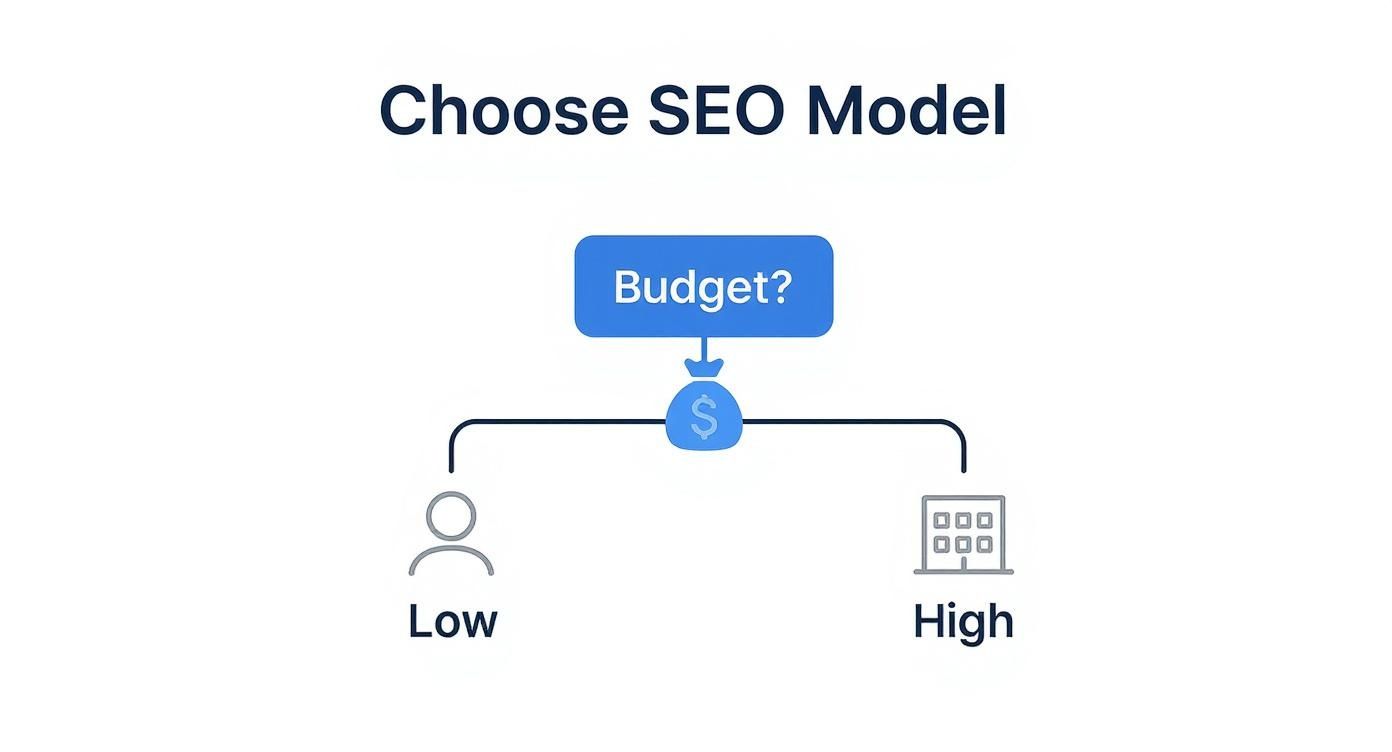
As the decision tree shows, budget is a great starting point, but the final choice really hinges on whether you need hands-on execution or high-level strategic direction.
Cost Structure and Long-Term Value
The investment for each model reflects their different contributions. Agencies usually work on a monthly retainer, with costs that scale based on the services you need. For small businesses in North America, this typically falls between $500 to $5,000 per month. That price covers the hands-on work from their team of specialists.
A fractional CMO is also retainer-based but represents an investment in senior strategic leadership. The monthly cost might be similar to or even higher than a mid-tier agency, but the value is different. You’re paying for C-suite expertise to build a durable marketing function, manage your resources (which might include hiring and directing a more junior agency or freelancers), and drive measurable business growth. To learn more about this model, check out our complete guide to fractional CMO services.
Here’s a real-world example. A US-based SaaS startup boosted its organic demo requests by 150% in just nine months after hiring a fractional CMO. The strategist quickly saw that their agency was targeting keywords that attracted researchers, not buyers. By shifting the strategy toward high-intent, bottom-of-the-funnel topics, they turned SEO from a simple traffic source into a reliable revenue driver.
Making the Right Choice for Your Business Stage
Ultimately, there's no single "best" choice. The right model depends entirely on where your company is right now and where you want it to go. Neither is better than the other; they’re just designed for different problems.
Here’s a straightforward framework to help you decide:
- Choose an SEO Agency if: You already have a solid marketing strategy and just need a dedicated team to execute it. Your in-house leadership has the expertise and time to manage the agency relationship effectively.
- Choose a Fractional CMO if: You're missing senior marketing leadership and need to build a strategy from scratch. You need someone to connect SEO to revenue, manage the marketing budget, and oversee other vendors or functions.
For many scale-ups in Canada and the US, a hybrid approach often works best. A fractional CMO sets the high-level strategy and then hires a specialized boutique agency or a freelancer to handle the day-to-day execution. This ensures every dollar you spend is directly tied to the company's core goals.
Real-World SEO Success Stories

It’s easy to talk about theory, but what really counts is tangible business growth. The right SEO partnership pushes past vanity metrics like traffic and rankings to deliver what actually matters: more leads, more sales, and a healthier bottom line. For businesses in Canada and the United States, seeing these results in action paints a clear picture of what’s possible.
At its core, strategic SEO is about putting your business in front of high-intent customers the moment they’re searching for what you offer. When done right, it’s a powerful engine for growth.
Let's look at a couple of real-world examples of how North American companies drove significant returns by choosing the right SEO partner. These stories show how a focused strategy, whether it’s sharpening local optimization or building out content authority, can directly boost revenue.
Driving Appointments Through Local SEO
For any service-based business, local search is the lifeblood of customer acquisition. A great example comes from the healthcare sector, where a targeted local SEO strategy produced incredible results for an urgent care franchise. They saw a 75% growth in booked appointments and a 61% jump in search impressions.
This didn't happen by accident. Their success was built on a meticulous approach:
- Google Business Profile Optimization: Every location’s profile was buttoned up—accurately listed, filled with reviews, and optimized for local search terms.
- Location-Specific Content: They created service pages and blog posts that spoke directly to the needs of the communities they served.
- Local Link Building: Citations and backlinks were acquired from reputable local directories and community organizations to build regional authority.
This case proves that for businesses with physical locations, mastering local search isn't just an option—it’s a direct path to filling your schedule.
Surging E-commerce Leads With Niche Expertise
The impact of specialized SEO services companies is just as potent in the cutthroat world of e-commerce. By zeroing in on a specific niche, one firm helped a major moving company, Allied Van Lines, achieve a 142% year-over-year increase in organic leads. Even better, they saw a 9.44% increase in organic conversions.
A skilled SEO partner understands that traffic is only the first step. The ultimate goal is converting that traffic into tangible business opportunities, whether it's a booked appointment, a product sale, or a qualified lead for your sales team.
Another client in a different sector experienced a 36% year-over-year increase in organic traffic after bringing on a top-rated agency. These wins highlight the value of deep industry knowledge and custom strategies that go beyond generic SEO advice. You can explore more about the impact of SEO on North American businesses and their growth.
These real-world examples prove that the right SEO partnership delivers a substantial return on investment. The key is finding a team that gets your unique business goals and has the chops to turn them into a winning search strategy.
Ready to write your own success story? Contact us today for a personalized consultation to discuss how we can help you achieve your business goals.
A Vetting Checklist Before You Hire

Making the right hire means doing your homework. When you're sifting through the dozens of SEO services companies out there, you need a structured way to look past the sales pitch and see what’s really under the hood. The goal is to figure out their actual expertise, how they work, and what happens when things inevitably go sideways.
To get there, you need to ask questions that reveal how they think and operate. Generic questions just won’t cut it. This checklist is built to help you probe deeper and find a partner who’s genuinely the right fit for your business.
Remember, you’re not just buying a service. You're investing in a partnership that should drive real growth, and asking the right questions is the first step.
Questions on Strategy and Process
Any half-decent firm can talk about keyword research and link building. What you need to uncover is their strategic brain—how they connect SEO tasks to your actual business goals.
Kick things off with these questions to get a feel for their approach:
- How do you build an SEO strategy for a new client in our industry? Their answer should go way beyond a simple site audit. Look for them to mention understanding your business model, your ideal customers, and who you're up against.
- Walk me through your process for finding revenue-driving keywords, not just vanity ones. This is a big one. It separates the tacticians from the true strategists. A great partner chases search intent that leads to conversions, not just a spike in traffic.
- What's your philosophy on technical SEO, and which tools are in your stack? A site's technical health is the bedrock of any solid SEO program. They should speak confidently about things like site architecture, crawlability, and Core Web Vitals.
A strong answer will show a clear, repeatable process that’s customised for each client, not just a recycled template. For a much deeper look at what separates an expert from the crowd, check out our guide on 12 ways to hire an SEO expert.
Questions About Communication and Reporting
Clear, consistent communication is absolutely non-negotiable. You need a partner who’s transparent about what’s working, what isn’t, and what the results look like. A lack of clarity here is a massive red flag.
A 2023 survey found that 42% of businesses that fired their SEO provider pointed to "poor communication and lack of transparency" as the main reason. This really drives home how crucial it is to get this right from the start.
Use these questions to dig into their communication style and reporting habits:
- What does a typical monthly report look like, and which KPIs do you focus on? They should be talking about business metrics like organic leads and conversion rates, not just obsessing over rankings and traffic numbers.
- How often will we meet, and who will be my main point of contact? This is all about setting expectations for accountability and knowing who to call.
- Tell me about a time a campaign wasn't hitting its goals. What were the exact steps you took to pivot? This question is critical. A great partner will be upfront about challenges and have a process for digging into the data, finding the problem, and adjusting the strategy.
Pay close attention to how they answer that last one. If they get evasive or start pointing fingers, it’s a sign of immaturity. A clear, data-driven explanation, on the other hand, shows you’re talking to a real pro.
Identifying Critical Red Flags
Just as important as asking the right questions is knowing how to spot the warning signs. Some promises and practices are dead giveaways of a low-quality provider who could do more harm than good.
Be very wary of any SEO services companies that:
- Guarantee #1 rankings: Nobody can guarantee a specific spot on Google. It’s an old, unethical sales tactic that has no place in modern SEO.
- Are secretive about their methods: If they can’t clearly explain their link-building or content strategy, they might be using risky, black-hat techniques that could get you penalised.
- Focus only on keywords: Today’s SEO is a comprehensive discipline. It covers technical health, user experience, and content authority—it’s not just about a list of keywords.
By using this checklist, you can get past the polished sales deck and have conversations that reveal a company's true capabilities. This structured approach helps you hire with confidence and find a partner who’s truly invested in your success.
Untangling SEO Pricing and What to Expect for Your Money
Let's talk about the big question: budget. Investing in professional SEO is a major decision, and figuring out what you should actually pay a SEO services company in North America is the first step to making a smart, sustainable choice. The truth is, prices are all over the map, but understanding the common models will help you set realistic expectations from the get-go.
Most firms in Canada and the United States work with one of three pricing structures: monthly retainers, project-based fees, or hourly rates. For ongoing SEO work—the kind that builds real momentum—monthly retainers are the standard. They give you a predictable budget for continuous optimisation, content work, and strategy tweaks. Project fees are better for one-off jobs, like a deep-dive technical audit or a specific content campaign.
Understanding the Common Pricing Models
When you're looking at proposals, you have to look past the price tag and see the value you’re getting. Rock-bottom pricing almost always ends in disappointment because quality SEO takes a ton of expertise, time, and resources.
- Monthly Retainers: The best option for long-term growth. These packages cover a defined scope of work each month, which allows for steady, consistent progress.
- Project-Based Fees: Perfect for well-defined tasks. This model gives you a fixed price for a specific outcome, like a website migration or a full backlink audit.
- Hourly Consulting: This gives you access to an expert's brain on an as-needed basis. It's a great fit for companies with in-house teams who just need some strategic direction.
Be wary of anyone promising the world for a few hundred dollars. In this industry, you really do get what you pay for.
Setting a Realistic Budget and ROI Expectations
So, how much should you budget? While every business is unique, industry data gives us a pretty good benchmark. The average hourly rate for SEO companies in California, for example, floats between $100 and $300. Data also shows that businesses spending just $500 per month on SEO are 75% more likely to be unhappy with the results compared to those investing more. That stat alone tells you a lot about the importance of budgeting for quality.
With 65% of California’s small businesses already working with SEO partners, a smart investment isn't just an advantage; it's essential to keep up. You can find more California SEO spending statistics on DigitalSilk.com.
The real ROI in SEO isn’t just about more traffic. It's about driving tangible business outcomes—more qualified leads, more sales, and long-term brand equity that delivers a return well beyond what you initially spent.
A good conversation about budget shouldn't start with you asking for the cheapest package. Instead, tell a potential partner what you want to achieve. That allows a quality firm to build a strategy that will actually deliver results, turning your SEO spend from an expense into a powerful growth driver.
Ready to invest in an SEO strategy that delivers a clear return? Contact us today for a quote tailored to your business needs.
Got Questions About Finding an SEO Partner?
When you’re vetting SEO services companies, a few key questions always come up. Getting straight answers is crucial for making a decision you can feel good about, whether your business is in Canada or the United States. This section tackles the most common ones head-on.
Choosing the right partner means getting real about timelines, knowing what to measure, and figuring out the best working relationship for your specific needs.
How Long Does It Take to See SEO Results?
While you might spot small wins within a few weeks, a properly built SEO strategy usually needs four to six months to deliver significant, lasting results. This isn't just about waiting around; that time is essential for doing the foundational work right—deep audits, creating genuinely useful content, and building authority.
Search engines need time to crawl, index, and ultimately reward all that effort. Things like your website's history, how fierce the competition is in your industry, and the ambition of your strategy all play a role. Think of SEO as a long-term asset, not a quick hit for instant traffic.
What Are the Most Important B2B SEO KPIs?
For B2B companies, traffic is just vanity. Success is about driving real business outcomes. Your key performance indicators (KPIs) have to reflect that by zeroing in on metrics that lead to revenue.
Here are the B2B KPIs that actually matter:
- Organic Lead Generation: Think demo requests or contact form submissions from qualified prospects who are ready to talk.
- Conversion Rate: What percentage of your organic visitors turn into marketing qualified leads (MQLs)?
- Keyword Rankings: Specifically, for high-intent commercial terms that show a user is in a buying mindset.
- Backlink Profile Quality: Are you earning links from authoritative, relevant sources in your industry? That’s what counts.
Tracking these ensures your SEO efforts are directly feeding your sales pipeline and contributing to the bottom line.
Should I Hire a Local SEO Company?
If your business primarily serves a specific geographic market in the US or Canada, then yes—hiring a local SEO company can be a huge advantage. Take California, for example, where a deep understanding of the regional market is a major factor for local businesses. According to industry data, most California companies pick SEO providers based on reputation and proximity. You can dig into more of California's SEO provider trends on Clutch.co.
But for businesses with a national or international footprint, deep industry expertise and a proven track record often trump physical location. The real goal is to find a partner who gets your target audience inside and out, wherever they are.
Ready to stop asking questions and start seeing results? The team at B2Better provides the strategic leadership to build an SEO program that drives real growth. Contact us for a personalized consultation today.