

Ecommerce SEO is the engine that drives your online store’s visibility in search results, pulling in more organic, non-paid traffic. It’s a strategic process that involves fine-tuning everything from your site’s technical backbone and product pages to your broader content strategy. The end game? To connect with high-intent shoppers in the United States and Canada the exact moment they’re searching for products just like yours. A staggering 93% of all online experiences begin with a search engine, making SEO an indispensable channel for North American businesses.
Why Ecommerce SEO Is Your Greatest Growth Lever
Imagine your online store isn’t just a website, but a flagship location on the busiest digital street in North America. That’s the power of strategic ecommerce SEO. Paid advertising can get you temporary visibility—much like renting a billboard on a highway—but it demands constant investment to keep traffic flowing. The second you stop paying, the visitors vanish. That model simply isn’t sustainable for long-term, profitable growth.
SEO, on the other hand, is all about building a permanent, high-value asset for your brand.
Think of it like this: Paid ads are like buying groceries. You get food for today, but you have to go back to the store and pay again tomorrow. SEO is like planting a fruit tree. It takes some upfront effort and patience, but over time, it yields a compounding return—a consistent harvest of high-intent customers for years to come.
Building a Sustainable Traffic Engine
For businesses in Canada and the United States, the real challenge is attracting a steady stream of customers who are actively looking to buy. This is where a dedicated ecommerce SEO service truly shines. It’s laser-focused on capturing traffic that isn't just high in volume but high in intent. These are the shoppers typing queries like “buy industrial-grade widgets in Ontario” or “best B2B software supplier California,” signalling a clear desire to make a purchase.
The results of this focused approach can be dramatic. One B2C ecommerce brand in the United States saw a 658% increase in organic revenue in just seven months after implementing a comprehensive SEO strategy. This success story is part of a larger trend, as over 2.54 million small businesses in California alone now sell online, making strategic SEO a critical differentiator. You can explore more about these ecommerce platform statistics and their impact.
SEO is not just a technical task; it is the fundamental engine for building a defensible, profitable, and scalable ecommerce brand. It moves your business from a position of renting attention to one of owning your audience.
By investing in ecommerce SEO services, you're not just optimizing a website. You are building a predictable and cost-effective customer acquisition channel that drives sustainable revenue.
Ready to build a powerful growth engine for your store? Contact us today to discuss a custom ecommerce SEO strategy.
The Four Pillars of a Winning Ecommerce SEO Strategy
A powerful ecommerce SEO strategy isn't a single action. It’s a coordinated effort built on four interconnected pillars. When these components work together, they create a robust structure that drives sustainable traffic and revenue for businesses in both Canada and the United States.
Think of it like constructing a high-performance retail storefront: every single piece has a crucial role to play. Let's demystify each component, connecting it directly to tangible business outcomes. A comprehensive ecommerce SEO service doesn't just focus on one area but ensures all four pillars are strong and mutually supportive.
The flowchart below breaks down how organic growth through SEO stacks up against paid advertising, highlighting its role as a core business asset.
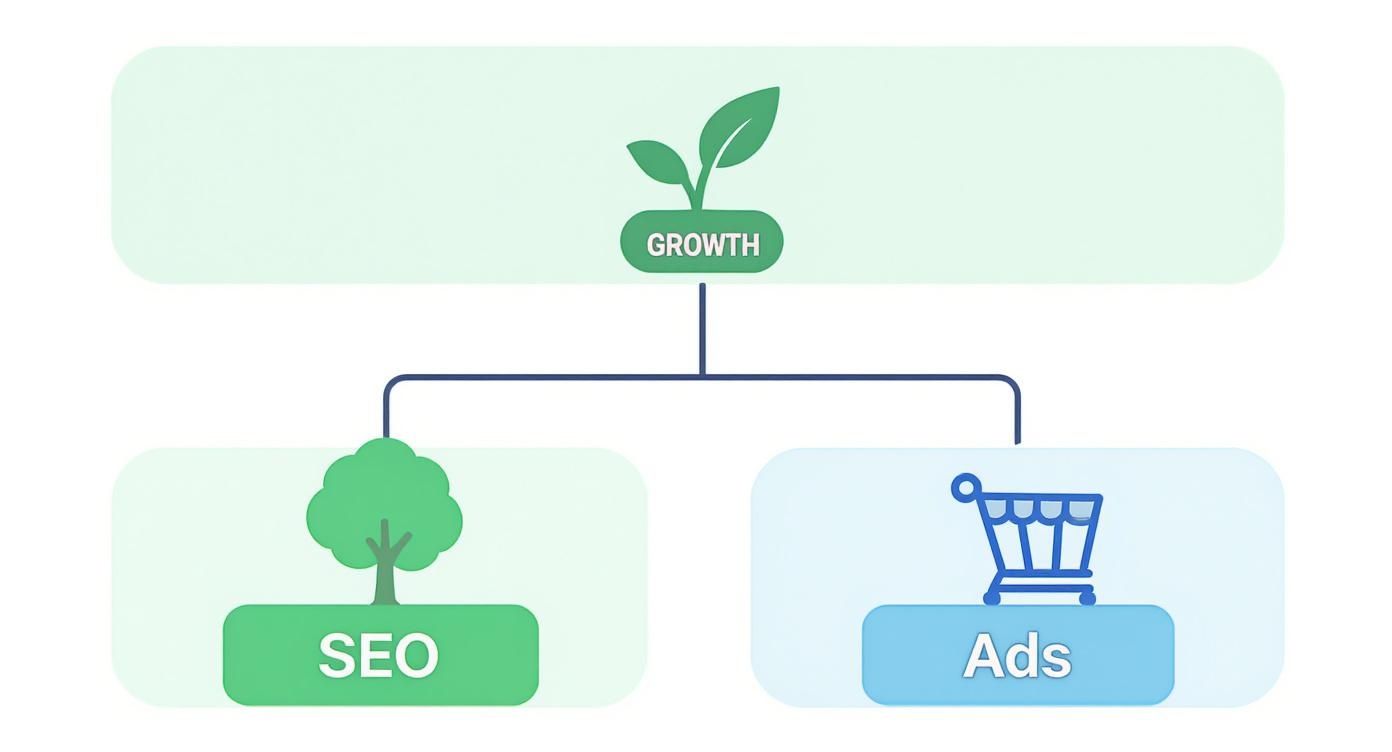
While ads offer a temporary boost in visibility, SEO builds a lasting foundation for growth. It’s like planting a tree that produces fruit year after year.
Let's break down the four essential components of a successful ecommerce SEO strategy and their direct business impact.
| SEO Pillar | Core Activities | Business Goal |
|---|---|---|
| Technical SEO | Site speed, mobile-friendliness, crawlability, security, schema markup. | Ensure search engines can find, understand, and rank your site. |
| On-Page & Product SEO | Keyword optimization, compelling product descriptions, alt text, internal linking. | Turn your product pages into high-converting sales assets. |
| Content & Authority | Buying guides, blog posts, case studies, link building. | Build trust with customers and establish your brand as an industry leader. |
| Conversion Rate Optimization | A/B testing, user experience (UX) analysis, checkout streamlining. | Convert more visitors into paying customers, maximizing traffic value. |
When you build a strategy that integrates all four pillars, you create an unstoppable growth engine. Now, let’s dig into what each one really means for your business.
Pillar 1: Technical SEO
Technical SEO is the foundation of your entire digital store. If search engines like Google can't easily crawl, understand, and index your website, even the most brilliant products and content will remain invisible. This pillar is all about making sure your site is fast, secure, and structurally sound.
A key piece of this puzzle is page speed. Research from Deloitte shows that a mere 0.1-second improvement in site speed can boost conversion rates by 8.4% for retail sites. For an online store in the competitive U.S. and Canadian markets, that's a direct hit to the bottom line. Our services focus on optimizing code, compressing images, and ensuring a seamless mobile experience—which is critical, since mobile commerce is projected to account for over 44% of all ecommerce sales in the United States by 2025.
Pillar 2: On-Page and Product SEO
Think of this as your digital merchandising. On-page SEO involves optimizing every element on your product and category pages—from titles and descriptions to image alt text—to attract and convert shoppers. It’s about speaking the same language as your customers and the search engines.
Effective product page optimization can yield some seriously impressive results. For instance, by refining product titles and descriptions with high-intent keywords, a B2B supplier in Canada can see a dramatic increase in qualified traffic. Research confirms that 43% of all ecommerce traffic comes from organic search, highlighting the immense value of perfectly tuned pages.
A well-optimized product page does more than just rank; it acts as your best salesperson, answering customer questions and guiding them directly to checkout, 24/7.
For those looking to go deeper, our complete guide on how to improve SEO offers more advanced techniques for on-page success.
Pillar 3: Content and Authority Building
Content is how you build your brand's reputation and authority online. This isn't just about blogging; it includes creating in-depth buying guides, comparison posts, and helpful articles that answer your customers' most pressing questions. This pillar establishes you as a trusted expert in your industry.
High-quality content is also the number one driver for earning backlinks—links from other reputable websites pointing to yours. These are like votes of confidence that tell search engines your site is a credible source. A great example is TheBattery.com, which, through a strategy focused on SEO-friendly architecture and killer content, now generates 77% of its sales from organic traffic alone, a massive success for a U.S.-based company.
Pillar 4: Conversion Rate Optimization
Finally, Conversion Rate Optimization (CRO) is your sales floor strategy. It’s not enough to just get traffic; you need to turn those visitors into buyers. This pillar involves analyzing user behaviour, A/B testing elements like buttons and headlines, and streamlining the checkout process to remove any friction.
Improving your site's CRO can have a massive impact on your revenue. For instance, Walmart Canada saw a 20% increase in conversions simply by optimizing their site design and speed for a better user experience. Small, data-driven changes can lead to significant revenue growth, ensuring your SEO efforts translate directly into sales. Contact us to learn how we can optimize your conversion rates.
How to Choose the Right Ecommerce SEO Agency
Picking a partner to handle your ecommerce SEO is a massive decision. Get it right, and they become a true growth engine for your business. Get it wrong, and you're just burning time and money. This guide lays out a practical checklist for US and Canadian companies to cut through the noise and find an agency that actually gets your market.

It’s about looking past the slick pitches and finding a team that understands the nitty-gritty of ecommerce. A real partner focuses on business outcomes—revenue, profit, growth—not just vanity metrics like traffic.
Look for North American Success Stories
Your first filter should be experience. Does this agency have a track record with businesses like yours, specifically in Canada and the United States? The digital markets here have their own unique consumer behaviours, search trends, and competitive headaches. An agency with proven success in North America already speaks the language.
Ask to see specific case studies from their US or Canadian clients. A great success story isn't just about traffic going up; it's about measurable business growth. For instance, a campaign for a Toronto-based apparel brand that led to a 150% jump in organic revenue after they overhauled product pages and built strategic links—that’s the kind of result that shows a direct impact on your bottom line. We have a portfolio of such successes; contact us to see them.
Scrutinize Their Audit and Strategy Process
Any ecommerce SEO agency worth its salt will never pitch a cookie-cutter solution. Their process should kick off with a deep-dive technical and strategic audit of your website. This initial analysis is a huge tell—it reveals their depth of expertise right away.
A flimsy audit that only flags surface-level problems is a major red flag. A proper audit should dig into the foundations:
- Site Architecture: Is your site logically structured for both users and search engine crawlers? Can a customer find any product in three clicks or less?
- Indexing and Crawlability: Are there technical roadblocks stopping Google from properly finding and ranking your most important pages?
- Page Speed and Core Web Vitals: How does your site perform on mobile and desktop? A slow site kills conversions, and with 43% of all ecommerce traffic in North America coming from organic search, you can't afford to drive those visitors away.
- Content Gaps: Where are your competitors in the U.S. and Canada beating you, and what content opportunities are you completely missing out on?
A thorough audit isn't just a sales tool; it's the blueprint for your entire SEO strategy. It should lay out a clear, data-backed plan that directly connects technical fixes and content efforts to your specific revenue goals.
Ask the Right Questions to Find a Partner
To separate the true strategic partners from the service providers, you need to ask questions that go beyond the basics. Their answers will show you everything you need to know about their approach, transparency, and whether they’re truly aligned with your business.
Use this checklist during your evaluation calls:
- How do you measure SEO ROI beyond traffic and rankings? Their answer should immediately pivot to metrics like conversion rate, average order value, and the lifetime value of customers coming from the organic channel.
- What’s your process for aligning SEO goals with our actual business objectives for the Canadian/U.S. market? Look for a collaborative approach. They should want to understand your sales cycle, profit margins, and even your inventory priorities.
- Can you walk me through your communication and reporting structure? Transparency is non-negotiable. You should expect regular, clear reports that translate SEO data into business insights you can actually use.
- How do you approach content creation and building authority in North America? A strong answer will go way beyond just blogging. It should cover how they plan to use content to earn backlinks and build trust, a core pillar of effective website content optimization services.
Choosing the right ecommerce SEO provider is a serious investment in your company’s future. Taking the time now to properly vet your options will pay off for years to come. Contact us to start the conversation.
Understanding SEO Pricing and Calculating Your ROI
Investing in professional ecommerce SEO services isn't just another line item on your marketing budget—it's a strategic decision to build a long-term revenue engine. But to make a smart choice, you need to get comfortable with the numbers. What do these services actually cost, and more importantly, what kind of return can you realistically expect?
The goal isn't to simply spend money on SEO. It's to generate a predictable, profitable stream of customers for your Canadian or U.S. business.

Let's pull back the curtain on how agencies price their work and, crucially, how you can forecast the real financial impact of a well-run SEO campaign.
Common Pricing Models for Ecommerce SEO Services
When you start talking to potential SEO partners, you'll run into three main pricing models. Each has its place, and the best fit for you will depend on your company's growth stage, specific goals, and the resources you have in-house.
- Monthly Retainers: This is the go-to model for ongoing ecommerce SEO. You pay a fixed fee each month for a defined scope of work, covering everything from technical monitoring and content creation to link building and reporting. It’s perfect for long-term, sustainable growth because SEO is a marathon, not a sprint.
- Project-Based Fees: Got a specific, one-time need? A project-based fee makes the most sense. This is ideal for things like a deep-dive technical audit, a complex website migration, or a targeted content push. You pay a flat rate for a clearly defined outcome and timeline.
- Hybrid Models: Some agencies offer a blend of both, combining a lower monthly retainer for the foundational work with project-based fees for bigger initiatives. This gives you flexibility, letting you dial your investment up or down for seasonal campaigns or special projects.
In competitive North American markets, monthly retainers can run from a few thousand dollars to well over ten thousand, all depending on the scope and intensity of the campaign. For a deeper look, our guide on search engine optimization services cost breaks it down even further.
Calculating Your SEO Return on Investment
Here's the million-dollar question: "What am I going to get back for this?" While calculating the ROI of SEO isn't as instant as it is with paid ads, it's far more powerful in the long run. The good news is you can build a solid forecast using numbers you already have.
The real value of SEO isn't just driving traffic; it's about attracting the right traffic and turning those visitors into profitable customers. Your ROI calculation should tie every SEO effort directly to your bottom line.
To get a basic projection, you only need three key metrics from your business:
- Average Order Value (AOV): How much does a typical customer spend in one transaction?
- Average Conversion Rate: What percentage of your website visitors end up making a purchase?
- Projected Organic Traffic Growth: Based on the proposed SEO strategy, what's a realistic estimate for the increase in monthly visitors?
Let's walk through a quick example for a U.S.-based business. Imagine your AOV is $150, your conversion rate is 2%, and a new SEO campaign is projected to bring in an additional 5,000 organic visitors per month after six months.
The math looks like this:
5,000 new visitors x 0.02 (2% conversion rate) = 100 new orders per month
100 new orders x $150 (AOV) = $15,000 in new monthly revenue
This simple framework shows you exactly how SEO translates into sales, turning a marketing concept into a concrete financial forecast.
The Compounding Power of SEO ROI
Here's the best part. Unlike paid ads, where your visibility vanishes the second you stop paying, the value of SEO compounds. The content you publish and the authority you build become permanent assets for your brand, continuing to attract customers without any ongoing ad spend.
This compounding effect is why SEO consistently delivers a higher long-term ROI than other channels. Statistics show the average ROI for ecommerce SEO hits 2.6x after 12 months, climbs to 3.8x after 18 months, and can reach an impressive 5.2x after three years. That performance handily beats channels like Google Ads and Meta Ads over the same timeframe, with most businesses hitting their break-even point between 8 and 9 months.
When you invest in ecommerce SEO services, you’re not just buying clicks—you're building an appreciating asset that will fuel your company's growth for years to come. Ready to calculate your potential ROI? Contact us for a personalized projection.
Real Success Stories from North American Brands
Theory is one thing, but seeing the real-world impact of professional ecommerce SEO services is what really counts. The right investment can deliver measurable, game-changing results for businesses across the United States and Canada. These stories go beyond abstract metrics to show you what tangible growth in revenue, leads, and market position actually looks like.
Let's look at how a targeted approach transforms an online store from just another website into a powerful sales engine. The following examples highlight what becomes possible when a skilled SEO partner digs into a brand's unique challenges and opportunities.
Doubling Qualified Leads for a US B2B Supplier
Take the case of a B2B industrial parts supplier based in the American Midwest. Their problem was a classic one: they had a fantastic catalogue of specialized products but were invisible to the engineers and procurement managers actively searching for them. Their website attracted generic, low-quality traffic that almost never turned into actual sales inquiries.
The fix was a highly focused ecommerce SEO campaign centred on niche, high-intent keywords. The strategy involved:
- Deep Keyword Research: We’re not talking about broad terms like "buy bolts." The team identified the precise technical phrases that qualified buyers in the U.S. use, such as "high-tensile steel bolts manufacturer Ohio."
- Technical Optimization: The website's architecture was completely restructured, making it far easier for search engines to crawl and index thousands of specific product pages.
- On-Page SEO: Product descriptions and category pages were rewritten to answer technical questions directly, instantly positioning the company as an expert resource.
The result? A 110% increase in qualified organic leads in just nine months. By zeroing in on the right audience, not just more traffic, every visitor was more likely to become a valuable customer. It’s a perfect example of how a precise SEO strategy directly fuels a B2B sales pipeline in the United States.
Boosting Revenue for a Canadian Apparel Brand
Another powerful success story comes from a direct-to-consumer apparel brand based in Canada. They had a loyal social media following, but their organic search presence was weak, forcing them to rely on expensive paid ads to drive sales. Their goal was to build a more sustainable and profitable way to acquire customers.
The core of their strategy was to transform their product pages from simple listings into comprehensive buying guides, backed by a strategic link-building effort to build authority.
This meant detailed product page optimizations, integrating user-generated content like reviews and photos, and creating supporting blog posts that helped shoppers choose the right sizes and styles. Paired with a campaign to earn backlinks from reputable Canadian fashion blogs, the results were stunning. The brand saw a 150% increase in organic revenue in just one year, dramatically reducing how much they had to spend on ads.
These wins aren't flukes. Case studies from top agencies consistently show that strategic SEO investments yield dramatic results. For instance, one U.S. agency helped a client achieve a 10x boost in organic traffic in a single month, while another reported an 898% increase in keyword rankings on page 1 for a major eCommerce site. You can get more insights on the correlation between SEO spend and success.
These stories prove that with the right ecommerce SEO services partner, you aren't just improving rankings; you are building a foundational asset that drives real, sustainable business growth.
Ready to write your own success story? Contact us today for a no-obligation consultation.
Your Next Steps to Dominate Organic Search
Knowing the principles of ecommerce SEO is one thing, but real growth comes from taking decisive action. This is the moment where you turn that knowledge into a tangible strategy—the very thing that separates market leaders from everyone else.
For any serious ecommerce business in Canada or the United States, the path forward starts with a clear, honest look at your current digital footprint and future potential. The digital shelf is crowded, and just existing online isn’t a strategy. Success demands a proactive approach built on data, not guesswork.
Create Your Action Plan
Start by turning what you've learned into a straightforward checklist. This internal roadmap keeps your entire team aligned and focused on the same growth objectives.
- Audit Your Foundation: Get a real look at your site’s technical health and on-page SEO. Are your product pages actually set up to convert? Is your site fast enough on mobile? A great success, like that of a Canadian retailer who saw a 150% revenue jump, always starts with a solid foundation.
- Analyze the Competition: Pinpoint who’s winning the organic search battle in your U.S. or Canadian niche. It’s time to deconstruct their strategy and find out why it works.
- Define Your ROI: Use your average order value and conversion rate to set clear revenue goals for your SEO investment. What does success actually look like in dollars and cents?
The most critical next step is to get an expert, outside perspective on where you currently stand. A professional audit uncovers the hidden opportunities and critical issues holding you back from your true potential.
For businesses in competitive North American markets, a custom strategy is non-negotiable. One of our Canadian retail clients, for example, saw a 150% increase in organic revenue after we rolled out a targeted product page optimization and link-building campaign. That kind of success always starts with a professional assessment.
Information is only powerful when you act on it. We can help you build a customized roadmap to unlock sustainable growth and start dominating your market.
Ready to see how your store stacks up? Contact us today to schedule your complimentary, no-obligation SEO audit and strategy session. Let's build your path to organic search dominance together.
Frequently Asked Questions About Ecommerce SEO
If you're navigating the world of ecommerce SEO in Canada or the United States, you’ve probably got questions. Here are a few of the most common ones we hear from business owners, along with some straight-shooting answers to help you decide on your next move.
How Long Does Ecommerce SEO Take to Show Results?
While a few technical fixes can give you a noticeable bump in weeks, the real, meaningful gains in organic traffic and revenue usually take between six to twelve months. Think of it like building a valuable asset—the initial work lays a solid foundation, and the value compounds from there, creating a sales channel that works for you long-term.
Unlike paid ads that vanish the moment you stop paying, the benefits of good SEO keep growing. A U.S.-based home goods brand, for example, saw their organic traffic triple year-over-year after a sustained 12-month SEO campaign. Most businesses we see in North America start hitting a positive return on their investment right around the eight-month mark.
Is SEO a Better Investment Than Paid Ads?
They’re different tools for different jobs, and they work best together. Paid ads are fantastic for getting immediate traffic for a specific product launch or a seasonal campaign. SEO, on the other hand, is your foundational strategy for building long-term, “free” traffic and cementing your brand’s authority in the market.
A healthy marketing mix uses SEO as the engine for sustainable, profitable growth, while using paid ads for targeted, short-term boosts. When it comes to long-term ROI, SEO consistently outperforms paid channels, with some studies showing SEO can generate over 5 times the conversions of paid advertising.
What Kind of ROI Can I Realistically Expect?
Your return on investment will vary based on your industry and how fierce the competition is, but the data tells a pretty compelling story. As we touched on earlier, studies show ecommerce SEO services average an ROI of 2.6x after the first 12 months. Stick with it, and that can climb to an impressive 5.2x after three years.
We saw this firsthand with a Canadian apparel brand. After investing in strategic product page optimization and building up their authority, they saw a 150% jump in organic revenue within a single year. It’s a direct line from a focused SEO strategy to your bottom line.
My Store Is on Shopify. Do I Still Need SEO Services?
Absolutely. While platforms like Shopify and BigCommerce offer some basic SEO tools out of the box, they’re no substitute for a comprehensive, professional strategy. They give you the essential features, but you need a lot more to claim top rankings in the competitive US and Canadian markets.
A dedicated ecommerce SEO service digs into the advanced technical optimization, deep competitor analysis, strategic content creation, and authority building that make you stand out. One successful U.S. brand on Shopify increased their organic sales by $1.6 million in one year by partnering with an expert SEO agency. It’s the difference between just having a store and having a store that consistently pulls in your ideal customers.
Ready to get clear answers tailored to your business? The team at B2Better can build a customized roadmap to help you unlock sustainable growth through organic search. Contact us today for a no-obligation consultation.