

Marketing services are the professional activities that help small businesses build brand awareness, generate qualified leads, and foster customer loyalty. Think of them as the engine that powers your growth, turning a great product into a profitable enterprise. A study by Deloitte found that high-growth small businesses are twice as likely to prioritize marketing compared to their slower-growing counterparts, highlighting its crucial role.
Why Marketing Services Are a Strategic Investment
In a crowded market, having an excellent product or service simply isn’t enough anymore. Your business might be a hidden gem, but if customers don't have a map, it will remain undiscovered. This is where professional marketing services stop being an expense and become a core business function—one that generates a significant return.
Many small business owners hit the same walls: not enough time, limited resources, and no specialized marketing expertise in-house. Juggling operations, sales, and customer service leaves little room to master the complexities of SEO, content creation, or paid advertising. The conversation needs to shift from, "Can I afford this?" to "How can I afford not to do this?"
From Expense to Essential Growth Driver
A true marketing partner doesn't just run campaigns; they tackle fundamental business goals head-on. Their expertise is laser-focused on creating measurable outcomes that directly impact your bottom line. Instead of guessing what works, you get a data-driven approach designed for sustainable growth.
Here’s where professional marketing services really deliver value:
- Building Brand Visibility: Making sure your ideal customers know who you are and what you stand for.
- Generating Qualified Leads: Attracting potential customers who are genuinely interested in your solutions.
- Fostering Customer Loyalty: Creating relationships that turn one-time buyers into lifelong advocates.
- Optimizing Spend: Ensuring every marketing dollar is invested efficiently for the highest return. Understanding this is critical, and our guide on how to calculate customer acquisition cost is a great place to start.
A Real-World Success Story
Consider a local B2B tech firm that was struggling to get noticed. By partnering with a marketing service, they developed a targeted content strategy and a sharp SEO plan. The result? Within six months, they achieved a 150% increase in qualified leads, and their organic website traffic tripled. This wasn't magic; it was the result of a deliberate, expert-led strategy.
Investing in marketing is not just about spending money—it's about making a calculated investment in your company's future. The right strategy doesn't just find customers; it builds a predictable pipeline for revenue growth.
The competitive landscape for small businesses is intense. In Canada, 99.8% of all businesses are small businesses, collectively employing millions and driving the economy forward. This sheer volume highlights just how crucial effective marketing is for survival and expansion.
Ultimately, engaging professional marketing services is about bringing on a strategic partner dedicated to your growth. It’s an investment in expertise, efficiency, and—most importantly—results. To see how a strategic partner can transform your business, contact us today.
To help clarify which services align with your business objectives, the table below matches common goals with their corresponding marketing solutions.
Core Business Goals and Marketing Service Solutions
| Business Goal | Primary Marketing Service | Expected Outcome |
|---|---|---|
| Increase Brand Awareness | Content Marketing & Social Media | Greater visibility in your target market |
| Generate More Leads | SEO & Paid Media (PPC) | A steady stream of qualified inquiries |
| Improve Sales Conversion | Marketing Strategy & Analytics | Higher win rates and a lower cost per acquisition |
| Boost Customer Retention | Social Media & Email Marketing | Increased repeat business and customer lifetime value |
| Establish Thought Leadership | Content Marketing & Fractional CMO | Recognition as an industry authority and trusted expert |
This framework shows how a tailored mix of services can directly support your most critical growth targets, creating a clear path from investment to return.
The Marketing Services That Actually Fuel Small Business Growth
Diving into the world of marketing can feel like learning a whole new language. With countless channels and tactics popping up, it’s easy for a small business owner to get completely overwhelmed. The secret? Stop chasing every shiny new trend and focus on the fundamentals that consistently deliver results.
The most effective marketing services don't work in isolation; they’re part of a powerful, interconnected growth system. By understanding the three core pillars—Search Engine Optimisation (SEO), Content Marketing, and Paid Media—you can build a strategy that attracts, engages, and converts the right customers.
Let's break down exactly what these services do and how they create real, sustainable momentum for your business.
Search Engine Optimisation (SEO): Your Digital Storefront
Think of SEO as the work you do to move your shop from a quiet back alley to the busiest spot on main street. When a potential customer searches Google for something you offer, SEO is what makes sure your website shows up right at the top. Without it, you’re practically invisible.
And that visibility is non-negotiable, because a staggering 93% of all online experiences begin with a search engine. SEO involves fine-tuning your website's structure, content, and authority so that search engines like Google see you as the most credible answer to a user's problem. It’s not an overnight fix; it's a long-term strategy that builds a steady, reliable stream of free traffic.
Take a local bakery in Waterloo, Ontario. They used local SEO to spruce up their Google Business Profile with sharp photos, accurate hours, and glowing customer reviews. Within just three months, they were ranking in the top three for "best croissants near me" and saw a 40% spike in foot traffic that came directly from search. That’s the power of being the first and best answer your customers find.
Content Marketing: The Art of Building Trust
If SEO gets people to your front door, content marketing is the expert inside who builds relationships and trust without ever being pushy. It’s all about creating and sharing genuinely useful articles, videos, and guides that solve your customers' biggest headaches. This positions your business as a helpful authority, not just another vendor.
Instead of shouting "buy my stuff," you're providing real value first. And it works. A business that consistently puts out helpful content finds that 61% of consumers are more likely to buy from them. You’re not just making a sale; you’re educating a loyal community that sees you as the go-to expert.
"Blogging can help establish your expertise in your field. Posting valuable content consistently helps people identify your business as a useful resource, resulting in repeat viewership. This can send signals to search engines like Google that your site is a quality source."
A B2B software startup, for example, created a series of deep-dive blog posts analysing industry trends. The articles were so insightful that other industry publications started linking to them. This not only gave their SEO a massive boost but also generated high-quality leads from decision-makers who now saw them as a credible, authoritative voice.
Paid Media: Getting in Front of the Right People, Right Now
Paid media, often called Pay-Per-Click (PPC), is like placing a perfectly crafted ad directly in your ideal customer's path at the exact moment they need you. While SEO is a slow burn that builds momentum over time, paid media delivers immediate, targeted visibility. You can be at the top of Google search results or in social media feeds within hours.
This strategy lets you zero in on potential customers with incredible precision, targeting them based on their demographics, interests, and online behaviour. The data is clear: for every $1 spent on Google Ads, businesses earn an average revenue of $2. It's a direct, measurable path to driving traffic and sales.
A great example is a small e-commerce boutique that used targeted Facebook and Instagram ads to launch a new clothing line. By targeting users who had already visited their site or shown interest in similar brands, they hit a 500% return on ad spend and completely sold out the collection in just two weeks.
These core marketing services aren't independent silos; they are interconnected gears in a larger growth machine. SEO makes you findable, content marketing makes you trustworthy, and paid media accelerates your reach. When you combine them strategically, you create a powerful, self-sustaining system for attracting and keeping customers.
Ready to see how these essential services can fuel your business? Contact us today for a complimentary consultation, and let's build your roadmap to sustainable growth.
How Digital Marketing Delivers Tangible Results
The real value of marketing services isn't found in theory; it's measured in tangible, bottom-line results. Good digital marketing isn't about just "getting your name out there"—it’s about creating a predictable system for attracting customers and driving sales. When done right, every dollar you invest is designed to deliver a measurable return.
This direct line between action and outcome is especially powerful for businesses serving a local community. Mobile and online searches are now central to how customers find and choose businesses nearby. The impact of this shift is huge, creating a massive opportunity for small businesses ready to seize it.
Turning Clicks into Customers
The path from a potential customer’s online search to an actual sale is shorter than you might think. A recent report found that 76% of people who search for something nearby on their smartphones visit a related business within a day. Even better, 28% of those searches result in a purchase, showing the immense power of a well-optimised local presence. You can read the full report on how mobile strategies impact the California economy from the California Chamber of Commerce to get a deeper understanding.
This data proves that effective digital marketing isn't a passive activity. It actively guides interested buyers straight to your doorstep—whether that’s a physical store or your website. By making sure your business is visible and compelling at that critical moment of decision, you turn online interest directly into revenue.
Success Story From a B2B Consulting Firm
To see how this works in a B2B context, think about a small consulting firm struggling to connect with high-value clients. Their expertise was top-tier, but their lead pipeline was all over the place. By rolling out a focused strategy that combined insightful content on LinkedIn with targeted SEO, they completely changed their trajectory.
This dual approach positioned them as industry leaders while making sure they showed up in search results for key decision-makers. The outcome? A 300% increase in qualified leads in just over six months. This wasn't luck; it was the direct result of using the right marketing services to reach the right audience with the right message.
Success Story From a Local Retail Boutique
The same principles apply directly to brick-and-mortar businesses. A local retail boutique wanted to increase foot traffic and compete with larger chain stores. They started by fully optimising their Google Business Profile, making sure their hours, photos, and reviews were pristine.
Next, they ran hyper-local social media ads targeting shoppers within a five-kilometre radius who had shown interest in similar fashion brands. This one-two punch of being easily findable and proactively reaching out led to a 50% increase in in-store foot traffic within the first quarter. It just goes to show how foundational digital marketing services can produce powerful, localised results.
These examples are not outliers; they are illustrations of what happens when a clear strategy is applied with expertise and consistency. The right marketing partner translates your business goals into measurable actions and tangible growth.
Ready to see how a strategic approach can deliver these kinds of results for your business? Learn more about the specific digital marketing services that drive growth.
The evidence is clear: professional marketing services are an engine for growth, not just an expense. Whether you're a B2B firm chasing qualified leads or a local shop trying to boost sales, the right strategies deliver a powerful and measurable return.
Contact us today for a free consultation to discuss how we can help your small business achieve tangible results.
Choosing the Right Marketing Partner for Your Business
Deciding who will run your marketing is a huge call—one that hits both your budget and your growth trajectory. As you dig in, you’ll find three main paths forward, each with its own pros and cons. Let’s break them down so you can find the perfect fit.
The choice usually comes down to hiring an in-house marketer, partnering with a full-service agency, or bringing in a flexible freelancer or consultant. There's no single "right" answer; the best option depends entirely on your company's current stage, your team's capacity, and where you want to be in a year.
The In-House Hire: Deep Immersion with a Narrower Focus
Bringing a marketer onto your payroll means they live and breathe your company culture, products, and customer stories every single day. That deep immersion is tough to beat and often leads to marketing that feels genuinely authentic and aligned with your brand.
But this approach usually means you're hiring for a narrower skill set. It’s almost impossible to find one person who’s a true expert in SEO, paid ads, content writing, and analytics. The costs are also significant, going way beyond salary to include benefits, training, and equipment. This route works best for companies with a stable budget that need a dedicated, deeply integrated marketing presence.
The Marketing Agency: A Team of Specialists on Demand
Partnering with a full-service marketing agency is like getting an entire marketing department overnight. You immediately tap into a team of specialists—from SEO analysts and content creators to graphic designers and ad strategists. This sheer breadth of expertise is a massive advantage, as agencies are constantly solving diverse problems for clients and have to stay on top of industry trends.
A great example is a scale-up tech company that needs to launch a new product. An agency can execute a multi-channel campaign spanning SEO, content, and paid ads, driving results like a 400% return on investment in the first six months. That kind of coordinated, expert-led push is incredibly hard to replicate in-house. The trade-off? A higher monthly retainer and the need to manage the agency closely to keep them locked in on your specific business goals.
The Freelancer or Consultant: Flexible, Targeted Expertise
Hiring a freelancer or consultant gives you specific expertise exactly when you need it. This model is perfect when you have a well-defined need, like a content writer for a blog project or a paid media specialist to run a short-term campaign. It’s cost-effective and lets you scale support up or down as your needs change.
"For businesses that need senior-level strategy but can't yet justify a full-time executive salary, a fractional approach provides C-level guidance without the overhead. This bridges a critical gap for many growing companies."
This flexible partnership is also an excellent way to access high-level strategic thinking without the massive overhead. For those exploring this path, understanding what a fractional CMO service brings to the table can provide a clear roadmap for senior-level leadership.
This decision tree helps visualize how different marketing goals align with specific channels—a key consideration when choosing a partner.
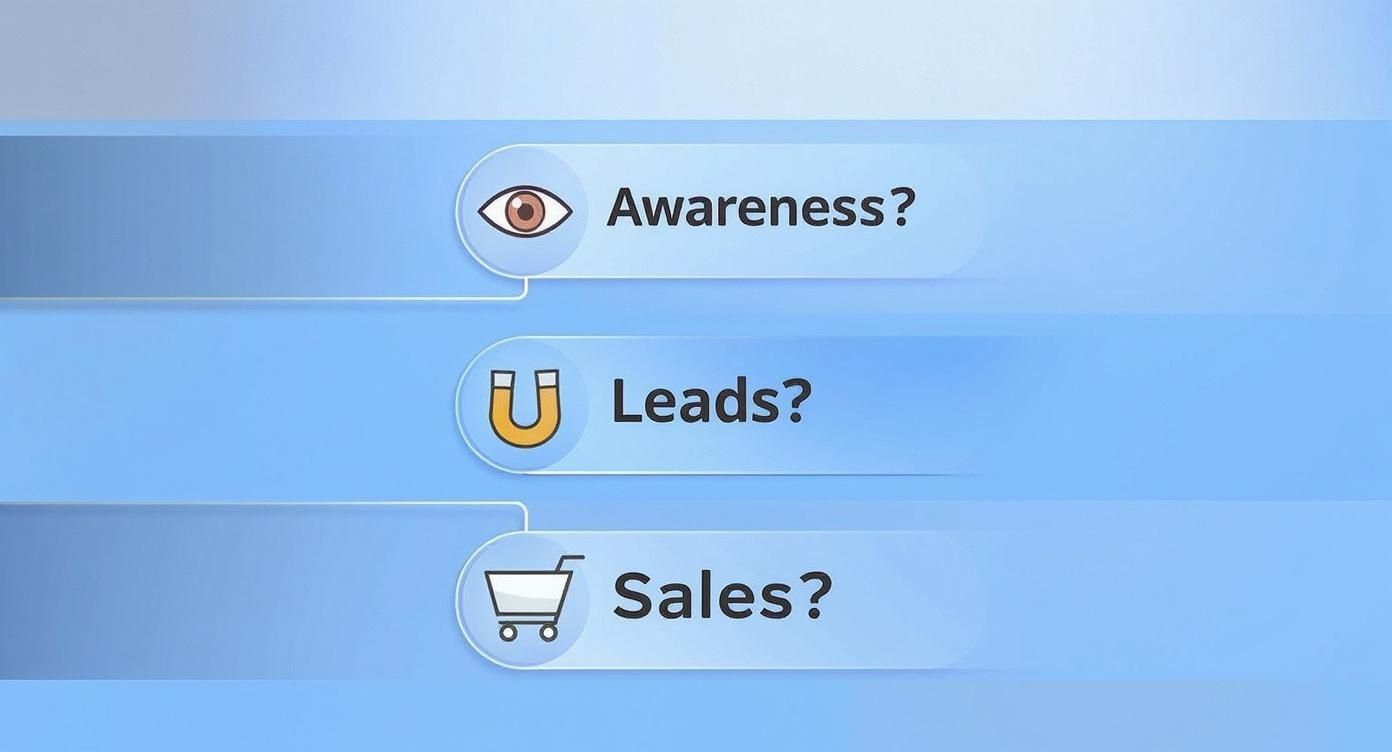
The diagram shows a clear path from building awareness at the top of the funnel to generating leads and, finally, driving sales. It helps you pinpoint which marketing services are most critical for your business right now.
Ultimately, the right choice comes down to your unique situation. By taking a hard look at your budget, growth stage, and internal resources, you can pick a partner that not only meets your needs but acts as a powerful catalyst for your success. Contact us to explore which partnership model is right for you.
Building Your Small Business Marketing Roadmap
This is where the real work begins—turning a jumble of marketing ideas into a concrete plan for growth. Think of a well-defined roadmap as your business’s GPS. It guides every single decision, ensuring all your efforts are pointed toward the same destination. Without that clear direction, even the best marketing services will fall flat, burning through time and money on mismatched activities.
The foundation of a winning strategy isn’t about chasing every shiny new trend. It's about a methodical, step-by-step process. By breaking it down, you can build an actionable plan that delivers measurable results and drives sustainable growth. Let’s build that plan, stage by stage.
Stage 1: Define Your Business Objectives
Before you even think about tactics, you need to define what success actually looks like in concrete terms. Vague goals like “get more customers” are impossible to measure and even harder to achieve. Instead, set crystal-clear, specific business objectives tied to real numbers.
Great objectives are SMART: Specific, Measurable, Achievable, Relevant, and Time-bound. This simple framework is brilliant for turning ambiguity into clarity. For example, instead of a fuzzy goal like "increase sales," a much better objective is to “increase online sales by 25% over the next six months.”
A recent study found that marketers who set goals are a staggering 376% more likely to report success than those who don't. This single step is the most critical part of building your roadmap; it dictates every single decision that follows.
Here are a few questions to get you started:
- What specific revenue target are we aiming for this quarter?
- How many new qualified leads do we need each month to hit that target?
- Do we want to increase customer lifetime value by a certain percentage?
Stage 2: Understand Your Ideal Customer
Once you know your destination, you need to know who you're bringing along for the ride. A deep understanding of your ideal customer—often called a buyer persona—is essential for creating marketing that actually connects with people. This goes way beyond basic demographics; it’s about digging into their pain points, motivations, and behaviours.
A well-defined persona helps you tailor your messaging, choose the right channels, and offer solutions your audience genuinely cares about. This detailed understanding prevents you from shouting into the void and ensures your marketing budget is spent connecting with people who are actually interested in what you have to offer.
Stage 3: Set a Realistic Marketing Budget
With clear objectives and a deep understanding of your customer, the next logical step is to allocate the resources needed to connect the two. Setting a realistic marketing budget is crucial. This isn’t about finding spare change in the couch cushions; it's a strategic investment in your company’s growth.
A common guideline for small businesses is to allocate 7-8% of total revenue to marketing. Of course, this can vary based on your industry, growth stage, and how crowded your market is. A B2B startup in a high-growth phase might invest more heavily, while an established business may just need to maintain momentum. The key is to commit to a budget that truly supports your objectives and allows for consistent, steady execution.
Stage 4: Select the Right Marketing Partner
Finally, you need to decide who is going to execute this roadmap. As we've covered, you have options: hiring in-house, partnering with an agency, or bringing on a freelancer. Use your objectives, customer profile, and budget as a filter to vet potential partners.
Ask them pointed questions about their experience with businesses like yours and how they measure success. Look for a partner who not only has the right skills but also gets your vision and can act as a true extension of your team. This decision is the final, critical piece in turning your strategic roadmap into real-world results.
Building a powerful marketing roadmap is your first step toward predictable, sustainable growth. If you’re ready to create a plan tailored to your unique business goals, our team is here to help.
Contact us today for a personalized consultation and let's start building your path to success.
Still Have a Few Questions?
Even with a clear roadmap, it’s natural to have a few final questions before you invest in marketing. These are the ones we hear most often from business owners, and getting straight answers is the last step before you can move forward with total confidence.
Let's clear up any lingering uncertainties.
How Much Should a Small Business Actually Budget for Marketing?
This is always the first question, and the answer isn't a single dollar figure. It’s about committing a percentage of your revenue, and that percentage depends entirely on your company’s age, industry, and how aggressively you want to grow.
Here are the benchmarks we use to guide our clients:
- For New Businesses (under 5 years): You should be investing 12-20% of your gross revenue. In these early days, you're building a brand from zero. That takes a more significant, upfront investment to cut through the noise and establish a foothold.
- For Established Businesses (over 5 years): A budget of 6-12% of your gross revenue is a solid target. You’ve already built some brand recognition and have a customer base, so the focus shifts from pure acquisition to maintaining momentum and deepening loyalty.
We saw this play out with a B2B tech startup that allocated 15% of its projected revenue to a focused content and SEO plan. That commitment got them onto the first page of Google within nine months, which led directly to a 200% jump in qualified demo requests. It works.
How Long Does It Really Take to See Results From SEO?
Search Engine Optimisation (SEO) is a long-term asset, not a quick fix. Think of it like planting an oak tree, not flipping a light switch. You might see some small signs of life in the first few months, but the kind of results that genuinely move the needle—consistent, high-quality traffic—typically take six to twelve months to show up.
This timeline hinges on a few things: your website’s current authority, how competitive your industry is, and the quality of the content you’re creating.
SEO is a marathon, not a sprint. The businesses that win are the ones that commit to a consistent, high-quality strategy over the long haul. The reward is a sustainable stream of free, organic traffic that pays dividends for years.
What Metrics Should I Actually Care About?
It's incredibly easy to get swamped by data. The key is to ignore the "vanity metrics" (like social media likes) and focus only on the numbers that tie your marketing efforts directly to business results.
Here are the only ones that truly matter:
- Customer Acquisition Cost (CAC): Exactly how much does it cost you to win one new customer?
- Customer Lifetime Value (CLV): What’s the total revenue you can expect from a single customer over their entire relationship with you?
- Conversion Rate: Of all the people who visit your site or see your ads, what percentage actually takes the action you want them to (like buying something or booking a call)?
- Return on Investment (ROI): For every dollar you put into marketing, how many dollars do you get back?
Tracking these keeps everyone honest. It gives you a crystal-clear picture of what’s working and ensures your marketing spend is driving real, measurable growth.
Ready to stop guessing and start growing with a clear, data-driven marketing strategy? The team at B2Better has the expertise to build a roadmap that delivers tangible results.