

When you sell a product, you’re selling something a customer can see, touch, and hold. A service, on the other hand, is completely different—it’s an experience, an outcome, a promise. That’s where service branding comes in. It’s the art of building a distinct identity around that intangible promise you make to your clients.
Your service brand is the sum of every single interaction someone has with your firm, from the first time they see your website to the way your team handles ongoing support. A study by McKinsey found that B2B companies with strong brands outperform weak ones by up to 20%, proving that a powerful brand is a direct driver of financial success.
Why Branding Services Is Your B2B Superpower
Selling a service isn't like selling a box on a shelf; you're selling a future result. This is both the biggest challenge and the greatest opportunity. Your brand becomes the tangible proof of your expertise, your reliability, and your value before a client even thinks about signing a contract. It’s the reason they pick you over a competitor who, on paper, seems to offer the exact same thing.
Think about choosing a financial advisor. Two advisors might have identical service lists, but you’ll gravitate toward the one whose brand feels trustworthy, clear, and genuinely aligned with your goals. That feeling of confidence is the brand in action.
Building Trust When Your Product Is Invisible
For B2B companies, where relationships are long-term and the stakes are high, a strong service brand is non-negotiable. It’s how you build that critical initial trust. A great brand works to:
- Make the Intangible Tangible: A consistent visual identity, a clear brand voice, and professional client documents turn an abstract promise into a concrete, reliable solution.
- Demonstrate Your Expertise: Through sharp thought leadership, compelling case studies, and glowing testimonials, your brand proves you know your stuff and can deliver on your promises.
- Create an Emotional Connection: A brand with a clear purpose and values connects with clients on a human level, building loyalty that goes far beyond the terms of a contract.
This collection of logos below includes many service-based companies.

Each logo instantly triggers an expectation—from fast shipping to seamless online payments—proving just how powerful a well-built service brand can be.
A Strategic Imperative for Growth
Investing in your service brand is no longer just a "nice-to-have." In today's crowded markets, it's a core driver of business. A staggering 89% of B2B marketers state that brand awareness is their most important goal, more so than sales or lead generation. This proves branding isn’t a one-and-done task; it’s an ongoing strategic function vital for growth and client retention. Find out more about how California businesses are using branding to succeed.
A strong brand is a company’s most valuable asset. It lives in the hearts and minds of customers, clients, and prospects. It’s the sum total of their experiences and perceptions, some of which you can influence, and some you can’t.
Ultimately, effective service branding lowers the perceived risk for a buyer, which helps shorten the sales cycle and allows you to command premium pricing. It’s your firm’s reputation, promise, and personality, all rolled into one powerful package.
Ready to build a brand that drives real business results? Contact us to learn how we can help.
How Service Branding Differs From Product Branding
Trying to apply a product branding playbook to a service is like consulting a road map to cross the ocean—it just doesn’t translate. A product brand revolves around a tangible item you can see, touch and unbox. Service branding, on the other hand, is built on an intangible promise of an outcome or experience. That fundamental distinction changes everything.
With products, you control the experience in a factory. A sneaker maker, for instance, guarantees every pair meets the same quality standards. For services, however, consistency is far more complex because your “product” is the combined performance of your people.
Intangibility And Human Interaction
The defining feature of service branding is its intangibility. You can’t place a marketing strategy or a legal consultation on a shelf. Instead, clients evaluate value through every interaction—from that first sales call to the final project wrap-up.
This reality thrusts the human element into the very centre of your brand promise. In fact, 86% of buyers say they’ll pay more for a standout customer experience. With products, a great item can survive a mediocre purchase process. In services, delivery and people are inseparable from the brand itself.
The essence of service branding is managing how clients perceive your expertise and reliability at every touchpoint. It’s a continuous effort to make an invisible solution feel like a solid, trustworthy asset.
Below is a quick comparison highlighting how product and service branding differ at a glance.
Product Branding vs Service Branding at a Glance
| Characteristic | Product Branding Focus | Service Branding Focus |
|---|---|---|
| Nature | Tangible attributes and features | Intangible outcomes and experiences |
| Quality Control | Factory-based consistency | People-driven consistency |
| Customer Interaction | Transactional | Relational |
| Delivery Timeline | Immediate fulfilment | Ongoing engagement |
| Co-Creation | Minimal customer input | Active collaboration |
| Trust Component | Product reliability | Personal credibility and expertise |
This table shows why a one-size-fits-all approach falls short. When you craft a service brand, you must weave trust, relationship-building and consistent delivery into every step.
Co-Creation And Customer Involvement
Unlike a product that’s designed, manufactured and boxed before it ever reaches the customer, a service often takes shape in partnership. A consulting project, for example, only succeeds when clients actively participate—sharing insights, giving feedback, refining direction. They become co-creators of the experience, not just end users.
Consider two global brands:
- Nike (Product): Built on performance and athlete endorsements. You buy the shoes, and the brand promise is delivered the moment you open the box.
- Salesforce (Service): Anchored in customer success and community. Their promise unfolds over months—or even years—through platform integrations, support interactions and shared business wins.
Salesforce’s model hinges on long-term relationships and proven results. One transaction becomes an ongoing partnership, and every touchpoint must reinforce that verifiable promise. Their success is staggering; they command over 23% of the CRM market by building a brand synonymous with customer growth and innovation.
Building a brand that thrives on these differences demands a deliberate strategy focused on people, processes and proof. Ready to craft a service brand that clients trust and value? Contact us to explore how we can help define your unique brand advantage.
Building Your Unshakeable Service Brand Strategy
A powerful service brand isn’t something that just happens. It's built deliberately on a clear, intentional framework. To get from abstract ideas to a concrete plan that works, you need to focus on three strategic pillars: Brand Positioning, Brand Promise, and Experience Design. This is how you build a brand that isn't just recognizable, but one that's trusted to deliver, time and time again.
Think of your brand positioning as planting your flag on a specific, defensible piece of turf in the market. It’s the definitive answer to the question, "Why should I choose you over anyone else?" This isn't just about what you do, but who you do it for and the distinct value you bring to the table.
Defining Your Brand Positioning
Your positioning acts as your North Star, guiding every single decision your business makes. It defines your ideal client, clarifies your competitive edge, and gives shape to all your core messaging. Get this right, and you become the obvious choice for a specific type of client with a specific problem.
To nail down your positioning, you need to answer a few key questions:
- Who is our ideal client? Get granular. Think about their industry, their day-to-day challenges, and what success looks like to them.
- What is our unique expertise? Pinpoint the one thing you do better than anyone else in your space.
- What does our competitive landscape look like? Understand where others are strong and, more importantly, where their gaps are.
Answering these helps you craft a compelling statement that connects with your target audience. It’s the foundational step in building a focused branding of services strategy that pulls in the right kind of opportunities.
Crafting a Memorable Brand Promise
Once you know where you stand, you need to articulate your brand promise. This is the oath you swear to every client—the tangible outcome or feeling they can expect every single time they work with you. A great promise is simple, believable, and speaks directly to a client's biggest pain point.
For a service business, this promise is everything. It has to be baked into your company culture and delivered flawlessly by every team member, from the first sales call to the final project report. This is also where a strong value proposition comes into play, clearly stating the benefits you deliver.
This infographic breaks down the fundamental differences between branding intangible, co-created services and tangible, standardized products.
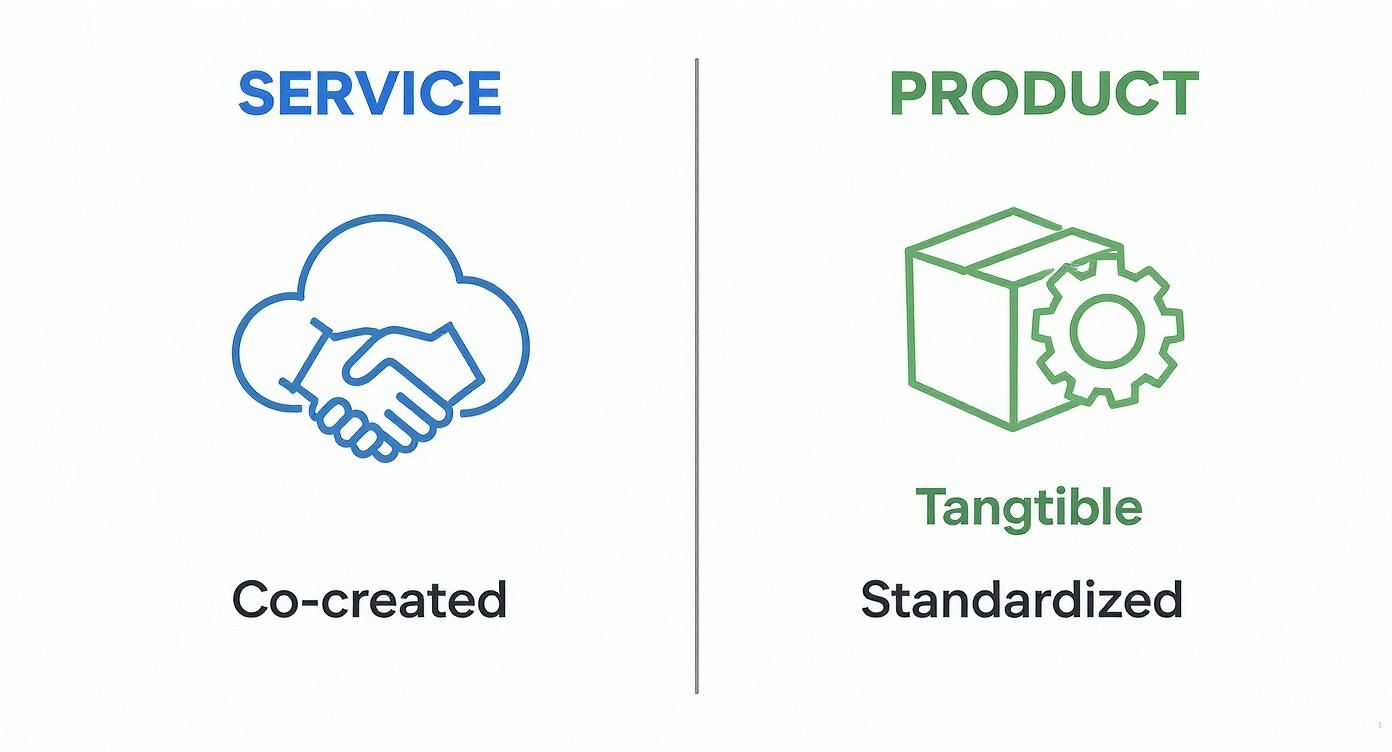
As the visual shows, service brands have to double down on the experience and the relationship, because the value is delivered through human interaction, not a physical object.
Designing the Brand Experience
Finally, Experience Design is where your promise is made real. Think of it as the detailed itinerary for your client’s entire journey with you, mapping out every touchpoint from their first visit to your website to the final project sign-off. This is how you ensure the promise you made is the experience they actually get.
In competitive markets, this focus on experience is non-negotiable. Data shows that 86% of consumers say authenticity is a critical factor when deciding which brands to support. Furthermore, 77% of marketers believe strong branding is essential for long-term growth. This proves that a consistent, positive experience isn’t just good customer service; it’s a powerful business driver.
By strategically designing this journey, you control the narrative and build a rock-solid reputation for reliability and excellence. Ready to design an experience that turns clients into advocates? Contact us today for a brand consultation.
Crafting Your Brand Voice and Visual Identity
Once your strategic foundation is solid, it's time to give your service brand a personality. This comes down to two things that have to work together: your brand voice (how you sound) and your visual identity (how you look). These are the elements that turn your abstract strategy into something clients can actually see, hear, and feel a connection with.
Don't mistake this for just aesthetics. Consistent branding across every channel can lift revenue by up to 23%. That’s proof that a unified look and feel contributes directly to your bottom line. Every email, every proposal, every social media post becomes another chance to reinforce who you are.

Finding Your Authentic Brand Voice
Your brand voice is the personality your business uses in every single communication. Are you the authoritative, reassuring law firm? Or are you the agile, energetic tech consultancy? Nailing this down ensures that no matter who’s writing—a marketer, a project manager, or the CEO—it always sounds like it’s coming from the same place.
A strong voice is always built on a narrative that clicks with your audience. For a deeper look at this, our guide on the https://b2better.co/unlocking-role-of-storytelling-b2b-content-marketing/ shows just how powerful compelling stories are for building lasting client relationships.
Take Mailchimp—a fantastic example of getting service branding right. Marketing automation can be a pretty dry topic, but their voice is quirky, helpful, and encouraging. That approachable tone makes the technology less intimidating and builds a real connection with small business owners, making them a top choice in a crowded field.
“Your brand voice is the purposeful, consistent expression of your brand through words. It’s what makes your audience feel like they know you.”
Designing a Memorable Visual Identity
While voice handles the words, your visual identity takes care of the look. This is so much more than a logo; it's a complete system designed to build recognition and trust. Consistency is everything here. Research shows that presenting a brand consistently across all platforms can boost visibility by 3 to 4 times.
Your visual identity system should include:
- Logo: The main symbol of your brand, designed for clarity and impact.
- Colour Palette: A defined set of primary and secondary colours that trigger the right emotions and match your brand’s personality.
- Typography: Specific fonts for headings and body text that make everything readable and consistent.
- Imagery Style: Clear guidelines on the types of photos, illustrations, and graphics to use, creating a cohesive visual story.
A well-defined visual system makes your service feel more tangible and reliable. Think about it: when a potential client sees the same colours, fonts, and logo style on your website, your proposal, and your LinkedIn profile, it builds subconscious trust. It signals professionalism and an eye for detail—exactly the qualities every B2B buyer is looking for.
Ready to define a voice and visual identity that resonates with your ideal clients? Contact us to start building a brand that gets noticed.
Putting Your Service Brand to Work Across the B2B Journey
A brilliant brand strategy is useless if it just sits in a PowerPoint deck. Real success in the branding of services comes from the follow-through—the nitty-gritty work of embedding your brand into every single thing your firm does. This is where your promise finally meets reality, turning abstract ideas into tangible client experiences.
This isn’t just a marketing task; it’s a company-wide commitment. It’s about getting every department, from sales to delivery, rowing in the same direction. When everyone is telling the same story and delivering on the same promise, your brand becomes a powerful, self-reinforcing asset.

Unifying Your Teams Around the Brand Mission
First things first: you need internal buy-in. A brand can’t be dictated from the top; it has to be understood and genuinely embraced by every single person who interacts with clients. Stakeholder workshops aren’t just a nice-to-have—they’re essential for getting your teams aligned and excited about where the brand is headed.
The payoff is huge. Companies with employees who are highly engaged with the brand mission see 21% greater profitability. When your people believe in the brand, they become its most powerful champions.
To make this happen, focus on three simple activities:
- Educate: Clearly walk everyone through the brand strategy—the positioning, the promise, the voice. More importantly, show each team how their specific role contributes to delivering on that brand promise every single day.
- Equip: Give every department the tools they need to bring the brand to life. This means consistent message guides, proposal templates, and even email signatures that all look and sound the part.
- Empower: Trust your team to make on-brand decisions. When a project manager truly understands the brand's core values, they can resolve a client issue in a way that actually reinforces trust and loyalty, rather than undermining it.
Weaving Your Brand Into Every Client Touchpoint
Once your team is on board, it’s time to methodically review and update every client-facing asset and interaction. Your brand has to show up consistently across the entire B2B customer journey, from the first time they hear about you all the way to project wrap-up and beyond. This is what builds trust and makes your service feel professional and reliable.
For a deeper dive into how this plugs into your wider marketing efforts, check out our complete guide on digital marketing for B2B.
A brand isn't what you say it is. It's what your clients experience. Every interaction is a moment of truth where your brand promise is either kept or broken.
Think about these critical moments:
- Proposals and Sales Decks: These documents shouldn't just be a list of services and prices. They need to tell your brand story, using your distinct voice and visuals to show why you’re the only real choice.
- Client Onboarding: This is your first major opportunity to deliver on your promise. A smooth, professional, and welcoming onboarding process sets the tone for the entire relationship and can dramatically reduce client churn.
- Project Communication: Every email, report, and meeting should reflect your brand’s personality. If your brand is built on clarity and transparency, then your communications better be straightforward and honest.
The Payoff: Great Implementation in Action
For a fantastic example of implementation done right, look at the consulting firm Accenture. Their brand promise, "Let there be change," isn't just a clever tagline; it’s woven into everything they do. Their thought leadership, client workshops, and project methods are all designed to guide clients through complex change, cementing their position as expert navigators. It's a masterclass in building trust and commanding a premium price, leading to over $64 billion in revenue in 2023.
By getting meticulous with implementation, you take your brand from a concept on paper to a living, breathing part of your business. This is how you shorten sales cycles, boost client retention, and turn customers into lifelong advocates for your firm. Ready to put your brand into action? Contact us to align your teams and delight your clients.
Measuring the ROI of Your Service Brand
So, you’ve invested in building your service brand. How do you actually know if it’s paying off? While you can’t track brand equity like ad clicks, you can absolutely connect brand strength to tangible business results. The trick is to look beyond vanity metrics and focus on Key Performance Indicators (KPIs) that prove your brand is making a real difference to client loyalty and your bottom line.
A strong brand isn’t just a creative exercise; it’s a hard-working economic asset. By tracking the right data, you can prove its value, justify further investment, and make smarter decisions to sharpen your strategy. It’s all about drawing a straight line from brand health to business health.
Key Metrics That Matter for Service Brands
To get a real sense of your service brand’s ROI, you need a balanced view that captures both what clients feel and what your financials show. These KPIs combine to paint a clear, data-backed picture of how your brand is performing out in the wild.
Here are a few essential metrics every service firm should be tracking:
- Net Promoter Score (NPS): The classic loyalty metric. It boils down to one simple question: how likely are your clients to recommend you? A rising NPS is a powerful sign that your brand experience is consistently delivering on its promise.
- Client Lifetime Value (CLV): This is the total revenue you can realistically expect from a single client relationship over time. Stronger brands foster deeper loyalty, which drives up CLV through repeat business, referrals, and new service opportunities.
- Brand Recall and Awareness: Measured through simple surveys, this tracks how often your firm pops into a potential client’s head when they think about the services you offer. Being top-of-mind is a direct result of effective branding, and it dramatically shortens the sales cycle.
Building Your Brand Performance Dashboard
A good performance dashboard pulls all these metrics together into one place, giving you a single source of truth for your brand’s health. It should be a smart mix of hard numbers and qualitative feedback to tell the complete story.
Here’s a glimpse of what a simple brand KPI dashboard might look like.
This kind of dashboard lets you visualize trends over time, making it easy to see how a strategic move—like a messaging refresh or a client experience overhaul—directly impacts key metrics like NPS and CLV.
Quantitative data puts a fine point on why this matters. Research shows that 76% of consumers prefer buying from brands they feel an emotional connection to. Even more telling, 57% are willing to pay more for that connection, proving that a strong brand directly boosts your pricing power and profitability. For a deeper dive, you can explore the full findings on brand loyalty and engagement.
To truly understand how your brand is performing, you need a clear way to track and interpret the right data points. The table below outlines some of the most critical KPIs for any service brand, explaining what each one measures and why it's so vital for assessing your brand's overall health and impact.
Key Performance Indicators for Service Branding Success
| KPI | What It Measures | Why It Matters for Your Service Brand |
|---|---|---|
| Net Promoter Score (NPS) | Client loyalty and willingness to recommend your firm. | High NPS scores are a direct reflection of a positive brand experience and strong client relationships. |
| Client Lifetime Value (CLV) | The total projected revenue from a single client relationship. | Strong brands command loyalty, leading to repeat business and higher CLV, which is a key indicator of long-term profitability. |
| Client Retention Rate | The percentage of clients who continue to do business with you over a specific period. | This metric shows how well your brand promise aligns with your service delivery, building trust that keeps clients coming back. |
| Brand Recall & Awareness | How easily potential clients can remember your brand when prompted by a service category. | Top-of-mind awareness shortens the sales cycle and reduces client acquisition costs because prospects already know who you are. |
| Lead-to-Close Ratio | The percentage of qualified leads that become paying clients. | A strong, trusted brand pre-sells your services, making it easier for your sales team to close deals and improving this ratio. |
By consistently monitoring these KPIs, you can move the conversation about branding from a subjective discussion to a data-driven strategy session focused on tangible business growth.
A brand that can’t be measured can’t be managed. Tracking ROI moves branding from a "cost centre" to a proven growth engine.
Ultimately, measuring your brand's ROI is about connecting the dots between the promise you make, the experience your clients have, and the results on your balance sheet. When you track these KPIs, you can confidently show that your brand is one of your company’s most valuable assets. Ready to prove the value of your brand? Contact us to set up your brand performance dashboard.
Take the Next Step In Your Brand Journey
You’ve assembled a clear roadmap—from defining your service offering and visual identity to rolling out your brand and tracking its impact. Now comes the most important part: putting pencil to paper and making it happen.
Start simple. For example, you could:
- Refine Your Core Brand Promise so it speaks directly to your clients’ biggest challenges.
- Map One Critical Customer Journey to uncover friction points and quick wins.
These targeted actions create momentum and deliver noticeable results right away.
From Blueprint To Market Leadership
True market leadership goes beyond offering the best service. It’s about a brand that clients instinctively trust, remember and recommend. Organisations that present their brand consistently are 3 to 4 times more likely to boost visibility—and that lift translates straight into higher lead generation and sales.
Think of your brand as a silent salesperson, earning credibility long before any conversation begins. It’s the reason prospects choose you—and, even more importantly, the reason they stay. This is the essence of effective branding of services.
Market leadership is built on a brand that clients trust, remember and recommend. It transforms your firm from a commodity provider into an indispensable partner.
Are you ready to bring your strategy off the page and into the market? Don’t let your hard work sit on a shelf. Activate your plan today and build a service brand that not only stands out but sets the pace in your industry.
Our experts are here to guide you—whether you need a comprehensive brand audit, a hands-on strategy workshop or full-scale implementation support. Contact us today to take the next step in your brand journey.
Frequently Asked Questions About Service Branding
Here are a few common questions B2B leaders ask when they're thinking about branding their services. This is where we cut through the noise with some quick, practical answers to get you moving.
What Is the Most Important Part of Service Branding?
If you have to pick just one thing, make it consistency. Because a service is something you experience, not something you can hold, your clients are looking for clues that you’re reliable. Trust is built when every single interaction—from the first click on your website to the final report you deliver—projects the same professional quality and voice.
That consistency is what makes your invisible promise feel like a tangible, dependable asset. In fact, consistently presented brands are 3.5 times more likely to enjoy excellent brand visibility than those with an inconsistent brand presentation.
How Long Does It Take to Build a Strong Service Brand?
Building a brand that people trust is a marathon, not a sprint. You might see some early wins in brand awareness within a few months, but earning a deep-seated reputation takes time and patience.
Think of a professional services firm, for example. It could easily take 12-18 months of consistent effort—publishing insightful articles, speaking at events, and perfecting the client experience—before they’re seen as the go-to leader in their niche.
A strong brand is a company’s most valuable asset. It lives in the hearts and minds of customers, clients, and prospects. It’s the sum total of their experiences and perceptions.
Can a Small Business Compete with a Large Firm’s Brand?
Absolutely. In fact, being small is often a branding superpower. Large corporations can struggle to keep their message and experience consistent across massive teams and departments. A smaller business, on the other hand, can deliver a highly personalized and uniform brand experience with much less effort.
A great example is the boutique consulting firm that becomes the undisputed expert on one specific industry problem. Their tightly focused brand, built on genuine expertise and personal relationships, will often beat out larger, more generic competitors. It just goes to show that a sharp focus is way more powerful than a massive budget.
Building a brand that drives real growth takes a clear strategy and unwavering execution. The team at B2Better has over 45 years of combined experience helping B2B firms create brands that win clients and keep them for the long haul. Contact us today to start your brand journey.